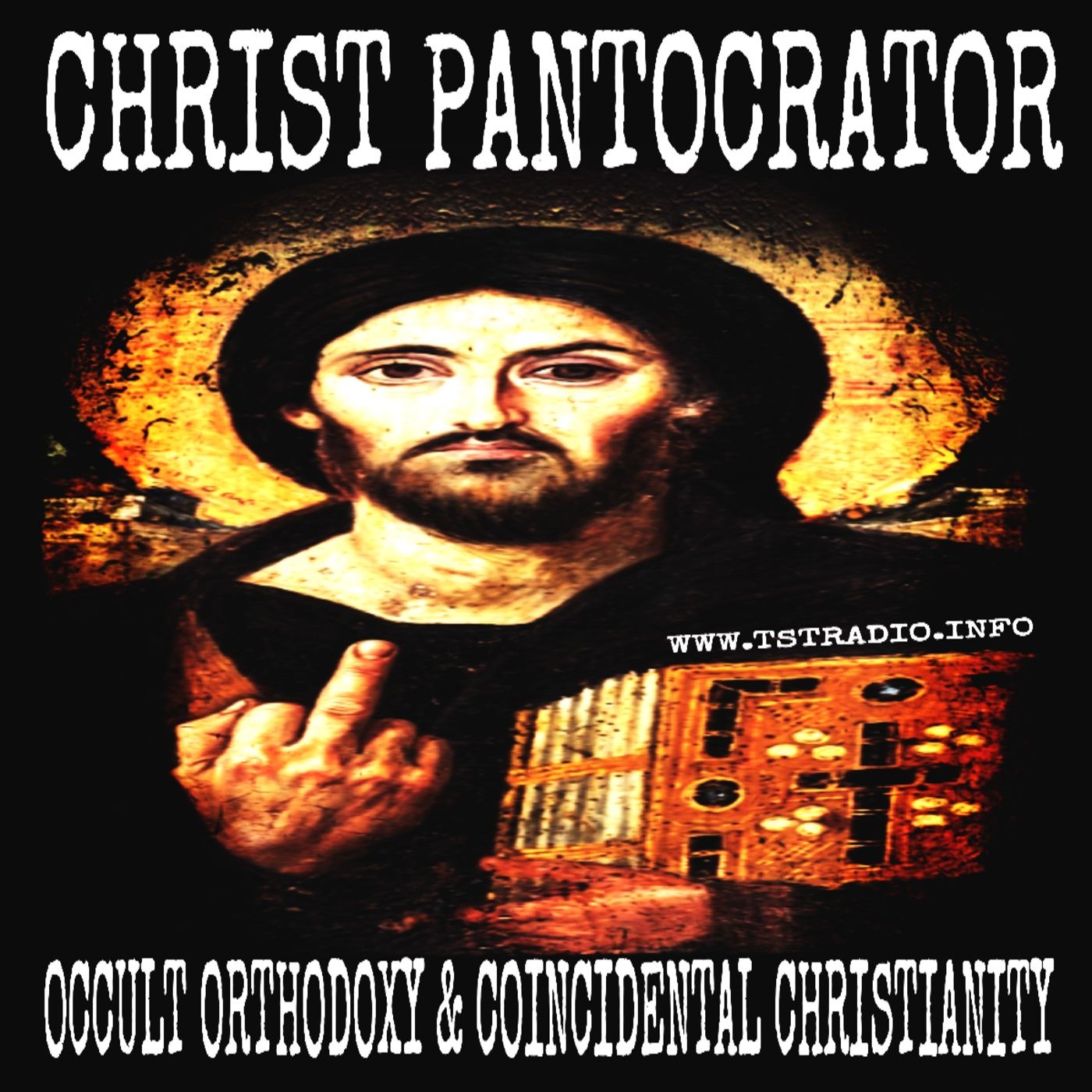
Christ Pantocrator: Occult Orthodoxy & Coincidental Christianity (September 3, 2026)
About this episode
The Secret Teachings is made possible by:
*The is the FREE archive, which includes advertisements. If you want an ad-free experience, subscribe below.
🌐 CONNECT & ARCHIVES
- Official Website: https://thesecretteachings.info
- Free Archive: https://www.spreaker.com/podcast/tst-radio--5328407
- Ad-Free Experience: https://thesecretteachings.info/donate-subscribe/
- Buy Me a Coffee: https://buymeacoffee.com/ryangable
- CashApp: https://cash.app/$rdgable
- Paypal: https://www.paypal.com/donate/?hosted_button_id=MJPYR9YEZFZW2
- Books by Ryan: https://thesecretteachings.info/books/
- X: https://x.com/TST___Radio
- Facebook: https://www.facebook.com/ryan.blank.7
- Twitch: https://www.twitch.tv/thesecretteachings
- Youtube: https://www.youtube.com/@TSTRadioOfficial/streams
- [email protected]
- Inquires to be a guest ([email protected])
Become a supporter of this podcast: https://www.spreaker.com/podcast/the-secret-teachings--5328407/support.
Thank you for supporting independent, unbiased inquiry into the mysteries of our world.
Get every episode summarized
Each time The Secret Teachings publishes, we email you a written briefing from the transcript — the topics, who appeared, and any specific claims, with the ad reads skipped.
Email me new episodesFree for 3 shows. No card needed.
Hosts & guests
Transcript ready
800 searchable segments. Every word is indexed and playable.
Full transcript
The Secret Teachings — Christ Pantocrator: Occult Orthodoxy & Coincidental Christianity (September 3, 2026). Machine-transcribed; use the interactive transcript above to jump the player to any line.
Hello, anybody home? Today, I want you to open your mind. I've almost come to the conclusion that the story is subbending, that the massive people can't deal with it. We are in process of developing a whole series of techniques to pit people actually to love their servitude. We face a hostile ideology, global in scope, atheistic in character, ruthless in purpose and insidious in method. But we are opposed around the world by a monolithic and ruthless conspiracy that relies primarily on covet means for expanding its sphere of influence. To change the minds and the attitudes and the beliefs of the people to bring about one world socialist totalitarian government. The potential for the disastrous rise of misplaced power exists. It is patterned itself after every dictator who has ever planted the ripping and printable boot on the pages of history since the beginning of time.
If you can get people to consent to the state of affairs in which they are living, then you have a much more easily controllable society than you would if you were relying only on clubs and firing squads and concentration camps. Tools and conquests do not necessarily come with bonds and explosions and forms. There are weapons and simply facts and it's prejudices. As you connect the dots between different people, organizations, religions, history, suddenly the picture starts to form. The Kingdom of God is within man, not one man, not a group of men. Someone born in the United States is not more special than someone born in Mexico. They're just vehicles for the consciousness to experience. They do not want your children to be educated. They do not want you to think too much. It was learned that the aliens had men and were then manipulating masses of people through secret societies which craft, magic, the occult, and religion. They're reaching to our children. Music, television, books.
Right, young children's existence. How can I disprove lies that are stamped with an efficiency? If you have the opportunity to stand next to one of these machines, it feels like an altar to an alien god. Genetic power is the most awesome force the planet has ever seen but you wield it like a kid that's found his dad's gun. The Army Air Force has announced that applying his is now in the possession of the Army. Too many others know what's happening out there and no one, no government agency has jurisdiction over the truth. Any state, any entity, any ideology that fails to recognize the worth, the dignity, the rights of man. That state is obsolete. A case to be found under M for mankind in the Twilight Zone. Outside I'm some of you got acquainted with the real hard truth. You are listening to the secret teachings radio. I'm your host Ryan Gabel. I want to thank you so much for tuning into another episode of TST. If you'd like to follow us on social media, I have to say good luck because we don't really have social media. We've been banned from almost everything.
If you've listened to this show for any amount of time, you'll probably know why. But you can't find us on X and you can find us on Facebook while they last. Links are on the website. And I want to thank all of you who reached out to me, who commented or who emailed me, RD Gabel 1991 at gmail.com, or forwarded me contact information, or potential guests, based on my question that I proposed on social media. Is there anybody out there who can explain to me what exactly Christianity and its various denominations? What it is, because honestly I'm confused about what Christianity even is. I can say the same thing with any religion, although most religions, including Christianity, I've studied pretty extensively, so I have a pretty good idea of what they are, but since I'm not part of the teams, I don't have the built-in, biased talking points,
and the circular logic to justify why my beliefs are unique, or why they are, if they're not unique, why they are the best version of a set of ununique beliefs, like they're the final incarnation, the final evolution. So I was wondering if there were people out there who could explain to me what Christianity is, or what it was, or what it's supposed to be. And here's how that went. There are a few people I reached out to, different backgrounds, different denominations. It's been over 24 hours, I've heard no response back, which isn't that big of a deal, I'm sure. Here's something back from somebody at some point. I did get one email response back from a potential guest and a, I think, a pretty long time listener who has a background in that, and he might be coming on the show, maybe this week. But I was looking for someone who can really just argue, even, even, buy-as-ly, give me the argument, give me the explanation, and then I'm going to tell you what I think, and then I want to have a discussion, not a debate, I'm not trying to win something.
I'm not, I'm not trying to beat somebody, I just want to have a discussion about it. And one person that I spoke to, and I don't want to say anything negative about them because they might end up coming on the show after the fact, but I reached out to this one person who was recommended to me. And I said, look, I'm just trying to get someone on the show as if it's looking for a potential guest. And their response to coming on to the show to talk about why they are a Christian, and they're a pretty popular person, pretty somewhat well-known. They said, sure, I'd love to come on, but that'll be $150. So I'm going to need you to give me $150 to come on to the show to talk about Christianity, which I thought was kind of ironic. It's also infuriating, and it's also frustrating, and it's also kind of comical. If you want me to tell you what I believe, I'm going to need $150 from you, which really considering how much money is going around the debate space nowadays.
That's not a lot of money, but still 150 bucks, I wouldn't give you 150 pennies. That's not how this works. I mean, maybe in the world of exchange, if you want to make radio and you want to make podcasting, you want to make it up a platform for trading and profiting from just basic conversations and people don't want to really have a conversation with someone that they might disagree with. So they want to get paid for it, so they at least get something out of it. I don't know, it's very irritating. It's infuriating. And that's not the first time I stumbled across that. It's the first time that's happened a long time. I used to have people that would say, sure, I'd come on your show for $1,000, $100, $20, whatever. That's not how it works.
That's not how this, I mean, yeah, if I had five followers and I just started last week, it's still, it's not how it works, but like I guess I kind of understand. But that's, that's not how this works. So I thought that was kind of funny. I also went because I got strangely enough, I got a notification yesterday that our good friend Jay Dyer was live on YouTube, so I went over to his YouTube page because I'm banned on X. And I was told to call into the show when I asked some questions and I obviously can't call in because I'm blocked. And then I sort of asking the questions in the chat about orthodox Christianity. I asked questions about theosis, I asked questions about the Eucharist, I asked questions about the various tenets of orthodoxy. And I received no response from anybody, nobody was willing to engage, nobody was willing to tell me why there are concepts and identical ideas that far predate orthodox Christianity.
And then I was blocked from that too. So the feeling I get is that there's a very small percentage of people of whatever denomination of Christianity who actually are willing, and I think that they're just average everyday common people. Some of the murder listeners to this show who are willing to discuss what they believe and willing to talk about it because they have a strong conviction and maybe they have their faith and can respect that, nothing wrong with that. But it seems to be that in the space of more professional Christianity, people want to be paid to talk about it. Or people just block you for asking questions. Like if you're really happy, excited and proud and faithful, you should be able to explain these things to people who are not prostitutes on the internet, not brain dead, brainwashed college students.
I mean, I could make myself look really good if I just went out and debated brain dead college students. I could make myself look really good, but that's kind of cheap and dishonest and a waste of time. I'd also want to reinforce the idea here that I don't like debating. I think debating is silly. I think conversations are preferable. But I wouldn't want to even have debates on air about it. I'd want to discuss it with people, but very few people are willing to do that. Unfortunately, they're looking for money or they're looking for a debate stage where they can repeat and regurgitate and vomit their talking points. So their audience thinks they want and then call the other person a bunch of names and then move on to the next platform. Again, that's not how this works and maybe it's because I have a reputation for that not being how this works, why it's sort of hard to get somewhat popular people on the show anymore.
But again, positively speaking, a couple of listeners, some of them are authors, some of them are longtime listeners of the show and just our Christian, one denomination or another. And they're willing to come on the show and talk. So I'm going to try to set that up in the very near future. Until then, though, we're left with what I end up concluding for most shows and that is why would I want to spend time trying to get in touch with someone who wants me to pay them or someone who just thinks that a debate is the only way to converse and like that by implication. Like there has to be a winner and a loser, which is completely, I mean, entirely subjective in most cases. Some cases, maybe not so much, but in most cases, I could just do the reading for myself, like I could just read the text for myself, which funny enough is what I was told by several people. I was told I can read to you on my Facebook post.
I was told in regard to asking if I could find if I could get a Christian to come on the show. Here's one of the response, a common response I got because I posted this on X as well. I was told to just read the Bible. I mean, I don't understand what is that supposed to mean. I'm looking for a Christian to come on the show and explain what Christianity even is beyond assumptions and stereotypes. Just read the Bible. I've had three people say that to me. That's not a response. You don't have to respond at all, but that's not an adequate response. That's not even a response. That's just read the Bible. It just is. That doesn't explain it to me. These people are obviously not recruiters of the faith. But when I was listening before I got booted, before I got banned from J. Dyer stream, and I took screenshots of what I posted. Nothing was malicious.
Nothing was even remotely classifiable as trolling. I was just asking, like, how do you quantify this in terms of chronology? One of the things I realized was that I don't really listen to J. Dyer, but J. Dyer is talking about orthodoxy and talking to people who are religion. He spent 20 minutes talking about how he made a lot of money off of crypto and how it's gambling and how there are certain forms of market and crypto gambling that's probably a waste of time. But you can make a lot of money off of gambling on these things. I thought, isn't that looked down upon by almost all Christians? Isn't gambling looked down upon by orthodox Christianity as much as any other denomination of Christianity? I think it is. I think it's looked down upon. I think that it's frowned upon.
Maybe it's not illegal by some religious principle, but it's strongly discouraged. Although it's strongly discouraged and Judaism as well, and Jews love gambling. Absolutely love gambling. In fact, you can read Old New York Times articles that Jews in New York, they just were so obsessed with gambling. It became like a community problem to the point of like a mental disease. They just love gambling, gambling, sports gambling, any kind of gambling. So I guess it doesn't affect the Jewish communities. It doesn't affect the Orthodox Christian communities either because if you can make money off of it, why not? That's what God wants for you, right? Just justify it. I find that strange. I'm not a gambler. You know, I'm not a gambler. I am not a... I don't do drugs. I, on occasion, will have a... A sip or two of sake. Rice sake. I'm having sushi or something like that. The one that I have is like 5% alcohol. It's basically sparkling water and they brew it in a way where it's literally just rice, water, and carbonation.
And they have these different flavor profiles. There's no chemicals or anything added to it. That's more so for flavor and it goes along with the meal. But other than that, I don't drink. I feel like I live a lifestyle that is... That is very Christian. But I also live a lifestyle that's very Muslim. I also live a lifestyle that's very traditionally Orthodox, Jewish. And I also live a lifestyle that's kind of like ancient Hindu. In other words, what I'm saying is I kind of live a lifestyle that is similar to a lot of religions because most religions, including and primarily major world religions, are teaching the exact same thing. They're teaching cleanliness. They're teaching unification with God in one form or another. They're teaching the direction, the directionalizing of your willpower, your consciousness. That's your prayer, your icons, if you're an Orthodox Christian.
It's funny too because those same people will then accuse Buddhists of being idol worshipers. But Buddhists don't see Buddha as an idol. They see Buddha as an icon. So Buddhism is icon, veneration. That's obviously not God. It's an outward projection of you. The Buddha is the soul. He's fat because he's happy. He's filled with the spirit. He's enlightened. Same thing with the fat black Buddha. But I guess that doesn't matter because even though it's the same thing, it's blasphemous. Even though Buddhism far predates Orthodox Christianity. Doesn't matter because it's the wrong interpretation. Which really is like when I went to school, I would take math class, which I was terrible at. And in math class, it was right around the time when I was in high school, they started doing that common core thing.
I don't think they really implemented it in West Virginia, which is where I went to my my my ladder high school years. I remember my teacher was cool with it, but some teachers were really into that common core thing where if you if you did the problem and you know you solved it and you got the answer, it still was wrong unless you used the common core method. And especially if you could do the which I couldn't, but some people I guess maybe sometimes I could, but if you could do it in your head, they consider that cheating. You have to show the work, which I get that to some extent, but you have to show the work. So it's like I can come to the same answer whether someone does it in their head or I do it, you know, using basic standard, like how I was taught math originally, how to do math or you can use the common core method. What does it matter if you get to the same place? Now don't it in your head doesn't mean that you're better than someone who has to use the common core method or someone who uses the standard method or someone that uses some other method.
You're getting the same. If the answer is still two plus two equals four, what does it matter how you get there? If unification with God is the answer, then what does it matter how you get there? I think Buddhism is one of those religions and also a lifestyle that Christians in general have a hard time refuting. The only way that you, maybe I'm wrong, but the only way I think you can refute it because it, I mean, Buddhism predates Orthodox Christianity by 1,500 years. The only way that you could really refute it is to say you could go through the list of fallacies and circular logic and all that. It's just the wrong interpretation. Sure, they don't do X, Y and Z, but they also don't do, they do do X, Y and Z, but they don't do X, Y and Z. That means it's just wrong. They don't believe in the Eucharist. That's why it's wrong. That's just why is the Eucharist important? Oh, it's the body and blood. And I mean, that's an old agricultural ritual. That's an old, it's very, very, very old.
Yeah, this idea of the Eucharist. And what because Buddhists don't, don't do, I mean, the Buddhists have like sacred things too. It's just very silly. And you, the only way you could really argue against it, it's a silly argument, but the only way you could really argue against it is just to say, well, like yet, okay, sure. Maybe some of that stuff is similar, but ours is the real thing, which Y will be because we say it is, which is circular logic. So Buddhism predates Christianity by 1500 years. And it appears. And for those of you who think that I'm too apologetic to Islam, I just personally don't like being lied to about what the book says or what the hot-oths say for that matter or the similarities to other religions. For those of you who say I'm too apologetic to Islam, I would argue that when you look at the success of development and evolution of religions in general, it seems like every time a new one forms, it devolves. So by that argument, I would argue that Islam seems and appears to be a devolved form of Judaism and Christianity.
You know, the Muslims also ritually sacrifice an animal to Abraham, like the Jews when they beat the hell out of a chicken. Although the Jews tend to do that one particular sect of Jews tend to do that much more often. The Muslim tradition is only once a year, but they both do it to Abraham. But I think every success of religion appears to be, and it almost feels the same way with architecture and maybe technology, depending on how you define technology. We think what we have iPhones, so we're really advanced, we have tablets who are really advanced. I mean, maybe, maybe not, I don't know, it's a really debatable topic, but it seems like there's a decline. There's a, there's a de-evolution. And we end up with these like very simplified, like even if you looked at Judaism where they've got 10, you know, the 10 commandments which are not, they're not Jewish, they're universal concepts, and they far predate the Jews by hundreds, by thousands of years. I mean, whether you're looking at, you're looking at the Code of Hama-Rabbi, or if you're looking at the 42 Confessions of Mott, which someone just argued, well, that's different because those 42 Confessions of Mott, that's not based on monotheism.
And what is that supposed to mean? And I mean, the Jews themselves, the point is have like hundreds of commandments, and then it's reduced to 10. And it's actually very similar argument to the, to the Bill of Rights, some of the founding fathers, as George Mason was one of the primary ones who argued, that having that these, these Bill of Rights is actually a bad idea, because it's almost restricts not the government, but the rights of the people, because it rights them down, and it restricts the implication that you have every right, unless, unless there's some, you know, explicitly, that the government has the right to do, like you just retain the rights of the people are the rights of the people, which is based the 10th kind of, in Shrine and the 10th Amendment. When you're right down these things, you sort of lose, you lose implication, you lose, in some respect, you lose context, which if you go back far enough, you can look at where, say, the Vedic,
scriptures are written down, they far predate when they were written down. You look at where the Egyptian religion came from, call it whatever you want, archaeologists, ecologists have been arguing about what it is, what it isn't for hundreds of years, but whatever it is, it predates Egypt. It came from a time before Egypt, whatever that might have been, and Christianity likewise, all forms of Christianity are far predated, and the same is for Judaism. So, like to me, that doesn't disprove what I think it does is it proves that there's a long tradition of human being, seeing and interacting in the world, and developing the same ideas and methodologies, etc, to interact with the world, interact with the spirits, interact with God. And there is an evolution of that process, even if it appears to be a de-evolution in terms of the complexities of the system, because if you would argue that Egypt was polytheistic, well, like, yeah,
but also they did have a conception of a chief God, and it depends on where you go, it depends on what city you go to, they each have their own chief God, and that is the monotheistic God, and everything else falls under that. I mean, maybe the Christian version, various Christian versions of that would be like the saints, or the angels, they're the hierarchy, but there's one God. We'll often unbelieve that. Tudent common believe that. I mean, they are one of the two of the rather, but they are one of the central sources in the development of monotheism in Egypt. But then again, we're also arguing about all of this stuff, thousands of years later, by modern interpretations, and we're trying to figure out what these people believed. Well, I don't even know if that's really the important question. So, I looked up, and I put together a list, a long list, of the various different tenets of Orthodox Christianity.
And I did that because I wanted to, I wanted to see, like, to get into the actual definition. Okay, what do these people believe, and how similar is it to things that came before? So, we're going to go through that tonight on the show, which is why we've titled the show, I have titled the show, Christ Panto Crator, the image of Christ giving the blessing, a cult orthodoxy, and coincidental Christianity. That's the title of tonight's show. The show promo came out pretty good. I edited it, so Jesus wasn't giving a blessing. He was actually giving you the middle finger. I'm proud of that promo. It looks really good, I think. So, before I read through the list of what the Orthodox Christians believe, there's two other things I need to mention. One, I don't understand how you can be one of the various denominations of Christianity, whether Roman Catholic,
maybe your Eastern Orthodox, Oriental Orthodox, a Protestant Lutheran, Presbyterian, Baptist, which is what I grew up in, Pentecostal, evangelical, Methodist. I mean, there's so many different interpretations, so many different. Just how can you be one of those things, and then just decide one day, well, actually, I'm going to switch to this other one, and that's where the real truth is. So then, by the simple fact that there are all of these denominations, what that means is what that implies is, so let's just say that there's more than 20, but let's say there's 20 denominations of Christianity. Let's just say that one of them is true. Well, that would mean that 19 of them are false, then, right? And then to jump back and forth between them as some people do, or to change teams, you're going from the one that you thought was true to one of the 19 that isn't true,
but then one of the 19 that isn't true becomes true because that's what you are, and then the other 19, including the one that you were before that you said was true, now becomes false because you're not part of that team anymore. It's mind-numbing. And where we can find balance, where we can be objective about this, is just to say, truly, to each their own. And if we can both find the answer 2 plus 2 equals 4, then it really does not matter how you get there. And any arguments that it does matter, how you get there. And ours is the right argument, is simply by definition what a cult is, and not occult, but a cult. A small group of people or a large group of people, having beliefs or practices that they believe is the only answer. Religious veneration directed toward a particular figure or object, cults are where people gang up on those that are not in the cult,
everybody else is wrong, everybody else is a blasphemeer, and everybody else will suffer and die, and that's occult. Either to each their own, and if we get the same answer, great, or it's occult, to keep things real simple. It's also kind of shocking when you go back and you read even just the mythologies, but when you go back and read, say the perceptual polytheistic nature of ancient Egypt, which I don't really think was polytheistic, I think it was a mixture of things, I don't really think we have words to describe what it was, it was too complex, too sophisticated, but whatever it was, whatever it is, it's too complicated to understand to the modern brain, I guess, it's too complicated, it's too sophisticated. And we practice a very watered down, very diluted, I call it tamu, like the Chinese company, it sells all those cheap products, it's basically tamu religion.
You take all the commandments, reduce them to a few, take all the gods, cram them together into one, condemn everybody else, and that's pretty much the end of it. I don't find that to be, plus you mix in the fallacies, circular logic, and the threats of war, and the name of what you believe. I don't really think that is a spiritual system, I think that is a personal and a state run system of control. And I think that's what a lot of people have, a criticism of, or for religion in general, which I don't have that criticism, per se, I don't necessarily, I don't just reduce, because the people that are anti-religious tend to just reduce the complexities down to, it's also stupid, and it's just a waste of time, which I don't agree with that either, I think that's a very stupid way to look at it, it's kind of a silly way to look at it.
But in regard to war and condemning other people of death, I don't know if you heard this, but this is the second thing I wanted to bring up. Did you hear JD Vance in an interview this week talking about the anti-Christ, and talking about the end times? If you have not heard this, even if you have heard it, you've got to listen to it again, because I listened to it a few times, and my brain could not process how utterly insane this man is. Let's listen to it. This is JD Vance talking about the end times. It's a very short clip, eight seconds. What I'm trying to focus on is doing as much of God's work as possible right now, and if that leaves the end times, okay? Yeah, so I'm going to do God's work. They all know in all powerful, all loving, creator of all things
that puts the spirit into the vessel into the container as the Son of God. I'm going to do His work, and if that God's work means that we bring about the end times, where lots of people die, lots of horrible things happen to the people that are living, that's okay. Let me explain how rational society deals with people like this. Rational society has an intervention. They put this man in a straight jacket, and they throw him in a padded room and study him for generations. That's how a rational society deals with things like this. For someone to say that in any position of authority, especially vice president, and in particular, a person who is likely going to run for president, that is insane. And it's additionally insane because this is the same group of people
that are accusing the Iranian leadership of being religious, fanatics, and religious radicals. Maybe they are, but what was that I just heard? Maybe the Muslims are also radical crazies, but is doing as much of God's work as possible right now? What is this? And if that leads to the end times, it's all okay. So if that leads to billions of people dying and then rabbis taking gillitines to the streets like left behind and cutting people's heads off because they violated the Noah had laws by believing in Jesus, that's okay. He also talked about the anti-Christ, that is to say his mentor. Do I think that we're in the end times? I don't know. And I think that it's probably bad for me spiritually to focus too much on it, because there are like things you got to do. I got to be good to my wife. I got to be good to my kids. I have to be, you know, as good of a leader as I can for the United States of America.
And so I think that focusing while I'm fascinated by it, I think focusing on it is too much can be very bad. I think that there are like things about the world that make me feel like not shocked if the anti-Christ was... Oh, you mean like Peter tealed a guy that mentored you and gave you a bunch of money? But again, I try not to focus too much on it. If the anti-Christ was a mess. That makes me feel like not shocked if the anti-Christ was on us. But again, I try not to focus too much on it. Yeah, I try to just do my duties. I try not to focus on the anti-Christ and the end of the world. That is a very insane, crazy person who should be removed immediately from every position of authority that he holds. And put into a padded room and studied for generations. And then when he dies, his brain is taken and dissected to see what kind of deformities or disease this person had.
That is insane, that is crazy. And no matter what you say about the Iranians and the Muslims, this is equal to any exaggeration, fabrication, or truth about Muslim extremist radicals. And this is who runs, this is who is a major influence in supposedly the biggest most important powerful strong country and military in the world. Who by the way, just as a reminder, whose mentor is Peter Till who likes blood transfusions like a vampire from young people so that he can live forever, which I'm pretty sure is a very anti-Christian thing to believe in to do for that matter. It's also something that like the caricature of Dracula would do because that's what Peter Till is.
The same Peter Till that is openly financing things like those flat cameras. Peter Till, the guy who not only mentor JD Vance and turned him into what he is and that is a psychopath. But the same community of people that includes Curtis Yarvan who wants to remove the US Constitution and replace it with a technological monarchy, a techno monarchy who thinks that he in his own words is an actual elf. Another crazy person that should be locked up in the key thrown away and they should be studied until they die in the brain dissected, but I guess if we did that the Curtis Yarvan that would be a holocaust because he's a quote unquote Jew. Although he's more happy to tell people he's a dark elf from like Lord of the Rings or something. Not a joke, look it up, it's in his writings, he wrote it, I didn't write it.
That's the same Peter Till who just held a talk about the Antichrist. He's worried about the Antichrist. What I mean is that like a self reflection problem as he worried that people won't accept him when he announces hey I'm the Antichrist. Are these people making manufacturing the Antichrist is this like American horror story where the Silicon Valley tech bros make a deal with the devil for victorious secret models and cocaine. A few days a week and then they build the system of the beast and they literally work with the son of Satan. That's what this sounds like. That's who JD Vance is. Well kind of because it's not really JD Vance, he's got like how many names. I mean if this guy really wants to help people he should probably consult his wife who's a Hindu. And ask her what she believes because I don't think the Hindus believe in any of this stuff.
The Hindus believe. Well pretty much in what everybody else every religion believes but but Hindus believe. That there are ultimate spiritual realities. There are moral duties the soul goes through this journey. It's what the Celtic people believe the druids believe it's what I mean it's it's Buddhism. It's Shinto it's Taoism which is what Shinto is Shindal Shindal the path the way of the gods. It's Taoism it's Hinduism it's it's basically every religion. I mean that's what Christianity is in many ways that's what you might disagree with me but that's what theosis is. And what about Christianity you're going through this journey. You might call it reincarnation and say that's wrong or something like this but you go through this journey of life and then you die. And that is the reunification with the spirit. Whether you are reborn again is almost irrelevant. They've just taken that piece to the puzzle and put it somewhere else and say well we believe in the resurrection of Christ.
Well that's the soul you resurrect you are reincarnated the soul reincarnates. Oh it's not what it means. No it is what it means. I mean your version is an evolution of older versions. That doesn't mean it's wrong. It just means it's an evolution of older versions. I'm trying to rat my head around how people even argue things like that and then when they can come up with this like. Use a video game analogy right now GTA 6 is very popular because of the recent extended gameplay video. And it would be like saying okay GTA 6 is the best GTA game because the graphics and the immersion of it. And it's the truth like it's the only game that matters. It's the real game. And you say what about GTA 5 and GTA 4 about the games that came before that. Set the stage for GTA 6 or what about GTA 7 when it comes out in 40 years. What about those well those don't matter because those are. Those are abominations those those really weren't the real GTA.
And what's the real GTA GTA 6. Yeah but GTA 6 was built on GTA 5 and 4 it was built it's a it's a series. No no no GTA 6 that's the real one. Why? Because it's happening right now because that's what I believe that's the game I'm playing right now. Who's going to go play GTA 5 when GTA 6 comes out. Who's going to go play Skyrim once Elder Shrills that the new Elder Shrills comes out. Elder Shrills was at 6. Who's going to go play Fallout 4 once Fallout 5 comes out unless Fallout 5 just totally sucks. Who's going to go play that immediately. You're going to go play the new game that's that's what these modern religions are they're just the new game. It doesn't mean that they're wrong they're really cool they're updated but. They're also sort of in many ways what you find out with a lot of video games is that there's something missing from them. If you play the games you notice this there's like a soul missing from them because all of the graphics get better and the immersion might get better in many ways. A lot of them tend to lack the spirit of the older games that might not look as good or played as good but there's something about them that like you know I can go back and I can play more wind or I can play a Bolivian before it was remastered or fallout 3 over and over and over again.
And a lot of people that really like these video games are real suspicious of the updated versions that are going to come out like I I feel like it looks good but I I'd rather go back to the game that doesn't look as good. Because if there's like heart in it there's a spirit there's a soul in it. So that's my video game analogy I don't know if that makes sense some of you might you could use a sports analogy to some of you might not like to understand the video game analogy but you could use a sports analogy as I say well you know the Chicago Bulls today that's the real Chicago Bulls. Well what about what about Michael Jordan well that that that's a fake Chicago Bulls the Bulls today are the real Chicago Bulls it's the same team. But this is the real one why because it because I because I can see them play right now. That's that's what this is like but the Hindus believe the same thing so JD Van should go ask his wife what they will I don't think the Hindus believe in this type of end of the world scenario. But they do believe in the end of the world well the Hindu conception of that is far more sophisticated and complex than just like there's going to be nuclear bombs and then I know not all Christians believe this but then like Jesus is going to return and he's going to say don't shoot those bombs at each other and then there's going to be like angels and then they're going to play trumpets and I'm going to just start floating into heaven and it's going to be real good.
That is like a child it's less than a children or more more they have better imaginations than that they're more creative than that Hindus believe that time really doesn't end the world never really ends things just proceed through cycles which you know if you looked at the world through that lens. You wouldn't be scared you wouldn't be as frightened because when we have the vice president talking about the end of the world in the any Christ among us. His wife believes that assuming his wife's a real Hindu his wife believes in the cycles. So I feel like that is a much more sophisticated mathematical geometrical a much more scientific even understanding of things rather than just saying like the in times which really what this then boils down to for JD Vance is that he's just. Playing on the two thirds of the population who believe or at least they'll believe it as part of their denomination of Christianity they have like some conception of quote the in times and that's insane I mean that really is what Bill Hicks was joking about when he said the Christians have their finger on like the nuclear launch code button and their eyes are rolled.
The face is eyes are rolled back in and their heads their heads are slightly tilted up toward the heaven they're like praying to God tell me when God tell me when Lord tell me when to press the button that's insane. And it's of course based in fear fear of the end of the world fear of nuclear weapons I don't know what devil these people worship. But I need some holy water I don't know what devil JD Vance worships. But but hopefully his wife's series and his wife's pantheon of gods and goddesses can help slay this devil. Maybe maybe we can get collie with her tongue sticking out. To slay this monstrous Judeo Christian evangelical demon and lick up its blood so that it doesn't form into more demons and so that this thing doesn't destroy the world.
Which is what collie does that's why her tongue sticks out among other reasons she licks up the blood of the demon rock tabija to stop the demon from multiplying. She's an evil goddess no she stops evil from spreading. She doesn't spread evil she stops evil from spreading. She also represents repentance pretty sure that's a big part of all Christian denominations maybe we should call on collie to destroy this whatever this demon is. Whatever this monster is the JD Vance worships. Her husband is also by the way if you don't know the Hindu mythology if you don't know the legend and lore. Her husband is Shiva the destroyer the transformer. Part of the Hindu Trinity which yes the tremerti is I believe dated to post Roman Catholicism post Orthodox Christianity but the concept of the triune gods is an incredibly ancient.
It goes back tens of thousands of years and the idea just like with polytheism all polytheism it's not monotheism well all those polytheistic gods fall under the heading of monotheism they come from a central source. So when you have these three gods well they're not it's not the same they're not three parts of the same they're three different components well actually if you look at it literally like they're like their people. What like their human beings. Then you could get very confused but if you were to understand it from the point of view. Of the Hindus or at least the ancient Hindus what they believed we read their texts. You look at Brahma the creator and Vishnu the preserver and Shiva the destroyer. Those aren't people. Their concepts and if Brahma is the creator who creates all living things and Vishnu is the preserver who preserves the universe and maintains order and balance.
And Shiva destroys things dissolves the universe the universe cycle. Which is a necessary evil if you can even call it evil it's just a necessity and then the cycle repeats itself. They are all one in the same. And this concept far predates Orthodox Christianity like far far far far far far predates Orthodox Christianity. So maybe JD Vance should go ask his Hindu wife what she believes. Because quite frankly I'm willing to adopt and believe the Hindu version of events because it's scientific because it's mathematical because it's rational. And the complexities of Hinduism have been reduced to mockery. They just they like poop. Actually the Bhagavad-gita is pretty explicit about cleanliness and order. They're just heathens. The end of the world the Antichrist comes in there's nuclear weapons.
That's a Hollywood version of events. That's the Jewish version of there's just 10 commandments and monotheism. We invented monotheism. Sure you did. So maybe JD Vance should go ask his Hindu wife what she believes. I'd be much more willing to believe in the Hindu version of events than whatever this version of Christianity is the JD Vance believes in. Which I don't really think he believes in anything quite frankly I think it's all just a ruse. I think it's all just a play on that 60% of the Christian population who generally whether they're one denomination or another believe this stuff. Think that this stuff is real. But there's so many Hindu gods there's this is a pantheon of all these demons. No, no, no, it's consciousness. That's what they that's what they represent regeneration consciousness preservation creation. That's all necessary. It maintains the order of the universe. I mean like if you read the Bhagavad Gita for example, it's basically an ancient scientific text.
It's basically describing the universe and consciousness like what's that book that the guy in the wheelchair who was watching the Midgits do math and Epstein Island. Stephen Hawking, I don't know Tony Hawk Stephen King. I don't know Stephen Hawking whatever's name is. It's basically his book but more sophisticated if you read the Bhagavad Gita. It's got great stuff in there too like Krishna the Christ and the walking on the water and the murdering of the first born babies or the infanticide. It's got all that same all the same biblical motifs in there. Oh, look at this. Talk about synchronicity folks. I just randomly opened my Bhagavad Gita. To chapter 14. Look at what this says and this will take us right into the orthodoxy. Although I have one more clip to play of J.D. Vance and we'll go right into the orthodox Christianity.
Three modes of material nature. The Supreme Personality of Godhead said, again, I shall declare to you this Supreme wisdom the best of all knowledge knowing which all the sages have attained the Supreme perfection. Do you know what the Godhead is? The Godhead is the Godhead. The Godhead is the head of God. That's divinity. That's essence. That's the Supreme being. So in the Bhagavad Gita they're talking about the Supreme God, the divine like that is God. And the essence of God, everything comes out of this. Brahma, Vishnu, Shiva comes out of this, the creator, the preserver, the destroyer. And if you don't like the religious angle to things, are they going to argue against Hinduism? Which I didn't intend to take this long of a detour about Hinduism, but it's important to actually provide this context.
If you're going to make that argument, okay, fine, let's just look at the most primal observations of the natural world. Most primal observations of the natural world, whether you're reading Golden Bow or you're reading an acolytis, look at the most primal versions of spirituality religion, how they developed. Humans are born. That's the great mystery. How is this possible? So those symbols of the vagina and the penis, they become synonymous with creation. And then by extension life and by extension death and by extension new babies are still born after people die. So resurrection and then become synonymous with the crops and the earth and the heavens are anthropomorphized into female, male, male, female, what culture you ask sometimes it's both because there's unity of masculine, feminine qualities in both. You know, on the ground the earth is hard. That's very masculine, but the earth can also get wet and soft and that's soft as you know, and the water is feminine emotions, Aphrodite, Venus.
So that's feminine. The sky is beautiful and shining. That's masculine or you could say that's feminine. Beautiful sunset and then you have like a storm that comes through that storm god is usually from from from Yavé to Susanne. Oh, it's usually a very angry storm god or I mean Odin or Thor or whatever Zeus lightning bolts ball. Very masculine, right? So you see these cycles. It's the Sun cycle. It's the agricultural cycle. Birth of the human becomes synonymous with birth of the animal birth of new life, the death and the resurrection of nature. This is where in the most ancient of societies, this is where these ideas come from. They can be anthropomorphized. These stories can be told in various different ways that sound different, but the source of all of this comes back to get rid of everything around you, put humans into a field, put humans into a valley on a mountain wherever they're living.
You know nothing, you're not doing anything trying to survive. This is what you come up with. That's where the gods and goddesses come from. And in fact, speaking of orthodoxy, the idea of the Eucharist, that's where this comes from as well because God was seen to exist in the crop. God was seen to exist and this concept is, I believe, over officially over 10,000 years old. This dates back to the time of the last ice age. The idea that God is in the crops, the spirit, because the crops nourish you and because the solar rays penetrate the female earth and it sprouts forth from the seed, this green, the green man, the green man, OSIRIS and Egypt, for example, the green man, it sprouts forth this greenery, this crop, whatever it is that you're growing. And then the God is within that, like the God in the tree or the God in the wheat, and then you take that down and then you make bread out of it and you eat the body of God.
Both by the nature of God existing within the crop, but also the nature of the crop coming forth from the womb of the earth, you're eating the byproduct of the earth, which is the sun of the earth, the child of the earth. You're eating that child of the earth. And that nourishes you and keeps you alive until you die. Your body goes in the ground. And then you are resurrected, whether literally or figuratively. That's where these ideas come from. Which is why, you know, when you talk to people about the Eucharist or you talk to people about the Trinity, there's all sorts of different arguments about why it's not the same thing, why it's a different interpretation. It was put there by the devil, whatever people argue, but I'm not arguing any of that. I'm what I'm arguing is that the concept has of course evolved, but the concept at its core is primal, archaic, ancient and universal.
And there is nothing unique about the Eucharist or there's nothing unique about the Trinity. I mean, the Trinity exists within and without you. It is birth, life and death. If you want to add a fourth part, it is resurrection, it is reincarnation. If you combine those two sets of ideas together, the Holy Trinity and the Quad, the four parts, you get seven, which is a sacred number throughout the entire world. Most places, some places, you know, numbers have different meanings like, for example, in Japan, the number four is actually unlucky. Because it has something to do with the congee for death. I think it's unlucky in China, it's unlucky in Korea as well.
Because four, the number can be read as she, and that's identical to the word for death. She, she, she, she, so death, death, death, death, death. That's a, that's a bad thing in Japan or Korea, China, but not so much. Four is like, what's, no big deal. Generally speaking in the West, where it's seven. You actually look at the symbol for that. It almost like, another thinking about it, it almost looks like legs inside of a coffin for the number four, or, you know, Yone. Which I think that actually is an under interesting observation. I'm just making right now. It's the Japanese word for underworld. I think it's Yomi. There's probably no linguistical, etymological connection. Well, not underworld. I'm not looking for May Kai.
I'm looking for, because I think it's similar to the Hindu version. Yomi. Well, I guess that's in Shinto. Yomi. Yomi is close to Yoni, which is the vaginal opening, the portal between life of the world of the living, the world of the dead. That's something for another show. I'm just thinking out loud. But anyway, I think it's similar to the Hindu underworld, too. There's definitely a connection there because Shinto came out of, had to have come out of Taoism in India. Which, you know, that's what I practice. And I don't really consider it to be religion. It's just a war of like a structured way of life. And I'm not offended by the fact that it comes out of Taoism and it comes probably out of ancient India. I just like, what does that matter to me? It's a rational practice. The more I read the Bhagavad Gita, the more I realized, wow. If I would have understood this when I was a kid and thought I had to pick a religion, you know, like it was a meal at a restaurant, I probably would have become a Hindu because this is a very sophisticated and this book is not about poop.
They have lots of different books, but this book is not about a not about poop. Contrary to what the Christians, Ellis want you to think today, that's not what this, but that's what ancient India is. Okay, well, those people who live in those conditions probably aren't really like JD Vance. That's not really a Christian speaking. That's a psychopath speaking. So let's finish with this. JD Vance. Reportedly, I've never read his book. I mean, he is just a just a vile human being. This is a clip that I saw of someone reading from JD Vance's book. I don't know what this is some podcast. This may be some pastor. My great grandparents, like patron saints of the episodes and emotions we all experienced in the course of life. I talked to Mema when I need strength or focus and to Papa when I need wisdom. I talked to Mema's brother. Mema Blanton when I need kindness or empathy and your father, Papa Blaine when I know who am I, who am I, who am I never met when I this guy is talking to the whole graveyard out here.
So that clip is a reading of JD Vance's book, which I don't believe anything. It's ended because the sky doesn't even have one name. And he wrote a book about how he wouldn't support what he's currently supporting. So I don't trust anything this guy does or says, but my issue is this. He's talking to his ancestors. I don't see the big deal. Oh, that's devilish. That's evil. So, so, okay, your grandma dies. And you think about your grandma later after she dies, your grandpa or your whomever it is, your mom, your dad, whatever. If someone tells you it's evil to think about them, that person is evil. If someone tells you it is evil to go to a cemetery and place flowers and say, I know that you really like these flowers. I'm thinking about you. I hope your soul's resting in peace. If someone tells you that's evil, that person who tells you that's evil is a wicked, wicked person. Plus you can tell here that just simply the word dead, the temple of the dead, the word dead, frightens people, Christians in particular apparently, which all the word means is no longer alive.
It also has other meanings, but it just means to die from the old German and Dutch dutch dude, I think, do the dood, dood or dood. The German taught to die. I don't see what's so evil about that. It actually kind of makes JD Vance sound more human, which is probably why this was written like this, but then Christians want to pick it apart. There's other Christians that disagree. They want to pick it apart. That's why this whole thing is just so silly and ridiculous. So let's pause and then we'll go into the Orthodox Christianity. If you're just tuning into the secret teachings, I'm Ryan Gabel. This is TST Radio. Please buy me a coffee. Please support us via cash app. You can get yourself a copy of one of my books like Occult Arcana or Protocols of Goiom or Liberty Shrugged at tstradio.info. You can sign up to the advertisement free archive. We don't have advertisers. We don't have sponsors for several reasons.
There are ads in that free archive though because speaker places them in there and they change all the time because the ad loading is it changes all the time and it changes different parts of the year, different times the year right now. They have a very low load of ads. So you might not hear as many in the archive, but it's free. If you want to get rid of those ads, you can sign up at tstradio.info to the ad free archive. It should be pretty simple. You just subscribe and then you can lock in and hit member area. Then there's the archive there with no advertisements. It's pretty straightforward. If you have questions, you can email me at already gable1991gmail.com. Let's look now at the Orthodox Christian tradition. What do these people believe? I've pulled this from official Orthodox Church websites which is hard to say which website because there's so many different denominations even if Orthodox Christianity.
There's Oriental Orthodox, Eastern Orthodox. I can't keep up with it all. But I don't think that you would dispute as an Orthodox Christian if you're listening. I don't think you'd dispute that the core components of Orthodox Christianity are one God in three personalities or three persons. Jesus Christ is fully God and fully human, which I personally find. Well, I'll tell you what I think about that soon. The resurrection is central to Orthodoxy. Salvation is union with God, the Bible is scripture, the church is ancient and apostolic. Seven major sacraments, which that one, if you're a fan of the secret teaching, should be a really easy one to see right through and to understand the history of that. The Eucharist is Christ's body and blood. I'll tell you what I think about that in a moment if you don't already know. Mary is the God bearer or theotocos, I believe.
So they call it the saints are honored, not worshiped. That's a nice little work around. We don't worship the saints. We just honor them. As is icons being important. They're not idols. We don't really think that idol is God. Like the old pagan religions. We just know that it's a symbolic representation of God or of, you know, Mary or the saint. Which is a really wild thing to argue for Orthodox Christians because you are assuming that anybody with a symbol is an idol worshiper except for you with the same symbol. Have you asked the Buddhists if Buddha is an idol or an icon? It's a pretty important distinction as Orthodox Christians like to point out. Have you asked an ancient Roman or an ancient Greek? Have you hopped in a time machine? If you hopped in your Delorean and gone back in time and asked them, what are these symbols? What do they mean to you?
Or have you just taken the entirety of the ancient world and said, that's all idol worship. That's pretty much what they've done. Like that's part of the problem here is that you could take. Take a book like the rise and fall of the Roman Empire, like given for example, nobody said that authors are not not bias in their writings. Everybody's a little biased. But that book is so massive and people just say, no, that's just a bunk. Okay, well, what about this other book? That's debunked. That person was biased. That's you can't trust that source. It's the easy way to refute thousands and thousands and thousands of pages. Read the golden bow on a Frazier's been debunked. He was a fraud. Okay, what exactly was debunked? Do you have any, it's like a textbook. Do you have a, an idea how big that book is? Mainly Hall's been debunked. Who debunked, what was debunked about it? Now they just, that's the new thing recently. They just call mainly Peahol a pedophile now. He's a pedophile.
And so you can't trust what he says. Sure, that, that makes sense. Just call people names and make accusations so you don't have to address the real root source of what's actually being said. Things that are, are self evident in the world around you. You don't need to consult some historical authority. I mean, birth, life and death are their paramount in the human experience. You don't need an authority to tell you that. If you live somewhere where it snows and then the snow and ice melts and then it's summertime or springtime summertime and then fall in the winter, if you get the four seasons. Or if you kind of get five seasons here in Japan where you have the two seasons of rain, if you kind of get four seasons out of it. You should be able to recognize those four seasons correlate to the four horses of the apocalypse. I never forget the funny, I think the funniest accusation that someone ever made against my observation of that correlation. Oralation was they said, this guy, this guy is crazy. He thinks the four horses correlate to the four seasons. That's insane. That's nuts. Everybody knows the four horses are real horses that are in stable. They're in stables on the clouds. They're just there.
That's what thunder is when the horses get out of the stable and they go around, they run around and play their exercise and they're preparing. They're getting ready to jump off the clouds and run around the earth when the end times come. Like, I'm crazy for thinking that it's maybe symbolic. Sure. Okay, that makes sense. That's one of the funniest things that anyone's ever said to me. One of the dumbest things he was ever said to me. This guy's crazy. He thinks the horses are metaphors and symbols. Everybody knows they're real. Okay, we'll see how that works out. So the point is much of this, much of these arguments are circular reasoning, which is really the one reason I want to get Christians on this show to tell me what exactly is Christianity and why? Because I've heard all, like, I grew up Christian. I've read the Bible. I've also read the Bhagavad Gita. I've read a lot of texts. I understand, but I need you to explain to me what you believe and why you believe it because what I don't understand is the argument that no, this, this is just the right thing.
Okay, why? I mean, that might work within the group of people that also believe, you know, that book or that particular interpretation or belief is the right one. But when you, when you're trying to convert other people, or when you're trying to explain it to other people, if you're even willing to explain to other people without blocking them or asking them for money to explain it, if you, if you're going to explain it to somebody, you need to do better than just, well, because I said so. You know, why do I have to do this? Says the kid and the mom says, because I said so. Because I told you so. How do you know Jesus loves you? Because he told me so I heard the song, Jesus loves me. This I know for the Bible tells me so. So you didn't really think for yourself about it, right? You just let the song tell you let the Bible tell you, but it says it in the Bible. And I, that's the problem that I have. What is that supposed to mean?
But it says it in the Bible. I know I've read the Bible, but I don't understand what you're saying, though, because it also says things in the Bhagavad Gita, also things in the Zendavesta. Like, like, if you read the Zendavesta, the Zendavesta explains the creation of the world, the domestic creation story is told in the Zendavesta, or it is called the Avesta. And like, what is, if I was just to say, well, the truth is in the Zendavesta. What truth? The truth. Why? Because that's the truth. That's circular logic. And that's really where I get hung up on these types of conversations. I don't really understand it. And you know how old the Zendavesta is for the record? The Zendavesta. Arguably, by arguably nobody really knows exactly when it was written down, or when it was first, well, we know it was written down the fifth, sixth century, roughly fifth, sixth century.
But the concept of it predates that by about a thousand years, like I think it's estimated a thousand BC composed by the Roaster the Prophet. And the texts were passed down orally for centuries. That's how most of this stuff worked. Things were passed down orally. It's the same thing with the Trinity. A lot of these concepts of consciousness and God, they were passed down orally because there wasn't writing. Which again is kind of like one of those things where you know something, something exists. It's an idea, but then it doesn't really exist until it's written down. That's the argument, which would be like arguing. I'm not really a giant fan of sci-fi, but I do like Dune. I like Frank Herbert's Dune. And the original Dune book came out before Star Wars did.
And if you watch Star Wars, a lot of things in Star Wars certainly were taken from the the archetypical stories of Campbell, the preservation of those ancient myths and archetypical stories and characters. But there's a lot of things in Star Wars that appear to be evolved ideas from Dune. So that doesn't mean that they didn't exist prior to Dune. It just means like if you were to argue like all Star Wars came up with this concept of whatever it is. It's like a darkness and light. I mean that is or moosed in a hermazda. That is the rostrianism. If you were to argue that like Star Wars came up with these ideas. But like what was Star Wars based on? It's based on Buddhist philosophy, it's a rostrianism. It's based on a lot of different things.
In Star Wars you can take them directly and read them in Dune. That came out. Star Wars came out when the 70s and 77s, so Dune came out over a decade before that. But if you weren't aware of Dune and you just read it, you saw Star Wars. All Star Wars coined these concepts. It's the same kind of a thing here when we're looking at these different religious systems. You're not really aware of the zindavesta. So like well, you know, not really aware of the zindavesta. Isn't it funny that a lot of things pre that that predate Christianity, a lot of things date to around the fifth or sixth century? I mean, the writing down of a lot of things date to that time period because it wasn't very common before with with a couple exceptions, so cylindrical tablets or what was in Egypt. It just wasn't as common to have those things written down. Ideas take time to evolve and solidify. Ideas can bounce around for centuries before they're written down because they're not fully formed.
And we're looking at all of this from a modern perspective, a contemporary point of view thinking, well, we understand them, but they're pretty formed today. Why weren't they written down before? That must be, and it was a corruption or no, they weren't written down before because it just not everybody had access to a computer or something to write with. That's another part of this. Most of the people that had the ability to read and write were priests. All right, let's get back to the the fallacies of all this. Let's get back to what orthodox Christians actually believe. A lot of this is retrospective reinterpretation. What I just explained. A lot of this is a false dichotomy because anything that came before, well, they're either somehow copying us like it's a plagiarism. I don't know how that can work, but or it's a corruption or they didn't really understand the real truth, which makes me just want to start my own religion and say, well, my religion is the truth. You just don't understand the real truth. That's not a valid argument. That's a cult. Confirmation bias. And well, then there's also the fallacy.
I don't know what they call this. I think it's like the genetic fallacy. The idea that, well, yes, sure. Those ideas came before, but the people that believe them, they were Christian. So they were pagan. So that that's it's you can't trust pagans. It's false. It's like you don't need to hyperventilate about it. I actually think that arguing that there were these ideas long before Christianity. I think it actually reinforces Christianity. And then we're back to that whole. Well, but Jesus is the truth. The truth about what? The soul, the spirit, the God, it's God in cart. Well, I don't think that that to take us to the core of orthodox belief. I don't really think that that is a good thing. I think to argue that Jesus is fully God, fully human. I think that is blasphemous because the concept of God that I think has existed for all of human history is an undefinable source of creation, an undefinable source of evolution.
If you reduce the undefinable to the definable, you are limiting the power of the undefinable. If you limit infinity to something that is finite, you are limiting infinity. To me, I find that to be blasphemous. And so when I hear these arguments, people that are orthodox Christians or people that believe this, whether they're orthodox Christians or not, I interpret, in my opinion, I interpret their reaction is usually very smug like, well, Jesus is really the son of God. So like, gotcha. Okay, yeah, you, that works with people that believe what you believe, that think the exact same way that use the same arguments, the same irrational, circular, logical arguments of fallacy that works with them. But for people like me, when you say that,
you assume that's a good thing. I don't assume that's a good thing. I actually find that to be blasphemous and I find that to be highly offensive. I also find it to be a gross and kind of disgusting revisionist and disgusting and kind of vile corruption of metaphor and myth, which has sustained us for thousands of years as human beings and given us purpose and meaning and direction. Because I interpret the son of God, its universality, I interpret the son of God, the son, the father, I interpret that as meaning the soul is a component of source, the father. And as a component of source, it's not the father, but it is a child of the father. Just like all the gods of Egypt, all the gods of India, all the gods of all the different various polytheistic religions, as they call them, they all come from a central source.
You have all these gods in Egypt, it's polytheistic polytheistic polytheistic, but there was a central deity, atum, the primordial God, the central deity. So like there is a central God, that is monotheism, that it's not a new idea or a new concept. And to reduce that God to a singular personality, to me, that's blasphemous. I think polytheism under the umbrella of monotheism is a much more rational way to describe anthropophies and define the various infinite limitless components, emanations. Of the Godhead. And I think that washing all that away, throwing all that away, and they'll just one monotheistic monolithic, this one God, but also it's everything, but it came into this one little body.
I find that to be blasphemous, I don't, that's not an I got you. That's not a, suddenly you just win the conversation because yours is right. I find that to be one of the laziest and one of the worst arguments that someone could make as an orthodox Christian, what we believe in the true God. Well, how do you define true God? What's the true God? Well, that's what you think. I don't think that. Well, you're a blasmer. No, you're an occult. I find that to be the worst or at least one of the worst arguments you could make as an orthodox Christian. I'm sure people might have a, maybe even a rational logical argument in response to what I'm saying, but remember, I'm not debating this. I'm simply saying that the fact that I can sit here and I can go through the core orthodox belief. And I can provide you with predated information. I can provide you with alternative interpretations. I can look at it from my point of view, just as an opinion on top of all that.
It means that you don't have the only truth because then what is the ultimate goal? The ultimate goal is to believe these things or is the ultimate goal to like theosis is it to unite with God? What is the ultimate goal? And if the ultimate goal is to just believe these things, is it just believe and faith or is it again, theosis, which is also not a unique concept. And if it's theosis, whatever that might mean to you, then it doesn't really matter the belief because if we both can connect with or unify with God, then it doesn't matter how we got there. It doesn't matter if you did it through standard math procedures or you did it through common core or you did it in your head or you asked the friend sitting next to you and got the right answer. We still reach the same destination. It does not matter how you get there, you get there. If that's your argument, if that's likely ultimate goal.
Otherwise, all these different core beliefs are just definitions to separate your cult from another cult because I could believe all these things, but then I could reject. Let's say I can reject that the church is ancient, for example, or I could just reject the Eucharist, then I still wouldn't be in Orthodox Christian even if I believed everything else they believed. That's the problem with this. We're too concerned with finite beliefs, definitions and titles. I don't think that matters. I think what matters is the in game here. And if the in game doesn't matter, then what is the point of having any of these beliefs? It's all very, very circular logic to me. One God in three persons, the Father, Son, and the Holy Spirit, the Holy Trinity, Orthodox Christians believe God is one in essence, but three distinct persons. Okay, we've already gone through the Brahmavishnu and Shiva. We could go through and we could list the various different trinities throughout all the world on new in little and anky.
2000, 3000 BC. There are various different trinities in ancient Egypt, the most famous is Osiris, Isis, and Horus, but there are various different trinities in ancient Egypt. And those trinities, like with Brahmavishnu and Shiva, they represent different aspects of either the universe or the world. And since the universe and since the world and these two particular examples are one in the same in the sense that they're all part of the same universe, the same world. They're just different opponents of it. That polytheistic interpretation is actually coming from a central monotheistic umbrella source, so that means that Osiris, Isis, and Horus actually are the same God. They're given characteristics and personalities, but they are coming from the same source. And it's also very scientific. It's not just stupid heathens, anthropomorphized in the world and thinking,
the grass is really alive. That's what you think. That's not what they thought. In fact, that interpretation is very similar to the book of Matthew, when the Pharisees accused Jesus of being the son of God and he says, well, that's what you've accused me of. What I'm saying is that people don't need your authority anymore. They can still find God. They can find salvation without it. It's almost like the black mass. You know what the black mass comes from in large part? What are some of the principal elements of the black mass? You've got witches in the middle of the night, leaving their homes to go to the mass. Were they actually doing that? I don't think there's many cases of that because the black mass was largely invented by the church. It was the church, it was local communities that would go to a woman's house in the middle of the night and kidnap them and then put them on trial. Which if she wasn't at the black mass and she was home anyway, then it would prove that she wasn't at the black mass. She was home. You just kidnap a woman and then tortured her.
The women leave the house and they'll have to go to the black mass. No, the church would kidnap people in the middle of the night and take them to torture them. One of the classic examples is, well, if they drown and die, not a witch. If they float, which will kill them anyway. So you're going to kill them either way then, right? So that's like a self-fulfilling prophecy. And if you're going to kill them either way, then you're the one kidnapping somebody torturing them and then killing them for your God. It sounds like you're engaging in a black mass and then you're trying to offset the responsibility on this other group of people by the way, like 10% of the so-called witches were men, maybe up to 15% some places I was reading. So it wasn't all women for the record. Go back to India. There are other trendities, not just Brahmavishnu and Shiva. Ancient Greece had trendities, various different versions of trendities,
just like in Egypt. You find this in Vedic India, you find this in Hinduism. And then after thousands and thousands and thousands of years, then you get the early Christian conception of a father, son, holy spirit, which in namesake is identical to the one that everybody knows in Egypt, Osirisizes Horus because Osiris is the father. Horus is the son, the holy spirit, that's ISIS. It flies around, the spirit flies around. That's why ISIS has wings. She flies around. By name, the early Christian first century conception of the Trinity is identical, not just to Egypt, but it's identical to all of the others. All of the other trendities that came hundreds or thousands of years before, by name. If you're arguing the concept, well, they're all one and the same. Yes, call it polytheism. They're different emanations of essential source, which is not a unique concept in Egypt or in India or in Greece or anywhere else for that matter, an ancient sewer.
Most of these ideas are scientific, like moisture, for example, the earth, the elements coming together to create something new. The only way that you can dispute this is to make fun of it, call it names, or find some work around so that your belief becomes the prominent belief. And I find that to be just really... I find that to be lazy. I find it to be silly. Look at the Egyptian Trinity, for example, of Tefnut and Shute. Tefnut got us a moisture. Shute is the God of dry air, and they are the offspring of Atum Raw. Another Trinity. Moisture and air. This is part of creation. And this is how creation, this is how science was taught to people.
Something that we probably need to incorporate into learning today, because it appears that the general public is just generally speaking a... Unable to understand the most simple and basic things. Jesus Christ is fully the Son of God. We looked at that one. The resurrection is central. Christ's resurrection defeated death and opened the way for humanity to share an eternal life. This is such a great one because resurrection in so many different forms is by no means in no way shape or form a unique concept. As I said, if you go back to the root of human spirituality and religion, the idea of being resurrected was seen in the birth of new children, the birth of animals, the birth of nature. Oh, but no Jesus defeated death. Well, so did the evergreens. They defeat death every single year when they don't die in the winter. That's a tree though, Ryan. That's different.
No, it's the same concept, but no, no, this is Jesus. But it's the same idea. Again, the only argument is an illogical and irrational circular thing. It's like, well, it's the same sure, but ours is called Jesus. So ours is real, even ironically, his name wasn't even Jesus. So it's very, very, very silly. As far as I'm concerned, Christ's resurrection is not a unique thing. Not only have various other gods resurrected, but they were symbols and examples and the more fused of nature, of the human, of the animal, of the different spheres of nature, resurrecting, being reborn, everything resurrects, everything is reborn. Going to sleep and waking up is death and resurrection. The sun, weakening, and strengthening is death and resurrection. The crop's dying and coming back to life is death and resurrection. Your emotions are death and resurrection. You're happy, you're sad, you're sad, you're happy. It's all death and resurrection.
And in regard to the Funerary Text of Ancient Egypt, these were rituals that were carried out while people were alive. And they were supposed to give you the knowledge you needed to pass through the gates of the underworld so that you could be resurrected. The only significant major difference, which again, I would argue, is not something to brag about, not something to hang your hat on, if you believe in Orthodox Christianity, but the only thing you could really say is, well, that's for the individual Jesus did it for me. Oh, okay, as long as it's getting done, what does it matter if I do it myself or if Jesus does it? I mean, it's not for nothing, but if you want something done right, do it yourself. I think I'll do it myself because ultimately, and I know that Christians do some Christians agree with me on this, because those have a conversation with a guy that the day who did, who said this and he agreed with me, even though he's Christian.
He said, part of the problem here is that once you believe that, well, I just believe in this story, I believe in this resurrection, I believe that this is like literally this actually happened. What happens to you is you just, you give up, you have no motivation to go any further, which in many ways that and the idea of just believing that infinity was made finite. These are not only kind of blasphemous things to the spiritual and religious history of humanity, but they're also kind of an inversion of, I think, in my opinion, kind of an inversion of things that all things that are good. Just accept this and you're good. And people that believe that, that's the problem with this tamu Christianity. That's the problem with tamu religion. The almost infinite complexities of the ancient systems reduced down to just accept what this person said and then it's all okay.
So I don't really have to do anything then, right? Obviously, some people would argue what you still need to do some things. You know, there's you, Christ. You, Christ. And okay, so let's get into some of that. Salvation is union with God. That would be your theosis. So what exactly is theosis theosis? And I just heard an Orthodox Christian arguing this. This is one of the things that make Orthodox Christianity unique. I mean, it's it's it's truly incredible that anybody could argue that with a straight face and just not acknowledge the fact that that concept it predates Orthodox Christianity literally by thousands of years. Oh, it's not the same though, because we believe that that you can not you're not God, you don't become like God, but you can unify with God. Well, that's what virtually every culture in the history of the world with a religion or not a religion believed happened after you died. Most major cultures believe that you you were unified. I mean, why do you think whether you're in the Mississippi Valley or if you're in the Nile Valley, they believe that the Mississippi River of the Nile River was connected to the to the river above to the Milky Way.
Because that's the river of souls. And if the people of the Mississippi, the people of the Nile believe that. So far apart and also venerated to solar bird light gods among other things, it's probably even more universal than that. And it also means that they believe certainly in life after death. I mean, if you believe in reincarnation, you clearly believe in life after death. So resurrection essential and salvation is union with God. Well, resurrection is something that you can see evident in the world around you every single day, every single change into the seasons and salvation is one with God. Theosis, this is not a new concept in one form or another evolved or otherwise theosis has existed from ancient Egypt, ancient India, to ancient Greece to its embodism, hermeticism, etc. And you can, oh, it's not the exact same. Well, of course, it's not the exact same because things evolve. The ancient Egyptian concept of defecation, where humans could become divine or into the realm of the gods after death.
Sure, it's not the same thing as Orthodox Christian theoses. They're separated by thousands of years. The iPhone 17 isn't even close to the iPhone 10 and they're separated by what like a decade or so, 3000 years, things people interpret things differently. But the same concept is there. If you look at the Hindu tradition, a little more recent, but still 1500 BC, their concept of makshah, for example, is liberation from ordinary existence, which is Buddhism. And it's done through the realization of the ultimate reality, Brahman. Does that not, is that not highlighted automatically for you? Does that not make sense? Makshah? Realizing the ultimate reality, Brahman. Brahman's the creator of all things. So by realizing there's a creator of all things that I'm a soul I live on forever, Makshah, this predates Orthodox Christian by 15 minimum, 1500 years.
The concept was probably around thousands of years before that, but 1500 BC is when this is dated to roughly, Makshah, from pronounced that correctly, Makshah. You just type it into the internet. Makshah is the spiritual concept in Hinduism, Jannism, Buddhism, Sikhism, that means liberation or release from the cycles of death and rebirth. And it comes from the realization that you are an everlasting spiritual soulful thing that exists beyond the body. And when you realize that you accept the true Godhead of Brahman, but that's Brahman, that's the devil. No, it's just, it's literally just another word. It's, it's just another language. A law is the devil. No, a law means God in Arabic. Oh, that's a false God. No, it's, it's another, it's another language. It's like the Catholic church over here in Japan. Oh, the Japanese are heathens. They don't say prayers to God before they eat.
No, they say itataki mas, which means thank you for this meal. I'm thanking the sun. I'm thanking the earth. I'm thanking the farmers. I'm thanking the truck drivers. I'm thanking the store staff. I'm thanking the people who are here. I'm thanking the person who cooked it. I'm thanking everybody involved in bringing this meal to the table, which is in one word, itataki mas is a lot more sophisticated. That's the umbrella of monotheism, if you will. And they all do the things that you're thinking are the kind of like the, the, the things that rain down that are the polytheistic concepts. Very sophisticated. One word, itataki mas, thanks for everything. Or I just thank you for this meal. Bless my body. Nothing wrong with that. But that's like a very devolved form of itataki mas. It's a very, in the Catholic church over here. I don't even know how you can establish yourself in a country like Japan or any other country for that matter. And then just you establish yourself in good faith. Well, actually not so much in good faith. And then you just berate the people that live there and call them all these horrible things.
I mean, that these people are just as far as I'm concerned, they're really just the bane of existence. That's the Catholics. That's a separate subject. But that's what the Catholic, some of the Catholic groups do over here in Japan. It's ridiculous. But Mocha is very similar. I mean, I would argue it's identical to theosis. It's the same, different words, different language, but it's the same. It's the same idea. Of course, as apotheosis, human beings are elevated to divine status and become a god. That is different than theosis. But this usually applies in the mythological archetypical record, like to characters such as Hercules, who became a god after death. But Hercules, I'm sure there were plenty of people named Hercules, but Hercules was a, was already, he's a mythological character. It's archetypical. It mostly has to do with the development of the self, the transformation of the self, the evolution of the self. So in other words, it's a much more once again complex thing apotheosis.
And then you have Plato and, and, and Homoiosis, Theo becoming light god, but not becoming God was not the same because of theosis is unifying with God. And that's different than becoming light god. You know, I, tomato tomato. It's, it's, I'm still going to eat it on my sandwich or put it on the pizza. Okay, tomato tomato or if you're from West Virginia, tomato. It's the same, it's the same exact fruit. Okay, it doesn't really, I don't care what you call it tomato tomato tomato, a big red ball. It's the same, it's the exact same thing. No, but our versions correct. It's, it's pronounced. Obviously have this with Nirvana, liberation from suffering and ignorance through awakening that comes from the older Hindu tradition. Hermeticism, I know that really pisses off all Christians. Hermeticism and Nosticism, that's all evil and demonic. Okay, well, it no stasis, Nosticism is basically like it more devolved for. I would say in some ways of the old Greek and Egyptian traditions, but okay, and then you got theosis, spiritual knowledge, purification, knowing God, humans awaken to the divine origin and become God like that's the same thing as Mocha.
I mean, I don't care what degree you have, how many books you've read, what denomination you are, how faithful you are to your religion, how much you wanted to debate and improve somebody wrong, or convert them. Mocha, Nirvana, same ideas, different cultures, different time. From ordinary existence, you realize what you are, the ultimate reality of Brahman, and then you are liberated. That's theosis. Orthodox Christian belief in theosis is, I would go as far to say as nearly identical to Mocha. It's nearly identical to Nirvana. The only thing you can argue is technicalities, which once again, as long as we get to four, it doesn't really matter how we get there. If we all realize simultaneously, we are something more than physical. We can unify with God, great.
But because someone did it with another uniform on, I mean, everybody's like symbolically ascending to meet God, and what are the Orthodox Christians going to do? They're going to beat down the Hindus with a stick. No, no, you didn't believe, you didn't call yourself Orthodox Christians. So get down there with Kali in the underworld. That's usually when they put Kali, Kali is not a Kali prevents death and destruction from spreading, but who gives a shit, right? Who cares about the actual stories? Take a very complex sophisticated history mythology, an archetypical storyline, and just reduce it to the dumbest things, like reading in that video, an audio I played you, just to call it cemetery, the temple of death, freaks people out. The temple of it's the death temple. Well, people die, Jesus died, but he conquered death. And if he conquered death, that means that you're going to be reincarnated. There's everlasting life. It's the same principle that's been taught in virtually every culture throughout the history of humanity. This is just crazy, I'll similar in how identical some of this stuff is. Okay, the Bible is scripture. Here's another one.
This is one of those ones that people think is like another I got. Yeah, but the Bible is scripture. Okay, well, I've got the Bhagavad Gita here. This is the truth. No, no, that's not the truth. Why? Because that's the Bhagavad Gita. But I'm saying it's I'm telling you it's the truth. No, the Bible is the truth. No, the Bhagavad Gita is the truth. No, no, the Bible is the truth. And we can just go back and forth on this all day. And you can ask me, why do you think the Bhagavad Gita is the truth? Because you think the Bible is the truth. But the Bible is the truth. And next you're going to tell me that crops need Brando. And when I ask you what Brando is, they say it's what crops need. And I say, but what is it? What is it? What how do they make it? It's got electrolytes. What are electrolytes? It's what they used to make Brando. That's the circular argument that people are making. Look, there are a lot of Christian speakers and authors and people that I can I can respect. And I'm sure have a fantastic conversation with.
But I'm telling you that this is this is the stuff that for thousands of years has not been rained in. And it's gotten worse because today you have an even less educated congregation on average that believes more in literalism is now more than ever. And doesn't even know what a metaphor is or a parable for that matter and things parables are literalisms. And these people are in position to power like the White House at the Pentagon. And that's incredibly dangerous and psychotic and insane. The church is ancient. I mean, that's one of the main core views of orthodoxy, which I can't dispute that. Yes, the church is ancient, which I don't really understand. I mean, maybe someone could explain this to me in a different way. But why that matters. Is it like a succession thing with the apostles? I mean, because if you're going to argue that. If you're going to I find that to be kind of a really that's the that's the real weak link in the orthodox belief system.
Because if you're going to argue that if you're going to argue that well, like it's successive. And so that that's it's ancient. Like a lot of things are ancient. I mean, the the imperial system here in Japan is ancient. I mean, the emperor here or the impure is in China. They're descended from from the God. I mean, like the emperor here is this is a descended directly from the sun God is Amatetes. So I don't really understand why that's like us. I felt like they should remove that one. But again, they I think they think that it gives them some kind of credibility. Well, because the early church fathers, the apostles, you know, that the bishops today are a descendant of them. They are the the successors of them. They are the successors of these these ancient men. And I genuinely don't see what is so impressive about that. Everything is is descended from something else. Everything is a session of something else. Again, the impure is in China are descended from God. The impure is in in Japan are descended from the the sun goddess who by the way her her shrine and sacred sanctuary date back 2000 plus years.
And her stories almost identical to Jesus too. It because we're dealing with the malgameses really that's one of the main reasons. Seven major sacraments. Okay, first of all, the number seven is sacred in like every community except with a few exceptions like the number four over here in Japan, like I mentioned, but you know the sacraments, what what are the sacraments you got baptism. You've got I think there's a word for this. I can't recall the word, but it's it's basically like utilizing oils and it's your confirmation. I think they still use oils. It's like your christmation or something. I think they call it Eucharist confession marriage, holy orders and 19 of the sick. Okay, so let's go through that list really fast and let's see if there's any similarities to these ideas and other cultures. Let's look at baptism. Okay, first of all, this you got John the Baptist, but if you go back long before that, this is a unit. This is one of this is the most I'll say 98% sure this is like the most universal concept of all.
Ritual purification through water Mesopotamia, Egypt, Greece, China, everywhere. Ritual purification from water. If I go to a Buddhist shrine and I pour the water on my hands or a shinto shrine and pour the water on my hands, is that a Christian tradition? I didn't think so using sacred oil and powering people, the divine presence. Again, none of this is new. All of the exact same cultures I just listed, practiced the very same type of thing, the confirmation sacrament, christmation, baptized and anointed with Christ. The Euler, I mean, this Egyptian fairers were anointed with oil. Mesopotamia had oils and perfumes used for religious and ceremonial rights. India, Greece, it's all the same. All the countries, all the cultures I just listed before. Then there's the Eucharist, which is a couple of things. You can reduce it to just the blood and body, just the wine and bread.
You could look at the rituals of the crop and the vine. God is in the crop, God is in the vine. The body of the God that you eat when you make the wheat into bread. The blood of the God that you drink when you make the grape into wine. But ultimately, overall, the sacred meal. This is three plus thousand BC official, like Mesopotamia, Egypt, all of the same cultures I just mentioned. They had ritualistic offerings of food and drink, and they would partake of them in temple rituals to the gods. And then on top of that, you have the cannibalism and the vampirism aspect of it, which by definition, I mean, that is really what that idea is. If you interpret it literally like they do, that's the kind of irony of it. It only becomes cannibalistic and vampiric. If you interpret it to be literal, which apparently is once again, one of those, I got you moments where you don't really got me because you're arguing something that's miss. I think miss identified a misrepresented anyway. And like you're the one turning it into cannibalism because it was never cannibalism before. It's the spirit of God, the essence, the nutrition, et cetera.
Confessions number four, confessions. Again, even in ancient Sumer, prayers were had in order to ask God or the gods for mercy and forgiveness. This is one of the early issues with the early Christians. One of the first issues was that people would come to the early Christians because the Christians offered absolute salvation and the Roman and Greek pantheon of gods would not without some kind of, you had to do something in exchange for the salvation and not just put some flowers or some bread or wine. Or something on the altar, you had to actually repent and do something about what you had just done. You know, kind of like the, you know, the AA program, like you can't just say like, oh, I got a problem and it's all fixed. You have to actually go through the steps. The early Christians did not require you to go through the steps, which is why all the worst people found that Christianity might be a viable thing to join because it was like, basically, you just get absolved of all your sins.
So it's apparently totally okay if you go rape and murder again, which maybe the Christians didn't believe that, but that's you can see that in the established church of various churches today. Some of the worst people call themselves Christians and I'll of course concede and acknowledge that that doesn't represent Christianity, but that's just the example that I gave is present like you can see it today. Marriage, a sacred union, this is obviously not a concept that is unique to Orthodox Christianity. You know, marriage was a fundamental and formal institution in ancient Mesopotamia over 3000 years ago. Again, universal sacred priesthood, holy orders. I mean, this is one of the most obvious of all. This is. That's why. Like that's one of the seven sacred aspects of Orthodox Christianity. Like sacred priesthoods exist all throughout the world. The Vestal Virgins were a sacred priestesshood, but you get the point and then you have the holy, what do they call the holy function, which is again a universal healing processes.
This is done through oil. This is done through ritual, which just means a way of a proper way of doing something. And it is once again universal healing the sick universal and the sick is also metaphoric because the sick could be people that are actually sick of the sick could be people that are sick in the soul. The resurrected are people that realize they're not just a physical body. They're actually a spirit. They're actually a soul. And that's your theosis. That's your mocksha. And then of course you have. Eucharist as we already talked about. A couple of last points. Mary is the bearer of God. That is the ancient goddess cult. I mean, that's. The various Venus figures from the Jumon culture in Japan to the one that was found 22,000 years. It's dated 20,000 years ago. Or actually, it might be older than that several of them. That have been found all throughout the world. The goddess is the bearer of life, the bearer of the soul.
The saints are honored not worship. We did talk about that. The icons and life after death, which we talked about that with reincarnation. The icons are important. It's like, well, that's. I mean, come on. The icons are the idols. Yeah, I know that maybe there's a technical difference between them. You know, idols are actual gods or goddesses and icons are just symbolic representations of them. But it's not really a matter of the definition or a matter of how, how like what I believe it's a matter of what you assume. The people believe who you call idle worshipers. Because most of them didn't worship idols like the Roman household gods, the little figurines that people used to have in their house of their family members. Like you saw that in gladiator. That's a real thing. People actually had little or you see it in Godzilla minus one. You know, the guy has his family member on the altar, family members on altar. It's the same, same concept. You would call that like worshiping the dead or you would call that evil or demonic or somebody in the spirit.
It's it's they're not the actual dead parents or children that like that. It's symbolic represent. It's an icon. Get the word iconique because it's representative of something that reminds us of something. It is a premier symbol of something. Which could bring us to say the cross. You know, the cross itself is we don't have time. It's not really an necessity to get into this, but the cross itself is a very, very ancient symbol that is it's not a Christian symbol. Which then takes us to some of the other icons of orthodoxy. Christ, Pontocrator. Christ, Pontocrator meaning Christ, the all knowing all powerful universal ruler, almighty, all things. I mean, that image. Yeah, it's some of its beautiful art, but it's also not it's also not unique. I mean, from the solar disk to the cross to the blessings.
That's not unique. You go back to the very ancient Mesopotamian world. You can find the concept of a divine king in Lord of the universe. And you can see some of the gods portrayed with solar corona, solar horns. I mean, myth, after the fact Persian god, very famous for that. So that's not unique either. And I can just let me just tell you exactly how people respond to these types of things when you try to talk to them. Try to talk to Jay Dyer about it. Jay Dyer blocks me. Ask his followers questions. They tell me that I am. Well, if they're even speaking English, I don't know what they're saying. It's like a jumbled mix of grammatical errors words that are spelled wrong. And you will know the true god, the true God is the true God that you would know that if you were one of us and that's just a cult or that top lost a guy. Try to explain this to him and he just sends Bible verses and then says things like you're a faggot yet because that's that's a rational argument.
So at least I can say for the people that will willingly discuss these things. I am. I respect that for those of you who are Christians that would actually discuss these things. Let me read you one last thing before we're done with the show tonight from the Bhagavad Gita. It says this in the Bhagavad Gita, the three modes of material nature, it should be understood that all species of life are made possible by birth in this material nature and that I am the seed giving father. In this verse, it is explained that the supreme personality of Godhead that's Krishna as in Christ or Krishna consciousness is the original father of all things or all entities. The living entities are combinations of the material nature and the spiritual nature such living entities are seen not only on this planet, but on every planet, even in the highest on the highest where Brahma is situated everywhere there are living entities within the earth, there are living entities within the water, within the fire. All these appearances are due to the mother material nature and Krishna's seed giving process mother the father in the offspring. That's the Holy Trinity. That's in the Bhagavad Gita as well.
And the Bhagavad Gita, the concepts within the Bhagavad Gita are beyond ancient. And I think this text was written down. This particular copy I have says that the text, see if I can pull up that exact statement again, Vedic knowledge was written out about 5,000 years ago prior to that it had been carried on an oral form. So it's ancient, very, very ancient. That's older than Christianity. Oh, that's a false interpretation. Well, it's possible that if your version came after this version that you have the wrong interpretation or it's possible that what's happening here is that you are you are taking ideas, you're taking concepts and you're watering them down and claiming that they're your own and you're changing little parts so you don't get hit with a copyright violation. Now you want to ask modern scholars, modern scholars may date the Bhagavad Gita to 200 CE, common error.
You'd say, well, that comes after Christ. Okay, well, there's a couple of things. One, that would be the most, because you could say liberal recent dating. The more conservative one is about 500 BC. However, that's when things were written down. There's no dispute that the concepts and ideas, the traditional beliefs and the dialogue are approximately 3000 BC older than that, that actually, but about 3000 BC. So that's orthodox Christianity. That's coincidental Christianity. And I hope that you've enjoyed the show tonight and that you got something out of it. I hope that you understand what I'm saying and you just you agree with it or don't agree with it, you you get the idea of the show. I appreciate you tuning in and I appreciate you supporting the show if you haven't done that yet, please buy me a coffee, please subscribe to the ad free archive.
Please share the show, get a book like a cult arcana stay safe, stay informed stay healthy as always. I will talk to you on the next broadcast. Let me know if you have any comments, questions, etc. are digable 1991 at Gmail.com.
More episodes
More from The Secret Teachings
Religion of 911: Eye for an Icon w. Clyde Lewis (September 11, 2026)
The Secret Teachings
Investigating 911: Crowley, Epstein & Ritual Murder w. William Ramsey (September...
The Secret Teachings
Christian Bros & Satanic Hoes: A Moral Panic without Morals (September 9, 2026)
The Secret Teachings
Esoteric Christianity: An Honest Conversation on God w. V Rogish (September 8, 2...
The Secret Teachings