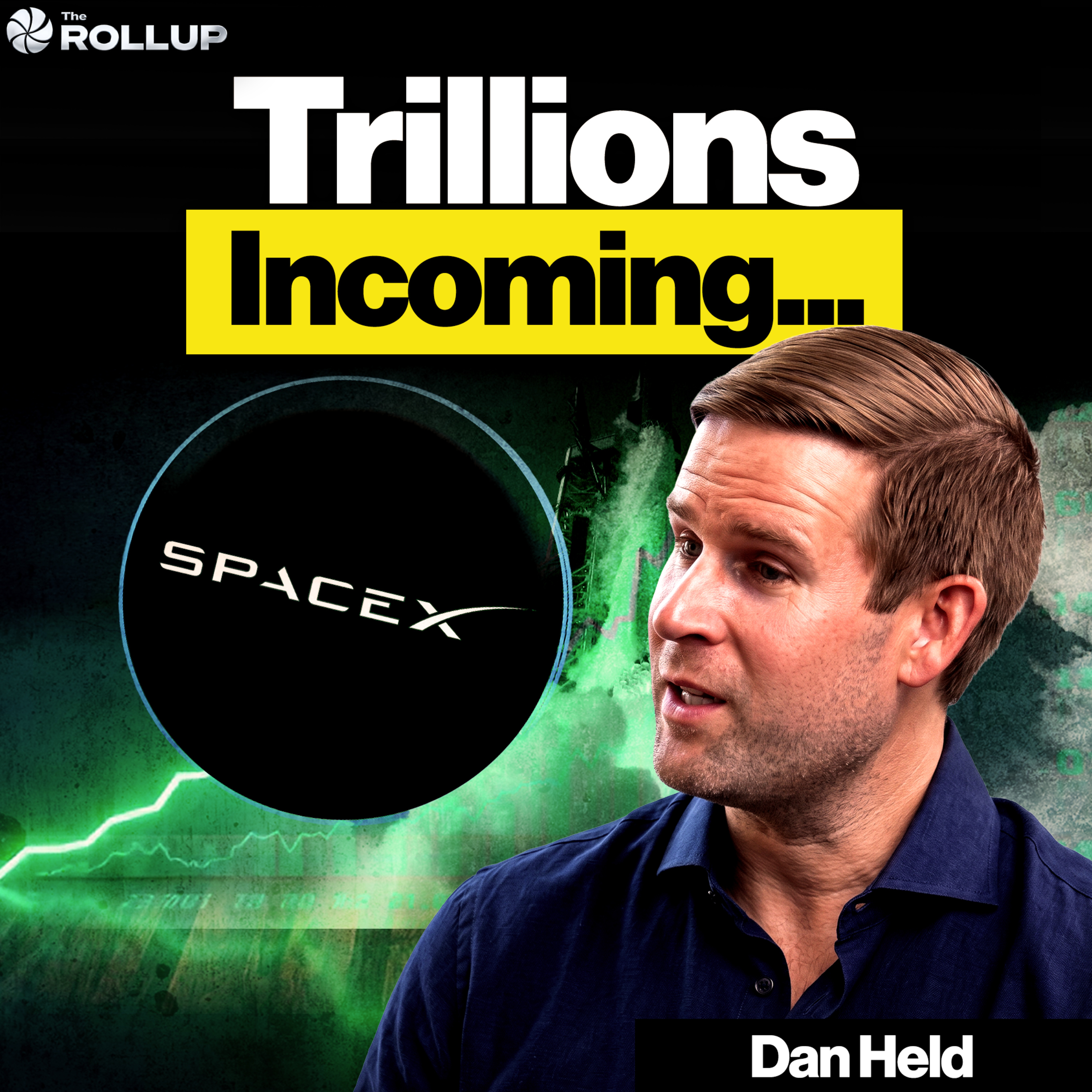
Dan Held: SpaceX Will Hit $100 Trillion Market Cap In 20 Years (The Detailed Thesis)
About this episode
Dan Held joins us to unpack what it means to become a generational investor in today's world. For reference, he bought Bitcoin in 2012 and recently sold a lot to pour it into SpaceX, and says the thesis has barely started.
The longtime Bitcoin investor lays out why Starship's collapsing launch costs could unlock a total addressable market bigger than global GDP, why he thinks this cycle just bottomed at $81,000 on the back of the Fed's bond-buying, and why Zcash's run looks more like a crowded trade than a real discount.
Dan Held is an independent investor and Bitcoin OG who bought his first coin in 2012, previously led growth at Kraken, and has spent over a decade publicly calling market cycles.
The Rollup is where the leaders of digital assets and finance converge. Live from the financial capital of the world.
Timestamps:
00:00 Intro
02:13 Apathy Was The Bitcoin Bottom Signal
04:15 OG Bitcoiners Are Buying Zcash
06:22 Privacy Chains Have A Supply Tradeoff
08:18 Bessent Treasury Twist Explained
10:46 Dan Sold Equity To Buy SpaceX
14:06 SpaceX Will Own Your Phone Plan
17:05 New York To Tokyo In 25 Minutes
19:00 SpaceX At $10T In Three Years
23:51 What Invalidates Your Investment Thesis
28:05 Sold At $1,000 Per BTC, Missed On Millions Story
30:14 Bitcoin Is Still Not Digital Gold Yet
34:44 Family Offices First Into Crypto
39:01 Dan's Net Worth Dropped 85% Three Times
Guest Socials:
Dan Held X: https://x.com/danheld
Dan Held Website: https://www.danheld.com/
Partners:
If you run concentrated liquidity positions you know the grind. Price moves, you're out of range, you're rebalancing at, like, 3am. 1inch Aqua lets you take a different approach. You can stack multiple positions on the same token balance instead of babysitting a dozen pools, and your tokens never leave your wallet. Your liquidity stays awake, so you can catch up on your sleep. Check it out at https://1inch.com/aqua
---
Dinari - Over 230 1:1 backed tokenized stocks, ETFs & more with dividends. US-based SEC transfer agent. Available on 5+ chains & via API. https://dinari.com/
---
Space and Time is providing verifiable data infrastructure for onchain finance. A decentralized database, blockchain indexer, and ZK coprocessor in one, giving DeFi protocols,stablecoins, and tokenized assets accurate, provable data.
---
Relay is the fastest and most reliable way to swap any token on any chain. Learn more here: https://relay.link/bridge
---
Zama is an open source cryptography company that builds state-of-the-art Fully Homomorphic Encryption (FHE) solutions for blockchain.
Learn more here: https://www.zama.org/
---
𝗦𝘂𝗽𝗽𝗼𝗿𝘁 𝘂𝘀 𝗯𝘆 𝗰𝗹𝗶𝗰𝗸𝗶𝗻𝗴 𝗮𝗻𝘆 𝗼𝗳 𝘁𝗵𝗲 𝗹𝗶𝗻𝗸𝘀 𝗯𝗲𝗹𝗼𝘄 𝗳𝗼𝗿 𝗳𝗿𝗲𝗲 𝗿𝗲𝘀𝗼𝘂𝗿𝗰𝗲𝘀:
Website: https://therollup.co/
Spotify: https://open.spotify.com/show/1P6ZeYd...
Podcast: https://therollup.co/category/podcast
Follow us on X: https://www.x.com/therollupco
Follow Rob on X: https://x.com/robbieklages
Follow Andy on X: https://x.com/andyyy
Join our TG group: https://t.me/+TsM1CRpWFgk1NGZh
The Rollup Disclosures: https://goodidea.ventures
𝗗𝗜𝗦𝗖𝗟𝗔𝗜𝗠𝗘𝗥: 𝘐𝘯𝘷𝘦𝘴𝘵𝘪𝘯𝘨 𝘪𝘯 𝘤𝘳𝘺𝘱𝘵𝘰𝘤𝘶𝘳𝘳𝘦𝘯𝘤𝘺 𝘢𝘯𝘥 𝘋𝘦𝘍𝘪 𝘱𝘭𝘢𝘵𝘧𝘰𝘳𝘮𝘴 𝘤𝘰𝘮𝘦𝘴 𝘸𝘪𝘵𝘩 𝘪𝘯𝘩𝘦𝘳𝘦𝘯𝘵 𝘳𝘪𝘴𝘬𝘴 𝘪𝘯𝘤𝘭𝘶𝘥𝘪𝘯𝘨 𝘵𝘦𝘤𝘩𝘯𝘪𝘤𝘢𝘭 𝘳𝘪𝘴𝘬, 𝘩𝘶𝘮𝘢𝘯 𝘦𝘳𝘳𝘰𝘳, 𝘱𝘭𝘢𝘵𝘧𝘰𝘳𝘮 𝘧𝘢𝘪𝘭𝘶𝘳𝘦 𝘢𝘯𝘥 𝘮𝘰𝘳𝘦. 𝘈𝘵 𝘤𝘦𝘳𝘵𝘢𝘪𝘯 𝘱𝘰𝘪𝘯𝘵𝘴 𝘵𝘩𝘳𝘰𝘶𝘨𝘩𝘰𝘶𝘵 𝘵𝘩𝘪𝘴 𝘤𝘩𝘢𝘯𝘯𝘦𝘭, 𝘸𝘦 𝘮𝘢𝘺 𝘦𝘢𝘳𝘯 𝘢 𝘤𝘰𝘮𝘮𝘪𝘴𝘴𝘪𝘰𝘯 𝘰𝘳 𝘧𝘦𝘦 𝘢𝘴 𝘢 𝘴𝘱𝘰𝘯𝘴𝘰𝘳𝘴𝘩𝘪𝘱, 𝘪𝘧 𝘵𝘩𝘪𝘴 𝘪𝘴 𝘵𝘩𝘦 𝘤𝘢𝘴𝘦 𝘸𝘦 𝘸𝘪𝘭𝘭 𝘢𝘭𝘸𝘢𝘺𝘴 𝘮𝘢𝘬𝘦 𝘴𝘶𝘳𝘦 𝘪𝘵 𝘪𝘴 𝘤𝘭𝘦𝘢𝘳. 𝘞𝘦 𝘢𝘳𝘦 𝘴𝘵𝘳𝘪𝘤𝘵𝘭𝘺 𝘢𝘯 𝘦𝘥𝘶𝘤𝘢𝘵𝘪𝘰𝘯𝘢𝘭 𝘤𝘰𝘯𝘵𝘦𝘯𝘵 𝘱𝘭𝘢𝘵𝘧𝘰𝘳𝘮, 𝘯𝘰𝘵𝘩𝘪𝘯𝘨 𝘸𝘦 𝘰𝘧𝘧𝘦𝘳 𝘪𝘴 𝘧𝘪𝘯𝘢𝘯𝘤𝘪𝘢𝘭 𝘢𝘥𝘷𝘪𝘤𝘦. 𝘞𝘦 𝘢𝘳𝘦 𝘯𝘰𝘵 𝘱𝘳𝘰𝘧𝘦𝘴𝘴𝘪𝘰𝘯𝘢𝘭𝘴 𝘰𝘳 𝘭𝘪𝘤𝘦𝘯𝘴𝘦𝘥 𝘢𝘥𝘷𝘪𝘴𝘰𝘳𝘴.
Get every episode summarized
Each time The Rollup publishes, we email you a written briefing from the transcript — the topics, who appeared, and any specific claims, with the ad reads skipped.
Email me new episodesFree for 3 shows. No card needed.
Hosts & guests

Transcript ready
960 searchable segments. Every word is indexed and playable.
Full transcript
The Rollup — Dan Held: SpaceX Will Hit $100 Trillion Market Cap In 20 Years (The Detailed Thesis). Machine-transcribed; use the interactive transcript above to jump the player to any line.
There's a long conversation to be had about how efficient L1 transactions are for doing this sort of function, but I think Bitcoin is permissionless and people should be able to like on it. For me, it's not about money, it's about a scoreboard of Bitcoin going up in value, means that the world is subjectively looking at Bitcoin. This led to a huge disillusionment and ultimately a civil war of Bitcoin cash, where people thought Bitcoin is useful that way. Just like the streets of Manhattan, I'm going to keep this quick. Over 70% of our viewers are not subscribers. Yes, you. Every week we interview some of the best entrepreneurs and investors in the financial industry. The easiest way to support our channel is to hit the like and smash the subscribe button. Now sit back, relax and enjoy today's show. All right, guys, we're here in the nest that took us a shot at Dan Hell. Dan, great to have you, buddy. Thanks for having me. Welcome to the show. All right, guys, Dan is one of the OG Bitcoin bulls. I mean, investor, early adopter, someone called a libertarian, early investor,
and early innovator in the space. So Dan, it's great to have you. What a day. We're pumping hard. People are sidelined. Bears are still out. Clearly bulls are in control for Bitcoin. Everything's moving in the right direction. What's your read? Well, it's always funny because it's darkest before dawn. One month ago, people are panicking. It's the end of the space that Bitcoin has failed to reach its promise. Institutions aren't here. It's all dead. And now, one month later, we see a bullish winds of comeback. So this is a classic representation of how the Bitcoin cycles work. Fear and despair. Complete apathy is what the bottom represents. And I think we had that. There was a widespread amount of apathy. It's like, it's over. I'm out. A lot of people quitting. It's usually a good bottom sign. So it's the overall given that this is my fourth cycle that I think we've bottomed. Now, the strong resurgence is because of the treasuries' actions of considering buying back treasuries, or sorry, the Fed's actions to buy treasuries in order to lower the effective rate on bonds. So when we see that happening, basically, the world is saying that we don't trust governments
to be able to pay back their debt, and then inflation is going to be a growing concern. Of course, Bitcoin, a special purpose built for that moment. That's why we do pump so hard from 60K all the way up here to like 81,000 today. Yeah. I don't think this is going to stop. I don't think it's going to go rock it right up to 100 right now. But this is what Bitcoin is built for, and I think that's why we're seeing the market move as it is. Yeah. I mean, some people call it the most reflexive financial asset that exists in the world. And so as soon as treasuries, secretaries, Scott Besson made that claim of, hey, guys, we're buying long-end bonds and to try to reduce the steepening of these curves, which in any normal economics class, they would tell you that the current bond yields are caused for a crisis. But we live in a fugaz, the economic world. As you know, this is why you're a big Bitcoin believer. The Druck and Miller legendary hedge fund manager came out the other day, wrote that really interesting letter. He said, like, look, just let the market be the market. If rates are rising, that's fine. It's just the market saying we don't trust in the US's fiscal policy. We don't trust your ability to cut spending or raise taxes.
And so that's basically what that number represents. Basically, you can also get an inflation under control. So it's funny that they go talk about these buybacks, but in effect, you can't stop the market from moving against you. You can't stop the market from going in certain direction. So the treasuries ability to really stop this from happening or these rates to increase is somewhat limited. Yeah. Well, man, I mean, Bitcoin's got 81 people are stoked on Ethereum and Solana and all these other names. One name that OG Bitcoiners, who I only have a couple in my network, I consider you one of them now, grateful to have known you. I got these texts over the last three months. And I really like three to six. And it was like, hey, Andy, just, you know, you're a friend of mine. Just want to help you out. I know you work hard. We're buying a lot of ZCash at 100 to 200. Anything in between the 200, 400 dollar range, I'm buying ZCash. I'm taking one fifth, one seventh, one eighth is the numbers that I heard of my kind of
long-term BTC and I'm allocating it in ZCash. So I'm like, okay, so these guys are, you know, these guys are, you know, multiple eight figures, nine figures, Bitcoin since 2013, you know, and something by something like, okay, so this is obviously going to be one of the trades of the cycle, not yet a Bitcoin, right, in terms of its money-ness or kind of, you know, network effects, but it's kind of coming on to be like this beta asset to Bitcoin. What's your take? Like the whole privacy narrative, the whole quantum narrative, what's your take on ZCash? I mean, I've seen so many crypto narratives come and go over the years about various crypto assets that this is one of a few thousand. The whole privacy angle, look for libertarian OG types, the privacy angle, of course, we like that, right? We like the idea of a money that can't be traceable and or transacting privately or storing your wealth privately. The problem with privacy chains is that they have a fundamental trade-off between the auditability of the supply and the privacy angle, which just happened to ZCash, what was that six months ago? Yes.
Or years ago? Yes. Yeah. Where there was a, not an inflation bug necessarily, I forget the nuances of it, but it made it hard to know exactly how many ZCash existed and or if there's an exploit done to where the amount of ZCash was artificially manipulated. So given that the most valuable part about Bitcoin is that it's, we can trust in the 21 million hardcap, Bitcoin's community decided not to make that trade-off. Remember that the Bitcoin protocol could be upgraded to absorb any of these features of other all coins. Bitcoin has upgraded itself numerous times. So if the community decided that privacy was a huge important factor, we would have made that trade-off. Yeah. However, the Bitcoin community won't make that trade-off, whereas the ZCash community has. What I'm trying to say in a very nuanced way is that we all want privacy and auditability, you can't have both. There's always going to be less auditability, even though there's all sorts of like turn styles and other ways that ZCash can audit their supply. That isn't inherent weakness for a store of value digital gold. That's why Bitcoin will never have it. ZCash has decided to add that, you know, that's entire premise is privacy.
Now why now? Why ZCash? Yeah. I always have an allergic reaction when everyone's talking about the same narrative at the same time. Where was everyone shilling ZCash a year ago? A year ago. A year ago or 10? Yeah, we're during the lows, right? I didn't see these eloquent thesis from top crypto VCs come out a year ago about ZCash. They all piled on after a pumped. The crypto space works pump the narrative. Correct. There is no narrative that drives it. The narrative is reflexive and produced afterwards, even for Bitcoin itself. Of course. So, is this narrative true and is ZCash all of a sudden an asset that's under value or not? I don't know, because for me, anytime I don't like buying things that are really hot and everyone's talking about it because it's been so early with things like Bitcoin and things like SpaceX. I like hated assets. Usually when they're priced well. So right now it doesn't feel like ZCash is exactly priced at a discount. It feels very, very expensive. I think a lot of people are buying it because other people are buying it.
Again, I believe in, you know, when you have an investment thesis, you should believe in this before anyone else believes in it. So I'm inherently not that type to chase a momentum trade. Yeah. That's my opinion. Actually, my entry wasn't at 20, but it wasn't a well-hundred. So I feel early. Right, but now it's at 950,000. It's like, well, okay. The hard part isn't getting in, it's getting out. Yeah. Because you haven't sold yet, right? But the OGs that I spoke to, Dan, you know, they said, you know, hey Andy, you know, you know how we did so well on Bitcoin, we never sold. True. But Bitcoin is a distinctly different asset from these other assets. Right. But theoretically, if you follow the logarithm of the growth curve of something like ZCash, you know, I'm just kind of like defending my positions, right? These opinions are held loosely, you know, things change. But you know, theoretically, the price appreciation of Bitcoin obviously is like, those people have a bit of, like, you know, you have a bit of like this like survivorship bias. Because there was thousands of all coins that you could have said, oh, yeah, how do we get rich?
We didn't sell. So we didn't apply, right? It didn't apply. So, you know, we'll see what happens. But yeah. Well, I have no doubt that you could have performed me in the short term. So are you up performing the long term? Exactly. I highly doubt it. Yeah, that's nice. And if you look at all legendary investors like Oak Tree Capital, Howard Marx, Warren Buffett, et cetera, they don't claim to make short term trades under profit. Most of them have a long term horizon. And if you look at the performance, they outperform almost everyone else. Yeah. So unless you're DE Shah, Rentech, where you have information or alpha that no one else has, and they can win on the short term, it's pretty difficult to win. So I've missed out on thousands of altcoin pumps. 10s of thousands. I will in the future. Yeah, that's fine. But long term, if you look at the BTC to altcoin ratio, like pick your altcoin, C crash Monero, Ethereum, Salana, whatever you like, anything, cardado, XRP, I have got it. But like the altcoin BTC ratio, yes, surely pump, and I've missed out on all of those. But long term, you know, getting in isn't the hard part, it's getting out. Right. And that's where most people don't have a systematic way to exit their position once
they've internet. For example, imagine it said, what is it today? It's almost 1,000. 1,000. So your entry is, let's say, 100? You know, a little bit higher, but yeah, look, let's just say 100. Yeah. Well, let's say it drops to 500. You probably won't sell because you're thinking that it's going to go back up. Then it drops to 200. And then you think that it's getting, you're not going to sell it. And then it's down at 100 at your cost basis. It's a psychological game against yourself. So if you're going to trade, which I don't recommend, I'm a long term investor for everything I do. I'm a shitty trader, by the way, sure. I only work on trading tech like where I did a crack in and my interchange of my last startup because I'm not good at trading. I like to build software for people to do. You have to have your exits pre-planned before you enter. Because you will always keep hotdling it all the way up. And then eventually it comes back down. Now for assets like Bitcoin or what I consider like Bitcoin or SpaceX, like multi-decade generational assets, that doesn't necessarily apply. But for altcoins, most of these I would consider gambling. Yeah.
And you have to have an exit plan. Exactly. So talk to us about the SpaceX play. So did you buy a lot here at the lows around like 100-ish, 150? We're breaking up above 150 now. So this kind of felt like the time to really get into SpaceX. I missed it. My best friend has been just pinging me. He's like an e-commerce entrepreneur. He just does Bitcoin and like S&P 500 and a Nasdaq. And he's like, I'm taking time for a set of my portfolio and doing my account. Not the indexes and not Bitcoin. And I'm putting it all in SpaceX to start. What's the SpaceX thesis? What's the long term thing here? This is a multi-decade investment I assume. So how do you think about this? Yeah. So I have a certain personality trait where I get obsessive about things. I don't know what you want to classify me as with that. But maybe it's alt-s, maybe it's something else. But for different assets and other things, I get really into it. Yeah. What I realized in life is that your alpha or your ability to outperform everyone else could just be because you're so obsessive about one asset.
I'm going to miss so many investments in real estate, commodities, all sorts of tech plays, AI. But for Bitcoin, I spent the time to really obsessively learn about it. And I would say like, I spent so much time that I realized I'm one of maybe a thousand people. I'm not going to say I'm a genius. I'm not going to say I know it all. But I'm probably top 1,000 back in like 2012, 2013 that really understood it. That gives me an edge. That means that I know how to price this asset. And I think everyone else has mispriced it. That's the bet I made. Now there was a lot of like path dependency risk of Bitcoin could have died. Like if we ran the universe simulation a hundred times, maybe Bitcoin dies for some reason 59% of the time, 60% of the time, so I mean, who knows. So I'm somewhat lucky. Because risk is what I can't calculate. So SpaceX, I applied the same thing. I've always been a really obsessed with SpaceX. I was the first Falcon Heavy Launching person with the employees. Wow. I went to the first Starship launch. That was after I made the investment. But five years ago, I basically sold most of my crack in equity and put it into SpaceX.
Wow. Because I had spent the last year getting obsessed about the unit economics of how it would work and the potential tam, like it did work. SpaceX, like Bitcoin, has a certain sort of, I would call it, a metric crux. Bitcoin is 21 million, like the whole world value divided by 21 million. Sure. Right. That's your classic. Like that's like the veteran. Yeah. 8 billion people, 21 million coins. Exactly. Ultimate scarcity. Yeah. What's the value of that? Ultimate provable scarcity. SpaceX is dollars per kilogram. How much does it cost to send one kilogram of matter into space? And SpaceX took, you know, the space shuttle launches were about $20,000 per kilogram. And with Starship, it'll be $10 per kilogram. Wow. It's $2,000 expert auction. So if that happens, that was my investment thesis. If that happens, that will unlock a tam that is likely larger to be the global GDP. Wow. Now that sounds fucking ridiculous. Like, you know, like I've usually got this sound and even crazy. No, it's not even crazy. Yeah, it's not a nuts.
Friends, family, lovers all hate me because it's like dinner time. You know, it's like I talk about Bitcoin SpaceX. I'm a little bit of a one or two trick pony now. Yeah. I invested under 100 billion valuation. I was going to say my risk was Starship. Were they able to execute and build Starship and launch it? And I'm like, I'll take that bet. Now, again, in universe simulations, if we had to rerun the universe 100 times, maybe 20% of the time they would have failed. Sure. But even with that, the Falcon 9, they can still go deliver starlink, which is a trillion dollar business. So I wasn't too worried about the valuation even if Starship failed. So Starship has massively been successful. They're launching their first orbital launch with an actual usable payload of the new Star Links. So like SpaceX totally executed on this. People don't understand how much they'll change everything. I mean, SpaceX will own Telco, including mobile connectivity, not just like, you know, this isn't a replacement for Fiber. It's a replacement for your T-Mobile AT&T Verizon. Then you have things like defense contracts.
Yeah, rods from God dropping kinetic payloads from space. So imagine like you could hit every target in Iran with no pilot risk, and you could hit it within seven minutes with very little to no detection. So pretty crazy. You could also do things like brilliant pebbles, which is a program in vision in the 1980s and 1990s. This is essentially the Golden Dome project that Trump has talked about. Since we can detect launches from adversaries, we can drop small payloads, kinetic bombardment, fragments onto those ICBMs or missiles from space. Wow. So that will give the US a complete dominance over the nuclear threat, other than smuggle nukes. So it's not only just like, it's a national security. Like, this is the equivalent of developing a nuclear bomb, though. Like you either have it or you don't, and if you don't have it, you're at a huge disadvantage. Right. So the US will have a complete global dominance net fat in that way for about a decade before trying to catch us up.
Yeah. Because China's space program is pretty advanced. So I was just out in the national parks with my girlfriend. We were hanging out for a couple of days out in Yellowstone and in the Teton. So beautiful. Beautiful. And of course, there's no Wi-Fi out there. I brought my little Star like mini plugged in 300 megabits speed in the middle of Yellowstone National Park on the roof of my cabin. And pretty soon it'll be right to your phone. And on airplanes. Yep. Everywhere, which will be incredible. And then also people forget about the connectivity of robotics and IoT. Every single boat, airplane, every single little humanoid robot, every single robot, farmer, et cetera. There's that. And then you have things like, you know, computer space, right? Like orbital data centers. And obviously that's become a really hot narrative this year. Oblital data centers make sense on paper. You basically trade off. It's a higher capex to get it up there, but then your op-x is zero. That's in the, so there's a cost curve analysis for that makes sense. So you know, that's huge as well. So you got a million things here. I'll write a lot for a couple of minutes.
I spent too much time. Earth observation, cameras in space, monitoring the globe. You could, before they were really expensive to get up there, they also didn't have continuous coverage. Didn't have the ability to stream the data because it's really data intensive or do compute, which will have all of that up with Starlink and StarMind. Yep. Then you have things like point to point. You take off in New York and land in Tokyo in 25 minutes. Wow. That will exist. I mean, you're just like, you're riding a rocket. It won't be a comfortable ride, but I travel for business on business class, therefore almost once a month. And I would be the first one to sign up for that. Millions of other things like this. You know, and if you look at it, it's sort of like, you know, what's the value of the new world for the, you know, back in, what was it, Columbus came into like 14 something. Like basically the tan of all of North and South America didn't exist. It's sort of the same thing. It's covering all these assets in space. And that tan is one pretty uncalculable. But we know it's large.
Asteroid money, and etc. Anyways, so, you know, if you look at this and you start to map it out, by the way, if you want to dig further into this, check out Mach 33's research. Okay. Aaron Bernett and Vlad of the two guys behind that. Super brilliant. Elon tweeted, I haven't seen a company produce such good research outside of a rocket manufacturer or satellite manufacturer. So Elon loves Mach 33. Those guys are fantastic. I've tried it a bunch with them. They, while I synthesize a TLDR narrative, they spend the time to actually do the math. So yeah. And if you want to check the math out, that's what I'm here is a bit about on the math side. Not necessarily about like, about all the rockets and the starship and the starlink and the robots, but more on the investment side, what is the investment math here? Like obviously you're in, you know, extremely early. I think the stock trading multiple trillion dollar valuation now, two and a half ish or something. Three ish maybe. I would say that less, but what's, I mean, not price prediction or like stock price prediction, but like, sure, if your thesis is right, give us like your bull and bear case for SpaceX. Yeah.
And think about it this way, like a dollar per kilogram or cost us in a kilogram into space, as that decreases makes it cheaper to get into space, the tan increases. So just think about it from that perspective. So if the keep executing on starship, mass produce them, mass launch them, reuse them, basically that cost curve keeps going down. If that occurs, you know, I think, I think by 20, I think by in three years, SpaceX trades at a 10 trillion market cap, I think by, I'm 38, I think by the time I'm old, older, maybe, maybe like mid late 50s, about 20 years from now, I think SpaceX trades at 100 trillion market cap. I know that sounds ridiculous, but you've got, you know, if you look at the projected starlink, star mines and other asset and these other product lines, these are huge and they predict, they predict, like for example, starlink, they predict the revenue to double for the next five years. That's two to the fifth power. Like people don't think an exponentials. That's why Bitcoin is so hard to value. Everyone's like, I remember when people thought Bitcoin is expensive at $100 or $1000.
And now it's close to $100,000. Yeah. But then someday Bitcoin will be at a million and people will be like, oh, well, $100,000 would be cheap. People's minds can't rock exponential curves. Yeah. And then when you're thinking species, the deer runs in front of us, we throw a spear, it hits the deer. Yeah. Crops don't grow exponentially. You get to do all the work and then it's kind of a linear process. Seeing things double and double and double and double isn't what our minds are made to think of. Right. So if you can see that curve or spend enough time to care about it, again, I'm not a genius. Anyone else can come to the same conclusions I did. You just had to spend the time to think about it. 100 trillion dollar market cap. Yeah, I'm going to buy, I'm going to buy SpaceX for the long term here after this show. My buddy's been harping on it and just been like, man, you got to get in. You got to get in. What about the investor psychology required to see that through? Like, again, what do I need to do? How do I like, do I need to make a separate brokerage account that is like long term holds and then like my trading brokerage account? And how do I mentally see this through, you know, I'm 27?
So I'll be 50, you know, theoretically in 20, you know, 23 years. How do I hold SpaceX for 23 years as an investor? Obviously, sizing is a big part of it. So, you know, you know, let's talk about percentages of portfolio. Let's talk about the psychology required because I write my time scale of investing career is I started when I was like 18, so, you know, 11 years, sorry, nine years. So I don't even have 20 years under my belt. So thinking about holding an asset for 20 years, how do I manage that trade? I mean, that's a fantastic question. There's a lot of different components to this. I, one, had the humility and the introspection to go, was I just completely lucky with my bet or was there a method to my madness that I can reproducibly do over and over? You know, that's where I read all of Howard Mark's letters from Oak Tree Capital. I read a lot of Warren Buffett stuff. And what's funny is if you actually take all of their learnings and distill them, there's really just two things that they both, that they all say, be obsessive about a certain asset and know everything about it.
And once you do, you probably will either find that it's overpricer underpriced because you've spent more time than anyone else looking at it. There's just too many things for everyone to look at. And if you know a lot about a certain industry or a certain asset, you have some alpha there. The seconds, which is funny because basically, it's our core mantra in crypto, it was HODL. Yeah. And the HODLing parts to the hardest. Howard Mark's is pretty kind of quirky and funny with how he references it. He's like, look, if you really understand the asset, if it drops, you should want to buy more. You know, if you're feeling like, oh, I should sell after a drop, it means you really never understood the asset to begin with. So the HODL part is extremely difficult. And I would say Morgan Housel with the psychology of money has a really good thought process behind this. There's investing practically versus investing rationally. Investing rationally would be like, if I truly have this conviction in Bitcoin and SpaceX, I'm 50% 50%. Right. I sure. That max full send. But I'd portfolio is almost all that.
I like a little bit of a cash buffer. Or expenses for like a year or two. And then I have a small percentage in S&P because that just makes me feel good. Sure. That's investing practically, knowing my own character versus investing rationally. Now, until 2021, my net worth was 99% in Bitcoin. Wow. So I did almost a decade in Bitcoin, exclusively. No S&P, nothing else. Wow. So I've lived that. I was a young guy and I feel like for men, young men can handle that better than other demographics, due to our whether it's stupid or smart ability to take outsized risks. Of course. I think women, for example, will outperform most men, but not for the outliers because men are idiots enough to take crazy risk. Like, where the one who wouldn't go stab the bear brought it back to the tribe, go in the favor of the tribe. But the other three dudes died trying to stab the bear. You don't hear about all the losers who invest in ultra high risk assets and lose. Right. So that's where it's not for the faint of heart. It's not for that. For a certain type of demographic for yours, for example, in your late 20s, you can stomach
a lot of risk. AKA, in risk is not volatility, but volatility is our rudimentary metric to measure risk. Sure. Our Marxist great thoughts on this because you know, you can't measure risk. Risk is what's uncalculable. So volatility is the representation of people repricing risk for an asset or what its future value is too. So your ability to stomach that is probably higher than most. And you're also born in crypto. Exactly. So if you can survive this asset, classic and survive anything. Well, it's funny. It's thinking about allocating the space next year from my portfolio actually feels like a bit of a de-risk. Like, yeah, you're diversified now. Right. Like, I mean, so many, I mean, Bitcoin, I mean, freaking tons of coins, I'll receive investments. My entire company is predicated on finance. I mean, it's gone from crypto to now finance, which is great. Yep. So we're having this conversation instead of, you know, going into the weeds about institutional option of crypto or something. But it feels like a diversification of a strategy somehow. Yeah. I mean, part of this is both calculating like your immediate liquidity concerns to pay for expenses, only investment you can afford to lose.
There's your ability to stomach risk. And then, you know, it's kind of a factor of like, which you can do interesting things by the way, like, QBera is a way to track all of your assets in one spot and it pulls in live data and it pulls in live balances. You can use that and then like talk to rock or chat about it. Yeah. We're like, you can analyze your life portfolio and you can chat about it. You know, there's again, the psychology of money, I think Morgan Housel did a great job of talking about practically versus rationally. Like, I like it. At what levels should you take money off the table? Like, you never, and you're not going to live forever. So money when you're younger is much more fun. Right. And that's where I woke up and looked at, you know, I've invested extremely well. But then I've been such a good toddler that like I never touch my Bitcoin or anything else, you know. And so there's this, there's this curve in life where the longer you don't touch your assets, they compound exponentially. Sure. Classic, classic return profile. Yep. But your health exponentially decreases at the same time.
So there's a sweet spot in a way where I think that everyone teaches you how to invest. But if you become really good at it, it means you've withheld consumption for such a long time. Correct. So you haven't figured out how to spend it or the fuck do you need any more for? Like, yeah, you know, I woke up and I'm not going to say I'm crazy wealthy. I've done quite well. But why the fuck would I want a billion dollars at 60? Yeah, no. Like those guys would trade 995 million and have 5 million bucks where we're at. I mean, you're a bit younger than I am about 10 years younger. They would trade that all to be your age. Yeah. Maybe 5 million in the bank right now versus a billion at their age. They would trade all of that. Hangover sock, they wake up later, people don't view them as attractive. Like they haven't been wanted in a decade. Yeah. You know, things like that. There is no calculable value for that. So also you could just die tomorrow. You know, 100%. Right. 100%. So yeah, I would say there was a lot of introspection I did of like cool.
I'm really good at this investing thing. But I'm only well at it. But what's the point? So that's the intimate side of being a human. Right. So I think there's a good balance of both. You know, for example, like let's say your net worth is a million just for easy numbers. And your buddies want to take an epic lifetime trip to Cabo. And you want to spend $5,000. You probably should take that trip. Like that's a pretty small percent of your net worth. And it's a trip with all your buddies. And then maybe you know, six years from now they're all married. And none of them can meet up again. And you definitely would have missed out on like a trip like that. But those are important to take. You know, we're some people especially in New York City, the grinders. I used to be a grinder as well. You know, it's early growth team at Uber. When I was working at crack and I worked the 80 hours a week for three years. Sometimes you have to grind. But at the same time, it's got to be worth your while. And that's where in New York, sometimes they see these like attorneys or investment bankers. And they're like, you know, they're like 30 years old and they're making maybe half a
million. I'm like, I don't think that's worth it, man. Like half a million a year, half that goes to taxes. And you got to pay high rents in New York. And so maybe you're netting like 100K in savings a year to lose your late 20s or early 30s. Yeah, probably not worth it. You need to be netting a lot more than that. So thinking like reading the psychology money and the artist spending money and die with zero, a bunch of these books helped reframe what the investing is all about to begin with. It's your producing your allocating capital wisely in order to have an appreciation of assets that then allow you to live a life. So you got to remember about the living part, the same time living decrements from your investment portfolio, so it's a balance. So to put this into more actionable, practical lens for the audience is what's your, what's your rich by 2040 portfolio? Is it Bitcoin and SpaceX? Is that it? I mean, if I felt any differently, I'd sell both. Yeah. I don't know.
And something else. Vals majority of my portfolio is SpaceX and Bitcoin. Yeah. So for me, I'm 38. So maybe if they five acts for 10 acts, I'd decrement 10 or 20% off now because I've got to start rolling into things that make me just feel more comfortable. Yeah. I totally hear you on that part. I'm very aggressive right now with my positioning, but I have, unfortunately, I had gotten some good gold and silver that's locked away. I guess great. Some Bitcoin that's locked away. So I have a house. So it's like these small things. Like, I don't even look at them or pay attention to them and they honestly, and like, you know, the real estate piece just bothers me. But it's the mental sanity. Exactly. The rest of the portfolio is in freaking beta altcoins, my careers and this and all, you know, and so it's that mental piece has helped me a lot. Let's imagine you outperform your existing portfolio. Let's say you could outperform it by being all in on risk and this was guaranteed. Like let's say you could eke out 3% more year return above what you currently have.
But you were sick to your stomach. Yeah, all the time. Yeah, exactly. Yeah, is that really worth or not? And you get a fucking ulcer at like 30 or something. And like, I don't know. You know, again, it's knowing your body in your minds and what you can handle. Yeah. And life is a game after all. Yeah. Yeah. Coming back to this kind of practical versus rational thinking, Q for the investor. You know, people think about investing as they get rich quick thing, especially in crypto. How do you remove the short-sightedness investing and think about longer term exponential outcomes? Because as you said, us humans are hard, you know, it's hard to think in exponentials. And we've spoken a lot about that already. So, you know, in a new way, kind of fresh way, how do we kind of delay gratification in the investing world? And how do you, is it, you know, you have a shorter term, kind of like perps bucket or something that you want to, you know, if you're, if you got a scratch that itch, that's what you do. And what I currently have, you know, it's like a small amount. It's like, all right, if something I, I think, you know, it's going to pump in a week.
I'm going to, you know, trade it there. And it's like my trade portfolio, but other accounts don't get touched. Is that like the right framing? How do you, you know, take short-sightedness out of this? That's a really good question. I mean, know yourself. Like, if you need to scratch that itch by having a trading account, get the trading account. But make sure you don't top it up. Like, maybe it's a quarterly amount, $10,000, $100,000, whatever your number is. And that's your limit. It's like, at the casino. It is gambling to some extent when you do day trading because you don't have any alpha. You might have alpha. Like, let's see if you know some information about a project, but probably don't have alpha if you're a regular trader. So yeah, if you need to scratch that itch that way, sure. You know, some of it to like maybe your concentrated position and like an ultra high-risk high volatility asset. Maybe there's a price you'd be willing to sell that. You could sell covered calls at that strike, which would give you a yield because you're selling your upside. Right. So it sort of commits you to selling it away. So it's sort of the market paying you to sell at that price if it does hit that. So you could use it as a way to keep yourself honest whenever you want to exit a position.
It's selling calls at certain strikes. And so the market is paying you that premium, that counterparty. And if it doesn't get called away, you just write it again. Yeah. And if it does get called away, then you're like, well, I would have sold it anyways. So that's an interesting way to scratch that itch where like a covered call trade as a seller of a call that is a trade. And it keeps you honest with exiting a position. So that's a good way of doing it. It also makes you feel rewarded for waiting because the market, the premium, the call buyer is paying you a premium for that privilege to exercise the adoption of a premium. So those are other ways, but basically, you know, you know yourself, you need a separate trading account, cover calls, and then finally, Howard Marks or Buffett, understand the asset. Do not buy shit because your friend told you to buy shit. I'm not picking on you. I'm just saying in general, pretty asset. You should know all the fucking details about this thing, every single little piece of it. You should know, look, did I understand Bitcoin perfectly when it got in? No. But after I bought it, I quickly did because it's all I could think about.
And I knew a lot about the existing financial system. I studied finance during the 2008 financial crisis. Yeah. And that old. So, you know, going down this rabble, you got to really understand it. And when you do, then you're not paying it when it's your dips. Yeah. Like, my faith is unshakable. You can check all the receipts on Twitter. Yeah. Like, all the way back through 2015. I didn't start tweeting until about 2014, 2015. Yeah. But yeah, you can check my receipts. You can ask, rock, be like, at Dan Dallin ever tweeted anything bearish. Like, it's unshakable because I understand the asset. Yeah. And so, hold outsized percentages of your portfolio in longer term assets that you firmly believe in and manage your psychology through potentially covered calls, scratching your perps itch, scratching your short term itch, however, you want to scratch it and stay up to date with the asset. Be in the top 1% of understanding your biggest holdings in your portfolio. Exactly.
Yeah. That's it. I know it sounds basic, right? The thing is a lot of people, I mean, what's funny is diversification is the process. Price you pay for ignorance. Sure. That's why you buy VU or VTI or S&P, which those are representations of that to some extent. Because, you know, for example, a small percentage of my portfolio isn't that and that is my ignorance diversification payment that I'm making where let's say I'm really fucking wrong about Bitcoin and SpaceX. Bitcoin has a game through redic exploit. Again, there's reasons why I don't think this is going to happen. But let's say it does. Yes. Elon Musk dies from an assassination and three of the facilities are targeted with bombs. You know, things that would be like, it's very improbable. I don't wish that to happen, of course, and I don't think it will happen. You know, those would massively decrement. I still don't think it would make either of those fail. Right. It would just delay the price path dependency up and up.
Up and up. So, yeah, I mean, I diversify because I don't know everything. Right. I don't know the payments I make because I don't know. For ignorance. Exactly. Yeah. You know, because they say diversification is the enemy of returns. However, like, you know, like my friend, for example, that I spoke about at the top, the guy's all in on e-commerce. He's not looking at charts every day. So he's just S&P Nasdaq Bitcoin. And that's great. Yeah, it's, you're going to get the average return. You're not going to get outside returns. But even the average return is phenomenal. Yeah. I mean, a lot of people don't have patience for that. And that's why they're trading all sorts of stuff. But the average return is great. In fact, the average return in the S&P 500 up performs the top hedge fund managers in the world. Yeah. Very few of them consistently beat the market. It's almost impossible. Yeah. So that's where, you know, unless I have better information on these singular assets, then I'm probably not going to try to trade against the best of the best on the S&P on a sub annualized
basis. So within a year. But it's funny as hedge fund managers are only rewarded for short term performance, which means that they're not valuing these assets for their long term value. And that's where you do have an edge against the smartest people in the room. Because they're not playing the same game you're playing a different game. You can, any don't have any reputational risk or career risk. Yeah. You're not going to get fired for buying this asset that's hated what Bitcoin was because it's your own money. Yeah. That's why family offices were the first institutions related to get into crypto or Bitcoin because hedge funds, other folks couldn't take on the risk. Yeah. Now venture capitalists did too. They were buying like equity and it's a little bit more complicated. Yeah. But yeah, like you're essentially on the same risk profile as venture capital. But even venture capitalists aren't that contrarian. It's actually at misnomer. Like people think VCs are super contrarian. They're not. There's very crowded categories and they've misallocated a ton of capital because of the reputational and career risk. For example, yeah, I understand.
Yeah. Like A16Z, Sequoia, if they invest and you're a smaller VC and you get into that round too, they don't actually do any other underwriting of due diligence. Yeah, just that they're right. Yeah. And then they're not even wrong. If they fails, then they're like, well, A16Z went in. Yeah. Yeah. The smartest guy in the world. A lot of course. Yeah. Yeah. So just then to kind of close the loop here, the last thing that I want to cover is what do you do when you're wrong? So thesis is established. Position is established practically speaking, but concentrated, right? You're concentrated. You think you're up to date on the asset. You're concentrated. You've got a plan. You've got an exit strategy. You've done the research, but you're wrong. You're still wrong. You're just flat out wrong. How do you change biases? How do you recover from losses? Maybe you haven't had as many losses as others in their career, but you're definitely taking on paper. Yeah. Exactly.
How do you deal with that? I mean, on paper, I've had my net worth drop 85% three times because I was 99% in Bitcoin. So I didn't sell, but it wasn't fun. Yeah. So two things. Go back to your investment thesis. You should literally write this down before you buy it. As the new information altered my investment thesis, like, for example, if the Bitcoin community decides to change Bitcoin's 21 million, that would be a pretty serious breach of like scarce digital gold. In that case, my original investment thesis would be invalidated. Therefore, I might choose the exit by position. So if you're original, and remember, you've got to write this down so it holds you to it. If new information invalidates that, then maybe you should reexamine holding the asset. You know, other things as well, it's more of a trading against your self game. Sure. At the end of the day, it's just you. It's you against you. So like, you know, if it's down that much, like, can you actually stomach it going to
zero? Yeah. But you should have entered the position knowing that it could. And then sizing is an important thing. Yeah. When I entered Bitcoin in 2012, it was when I first bought Bitcoin, but when I started to accumulate, I was in my early mid 20s. And so like for me, I didn't have that much money. Yeah. I was just trying to do wish I was 10 years older because I would have had a lot more disposable income. However, it also meant I could really have any obligations. No family, no kids, no mortgage. So if it all went to zero, I'm working. I'd be fine. I would have sucked, but I'd be fine. So you know, I think that is an important part about sizing, but then also knowing too, and this is about exiting the position, what is life changing money? Yeah. I know a guy, very close friend of mine. He sold all of his Bitcoin at $1,000 per Bitcoin. Now here's his path. He bought Bitcoin at like $10 a Bitcoin. In 2020, 2013, it went from $10 to $1,200, $100 extra turn. Well, so all of a sudden he was where he had a million dollars.
Now, he's in his early mid 20s and he's like, this is awesome. Million bucks. And this is again, a little while ago, so that more like $1.5 million is today's dollars. And so he's like, you know what? I think it's going to go higher. And so then it dropped from $1,200 all the way down to $170 back at the bottom of 2015. Then he promised himself as soon as it hits $1,000, he's going to sell it all. And he did. But then he could have had $20 million because he missed out from $1,000 to $20,000. He never understood the asset. Bitcoin at $1,000 a Bitcoin is a tiny market cap. If he thought that the Bitcoin is digital gold, why would you sell and you work close to that? And so he had $100,000 of Bitcoin, which is like $1.5 trillion, Bitcoin is starting to glimmer like digital gold. It's still not even digital gold. Yeah, I hear you. Like at $10 trillion, $20 trillion, now Bitcoin is really competing against gold as a digital gold or a gold alternative. So he never understood it. And so, you know, when we think about exiting the position, don't be like, I'm going to sell
it to X. Why? But why would you sell it to X when you're buying an ultra undervalued asset that has long-term potential? You shouldn't be coming up with like 2X, 3X. Don't think about it that way. Think about if my investment thesis comes true, what will this be worth? And then what would the market cap or the valuation of that be? And then you can back into, okay, if we get close to that, I want to sell some, et cetera, or like at that point, I might be in my mid-30s and I want to buy a house. So it would be good to sell some and my wife's bugging me to get a house. Yeah, we got two kids on the way. There's all sorts of life considerations, but that's the way I would think about it. And I wish we had more time. I think this is it. That was awesome. Yeah. Awesome conversation. Thanks for coming through. Beautiful day. Beautiful period. The corners. The markets ripping. Great to have you, buddy. And thanks for being a part of the show.
More episodes
More from The Rollup
Sam Kazemian & Raagulan Pathy: Why Neo Banks Are Quietly Selling Themselves (Ful...
The Rollup

John Gillen: Ethereum Will Fly From Here And Most Investors Aren't Ready (Here's...
The Rollup
Felix Jauvin: Why The Fiat Debasement Trade Is Set To Explode Soon (Full Portfol...
The Rollup

Arthur Hayes: Ethereum Will Outperform The Entire Market (It’s My Biggest Positi...
The Rollup