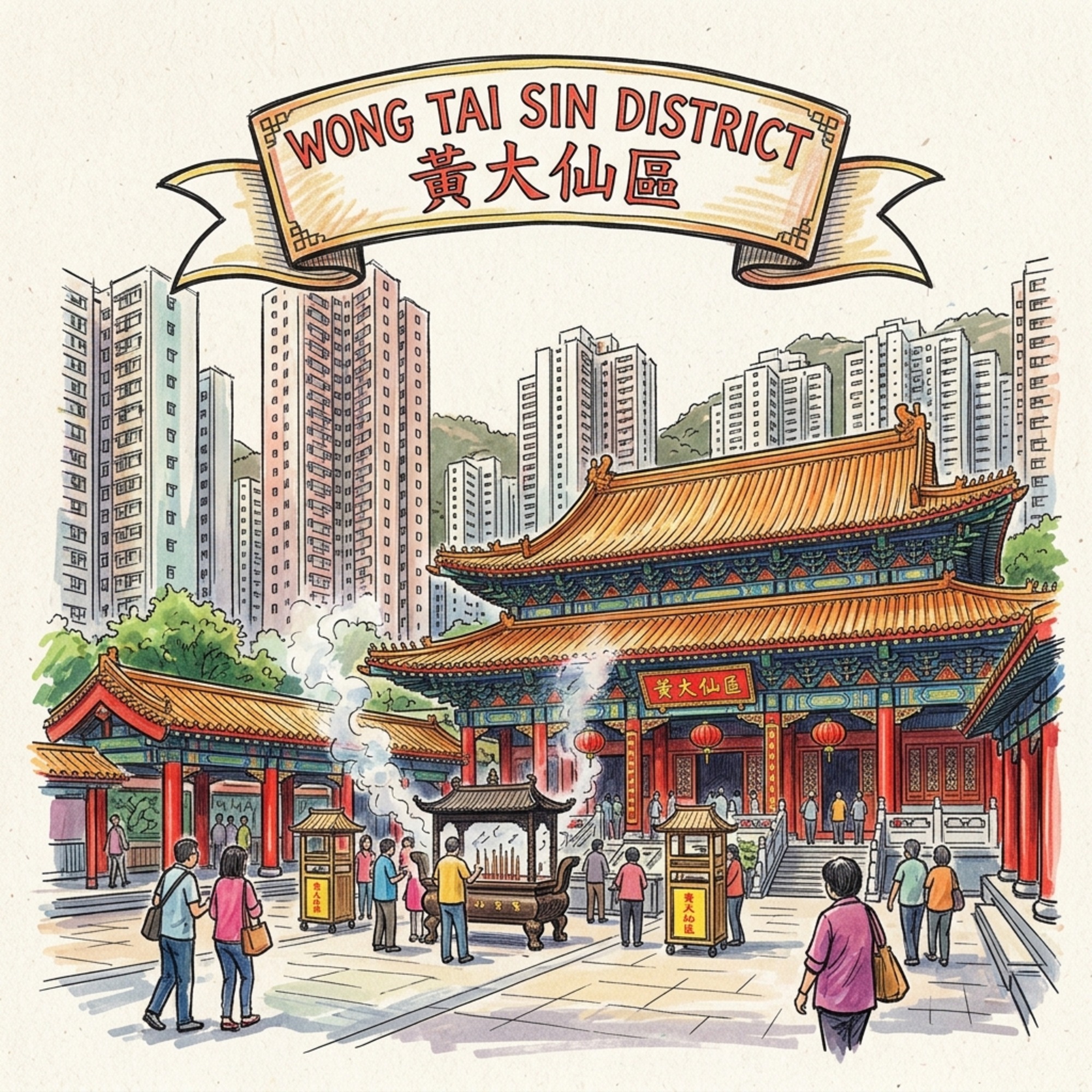
ENG-Multidimensional Spatiotemporal Historical Stories of Wong Tai Sin District
About this episode
The provided text is a detailed research dossier examining the Wong Tai Sin District in Hong Kong through a blend of geopolitical history and traditional geomancy. It analyzes five critical narratives, ranging from the 1953 Shek Kip Mei fire and the subsequent rise of public housing estates to the 1967 leftist riots in San Po Kong. The document also explores the transformation of Diamond Hill from a squatter village into a serene Buddhist complex and the social challenges faced by the Tsz Wan Shan community. Central to the analysis is Lion Rock, described as a powerful ancestral mountain whose symbolic and spiritual authority has been repeatedly claimed by colonial authorities, cultural creators, and political activists. Ultimately, the source proposes the theory of "Dragon Vein Leverage Syndrome," suggesting that the district's history is defined by different groups attempting to harness the mountain’s cosmological prestige to legitimise their own social and political agendas.
The Unwritten Pages of Yesterday Listen carefully to the long wind and speak of the old river
Support this podcast at — https://redcircle.com/shows/cfc0e32d-c1fc-435f-8d4b-b3f5fb352872
Read the full story with photos and day itinerary on my website⬇️https://www.lawrencetravelstories.com/hong-kong-wong-tai-sin-district-eng/
🔗 Website – Historical Travel Stories (5 languages): https://www.lawrencetravelstories.com
- Japanese historical travel stories: https://www.lawrencetravelstories.com/japanri-ben/
- Hong Kong historical travel stories: https://www.lawrencetravelstories.com/hong-kong-xiang-gang/
- Taiwan historical travel stories: https://www.lawrencetravelstories.com/taiwan-tai-wan/
- The UK historical travel stories: https://www.lawrencetravelstories.com/united-kingdom/
The Unwritten Pages of Yesterday 細 聽 長 風 說 舊 河
Get every episode summarized
Each time Historical Travel Stories💕旅行の歷史故事 publishes, we email you a written briefing from the transcript — the topics, who appeared, and any specific claims, with the ad reads skipped.
Email me new episodesFree for 3 shows. No card needed.
Hosts & guests
Transcript ready
290 searchable segments. Every word is indexed and playable.
Full transcript
Historical Travel Stories💕旅行の歷史故事 — ENG-Multidimensional Spatiotemporal Historical Stories of Wong Tai Sin District. Machine-transcribed; use the interactive transcript above to jump the player to any line.
Imagine walking to grab your morning coffee. Right. Just a normal, everyday routine. Exactly. You step on a cracked concrete tile near the subway entrance, and you are completely unaware that this exact tile was once the epicenter of a deadly riot. Or maybe a triad stronghold. Yeah. Or the site of an entirely erased, squatter village. What if I told you that the ground beneath your sneakers is actively pulsing with ancient, invisible, geomantic energy, and that city planners actually tapped into it by total accident? It sounds like fiction, but it's really not. No, it's not. Today, we are looking at a highly classified sounding source. It's called the Universal Spiritual Geospatial Historical Dossier. Such an intense title. Right. And it focuses on one incredibly dense, historically packed place, which is the Wang Tai Sin District in Kalloon, Hong Kong. And you know, it is a remarkable document because it completely refuses to separate the physical from the spiritual, or even from the historical for that matter.
Yeah, which is pretty rare. Extremely rare. I mean, we usually experience the city as a finished product, right? We're totally blind to the fact that its street grid was forged by immense crises, frantic political maneuvers, and well, ancient cosmological forces that dictate the very flow of the universe. Yeah. The Dossier really forces us to look at the concrete architecture, the human trauma, and Dau's form school Feng Shuui as overlapping layers of just a single map. So our mission for this deep dive is to peel back those physical layers of Wang Tai Sin. We want to understand how urban planning, human desperation, and the cosmological beliefs of a culture actually collide to shape the destiny of a city. It's a huge undertaking. It is. Okay, let's unpack this. And I think we need to start from the literal foundation. Because the modern concrete jungle we see today, it didn't just grow naturally. No, definitely. It was birthed from a massive, terrifying crisis on Christmas day, 1953. Christmas night specifically. And this happened in a massive squatter settlement called
Shik Kipp May. To really understand the scale here, you have to picture the demographics of Hong Kong at that time. Hundreds of thousands of mainland refugees had flooded into the territory after 1949. It nowhere to actually go. Exactly. They had absolutely no safety net. So they built these improvised, very fragile shacks out of wood and corrugated tin right on the steep hill sides. Which is just a recipe for disaster. It really is. And well, a kerosene stove have gotten knocked over in one of these shacks because everything was built shoulder to shoulder. And out of highly flammable materials, the fire just swept through. It wiped out 340,000 square feet of housing in a matter of hours. Oh, wow. Just hours. And by the time the sun came up on Boxing Day, over 53,000 people were sitting in the ashes. Completely homeless. Yeah. The colonial governor at the time, sir Alexander Graham, he was staring down an unprecedented political and humanitarian nightmare. I can imagine because these refugees had previously been, you know, sort of invisible to the formal planning maps of the colonial administration. But you cannot
ignore 53,000 people camped in the streets. Right. You can't just pretend they aren't there anymore. Exactly. And sending them back to the mainland was politically impossible at that point. Moving them to another hillside just relocates a massive fire hazard. So they had to act fast. They were forced to do something radical. So they authorized the resettlement program. And this is where they started throwing up these massive brutalist concrete structures called Mark I H blocks. Yeah, the H blocks. They were six or seven stories high shaped literally like a giant letter H. And when you read the dossier's description of the dimensions, I mean, I struggled to call it housing. They were incredibly cramped. They sound like concrete filing cabinets for human beings. A family of six would be assigned a single room of about 120 square feet, which is tiny. But the logic was entirely administrative. They just needed maximum density at the absolute minimum cost. But you didn't even get a private toilet. You didn't get a private kitchen. You had
to cook on the communal balcony. Right. You didn't get to choose your neighbors. You didn't pick your floor. It really feels like the architecture was designed to strip these families of all their agency. That is the intended administrative outcome. Yes. But the dossier highlights a wild paradox here. Oh, really? Yeah. For the people actually moving into these blocks, it didn't feel like a prison. It felt like a miracle. Wait, really? A miracle? Yeah, because think about it. After years of living in self-built shacks that could literally be blown away by a typhoon or burned to the ground by a single tip stove, a numbered concrete box with structurally sound walls was an actual permanent address. Oh, I see. It was the ultimate security for them. I can see how sheer survival completely changes your perspective on architecture. But wait, earlier you mentioned that was cosmology. Where does Feng Shui factor into a colonial government frantically building concrete boxes? Well, this is the fascinating part. The colonial government was just looking for
cheap, available land to build emergency housing. So they picked a specific topographic basin sitting just under a massive peak called Lion Rock. Now, there is zero historical record of the British administration consulting any Feng Shui masters. None. But completely by accident, they placed these sprawling estates in the exact optimal, geometric formation according to Form School Feng Shui. Okay, you're going to have to translate that for me. What makes the geography of Lion Rock so optimal? So in Form School practice, you analyze the physical landscape to understand the flow of energy or K. Lion Rock functions as the ancestral mountain. It sits to the north of the district acting as a black tortoise guardian. A black tortoise? Why a tortoise? In Chinese cosmology, the black tortoise is one of the four mythological creatures of the constellations and it specifically governs the north. So imagine the shell of a giant tortoise guarding your back. That's a great image. Practically speaking, a mountain in the north shields a settlement from harsh, freezing, more than winter winds and spiritually, it shields them from negative energy. So it's both physical
and spiritual protection. Exactly. Because Lion Rock creates this immense topographic bowl, you know, a solid mountain at your back, opening gently southward toward the harbor, it produces a wind concealing, kai gathering configuration. So if kaiyan is this invisible life force energy, the mountain essentially acts like a giant funnel and the basin acts like a bowl catching rainwater. Yes, exactly. The energy flows down and pools right where the people are living. Which is historically understood as one of the most auspicious, stabilizing formations for dense human settlement you can possibly have. That is amazing. Right. The colonial state acting purely out of political panic and a need for cheap land unwittingly nestled its most vulnerable population right into the strongest, most protective cosmological embrace in eastern Kalun. It's incredible. And for you listening, if you ever find yourself in Hong Kong, one actually feel this specific history, the dossier points out a hidden gem. Oh, yes, the older states. Yeah, you can go to the older surviving
blocks of Tung Tau estate. If you walk into those open air stairwells, the temperature instantly drops. The concrete walls have this specific deep gray green stain from decades of subtropical humidity. It's very atmospheric. It really is. You step on original, tiny mosaic floor tiles that have worn completely smooth by 60 years of footsteps. You can smell this amazing dense, overlapping mix of Haka and Shanghaini's cooking, wafting from the heavy metal gates. And the view. Oh, the view. If you look out the northern windows from the upper floors, Lion Rock fills your entire field of vision. Looks like a massive, indifferent granite wall protecting the estate. You are seeing the exact guardian tortoise. Those refugees saw when they first moved in. It is a very powerful spatial memory, but you know, the mountain and the concrete definitely provided physical shelter. But a roof over your head doesn't feed your family. That's very true. That immense concentration of resettled refugees created an incredibly dense
desperate labor pool. We have to look at where those people, particularly the sons and daughters of those refugee families spent their waking hours. Right. They went to the factories, which brings a whole new level of pressure to the district. In the 1960s, an area called San Pocong became a dense grid of light manufacturing. A very intense environment. Yeah, we're talking thousands of people making plastic flowers, cheap toys and garments. And the working conditions detailed in the dossier are just brutal 12 hour days, 12 hour days, six or seven days a week, no minimum wage, no sick leave, no safety regulations whatsoever. You know, all these traumatized displaced people packed into concrete boxes at night and sweating and unregulated factories by day. It was a powder keg. And in the spring of 1967, that powder keg detonated, a localized labor dispute over wages at an artificial flower factory in San Pocong escalated, which started as just a strike. Right. The workers went on strike to demand fair pay, but the factory management called the police, the riot police attempted to break the picket line and the situation
turned violent. Now, the workers had an entirely legitimate grievance about not being paid a living wage, but the situation was quickly absorbed into a much larger geopolitical struggle. It escalated very fast. Yep. Left wing unions, which were heavily influenced by the cultural revolution happening just across the border on the mainland stepped in. They used this local labor dispute in San Pocong as a spark. Within a matter of weeks, it escalated into the colony-wide 1967 leftist riots. It was a very dark time. The city saw general strikes, street barricades, and a terrifying bombing campaign with over 8,000 real and fake explosives planted across Hong Kong. 51 people died. The colonial government came extraordinarily close to losing control of the entire territory. And the sheer shock of that near collapse is actually what forced the administration to implement sweeping social reforms in the following decade. They instituted labor laws, free education, and vastly improved public housing. So it forced a massive shift. It did. But what is truly striking is how the physical space of San Pocong operates today.
The dossier introduces the concept of displaced memory sites or secular trauma geography. I love that term, secular trauma geography. It essentially means the ground itself holds the trauma even if the city refuses to acknowledge it. Precisely. If you visit San Pocong today, there is not a single plaque, no memorial, no historical marker to tell you that this grid of streets is ground zero for the event that completely transformed Hong Kong's social contract. It's just erased. Completely. Both the colonial government and the subsequent special administrative region government had strong political reasons to pave over this memory. Right. The colonial state had no desire to memorialize a moment when it's authority nearly collapsed under the weight of his own exploitative labor practices. Exactly. And later administrations had their own complex political reasons for leaving that specific era of radical pro-communist labor activism firmly in the past. The urban amnesia is entirely bipartisan. That brings up another amazing spot for you to visit. Because the amnesia
is just so physical. If you walk down Ingfong Street or Tayao Street today, you get this eerie, almost cinematic juxtaposition. It's very surreal. It is. You are surrounded by mid-century industrial architecture, corrugated metal loading bays, oppressively low ceilings, the actual ghosts of old tram lines still embedded in the cracked asphalt. But the use is completely different now. Entirely different. Instead of factories churning out plastic flowers, these exact same buildings now house incredibly popular day-pay-dong food stalls. Oh, the food there is amazing. The air smells like roasting goos, hot-cooking fat and garlic, all mixing with the diesel fumes from delivery trucks. The intense underpaid labor of the 1960s has been completely overwritten by the leisure and culinary consumption of the modern city. The city managed its trauma by aggressively rewriting the space. And that realization that physical space needed to be controlled and managed to prevent another 1967. Well, that became a major obsession for urban planners in the decades that followed. But aggressive top-down redevelopment
often created disastrous unintended consequences, particularly when it came to a racing organically formed community. Let's talk about Tayao Home Village in Diamond Hill because this perfectly illustrates that disaster. This wasn't a formal state-built estate. It was a sprawling, massive squatter settlement that had grown over 40 years into a highly functioning living community. The other own infrastructure. Yeah, intricate kinship networks, bustling noodle shops, and even their own vernacular tin-how temple built by the residents. And in the 80s and 90s, the government just drew a line on a map and cleared it out entirely. Bulldoze the whole thing. They bulldoze the village and disperse the residents to different public housing blocks across the city, totally severing decades of community bonds. And in the footprint of that village, they built the Chilin nunnery. And look, the nunnery is an architecturally magnificent tang dynasty style Buddhist complex. It is stunning. But structurally, it represents a deep sociological irony. The dossier uses the concept of sacred site substitution. Think about
the vernacular sacred geography of Tayao Home Village. It was messy, working class, and organic. Built by the people living there. Right. Shrines built out of scrap materials by the people, for the people, deeply integrated into their daily survival. The state raised that to the ground and replaced it with a Buddhist mandala layout. I hear the word mandala a lot in passing, but what does a mandala layout actually mean for the architecture? So mandala is essentially a geometric blueprint of the cosmos, representing a perfect divine order. In architecture, it means the complex is heavily symmetrical, rigidly structured, and designed top down to represent spiritual enlightenment. So the exact opposite of a sprawling chaotic shanty town? Exactly. The state upgraded and aestheticized the spherical function of the land, creating a pristine monument, but they entirely depopulated the actual community that the old shrines used to serve. Think about the neighborhood you grew up in. Now imagine the government bulldozes it tomorrow, scatters your family and friends to opposite ends of the state, and builds a flawlessly beautiful,
perfectly silent monument in its place. That is sacred site substitution. It's a harsh reality. And there is a secret space at the nunnery where you can actually feel this collision. If you visit, walk around to the very back of the complex. There is a 10 meter strip of raw, unpaid dirt hidden behind the immaculate, cut stone rear wall, pressed right up against the wild hillside. I know exactly where you're talking about. It's the ghostly footprint of the village's old back lanes. If you stand on that dirt, the dead silence of the hillside meets the deep, resonant strike of the bronze bell from inside the temple. It's the exact physical dividing line between the messy human lives that were erased and the perfect cosmic order that replaced them. It's a profound spatial memory, but if Diamond Hill is a story of an organic community being destroyed, the estate built just slightly up the hill is a much darker story. It's about a community that the state actively prevented from forming. Here's where it gets really interesting. Just above Diamond Hill is Tuan Shan. The name translates beautifully to compassionate cloud mountain.
A lovely name. Yeah, following the logic of managing the population, the government built massive terrorist resettlement blocks up there. But unlike Ty home village, which grew based on human relationships, Tuan Shan was pure administrative math. Just numbers on a page. They built the housing units, but they provided absolutely zero community infrastructure. No schools, no clinics, no youth centers, no social spaces, just tens of thousands of displaced people packed into concrete corridors. This is the critical sociological failure the dossier highlights by destroying the informal kinship bonds and the squatter camps and replacing them with nothing but numbered doors and dark corridors. The state created a massive social vacuum. Nature abhorrs a vacuum. Right. The dossier calls this the stigma trap. You isolate thousands of disconnected people at a hyper dense space without any support system and something will inevitably evolve to fill that void. In the case of Tuan Shan, the triad specifically the Sunyeh on society stepped in.
Wait, I have to push back on that. The Sunyeh on were a massive, violent, criminal syndicate. How does extorting teenagers and running illegal gambling dens count as building a community? Well, because community isn't always positive, you know, sometimes it is purely transactional and coercive. The triads provided a distorted kind of belonging. Like a twisted alternative to a social club. Yeah. If you were a teenager in Suan Shan with no school to go to and parents working 12 hour factory shifts, the triad offered you a hierarchy, physical protection from rival groups, and a path to illegal economic opportunity. And the government accidentally built the perfect architecture for organized crime. How so? I mean, a concrete box is a concrete box, isn't it? Not when you look at the connectivity, the blocks in Suan Shan were connected by elevated walkways and dark, unmonetored stairwells. This made it incredibly easy for gangs to control the territory. Oh, because of the escape routes. Exactly. If the police raided the ground floor of block A, suspects didn't have to flee out into the street. They could just run up the stairs,
cross an elevated bridge on the fourth floor, and disappear into block B. The police just couldn't lock down the space. Wow. The state wanted legibility and control, but the physical design allowed the triads to move like ghosts above the street level. It became one of the most socially troubled estates in the city's history. The irony of naming a place compassionate cloud mountain when the government showed zero compassion and basically abandoned the youth to organize crime is just heavy. Very heavy. If you walk through the older covered walkways of Suan Shan today, you can physically feel that design flaw. There are these long wind tunnels of damp, concrete, and geometric tiles. The wind literally howls through them. There are very bleak spaces. You realize instantly they were designed purely for transit. Just to move bodies from point A to point B is efficiently as possible. They weren't designed for neighbors to stop and talk. The starkest contrast is seeing a small Buddhist center up there today, still trying to live up to the name of the mountain in a space engineered to be completely unfeeling.
And all of these fractured stories, you know, the catastrophic fires, the factory riots, the bulldozed villages, the triad control to states, they all unfolded under the literal shadow of one unifying force. Allian rock. Exactly. The mountain didn't just passively watch this history happen. The image of the mountain was actively weaponized to shape the narrative of what was happening to the people below it. Let's trace how that happened because Lion Rock went from being a geological formation to the ultimate cultural symbol of Hong Kong. It really did. In 1972, a television show called Below the Lion Rock aired. It centered around the daily lives of people living in these exact resettlement estates. The show popularized this idea of the Lion Rock spirit, right, which became huge. The core narrative was one of apolitical working class resilience. The message was, hey, we are all in this struggle together. We are working hard and we are enduring this immense hardship beneath the mountain without complaining. Which was to be fair,
a very authentic reflection of how those estate community survived day to day. Oh, absolutely. But we have to look at how incredibly useful that narrative was for the colonial administration. It converted the genuine suffering caused by the inadequate resettlement system, the cramped rooms, the lack of infrastructure, the grueling factory hours into a badge of civic pride. That is convenient. Very. The administration didn't have to apologize or take accountability for the conditions. They could just point to the mountain and praise the people's resilience for enduring them. But then you fast forward to October 2014 during the umbrella movement. Pro-democracy activists physically scaled the sheer cliff face of that exact same mountain in the dead of night and hung a massive yellow banner that read, we want genuine universal suffrage. A completely different use of the sobble. Right. It is the ultimate cultural symbol of endure your hardship and don't complain and turn it into a massive highly visible demand for political agency. If we connect this to the bigger picture, this brings us to the
ultimate revelation of the dossier. The author's coin a phenomenal term for this phenomenon. They call it Dragon Vane Leverage Syndrome. Dragon Vane Leverage Syndrome. I feel like I need an analogy for this. It's like, oh, it's like three entirely different rival corporations taking turns hiring the exact same trusted celebrity spokesperson to sell completely contradictory products to the public. That is a perfect analogy. Yes. Three entirely distinct political projects sequentially parasitize the exact same geomantic authority. Wow. First, the colonial state unconsciously borrowed the mountain's stabilizing Feng Shui energy, the Dragon Vane, to physically warehouse its refugee population in the 1950s. Second, the colonial cultural apparatus consciously borrowed the mountain's image in the 70s to legitimize its rule and depoliticize working class suffering. And third, the democratic opposition borrowed it in 2014. By hanging that banner on the southern face, they were literally petitioning the ancestral mountains dragon on behalf of their political cause. Exactly. Three totally different groups across seven decades, all claiming the
authority of the exact same mountain. In traditional Chinese sacred geography, a declaration hung on an ancestral mountain is a direct invocation of that mountain spiritual authority. Whether the 2014 activists consciously knew the deep cosmological implications of form school Feng Shui or not, they were asking the black tortoise to witness and endorse their demand. It is a breathtaking pattern of cosmological appropriation, which brings us to the final hidden gem you have to experience to really tie this all together. Head to the Tung Tau Tsui and Road Trailhead. You hike up the steep approach to the Lion Rock summit and you stop on the ridge about two thirds of the way up. It's quite a hike. It is, but it's worth it. You are standing on raw, quartz-fledged granite. The wind is howling, channeling fiercely through the hills. If you look down, you see the dense, sprawling history of the Wang Tai Sinna States. The perfectly symmetrical temple roof lines of the Nunnery and the industrial grid of San Pou Kong. It's all laid out before you. And if you turn around and look up, you see the
absolute sheer vertical drop of the mountain's southern face. The exact spot where they hung the banner. You are physically trapped in the middle. You have the absolute, immovable authority of the mountain above you. And the dense, messy, traumatized human history sprawling below you. It really puts things into perspective. So what does this all mean for you? Think about your own city, whether you're commuting in London, New York, or Tokyo. A city district is never just concrete in commerce. It is a living, breathing record. That's so true. You're always walking over the ghosts of erased communities. You are navigating through spaces designed by authorities to control your behavior. And you just might be walking through invisible cosmological forces that city planners tapped into by total accident. It is a profound way to view urban space. But this raises an important question. And it's a detail from the very end of the Daucee that deeply challenges everything we've just discussed about the power of place. Oh, what is it? The Daucee notes that another district in Hongkong,
Kuan Tong, had very similar high density resettlement housing built around the same time as Tsuan Chen. It had the same dark corridors and the same lack of initial infrastructure. Okay, so a very similar setup. Right. But Kuan Tong developed entirely differently. It didn't fall into the same triad controlled stigma trap. Why not? Because it had massive thriving industrial employment located right at the base of the estates. The residents had immediate access to jobs. Oh, wow. So they didn't have a social vacuum because they were fully employed. Exactly. It forces us to ask a difficult question. We place so much emphasis on the spirit of a place, the cultural resilience of a people, the geomantic power of an ancestral mountain, or the specific architectural design of public housing. But at the end of the day is the true destiny of a community ultimately decided by something as simple, secular, and unromantic as the proximity of a steady paycheck. Does the power of the dragon vein even matter if you can't pay rent? Wouldn't an incredible question
to leave off on. We've covered a massive amount of ground today peeling back the layers from catastrophic fires and factory riots to perfectly ordered temples and triad run corridors. It's been a journey. Thank you for joining us on this deep dive into the Wang Tai Sin Dau Cier. Next time you're walking down a busy street in your own neighborhood, take a second to think about the invisible layers of history hidden right under the concrete beneath your feet. We'll catch you on the next one.
More episodes
More from Historical Travel Stories💕旅行の歷史故事
JPN-数千年にわたる神聖な地理と文化にまたがるロンドンのタワー・ブリッジ
Historical Travel Stories💕旅行の歷史故事
FRA-Le Tower Bridge de Londres embrasse des millénaires de géographie sacrée et...
Historical Travel Stories💕旅行の歷史故事

SPA-El Tower Bridge de Londres abarca milenios de geografía sagrada y cultura.
Historical Travel Stories💕旅行の歷史故事
ENG-London’s Tower Bridge Spans Millennia of Sacred Geography and Culture
Historical Travel Stories💕旅行の歷史故事