Loading...
societycultureplaces
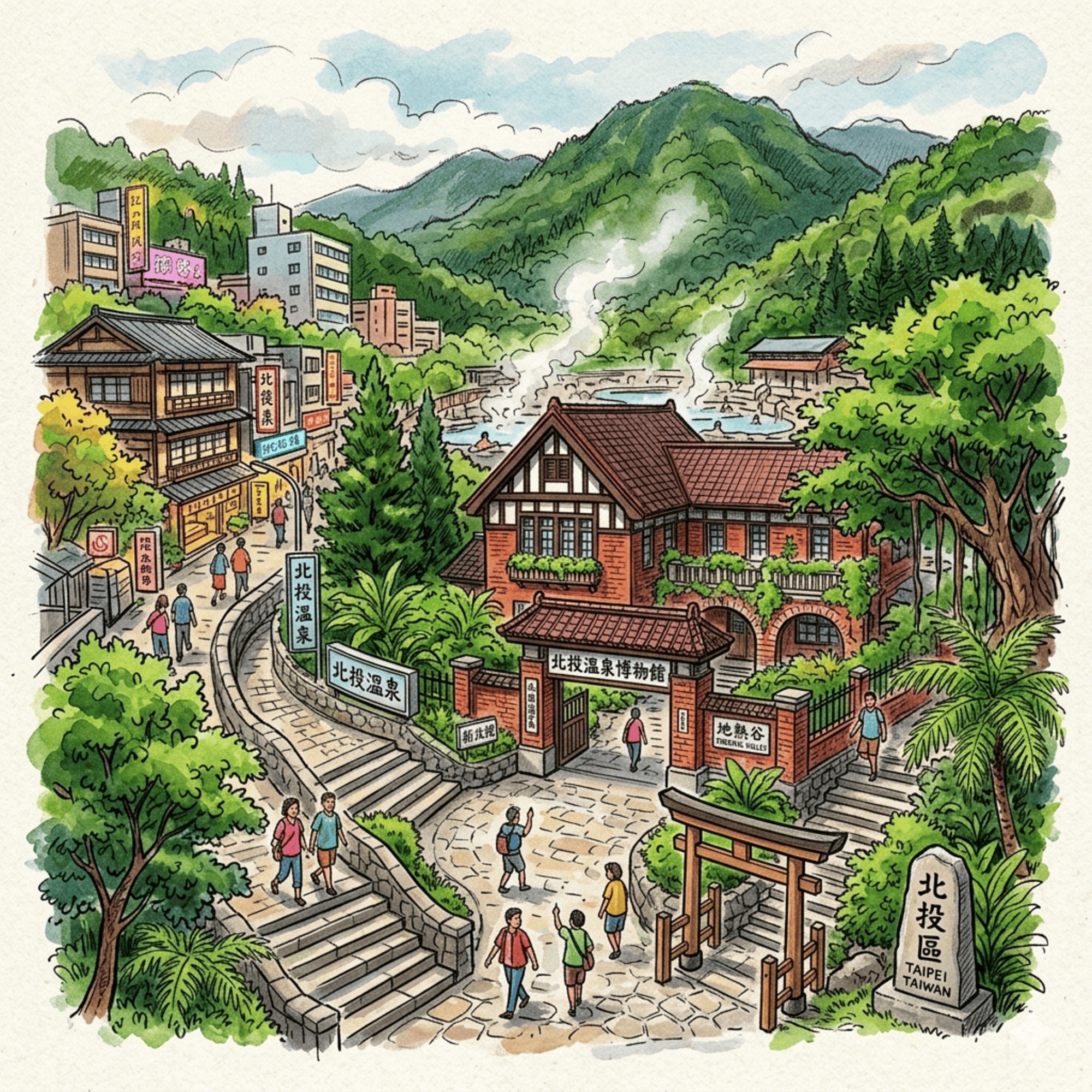
(ENG) the historical and spatial transformation of Beitou, Taipei
About this Episode
This comprehensive research dossier examines the historical and spatial transformation of Beitou from its origins as an indigenous sulfur source to its development as a modern cultural hub. The text chronicles the region's evolution through five key narratives, highlighting how natural resources like sulfur and geothermal springs were reinterpreted by successive regimes for military, scientific, and leisure purposes. It highlights significant sites such as the Puji Temple, which represents the spiritual side of Japanese colonial infrastructure, and the Marshal Zen Garden, which illustrates the area’s role as a site of political confinement. Furthermore, the sources explore Beitou's mid-century identity as the "Hollywood of Taiwan" and the discovery of the rare Hokutolite mineral, which shifted perceptions of the local waters from toxic to healing. Ultimately, the report provides a multi-layered analysis of how shifting power structures and global trade have continuously reshaped the identity of this unique volcanic landscape.
The Unwritten Pages of Yesterday 細 聽 長 風 說 舊 河
Hosts & Guests
Transcript
Imagine you were like soaking in this luxurious steaming hot spring.
Oh, yeah. They absolute best.
Right. The water's perfectly heated.
You've got these lush green mountains wrapped in mist all around you.
And you're just, you know, completely relaxed.
Just totally zoned out.
Exactly. But you are probably completely unaware
that the very ground beneath you was once deliberately torched to ash,
just completely burned to protect a global empire's gunpowder supply.
Yeah. Or that the, you know, that really elegant tea room just up the hill
was actually the final alcohol soaked party spot for World War II suicide pilots.
It's crazy to think about. I mean, we tend to treat history as this static thing.
Yeah. Like a museum exhibit.
Right. Like it's neatly trapped behind some temperature-controlled glass.
Yeah. Totally separated from the modern spaces where we, you know,
grab our coffee or take our vacations.
But that is such a comfortable illusion.
Because the reality is that the physical spaces we occupy are essentially living
laboratories. Right.
The landscape itself literally absorbs the shifting priorities of,
well, whoever happens to be in power at the time.
Well, welcome to the deep dive.
Today, we are bringing you to a destination that absolutely shatters that museum glass.
We're heading to Bay 2.
Bay 2? Yeah. If you visit the northern edge of the Taipei basin today,
the area pitches itself as this tranquil hot spring district.
Right. A total wellness retreat.
But the comprehensive dossier of historical and spatial analysis we are impacting today
reveals a radically different reality.
A much darker, much more complicated reality.
Exactly. This single geographic footprint has been violently reshaped by indigenous tribes,
expanding global empires, paranoid political regimes, and even a completely chaotic
guerrilla film industry.
It is basically a masterclass in how human beings manipulate nature to serve their most,
you know, immediate and desperate needs.
Yeah. The layers of human experience stacked on these specific GPS coordinates
are just staggering.
So our mission today is to extract five incredible historical stories from this dossier.
And we aren't just looking at history, either.
No, we are actually mapping out the hidden gems that you can go visit today.
We're decoding the secret paths to the ground you walk on.
But before we really dig in, we should note from you that our sources today touch on some
intensely charged history.
Right. We are going to be discussing World War II military operations
and Cold War political imprisonment, drawing on documentation that spans,
well, multiple ideological perspectives.
Both left wing and right wing viewpoints.
Exactly. And as always, we aren't here to endorse political viewpoints,
take sides or, you know, pass moral judgment on any of these events.
Right. We are strictly and impartially laying out the historical timeline
and the spatial facts our sources have provided.
So you can fully understand the gravity of the terrain.
Because the mechanics of how this space changed are just fascinating.
And they begin with a perspective that is entirely opposite to today's luxury
spots. Oh, completely.
Because before bay two was a place of relaxation,
it was universally perceived as this terrifying toxic wasteland.
Yeah, an absolute nightmare environment.
And to understand its birth on the global stage,
we really have to go back to a massive imperial crisis in the 17th century.
Okay. So the year is 1696.
The King Dynasty suffers a catastrophic blow.
A massive fire completely destroys their primary gunpowder magazine in Fuzo.
Oh, which is right on the mainland coast.
Yeah. Suddenly, the imperial military is incredibly vulnerable.
They desperately need sulfur, which is, you know,
the absolute core ingredient for black powder.
You can't run an empire without it.
You really can't.
So because their local reserves are gone,
they are forced to look across the ocean to the frontier of Taiwan,
which they considered well-wild and incredibly dangerous.
Uncharted territory.
Right. So in 1697, they sent an explorer named Yu Yang
straight into the toxic volcanic badlands of bay two,
which the indigenous Ketagallan tribe who lived there called Patto.
Okay, let's unpack this.
Because this sounds exactly like a modern global supply chain crisis.
Oh, absolutely.
A sudden microchip shortage forcing tech giants to venture into
completely uncharted territory.
But how did they actually get the sulfur out of a volcanic wasteland?
Well, getting raw volcanic dirt doesn't automatically give you pure sulfur.
Processing it was this incredibly brutal,
cross-cultural labor effort.
I can only imagine.
The source's detailed this technique called the pingo melting method.
Pingo roughly translates to boiling in a cauldron.
Hey, literally boiling dirt.
Yeah, the imperial workers had to haul these massive cast iron vats into the volcanic valleys.
They would mix this highly toxic sulfur dirt with heavy oils,
which acted as a solvent, right?
And then they'd boil the mixture over a roaring intense fire.
The oil would cause the pure sulfur to melt and rise
while all the impurities sank to the bottom.
That sounds dangerous on so many levels.
It was. The environmental conditions were oppressive.
You've got workers operating these boiling cauldrons of oil and rock
in a valley that's already venting natural volcanic heat.
And gases, right?
Yeah, thick sulfur dioxide gases.
Yeah.
The explorer has actually described it as feeling like it could split your brain open.
Man.
And the king officials couldn't navigate that kind of extreme environment alone, right?
No, not at all.
They had to rely entirely on the indigenous categalan people
for the geographical knowledge of where the vents were
and, you know, the physical labor of extracting the raw dirt.
And the sources show they set up a strict,
frankly, exploitative trade system.
They would trade seven feet of cloth to the indigenous people
for one hundred caddies of sulfur dirt,
which is roughly 130 pounds.
That is a lot of dirt for some cloth.
But here is the massive logistical nightmare for the king government.
They are terrified of local rebels.
Oh, highly paranoid.
Yeah, they have this wild volcanic valley full of the exact ingredient
needed to overthrow the empire,
surrounded by a frontier population they don't fully control.
So you'd think they just lock that valley down
with an immense military garrison, right?
Right, just sending the guards.
But actually they did something far more extreme.
They implemented an environmental scorched earth policy.
The sources call it mountain burning.
Mountain burning.
Yeah, the king government realized that no amount of guards
could monitor every single ravine and brush-covered hillside.
So every single year they sent soldiers to deliberately
torch the entire landscape surrounding the sulfur valleys.
Just burning it all to the ground.
They burned away all the vegetation, the trees, the underbrush.
They turned the area into a completely barren, lunar landscape,
simply to ensure that no rebels could secretly hide in the brush
and run private illegal mining operations.
That is wild.
And you can actually still see the visual remnants of this paranoia today.
If you go to the sulfur valley geothermal scenic area
on Quanyun Road, it still looks like a scorched alien planet.
It really does.
You have these pale, rocky depressions
with roaring steam vents shooting out of the grid.
And there's a specific monument there
marking you youngy sulfur mining site.
Yeah, it's a great spot to visit.
And you can watch that thick white sulfur steam
billowing into the air.
But the irony is that today that exact same steam
is piped directly into the surrounding luxury hotels
for high and hot spring baths.
It completely masks the history.
Right.
The modern tourism industry completely covers up its original role
as the violently guarded lifeblood of Imperial military power.
It's just a profound shift in how humans value natural resources.
Because for centuries, these steaming vents
were viewed by the locals as well.
Poison water and evil gas.
Yeah, you wouldn't want to go near it.
But the arrival of a new empire brought a massive shift in global science
which would completely flip the script.
They turned a toxic hazard into a medical miracle.
And that shift happens in 1895, right?
Exactly.
The Japanese Empire takes control of Taiwan
and they bring with them highly regimented
western scientific classification systems.
They start mapping and measuring everything.
So in 1905, there's this mineralogy expert
named Okomoto Yohachiro.
He's examining the highly acidic stream in Bay 2.
And he notices these strange crystalline deposits
crusting on the rocks.
Right.
He takes them back to study them.
And after years of testing, he makes his wild discovery.
He realizes these crystals contain radium.
They can literally expose photographic film.
You're emitting radiation.
Wait, so they found radioactive rocks in the water.
And instead of running away, they decided this was a health cure.
I mean, that sounds terrifying to a modern listener.
Well, what's fascinating here is how science
completely rebranded nature.
You have to view this through the lens of the early 20th century.
This was the absolute height of the global radium craze.
Oh, right.
Like people drinking radium water.
Exactly.
Before the medical community understood
the cellular damage radiation caused,
it was viewed as this magical life force.
So when Okomoto found radioactive crystals
in the Bay 2 stream,
the Japanese colonial government realized
it was an unprecedented public relations opportunity.
So the toxic water was legitimized
as a modern medical treatment?
Precisely.
They spun the poison into a premium wellness product.
In 1912, the international scientific community
officially named the Crystal Hokuto Light
or Baytou Stone.
You only mineral in the world named after a place in Taiwan?
Yeah.
And it was viewed as such an astronomical scientific triumph
that Crown Prince Hirohedo made a specific visit
to the Baytou stream in 1923.
Using the mineral to project an image of
what do the sources say, civilized enlightenment?
Right.
They were demonstrating they possessed
the technological superiority
to unlock the energetic secrets of the Earth.
Well, if you want to see the scientific marvel up close today,
you need to visit the Baytou Hot Spring Museum.
Right next to it is the Taki Yu,
a small waterfall in the Baytou River.
Which is one of only two micro environments on Earth
that produces Hokuto Light?
Yeah.
And inside the museum,
you can see a massive 800 kilogram raw specimen
of the radioactive rock.
Plus,
hitting on a nearby mountain path,
there's a monument to Okomoto Yohachiro.
But, you know, transforming a wild,
volatile environment into a sophisticated scientific spa
required massive infrastructures,
specifically railways.
And building those railways through the mountains
was dangerous, deadly work.
Incredibly deadly.
The colonial authorities realized
they needed to build an entirely new spiritual space
to protect the psychology of their terrified workforce.
So the 1901 Tamsui railway line
was the catalyst for Baytou's boom.
But to comfort the railway workers
facing injury and death,
the Japanese railway department
funded the creation of Tizenin in 1916.
Which we now know as Pujii Temple.
Right.
Built entirely of premium cypress wood.
It was an elite spiritual sanctuary.
And it perfectly illustrates the intersection of industry
and spirit.
The temple was literally named
after a Japanese railway official
Morakami Shouichi.
So they're physically embedding colonial power
into the religion?
Exactly.
And they worshiped the hot spring guanyin
to ensure the hot springs never ran dry.
Okay, here's where it gets really interesting.
When the political regime changed
after World War II, the deity morphed.
Yes.
The hot spring guanyin was holding a baby.
So locals just started worshiping her
as a fertility goddess.
It's like a software update.
They patched a new cultural meaning
over the old religious code
so the space could survive.
It's such a brilliant example
of cultural adaptation.
And you can see it for yourself.
You just head to 112 Wenquan Road
and walk up the 80 stone steps
which are made of local kulean stone
to get to Fuji Temple.
It's so peaceful up there.
It really is.
You can see the distinct Japanese architectural language,
the bell-shaped firelight windows,
and the quarter-shape roof tiles.
And of course, that specific
child-giving bodhisattva statue
that bridged the gap between Japanese
and Taiwanese religious traditions.
It sounds so serene.
But it wasn't always peaceful, right?
No.
As World War II dawned,
Betu's serene, elegant spaces
were suddenly hijacked
for much darker,
far more tragic purposes.
Let's talk about the Nitaka hotel.
Right.
The new high hotel,
built in the 1920s,
perched high on a hill
overlooking Magwandau plain.
But during the dying days of World War II,
the Japanese military seized it.
They turned it into a comfort station
and a final party spot for kamikaze pilots.
Yeah, these young men would drink
and write poetry,
knowing with absolute certainty
they would die the next day.
If we connect this to the bigger picture,
we see how Betu became a political dumping ground.
Because after the war,
the nationalist government
took over that exact same building.
Right.
And they used it to hold
Zeng Suelian.
Young Marshall,
the guy who famously kidnapped
Chan Kai-shek
in the 1936 Zian incident.
Exactly.
From 1960 to 1993,
this gorgeous resort
served as a velvet-lined prison for him.
And there's that bitter irony
in Zeng's quote,
my story ended at 36.
Can you imagine the psychological dissonance of that?
You are given hot springs and beautiful sunsets.
But every single person serving you
is an intelligence officer reporting your every move.
It's a gilded cage.
Built directly on top of a World War II
Suicide Pilot Lounge.
It's heavy.
Very heavy.
But you can actually visit this site today.
It is now the Marshall Zeng Garden
at 34-year-old Road.
You can grab tea at the Jelly Pea House,
which was actually the former guard dormitory
used to monitor Zeng.
And you can even hunt down the underground chapel
on the grounds,
which doubled as an air raid shelter
where he practices Christian faith.
It's incredible how much history is layered there.
It is.
But while political figures were being hidden away
in the Silent Hills,
down in the valleys of Bay 2
in the 1950s and 60s,
a chaotic,
loud,
and incredibly public industry
was taking over the remaining hotels.
Oh, this is my favorite part.
The film industry.
Yes.
Taiwan's Hollywood.
With zero large studios and tiny budgets,
Taiwanese filmmakers realized Bay 2
was basically a giant,
ready-made movie set.
They would literally shoot an entire movie in 15 days.
That is unbelievably fast.
They filmed exterior action scenes
in the parks during the day.
And at night,
they rearranged their hotel rooms
to shoot indoor dialogue scenes.
Just completely repurposing the architecture.
And the sources mentioned a motorcycle express system
who was basically an early gig economy.
Way before modern delivery apps.
Right. Before Uber Eats,
you had these motorcycle fleets buzzing through Bay 2.
They were delivering hot spring guests,
sure.
But they were also rushing actors
between movie sets
and physically transporting film reels.
So production wouldn't stop.
It was absolute creative chaos.
But it was also a brilliant creative translation
of ready-made space.
How so?
Well, they took these post-colonial hotels
and repurposed them
to build a booming local language,
Taiwanese pop culture.
Oh, I see.
Sadly, as government policies
later favored Mandarin media
and TV emerged,
Taiwan's Hollywood vanished.
It left only fragments of beta's hotels
captured on aging celluloid.
But you can still track down those cinematic fragments,
like the Feng Huang Pavilion on Wenkuan Road,
where you can see the old school
tatami rooms used in classic films.
Or the giant rocks
in front of Zong'a's and temple on Queen Road.
Oh, yes.
That was the ultimate hotspot
for stringing up wires
to shoot those flying wook-the-a-martial art scenes.
And we can't forget the Beitu Park Fountain,
the backdrop for countless cinematic breakups in reunions.
No less.
So we've covered gunpowder, radioactive water,
morphing gods,
political prisons, and gorilla filmmaking.
What does this all mean
for the listener walking through Beitu today?
Well, the meta-analysis from the sources
is that Beitu's history isn't a straight line.
It's a story of layering and appropriation.
Lairing and appropriation.
Right.
The exact same GPS coordinates
morphed from an indigenous spiritual site
to an imperial resource mine
to a scientific spa,
to a political prison,
to a movie set
to today's tourist haven.
So when you visit these spots,
you aren't just looking at old buildings.
You are looking at physical manifestations
of how human beings value nature and exert power.
Exactly.
I want to leave you with a final thought to mull over.
The next time you are sitting in a coffee shop,
an office building,
or a local park,
ask yourself,
what was this exact patch of dirt 100 years ago?
It's a great question.
And more importantly,
with the way technology and power shift so rapidly,
what completely unimaginable thing will it be used
for 100 years from now?
It really changes how you see the world around you.
Thank you for joining us on this deep dive.
We highly encourage you to pack your bags
and go see these layered histories of Beitu
with your own eyes.
Safe travels, everyone.


