Ep 245 | Nepal Tea Recovers | India Maps Tea by Satellite | US-Grown Matcha
About this episode
Nepal Tea Enters Recovery Mode | India Puts Tea Under Satellite Surveillance | Vale Bets on US-Grown Matcha
NEWSMAKER – Author and Ecological Economist Pierre William Johnson
PLUS |Behind the Cup: Why Quality Tea Needs a Better Business Model
Social and environmental conditions behind tea production remain far less scrutinized than those for coffee or cocoa.
In this Tea Biz Spotlight, Ecological Economist Pierre William Johnson, author of the French-language Thé: l’envers de la tasse — Tea: Behind the Cup — examines the structures that shape how tea is grown, processed, traded, and valued. We discuss why paying more for quality does not necessarily translate into higher income for workers or smallholders; how colonial-era plantation systems continue to shape wages and working conditions; why monoculture poses both economic and environmental risks; and whether producer organization, agroforestry, stronger quality incentives, and shorter value chains can lead to a fairer distribution of value. | Podlink signup: https://pod.link/1549975153
Advertising Inquiries: https://redcircle.com/brands
Privacy & Opt-Out: https://redcircle.com/privacy
Get every episode summarized
Each time Tea Biz publishes, we email you a written briefing from the transcript — the topics, who appeared, and any specific claims, with the ad reads skipped.
Email me new episodesFree for 3 shows. No card needed.
Hosts & guests

Transcript ready
409 searchable segments. Every word is indexed and playable.
Full transcript
Tea Biz — Ep 245 | Nepal Tea Recovers | India Maps Tea by Satellite | US-Grown Matcha. Machine-transcribed; use the interactive transcript above to jump the player to any line.
The TBS Podcast delivers TNews that you need to know. A recap of the week's major headlines, with commentary and cultural trends hosted by Dan Bowle. It is the voice of origin for T-professionals and enthusiasts worldwide. He is captivating, complex and more intricate than anyone confulling master. That's why the TBS Portal brings together 40 voices fluent in 12 languages to share the story of TBS. Our strength lies in storytelling by professionals who have grown up in the T-lands and speak the native tongue. Hello everyone, here are the weeks headlines. Nepal T enters a recovery mode. India puts T under satellite surveillance and veil bets on U.S.-grown matcha. Loss behind the cup, why quality T needs a better business model.
Social and environmental conditions behind T-production remain far less scrutinized than those for coffee or cocoa. In this TBS Spotlight, an ecological economist, Pierre William Johnson, author of the French language, Té L'Oenve de la Tosse, T behind the cup, examines the structures that shape how T is grown processed, traded and valued. We discuss why paying more for quality does not necessarily translate into higher income for workers or smallholders. How colonial, era plantation systems continue to shape wages and working conditions. Why monoculture poses both economic and environmental risks. And whether producer organization, agroforestry, stronger quality incentives, and short value chains can lead to a fair distribution of value. More in a minute, the first this important message.
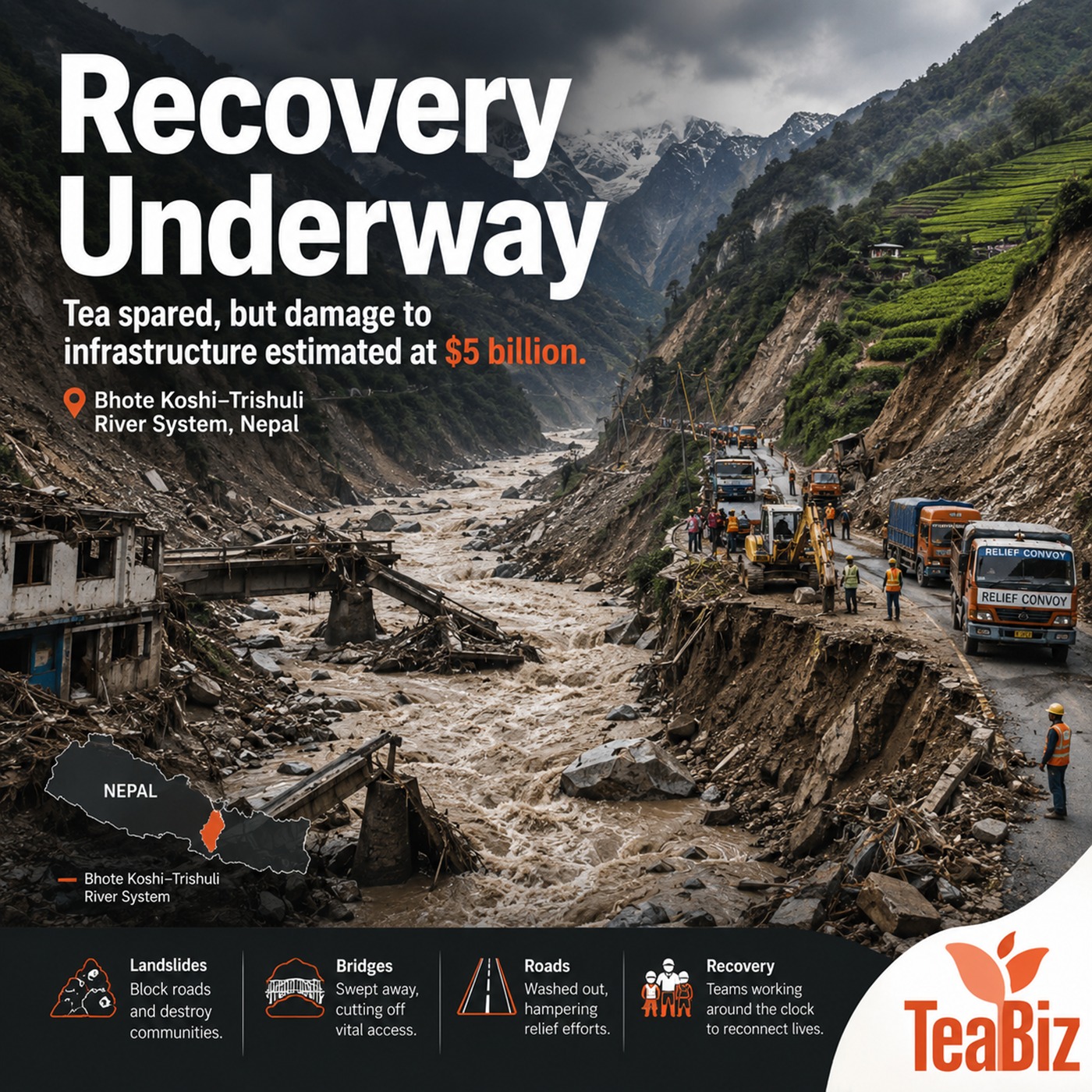
What makes a perfect cup of Célaan T? The perfect cup is from the T-businesses that ensure the protection of all the children living within their T-estates. We salute Célaan Valley, Tela Wackily, Boga Wanthala Wa, Harana and Elyftia T-estates. Support Save the Children Sri Lanka. The Palomste industry escaped the worst of the direct destruction from the catastrophic late August floods. But the sector is entering a difficult recovery period marked by damaged roads disrupted power, displaced communities, and an economy facing a reconstruction bill of up to $5 billion. The disaster began on August 26 when a massive rock and ice collapse near the Chinese Nepal border triggered a high velocity debris flow through the Bote Koshi and Tushouli River
systems. By September 3rd, at least 1,252 people have been confirmed dead and more than 4,200 remain missing. About 20,000 homes were destroyed or runnered unannominable. Finance Minister Juanim Wackily estimates rebuilding could require $45 billion approaching one-tenth of Nepal's total economy. Roads, bridges, and hydropower clients were among the hardest hit assets with more than a dozen power projects damaged and key transport corridors severed. Or T, location matters. Nepal's principal commercial T-belt lies well east of the worst destruction. The main T-driistics are Ilam, Yapa, Planchar, Daokutah, and Tahrhatru. Ilam is the center of Nepal's high-value orthodox sector while lower elevation Yapa accounts
for most of its CTC production. The district's hardest hit by the flood were Roshuwa, Nguoktoat, Dockbing and Gorka. So far there is no evidence of catastrophic crop loss across Nepal's principal T-producing regions. The bigger risk is indirect. Nepal's specialty T-trade depends on mountain roads connecting smallholders, factories, castmen do, and export routes. Flood damage roads, bridges, and power systems can interrupt collection, processing, packaging, and shipment even when the T-garden themselves remain intact. For small orthodox factories operating during the late monsoon harvest, this can quickly become a quality problem. Freshleaf cannot wait indefinitely for transfer or processing. The structure of Nepal's T-industry adds to the vulnerability. Much of the country's orthodox T-comps from thousands of small farmers, many of whom
have limited financial buffers, even modest disruptions to road access, labor availability or household income can ripple through the supply chain. The timing is also difficult. Nepal's autumn specialty T-season is approaching when smaller factories produce limited lots for premium international buyers. T-companies are now helping direct attention towards relief. Nepal T-collective and Gharans, T-a-stater, and curaging customers and overseas partners to donate to the Prime Minister's natural disaster relief fund. Nepal T-collective told his community that, soon, first asked whether growers, families, and two partners were safe, then came another question. How can we help? International assistance is also expanding. The Red Cross estimates more than 90,000 people have been directly affected.
UNICEF says that at least 22,000 children still urgently need safe water, seditation, and hygiene support. Business Insight For Nepal T- this is less a crop loss story than a test of infrastructure and resilience. The major T-districts escape the worst destruction, but the stetcher still depends on roads and electricity, small factories, and thousands of farming households. The immediate priority is continuity. Keep the leaf moving, keep factories powered, and keep growers connected to the market. Please consider donating to the relief efforts. See the T-biz blog for details. The T-bort of India disclosed a three-year partnership with ISRO's National Remote Sensing Center and NIT-Rawar-Keyla to build an AI-based monitoring system for India's T-plantations.
The project is called Chai An Khan, comprehensive AI-based geospatial data analytics for T-plantation monitoring. It will combine satellite imagery drones, ground observations, weather data, and entomological records. The T-bort says the system will automatically map T-Equerage, detect plant stress, forecast major pests, and diseases, and estimate green leaf yield. India already operates an ISRO-backed T-area management information system. The current database includes 281 gardens in Assam and 227 in West Bengal with satellite imagery, garden boundaries, and other spatial data. Chai An Khan adds predictive analytics to that infrastructure. T-statistics are notoriously retrospective. Rough estimates arrive weeks or months after the leaf has been harvested.
S-doubt breaks are often measured after damage has occurred. T-credits figures can lag changes on the ground by weeks or months. If Chai An Khan works, India could begin moving from reporting what happened to forecasting what is happening. That could eventually improve crop estimates, pest intervention, insurance, climate risk assessment, and government policy. It could also provide buyers and producers with earlier warning of changes in supply. There's an important caution, satellite imagery can identify stress, but without reliable ground data, it does not necessarily indicate whether the causes of drought, disease, nutrient deficiency, poor pruning, or husbandry. The value of the system will depend on the quality of field operations used to train and validate it. In fact, India is building something that tea trade has long lacked, a more timely view
of supply. The real value of Chai An Khan may be better crop intelligence, narrowing the information gap between the garden and the market. Seattle-based Vale mantra has begun planting what it intends to become one of the largest tea farms in the United States, and if the project develops as planned, the country's first integrated commercial-scale operation combining tea cultivation, tensha production, and mantra milling. Vale has planted the first 12,000 tea bushes on a 365 acre property on WIDB Island north of Seattle. The long-term plan calls for about 200 acres of tea and nearly 1 million plants with the first commercial harvest from the initial planting expected around 2030. The farm is only part of the investment. Vale also plans a 30,000 square foot processing facility and thereby oak harbour using equipment
from the Japanese tea manufacturer to Roddish's cycle. Fresh leaves would be steamed and processed into tensha there and sent to Vale's Seattle milling operation to be converted into mantra. The vertical integration is what makes the project significant. The United States already has several small commercial tea farms, but domestic production remains small compared with imports. Vale says its project is the first in the country designed from the outset as an integrated commercial-scale mantra supply chain. The claim remains forward-looking. The farm still must demonstrate yield, quality, consistency, and economics before Washington growing mantra becomes a commercial reality. There is a reasonable agronomic case for trying. Washington State University has conducted tea research since 2019 and says the Western Washington's temperature, climate, rainfall, and acidic soils are favorable for chameleon sinances.
Vale's first 12,000 plants came from T. Hawaii and company where evenly and Chio Leone have spent more than two decades working with Japanese origin tea varieties. The harder question is whether Washington can produce mantra quality, tensha economically. Shade management, plucking standards, rapid steaming, drying, sorting, and precision milling, all influence mantra quality, labor, and processing costs in Washington will also differ significantly from those in established Asian tea regions. Phil describes the project as a multi-year agricultural experiment, not a response to the current mantra shortage. The company says it will continue to buy ceremonial grade mantra from its established Japanese partners. There is also a historical connection. On August 31, 1896, the Japanese steamship Mickey Maru arrived in Seattle carrying tea,
silk, and other goods. On the first regular Nippon Yuson Keshia service between Japan and Seattle, Vale announced its farm exactly 130 years later. Business insight, Vale farms matters less for the volume of tea capabilities than for what it could prove. Two hundred acres will not change global mantra supply, but a farm-attentifactor in a milling operation at the scale could show whether U.S. grown tea can move beyond specialty farm novelty into repeatable commercial production. The real test is not whether tea will grow in Washington. It is whether Washington can produce distinctive high-quality tea at a price consumers will repeatedly pay. The week 35 tea price report for the period ending August 28 is sponsored by the East Africa Tea Trade Association, owners of the Mombasa Tea Auction since 1956.
Tea markets closed the week 35 with headline support intact, but quality mattered more than volume. Bires remain disciplined, closely tying bids to immediate blending needs. Colombo was buoyant overall led by low-grown leafy teas and select better high and mid-grown descriptions. Mombasa improved at the headline level, though in complete clearance revealed uneven demand. North India drew good participation, but planar assault teas, orthodox descriptions, and dust-met resistance. South India was fair during an holiday-effective week. Indonesia saw slow demand with selective firmness for scarce West Java lines. In Colombo, prices averaged $3.70 a kilo this week, up 7 cents per kilo versus the previous sales constructed $3.63 per kilo benchmark. In North India, prices averaged $2.33 a kilo this week, down 6 cents per kilo versus the
last available official benchmark of $2.39 for the week ending 15 August. Mombasa prices averaged $2.21 a kilo this week, up 3 cents per kilo versus sales 33s to $0.18 per kilo benchmark. In Indonesia, prices averaged $1.12 per kilo this week, up 1 cent per kilo versus the prior indicative week 34 benchmark of $1.11 per kilo. The common thread is widening quality segmentation. Players compete for clean manufacturer and dependable liquor, but resist secondary teas without adjustment. Exporters have little incentive to concede broadly. Current C support does not offset the cost of imported energy packaging and finance. Composite freight ease, but round specific insurance and transit risks could quickly reverse
that benefit. The takeaway is straightforward, benchmarks are holding while execution depends on the exact lot by or need and cost position. Watch clearance as closely as price next week. And now a word from this week's sponsor, brew maker one. Hello, I'm Bogdan, a passionate tea drinker and the inventor of the ultimate tea machine, the brew maker one. The preparation is key to making fine tea. Sequential steppings deliver the best taste possible and unlock the true value of whole leaf teas and botanicals. Brewed out to mates that process without using any pokes or capsules. The simple to operate, smart from control device stores steeping profiles to consistently make great tea at the push of a button. Brew also reduces time, waste and energy.
That's because I engineered the brew to remember control settings for temperature, brewing time and quantity. Using my patented process lets you stack, steep, simply and conveniently. A higher price for tea does not necessarily mean a higher income for the people who grow and harvest it. And some of the most familiar images tea, manicured hillsides, hand plucking, plantation traditions can conceal economic and environmental structures that have changed remarkably little since colonial times. Social and environmental conditions behind tea production remain far less scrutinized than those of coffee or cocoa. In this tea biz spotlight I speak with environmental economist Pierre William Johnson, author of the
French language te l'un d'autace. Peer, behind the cup. Pierre's central argument is not that the tea trade should be made to feel guilty. Rather, it is that quality, economic, viability, social justice and environmental resilience are interconnected and that a higher price tea is not necessarily more equitable. His research examines the structures that determine how tea has grown, process, traded and valued. We discuss why one of the premiums did not necessarily reach workers or smallholders what happens inside the processing black box between green leaf and finished tea. Now plantation systems might evolve without abandoning workers and why monoculture creates both business and environmental risks. Along with what tea companies should change first to build stronger relationships with producers.
Pierre William Johnson specializes in ecological economics and the sustainable development of agricultural and artisanal value chains. His research focuses on tea producing regions in Asia and East Africa. His latest book examines labor relations, trade structures, producer organization, environmental pressures and value distribution across the tea sector. Pierre, thank you so much for joining the tea biz podcast. It's a delight to have you with us for this conversation about quality and to tap your expertise as a socio-economist. Thank you, Don. Thank you for interviewing me. It's a pleasure to talk to your audience as well and to introduce those themes they may be less familiar with. I felt it was important to tackle them even as a tea not only a socio-economist but as a tea amateur, somebody who loves tea as well. Pierre, why doesn't a quality premium necessarily reach the producer?
Well mainly because most of the value is done in the country of production. So this seems quite simple but it has several steps. It has plucking, manipulating processing tea. They are not the same players who produce tea, who plug the tea and who process and transform it and then who sell it. So in most of the cases, the actual producers and workers of the tea plantations and even the small producers are not the one that I in contact with the buyers. And in most cases, the step of processing, the fresh tea leaf is done in a factory by other workers and it's a kind of blog box. That step between production and processing is a kind of blog box in terms of value and in terms of how each of those steps is treated, how it's reminirated, how it's paid,
each of those steps is a kind of blog box for the buyer. It doesn't mean the buyer has some bad intention. It just means that he doesn't see that there are different steps before a dried process leave reaches him. Which is quite different from let's say Coco, where of course Coco beans that reach consumer countries and then his process again, so the buyers actually have quite raw product, which is not the case with tea. Here describes a separation that is easy for the final buyer to miss. The people who grow and pluck the leaf are not often the ones processing or selling the finished tea. That brings us to the stage he calls the black box. What information would make the relationship between green leaf and made tea more transparent and who should be asking for it? The information that we're looking for is what working agreements, what payment agreements is there for fresh leaves, for example.
Is it the same economic unit that's providing fresh leaves and that's processing it or are there two economic units? This one can be a family, the second one what we call bot leaves factory, for example, or it could be all in a plantation unit. We need to know what are the business agreements between those two steps and how each of the producers, the workers in those two units are paid. Who should ask this? If there are several kinds of certification, but in terms of fair trade or social certification or social responsibility, they definitely look into this structure of the value chain in the producing countries. It cannot treat tea as a whole, as a final product. It has to look into how it is made in terms of fresh leaves and then processing and
selling. It's certainly an obligation, let's say for any social certification. Then for buyers, my intention is perhaps to introduce this topic in tea schools. When you learn about where to buy tea, how to buy tea, what to look into when you buy tea, perhaps it should be introduced. I haven't found it in any tea schools, at least in France and there are several. The first special tea tea buyer wants good tea on the long term, on a sustainable basis, meaning year after year, perhaps it's better to know how it is done socially also in order to be sure that the value chain will be balanced in the producing countries. He should look into how things are done, ask the question to the person that sells the
tea, which is usually processing units or an expert unit. What is the arrangement for producers, how they are your own workers or are they independent producers, how do you set the price of fresh leaves, etc. So just by asking the questions, he can have more insights on how the value chain is structured in the production country. How do you call the person that tunes a piano? So I see myself a bit like somebody who tries to tune a value chain. So who tries to go look into, he opens the piano, which in this case the value chains. And he… Lovely analogy. This is what the chords are out of tune. So if you don't open the piano, we use a piano at home. You cannot re-understand where things are fixed at least. You can listen to it, we cannot fix it, so if you don't open the… Transparency could identify where value is being lost or concentrated, but changing
those relationships becomes much harder when employment, housing, social services, and an entire community have historically been tied to the plantation itself. What would a credible transition from the colonial plantation model look like, one that raises worker responsibility and income without destabilizing production? Yeah, I think the… First, you need to have a timeline. You have to give a perspective of vision to everybody. Two, three years vision. So a first step could be as I saw in a plantation in Sri Lanka to diversify… to diversify the activities of the plantations to introduce agrotourism. So the same workers could add value in another way than other seasons also, then teaplocking and processing seasons by guiding tourists, showing them around the plantation.
So if you add activities like this and if you give them more responsibilities, and the other things they did is also turnover, have small teams, and women are not always going to be stuck in plucking, they could also be in processing, be guides, etc. So if you give more responsibilities slowly, you can do that slowly and base also on individual preference or scales. We can slowly give to workers more responsibility. Now there could be a more radical shift, there has been, when the plantation considers that it's unsustainable economically, so it's going to close as a plantation. Of course it can distribute land to the workers, but this requires a plan, as I said, a long term plan. You cannot just say we're closing, we'll give you some land and let's go ahead and try to make living. So there has to be some coaching, some people, some plan, and there has to be some discussion
on how to make this transition. This is a much harder transition because it means that the plantation's owner basically or the company that owns the plantation is basically withdrawing itself, so people working there must assume not only the work, but also the economy, the business side of things, which we see also in other sectors in France, there's been an Argentina, there's been the factories that have been managed by workers after the owners left. So we see that it's a big challenge because workers are not used to manage business, right? They would like to, they would like to be perhaps owners of this. And we've seen that in Assam where a lot of companies have left the T sector, at least have left the plantations, the production stage, to concentrate on marketing, on more stages,
which bring more value according to them, like marketing, packaging, et cetera, and it's okay, we leave production to small holders, but it's a difficult step for them, so they need some coaching, they need some training, perhaps in business, et cetera. So if it isn't planned, it will be difficult for those small holders. The social structure is only one part of Pierre's argument. He also asks us to consider something the T industry has spent generations celebrating. The perfectly manicured Teufkarten. How can buyers recognize genuinely resilient systems such as agroforestry or intercropping, and value benefits that may not be immediately visible in the cup? Yeah, well, I think to take the last part of your question, I think benefits will come from more diverse systems, so the idea, of course, it will be by the system itself when we reward more diversified plantations.
Now, how do you recognize them? Well, this implies, you know, listening and understanding a bit of systems, so you can just look, it's not like monoculture, you can just look at a diversified system and say, oh, how nice and how diversified and how efficient is this system. Actually, it doesn't deliver this information just by sight. You can see all trees, you can see that type of thing, but it doesn't necessarily mean it's diversified. So you must talk with producers, listen to them, and have them explain how their system works and go, you know, walk with them across their fields and say, what is this tree here? What does it bring to you? Have you noticed any advantage when this type of tree is here? You can notice food crops, so it's really going around the field with, I mean, you can't
do that with all the small producers, of course, but perhaps a selection of them and try to understand what the, how they manage their system, because usually small producers who have a diverse system do have experimentation, do have a thinking knowledge, vernacular knowledge, of the crops and their uses, but they won't tell it in an academic way, right? You have to go around the field with them and have them explain probably. For peer understanding, these systems means going beyond photographs, certifications, and specifications. It means understanding how producers manage their land and ultimately how buyers manage their relationship with producers. If a tea company wants to improve its business practices, what should it change first?
Yeah, it depends what type of companies you're talking of, because they're really several kinds of tea of importers, even if they just import us. But I think the first thing is the way you buy tea, the type of contracts, the companies I know that are by good tea and that per price more or less to producers, or the ones that visit their producers every year or every two years, and that really discuss with them, and that have a contract that is more horizontal. Of course, buying in auctions doesn't guarantee this. It's very difficult to get this type of relationship if you buy it back with auctions, which is a kind of heritage from the colonial system also. First, I think contract relationship with producers and then this kind of trust between the buyer
and the producer seller, because tea will be different every year due to climate, due to events, etc. It's related to what we were saying about time, because tea is different every year, every season, even from the same place, even from the same same. This must be some expectation that good tea will never be standardized, will never be exactly the same from one year to another, even in the same season. This means discussion, this means also that that of course a company can choose to buy a little bit more from this place this year and a little bit less from the another place, so there will be some flexibility on both sides. But for that, there must be some understanding, must build understanding between both sides with respect, right? Peer's answers bring the discussion back to something fundamental, how tea is bought,
and the quality alone does not tell us how value is distributed. The certification alone may not reveal what happens between the farm and the factory, and resilience cannot always be recognized from the appearance of a garden. Peer's argument is that buyers need to understand a relationship behind the product, who produces the leaf, who process it, how prices are determined, and whether the people at a origin can participate meaningfully in the value they help create. Thank you Peer for joining us today. Intrigue by what you've heard in today's podcast, would you like to learn more from our developer network of tea biz journalists and tea experts? Remember to visit the tea biz website for more comprehensive coverage. That's www.hyphenbizbiz.com.
Thanks for listening. Farewell till next week. Produced by Atevita Studios. Connect your voice to the world.
More episodes
More from Tea Biz

Tea Price Report | Week 35 | Ending 28 August 2026
Tea Biz

Spotlight | Behind the Cup
Tea Biz

Tea News Recap | Nepal Recovers | India Maps Tea | US Grown Matcha
Tea Biz

Tea Price Report | Week 32 | Ending 7 August 2026
Tea Biz