About this episode
Behind the Cup: Why Quality Tea Needs a Better Business Model | Social and environmental conditions behind tea production remain far less scrutinized than those of coffee or cocoa.
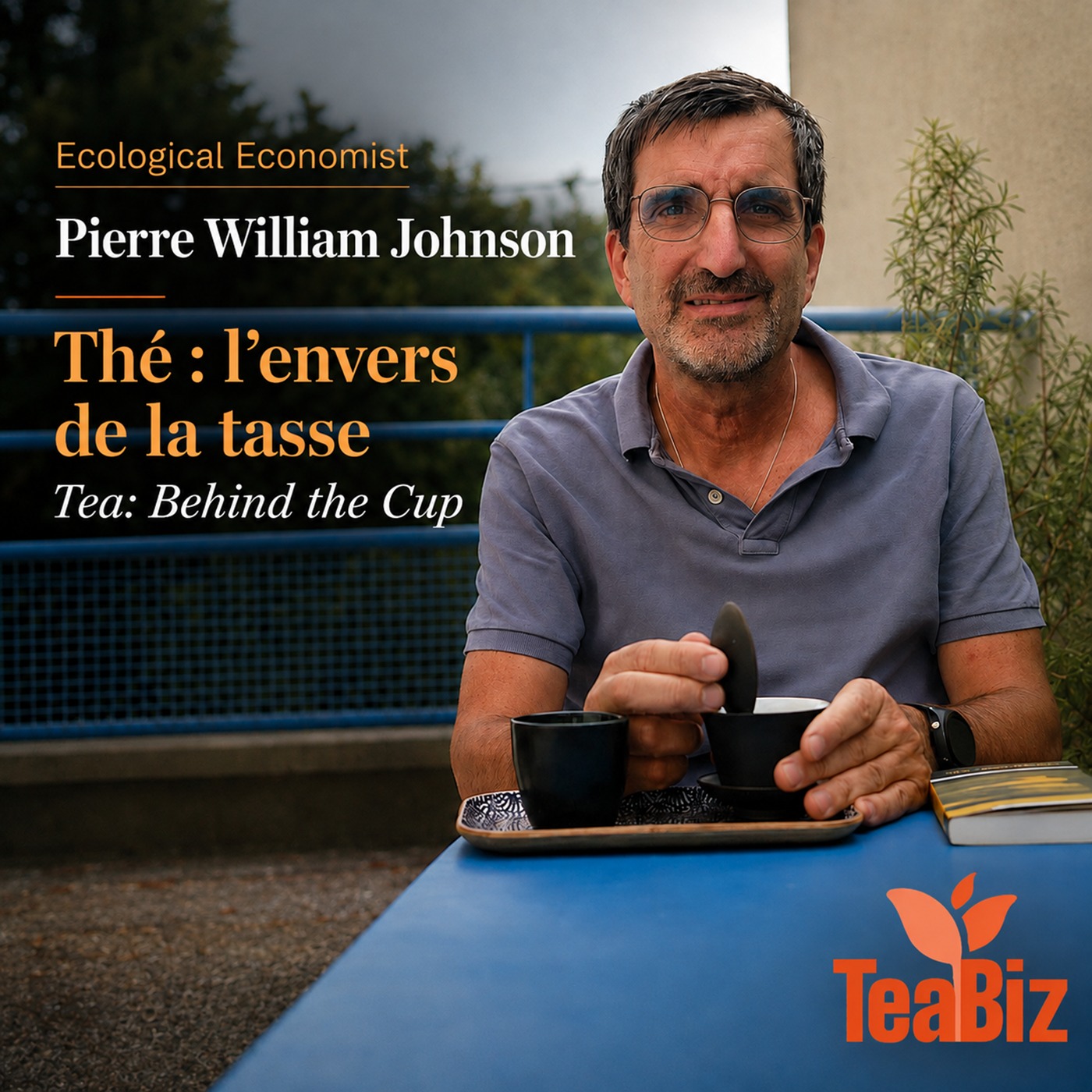
In this Tea Biz Spotlight, I speak with Ecological Economist Pierre William Johnson, author of the French-language Thé: l’envers de la tasse — Tea: Behind the Cup. Pierre’s central argument is not that the tea trade should be made to feel guilty. Rather, it is that quality, economic viability, social justice, and environmental resilience are interconnected — and that a higher-priced tea is not necessarily more equitable.
His research examines the structures that determine how tea is grown, processed, traded, and valued.
We discuss why quality premiums do not necessarily reach workers or smallholders; what happens inside the processing “black box” between green leaf and finished tea; how plantation systems might evolve without abandoning workers; why monoculture creates both business and environmental risks; and what tea companies should change first to build stronger relationships with producers.
BIO: Pierre William Johnson specializes in ecological economics and the sustainable development of agricultural and artisanal value chains. His research focuses on tea-producing regions in Asia and East Africa. His latest book examines labor relations, trade structures, producer organization, environmental pressures, and value distribution across the tea sector. | Podlink sign-up: https://pod.link/1549975153
Advertising Inquiries: https://redcircle.com/brands
Privacy & Opt-Out: https://redcircle.com/privacy
Get every episode summarized
Each time Tea Biz publishes, we email you a written briefing from the transcript — the topics, who appeared, and any specific claims, with the ad reads skipped.
Email me new episodesFree for 3 shows. No card needed.
Hosts & guests

Transcript ready
151 searchable segments. Every word is indexed and playable.
Full transcript
Tea Biz — Spotlight | Behind the Cup. Machine-transcribed; use the interactive transcript above to jump the player to any line.
She's got a breakaway! She's all alone! She's going! She's going! Oh no, wrong goal, kiddo. It's chaos out there. Their stomachs don't have to be. Introducing cultural kids' probiotics plus electrolytes. Sugar-free, more hydrating than water alone, from the number one pediatrician-recommended brand. Youth soccer is never boring, but your kid's stomach should be. Culture-real probiotics. This science of a boring gut. See website for details. A higher price for tea does not necessarily mean a higher income for the people who grow and harvest it. And some of the most familiar images tea manicured, hill signs, hand plucking, plantation traditions can conceal economic and environmental structures that have changed remarkably little since colonial times. Stocial and environmental conditions behind tea production remain far less scrutinized
than those of coffee or cocoa. In this tea biz spotlight, I speak with environmental economist Pierre William Johnson, author of the French language, la du dotte. Pee behind the cup. Pierre's central argument is not that the tea trade should be made to feel guilty. Rather, it is that quality, economic, viability, social justice, and environmental resilience are interconnected and that a higher price tea is not necessarily more equitable. His research examines the structures that determine how tea is grown, process, traded, and valued. We discuss why one of the premiums did not necessarily reach workers or smallholders. What happens inside the processing black box between green leaf and finish tea? How plantation systems might evolve without abandoning workers? And why monoculture creates both business and
environmental risks, along with what tea companies should change first to build stronger relationships with producers? Pierre William Johnson specializes in ecological economics and the sustainable development of agricultural and artisanal value chains. His research focuses on tea producing regions in Asia and East Africa. His latest book examines labor relations, trade structures, producer organization, environmental pressures, and value distribution across the tea sector. Pierre, thank you so much for joining the TBS podcast. It's a delight to have you with us for this conversation about quality and to tap your expertise as a socio-economist. Thank you, Don. Thank you for interviewing me. It's a pleasure to talk to your audience as well. And to introduce those themes they may be less familiar with, I felt it was important to tackle them even as a tea, not only a socio-economist, but as a tea amateur, somebody who loves tea as well.
Pierre, why doesn't a quality premium necessarily reach the producer? Well, mainly because most of the value is done in the country of production. So this seems quite simple, but it has several steps. It has plucking, manipulating processing tea. There are not the same players who produce tea, who plug the tea and who process and transform it and then who sell it. So in most of the cases, the actual producers and workers of the tea plantations and even the small producers are not the one that I encounter with the market, with the buyers. And in most cases, the step of processing, the tea, the fresh tea leaf is done by, in a factory, by other workers. And it's a kind of blog box. That step between production and processing is a kind of blog box in terms of value and in terms
of how each of those steps is treated, how it's reminirated, how it's paid, each of those steps, it's a kind of blog box for the buyer. It doesn't mean the buyer has some bad intention. It just means that he doesn't see that there are different steps before a dried process leaf reaches him, which is quite different from, let's say, Coco, where of course, Coco beans that reach consumer countries and then his process again, so the buyers actually have quite raw product, which is not the case with tea. Here describes a separation that is easy for the final buyer to miss. The people who grow and pluck the leaf are not often the ones processing or selling the finished tea, and that brings us to the stage he calls the black box. What information would make the relationship between green leaf and made tea more transparent? And who should be asking for it? The information that we're looking for is what working agreements, what payment agreements
is there for fresh leaves, for example. So is it the same economic unit that's producing, that's providing the fresh leaves and that's processing it? Or are there two economic units? First one can be a family, the second one, what we call a bot leaf factory, for example, or it could be all in a plantation, unit-fired plants. So we need to know what are the business agreements between those two steps and how each of the producers, the workers in those two units are paid. So who should ask this? Well, if there are several kinds of certification, but in terms of fair trade or social certification or social responsibility, they definitely look into this structure of the value chain in the producing countries. It cannot treat tea as a whole, as a final product. It has to look into how it is made in terms of
first fresh leaves and then processing and selling. So it's certainly an obligation, let's say for any social certification. And then for buyers, well, my intention is perhaps to introduce this topic in tea schools. When you learn about where to buy tea, how to buy tea, what to look into when you buy tea, perhaps it should be introduced. I haven't found it in any tea schools, at least in France, and there are several. If a special tea buyer wants good tea on the long term, on a sustainable basis, meaning year after year, perhaps it's better to know how it is done socially also in order to be sure that the value chain will be balanced in the producing countries. So perhaps he should look into how things are done, as the question to
the person that sells the tea, which is usually processing units or next for unique, how do you, what is the arrangement for producer, how they are your own workers, are they independent producers, how do you set the price of fresh leaves, etc. So just by asking the questions, he can have more insights on how the value chain is structured in the production country. How do you call the person that you know that tunes a piano? So I see myself a bit like somebody who tries to tune a value chain. So who tries to go look into, he opens the piano, which in this case the value chains. And he is lovely analogy. This is what the sports are out of tune, you know. So if you don't open the piano, we use a piano at home. You cannot, you cannot really understand where things are fixed at least. You can listen to it, we cannot fix it. So if you don't open the
transparency, it could identify where value is being lost or concentrated. But changing those relationships becomes much harder when employment, housing, social services, and an entire community have historically been tied to the plantation itself. What would a credible transition from the colonial plantation model look like? One that raises worker responsibility and income without destabilizing production? Yeah, I think first you need to have a timeline, you have to give a perspective of vision to everybody, two, three years vision. So a first step could be as I saw in a plantation in Sri Lanka to diversify the activities of the plantations to introduce agrotourism. So the same workers could add value in another way than other seasons also, then T-plucking
and processing seasons by guiding tourists, showing them around the plantation. So if you add activities like this and if you give them more responsibilities and the other things they did is also turnover, have small teams and women are not always going to be stuck in clucking, they could also be in processing, be guides, etc. So if you give more responsibilities slowly, can it as slowly and base also on individual preference or scales? You can slowly give to workers more responsibility. Now they could be a more radical shift, there has been when the plantation considers that it's unsustainable economically, so it's going to close as a plantation. Of course it can distribute land to the workers, but this requires a plan, as I said a long term plan. You cannot just say we're closing, we'll give you some land and let's go ahead and try to make living. So
there has to be some coaching, some people, some plan and there has to be some discussion on how to make this transition. This is a much harder transition because it means that the plantations owner basically or the company that owns the plantation is basically withdrawing itself. So people working there must assume not only the work but also the economy, the business side of things. Which we see also in other sectors in France, there's been an Argentina, there's been the factories that have been managed by workers after the owners left. So we see that it's a big challenge because workers are not used to manage business. They would like to, they would like to be perhaps owners. And we've seen that in Assam where a lot of companies have left the T sector, at least have left
the plantations, the production stage to concentrate on marketing, on more stages, which bring more value according to them, like marketing, packaging, etc. And it's okay, we leave production to smallholders. But it's a difficult step for them. So they need some coaching, they need some training, perhaps in business, etc. So if it isn't planned, it will be difficult for those small holders. The social structure is only one part of Pierre's argument. He also asks us to consider something the T industry has spent generations celebrating the perfectly manicured Teef Garden. How can buyers recognize genuinely resilient systems such as agroforestry or intercropping and value benefits that may not be immediately visible in the cup? Yeah, well I think to take the last part of your question, I think benefits will come from more diversified systems. So the idea,
of course, it will be by the system itself with reward, more diversified plantations. Now how do you recognize them? Well, this implies, you know, listening and understanding a bit those systems. So you can just look, it's not like monoculture, you can just look at a diversified system and say, oh, how nice and how diversified and how efficient is this system? Actually, it doesn't deliver this information just by sight. You can see all trees, you can see that type of thing, but it doesn't necessarily mean it's diversified. So you must talk with producers, listen to them, and have them explain how their system works and go, you know, walk with them across their fields and say, what is this tree here? What does it bring to you? Have you noticed any advantage when this type of tree is here? You can notice food crops. So it's really going around the field with,
I mean, you can't do that with all the small producers, of course, but perhaps a selection of them and try to understand what they managed their system because usually small producers who have a diverse system do have experimentation, do have a thinking knowledge, a vernacular knowledge, right? Of the crops and their uses, but they won't tell it in an academic way, right? You have to go around the field with them and have them explain probably. For peer understanding, these systems means going beyond photographs, certifications and specifications. It means understanding how producers manage their land and ultimately, how buyers manage their relationship with producers. If a tea company wants to improve its business practices, what should it change first?
Yeah, it depends what type of companies you're talking of because they're really several kinds of tea of importers, even if they just import us. But I think the first thing is the way you buy tea, the type of contracts, the companies I know that are by good tea and that per price more or less to producers are the ones that visit their producers every year or every two years and that really discuss with them and that have a contract that is more horizontal. Of course, buying in the auctions doesn't guarantee this. It's very difficult to get this type of relationship if you buy it back with auctions, which is a kind of heritage from the colonial system also. So first is, yeah, I think contract relationship with producers and then this kind of trust between the buyer
and the producer seller because tea will be different every year due to climate, due to events, etc. So it's related to what we were saying about time because tea is time, tea is different every year, every season, even from the same place, even from the same time. So there must be some acceptation that good tea will never be standardized, will never be exactly the same from one year to another, even in the same season. But this means discussion, this means also that of course a company can choose to buy a little bit more from this place this year and a little bit less from the another place. So there must be some flexibility on both sides. But for that, there must be some understanding, must build understanding between both sides with respect, right? Here's answers bring the discussion back to something fundamental. How tea is bought.
Fundy alone does not tell us how value is distributed. The certification alone may not reveal what happens between the farm and the factory and resilience cannot always be recognized from the appearance of a garden. Here's argument is that buyers need to understand a relationship behind the product who produces the leaf, who process it, how prices are determined, and whether the people at origin can participate meaningfully in the value they help create. Thank you Pierre for joining us today. Produced by Atavita Studios Connect your voice to the world.
More episodes
More from Tea Biz

Tea Price Report | Week 35 | Ending 28 August 2026
Tea Biz

Tea News Recap | Nepal Recovers | India Maps Tea | US Grown Matcha
Tea Biz

Ep 245 | Nepal Tea Recovers | India Maps Tea by Satellite | US-Grown Matcha
Tea Biz

Tea Price Report | Week 32 | Ending 7 August 2026
Tea Biz