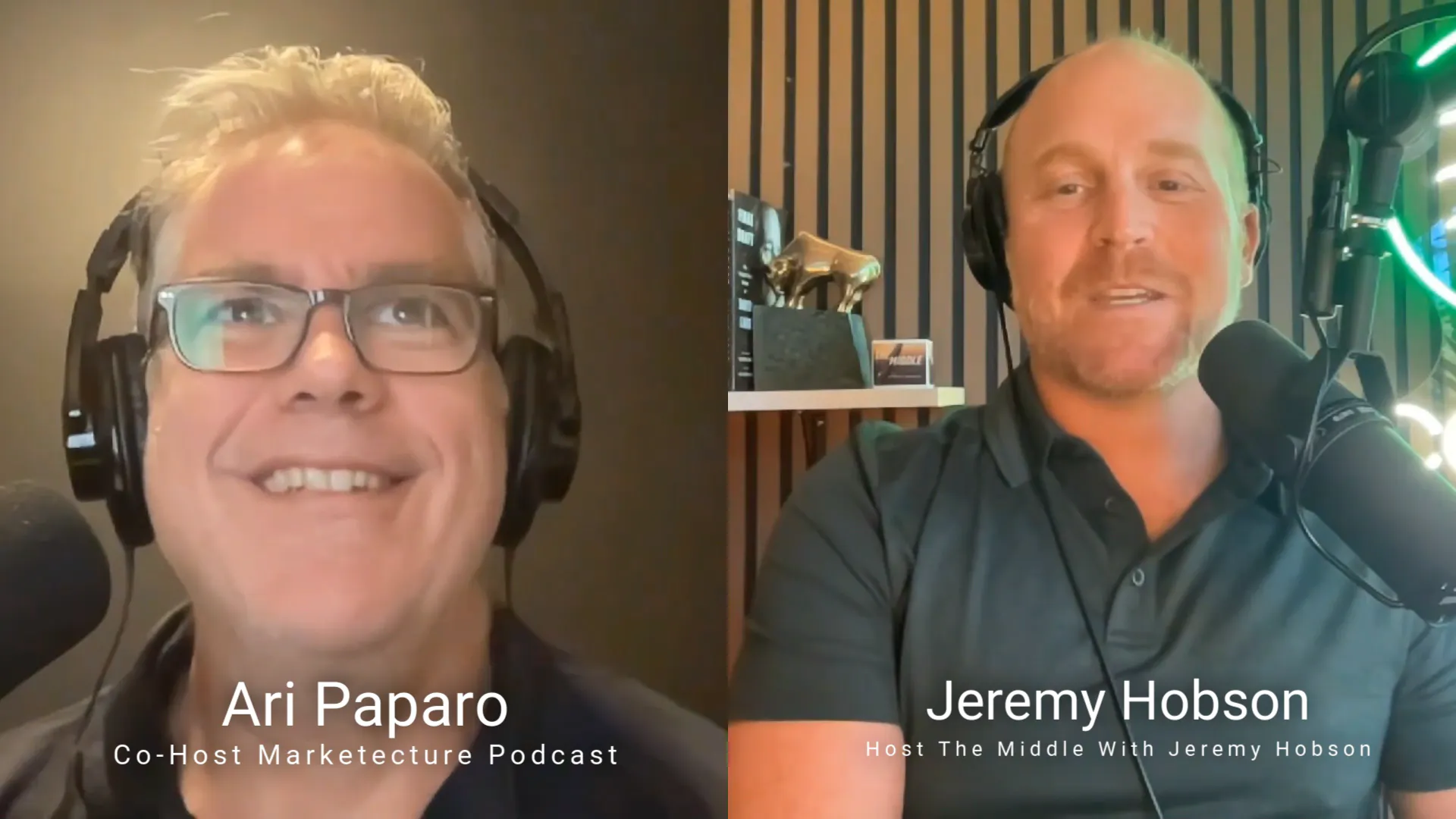
Episode 189: Jeremy Hobson is Bringing Live Radio to the Digital Era, Plus Google's Big Win in Court
About this episode
Marketecture: Get Smart. Fast. is made possible by:
Get every episode summarized
Each time Marketecture: Get Smart. Fast. publishes, we email you a written briefing from the transcript — the topics, who appeared, and any specific claims, with the ad reads skipped.
Email me new episodesFree for 3 shows. No card needed.
Hosts & guests
Transcript ready
891 searchable segments. Every word is indexed and playable.
Full transcript
Marketecture: Get Smart. Fast. — Episode 189: Jeremy Hobson is Bringing Live Radio to the Digital Era, Plus Google's Big Win in Court. Machine-transcribed; use the interactive transcript above to jump the player to any line.
This episode is brought to you by Sojourn. The number one platform for travel and hospitality advertising, travel data is unique. Someone searches for a flight, a hotel, and then a rental car. Those aren't three separate signals that's a trip taking shape. With Sojourn, travel marketers get visibility into the entirety of the travel journey to target real travelers when they're in market. From impressions to insight to impact, Sojourn is the only travel data platform that closes the loop. Visit Sojourn.com for more. That's SOJEN.COM for more. This podcast is brought to you by Stack Adapt. Look, advertising shouldn't feel like a workout. You shouldn't be jumping between a dozen dashboards and tabs just to figure out what's happening with your budget. Stack Adapt helps you bring it all together into one clear view. As an AI advertising platform, Stack Adapt gives you one place to plan, measure, and optimize your campaigns. Their built-in AI helps you turn all that raw data into actual next steps, whether you need campaign insights or better audience targetings.
Stack Adapt is built to help marketers move faster, with less complexity, and more confidence. See how Stack Adapt can help you grow boldly at StackAdapt.com-grow. That's StackAdapt.com-grow. Welcome to the Market Techs podcast. This is Ari Papparel. I'm recording for a non-disclosed location today. And Eric, you're back. Welcome back. Back. Feels good to be back. Feels good to be home. How you been? Yeah. I've been good. I've been off doing personal stuff, of course. So basically, since the Google trial ended last fall, I've just been on watch. I've been like, one day this judge, this 83 year old judge is going to drop her thing. And every time I've been on vacation or not online, I've been sure that's the day it's going to happen. And we thought it was going to happen in March. That was the expected date. And so, it's September. So what am I doing?
College drop off. Full day, moving bunk beds, lifting heavy things, being a dad, and my phone starts blowing up. I'm like, what is going on? But it was only yesterday, the day before yesterday, we were recording this on Thursday, September, February, February, February, February. Came out yesterday Wednesday. Yeah. All right. So this is so fresh. We've got a fun little thing with these Ben from Nexon. Every time something happens, he puts on X, R and Eric, hope he didn't record yet. Like, he did it yesterday. Yeah. I think that's how I saw it. That's the first thing I saw. And I was like, oh God. What is it? So I'm like, I'm like, jumping into like parent orientation and jumping out. It taking phone calls with paternalists. And I'm like, should I do a tweet thread? Like, no, I don't have time or energy. Let's pay attention to the family. So here I am with you. Yeah, we'll go talk about it. And then we'll also, I'll do my, I'll do a very in-depth newsletter.
They'll come out Monday morning with everything you need to know about the situation. So Paul, Connection did a pretty good job in your absence. You worry about your job here, Eric? I am. Yeah, I hear the guys on fire. Here is nipping up my heels. Well, you know, we think he's going to become a corgi girl. So he will, you know, so people thought that was real. So yesterday last, I don't know if he listened. But last week he declared he's going to work for corgi as a joke. And he of course he got follow ups like, you know, people took it seriously. You know, so that's one job that I don't think he's, he's qualified for. Unfortunately, I love your talented guy, but not that one. Have you ever gotten like a pitch as a VC from like, a startup that just wants to do the most ridiculous marketing stuff? I mean, obviously Vibe did some crazy marketing stuff. It was usually successful, but like, do you ever get people are like, yeah, we're just going to hire a bunch of hot ladies and, you know, blast the airwaves.
I don't know. That's, that's typically not part of the first conversation. Yeah. You find out about that after they have your money, right? They're not going to tell you that. Sorry, right, but you're ready. Exactly. Hey, do we have a guest for this week? What's going on? We do. All right. Thank you for kicking me on the schedule. Uh, yes. So I did an interview earlier this week with a really interesting guy named Jeremy Hobson. It's continuing, um, us bringing guests who are a little bit outside of the ad tech realm for a really interesting perspective. So Jeremy is the host of a live interview show that's on NPR and other stations called the middle where he talks about politics with live columns, like, you know, like, Tristro radio, but it's a digital podcast kind of show. Um, he's an interesting guy. He's got this long background in Tristro radio and now he's kind of moving to the digital realm. Um, and he's got a lot of perspectives on how to make that work, how to get audience, how to get distribution and also, you know, how it is to make money. Um, so I think it's a pretty interesting conversation. Um, so we'll have that in a minute and then, uh, you and I will be back to
talk about a lot of big news so that the Google breakup, obviously. Uh, but we also heard for open AI about their billion dollar run rate and then Amazon is now in the crosshairs for teething. So three big stories to talk about. We need a lot of time. All right, before I go, let me just remind everyone market to have sure, market actually live Chicago is coming in just three weeks. Prices go up on, uh, next week on, uh, the ninth of September, I think this next Wednesday. So you got to buy a now or the prices go up and tickets tickets are selling fast. Uh, the final agenda is up on the site. And a reminder, so we're going to finish the day we finish each market tech, real life with an interview that I conducted and becomes a, uh, broadcast on podcast. So I'm interviewing, uh, Steve Galanis, who's the CEO of cameo, cameo of the app where you can get celebrities to wish you a happy birthday and stuff. And I'll be talking to him about fame and the changing nature of influencers, how to make money and whether maybe I can make a little money, wishing people happy birthday out there. So that should be super interesting. That's fascinating.
So two things, um, how do you ever, uh, given or received a cameo? I haven't personally, but at my kids, uh, junior high school graduation, someone put up the rock, wishing everyone a happy birthday, happy graduation. So I thought that was, that's a big, yeah, that's an experience of you. You can pay for that one. Yeah. Wow. Yeah. I don't even know. I've done it. I've done it a couple of times in the, in the past and, and it was great. It's like a super special gift. Um, yeah. And then I just, it's fascinating. The ending keynote with you is, um, is in the creator's face just an overall commentary on like where things are going. Yeah. Well, I don't want to talk about ad tech anymore. So I got to make, I got to make the transition to something more interesting. Uh, uh, gotta hear you talk about this stuff more. All right. Let's, uh, let's go in with the interview with Jeremy Hobson from the middle. Oh, welcome, Jeremy Hobson. Nice to be to Jeremy. It's great to be here. Thanks so much for having me. So you and I connected because, uh, the CEO of Mark Texture, Jeremy Bloom,
pretty much knows everybody who's ever lived within 200 miles of Chicago. So how do you know, Jeremy? Uh, so I actually grew up in Champaign, Urbana, uh, uh, University of Illinois is, and then Jeremy and I were in the same fraternity for my course. Of course, yes, exactly. And he was actually my older pledge brother, uh, when I started there, we were the two Jeremy's and I just found this like, uh, paddle that has a, oh my God. Note from him that says, you're a stellar little bro with your communication and extrovert skills slash qualities. All right. Jeremy hasn't changed at all. Uh, for those not watching on video, there was a, uh, like a paddle, like an animal house or the smack because, uh, no, you're, you're a real, real podcaster. And like me, you've, you've got like a Spotify logo in your background. You got a studio. Um, tell us about the middle, which is your, your podcast and media company. Yeah. So, uh, for, for people that may know me from NPR from years ago, I used to host the show here and now for seven and a half years. I hosted Marketplace morning report for a few years before that.
I'd been a reporter and a producer in the like NPR world for a long time. But I started the middle, uh, I piloted it four years ago around the 2022 midterm elections and then started it as a weekly show about three years ago. And it is the idea is it's a, it's a live national call in talk show. We now air on almost 500 NPR stations as well as serious XM and a podcast, uh, distributed by megaphone, but it is about bringing the voices of Americans from the geographic political philosophical middle into the national conversation and allowing people to meet in the middle, even if they have different views, because so much of our media has become so siloed. Uh, and so like pushed to the extremes. And this is about the broad middle that exists out there that doesn't have a, a real place. So that's what that's what we've been. So live call in. So like you just, you just get on the air and you have a producer or someone listening for like physical phone calls, people are using their phones and stuff. Yeah. So yet people are using their phones.
Um, so we, so and the fact that it's a live call in means that we have to be live on the air. Uh, so most of our stations carry us live. We're on at nine o'clock PM Eastern time on Thursday nights. And the idea behind that was to put us at eight central seven mountain after all things considered, which all the stations air so that we didn't, when we were building it, we didn't have to be, you know, in competition with a show that stations were not going to take off. So we, but yeah, we, and we have two panel guests every single week on the show on it, on a specific topic. I've got two call screeners that work like by the hour, ones in Kansas City, ones in Baltimore. Uh, I have my senior producers in San Diego and we, yeah, we, we, we go live every week and, uh, and, and take calls and, and the callers are probably mostly crazy, right? No, I assume amazingly they are not, I mean granted, I don't know exactly what the call screeners screen out of there, but, but, but they, the callers are great.
And like they are actually very mixed politically. Like we have, you know, we have more liberal people, we have Trump supporters, we have people that voted for Trump, but are not for him anymore. We have a lot of people who consider themselves politically independent, call into the show and they, they're actually like, they have been great. I will say it. I'm not, I'm not kidding. It was, it's been a really good callers. You didn't really, you didn't invent the call in format by any means, but like, uh, these are the first time I've really heard of it being scaled on a, for, sort of a digital first podcast first. Is this a popular format? So, um, we, uh, yes, I mean, it's, it's very old school. Um, and but the fact is like a lot of people, if you look at the radio shows, and I think the latest numbers are eight or nine out of 10 Americans, listen to the radio every single week. So to rest your radio, to rest your radio. And if you look at the radio shows that are popular, most of them are live call in shows, whether it's like Sean Hannity or sports shows, exactly.
And so, uh, that, that aspects of it is popular. Now the podcast side of it, you said podcasts first, I would say that we are, we were at the beginning radio first, okay. Um, podcast second, but the podcast growth, obviously, and especially from an advertising perspective, as you know, that's where, that's where they advertisers. Yeah. They, a podcast listener is worth much more than a radio listener, but, you know, we have about 400,000 radio listeners every week. So that, so like our big audience is on the radio. So we, uh, I have a bunch of follow up questions. Yeah. Why is a podcast audience worth more than a radio audience? Because I think, um, the advertisers know more about those listeners. Uh, the radio audience is a broad, like your national, no idea who they are. They're, you don't know exactly what I mean. Look, I have Nielsen numbers for every single market that we're in. I know exactly how many people are, or, you know, I have estimates of how many people are listening in Detroit or in Cleveland or in Houston. But I don't know that much about those people other than maybe their age,
their, you know, gender or something like that. Whereas I guess a podcast listener, you know, a lot more about allegedly. I've covered that on this. I'm a bit of a podcast, uh, skeptic from my ad tech background. I love podcasts and advertising. I just don't love the tech for it. Um, so, um, do you, do you, do you distribute as a podcast? The recording, is it cut down or is it the full? The full run? Yeah. So, so we, we go live on Thursdays, uh, for, uh, for an hour on the radio with two, like one minute breaks and a five minute hole for the NPR newscast on the stations. Okay. And I have my, my, you know, part time digital producer will take that video, because now we're video, we weren't at the beginning, but now we're video everybody. And we live stream on YouTube and we live stream on Twitch to like two people and we live stream on, on, on Instagram and Facebook. But then, then he, uh, takes the, takes the video that we did and, and puts it together. With the switching that's necessary, takes the music that we play on the radio out of it because that we don't have the rights to put that on the podcast. Sure. And, and then, uh, and then puts it out at five o'clock in the morning, Eastern time,
the next day and then pulls a couple of one minute clips to put out on social media. How, how is the clipping strategy going? I mean, it's the hot, that's the hot thing in podcasting right now. Yeah. It's like, so our YouTube shorts do way better than the full video of the podcast. Okay. Um, and sometimes they will blow up on Instagram or whatever if the right person reposts them, like if we have a big guests on the show and they, you know, SC Cup or Farid Zakari, I put it out there and it's like, Oh, wow. That, uh, this got a lot of attention. It doesn't often do that organically. Like, Oh, YouTube's algorithm, just like, but so here's another thing that, like, I found really weird about about the, the YouTube part is we, I went to somebody who I know at YouTube or like who a friend of a friend at YouTube. And I was like, how do we get more attention to our YouTube channel? And she was like, well, you, I know you're putting the full videos of your show up there, but you're not, you actually don't have your RSS feed for the podcast,
just making these into YouTube videos where it's just the image from the podcasts. It's not even the video of it. It just creates that audio file and puts it out there automatically. You should do that. And I'm like, how is it possible that megaphone doesn't automatically do that, but they don't? Well, you know, that's a weird thing to say. The, the, the, now you've, you've scratched the itch. I've got, which is, you know, we have, it, it, megaphone does not do anything. Basically, let's start there. But secondly, uh, so you can put the RSS feed in your YouTube account, but then you end up with duplicates because you upload the video and then the RSS pulls the audio and you know, you have two and people start complaining like, Oh, I saw duplicate. The one has the video one doesn't. And also the audio only one doesn't have any ads in it unless you bake them in. Yep. So we turned it off. Like we turned off our RSS feed into YouTube. Well, and also the, the metrics from those, those views don't count in megaphone either. So like that, that, then you don't, you don't see exact, but the thing, the thing that happened from that was all of a sudden our YouTube channel had like
tons of views that were some of them were like 12 seconds. And then you look at what is the, what are the videos that people are seeing that are set that is like this is being fed up to them on YouTube. And it's like porn in India. What, what is going on here? But anyway, okay. Okay. Let's zoom out. Right. So I don't think people listen to podcasts to get their, their tips and tricks. So I'm getting more views on YouTube. Zooming out, like it's interesting because you know, you, your career, you've gone from traditional radio, successful career there to now being an entrepreneur and terrestrial radio has exploded into this multi channel, half digital, half audio world. So tell us about how you saw this opportunity for yourself to do this. Is it part of like the sub stackification of journalism? You know, a different flavor of that. You know, walk us through how this happened. So you know, when I started this, it was an idea that came to me about what was missing in the media. So the original idea was not like, how do I build a business and make a lot of
money on it? It was there is something that is missing in terms of the voices that are necessary to be a part of the national conversation right now. And I want to bring that in because I think that a lot of NPR stations will be interested in taking this program. And part of it was because, you know, I, again, I've been in public radio my whole career. And I have started to get very annoyed about some of the things that I hear on public radio. I'm like, this could be done so much better. They've moved so far away from live, which I think is really important in radio and broadcast radio. And also just like the unexpected. So I wanted to build that. And then like went to station after station after station and said, are you interested in this? And they're like, oh, that's a great idea. That's a great idea. So then I linked up with somebody who had built some shows in the past on public radio. And we started pitching this individually to all these markets and got them to take it. Right. As a free show at the beginning, now it costs money, which has been a very important part of our revenue is like, it costs who money? Station fees. The stations to carry the show.
So you're getting paid for the fee every year. Yeah. Yeah. That they they pay some of the money. And then, you know, and then we're like, Oh, then advertising will build the rest. Now what is eventually what has happened over the last few years is there's the station fees. There's grant funding. We've gotten some we've gotten money from grants. We've gotten, you know, crowd funding from people that have made donations to help us put this on. And then the advertising and now like finally, and I started with I heart, which was crucially important in getting the show off the ground. But then eventually moved over to megaphone and now I'm working with this company called Impressions.fm that sells my ads because they wanted to I heart never wanted to sell the underwriting inventory, which is basically advertising on the public radio broadcast because it has to be different. You can't have a call to action. It has to be, you know, support for the middle comes from McDonald's. Now making a new cheeseburger, more information McDonald's.com. They didn't want to do that. Impressions.fm was like, we see the value in your radio audience and we're
going to sell both the broadcast and the podcast. So impressions is doing it. Did they run the same ads on both or different ads? Well, it's it's the same companies, but it is a one. I'll do a, you know, 15 second public radio style ad and then one. I'll do a 60 second video ad for the podcast. Yes. Do the NPR stations not allow you to do a traditional ad? They can't try to. Not even just the NPR stations, the FCC won't allow it. Yeah. The FTC won't. Why is that? I'm sorry. The rules around public public broadcasting is just that's how that's how it goes. Yeah. Right. Right. Okay. So so you have an outsource rep firm effectively that's friendly to your very unique circumstance of being half NPR and half have digital. Exactly. And like, look, the other thing is over the last few years, you know, there are many months where I can't pay myself anything. Now we're getting to the point, hopefully, of sustainability where like I can pay myself and I've been able to pay my team and pay, which is a sort of team, but and pay the bills, but sometimes like I haven't been able to pay myself. So I've learned about that aspect of being an entrepreneur as well.
Yeah. That's the fun part. So is this a labor of love or are you think you're going to create a big business out of this thing or somewhere? I mean, look, I would love it if it was, if we could create a big business out of it. I, at this point, I would love it if it is sustainable to the point that I can spend my time focused on doing the shows every week, because now we do the weekly show and then a podcast only extra every week. Sure. Yeah. Where I can do that and spend less time raising money and doing the, you know, quick books and parts of the stuff that I don't love as much. I mean, is this sounds a little bit like what people were telling me when I started writing a book. I wrote a book last year. And my husband, by the way, is in the advertising world, he works for media ocean and he read your book. Oh, great. So yes, wonderful. The, yeah, so he's one of the only people who did, but that's fine. But the point I was trying to make was that, you know, when I started writing the book, everyone told me the same thing, which is you don't write a book for the money. You write a book for like the exposure and the, and the other things that happen. Is that like where you're finding yourself career wise?
Is this like, you know, part of your persona as an influencer, you know, member of the public sphere? Look, I like to have impact. And I think that, you know, when I do a show and I can get, you know, great guests on the show to talk about things that are going on, be heard by hundreds of thousands of people around the country, you have all these callers of different views call in. That makes me feel like what I'm doing is making a difference. And like, when I do get kind of down about this, you know, God, I got to raise another $10,000 to make this work, you know, for the next couple of months or whatever. I'm like, but I also am doing a show that's on in seven of the top 10 major markets. NGR serious XM channel is carrying it five times a week. We have, you know, a growing podcast audience, growing YouTube audience. I'm like, okay, why would I, why would I want to give this up right now? Because I've built something that actually people are listening to. I just need to figure out making like, making enough money.
Yeah, I know how that is. So I want to talk a little bit about politics. Since you do talk about politics every week. And I know you're not necessarily a political ads expert, but I kind of want to touch on a couple of things since we're in a election year. And we're coming up on what probably be the most expensive presidential election in history. I mean, everyone is right. So, you know, one of the things I think I'm noticing, I feel is under reported is the politician as influencer that the, the, the old way of politics of talking about, talking about issues and trying to get home. Your message doesn't seem to be nearly as important as being really good on camera. Maybe that, maybe I'm just not even a toe has been like that. But you look at like the mayor, Maldonnie in New York and, you know, his policies don't make any sense, but he's incredibly good on camera. Right. So do you buy into that? What do you see going on here? Well, look, I think like if you look at the world of podcasting right now,
the people that are, that is easier for the celebrities. So like these politicians, right. Like, like, Mom, Donnie, like, El Sayed, like, I mean, so many of them now, AOC, certainly, they are like celebrities and they understand how to feed the, feed the people what they want. Now, here's the other thing. The other way I think that people succeed right now is to, you know, feed the red meat of either making people really angry or just giving them what they already believe. And I think that these, these politicians are doing that. They can like, they can make people, they can give the people something that will make the algorithms go nuts because they're, they're able to do that. They're also, they're also mostly attractive people. It matters a lot being young and attractive. And I feel like a lot of politicians haven't realized that they're not young or attractive. And also, by the way, like, we've tried to get, I don't want this to be,
I don't want the middle to be a show that is just like me talking to a politician every week because I don't think it's interesting. Sure. We have tried to get some of them that are going on this like podcast circuit, because that's what they do now. It's like all they do is to Gavin Newsom is just on a different podcast every week. Pete Buttigieg is on a different podcast every week. And like Newsom hasn't said yes to us, which I find very interesting. And it's like, oh, maybe that's because we're not just like the bullwork or somebody that's just going to give him all questions that he wants. Ron DeSantis, also, we've tried to get on and like he won't say yes to us. And we've gotten big people, but like, I think they're so used now to doing interviews with just friendly, friendly audiences that they don't want to do something where like, oh, I don't know what this caller is going to say to me. Yeah. I have no idea who it is. And it's live. It's not controlled. And also, you know, the probably the challenge of podcasts is that they're often unbounded like there are lots of follow up questions. You can't just ask a question and then piece out the way you might on a live TV show or something like that, right?
The Joe Rogan three hour format is pretty difficult to escape. Right. I mean, that's right. And remember that in the last presidential election that Rogan wanted Kamala Harris to come to Austin and she wouldn't do it. And then like that was like a big that was like people are like, Oh, is it is that the reason that she lost because she didn't go on Joe Rogan? But then also he endorsed Trump too. So like and Megan Kelly came out and was like at a Trump rally. That that whole I kind of wonder though, if this next election is going to be quite different than the last one. Because if you look back at the last several presidential elections, it's like there's the there's the Obama election where it's all about the email address. Like he's goes to every rally and like collects everybody's email address. So you can send them a direct message. Then Trump comes in and like knows how to do the social media thing. And then it's the podcast election. What is this one going to be other than maybe like deep fakes? I don't know. Like you know, fake AI videos of people. Yeah. I think I think largely is the vertical video social election is what we're heading
towards, which is very scary because the content is so, you know, surface level, deceptive AI driven, et cetera. But that seems to be the way the way certainly for young people is heading. I mean, it probably it has reduced effectiveness when you go up the age bracket. Yeah. Well, I will say like we've done some shows about AI and we hear from like Gen Z people. And what I've heard now is the generation alpha, the younger ones, the ones that are like in high school now, they are rebelling against, they're rebelling against social media and phones because they see what it's done to all of us, which makes me feel really good. But that's actually the half. But also I was with my like nieces and nephews who are all like in their, you know, early 20s and they and I asked them about AI and they're like, Oh, yeah, we're really going to we're really going to be able to compete with China when we're like using AI to make fake videos of things that didn't really happen. That'll that'll get them. I'm like, Oh, that's so funny that that's what they think. Yeah, the generations has some very cynical views about AI, which is good and bad.
I don't know exactly where. All right. Well, that's a great place to stop. So Jeremy Hobson, thank you so much for joining us. I learned a lot here. Where can people find you and where can they tune in? Listen to the middle.com's our website. We're at the middle wherever you get your podcast or that makes me feel good because then I get the credit for each of you that signs up some subscribe. But also you can listen to us every week on your NPR station Thursdays, usually at 9 PM Eastern. All right. I'll be tuning in as well. Thanks again. Thank you. Oh, hello. I'm Jeremy Bloom co-founder and CEO of architecture media. And boy, do I have news for you? Architecture live is back. And if you've been watching from a distance thinking that looks phenomenal. But a trip to New York is just a bridge or several too far. We've got great news for you. We're bringing architecture live to the beating heart of that land. That's right. On September 23, 2026, architecture live is coming to Chicago. We're going to be bringing the same sold out energy, sharp insights and industry
defining conversations to the center of advertising's biggest transformations from media and commerce to AI tech and modern marketing. This is where the people shaping what's next for the ad industry will be want to be and need to be early registration is live. Now, so lock in your ticket at Chicago dot market texture live. com again, lock in your ticket at Chicago dot market texture live. com disclaimer. I live in Chicago. It's not Chicago. It's Chicago. All right. We're back with the news. And like we said in the beginning, we have three big ones this week. Not a lot of small announcements happening. They the week before for a Labor Day weekend, but got bombs. We have to start it from the top. We have to start with this conversation about Google avoiding the breakup of their ad business. And I would like to set the mood a little bit.
I asked so so we all use multiple LLMs. I asked one that would I think be appropriate for this situation. Give me an image of how you interpret this news. And here's what I got for our YouTube viewers. I'll let you take a look at this right now. So this is soon our in dress as John Gotti with a New York post headline. Teflon Don does it again. Google dodges yet another DOJ breakup. Judge Spares ad empire charges won't stick. All right. All right. We think that's pretty good. Did you tell it to do that? Or you just gave it an open prompt like create an image based on the trial. We work together a little bit. We work together. Okay. The collaborative effort got it. We mutually decided that this was the most appropriate one for those that didn't grow up in the 80s. This will completely go over your head for probably more than half of our audience. You're like laughing hysterically right now. Yeah. I don't think young people have even know what organized crime is.
But it's not on TikTok. But it's over with all the cameras and camera phones. Yeah. They lost their influence. Exactly. Google avoids the breakup of their ad business. The judge rejected the proposed DOG remedy of spinning out. Yeah. Alex and possibly DFA. They'll have to pay a fine and change business practices, but specifics are sealed for 30 days. Yeah. What you got the man that wrote the book literally wrote about it. All right. I'm going to because there's so many hot takes out there and so much news and the overwhelming hot take is what you put in the image, which is they got away with it. I'm going to do give three non-obvious takes. Okay. So the first non-obvious take is that the behavioral remedies are really substantial and actually solve most of the problem. The behavioral remedies are basically number one that and these have not been formally announced, but we know what was asked for and we know what was discussed in the trial. So they're most likely going to be number one that Google ad X is going to bid into pre-bid
header, header bidding. That is huge. That basically allows publishers to choose whatever answer they want. And to get away from Gam if they want and still get the ad X demand. That solves the ad X Google Gam tie very well and gives freedom to the ad server market, which you know, the ad server market is 90% Google. So it's a tough uphill climb for someone who wants to compete, but that does solve that problem assuming that Google is forced to have parity. There are a lot of details here. And I'll put this in my newsletter, like for example, will they do it for native ads? Will they do it for video ads because the DOJ trial was only for banner ads? Okay. So that's number one. Number two is that Google will force the Google ads and also known as ad words demand to bid non-discriminatorially into other exchanges. So this is where the Pubmatics and and magnets and others of the world benefit. I have a quote here that Rajiv Joel go from Pubmatic has been giving out that he estimates
that every percentage point in market share that shifts to Pubmatic will generate 50 to 75 million in incremental revenue with the vast majority increasing profitability. So that's where he's talking to the street. Sounds right to me. So so there's a lot of details here. This is probably the thing that require that the skeptics of the deal have the most to holes to pick because you know, what does it mean to be non-discriminatory? You can move the things around. So those two things are are big and the generally the monitoring the whole of the whole agreement. These things, you know, basically in my opinion will largely restore competition to this part of the market. So that's my first non-obvious thing. I'm big. I'm a big fan of behavioral remedies. The second thing is this idea that, ooh, those slippery Google people got away with it. An antitrust is fecalous and all that. It ignores the specifics and the specifics are that there have been three cases. The DOJ has not achieved its goals unless they that those the medicase where they lost,
which I think by all observers was a bad case. They probably shouldn't have brought or they brought it way too late where they accused met of anti competitive activities by buying Instagram 10 years after the acquisition was closed. So do you bat on the DOJ number two? The Google search case and number three, this case and in both the search case and in this case, the key problem was not that they the DOJ didn't find them to be a monopoly because they did. They were able to prove their monopoly. So DOJ won and proved their monopoly. The problem was in both cases that the DOJ screwed up the ask for the remedy. The in both cases they gave the judge remedies that were difficult to impossible to actually execute. And the judges didn't want to go in the hook with some novel, weird remedy. So in the search case, spinning out Chrome or spinning out Android was a massive activity that had huge unpredictable results. And the judge and and it didn't sound feasible. So everyone is upset with judge Maddof for not doing that.
But put yourself in his position and say, Oh, I'm going to spin out Chrome and disrupt the entire internet to solve the search problem. No, and related like stopping the payments to Apple. Same thing. If you stop Google's payments to Apple, Google gets the distribution for free. Doesn't solve a problem. In this case, the DOJ asked for a very complicated three part spin out. They if not like, Hey, just spin it out, higher banker, spin it out. That probably would have worked. But instead they went for the subtle multi stage complicated remedy that Google's lawyers were able to pick a million holes in, shoot holes in it left and right to say, Oh, if you spin out just at X and not Gam, what happens? Well, you know, me as an ad tech expert, I had to scratch my head and say, well, what does happen? Like what does it mean to spin out at X without Gam? And what does it mean to like open source parts of Gam? It was really complicated. And expert after expert was able to come on this on the stand and poke holes in it. Right. If I believe that the DOJ had just said, you got to spin the entire network business.
They would have had a much or maybe the entire network business X ab mob. They would have had a much better chance of the judge saying, yeah, that makes sense. So they shot themselves in the foot there. The third thing, which I think other people are talking about, it's not entirely non obvious is that, you know, basically the other shoe hasn't dropped because we have three other sets of lawsuits. We had the EU, which is demanded to spin out and has not yet resolved that they were waiting on Virginia. So now the EU is in a tough position because if they demand to spin out, they're going to have to cause a giant geopolitical problem. Then you have the states led by Texas, which has been unhold for the past year. And that's going to go back to trial. And they're asking for a pretty huge amount of damages, so many, many billions of dollars or trillions of dollars. And then of course, the civil suits. So you have, you know, something like 10 different civil suits from, from publishers, from competitors, also major dollar amounts. So Google's not going to set all. They're going to appeal because they don't want to be on the hook for this judgment that then turns into huge dollar amount.
So those are my, those are my three kind of takeaways. I'll put a lot more in my newsletter coming on Monday. I think the third one in that, like think about what you're asking for, DOJ, in terms of breaking the internet, breaking how publishers get paid, breaking how search works and Apple is, it's a really interesting perspective. And I think it's just like indicative of just big tech having grown into being probably unintentionally, just like monopolies, you know? Yeah, I think one good argument that DOJ made in the trial was that when Google said basically, this is too complex to spin out, the, the rebuttal is, well, that you can make that argument about anything big tech does. So it's now being too big to fail an argument. Okay, get that. That's a good, that's a good counter argument. At some point you have to bite the bullet. But that doesn't change my assessment of the situation, which is that the remedies were not well thought through on the, on the DOJ side.
And there is some evidence or some thought of people I've talked to that like this was political because the Biden administration was firmly anti tech and would have, if it was under Jonathan Cantor, have gone to the mat, spin the whole thing. But then when the administrations turned over, even though it was the same lawyers at the DOJ who, who prosecuted the remedy phase, they were under pressure to be a little more, what quote unquote business friendly. And so they tried to craft remedies that were just a little too cute and a little too precise. Right, right. Makes sense. Well, I mean, hopefully the proposed business practice changes are going to have like good positive impact on the ecosystem. I think they will. I think that the devil's in the details. So hopefully we won't get into a whole bunch of Potemkin resolutions and fake, fake activities. Yeah. Okay. Well, I look forward to your newsletter on Monday. Yep. I look forward to writing it later this week.
All right. Let's leave that one there. Great job on on the Nylon obvious. I'm sorry about opening. Sure. All right. So open AI posted on their website. This wasn't like a scoop or a leak or anything like that that they're at a billion dollar run rate for ads on chat GPT. And they have now expanded internationally. So from one perspective, this thing's rocketing and they're growing in there. You know, it's got thousands of advertisers and they're expanding globally. Similarly, devil in the in the details is maybe twofold. So number one, their target for the year is $2.5 billion. So we're heading to Q4. If we're judging this on a run rate perspective, like I think they can probably get there from a run rate perspective in Q4. And perhaps this is how their, um, their beginning to communicate this with the night towards the street. And then the second is you put this in the run rate.
It's so like you're saying that when they said they were going to have 2.5 billion, they meant run rate. They didn't mean total revenue for the year. It was unclear. And this is where our friend Nate Elliott from a monitor might come. Yeah, might come in with something. So he is saying that this is actually them missing it by quote unquote, a country mile in that a billion is run rate, not revenue. And they made approximately 83 million in August. So it's grown fast. It's probably close to 300 million, then a billion. Um, but depends on how you look at this and probably for chat, you would see what matters depends on how the street interprets this stuff. Right. So really fast growth, amazing execution. I think we all in the antique world are watching what they're doing. And it's like, yeah, oh, yeah. You know, don't overthink this. Just like put out all the features people want. Just copy, Edwards, copy meta, like, let's just do this. So kudos to the open AI team.
But, you know, gearing up to an IPO and expecting advertising to be the next Google, right? And potentially not being close to the numbers that were expected is definitely an interesting data point. Right. The thing that I'm definitely, I think a lot of people are realizing is, you know, the meta, the analogy that AI ads are going to basically be a new form of search ads seems to not hold exactly. They're like different. The medium is a message. It's a little different. All right. And some early thoughts I had was like, they're like search ads, but even better because you have more data, more, but it's not, and maybe they will be, but they're not yet. Yeah. You could think about that in two ways. So it's, you know, number one, um, this massive, you know, like global search market might not be their tam, right? Like so maybe strengthens Google's position, you know, maybe you've had kind of weekends, strategy BT from that perspective, but then on the other side, the tam for this is quite unknown to your point.
Like what is this? Is this, you know, unlocking something that's very interesting in terms of the mid funnel. Does this unlock something with respect to agente commerce, agente search, agente transactions? Like there's a lot of unknowns here that again, make me think that like the potential here is, is probably to the upside. Yeah. I think the potential is almost unlimited here. Right. It's just how do you, how long does it take to get there? And also there's some differences with search that are important like the, uh, the paid service. So most people don't pay for search virtually. No one pays for search. So you have 100% of the users of search are monetizable, um, with AI. It appears that a pretty big portion of the world is going to pay for it. So you could have less valuable users. Um, and, um, and you just have a pretty big learning curve for the advertisers to figure out what to bid on for the algorithms to figure out what works.
Uh, the consumer behavior of clicking out to websites to purchase things may be different, and that hasn't evolved yet. Um, so there, so there's a big question on the timing of this growth. Like obviously they're growing usually fast, but will it continue? Will it be similar to what happened to Google ad words back in the early 2000s? Um, and we'll open the IB the one to capture it or we'll Google capture parts or meta for that matter. Yeah. Yeah. All good questions. One final point here, um, which may make a difference may not make a difference is there being like very open in terms of partner strategy. Um, we, we, we at a parent, what we're going to, you know, probably talk about this. Stuff more over the coming weeks and months, but there's a category of startup that is being birthed. Um, we're still kind of figuring out what the proper name proper now and an acronym for it. Um, but they're kind of sitting on top of all of these API available, um, platforms and you're allowing for just, you know, kind of cool uses data creative optimization more come on that.
Um, but increasingly all of them are showing up with access to chat GPT as part of this like foundational media access layer. So chat GPT is being like, I think very, very open and opening up to all of the available to Matt. Yeah. So in the early days of Google, there are SCMs, SCM platforms, but there weren't that many of them. And there was always kind of a limited shelf life for those things. Because it was pretty clear that some point Google was going to extract all the margin and they did. Same thing with meta, very few meta partners survived. Um, will this be different? Don't know. Yeah, this and again, we'll talk about this more. This isn't like add LLM optimization. This is ad LLM as a, as you had another channel to be optimized. So more to come on that point, but I think it's very interesting that they're, you know, kind of following the partner playbook. Um, yeah, we're going to see what this looks like with the S1. Very, very, very, very interesting. One analogy that maybe people don't know so much about is that in Japan, back in the 2000s,
when mobile ads start working and it was only working in Japan, the mobile ads didn't work anywhere else in the world. A lot of the vendors that developed were both, um, advertising and conversion landing page providers, because the marketers didn't have, didn't know what to do with a, with a click out. Um, and so that was the standard model was like, you did everything for the advertiser and you did conversions and you optimize conversions and you measured the conversions. Uh, and this strikes me as maybe similar in that like maybe you play the vendor plays that you place an ad and then you execute the conversion in the chatbot through syndicated chat conversation. Um, that would be something I would look for because that's a value ad that won't be eliminated by the platform. That makes a ton of sense. It makes a ton of sense. Um, okay, I'm sure we're going to be talking about this a lot over the course of the next few months. Let's move on to Amazon big company news this week. So the FTC and 22 states accuse Amazon of rigging ad auctions with
soft floors. Um, so you need to understand second price auctions for this, but apparently these soft reserve prices that Amazon was allegedly putting in made buyers pay more than they might have otherwise, um, with their with their bids and to the tune of 80% of the bids and buys in 2024. And to the tune of potentially like tens of billions of dollars of uh, overspending on, you know, why might be the most accountable ad channel there is. Um, there's a lot here. Amazon is calling it misguided. There's a lot of breakdowns showing like why these soft floors existed and pointed to things like, you know, wanted to make sure it's relevant to users, but there's something here. Yeah, yeah. So basically the tradeoff that these platforms make is that if you do a first price auction that bidders will bid lower because they want to bid they want to pay as little as possible for the ads. So the reason why second price options come in is because theoretically you can tell the advertiser just bid what it's worth and will only
and will reduce it so you'll get you'll get the least possible price and you'll still win whenever you think it's worth winning. That's a very good tradeoff. The problem for the platforms are that if you have bids scarcity or a lack of bid density, meaning if want to give an auction, there's only one bidder. What is the price? And it tends to be the minimum platform price. Let's call it five cents, which was for a long time the Google price. I don't remember what Amazon's actual minimum prices. So you're leaving money on the table, right? Or you really not leave the money on the table. You're really just being honest, but if you could see a perspective that says, oh, this is this advertiser, he got this super cheap ad slot or click and they would have paid more. Why are we letting them get away with that? And so the natural inclination is to fudge with the mechanics and this was done with there's a lot of historical precedent for this. It's so the exchanges, the ad exchange is an open web. We're doing this rampantly so much so that app Nexus where I was that a product had this as a feature. It was just a feature called soft floors that you could set
one time quick anecdote here is I was in Europe doing a road show where I was talking to various groups. And I got heckled in as a speaker, which has never happened to me previously, where I was in a group of like Germans and and Northern Europeans and their sense of right and wrong were offended. And when I showed the slide explaining how soft floors work, someone yelled at me from the crowd saying, you cheat. You says cheating. So that's my little experience. I did your reaction. Hold on. How did you react? I said at least we're disclosed to get everyone else is doing it and keeping in the secret. So the other historical note here is back to Google is Google was doing this rampantly under what was called project Bernanke where they were sending multiple bids where they didn't have to so that Google's method was even sneakier because they controlled all the demand from ad words. Instead of sending one bid, they would send two bids even though they knew the second bid had no chance of winning. Which is like, you know, you can almost see the rationale here.
You know, like they Google could say, well, if that second bid was represented by a different platform, they would have bid. Okay, sure. So yeah, so this is, I don't know the facts of this case. I don't know if I was on the guilty, but you know, it feels pretty, it feels like a pattern that we've seen with other platforms. They'd be very surprising if the if these allegations were totally false or made up. Yeah, yeah, allegedly. Is there another book coming? Like, no, this is just now your, your 2027 right in front of us. Yeah, yeah, I mean, I think there could be a book about, you know, Amazon's rampaging through the retail space. Probably, maybe it's very been written, not for me. Someone else wants to write it. You'll do Amazon prevent. That sounds like a movie. There's nothing illegal about any of this, but what's illegal is if you do one thing and you say something else, right?
If you tell people to second price auction and is not, you might be, you know, held accountable. Yeah, well said. All right. Well, that's the news for this week. We're coming into Labor Day weekend here in the US for things might slow down for a little bit. And my sense is it's going to get real busy. Come next week. Yeah, I give an amount of like emails and events and things. Like, I think September is going to be nonstop. So make sure to take subscribe if you're on YouTube. Listen to this podcast. You're going to get your best takes on the news. Yes. And rest up this weekend if you're in the US or rest up this weekend if you're anywhere. Absolutely. All right. Thanks everybody. Thank you for subscribing to Marketexher. New interviews are added every week at Marketexher.tv and your favorite podcasting app.
More episodes
More from Marketecture: Get Smart. Fast.

How Cadent Is Unifying Advertising Across TV, CTV, YouTube & AI with CEO Nick Tr...
Marketecture: Get Smart. Fast.

Episode 188: Rich Greenfield on the Meta Settlement and TTD's Stock Woes
Marketecture: Get Smart. Fast.

Episode 187: Jack Raines Trolls LinkedIn and Ends Up with a Book Deal
Marketecture: Get Smart. Fast.

Episode 186: Matt Drengler on Why Ari is Wrong About Podcasting
Marketecture: Get Smart. Fast.