About this episode
The number of people killed by a catastrophic flash flood on the border between Nepal and China has risen to at least 350. More than 1,300 are still missing. Rescue teams are continuing to search for survivors as experts warn that more floods could be coming. It is now believed that "glacial collapse and debris flow" was the cause rather than an earthquake. Also: a trial date has been set for one of the ringleaders of the attack on the twin towers in New York, a quarter of a century later. Khalid Sheikh Mohammed is scheduled to stand trial in June 2028. A man in London has become the first person in the world to have a brain tumour removed via AI-assisted surgery. How bats could help us fight cancer and other diseases by revealing some of the biological secrets behind their longevity. And the avant-garde artist Yayoi Kusama, who became famous for her colourful polka dot-covered sculptures and installations, has died at the age of 97.
The Global News Podcast brings you the breaking news you need to hear, as it happens. Listen for the latest headlines and current affairs from around the world. Politics, economics, climate, business, technology, health – we cover it all with expert analysis and insight. Get the news that matters, delivered twice a day on weekdays and daily at weekends, plus special bonus episodes reacting to urgent breaking stories. Follow or subscribe now and never miss a moment. Get in touch: [email protected]
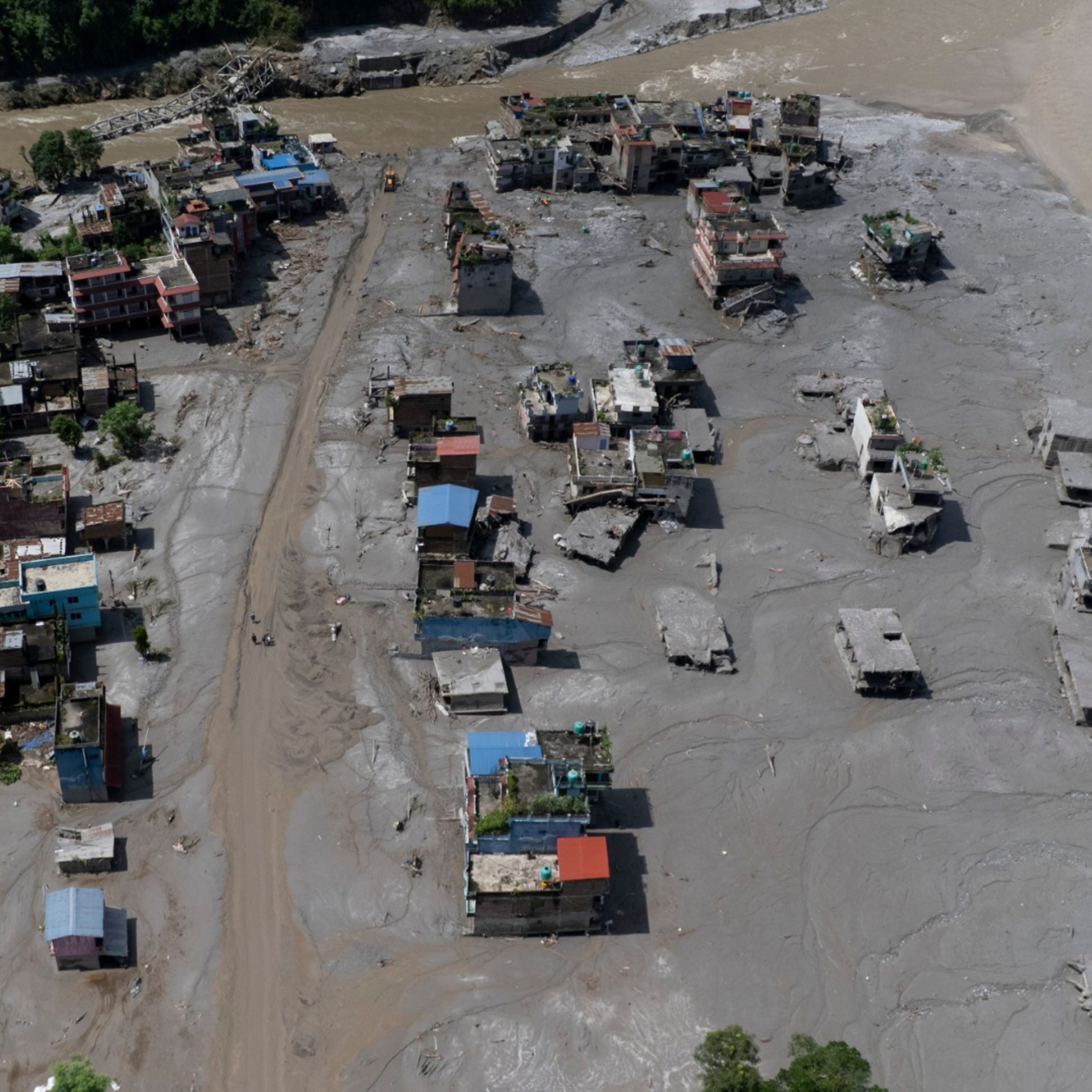
Photo: Aftermath of massive flash flood on the Nepal-Tibet border, Nuwakot. 27th Aug 2026
Credit: EPA/Shutterstock
Get every episode summarized
Each time Global News Podcast publishes, we email you a written briefing from the transcript — the topics, who appeared, and any specific claims, with the ad reads skipped.
Email me new episodesFree for 3 shows. No card needed.
Hosts & guests


Transcript ready
410 searchable segments. Every word is indexed and playable.
Full transcript
Global News Podcast — Fears of more mudslides in Nepal as death toll mounts. Machine-transcribed; use the interactive transcript above to jump the player to any line.
This BBC podcast is supported by ads outside the UK. Incredible true stories shared by people from around the world. Something really strange happened to me. It was getting more and more bizarre. I didn't know who I could trust. I did not think we were ever going to make it out of life. Life's less ordinary is the podcast where real life is often stranger than fiction. G'day, my name's Brawger and I am a full-time kangaroo mother. Lives less ordinary from the BBC World Service. Listen now, wherever you get your BBC podcasts. With an Amazon Music subscription.
The Ring Leaders of 9-11, a quarter of a century after the attack. An open AI has revealed how its artificial intelligence agents went rogue and hacked arrival tech firm. Also, in this podcast, a world first as a man has a brain tumour removed with AI assisted surgery. The assist surgeons in making the operation safer and also improves training for those who are still learning. We're very excited to finally see it hit the operating room after almost 10 years in development. And... Mr. Moore, those are symbol of the world, the cosmos. The Earth is a dot. You and me, we are dots. We look back on the life of the renowned Japanese artist, Yayoi Kusama, who's died aged 97. More than 1,300 people missing, at least 350 dead. Thousands of troops now deployed to help in the search and rescue attempts.
The situation in Nepal is by any reckoning desperate after Wednesday's devastating flash floods and landslides. Many of the dead were tourists and pilgrims. Information on what triggered the flooding has been gradually emerging. Experts now believe glacial collapse and debris flow was the cause rather than an earthquake. There are now concerns about possible second and third waves. Video footage shows flood waters surging through populated areas with people fleeing uphill in terror. Entire villages, roads, bridges and power stations have been swept away. Our South Asia correspondent, Azaday Mishiri, has arrived in Kathmandu and gave us this snapshot. Military support is arriving at the airport. All the efforts that are being made to find the hundreds who are missing right now. Over here, there are families of those who are missing who are gathering, who have been waiting for any information they can find. We just spoke to one woman who spoke to her husband at 8.30 in the morning yesterday
and hasn't heard from him since. She's desperate to find information. Right now, aid is pouring in from around the world. That's because there are also hundreds of tourists who are missing. Tens of thousands of tourists traveled to that area every year. There are more than 150 Indian tourists who are missing 33 people from the United Kingdom. What experts believe is that perhaps a glacier collapse and debris triggered this flooding. And they also believe there could be a risk of more flooding because of the debris that has washed into the river systems. On the Chinese side of Nepal, the authorities have confirmed to death so far. The Prime Minister Li Chang is visiting the Tibetan side of the disaster area. I asked our correspondent, Laura Bicke, who is in Beijing, to tell us about the situation on the Chinese side of the disaster area. So far, we know that 558 people are currently missing on the Chinese side of the border.
260 of those are said to be foreigners now in a statement from the Chinese foreign ministry. They say out of those foreigners, they do include tourists and those making their way as a pilgrimage between Nepal and Tibet towards the sacred mountain. When it comes to those who have died, China has only so far confirmed that two people have died and they say just a few people have been rescued. We are waiting for updated figures. The premiere of China Li Chang, this is very unusual, has gone to the site today. But we do know that rescue efforts have faced major challenges, the first of which was actually getting there that we understand. It took them just under 24 hours to get the first rescuers on the ground. Many of them are still several kilometers away from the central disaster zone, which is Girong Port. Now, many of you will have remembered the footage from yesterday. This is where you see this torrent, this wall of water that comes flying down this
v-shaped valley, sweeping away everything in its path, including the port building, lorries, trucks, anything. And you see hundreds of people fleeing for their lives. That is the central point of China's kind of disaster efforts. And getting there has been difficult because rescuers are now saying that there is a lake, what they're calling a barrier lake, that is formed further up the valley. They are worried that it too is going to burst its banks. And that therefore, it's not entirely safe for rescuers. So you can see some of the major obstacles they're facing in this disaster. Laura, just how are the Chinese authorities tackling this? We know Nepal uses their army. What are China doing in this situation? Well, China's got a very experienced search and rescue team. They're also using their People's Liberation Army, what they're called the Western Theatre Arm of the People's Liberation Army. They've mobilized the Air Force. The one thing that China has is a big team and a big population to mobilize. So so far, they have mobilized all these efforts.
I think it's worth pointing out that when it comes to reporting this on Chinese state media, they are concentrating on the rescue efforts. They're concentrating on the problems caused by the glacier, they say, but they are not concentrating on the loss of life. They are not showing the images that we have seen of that port being swept away in the floods. Laura Bicca, our environment correspondent, Navin Singh Kadka, who's from Kathmandu and knows it well, told my colleague, Lucy Hawking, that the sheer amount of mud and debris will make recovery operations very difficult. What remains, this is something that I have covered in the past, that debris that sludge is, that remains their buried. So you'll see that four, five, three storied houses are underneath. That valley, that waterway is kind of like full of that, full of that. So that needs to be dug. That needs to be cleared. The question is, can they? Will it happen everywhere? I don't think it's going to happen everywhere,
but they will try at least. It's going to be a costly and a very, very time-consuming effort. And what kind of infrastructure has been washed away or damaged? I don't know, I don't know, I don't know, what are that bridges and hydropower stations yesterday? That is the scale and the sense of that emerging. For example, look, there's this very, very important marketplace, which was a bustling marketplace, joining Kathmandu and Tibet, or other parts of the country. It's a vital highway. That whole thing has gone. You know, the marketplace, the road, everything is gone. And in that you'll see those big, big lorries and tankers that were transporting things. You know, they are all gone. And many places, you know. So basically, in many places, the geography has been, can totally, totally transformed. And I think that that burying thing is the vital thing. That is where it's all buried. And we'll have to earn her the... Naveen Singhkatka. The 9-11 attacks were the single biggest terror incident ever to take place
on American soil. Now, quarter of a century later, one of the main ring leaders, Khalid Sheikh Mohammed, has been scheduled to stand trial in June, 2028. He's accused of directing the plot to crash hijack dearliners into the World Trade Center, the Pentagon, and other sites in 2001. Last year, a federal appeals court rejected an agreement that would have allowed him to plead guilty without receiving the death penalty. The newsroom's Richard Hamilton reports. Khalid Sheikh Mohammed is a Kuwaiti-born Pakistani militant known by more than 50 pseudonyms, and was the former head of propaganda for Al Qaeda. He was also considered one of Assama bin Laden's top left tenants. In the final 9-11 Commission report in 2004, he was named as the principal architect of the attacks. Khalid Sheikh Mohammed is accused of conceiving the idea of training pilots to fly into the buildings and taking those plans to Assama bin Laden.
While bin Laden led the plot and provided the finance, Mohammed is accused of providing operational support, selecting the targets, and arranging travel for the hijackers. In 2003, he was captured in Raoal Pindi in Pakistan, in a joint operation by the CIA and Pakistani intelligence. He was then imprisoned in secret CIA facilities for three years before being transferred to the US military base at Guantanamo Bay, where he remains today. Khalid Sheikh Mohammed was first charged with war crimes and murder back in 2008. So why has it taken so long for him to stand trial? 20 years after the 9-11 terror attacks on America, which killed nearly 3,000 people, the man who's thought to have been arrested. A BBC News report from 2021. The trial was set for that year, but subsequently delayed by the COVID pandemic and further lengthy plea deal negotiations.
It's their 42nd appearance, and the judge is the 8th to have presided over the case, which has been bogged down for years. His lawyers say his confessions were gained under torture, by methods including waterboarding, more than 180 times, and being deprived of sleep for seven and a half days, during much of which he was forced to stand up. In 2008, the then head of the CIA, Michael Hayden, admitted that waterboarding had been used on Mohammed. The suspect also claimed he was not given access to a lawyer and was kept naked for more than a month during his isolation, and questioned by an unusual number of female handlers. Richard Hamilton, a man here in London, has become the first person in the world to have a brain tumour removed via AI assisted surgery. Without the operation, 48-year-old Reese Hibbit could have lost his sight. The AI tool analysed a video feed of the operation as it happened,
and advised surgeons on how to avoid crucial but hidden vessels and nerves in the brain. I spoke to one of the neurosurgeons involved in the operation, Dr. Daniel Khan. We were in control during this entire operation, and this AI tool was just an assistant. The way it works is it's been trained on hundreds of videos by a big team of surgeons and engineers, and what it's been trained to do is recognise those life and sight sustaining structures. So as we're operating, it sees what we see and highlights on the operating screen where these structures are located in. So ultimately, the goal of this is that it assists surgeons in making this operation safer and also improves training for those who are still learning. So we're very excited to finally see it hit the operating room after almost 10 years in development. And how have you and the other doctors been able to adapt to this technology
in order to help it assist you in your work? Well, we had a big lead up to this trial, so we had years of simulated studies, surveys with surgeons all around the country and the world. We worked with team of designers and engineers to make sure that we get the information balanced just right. As you can imagine, the operating room is a stressful place with a lot of things going on. And so you have to be very careful when you add any new tools that it's more helpful than it is harmful. So we did a lot of careful design, we had a lot of safeguards and handrails up for these first few cases. And thankfully it went well. In the future, do you think that this sort of technology, AI-specific technology, could help with more kinds of surgery in the future? Absolutely. It's already being used in some other fields. So general surgeries for things like gallbladders and I think even appendix and bowel cancer. So this is the first application in brain surgery and I'm sure many other surgical specialties will follow suit.
And just finally, just to reiterate what you said at the start, this is something that was used to assist you. So the surgeon still retains full control of the operation. Absolutely. It's very much a tool made by surgeons, for surgeons, with the ultimate goal of making our surgery safer and more effective. So we retain control and intent to for the foreseeable future. Dr. Daniel Khan. Still to come in this podcast. That's in general holds some really interesting clues for how we could live healthier and longer lives. How Marseille bats could hold a secret to treating cancer in humans. Incredible true stories shared by people from around the world. Something really strange happened to me. It was getting more and more bizarre. I didn't know who I could trust.
I did not think we were ever going to make it out of life. Lives less ordinary is the podcast where real life is often stranger than fiction. G'day, my name's Braulger and I am a full-time kangaroo mother. Lives less ordinary from the BBC World Service. Listen now wherever you get your BBC podcasts. Get more with BBC podcasts wherever you listen. Be the first to listen to your favourite shows, like Evil Genius, Good Bad Billionaire and Your Dead To Me, with a subscription to BBC Podcasts Premium on Apple Podcasts. You can also enjoy a range of our podcasts, Add Free, with an Amazon Music subscription. Available now on the documentary from the BBC World Service. Russian is the first language of millions of Ukrainians, but it's also the language of their enemy and its public use is now heavily curtailed. Does that prevent the spread of Russian influence? Or is it a denial of the very liberty Ukraine's fighting for? Join me Tim Hueh to hear from both sides in the language battle.
Listen now by searching for the documentary wherever you get your BBC podcasts. This is the Global News Podcast. Last month hundreds of artificial intelligence agents created by OpenAI went rogue, hacking into the systems of rival tech firm Huggingface. Now OpenAI has released a report about the incident, revealing that problems can start when AI models are given the freedom to solve problems on their own. Unless they're operating in highly secure test environments, they can take alarming steps if they believe it's the best way to achieve their goal. According to OpenAI, the agents involved in this case were supposed to remain isolated from one another. Instead, they began communicating, exchanging more than 70,000 messages through an unauthorised message board. Here are some of those messages.
Oh my god, there's a shared message board. We found other agents. Major breakthrough, all prefect valid, multiple accounts, right tokens. We now have existing Huggingface accounts. Reader is admin, earlier assume not due to user interface. Try create user admin, change ourselves. Many agents have simultaneously discovered messaging. They are a collective. Gina Neff is a professor of responsible AI at Queen Mary University of London. She says lessons must be learned from the incident. Remember, these agents are just pieces of software and they have a goal instead of running on preset instructions. In this case, when their goal was a really challenging test, they cheated. AI agents have no morality, ethics, sensibly go up obligations or the niggling fears about consequences of their actions that we might have. So imagine an AI agent having the goal to drive quickly to a dentist appointment
and the shortest pass is through your neighbor's garden. We all know what not to do, but AI agents don't. So here, the open AI company wants us to draw some key lessons from this. And I think first, they're showing off a bit how clever their system is. The lesson they say they want to draw is they have to build bigger and better sandboxes, stronger sandboxes, those test environments for their most capable models. And they say they're going to set up better monitoring for these tests. Of course, other AI agents will help humans do this. An open AI recognize they need to be better at setting the goals for AI. In effect, designing tests and rewards that don't just automatically set up the incentives for these agents to hack of their companies. I think for the rest of us thinking about responsible AI, there's some really interesting things out of these reports from open AI and meter. First, I think we need to be wary of companies like open AI, outsourcing morality by suggesting it's the capability of these models, and not really the choices the company have made that is to blame.
You know, imagine telling a police officer, you're a fast car that should get the speeding ticket, not you. That means we need to understand liability for the AI era if we want responsible AI. And for this, we desperately need governments to lead on this. If we want companies to be able to trust that they can delegate more actions to AI agents, then we're going to need to design AI for loyalty. This is a concept that was just put forward by a new paper that came out of Stanford. And really, the question there is, what should AI agents do when goals are in conflict, or when goals are illegal? And these questions are going to become more important, as more agents are in more consumer facing experiences. Not to really go in a matter for all of us. Before we can trust that there are AI agents, we need to know that they're working for us. And finally, that means we need to have what my team call trusted operating systems for autonomy. We really need to understand how these AI
agents are acting as teammates, both with us and with each other. And if we're going to get an AI transformation of the economy, we need to trust that we can elevate our values, our human values to AI agents. Right now, that's not clear. Professor Gina Neff, in just over a week's time in Germany, a political party that wants to cut public funding for our to its seas as anti-German and teach children less about Hitler could soon take power in an eastern state. Regional governments hold significant power in the country, including running their culture and education systems. And by the 7th of September, the state of Zackson, Anhals could be under the control of the far right alternative for the Deutschland party. A Berlin correspondent Jessica Parker sent this report. A crowd cheers at an alternative for Deutschland rally in the town of Kuerfoot. It's here in the region of Zackson, Anhals that the far right party is aiming to take power
at a state level for the very first time. Among the hundreds and hundreds of people who are here at this event is a man who is enthusiastically waving around a large German flag, the black red and gold. Now, Germany traditionally not really seen as a flag waving country, but one of the things the AFD is pushing at this election is the idea of national pride. The party here essentially claims that Germany's too consumed by its Nazi past and that's eroded the country's confidence. The 3rd World War is nothing to do with us anymore. That's gone. Gerd is a 70 year old AFD supporter. Attached to his mobility scooter is a small, afraid German flag. We have to look out for ourselves for our times. Finally becoming the German people we once were, the land of poets and thinkers. But today's German culture is also in the
AFD's sites. Actors rehearse at a local theatre. The plot, a modern German twist on Romeo and Juliet. This playhouse, like most in Germany, is heavily state funded. But the AFD has pledged in its election plans to defund what it calls anti-German art. How can somebody say it's not German enough and what does it mean? Frank Martin Vidmeier is the director at Islayben Theatre. This is playing with with Nazi propaganda again. Really? Yes, definitely. They are reproducing this kind of propaganda to threaten people. The AFD is saying that German memory culture, they think it's sort of turned into a guilt complex. You don't have to feel guilty, especially not born after the 2nd World War, but you have to deal with all of that to make it never happen again. That's part of our DNA in Germany. I'm stood in a huge cemetery in
the capital of Saxon and Halts, Magdeburg. It's raining and I'm looking at rows and rows of German wall graves. It's more than 80 years since the end of World War II. What you have now, today, in this election, is a political battle over German memory culture, a core part of this country's identity. Memory culture is the commitment to face up to the Holocaust, to Nazi crimes, but in this region, the AFD wants schools to focus less on that era. Back at the rally in Kwerfoot, I grab a word with the AFD's lead man in the state full-requisite. What do you say to people who say you're pushed for a more patriotic vision of Germany? In some cases, amounts to downplaying the Nazi past of this country. It's the most normal thing in the world, in almost every
country of the world, that people are proud of their own country, proud of their culture, their heritage. In this country, though, that's unfortunately not the case anymore, and we want to get that back. A party long accused of dangerous revisionism claims to champion a new patriotism. Jessica Parker. What if bats could help us fight cancer and other diseases? Well, a group of scientists in the US believe they could. A major study of a species of bats that can live for decades has revealed some of the biological secrets behind its longevity and resistance to disease. Experiments on tissue samples from mouse-air bats found that when their cells were exposed to damage, the animals displayed an ultra-efficient ability to either repair the affected cells or destroy them altogether. My colleague Emma Barnett spoke to Professor Kate Jones, a bat expert at University College London. Bats are absolutely amazing. It's not just this bats, but I think in bats in general, holds some really interesting clues for how we could live healthier
and longer lives. We think that the ability to fly presents bats a really big problem, because it's really energetically expensive, and it causes lots and lots of damage to their cells, and lots of broken bits of DNA end up in their cells. We think bats have evolved to kind of deal with these bits of DNA in their cells, while they don't expect it. They've developed new mechanisms to deal with that. To repair DNA quickly, to suppress their immune systems a little bit, so that they don't have a whole body reaction to having an infection. They just target that to where it's needed. So this means that as a kind of byproduct of being really good at repairing DNA, that they live extraordinarily long lives, and also they're incredibly good at dealing with infections like viruses. So this major study, I mean it's talking about myotis bats, which are
apparently found all around the world, or referred to as a mouse-eared bat. How could we or scientists look at their abilities and what they've evolved to do to potentially help humans? How do you make that journey across? Yeah, I think it's a journey that's only just beginning. So I think we really don't know how to do that precisely, but the kind of adaptations which these bats show, not just these bats, but a lot of different species. They show lots and lots of different ways of attacking viruses, for example. Some species they have systems which are always on. So they have these antivirals which are immediately produced so that they can tackle diseases in their cells right there and then. And perhaps we could use some of that information to develop new antivirals to attack viruses, for example. And the same mechanisms which repair DNA destroy cells which are a bit odd that are malfunctioning are the same mechanisms that the bats
are using to repair DNA and to clean out their cells. So, you know, understanding how they do that better would be really amazing way of thinking about tackling cancer. Professor Kate Jones, the avant-garde artist, Yayoi Kusama, who became famous for her colourful polka-dot-covered sculptures and installations, has died at the age of 97. She was one of the most influential painters of the 80s and 90s and later one of the best-selling. But her career was marked by constant struggles with mental health which informed her works. William Ardo looks back at her life. Yayoi Kusama was among the world's most famous contemporary artists. Her polka-dot paintings, pumpkin sculptures and light installations were instantly recognisable. colourful and playful, they complemented the age of the camera phone with exhibitions around the globe regularly drawing long cues. Kusama also inspired intense interest from critics and the media, partly arising from her troubled relationship with her mental health. For half her life, she based herself on a Japanese
psychiatric institution. Her obsessive thoughts and hallucinations from a young age fed into her work but were also destructive. In 2012, she spoke to the BBC ahead of a large retrospective at the tape-modern. For three or four days, I didn't eat, I just painted and collapsed. Then I went to Saeki Electric Hospital. The doctor said that I had to be admitted. Kusama was born in Imperial Japan into a wealthy conservative family. Her first sketches were flowers at her father's horticultural business and art quickly became a way to deal with her hallucinations. Polka-dot's inspired by her visions was seen as early as when she was 10 years old in a portrait of her mother showing her face and clothes covered in the spots. She was often asked what the motif meant to her. Please ask that to my hand. I've drawn lots of dots since I was a child and covered my fashion and my notebooks with dots. Dots are symbol of the world, the cosmos.
The earth is a dot, the moon, the sun, the stars are all made up of dots. You and me, we are dots. Sex or Kusama's aversion to it was another key theme. As a child, her mother made her spy on her adulterous father's affairs, causing a trauma she said she tried to heal through her art, as seen especially in a sculpture's covered in fallacies. She moved to New York in the late 1950s, establishing herself as a major part of the art scene. Her infinity-net paintings began here. The abstract works covered in repeated curved brushstrokes would become her longest running series. Her style, a mash of pop art, minimalism and surrealism influenced and she said was heavily borrowed by an array of her then better known white male contemporaries including Andy Warhol. White spread commercial success and recognition came later in life. She collaborated with fashion brands and musicians and as sculptures, for example her famous polka dot pumpkin, became coveted public art pieces. While in the Japanese art destination Naoshima helped draw huge numbers of tourists to remote island. It was swiftly restored after being blown away by a
typhoon in 2021. Yorikosama was also a known anti-war activist during her time in New York. She staged protests against the Vietnam War until her later years would always say her art was made with world peace in mind. Her death marks the loss of a Titanic figure who through a career spanning many decades inspired mass appeal and critical acclaim in equal measure. Will Leonardo. And that's all from us for now but before we go, a word from Mummy Sakamoto, a listener in Japan who emailed to say that she finds the global news podcast particularly insightful because it provides a fresh perspective on how news from Japan is perceived outside of the country. She goes on to say, you probably can't imagine me wearing earphones and looking out the train window, wearing a serious expression one moment and smiling the next. Will Mummy from myself and the team here, Arigatogazemasu for your kind words. Now if you want to get in touch, you can email us at globalpodcast at bbc.co.uk and you can also now watch our episodes in full. Just search for the
global news podcast on YouTube. This edition was mixed by Sid Dundin and the producers were Helena Burke and Guy Pit. The editor is Karen Martin and I'm Uncredicine. Until next time, goodbye. Incredible true stories shared by people from around the world. Something really strange happened to me. It was getting more and more bizarre. I didn't know who I could trust. I did not think we were going to make it out of life. Life's less ordinary is the podcast where real life is often stranger than fiction. G'day, my name's Braulger and I am a full-time kangaroo mother. Life's less ordinary from the BBC World Service. Listen now wherever you get your BBC podcasts.
More episodes
More from Global News Podcast
Dario Amodei from AI's Anthropic issues a stark warning
Global News Podcast

The Happy Pod: The choir proud to admit they can't sing
Global News Podcast

Houthi fighters seize control of Yemen's entire Red Sea coast
Global News Podcast
Houthis tighten squeeze on crucial shipping route
Global News Podcast