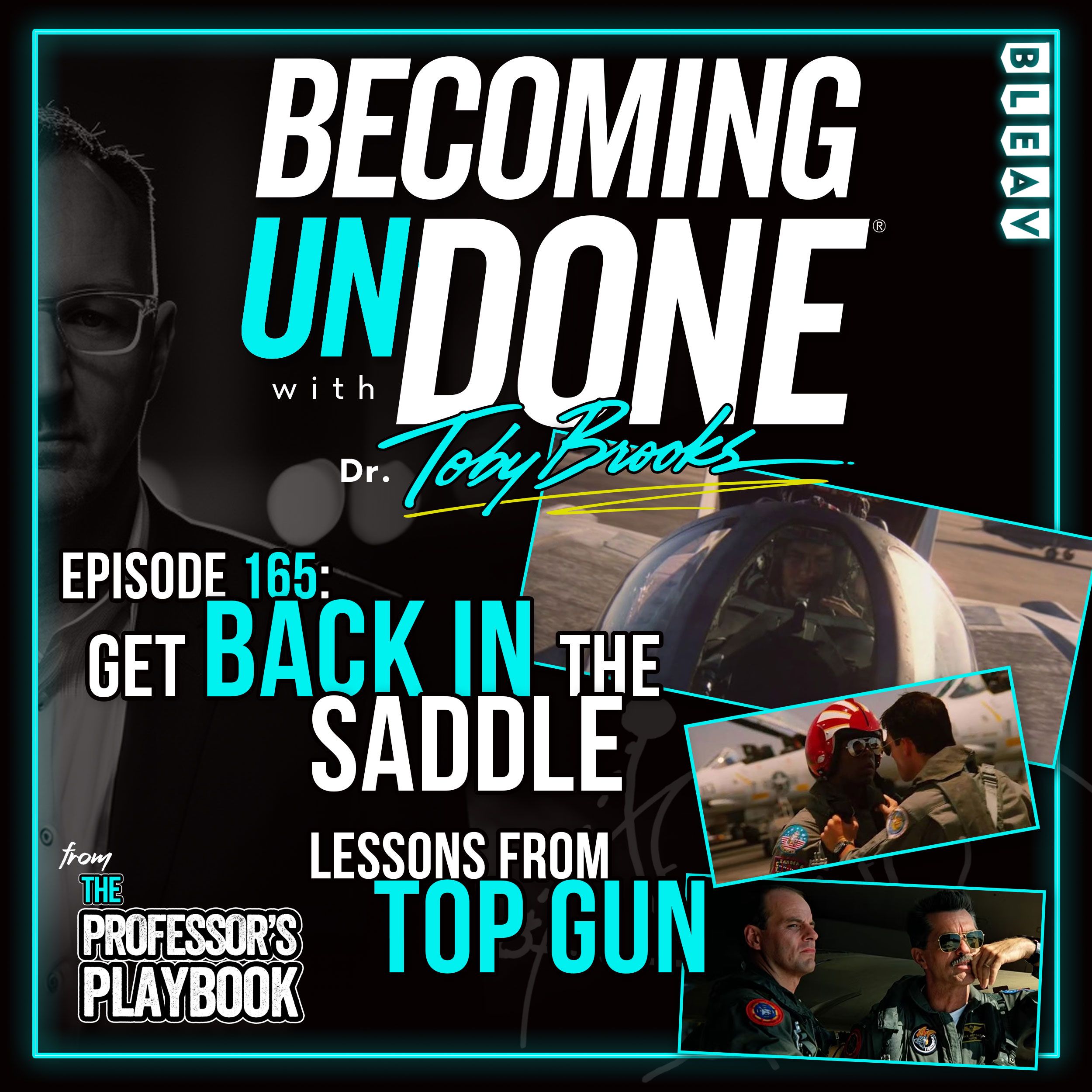
About this episode
Becoming UnDone is made possible by:
About the Host
Dr. Toby Brooks is a professor, author, speaker, and performance scientist with over two decades of experience working as an athletic trainer and strength coach. His clientele has ranged from professional athletes to high school competitors. Currently, he focuses on understanding high achievers across various domains, observing their paths to success despite failures and setbacks. Dr. Brooks is passionate about sharing insights on overcoming challenges and maximizing potential, integrated into his podcast, Becoming UnDone.Episode Summary
In this episode of Becoming UnDone, Dr. Toby Brooks reminisces about the iconic movie Top Gun and its personal significance, tying it to deeper revelations about setbacks and recovery. With vibrant storytelling, Brooks explores how memories of watching Top Gun with his father at a transformative time in his life have shaped his understanding of resilience. He delves into the movie's themes, particularly focusing on Maverick's journey post-tragedy, drawing insightful parallels to real-life challenges.Throughout the episode, Dr. Brooks reflects on the themes of recovery, healing, and finding strength after failures. He compares Maverick's need to "get back in the saddle" to real-life experiences, encouraging listeners to acknowledge their struggles and continue striving forward. Using a compelling narrative, Brooks conveys that while setbacks might alter life's trajectory, they also offer profound growth opportunities. The episode resonates with anyone who has faced a disruption in their professional or personal life and seeks motivation to soar once again.
Key Takeaways
- The journey to recovery involves acknowledging pain, rebuilding confidence, and embracing new beginnings.
- Experiences, such as setbacks, significantly impact self-perception and responses to high-pressure situations.
- Confidence is often rebuilt one step at a time, sometimes requiring the support of mentors and allies.
- Major setbacks may prompt re-evaluation of identity and purpose but can lead to growth and new opportunities.
- The importance of having mentors who encourage persistence, healing, and continued effort in the face of adversity.
Notable Quotes
- "When we've been through failure or navigated loss, psychologists would tell us that there is a natural tendency to avoid further trauma."
- "A major setback can do more than interrupt our plans. It can make us question our judgment."
- "The comeback isn't simply getting cleared. The comeback is learning how to fly again."
- "You can be cleared before you're confident. You can be capable before you feel capable."
- "Surround yourself with people who will keep believing in your return."
Resources
- Becoming UnDone Podcast
- Dr. Toby Brooks' social media: Facebook, Instagram, LinkedIn
- Book: "Sensory Overload" by Dr. Toby Brooks
Hosted by Simplecast, an AdsWizz company. See pcm.adswizz.com for information about our collection and use of personal data for advertising.
Get every episode summarized
Each time Becoming UnDone publishes, we email you a written briefing from the transcript — the topics, who appeared, and any specific claims, with the ad reads skipped.
Email me new episodesFree for 3 shows. No card needed.
Hosts & guests

Transcript ready
441 searchable segments. Every word is indexed and playable.
Full transcript
Becoming UnDone — Finding Strength in Setbacks: Lessons from Top Gun. Machine-transcribed; use the interactive transcript above to jump the player to any line.
Hey y'all, it's Charlie Star from Blackberry Smoke. Y'all know our fans are like family to us, and family watches out for each other, especially when we're out riding. So before you or your crew get on your motorcycles, make sure you're good to ride. Even one drink could be too many. Don't let a good ride end the wrong way. This little mini-tankle It ain't nothing new We outstick around Ride sober or get pulled over. At the University of Arizona online, we bring a top-ranked education to you. We offer 150-plus programs, 100% online. Expand your career opportunities by earning a degree that meets you right where you are. Learn from the same faculty and earn the same degree as on-campus students. Build your future with Arizona online. Classes start every seven and a half weeks. Apply today and make your tomorrow amazing. This podcast is sponsored by Talkspace.
Last year, I went through many different life changes. I needed to take a pause and examine how I was feeling and the inside to better show up for the ones who need me to be my best version of myself. When you're navigating life's changes, Talkspace can help. Talkspace is the number one rated online therapy, bringing you professional support from licensed therapists and psychiatry providers that you can access anytime, anywhere. Living a busy life, navigating a long-distance relationship, becoming a first step father, Talkspace made all of those journeys possible. I could speak with my therapist in the office, I could speak with my therapist in the comfort of my home, I was never alone. Talkspace works with most major insurers and most insured members have a zero-dollar copay, no insurance, no problem. Now get $80 off your first month with promo code Space80 when you go to Talkspace.com. Match with a licensed therapist today at Talkspace.com. Save $80 with code Space80 at Talkspace.com.
This is Becoming Undone. There are a handful of movies that have stayed with me for most of my life. And Top Gun has always been near the very top of that list. Part of it's probably obvious, I grew up in the 1980s, and there was something almost impossibly cool about the F14 Tomcats and the music and the motorcycles, even the weird tongue silhouettes that made 11-year-old me look away and discussed. But there was that confidence in that swagger, all the larger-than-life characters. If I'm being really truthful, I think my attachment to that movie has quite a bit less to do with Maverick and Goose than it does with my dad. Let me explain. In 1986, many of you probably weren't even born yet. That summer for me was transformative. The stream machine nationals had come to Southern Illinois and experienced that I'd later write about in my book Since Reoverload. But at home, things were rocky.
My parents were talking about a divorce. They were separated when I first saw the movie. I'm like I said, I was 11 years old. My dad was a mechanic at a coal mine, and my mom was a stay-at-home mom. I'm quite sure that if they would have gone through was finalizing the divorce? It probably would have been a bad thing. But I gotta tell you, at the time, it had resulted in some of the best memories I've ever had with my dad. That summer, I got to spend the night with my dad in his short-term apartment. And for what may have been the first time in my life, I had him completely to myself. He took me bowling. We played pool. And then we went to see Top Gun. I still remember how significant those two days felt to me, because I don't know that there was ever another stretch of time when I had so much of his undivided attention. For an 11-year-old boy who desperately wanted time with his dad, that weekend became forever attached to the movie in a way that's never really gone away.
For most of my life, when I thought about Top Gun, I thought about that experience. I thought about Goose and Maverick, the F-14s. Danger zone, all the things that made the movie what it was. But over the past several months, I found myself returning again and again to a scene that I had never really paid much attention to before. And honestly, until recently, I don't think I even really understood what was going on. It comes after Goose dies. The first time I watched it, I know I didn't get it. Kind of like that scene in ET, where all the dumb grown-ups are in the hazmat suits, and they turn Elliot's house into this huge white plastic trash bag when ET is dying. Still not sure I get that part. But whatever, back to Top Gun. I had no idea why Maverick, who had just crashed his plane, lost his best friend, and spent the morning shaving and what appeared to be a public bathroom in his underwear. But then suddenly he was in full uniform or what looked like a courtroom in front of what I thought were three judges.
But why? After all, he had been the victim here, right? What I would come to understand much, much later, was that yes, Maverick has been involved in this catastrophic training accident. His best friend was gone. And he was carrying not only the grief of that loss, but also the possibility that somehow he might have caused it. And the aftermath of his accident, there's a formal inquiry into what happened. Eventually the board determined that Maverick was not at fault. His record is clear. His flight status is restored. And eventually he gets the instruction. Get him back up the flight. 14 flat span was induced by the disruption of air flow into the starved engine. This disruption stole the engine, which produced enough yaw rate to induce a spin which was unrecoverable. There was no way Lieutenant Mitchell could either see or avoid Jeff Washington
which produced the engine's goal. Therefore the board of inquiry finds that Lieutenant Pete Mitchell was not at fault in the accident of 29 July. Lieutenant Mitchell's record will be clear to this incident. Lieutenant Mitchell is restored to flight status without further delay. As that courtroom scene concludes, the music begins to shift. There's like this faint melody that begins to break through. It's fast and it's light. To me it kind of feels like icicles, an opinion from which I will take no further questions. But then the unmistakable 80 synthesizer comes in.
It's like this musical transition, where Mavic goes from the grief of his loss to the uncertainty of what's still ahead. From a crash jet that had your best friend flying rear to a new jet, with someone you don't love like a brother in the back. Then there's this errant guitar riff that sounds a little like Marty McFly when he's starting to disappear from the current timeline. It kind of barges in. It isn't one of those songs everyone associates with Top Gun. It's not Danger Zone, it's not even Top Gun Anthem. And as far as I've ever been able to tell, it never appeared on the official soundtrack or the Harold Fultamire score. I only found it isolated on YouTube, and judging by the comments, I'm not alone in my love for the motivation
and the recovery from my own tailspints, whether they were my falls or not. But it starts underneath that scene, and it slowly builds in as Maverick heads back towards his jet. And there's something almost perfectly matched between the music and what's happening on the screen. The whole sequence feels like a scent. It feels like someone who's been grounded, figuratively and literally being told that he can go back and do the thing that he was made to do. I've watched that scene more times than I can count over the past few months. I've listened to that music over and over. I found a tool on the internet that allows you to paste in a YouTube link and it will play it as often as many times as you want. And I've used it. I've listened to it while driving, while walking, while sitting alone trying to make sense of a season that didn't unfold the way I expected it to. I've imagined what it must feel like to sit through an inquiry, to have your actions scrutinized, to wonder what somebody else thought
and to see what they concluded about you. And honestly not to be overly dramatic, but emotionally, I bet that there are lots of parallels between what Maverick went through emotionally and what I've been wrestling with for the past five months, almost daily. I've been praying that like Maverick, I'd finally hear the words that tell me that I've been cleared and that I can get back to work. One thing I love about the scene is Maverick's mentor, Viper. He's rightfully concerned. As soon as the formality of the inquiry is over, he tells Fellow Top Gun instructor Jester to get him up flying soon. Get him up flying soon. There's hard earned wisdom in that. When we've been through failure and navigated loss, whether it's our fault or it's an accident, psychologists would tell us that there is a natural tendency to avoid further trauma. PTSD is a thing, and it can show itself in the things that we do,
and in the things that we refuse to do. Without getting into the specifics, the past five months have forced me to think a lot about setbacks, about identity. And about what happens when circumstances disrupt the story that you've been telling yourself about where your life was headed. There are seasons when you feel as though you are flying exactly where you're supposed to be flying. You're doing exactly the work that you understand. You're using the gifts that you trust, and then something happens. And it wipes away all that certainty. What I've started to realize though is that the inquiry isn't really the most important part of Maverick's story. Now don't get me wrong, being cleared is important. Being told that you aren't responsible for what happened matters. Having someone remove that accusation, restore your status, reopen the door that had temporarily been closed and locked, that can be incredibly meaningful. But none of those things automatically make you ready to fly again. What Viper knew was that Maverick needed to get back in the saddle.
He needed to re-engage. He needed to wrestle with the fear and the doubt and the uncertainty in a way that would only come while back in the sky. And friend, I'm here to tell you, we all need a Viper in our lives. Because in reality, I know. I'm going all in on this fiction, but in reality Maverick is cleared before Maverick is healed. He sent back up before his confidence has fully returned. The institution tells him he can fly, but he still has to decide whether he believes that about himself or not. And I think that may be where the real work of a comeback begins. A major setback can do more than interrupt our plans. It can make us question our judgment, it can make us replay decisions that once we made without hesitation. It can make you wonder whether the person you believed yourself to be before the setback is still there on the other side of it or not. Even when the circumstances begin to change, even when the facts become clearer, even when other people tell you that it's time to move forward,
there can still be part of you that's standing beside the wreckage, trying to figure out whether you trust yourself enough to climb back into the cockpit. That's the part of the top gun story that means something different to me now than it did when I was 11 years old. The comeback isn't simply getting cleared. The comeback is learning how to fly again. Now as a good time as I need to tell you that I'm Dr. Toby Brooks, a professor, author, speaker, and performance scientist. I spent much of the past 20 years working as an athletic trainer and strength coach working with athletes from the professional to high school levels and all points in between. Today I focus on high achievers of all different kinds. I study them, I interview them, I observe them to learn about what makes them different. I love to see first hand how failures and setbacks that would destroy most actually set high achievers up for success. Each week on Becoming Undone I bring you a new guest where we talk about how unraveling can be the prerequisite to the best build-ups and the most massive success.
But every so often onward to the third, I bring you a solo episode where I reflect, reprocess, and recommit to taking what we've learned from them and getting better ourselves. And today we're talking about getting back in the South. At the University of Arizona Online, we bring a top-ranked education to you. We offer 150-plus programs, 100% online. Expand your career opportunities by earning a degree that meets you right where you are. Learn from the same faculty and earn the same degree as on-campus students. Build your future with Arizona Online. Classes start every seven and a half weeks. Apply today and make your tomorrow amazing. Shop the Sirwin Williams Labor Day Sale and get 35% off paints and stains August 28th through September 9th. Whether you're refreshing your interior or exterior, we've got the colors to bring your vision to life.
And with delivery, getting everything to your door is easier than ever. Online to have it delivered or visit your neighborhood, Sherwin Williams store. Click the banner to learn more. Retail sales only, some exclusions apply. See store for details. Delivery available on qualifying orders. So let's go back to that scene because this is where I think Top Gun gets something about setbacks. Perfect. Incredibly right. Vipertel's gesture to get Maverick back up flying. And they do exactly that. His new Rio is sundown who has the uninviable task of climbing into the back seat of a replacement F-14 in a seat that was just a few days earlier, gooses. And almost immediately we discover that getting Maverick back into the aircraft and getting Maverick back are two entirely different things. They get into a training engagement and Maverick has exactly what he would have wanted before the accident. Gestures right there in front of them sundown season. Gestures season everybody sees it. Averick has the angle and the opportunity to engage but he won't take the shot.
Come on kid, come on get in there. Gage. All right you got to pull it get two o'clock low Maverick. You got the angle. Feed the cake now. Take the shot kid. Take the shot. I'm going to engage at a time Maverick. Hey where the hell are you going? It's not good it doesn't look good. What do you mean it doesn't look good? It doesn't get to look better than that. Instead of distressing about it he breaks away. It says it's no good. I don't know about you but I've been in a similar headspace and I know many of my athletes have. Maybe you have as well a situation that would have been a slam dunk. Don't even think about it. Reflexive W one day. Become something that we stew over. We consider all the wrong that might happen. And maybe even run away from it the very next sundown is understandably confused by this.
Because from his perspective there's nothing wrong with the situation. This is what they came here to do. They have the advantage. The opportunity is right in front of them. Maverick turns away from it. And that's where I think the scene becomes about something much more than dog fighting fighter jets. Because sundown is looking at the situation in front of Maverick. And Maverick is reacting to the situation behind him. And for those are two very different things. Sundown sees that F5 in front of them and it's an opportunity to make the kill. Maverick sees jet wash. A flat spin. A canopy. An ejection. And an empty seat. Where his best friend used to be. In that moment nothing bad is happening. But something terrible happened in a similar moment. And it probably felt an awful lot like what just happened a few days before. That's one of the things setbacks can do to us. They have this amazing ability to reach forward from the past and begin influencing decisions that have very little to do with the thing that originally heard us.
We start hesitating in places where we used to act instinctively. We become suspicious of opportunities that once would have excited us. Sometimes we protect ourselves from repeating something that might not even be repeating. And the people around us might not understand it at all. Sundown certainly didn't. So when they land he's frustrated because he knows that they had this shot. Maverick responds defensively. Telling him essentially he'll decide when he's darn well good and ready. Hey man we could have had him. Hey we could have had him man. I will fire when I am god damn good and ready. You got that. And then Justin Viper have what may be one of my favorite exchanges in the whole movie. You can't get back in the saddle won't engage. It's only been a few days.
You know he just might not make it back. Keep sending him out. Justin watches Maverick walk away. And he says he can't get back in the saddle won't engage. And Viper's response is simple. It's only been a few days. Justin isn't convinced. He tells Viper that Maverick might not ever make it back. And Viper says the thing that I needed to hear. Maybe the thing you needed to hear. Keep sending him up. I love that exchange. Because there's wisdom on both sides of it right. Justin isn't being cruel. He's recognizing something that is objectively true. Maverick isn't the same fighter pilot right now. The guy who spent the first half of the movie looking for absolutely any excuse to engage. Suddenly has a clean shot and he flies away from it.
He's seen pilots go through things like this before. And he knows that not all of them come back. But Viper understands something else. It's only been a few days. Think about that for a second. Loose has just died. Maverick has survived a violent crash. He's gone through an inquiry that could have changed the entire trajectory of his career. But he's been clear to fly again and now he's sitting in the same cockpit doing the same kinds of maneuvers. But with somebody else sitting in the seat that used to belong to his best friend. After one bad flight, Justin wonders whether maybe Maverick is finished. But Viper says, basically, not yet. Give him another rep. Keep sending him up. There is grace in that response that I think we sometimes fail to give ourselves. I know I've failed to give it to myself in the past. We decide way too quickly because we aren't immediately who we were before the setback that we must never be that person again.
Something broke us. And now we take that identity cloak and we throw it on and we wear it. It didn't just break us. We are broken. We go back to work and it feels strange. So we think something's wrong. We try something we used to do easily and discover that we're hesitant. So we assume that we've lost something. We step back into a place where we were hurt and noticed that our confidence didn't magically follow us back through that door. And suddenly we start wondering whether maybe Justin tried. Maybe I'm not coming back. Maybe that part of me is gone. Maybe this changed me forever. Maybe I don't have it anymore. And sometimes what we need in that moment is a viper who can look us in the eyes and say, bro, it's only been a few days. Not literally, of course. Sometimes it's been weeks or months or sometimes way longer. The point is that recovery has a timeline.
And that timeline doesn't necessarily care how badly we want to be finished with it. You gotta go through it. Sometimes the only way out is through. You can be cleared before you're confident. You can be capable before you feel capable. You can be back in the cockpit way before you feel comfortable sitting there. And maybe the answer in that moment isn't to interpret every hesitation as evidence that you're finished. Maybe the answer is to simply keep going up. It doesn't mean you're ignoring pain. It doesn't mean you're pretending nothing happened. And it certainly doesn't mean repeatedly putting yourself in a situation that are genuinely unsafe. Instead, it means recognizing that confidence is often built a piece at a time, experientially. There are some things that you can't sink your way back into. At some point you just need another rep and another one and another one.
And some of those reps may be ugly. They may be hideous. Some may leave you frustrated. Some may send you back to the locker room wondering whether you still have any business doing this at all. Keep sending him up. I thought about those four words a lot lately. Because there have been moments during the past few months when I've wanted certainty before taking another step. I've wanted to know how the story ends before deciding how fully I'm willing to reengage with it. And I've wanted to feel like myself again before doing the things that I associated with being myself. But increasingly I've become convinced that it probably works the other way around. I don't like it, but that's what I'm learning. Sometimes you don't get your confidence back and then get in the saddle. Sometimes you get your confidence back by getting back in the saddle.
And I think there's another lesson buried in Viper's response that matters just as much. We all need somebody willing to keep sending us up. We need people who can see the difference between struggling and being finished. People who won't define us by our first attempt after the fall. People who understand that the version of us they're seeing today might not be the final version that emerges from whatever we've been through. Sometimes we need someone who expects us to get back. Not because they're oblivious to what happened, but because they know enough about us to believe that what happened doesn't get the final word. And in the process, we learn a bit. Maybe a lot about who we are. We find out who we are and then we pursue it on purpose. Maybe that's ultimately what getting back in the saddle is really about. It isn't about pretending that the crash never happened. It's not convincing yourself that you weren't scared or weren't hurt.
You're not bulletproof, that you weren't disappointed, that you weren't changed by whatever knocked you out of the sky in the first place. It certainly isn't demanding that you immediately become the exact same person you were before everything went sideways. Maybe the goal isn't to become that person at all. Maybe the goal is to figure out who you are now. What's still true about you now? What has the experience taught you? And then as Wayne put it this morning, pursue that person on purpose. I think that's part of why this scene has landed so differently for me at this point in my life. When I was 11, I watched Maverick climb back into that F-14. And I thought it was cool because, well, he was Maverick and it was an F-14. He's sitting there all sweaty and he's clipping that face mask on like a certified badass fighter pilot. I love the music and the jets and the aviator glasses, all the stuff that an 11-year-old boy was supposed to think was cool in 1986.
I had no idea that 40 years later I would watch that same scene and see something completely different. Now I see a guy who has been through something that shook his confidence in who he was, a purposed arm that had shaken him to the core of his identity. I see people around him trying to figure out whether he's going to make it back. I see one mentor who understands that a bad first attempt doesn't necessarily mean the story's over. And I see somebody who eventually has to make the decision that nobody else can make for him. He's got a fly. I don't know what your version of that is right now. Maybe you lost a job. Maybe your relationship ended. Maybe you failed. That's something that you were absolutely certain was your purpose in life that you would succeed at. Maybe somebody made a decision about you that you didn't agree with. Maybe you made a mistake yourself and now you're trying to figure out how to live with it. Maybe life simply handed you something you never saw coming and you're still trying to get control out of that spin.
Whatever it is, I don't think the answer is necessarily to rush yourself through it. But I also don't think the answer is to stay grounded forever. There is a time to grief. There's a time to evaluate what happened. There's a time to take responsibility for whatever belongs to you and a time to release. Whatever it doesn't. There is a time to heal. And then, eventually, there's a time to go back up. You have to fly. Friends, you were made to fly. And maybe that first flight is going to suck. Maybe it's not very good. Maybe you'll hesitate. Maybe you'll break off when everybody around you thinks you should engage. Maybe you'll walk away afterward wondering whether Jester was right and whether or not you still have it. But that doesn't necessarily mean you're finished. It might just mean it's only been a few days. So give yourself some grace. Find the people in your life who know the difference between struggling and being done.
Listen closely to the ones who know you well enough to remind you what's still true about you. Even when you're having trouble seeing it yourself. Allow yourself not to look in the mirror without disgust. But look yourself straight on from another perspective. Well, I've Chrissy shared something with me this week that's really stuck. She said sometimes when you can't see yourself clearly through your own eyes. You need somebody who loves you enough to say, then see yourself through mine. And keep going up. One rep at a time. One decision at a time. One imperfect flight at a time. I still don't know exactly what the next chapter of my own story looks like. There are some things I'm still waiting on. Some things I'm still working through. Some questions. I don't have the answers to yet. But friend, I know this much. I don't want a difficult season that convinced me that I am no longer capable of doing the things that I know I am called and equipped and meant to do.
And I don't want the fear of another tailspin to keep me permanently on the ground. So maybe that strange little piece of unreleased 1980s synthesizer music has become something of a soundtrack for this era, this season of my life. Eventually the inquiry ends. The engines light up, the music rises, and sooner or later you have to decide whether or not you're going to fly again. I'm working on it. Maybe you are too. So wherever you are today, give yourself the grace to recover. Surround yourself with people who will keep believing in your return. And when the time comes, get back in the saddle and keep going up. I hope you enjoyed this week's episode. Be sure to check it out on the web. Head on over to undenpodcast.com
to see the notes, links, and images related to this week's show. So click up, dates about the show. We're currently number six in the world on Apple for Education, number five and self-improvement, and number one 51 across all categories. If you want to see how we're doing in the rankings for yourself, just go to undenpodcast.com, backslash rankings, and cheer me on. If you'd be so kind as a share the show with a friend, leave a comment or a review that would be so very helpful. And so appreciate it. This week's TL of the week is the Hawaii Pacific University Sharks. HPU is home to nearly 7,500 students in Honolulu, Hawaii, and the 14 varsity athletic teams participate at the NCAA Division II level. Their official colors are HPU Teal and HPU Light Teal, Black and White. So actually they have two Teal, so bonus points for the Sharks. You know, I've long believed that performance is influenced by our environment that we set up. And whenever possible, I like to put myself in mind.
And that usually includes Teal. I know the branding start and a stick when people around campus always point to my Teal Nikes or my wristband, even my pocket square when it's a sport-cob-meeting scottoday. So once again, shout out to the Hawaii Pacific University Sharks this week's TL of the week. Coming up on the show, I've got former competitive gymnasts and now yoga teacher, social media influencer, Alexandria Crow on the show. We'll hear how she's overcome injury, a medical scare, and other setbacks to become a powerful force in the yoga space. And after that, I've got more coming up on the Biv 10 bunch. We started with Hayden Hydo a couple weeks ago, and I'm working on an interview with producer and artist Mark Payne. This and more coming up on Becoming Undone. Becoming Undone is an I-Trop creative production, a proud member of the Believe Podcast Network. Show's written and produced by me Toby Brooks, intro and outro music by Mark Payne. Post production assistance from decipher and analytic support from Mopod.
Tell a friend about the show and follow along on Facebook, Instagram, and LinkedIn at Becoming UndonePod. And follow me at Dr. Toby Brooks on Facebook, Instagram, and LinkedIn. Check out my link tree at link tr.ebackslash.dct.toby. Brooks. Listen, subscribe and leave me a review on Apple Podcasts, Spotify, iHeartRadio, or wherever you get your podcasts. Till next time, get back in the saddle and keep getting better.
More episodes
More from Becoming UnDone

Dr. Matt Geddie | Building Wealth Through Intentional Choices and Financial Plan...
Becoming UnDone

Hayden Hajdu | From Stardom to Solitude: A Journey Through Music and Recovery |...
Becoming UnDone

Darryl Strawberry: From Baseball Greatness to Personal Redemption Journey | 16...
Becoming UnDone

161 | Navigating Burnout and Career Identity in Athletic Training with Dr. Shelb...
Becoming UnDone