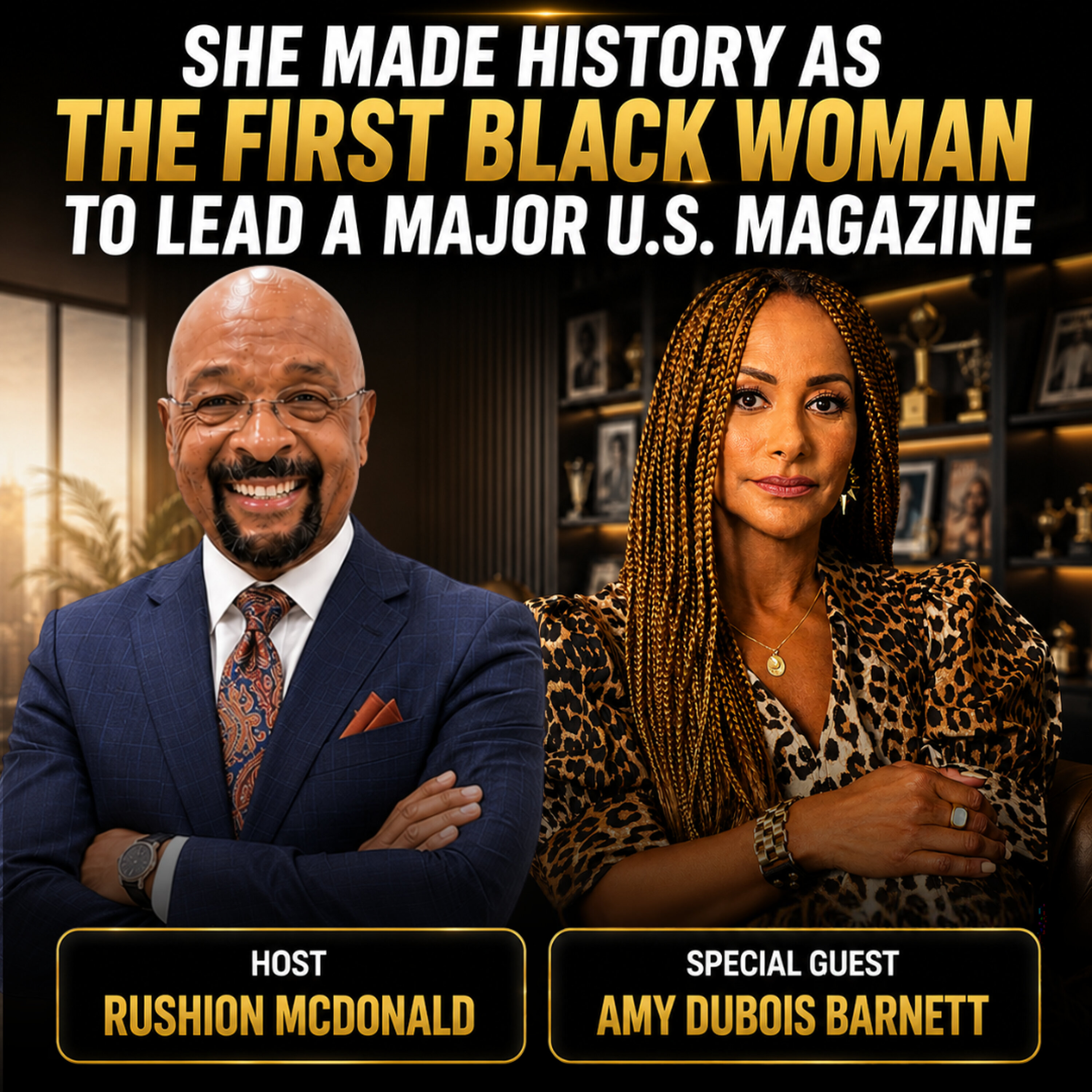
Follow Your Passion: Media executive Amy Dubois Barnett gives insights on success, authenticity, and navigating the evolving media landscape.
About this episode
Listen and subscribe to Money Making Conversations on iHeartRadio, Apple Podcasts, Spotify, www.moneymakingconversations.com/subscribe/ or wherever you listen to podcasts. New Money Making Conversations episodes drop daily. I want to alert you, so you don’t miss out on expert analysis and insider perspectives from my guests who provide tips that can help you uplift the community, improve your financial planning, motivation, or advice on how to be a successful entrepreneur. Keep winning!
Two-time Emmy and Three-time NAACP Image Award-winning, television Executive Producer Rushion McDonald interviewed Amy DuBois Barnett.
📝 Summary of the Interview
Amy DuBois Barnett, a trailblazing media executive and author, joined Rushion McDonald to discuss her career, her upcoming debut novel If I Ruled the World, and her insights on success, authenticity, and navigating the evolving media landscape. The conversation covered her historic role as the first Black woman to helm a major mainstream U.S. magazine, her experiences in media and publishing, the importance of Black voices, and her journey toward becoming a novelist.
🔑 Key Takeaways 1. Career Milestones & Legacy
- Amy made history as the first Black woman editor-in-chief of a major mainstream U.S. magazine (Teen People).
- She held leadership roles at Harper’s Bazaar, Ebony, Honey Magazine, and digital platforms like BET and The Grio.
- Her editorial style focused on humanizing success, sharing personal stories and lessons rather than just promoting content.
2. New Novel: If I Ruled the World
- Set in late 1990s/early 2000s New York, the novel follows Nikki, a woman navigating the fashion and music magazine world.
- Themes include misogyny in hip hop, professional ambition, friendship, and self-discovery.
- The title is inspired by the Nas and Lauryn Hill song, and Lauryn Hill was the first cover of Honey Magazine under Amy’s leadership.
- Amy envisions the novel as a TV series, and is actively working toward that goal.
3. Importance of Preorders
- Preorders are critical for debut novelists to hit bestseller lists.
- All preorders count toward first-week sales, which are essential for making lists like the New York Times Bestseller.
4. Authenticity & Black Media
- Amy emphasized the need for authentic Black voices in media, especially in today’s political climate.
- She praised independent platforms and figures like Roland Martin, Joy Reid, and Don Lemon for maintaining integrity.
5. Success Principles
- Success requires more than talent—it’s about energy, attitude, collaboration, and kindness.
- She highlighted the importance of networking through genuine relationships, not just transactional exchanges.
- Believing in oneself is essential: “The universe will not give you an opportunity that you don’t think you deserve.”
6. Pivoting & Resilience
- Amy’s career involved multiple pivots—from finance to fashion to media.
- She stressed the importance of recognizing when to pivot and manifesting goals through vision and hard work.
7. Print vs. Digital Media
- Print magazines offer permanence and thoughtful journalism, while digital media provides speed and volume.
- She misses the visual artistry of print, like cover shoots and fashion spreads.
8. Personal Notes
- Amy’s son is a music producer and DJ, studying at Drexel University.
- Rushion and Amy have a long-standing friendship dating back to 2012, when she was at Ebony and he was producing the Steve Harvey show.
💬 Notable Quotes
- “You have to believe that you deserve all of the opportunity.”
- “Networking is not about handing out business cards. It’s about building relationships.”
- “Magazines have a permanence that made you incredibly careful.”
- “I’m manifesting big things.”
- “We are out here flawed and just trying to find success, love, and fulfillment like everyone else.”
#SHMS #STRAW #BEST
Money Making Conversations Master Class with Rushion McDonald is America's premier entrepreneurship, business leadership, financial literacy, and wealth-building podcast featuring successful entrepreneurs, executives, founders, celebrities, and industry experts sharing actionable insights for professional and financial success.
Business Podcast
Entrepreneurship
Small Business
Business Growth
Financial Literacy
Wealth Building
Black Entrepreneurs
Minority Business
Leadership
Executive Leadership
Business Funding
Marketing Strategies
Personal Development
Startup Advice
Sales Training
CEO Interviews
Founder Stories
Professional Development
Economic Empowerment
Business Success
Networking
Brand Building
Innovation
How to start a business
Small business funding
Entrepreneur success stories
Business leadership podcast
Wealth building strategies
Black entrepreneur podcast
Minority business development
Marketing for small businesses
Business growth strategies
Startup funding opportunities
Executive leadership training
Financial literacy education
Success mindset podcast
Support the show: https://www.steveharveyfm.com/
See omnystudio.com/listener for privacy information.
Get every episode summarized
Each time The Steve Harvey Morning Show publishes, we email you a written briefing from the transcript — the topics, who appeared, and any specific claims, with the ad reads skipped.
Email me new episodesFree for 3 shows. No card needed.
Hosts & guests
Transcript ready
484 searchable segments. Every word is indexed and playable.
Full transcript
The Steve Harvey Morning Show — Follow Your Passion: Media executive Amy Dubois Barnett gives insights on success, authenticity, and navigating the evolving media landscape.. Machine-transcribed; use the interactive transcript above to jump the player to any line.
This is an I Heart Podcast. Guaranteed Human The General Election is coming fast and if you're working on a campaign you need every smart way to reach voters. I Heart delivers trusted audio at scale through AMFM radio, podcasts and streaming, helping campaigns connect with voters at home, in the car, at work, and on the go. Whether you are building awareness, reinforcing your message or extending your TV by, I Heart can help you reach the voters that matter.
Put audio to work for your campaign today. Call 844-844-I Heart. That's 844-844-I Heart. McDonald's is putting value back on the menu. Whether you're craving a big mac, McNuggets or sausage egg and cheese, McGrittle's, make it a meal and save. Your favorite is now your wallet's favorite too. Extra value meals are back. Sun rises, prices fall, get a sausage week muffin with egg or sausage egg and cheese, McGrittle's small hot coffee and hash browns for just $6. Price and participation may vary, promotion pricing may be lower than meal pricing. When the power goes out, there are two kinds of people. The ones hoping someone else can help and the ones who are ready. This National Preparedness Month, being ready with the Patriot Power Generator 1200 from 4 Patriots. It's lightweight, safety-use indoors and keeps your essentials running. Order today and you'll receive a 100 watt solar panel and mini generator absolutely free.
Stop depending on the power grid. Start depending on yourself. Visit 4patriots.com today. Toyota's easy choice sales event is on. Whether you're looking for the performance of a Camry, the versatility of Rav4, the efficiency of a Corolla or all electric driving in the BZ. There's a Toyota that's just right for you. And with great deals across the lineup, now's the time to find yours. But hurry, these deals won't last long. Toyota's easy choice sales event ends soon. We make it easy. Toyota, let's go places. Welcome to my show. I'm Richa McDonald, the host of Money Making Conversations Masterclass. When we encourage people to stop reading other people's success stories and start planning your own. Now you don't want to miss an episode. So please take a moment right now to follow or subscribe to Money Making Conversations Masterclass. It's free. You can follow me on iHeartRadio app, Spotify, Apple Podcast, or wherever you listen to your podcast.
New Money Making Conversations Masterclass episodes drop daily. I want to keep you on alert because my guests provide tips on how you can uplift your community, improve your financial planning, motivation, or advice on how to be a successful entrepreneur. Now let's get this podcast started. My guest made history as the first black woman to help a major mainstream US magazine and as deputy editor in chief of Hopper's Bazaar. She's held senior leadership roles at Paramount, Hurst, Disney, Timing, and several independently owned brands. Now she has a novel. If I ruled the world, please walk with the Money Making Conversations Masterclass Amy Duois on that. So nice to be here, Richa. Thanks for having it. Well, first of all, I got the DuBois, right? Yes, you did. W.U. Duois is my name's A.C. So that's how I get there. I get there on the book. I don't want people to be looking for any born-ad and Mr. G. See, right there, if I say it's right, then you type that in.
It go come directly you because you're one of a kind. I appreciate you, sir. And I'm proud of my middle name again. I'm named after W.U. Duois. So I'd like to use my whole name. Well, you know, I said some really amazing things. And I've known you over the years and followed your career, followed you through the injured leg and all that stuff. Well, I'm mercy. And but you're very humble, but you've been in a very competitive industry. How do you balance that, Amy? I mean, I appreciate that. And that's a very kind thing to say. And it's interesting because it is one of the things that I talked to people that I mentor about. You know, I talked to people about the energy that you put back in the world and the way that that comes back to you. And the fact that, you know, all of it is sort of circular. And you have to really be intentional about the way that you walk through the world. So I think that the way that you are treating people around you is the kind of energy that you're going to get yourself.
As it comes back to you, the other thing is, you know, I really spend a lot of time over the course of my career humanizing success. You know, I think that for a lot of people, you know, they look at, you know, those folks who have had certain kinds of professional accomplishments. And they think that these people are different or they're somehow, I don't want to say better, but they just have a sort of different set of experiences or what have you. And, you know, my goal throughout a lot of my career has been to help people understand that we all make mistakes. Like nobody is better than anybody else. You know, we are out here flawed and, you know, and just trying to find success, find love, find fulfillment. The same is everybody else. And that was actually one of the reasons why I started writing my editors letters at Honey magazine. That was actually my first editor in chief job. So when I started writing my editors letters at Honey magazine, I decided that I wasn't going to do the normal editors letters where you say, OK, well, on page 53 is a great beauty story on page 25 is a great fashion story.
Instead, I chose to use that magazine real estate to talk about my own stories and my my failures and the lessons that I've learned and the insights I wanted to impart. So, you know, it's just it's part of who I am and it's part of what I want to leave with the world. What does Amy, well, Amy, you know, it's really interesting because, you know, I was sick, I'm writer. OK, I'm just say that not your your level of writing because there's a different, there's different levels of writing out there, ladies and gentlemen. I was the black, the black information pipeline seems to be under attack nowadays where we're being discouraged to identify ourselves and be proud and believe me, they would say I want to do this. When you hear these attack messages being put out there, I'm not going to direct it to anybody in particular, but I do read it. I do see it and I feel uncomfortable. How do you respond to that, Amy?
Well, I think that it's incredibly important, especially in this political environment, right? Right. You know, that we find ourselves in in this country to retain as much authenticity as part of the world. And to also be very clear about where we stand both personally, professionally, politically, politically, with a bunch of social issues. Well, it's great because I feel as a transition to your novel, which is in a different period in the 90s, you know, you're entitled to if I ruled the world. Yes, if I ruled the world, why if I ruled the world, you know, a song pops into my head when I hear that if I ruled the world, why did you call it if I ruled the world? That is that is the song that should pop in your head. Stay with us more money making conversation masterclass coming up next.
Welcome back to money making conversation masterclass hosted by me, Risham McDonald. Let's get back into it. As you mentioned before, I do have a career in media. So I, I am a three time editor in chief. I was editor in chief of honey magazine. I was editor in chief of team people magazine. And I was editor in chief of Ebony magazine. And I was deputy editor in chief of Harper's Bazaar. And so this particular novel has been in my head for years. And it is about a woman who works at a fashion magazine and eventually becomes the editor in chief of a, you know, urban women's music and lifestyle magazine called sugar somewhat similar to honey magazine, if you will. So somewhat similar. And you know, initially the book was called sugar right after the fictional magazine that my protagonist edits.
But I was like, I don't know if that's really conveying what this book is about because my protagonist is a complicated, ambitious, flawed woman who is trying to achieve her professional goals, who is trying to find love, who is fighting enemies who ask, you know, complicated relationships with her friends, she's dealing with massage hip hop. And so she is really on a journey that is about finding herself coming into her own. And you really, you know, kind of understanding the world of which she, she belongs. And so the title, I love the title of obviously the NOS song, right. So the title is, you know, really about like if I ruled the world to me was like a vocative of like the journey that my protagonist is taking. And then I was also thinking, well, who are the music artists who are popular right? I was like, I was like, NOS, right. And he is still popular. But in the late 90s and early 2000s, when my book is set, he was incredibly popular. And this song features Lauren Hill, who we all love and revere. And who was also a little sort of, you know, kind of low, you know, small reference coincidentally, Lauren Hill was the very first cover of honey magazine back in the day.
So there's lots of references. Happy so a lot of personal references. That makes, that makes for a great story. That means that you are more authentic. Like you like you stated earlier, we were referencing black history and black information, it's been denied, denied by, to the general public by a lot of sources now days. Now. Now, now let's go back to the book, if I rule the world novel, because I had a comment. A club called the hip hop comedy stop. And I opened it in 1992 and music, you know, I just think about all the music hip hop, but just really, you know, Snoop Dogg and all of them. Snoop Dogg, everybody was just, Dr. Dre, everybody was coming out. And so that music, I was telling everybody, time period was such an important time between the deaf comedy jam, used music. So I know it's a novel, but do you, are you able to sell the importance of music, and media in your book? So absolutely. Well, I mean, in urban media,
you know, we were completely intertwined with the music industry. You know, so I like to say, I mean, I've been music industry adjacent for 20 years now. You know, most of the artists that I feature, you know, earlier in my career were music artists. Most of my covers were music covers. I mean, Black Hollywood is, I'm say it's new, but, you know, there's been a real rise of, you know, Black Hollywood. For so many years, you know, music really drove everything that media did from a celebrity perspective. And even today, I mean, music drives culture, you know, whereas Hollywood reflects culture. And you know how we love our music. So, you know, when you look at urban publishing, you know, you see magazines like, you know, Honey magazine, right? You see vibe, you see double XL, you see the source, you know, these were all magazines that centered around music. And this book in particular is very reflective of the culture of the time. And what that means is that it's not just
about this woman's journey. It also has themes that talk about the music industry. So there's misogyny and hip-hop, for example. You know, we're seeing a kind of reckoning go on right now in the music industry. And this book reflects a lot of what female executives went through during that time. And so we're absolutely talking about that. I'm referencing a lot of music artists that were popular at the time. I also have fictional music artists, you know, that I'm, you know, talking about, you know, who also kind of go through things, you know, have a journey of themselves in the book. So it is very, very music related. Well, that's important. You know, the interesting thing about this Amy, because you always are planning her now. And you know, driven car stuff. You know, you know me, Richard. You know me for a long time. You know, I go all the way back to, you know, you know, living single. I go all the way back there. Okay, and you just come forward.
Does that magazine driven is a television concept or a movie concept part of the bigger plan of this release of I rule the world? Oh, absolutely. Yeah, I mean, I'm like, I'm like, you can die. You can't say, you can't. No, absolutely, absolutely. Oh, yeah, no, I'm like, you know what I'll play about. You know, you know, I don't play about my goal, Richard. You know, I don't play about my goals. I'm over here manifesting big things. So yes, and I'm also a very visual thinker, a visual person. And so when I was writing the book, I was thinking visually, I was thinking about set pieces. I was just, I was thinking semantically. So I absolutely see my book as a television series. And I'm working on that right now. The mention is because when you write a book like this is kind of close to who you are, okay? Kind of close to you. Are you dropping kind of like a memoir type tone to it? Or this is just so fictional, you just because you, this is what you did for a living, you can keep it accurate.
You know, it's interesting. Everybody, many people will think that's a Romance acclaim, meaning that it's about me, but it's actually not my story. It's just based in a world that I know extremely well. That I know better than almost anyone else. And I have referenced certain aspects of my life and my journey, but it's not my story. Please don't go anywhere. We'll be right back with more money making conversations, masterclass. Not need for you to do me a favor. Right now, you'll follow or subscribe to money making conversation. It's free. And you can find it on the iHeartRadio app, Spotify, Apple podcast, or wherever you get your podcasts. Please do me that favor. Follow or subscribe money making conversations. Welcome back to money making conversation, masterclass. Hosted by me, Rishan McDonnell. Money making conversation, masterclass continues online at moneymakingconversations.com. And follow money making conversation, masterclass on Facebook, X, and Instagram.
Imagine this, Amy, because there are a lot of talent that people are there. A lot of talent in the basketball players and athletes out there, but only a few breakthrough. What is your qualities or your skill set? Because I got to put you to the skill set, you know? You know, it's a lot of people can dribble a basketball, a lot of people can dunk it. A lot of people can get baseball over the fence, but they can't hit it consistently. What enabled your rise in this industry? Is it a writing style you achieved? What qualities, if somebody's listening, trying to get into this business, that they have to stick to in order to even be considered a possibility of achieving success in this business. That's interesting. Well, I think that this transcends media, transcends being an author. I think that the qualities you need to be successful are universal across basically any industry, sports, medicine, I mean law.
I mean, you know, I think that it's not just about having the skills and the experience to do whatever, you know, job it is you're trying to do. There's a separate success skill set that I talk about that is really something different, right? And a lot of that is about the energy, like I was saying earlier, but the energy that you put forth, right? It's not just about doing your job, it's about doing your job with an energy that makes people want to be around you. It's about being, you know, very enthusiastic about what you're doing, finishing what you have, asking for more, doing that with a great attitude, you know, helping people around you, being collaborative, being kind, you know, like a lot of that is circles back to you in ways that you can't possibly imagine. You know, it's kind of part of networking. Networking is definitely, you know, intrinsic
to that success skill set, but people think that networking is like going to these events and giving people a business card, and that's not what it is. It's about building relationships. It's about supporting people. It's about asking people what you can do for them, right? It's about being kind. You know, you and I have known each other for a long time. You reached out to me for this for which I am incredibly grateful, but that's because we have built a relationship over it. It's about years, right? And that's something that people don't understand. It is really about having the kind of energy that people want to be around, building relationships, and then supporting people in your community. And so much of it, and you just don't know me, and you're not doing that because you think you're going to get something back, you're doing that because that's how you authentically show up in the world. You're walking through the world in a way that is generating opportunities. And the other thing I will say is that, in terms of success, the universe will not give you
an opportunity that you don't think you deserve. It just doesn't happen. So you have to believe that you deserve all of the opportunities. So manifesting, you know, when I talk about manifesting something, I'm not like cunning pictures out of magazines that I love so much and putting on poster boards. That's not what I'm doing. I'm envisioning a goal, right? I am trying to understand or I'm then being who I need to be in order to achieve that goal. I'm part of that is believing that I deserve that goal, right? And then I'm putting in the work, right? And then I'm putting in the straight up work, right? To achieve it. So it's, you know, sort of energetically being authentic and being kind. It's envisioning your goal and manifesting it by understanding that you deserve it and then putting in the work. Now here's something interesting. She said we've been friends a long time. Well, she's accurately, we met in 2012 when I was producing the Steve Harvey talk show
in Chicago. And she was in the Japanese and we used to meet once a week for breakfast. She's very proud. We got to meet once a week. But she's very organized. We meet breakfast until we find the right place to eat who we meet. But you know, that was when print magazines mattered. Print magazines mattered. And now we in an era, I have a two-part question for you. Okay. You've seen the transition from new stand to digital. Explain to us the difference. And what did the good it brought to your industry and something you felt were bad it brought to industry, especially black print? The tough one, Rashan. I mean, because it's true, I've been in both. I mean, I'm a magazine maker. I'm like, core, I love magazines. I think that it's like creating a piece of art every month. And I deeply respect what magazine making is because it's very dichonomous. It's textual and visual. And being editor-in-chief, it's creative and business. I mean, it's in front of the camera behind the camera.
There's so many aspects to it that are complicated that you don't find as much in the digital universe. Now I have run digital brands. I ran the GRIO. I ran digital for BET. And what you do have in the digital world is an ability to put out a lot more and for real information much more quickly. So that is a good thing. I mean, you have their speed to it. There's a volume to it. Basically, limitless volume to the de-mederation you can put out. But what you lose is that kind of careful, thoughtful journalism that goes in creating something that's going to live forever. Magazine, once you have it, it exists. It lives forever. When you put something online, and of course, there's great journalism on digital platforms. But there is a lot of journalists, and that's much more rushed. Because you can change it. It doesn't have to stay up forever. You can take it down.
People won't see it. It's more a femoral. Whereas magazines have a permanence that made you incredibly careful. Everybody went to producing magazines, made us all incredibly careful of what we put forth. So, and I also miss the visual aspect of it, too. I miss the photo shoots. I miss the cover shoots. That's something that, again, you don't really get as much in the digital world, at least not to the same extent. You have video, which is fabulous. But you don't have those same kind of fashion shoots that really characterize magazines. I was being an Amy Du Bois on that. She is in history, first black woman, to have a major mainstream US magazine. That's big, y'all. And as Deputy Editor-in-Chief of Harper's Bazaar, she held senior leadership roles at Paramount, her Disney, just a name for you. Just a lot. I made it in Chicago when she was running the helm of every magazine at the time. But what did I do know about Amy? You understand pivoting, you understand, and I talk about that a lot on my show. Because a lot of people don't know when to jump,
understand what opportunities in that current location is changing. They don't understand, they might devalue themselves and think it's all on them. Let's talk about pivoting and understanding how you can maintain a balance that is not about you and you should continue to be successful because it is about you. That's interesting. I mean, I have pivoted throughout my life, throughout my career. In my personal life, I've lived in 13 cities on three continents, but in my professional life, I actually started off my current finance. And then I spent some time in the fashion industry. And then I got a graduate degree in creative writing at MFA and started a 20-year box-and-mette career in media. And even within media, I pivoted multiple times. I started off as the fashion beauty features editor for Essence Magazine. And then I pitched and eventually became the editor-in-chief of Honey Magazine. And then I became the editor-in-chief of Team People, which was a pivot.
Because I'd gone from Essence and Honey, which were black and urban magazines to two people, which was a mainstream magazine. And that's why I became the first black woman to run a major mainstream magazine. That's the team people with the team version of People Magazine. Now, let's not understate that because people can like stereotype you. And I'd say, hey, now that's why I keep talking. You know, one thing I was no Amy, even when we met every week, you know, she said across from me and I'm looking to this, I'm gonna just tell you, this brilliant person, tend to undersell herself. And I go, I don't get this. Like she just went, you know, we're shining. I was always Essence and Debra Honey and then with the team People's Magazine. Really, you went from black, black, white, like that. Black, black, white. And we just both picked that was just like normal, normal. You go white, white, white, black. But black, black, white, not that. That's something that's happening there. So talk to us, Miss Authentic. Okay, I rule the world author. Okay, just be real that there's some skill there.
And not this casual conversation of being in the room and being even meet people and doing the hard work. You are at the hustle and you have to keep submitting. Come on now. Oh, oh, yeah, let me listen. That's why I was trying to talk to you about it in this sort of pivoting conversation because it was not just a pivot, but you're right. It was some, it was some work. So let's just keep it above, right? Let's just talk about it. So when I was editor in chief of Honey magazine, there was an organization and it still exists called the American Society for Magazine Editors. The acronym is As Me. And that is the most prestigious organization in the magazine and publishing and frankly, media world, right? You can only be a part of that organization if you are an executive editor or above. So basically the top two positions on a mass head of a respected magazine. That is the only way that you are admitted into this organization. They weren't admitting people in this organization from like vibe, the source, they were not admitting,
maybe vibe, I guess, eventually even people came in. I mean, eventually people they started opening up, but largely because I huffled and I formed relationships, and I did what I had to do basically to get myself admitted to this organization. I had to volunteer for the events. I judged the As Me. Again, that's their acronym for American Society of Magazine and there's a hell of a word ever you call the LEs. I judged the LEs for them. And I proved myself time and again, so that they eventually admitted me into the organization, right? And that opened up an incredible number of doors. So when I was admitted into the organization as the editor in chief of Honey, again, breaking ground because they were not letting in people from urban magazines at that time. So when I got admitted to the organization, at that point, I started to make, not just do the work, not just prove myself
in these rooms with all these editors, which is by the way, I look scary, right? I'm in there with the editor in chief of the New Yorker, the editor in chief of the Atlantic, the editor in chief of the Washington Post, the editor in chief, do you see what I mean? The editor in chief of Vanity Fair. And me, the editor in chief of Honey magazine, judging the LA Awards, you're making commentary about the future of the industry, I had to prove myself to be a worthy colleague. And when I did so, that's when the people at time ink that at that time owned people magazine and team people magazine, that's when they took note. And they started to talk to me about coming on board to time ink because they recognized that I understood culture. They knew that I was a good editor. They saw that I could generate ideas and that I was strategic. But it took a lot of hustle and then a lot of proofing myself and a lot of being confident, too. I had to walk in those rooms with confidence, with the energy of somebody who belonged. If I walked in with the energy of somebody who felt unsure about what I was doing there, if I looked as scared as I felt,
then I would not have gotten the respect of the people who then recruited me to be the editor in chief of team people. There you go. She's aiming at born it. So again, if I ruled the world is available now, go to any Amazon, any police you buy your books is available. Thank you Amy for coming on. Money making conversations, masterclass. I appreciate you Sean, as always. Thank you for listening to this episode. Not need for you to do me a favor. Right now, you'll follow or subscribe to money making conversation. It's free. And you can find it on the iHeartRadio app, Spotify, Apple Podcast, or wherever you get your podcasts. Please do me that favor. Follow or subscribe, money making conversations. Keep winning.
More episodes
More from The Steve Harvey Morning Show

Follow Your Dreams: Loni shares lessons about perseverance, mentorship, and over...
The Steve Harvey Morning Show

Follow Your Dreams: Montee served in the U.S. Marine Corps, worked in pharmaceut...
The Steve Harvey Morning Show

Home Ownership: Paul's conversation about Amazon selling tiny homes for under $5...
The Steve Harvey Morning Show

Follow Your Dreams: Jasmine's journey from a small rural town in Alabama to beco...
The Steve Harvey Morning Show