Loading...
newspoliticscommentary
France’s nuclear arsenal, dinosaurs for sale and North Korean football
About this Episode
What does France’s nuclear policy shift mean for Europe? Why is the dinosaur market booming? And can North Korea regain its place at the top of women’s football?
Hosts & Guests
Transcript
In a week, when the world is reeling from the U.S. and Israeli attacks on Iran and their military retaliations,
we've got three under-reported stories for you. President Macron's plans for nuclear weapons,
how the super-rich are buying up the dinosaurs, and the perhaps surprising success
of North Korea's women's football team. I'm Oli Mann, and this is The Week Unwrapped.
And remember, you can read all you need to know about everything that matters in The Week magazine.
But joining me to unwrap the week from the week's digital team is Jamie Simpson,
Harriet Marston, and this week Rebecca Messina, and this week really feels like one of those in
which we've had about five months worth of news in five days. Have you felt able to keep on top of
it all? I think we probably won't want to admit it if we can't give them it's our job.
Yeah, I think quite a lot of it has been bubbling away for the best part of three years.
You know, there's not necessarily that many developments that like we spoke about just on the
podcast a couple of weeks ago, we spoke and we all agreed that the likeliest next step for the U.S.
was a targeted strike to take out the top of the regime. So I wouldn't say that there was
anything in particular that had come as like a massive surprise in terms of trying to keep
your sanity while you stay on top of it. That's another story entirely.
I mean, Rebecca is all on social media all the time, isn't it? And you can't even necessarily
trust what you're seeing and some of what you're seeing is unbelievable even if it's true.
Yeah, I mean, I won't name names, but a friend of a friend is preparing to go to Dubai and
is still hoping that that holiday is going to go ahead and when our mutual friend pointed out,
like, what about the bombs raining down? They were like, oh, well, the Western media really exaggerates.
So I was like, you know, you're used from TikTok influencers based in Dubai. Yeah, interesting.
Although that said, I was speaking to a travel journalist yesterday and she was like, Easter is
a long time away. You know, people are saying, oh, we'd never go to these places in April,
but actually look what's happened in five days. We're still talking about four weeks time.
Jamie, what do you think this week should be remembered for?
This was the week we learnt the French for Bababoum.
You may not recognise that song. It is the French national anthem being sung in front of a very
echoey, nuclear submarine hall. Jamie, who was singing and why? Quite haunting, isn't it?
In some way, you could clean that up and play it in a Berlin nightclub on repeat and you'd
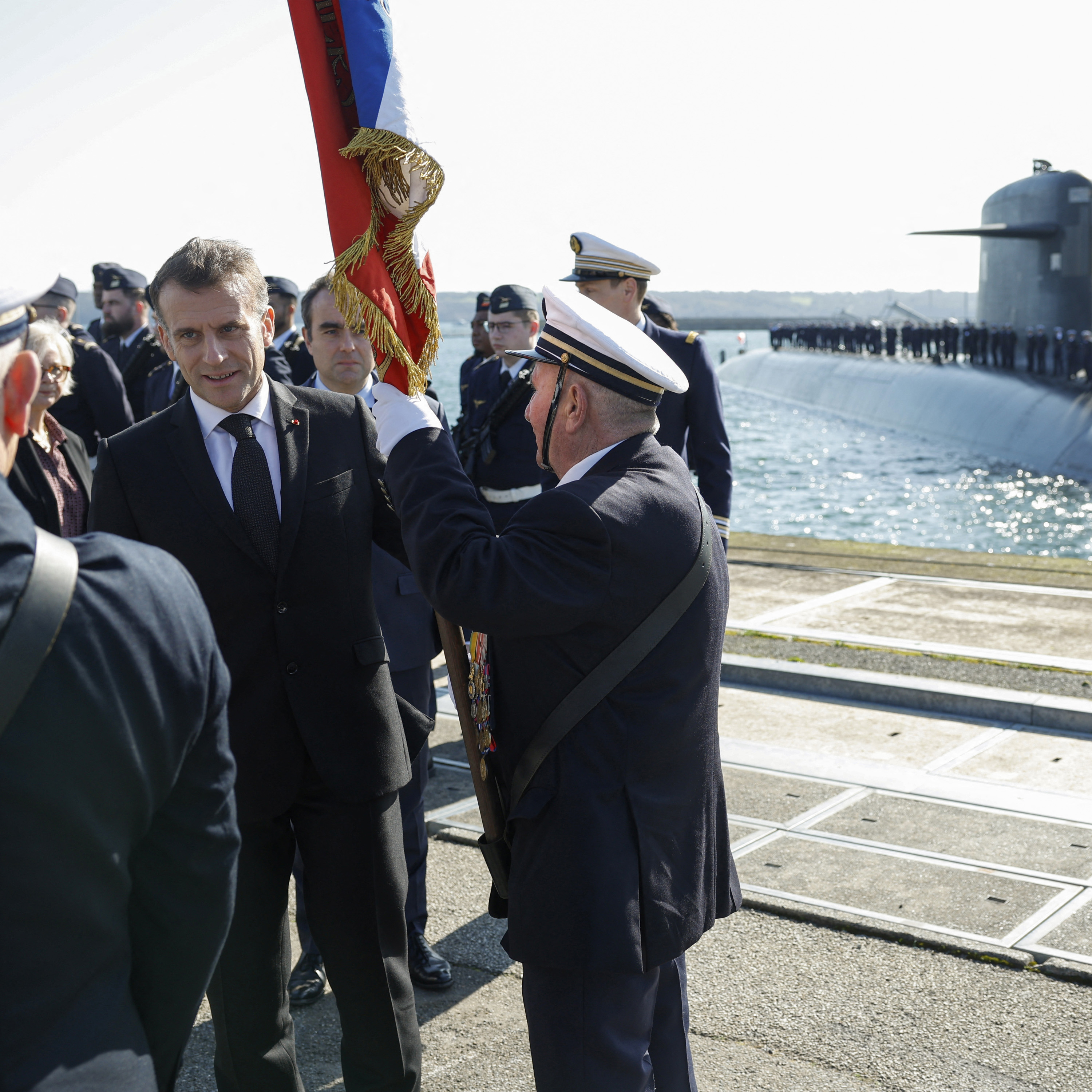
have quite a good evening. French President Emmanuel Macron was one of the singers and it was
as part of a speech this week. Widely, I mean, obviously, as early a trailer trailed,
there's been other stuff going on, but it has been described as one of the most consequential
speeches on European defence since the end of the Cold War. So he announced that France would
increase the number of its nuclear warheads and then also open discussions with European partners
about effectively integrating France's nuclear deterrent into a broader European defence framework.
He mentioned, I mean, it involves cooperation in countries including us, the UK, Germany, Poland,
Sweden, Denmark, Greece, Belgium and the Netherlands. The kind of idea is that France would retain
full control over its nuclear weapons, but then the aim would be to kind of extend a kind of
European nuclear umbrella backed by French capabilities but coordinated with allies.
So a kind of mini NATO within NATO then?
Yes, so this is a kind of response to the fact that nuclear deterrents previously in Europe
was basically under the auspices of the US. But now for the first time since the Cold War,
a major European leader is proposing something different, but it is a pretty big change
and it is obviously born out of the way that people view the US and the breakdown of NATO
potentially more broadly.
Yeah, which is obviously a bit of a medium-term shift, isn't it, Harriet? People
obviously react to this news in the extent that they've seen it at all, as Jamie alluded to,
a lot of people will have missed this, which is why we're covering it. But when they see it,
they've been saying in comments on news websites, etc. All, you know, look what's happened,
look how France has reacted to what America and Israel have been doing. But
you can just see from the scale of that event, we just played a clip of, this has obviously been
planned for some time. I wonder what it has its roots in? Is it Trump's, you know, position on
Greenland? Is it Trump just coming back to office at all? Is it Russia's invasion of Ukraine?
Like, how far back do you have to go for France to be thinking we need to completely pivot on
nuclear weapons? Well, it actually goes back a really, really far away because France has always
been really protective of its nuclear deterrent and the independence of it. It stayed out of NATO's
nuclear planning group. So it's nuclear doctrine is actually distinct from NATO. So that goes back
to the start of its nuclear deterrent. And then six years ago, Macron actually offered
European allies kind of a similar chance of dialogue, a chance to have a conversation about
France's nuclear umbrella, which they sort of didn't, nobody went for. This goes a lot further than
that. So the key thing is what's happened in the last six years. So that's not just, obviously,
the big one is Russia's invasion of Ukraine, but also the US undermining the NATO alliance,
not seeming as though it would come to Europe's defence in the case of Russia more and more overtly
attacking NATO countries with undersea cable sabotage, with the cyber attacks that we've
mentioned, drone incursions, that kind of thing. And then there's also the big nuclear treaty
between Russia and the US has just expired. That was a legally binding limit on the world's
two biggest nuclear arsenals, and that expired last month. So all the treaties that have kind of
been governing the control of nuclear weapons since the Cold War have kind of disappeared or expired.
So that's the background to this, but the big, big moment, the big final thing was Trump's threat
to seize NATO's ally, Greenland, and threatened the sovereignty of a NATO country Denmark, which
was previously one of their closest allies. So it's been bubbling in the background for quite a
long time, but that was the big catalyst. What are the teething problems we might expect to see
with a shift like this Rebecca? Well, firstly, there's the fact that as Harriet was
leading to France has kept its arrangements quite separate from NATO's own nuclear project,
which obviously is very much dominated by US, US weaponry. One difficulty is going to be
France has said that they want to work with the NATO framework, although still not within it,
but several of the countries that it's proposing to work with are already involved in NATO's nuclear
project. So where you're going to see a bit of friction perhaps is in exactly what this joint
French orspice alliance is going to look like, because France has said, for instance, that it's
fighter jets that are unable to carry nuclear warheads, it's rough out fighters. They will
still be carrying them. They just might be in the future deployed to some of these other European
nations, whereas under the NATO system, there are several countries whose own warplanes are equipped
to carry US nuclear warheads. So it's going to be a slightly different way of doing things. It's also
just going to be a shift in the culture to get around. For instance, one of the things that's
been unveiled this week, sort of in tandem with this, is that there's going to be a French and
German joint nuclear steering group to kind of discuss doctrine and discuss what working together might
look like. And that is something that would have been unthinkable, you know, for decades really up
until the very recent past was France and Germany sort of working together on this nuclear project.
And at the same time, another thing we've seen kind of in contrast, though, is that when Macron,
I thought this was really interesting, when he announced that France was going to expand its
nuclear stockpile, he didn't say by how many, you know, how many new warheads to expect, which,
of course, is normal that he wouldn't necessarily divulge that information. But also, France's policy
going forward is going to be to keep its nuclear arsenal, the details of it private. At the moment,
it's sort of public information that it has around 290 nuclear warheads. But going forward,
they're not going to be, you know, keeping a public tally of what its arsenal actually is. And I
thought that was a really interesting, small but symbolic gesture of how they're thinking around
nuclear weapons is changing from a kind of almost like sort of wrote background, okay, we'll look,
we understand that we have nuclear weapons now we can talk to this idea that it is something that
that countries are increasingly thinking may actually have to be deployed, not just something as
this sort of background safety mechanism that we all understand would never actually be used.
There is a shift towards thinking, yes, on one hand, we need to start working more with our allies
about how we would actually, you know, what it would actually like in practice if we were to deploy
nuclear weapons. But also that we need to try and keep some of that core information private as
well because it is now something that we don't necessarily want our enemies to be able to keep track of.
Yeah, I mean, for years, Jamie, the conversation was about reducing the amount of nuclear weapons
in the world. I remember covering the 2010 general election and that was the Liberal Democrat policy
was we're not going to renew Trident. And okay, yes, you know, just the Liberal Democrats,
but Nick Clegg ended up as Deputy Prime Minister in that election. We're a world away from that now,
aren't we? People are accelerating nuclear weapons around the world, it seems.
Yeah, I wonder what happened to that Nick Clegg guy.
Yeah, I think it's, I mean, it's quite depressing, I think, from one perspective to just think
how much it has changed in like, say, 15, 16 years. I think the UK role is actually really interesting
as well. Obviously, with a kind of other nuclear power when it comes to Europe. And we are deterrent
is through submarine launch ballistic missiles carried by Trident. Those missiles are deployed
on our submarine nuclear submarines. But our, I'm like France, our nuclear forces is kind of
heavily integrated with the US. So the missiles themselves are at least from the US. And obviously
operational cooperation between our two countries, despite what we may have heard this week.
Yeah, it's integral to that system. It doesn't work without it. Yeah, we can't
transform our nuclear deterrent into a European one. But we have, you know, more broadly been looking
at kind of closer relations with France. And as the kind of idea evolves, it's possible that,
you know, we would want to take a leadership on this, you know, Starmer has put a lot of,
of his kind of cache into his position on the global stage. And so I wouldn't be surprised if
this does come about he wants to jump on board. I think it's interesting, kind of, you know, a lot
of the conversation has been about, you know, why would France want to do this. But I think it's
specifically the thing that I've found most compelling in this case is it's specifically about
Macron and Macron's legacy. He can't run again in 2027. This is kind of his final act. And he's
kind of constantly wanted to reshape Europe into a kind of closer cooperation, particularly on
European defence, but also industrial policy and kind of a kind of independence from the US.
If this succeeds, I see this as being obviously a massively defining achievement of his.
But it's a big if. And I think there is a part of it that is just like, I've been building up
for this moment for quite a long time. I've only got maybe 18 months left in the job. I've got
to put a stamp on, you know, otherwise, how do we view Macron when we look back at it? It isn't,
he wasn't the Obama-like figure that everyone thought he might have been when he first came in.
Certainly not in terms of French politics. So yeah, this seems to be a kind of legacy thing.
Yeah, but what does it mean, Harriet, when the personalities change? And, you know, the legacy of
what a moderate centrist president did feel completely out of step with who they vote in. We could
end up with Le Pen running France. We could end up with the AFD in Germany and reform in the UK.
Then what's the point of having a new click operation? It's bigger than the holders of the office,
though. These are not decisions that can be just overturned or undermined in the course of one
term. Obviously polls do suggest the possibility that a far-right candidate could replace
Macron as France's president next May. They don't suggest the same in Germany or the UK in terms
of far-right candidates replacing the leaders in the next year. So that's not relevant. In terms of
the UK France cooperation, last year France and the UK already committed to a nuclear policy
coordination, like cooperation of unprecedented levels, which was the Northwood declaration.
So that's already in the bit mix as well. But this is a much more macro story than France.
There are two big things that we haven't mentioned. Firstly, China. China is absolutely racing
to produce nuclear warheads and build up its military and is becoming increasingly
belligerent towards Taiwan and, you know, in the South China Sea as well. North Korea has been
repeatedly threatening South Korea and the rest of Asia with nuclear warheads, too.
As we said, the trust in the US protection in NATO has collapsed. So there's all of that,
but the other big thing is the EU. Because yes, the UK and France were Europe's big nuclear powers.
But now the UK is out of the EU in the last 10 years, leaving France as the only nuclear power
in the EU. And the security framework on the continent is shifting slightly from where it was
previously defined around NATO. Now it's becoming more and more defined around the EU.
Because obviously a lot of European countries are starting to think that the NATO alliance doesn't
really mean much. So in that sense, you can see this as a really defining moment for the Franco
German alliance taking center stage in the EU as the security leaders. Because obviously Germany
has lost Russia a really big ally in the past. And yet the technology remains imperfect, Rebecca.
You know, as you were saying, really, the point of it is to get to the negotiating table or
stay away from the negotiating table, but in either case, because you have theoretically the weapon.
But as soon as you actually have to deploy it, as we've seen in Catherine Bigelow's
film A House of Dynamite, you know, the system gives you what is it? Six minutes, 12 minutes to
respond. And a whole portion of the world gets taken out. I mean, it's not something that anyone ever
wants to do still. Yeah, and it is this real departure from the past policy in France, which is
one that was called strict sufficiency, which basically stockpiling just enough warheads to ensure
France wouldn't be targeted. And what Macron's moving towards now, this policy of
forward deterrence, which is, you know, extending the French nuclear umbrella out into allied countries
possibly at some point in the future, would be a significant shift towards recognizing that there
may be a day in the not too distant future where nuclear weapons will become, you know, something
that people are actively talking about deploying. Obviously, everyone hopes that that isn't the case,
but there is certainly a shift towards a reality of how would we actually do that? And I think it's
part of what we're seeing, like, and then we're talking about very faint stirrings here, like,
not to get too far ahead of ourselves, is that the EU, especially Western Europe, is looking at what
a post-US future might look like. I mean, obviously, the US will never be completely decoupled from
Europe. That's not going to happen. They're just too intertwined, you know, economically. It turns
of intelligence sharing culturally as well. But we are seeing a world where different countries
than Europe do maybe start to take on some of the roles that the US has occupied to agree. Obviously,
we're seeing France positioning itself as a nuclear force. And Germany's been taking on a really
prominent diplomatic lead. Obviously, there is a taboo that stops Germany really becoming the
military wing. And we've talked before about Poland's rearmament and its military force. So,
we are starting to see some stirrings of the EU. I mean, kind of doing what Donald Trump said
to be fair, which was that taking on more responsibility for its own security. Yeah, I bit, I mean,
it's the fact that he said that has made them then do it, even though what he said was the thing
that frightened everyone in the first place. And now they're doing what he wanted. So in a round
about way, I guess he's getting what he wanted. Okay, up next, going, going extinct,
bones under the hammer after this. Okay, Rebecca, it's your turn. What do you think this week
should be remembered for? What do you get the plutocrat who has everything?
Dinosaurs and fossils, but specifically dinosaurs, have always been in vogue, right? They've
always captivated our imagination. They've always been interesting because it's a tangible part of
our ancient history that we get to know through these amazing displays. And people are now starting
to see the value and investing in these assets. The dinosaur has always been privately owned. So,
I think that's a really important distinction that we need to make here. It's not being deaccession
from a museum's collection. It is a privately owned natural history object that is now being offered
for sale. Paleontologist Andre Leon, speaking to the associated press on Monday, Rebecca, what's the
story? So we found out this week that Trey, a 17-foot-long triceratop skeleton, is going to be sold
an online auction this month. Just as a side note, the auction house Jupiter was founded by Pharrell
Williams. The bidding is going to last for two weeks. Trey is currently in Singapore where he moved.
I feel straiting here because it's a skeleton, but he... Also, I mean, calling it Trey. I mean, now
you've mentioned the involvement of Pharrell. Trey sounds like a rapper, but was he always called Trey?
Yes, he was always called Trey. I don't think Pharrell is personally involved in naming exhibits,
but I mean... But I've been on the auction platform and it's all bling stuff, isn't it?
Rolexes with diamonds on and stuff. And dinosaur bans? This is very much part of the story. It's all
the evolution of dinosaur remains being sold at specialized specimen auctions. And more towards
auction houses that are more used to selling off, you know, Fabrier eggs, old masters, etc. But
the important thing with Trey and Trey is an interesting case because it's slushy has been on
display at the Wyoming Dinosaur Centre Museum since it opened in 1995. Trey was discovered by a
commercial paleontologist in 1993, but he has always been in private ownership. So although it kind
of may look from the outside like this is a dinosaur who's been on display that generations of
children have grown up visiting at this Wyoming museum. It's going from the public into the hands
of private owner. In this case, it has always been in private ownership. It was on loan, like long
term loan to this Wyoming museum. In 2023, it was sold in a private transaction and it's now in
Singapore where, by the way, potential buyers can view it if they are interested until the auction,
which takes place. Well, it begins later this month and it's going to last two weeks.
Yeah, but is that a worthwhile distinction to make Jamie when you're talking about the ethics of
the private ownership of dinosaurs? Because it may well be that the former owner was philanthropic
and put it on display in a museum, but the point is the next owner might not be. They might just
keep it in their house, right? That's the issue. Yeah, I actually, it's interesting how much
of a kind of internal anger this brought out in me in that I seem to, I seemingly, despite
never really thinking about dinosaurs since I was about six years old, seem to believe that every
dinosaur, like fossil, should be available for public viewing. Like, I feel like it's a worldwide
public good dinosaurs. And I don't know where that's come from, but that's my, that's a real
in deep feeling that I have where I'm just like, I don't think you should be able to privately own
dinosaur stuff because like, you know, it seems quite an important part of our historical
world, the world's history, I guess. We've all seen Jurassic Park. We see where it can go wrong.
Yeah. Yeah, yeah, yeah. I think it's interesting what Rebecca was saying about an object
art. I hope I pronounced that correctly. But it's particularly that dinosaurs are kind of being
seen now as being something that people do want to buy in the same way as Faberiergs or
Grandmaster Papers like paintings. And I guess it's the rarity aspect of it, but also the visual
impact, like you say, we've all seen Jurassic Park. I imagine if you are a private collector and
you're able to put to show an incredibly almost close to full skeleton of a dinosaur in
your back garden or in your, in your front lounge or wherever, I guess that's very important.
And then I guess it's the investment side of things, which is very boring, but I guess it is
an alternative investment, like we've seen with lots of other interesting kind of rare collectibles
or whatever. People are now looking at where they can put their money. There isn't just
property or gold, but now interestingly, dinosaur bones is one of those as well.
Yeah, what do you make of it, Harrier? Well, I'm sort of on the other side a little bit. There
are obviously ethical. You're saving up to invest in a dinosaur? I mean, I've been obsessed with
dinosaur fossil hunting for a very, very long time. But the thing about dinosaur bone ownership
is that historically speaking, it was mostly private collections. I mean, this goes back to,
you know, the era of Roman emperor Augustus and his collection. And in ancient China,
where they were known as dragon bones and they were very much in demand as an ingredient for
traditional medicine. But for most of the European and the American dinosaur fossil hunting history,
it was private fossil hunters. So either in the case of the UK in the 1850s, when the first
complete skeletons were uncovered and dosed it, there was like Victorian amateur fossil hunters
like Mary Annning. And then in the US, when the Transcontinental Railroad opened up the American
West, so all of the like Wyoming, Colorado, Nebraska, where a lot of the best known species have
been found, it was a heated rivalry between two leading paleontologists that found a lot of the
best specimens that we know and love. And then when Jurassic Park came out in the 90s and there was
this big dinosaur Renaissance and kind of interest sword fossils are regularly sold for millions of
dollars, but they're also regularly donated to natural history museums because they don't budget
for acquisitions unlike art museums. Obviously, they can't compete with billionaires and bankers,
but a lot of those billionaires and bankers do loan or donate these specimens to big natural
history museums. And also, this is also a failure of US and British law to be honest, rather than the
consumer. Because in the US and the UK, the law treats dinosaur fossils more like a sort of mineral
right. So there are commercial perspectives in the US, whereas a lot of countries where there are a
lot of dinosaur fossils like China, Mongolia, Brazil, Argentina, they treat dinosaur fossils as
cultural heritage and don't allow them to be exported. So if most of history specimens that we know
were found by amateur enthusiasts, then why exclude those people from the entire conversation?
I mean, are you still a amateur enthusiast, though, Rebecca, if you've got this kind of money,
a seven figure sum or more to spend on some bones? As you were leading to earlier, you're just
a very, very narrow window of billionaire looking for a toy.
Yeah, we do actually have a living insight into who is buying them because I went in thinking it
can't be as simple as the generation that grew up watching Jurassic Park have now, you know,
become sufficiently old and established that it's produced billionaires and millionaires who
want to indulge that childhood fancy. But I fear that might actually be the case. This London art
dealer described kind of the scene. He said the demand is growing exponentially. From our experience,
they are professionals in their 30s and 40s working in the science or tech space. And he also said,
I thought this was interesting. The trend is people with dinosaurs, which are, I would say,
more private collector-friendly size-wise, they can fit into a home. So these are very much people
who are looking for, I don't know, maybe a velociraptor, something that you could fit in in the
abstract fashion as you walk in. But if you can buy a gemstone, why not a fossil?
Yeah, I mean, to be fair, though, I think that although the market is definitely booming and we're
seeing like really, really massive sales, it's interesting to look a bit into what happened to
those most headline-grabbing sales because the most ever paid for dinosaur remains at auction,
that record was set in 2024 as a stegosaurus called Apex, which sold for $44.6 million.
And it beat a previous holder, a T-Rex skeleton called Stan, which had sold for $31.8 million
in 2020. But if you look at what actually happened to them afterwards,
the, you know, I think it's easy to imagine that these private owners are like
bored, salty, 19-year-old, airs who are just flinging their T-Rex into storage with 10-land
bikinis. But some of them are very passionate about paleontology. So the billionaire who bought Apex,
the stegosaurus, hedge fund manager Ken Griffin, has loaned it long-term to the American museum
of natural history. And Griffin has been a major donor to that museum in the past, so it's
viewable to the public and more significantly, it can be studied by the museum's experts.
And Stan the T-Rex, who is named actually after one of these amateur bone hunters who found
the first fragments Stan Sacrason, Stan the T-Rex, not Stan Sacrason, is on display at the new
natural history museum in Abu Dhabi. So, you know, there have been instances as well of private
individuals who are buying remains specifically to gift them directly to the museum, so not to
loan them. But again, it comes back to you that depends on the magnanimity of the owner,
and it evokes this kind of Victorian philanthropic model where access to this heritage and to that
knowledge is controlled by benevolent capitalists, and they can provoke it at any time, you know,
one of the, a professor at the natural history museum in London, Paul Barrett told the financial
times, all you see are the numbers going up and up. Everybody can agree that there is a point
where this is not helpful for science, but it remains to be seen, you know, what the alternative
would be, because if these commercial paleontologists weren't being funded by these big sales,
is there an incentive for them to do it or to do it at the scale they're doing it now? And so,
the question is, is it better to have these artifacts in private ownership than not have them at all
because they are still buried because there isn't the commercial incentive to be excavating them at
the scale that they're currently being excavated? Yeah, because the alternative Jamie,
so that the institutions would be able to afford to display them is that it would cost 300 pounds
a ticket to go and look at the dinosaur. So, I mean, this is back to the argument we were having
before around BP and their sponsorship at the Science Museum and, you know, the National Theatre
and the National Gallery is reliant on a lot of money from corporate sponsors. It's the same
thing, isn't it? It makes it actually better for everybody to be able to see these artifacts when
they are donated. Yeah, and I mean, I'm not suggesting kind of like forced collectivisation of
fossils from around the world in a kind of, you know, Tyrannosaurus Soviet Union. So, anything you
can't force collectivisation of? Yeah, exactly. Yeah, if you have the, as long as you control the
means of the dinosaur bone production, you're fine. What I would say is one, like, I think there's
probably like three possibilities. And I kind of, I think there does need to be more regulation as per
everything in the world. And it seems like that's my answer to a lot of things. I think there's a
big distinction between what scientists find, you know, what is scientifically valuable. And maybe
it's a case of being like, does science and scientists and paleontologists or, you know, things that
could help us understand better? Do they get like first dibs on access to it before it goes into,
like being sold? It is it that you can have it in private ownership, but you have to give access to
your national museum or, or it's for them to study it. Because obviously there's some dinosaur
bones that they like just don't care about anymore, that they've got all of the information they
need out of this. And then it's perfectly fine for, for all Williams to have it in his house. But I
think there must be a kind of hybrid system that means that we aren't in a situation where
things are being bought and we're relying on people being benevolent in order to be able to see
or access or to understand it. So I admit it's tricky. And I don't think there's going to be like a
a big blanket rule, but I would always err on the side of like, I don't want just the rich capitalist
to be able to hold all of the stuff that could be really interesting and make a massive difference
to our lives. Well, where Jamie always falls down on the, we need more regulation. I always fall
down on the, well, if governments properly funded the arts and science and cultural heritage,
then this wouldn't be so much of an issue and there wouldn't be such a gap and there wouldn't be
such an incentive because obviously the demand is there. People want to see dinosaur bones and
fossils, you know, one in the natural history museum, one of its biggest draws is Dippy, the
Diplodocus, you know, it's people are desperate to see these fossils. And if governments around the
world won't properly fund exploration of cultural heritage, paleontology, the arts and scientific
research, which in the, in the case of the UK, they don't, not properly, then I'm sorry, but like
at least somebody is finding that at least they're being taken out of the earth before they're
exposed to the elements and disintegrate naturally in the process of geology anyway. You know,
there's a fundamentally going to look for dinosaur fossils is very, very, very expensive time
consuming endeavor with absolutely no guarantee of success. Somebody has to fund that.
The problem is when it's state funding that's trying to compete with commercial interests,
you end up at a point where can the state justify spending any more when the money on the commercial
side is so limitless? It's making me think of, you know, the BBC competing for rights to sports
broadcasting, you know, you can't compete with public money when it's going up into the millions
and the billions, which seems to be the case at the moment. It's just the the spiraling of the
cost means that even if there was more public funding, just museums just won't be able to compete,
but it, but then it comes down to what's the alternative. There has been a suggestion, some
paleontologists back this idea that museums should be offered dinosaur remains at a reasonable
price before they go on public sales, they get kind of first right of refusal, but obviously this
would require like huge logistical effort to enforce, like who would decide what was a reasonable
amount to pay, how would you enforce that around the world with different laws about excavation
and export and sales, and what institutions would get offered first, you know, would it be a case
of, you know, we're talking now about kind of commercial buyers getting one up on museums,
but if museums are being offered first, would it be a case that the natural history museum is
getting a one up on a smaller institution, for instance? I think there's always going to be this
tension over on where these remains should be displayed. I mean, for my part, I would be happy with
just one of the props from Jurassic Park, and I feel like that's an achievable auction goal for me
one day. Next up, it's a game of two halves, it's a nation of two halves, the footballers doing it
all for Kim. Harriet, you're finishing the show, what do you think this week should be remembered for?
Champions of Asia will never sing that. There are the two teams in the tunnel,
DPR Korea, a decorated history in this competition, but for them, it is history. They have been three
time winners, but the most recent was back in 2008, and they haven't actually played in this tournament
since 2010. Their last game was a losing final to the host nation of this competition, Australia.
The live commentary from the start of an AFC Women's Asian Cup football match between
Uzbekistan and North Korea. This happened in Sydney on Tuesday, Harriet, not the sort of thing we
usually cover. What's the story? It's a story of a big football comeback. This is the world's most
secretive country, and one of the most deeply patriarchal at a state level, and their women's
football team is back in international competition for the first time since 2010. North Korea's
Women's Football, the senior team, is back in the Asia Cup tournament, and they won their opening
game against Uzbekistan three-neil. It's just such an incredible story of this senior team basically
disappearing from global competition for 15 years. Their youth teams continued to excel. There's
actually quite a few of their under-17 World Cup title players in their starting lineup,
but their senior team, they were absent, but we can talk about why for a long period of time,
but their Eastern Azaleas, as they're known, are back and they've been invigorated by this whole
generation of youth World Cup winners, and they are among the favourites to win this competition.
Okay, well let's talk about why they were absent, because I don't want you to float that idea
and then leave people thinking about that, because there's so much more to say. There was a bit
where they weren't so dominant, and why was that? Well, we can talk about how they rose to dominance,
because it's a very interesting story of the history behind it, but basically in 2011,
they were, at that time, riding high, one of the best teams in the world in Women's Football,
one of the best teams in Asia, and there was this major doping scandal. Five of their players
of the national team tested positive for a band steroid at the Women's World Cup in Germany,
and North Korea's defence was that these players had all, all five of them, been struck by lightning,
and given a traditional Chinese medicine derived from the dear musk gland, which caused the positive
test results. So they were banned from the 2015 World Cup, because they were banned for four years,
then they failed to qualify for the Asian Cup. I mean, it's bad when your corruption is so bad
that even FIFA doesn't take it, but they then failed to qualify for the Asian Cup in 2018
and the World Cup in 2019, then because of the very tightening sanctions on North Korea,
the players were not able to sign overseas contracts, and then the pandemic hit, and North
Korea just completely shut its borders and withdrew from both the World Cup and the Asia Cup.
So this is the first time that they're back. Okay, thank you for that. Right. So the
Talon Pool was a bit decimated by the fact they couldn't compete internationally for other
teams, Rebecca, but then that tells you, doesn't it? Just what a powerhouse they've managed to build
in North Korea that they could build a whole new team not playing for other international teams,
but just in North Korea on a world-class level. Yeah, I mean, and they are, they are a bag, baby,
in the qualifying matches for the Asian Cup currently, they won the 6,010,010,0, which is a
pretty impressive record. But a huge part of this renewed flourishing is North Korea's huge
investment in youth football, because obviously during this kind of fallow period, the youth football
system was still going strong, and so now they have this renewed senior lineup. Both boys and girls
are identified from a very young age in North Korea if they have talent in football and they are
trained in these very top-level elite academies, the latest technological, medical, nutritional
advancements, you know, really in North Korea is investing a lot specifically in this, and that
then is developed into the adult system, including in the military, because North Korea is one of
the most militarized populations in the world. Boys start to undergo the draft process at 14,
and the majority of them are then drafted into military service at 17, and they're there for at
least 10 years. Girls are drafted a ratio of one for every nine boys and they serve then at
least seven years, from the age of 17. So there are millions of North Koreans in the military
at any one time. Some estimates say one in three North Koreans is in military service in some
capacity, and the military has its own footballing system, has its own football teams. So those who
have talent are then assigned to those teams and basically are just going to spend their entire
term of service training and playing. So there is this huge feeder system at all levels of North
Korean society, and then as for the question of why women specifically, why is North Korea so
dominant in the women's game, the creation of the women's world cup in the late 1980s was this
really precarious time for North Korea, because it's a chief supporter and kind of prop that Soviet
Union was flagging and moving towards, you know, collapse and post-Mal-China, but also becoming
a bit more open to the rest of the world. So to kind of make up for this dwindling geopolitical
cloud, sport was a way for North Korea to remain relevant and exert some soft power on the world
stage, and although the regime did have this ambitious plan to compete in the men's game, and it
still does invest heavily in the men's game, the women's game, obviously at this point, was so
underdeveloped and underfunded that it was a much more level playing field for country like
North Korea to kind of get in on the ground floor. And when it, you know, it's really a sign of how
little importance was assigned to the women's football globally in those early years, that just by
investing in it at all and having training programs and academies, they were able to produce
a world class team by the mid-90s. Okay, so that was then, but why now Jamie? You know, I sort of,
I understand what's going on in a North Korea's an authoritarian country. These people as Rebecca
saying would probably otherwise be in the military. So of course they're going to take this option of
playing football instead. And if they tell you to do it and they invest in it, you're going to
get good, but why does it matter? You know, the army matters to them. Why does women's football matters
to them? I mean, I think on our kind of macro level, sport is obviously a massive part of North
Korean culture. And we can kind of see that from the like absolutely bizarre friendship that Dennis
Rodman had with Kim Jong-un, Dennis Rodman's a form of NBA basketball player who would go
go over to North Korean was actually, but we're kind of widely seen as probably the only American
that was talking directly to Kim Jong-un. And he would go over and it was called basketball
diplomacy. And it was basically because Kim Jong-un had grown up loving American sports and
Dennis Rodman played for the Chicago Bulls in the 90s with Michael Jordan. So it was a big thing.
And sport is a big part of the culture there. And I think it's a kind of rare opportunity for
the regime to project a positive image of themselves and their country abroad. National pride is
obviously a big thing. And the idea that the country can remain strong on a kind of international
setting, despite obviously economic sanctions, the isolation, the kind of towing and throwing with
South Korea and all of that and all of the issues there. International tournaments in general
are one of the few moments when North Korean athletes do get to interact directly with the outside
world. It obviously means a lot to the people in North Korea. I think it's I was reading when you
read about this kind of stuff. The other stuff that always comes up is the kind of psychological
edge that they have now, which is that basically they're told that they're representing the strength
of the state and the leadership of figures like Kim Jong-un and they're kind of messaging that
can produce that teams that seem extraordinary disciplined and mentally resilient. The training
regime sound absolutely incredibly demanding. And obviously fitness is a big part of why they've
been successful. But it is funny that even in the stuff that I'm reading, we are still massively
othering these people in a way that is kind of quite, we've talked about it on this podcast
before, that is quite bizarre. You know, we talk about these people almost kind of as if they're not
human with some of their further and passion for the way that they perform. And I was really struck
by this kind of concept of psychological edge that a lot of their articles talk about and kind of
why they do so well is kind of almost there's hints of, well, they're kind of cheating by the
indoctrination that they've been put under. And I think that's, it speaks to how we still see
North Korea as a kind of hermit state that actually even, you know, in 2026 when we know that these
people are human. We're still spending our time almost suggesting that they're not.
But there is there is there is a big, big element of state sponsored indoctrination that I mean,
I think that it would be naive to suggest that that wasn't that didn't play a part that is
such a tightly controlled regime in terms of the information that people get, the control that
the state has on its population. But it's also like it's, it's a question of nationalism more
than more than women's empowerment. And this is, I think, the really interesting thing with these
seemingly very patriarchal communist regimes like China and North Korea. It seems paradoxical
that they would be so invested in women's sport. But actually, they proclaim women's empowerment
in theory, in their policies, even if not necessarily in reality. What's about gender equality,
isn't it? They say socialism means gender equality. Yeah, it's, so North Korea really encourages
women to participate in sport as part of that policy. And the media coverage in North Korea,
unlike a lot of the media coverage here, does not include any sexualized representation of female
football and it doesn't make it seem marginalized. But this isn't really feminism as much as its
nationalism. You know, this is an opportunity to, it's a tool of propaganda to kind of boost nationalism
among the people of North Korea's strength, the strength and national pride use it to glorify
the country and the regime. And there's also a big element of motivation for a lot of these
players who don't come from Pyongyang, they come from rural areas that suffer from major food and
health care shortages. If they get into a football team, it's like winning the lottery. If they can
get out of the rural areas into Pyongyang and get the support of Kim Jong-un who's said to be a
big football fan, it's, it's a life-changing opportunity. Yeah, so does that mean it's different
than Rebecca? You know, if you get into team GB, you get a stipend, don't you get supported by the
government? You are not indoctrinated, but you're certainly told what the goals and mission
statements of Great Britain are and you're out there as our representative. All of that is in
place in most countries. What's different here? Well, I think you are being put on, you're really
being put on a pedestal within North Korea first. I mean, I understand what Jamie was saying,
you know, the way that we talk about North Korea is sometimes like it is an alien culture, but it
is very difficult to know what is genuine outpourings of enthusiasm. I mean, you can see that it absolutely,
there could be vast amounts of enthusiasm because it's a domestic moral booster to be on performing
well on the world stage, but also if you have control over the entire media, media ecosystem and
you've completely cut off access to the media of the outside world, you can really emphasise the
impact of having a top flight women's football team. If you also have the means to tell your
population that women's football or under 17's football are some of the most prestigious and most
followed events in the world, like it's very easy to magnify the impact as well. But at the same time,
you know, the North Korean government took the unusual step a while ago of releasing footage of
people celebrating on the streets of Pyongyang as they watched an under 17's game. I can't
remember it was men's or women's, but either way, it's not something that would stop traffic in
most countries around the world, but people were, you know, shouting and crying and stopping their
cars by the side of the road to watch this game, which by the way was a pre-recorded broadcast
because they never broadcast anything live. So it is difficult to work out exactly how big of a deal
this would make you within North Korea, but it is certainly a life-changing opportunity domestically,
but there is a ceiling on the success, too. And this comes back to who talking earlier about the
sanctions, which mean that North Korean players can't sign contracts with foreign clubs. And that
means that for both the men's game and the women's game, which obviously is now developed to a
much higher level than it was in the past, these youth programs in North Korea can only get the
country so far because to be really competitive at the senior level, North Korean needs players
of experience in the world's best leagues, but because of those UN sanctions, they can't do that.
So at the moment, you know, they've had massive success in the UC, and they're probably going to
continue to do that because every country is training its own youth, right? They're not
going and playing seasons with Real Madrid. And same with the women's game, because the women's game
has been underdeveloped for a long time. But I think we are going to start to see a bit of a gap
because as the women's game has has become more developed and the top women's players are
playing internationally at different clubs, you know, the level of the game has really advanced.
I do think in years to come, North Korea's women's side is going to struggle to compete in the way
that we already see the men's side is held back by the fact that their players aren't getting that
internationally experienced. You're nodding, Harriet. So do you feel like North Korea isn't a hot
tip there? And I shouldn't be putting my money on North Korea to win the women's world cup in five
years time? I mean, we don't know yet whether they can qualify for it, but the women's world cup
is actually next year in Brazil. Yeah, so I mean, I mean, you know, in the lengths of time,
sure, I appreciate that every four years. We don't know whether North Korea can qualify for the
senior women's world cup in Brazil next year. But this Asian cup is going to be a very good glimpse
because the squad is kind of relying heavily on these youth sides that are like they're the under 17
and under 20 reigning champions and they've won record titles in both. They are absolutely dominant
and some of that generation is now some of them are in this starting squad. So we don't know much
about these players yet. We really, they're really unfamiliar to us. And so we have no idea, but
North Korea are heavily tipped as the favorites for the Asia Cup, although the reigning champions
China also have an amazing women's side. But I think my big takeaway from this story is an unlikely
takeaway of a positivity for North Korea, because as Jamie says, we do very regularly talk about
North Korea on this podcast in a way that is either in the through a very negative or very
othering lens. But in terms of what we can take away from it is look what they were able to do
in such a short time with targeted investment. Like what an incredible story. I mean, these women
have trained their little legs off like this. This is an absolute. It is whether or not you can talk
about the fact that it's used as a tool of political propaganda or to ferment nationalism or to
reassert power on the world stage. That is a different story to how much of a success the
investment in the women's game has been. Well, as Kim Yongan himself has said, when young people
are powerful, our party and people's army are powerful. And there is nothing for us to be afraid of.
Something to cherish in this difficult week. I'm sure you'll all agree. Harriet, Rebecca, Jamie,
thank you. You can follow this show for free. You can get every episode as soon as it's released by
searching for the week unwrapped wherever you get your podcasts, including YouTube where you can
watch us as well. And you can also get six free issues of the week magazine with a trial
subscription if you go to theweek.com slash subscriptions. In the meantime, I've been Oli Man. Our
music is by Tom Morby, our supreme leader, Oli Peart at Rethink Audio. And until we meet again,
to unwrapped next week. Bye-bye.