About this episode
When gas prices go up, Americans freak out. It doesn’t matter that gas prices often fluctuate independently of all the other stuff we have to buy and pay for; more expensive fuel makes an impact on the consumer psyche. In this episode, Americans’ unique emotional relationship to gas costs. Plus: Airlines contend with jet fuel price growth and TSA shortages, the trucking industry is hit by a diesel price-immigration restriction double whammy, and a federal tax code change could reduce charitable giving.
Every story has an economic angle. Want some in your inbox? Subscribe to our daily or weekly newsletter.
Marketplace is more than a radio show. Check out our original reporting and financial literacy content at marketplace.org — and consider making an investment in our future.
Get every episode summarized
Each time Marketplace publishes, we email you a written briefing from the transcript — the topics, who appeared, and any specific claims, with the ad reads skipped.
Email me new episodesFree for 3 shows. No card needed.
Hosts & guests

Transcript ready
322 searchable segments. Every word is indexed and playable.
Full transcript
Marketplace — Gas price vibe check. Machine-transcribed; use the interactive transcript above to jump the player to any line.
Running a business is hard enough, so why make it harder with a dozen different apps that don't talk to each other? Introducing ODO. The only business software you'll ever need. It's an all-to-one, fully integrated platform that makes your work easier. From CRM, accounting, inventory, e-commerce, and more. And the best part, ODO replaces multiple expensive platforms for a fraction of the cost. This is why over thousands of businesses have made the switch. So why not you? Try ODO for free at ODO.com. That's ODO.com. This marketplace podcast is brought to you by Wealth Enhancement, who asks, does your advisor do comprehensive planning? Statistics show that only 34% do, which means no tax strategies, estate planning, or retirement? That's not planning. That's portfolio babysitting. Get a wealth blueprint at no cost and see what else your plan should be covering. The way planning should be done for the life you want to live. Learn more at WealthEnhancement.com slash build.
On the show today, jet fuel, gas, and diesel, a lot of our economies still runs on them. From American public media, this is Marketplace. In Denver, I'm Amy Scott in Forkai, Rizdal. It is Tuesday, March 17th. Good as always to have you with us. We are now in today 18 of the war in the Middle East. Commercial airspace and much of the region remains closed. Oil prices are fluctuating, but high above $100 a barrel for Brent Crude, the international benchmark, and here in the United States, airport lines keep getting longer, as the partial government shutdown of the Department of Homeland Security stretches into a second month and more TSA agents don't come to work. You see where I'm going here. All of this is adding up for airlines. Marketplace's Samantha Fields has the 30,000-foot view
of the business of flying right now. Just a few weeks ago, airlines were paying about $2.50 a gallon for jet fuel. Today, it's closer to $4 a gallon. That is putting extreme financial pressure on airlines. Charles Duncan at Altitude X Aviation Group says no one has any idea how long these high fuel prices will last, which makes it nearly impossible to plan for. So I think everyone is, you know, taking a day-to-day week to week. The same is true with the closure of commercial airspace and the severe disruptions at key airport hubs in the Middle East, including Dubai, Doha, and Abu Dhabi. The industry has really had to shift capacity and passengers have had to scramble to find new ways to travel globally. The options for flying from Europe to Asia have narrowed. And Mike Stangle at Aerodynamic Advisory says in many cases, the new routes are longer. These detours can add significantly to flight time, which means more fuel. And higher costs. Airlines based in the go for more affected than others.
But Stangle says all are scrambling to adjust their operations and account for spiking fuel prices. If I were an airline executive, it would fuel me my number one concern on cost items. airline profits are highly sensitive to changes in fuel prices. And Dan Aikens at Flate Path Economics says as much as they can, airlines will pass higher prices on to consumers. The problem is once you start doing that, you destroy some of the demand. There's another problem too, he says. It's not just higher airfares that could make people less inclined to fly. It's also safety concerns. So for the conflict in the Middle East, plus long security lines and staffing shortages at U.S. airports because of the partial government shutdown. Combined, all of the microelements of this have the makings of a bigger macro problem. For now, demand for air travel is still strong. But the longer the war in Iran and the shutdown drag on, the more the risks mount for airlines and for the economy. I'm Samantha Fields for Marketplace. On Wall Street today, the major indices closed higher will have the details when we do the numbers.
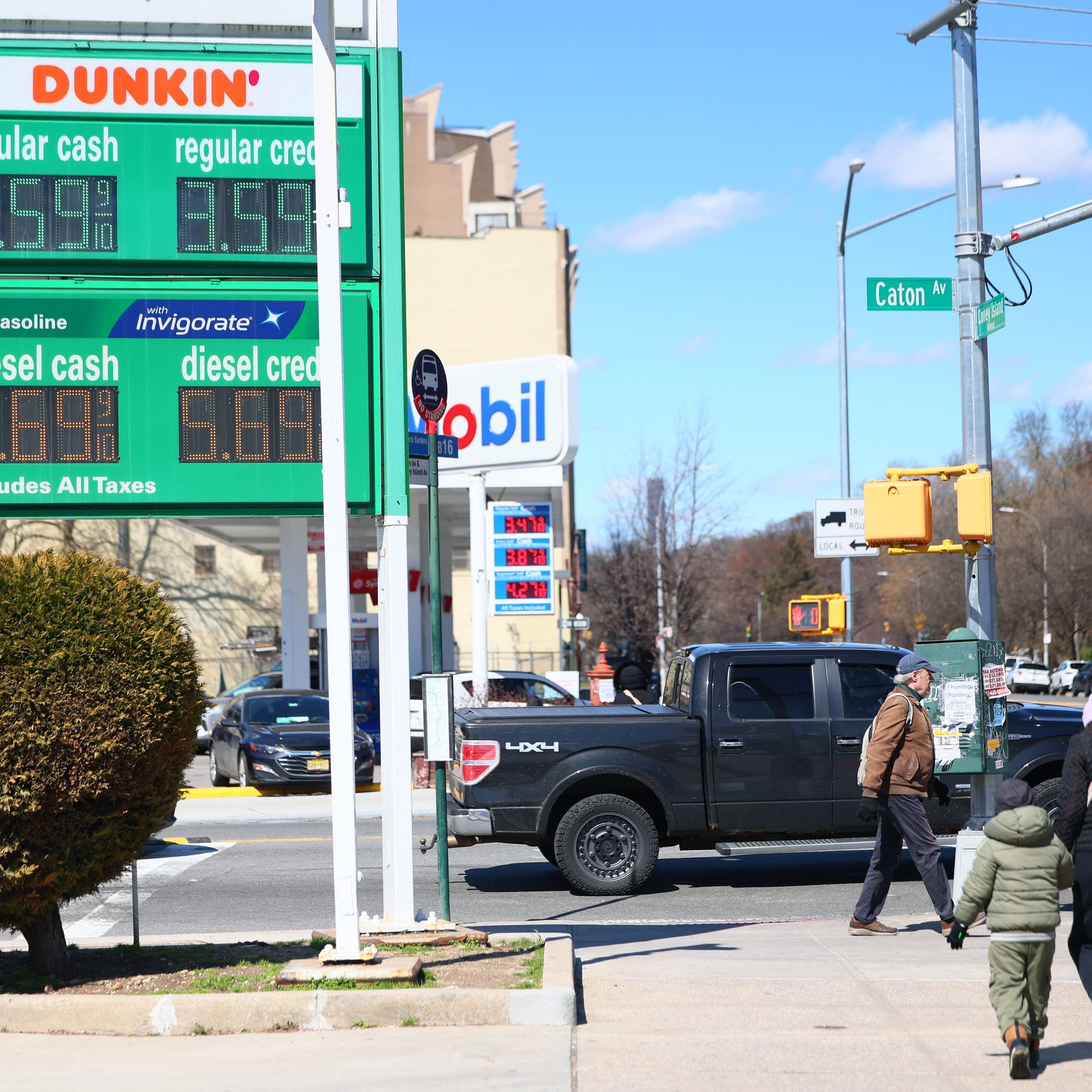
We've been talking a lot about the price of fuel in recent days because it matters to people's personal finances, of course. But gas prices also have a psychological effect. The National Association of Convenient Stores found that 70% of consumers say gas prices affect their view of the economy. In reality, though, the oil market is mostly its own beast driven by OPEC, inventory, and, as we're seeing now, geopolitical events. So why does so many Americans gauge the health of the economy by the cost of fuel? Marketplace's Kristen Schwab looks at Americans' unique relationship with gas and the cars it powers. There are a few people more sensitive to gas prices in New York City than taxi drivers. Raouf Kadeer is fueling up his yellow cab at a BP gas station
near LaGuardia Airport before his shift. I feel the gas every day almost. The fuel was like $35, now it's 51. Kadeer tracks gas prices and says this station usually has the best deal. A gallon of unleaded here today is $3.30. He opens up Google Maps on his phone and shows me prices at stations nearby. I stare at his phone, then look up at the huge neon green sign showing today's rates. I can't think of a single other price so prominently displayed. Plus, says Scott Rick, a marketing professor at the University of Michigan, there's the screen on the actual pump. You have to stand there and watch these numbers inflate and magnify in front of you and really feel it, you know, the money flying out of your possession. It's very visceral. Also, Rick says there's just no way to hide a rising price. Shell and Exxon can't make gas seem
cheaper the way, say, a potato chipmaker can by putting fewer chips in the bag. I can't tell you like 95% of a gallon and keep the sticker price the same. Sure, you can go electric or get a smaller car, or you can just try to drive less, but that's not as simple as other budgeting trade-offs, like buying chicken thigh instead of chicken breast. Rick says when gas prices go up, people feel a bit powerless. You know, you can play around on the margins, but you know, we still have to do the things we need to do. Like, go to work. Peter Norton is the author of Fighting Traffic, the dawn of the motor age in the American city. He says Americans are increasingly living farther away from their jobs. And so even a small increase in gas prices can be very expensive if you have a home where people are driving that much every day. Not only have commutes gotten longer, people are driving bigger cars. Americans like SUVs and pickup trucks. They're considered shockingly big
by world standards. In fact, a lot of the cars that we drive here are too big to be legally drivable on the roads of much of the rest of the world. And this appears to have something to do with people's need to express themselves or to say something. We invented the drive in and the drive through musicians write songs about pickup trucks and corvettes. I mean, there is a trend where Jeep owners leave little rubber ducks on other people's jeeps as a sign of mutual appreciation. Americans have a long and well-known tradition of loving the road trip, of loving the road adventure, of loving getting to someplace new, getting away. Sometimes this is called the American love affair with the automobile. Driving is freedom. Open road, windows down, music up, wind in your hair. At least when gas prices are low. Because when they're high, driving can feel like a burden, especially when it's your job. At the BP station near LaGuardia, cab driver Roof Kadir says rising gas
prices means he is making less. He says he needs to see prices go back under three bucks a gallon to feel good about the economy again. In New York, I'm Kristen Schwab for Marketplace. The war in the Middle East also has truckers feeling some sticker shock at the pump. Retail diesel prices are averaging above five dollars a gallon, according to AAA, nearly a buck 50 more than they were a month ago. At the same time, new restrictions on certain foreign-born truckers are pushing tens of thousands of drivers out of that workforce, with more on how shifts in energy and immigration are shaping the trucking industry, Marketplace's Elizabeth Troval reports. Diesel is a major input cost for companies like J.K.C. Trucking, where Mike Kaczarski is co-owner. I keep getting calls from drivers saying that they're seeing spikes from 90 cents to over a dollar in some areas. While a lot of fuel costs
get passed on to shippers through surcharges. The problem in the truck industry is we're always struggling because we have very low freight rates. Independent owner operators and smaller companies are more likely to eat that spike in fuel costs. Avery Vice is with FTR transportation intelligence. There will certainly be a lot of small trucking companies that aren't going to be able to survive this surge in diesel prices. That price pressure is happening as the Trump administration and states are moving to take certain foreign-born drivers off the road. For two decades that I have seen, where more and more unqualified drivers are getting behind the wheel. John Asparza is with the Texas Trucking Association. He says a lot of foreign-born drivers lack proper training. It is not about where you're from. It's how qualified you are once we put you behind the wheel. Amanda Shore with the trucking company Jetco says there's room for more qualified foreign-born drivers in industry. I go out to high schools and middle schools and talk
about careers in trucking. In general, I think that there are not a ton of people who necessarily have that desire or that interest to get into trucking. Analyst Avery Vice says he's noticed the conversation around immigrant drivers shift since the new administration took office. About a year ago, it was always a driver shortage, which then begs the question, why are they supporting an even deeper shortage? That's when it became a shortage of qualified drivers. He does expect immigration changes to tighten trucking capacity further while higher diesel prices take out certain small-scale operators. I'm Elizabeth Trophal from Marketplace. Moving on, it's tax season and one of the big changes from last year's Republican
tax and spending law affects how taxpayers calculate deductions for their charitable giving. That is likely to change charitable giving itself. The report out today from the Lilly Family School of Philanthropy at Indiana University says more Americans are likely to make donations under the law, but they're likely to give less money in total. Some $5.7 billion a year less, Marketplace's Carla Javier has more. The changes do not impact the return's taxpayers are filing right now, says John Bergdahl, one of the researchers on the Indiana University's study. But in terms of their actions this year and for the taxes they file next year, all of these effects that we're discussing today are in place. The vast majority of households take the standard deduction, which increased under the new law. Bergdahl says before the changes, these filers, they've not been able to get any sort of tax incentive at a federal level for their giving. But now the law lets a single filer deduct up to $1,000 of contributions.
That Bergdahl says should encourage more people to start making small donations. We see it adding a significant number of new donors, around 8 million new donors, back into the donor pool. Filers who do itemize tend to have higher incomes and make bigger contributions, says Erica York at the Tax Foundation. Under the new law, they need to give at least half a percent of their adjusted gross income. You have to give above that floor in order to kick in that itemized deduction. York says the law also limits itemized deductions for the highest bracket. So instead of someone in the 37 percent tax bracket, getting to deduct their itemized deductions against that 37 rate, they deduct it against the 35 percent rate. Ultimately, York says changing incentives may impact taxpayers on the margins. But overall, it's not going to be a massive effect. The Indiana University study estimated that the changes would result in about a 1 percent decrease in giving. And that's not great news
for nonprofits in today's environment, says Ray Mattoff at Boston College. Funding for all sorts of organizations has been drastically caught by the federal government. And there's nothing that will increase the likelihood of charitable giving making up that slack. Which Mattoff says puts charities in a tough position going forward. I'm Carla Javier for Marketplace. We've got to the point where all of our devices just assume that GPS is going to be there for us. We would be lost without it. But first, let's do the numbers. Dow Jones Industrial Average added 46 points, one-tenth of a percent to close at 46,993.
The NASDAQ gained 105 points, a half percent to finish at 22,479. And the SAP 500 ticked up 16 points, a quarter percent, and at 67-16. Samantha Fields was telling us how airlines are coping with high fuel prices and travel disruptions. Still, both Delta and Americans said today they're looking at strong revenue growth this quarter. Delta Airlines soared six and six tenths percent. American Airlines Group flew up three and a half percent. United Airlines holding gained three and two tenths percent. Southwest Airlines added two and two tenths percent. Bonds rose the yield on the 10-year T-note fell to 4.20 percent. You're listening to Marketplace. This Marketplace podcast is sponsored by the University of Illinois Geese College of Business. For many, the next step in their career is an MBA. But finding the time and budget can be a challenge.
The University of Illinois Geese College of Business offers their online MBA. The IMBA. It's fully online, flexible, and delivered at a fraction of the cost of a traditional MBA. Students get the same world-class Illinois faculty and an interactive global network all designed to fit their lives. To learn more about the Geese IMBA, visit onlinemba.illinois.edu. That's onlinemba.illinois.edu. No, it's not your imagination. Risk and regulation are ramping up and customers now expect proof of security just to do business. That's why Vanta is a game changer. Vanta automates your compliance process and brings compliance. Risk and customer trust together on one AI-powered platform. So whether you're prepping for a SOC 2 or running an enterprise GRC program, Vanta keeps you secure and keeps your deals moving. Companies like RAMP and Writer spend 82% less time on audits with Vanta.
That's not just faster compliance. It's more time for growth. Get started at vanta.com slash marketplace PM. That's vanta.com slash marketplace PM. Running a business is hard enough. So why make it harder with a dozen different apps that don't talk to each other? Introducing ODO. The only business software you'll ever need. It's an all-to-one fully integrated platform that makes your work easier. From CRM, accounting, inventory, e-commerce, and more. And the best part, ODO replaces multiple expensive platforms for a fraction of the cost. This is why over thousands of businesses have made the switch. So why not you? Try ODO for free at ODO.com. That's ODO.com. Advanced manufacturing demands precision. Aerospace demands trust. In Puerto Rico, companies like Honeywell, Luftonza Technic, and Collins Aerospace deliver complex engineering and high-value production within a U.S. jurisdiction. That means federal regulatory alignment, strong IP protections,
and fast access to the U.S. mainland. Plus competitive tax incentives and a STEM-trained workforce. From aerospace to advanced manufacturing, the infrastructure is proven. And the talent is here. It's not what's next. It's where. Puerto Rico. Visit investpr.org. This is Marketplace. I'm Amy Scott. I don't have to tell you that medical care in this country is expensive. But here are some striking stats, anyway. According to data from KFF, 41% of American adults report having debt due to medical or dental costs. And all of that collectively adds up to $220 billion in outstanding bills. But there are resources out there to help with some of that, and people to help find those resources. That brings us to the latest installment of our series My Economy, where we're bringing you stories from health care all this week. My name is Beth Scott, and I am the Director of Case Management at the Patient Advocate Foundation.
And we are located in Hampton, Virginia. I'm actually a surgical tech by trade. I worked at a doctor's office for 20 years where I did lots of surgery authorizations. I realized that I really couldn't help the patient as much as I wanted to, and I didn't really know what happened to that patient after surgery. So I came here in 2015, helping patients with insurance denials, appeals, and I've just really loved being able to help the patient more. We're in demand now, probably more than ever, especially with all the changes that have happened with health care and premiums that are outrageous. In this time that I've been here, resources have gotten fewer and far between, and mostly since COVID. Sometimes we don't know where to start with a patient when they have so many needs. So when you get sick, you have to think there's more than just the sickness. There's a lot of other things. What am I going to do with my kids? Who's going to pay for food? Who's going to take me to my treatment?
So do we focus just on the rent and find them a grant, which is few and far between? Or do we try to look what's going to be able to help them in the long run? Is there premium assistance out there for their type of disease, for example? Do they have a plan that we could maybe find a supplement plan? Could the patient benefit from being on Medicaid if they're disabled? And we do have to be very honest that sometimes we may not be able to resolve all of their problems because the resource is not out there. So we do have to be very creative in what else we can find. It's not an easy job because you know all of our patients are sick. All of them are calling at the worst time of their life. They may have just been diagnosed. They may have been diagnosed a couple of years ago and they've run out of their funds. So it's not an easy job, but we do have wins. I did have a patient who had a cancer diagnosis.
Treatment was off-label for his diagnosis of cancer. So we do all levels of appeals, first level, second level. And we were on the third level and he was almost giving up. I mean the doctor had put him on something else in the meantime with hopes that he would get this. And he was actually approved for the off-label medication or immunotherapy. So you know it's a big win to that patient, but that was just one of many. Unfortunately we were founded because insurance is challenging and insurance is complicated and sickness is complicated and I don't think anybody ever thought when you get a chronic illness what's going to happen to everything else in your life. So we try to take that from the patient when we talk to them. We try to say okay you focus on getting your treatment and let us fill out these applications let's look for these social programs to see if we can find help. It's a fulfilling job I mean it is hard.
If everything were perfect we wouldn't we'd be out of a job I guess. But it is very rewarding on the other end as well. Beth Scott is Director of Case Management at the Patient Advocate Foundation in Hampton, Virginia. Whatever is going on in your economy we want to hear about it. Let us know at Marketplace.org slash my economy. The Straight of Hormuz through which 20% of the world's oil travels in normal times is now a GPS dead zone. The signal is being jammed as a form of electronic warfare and that's one of the reasons why it's so hard for ships to go through the street right now.
Christopher Mims is a technology columnist at the Wall Street Journal and wrote about the phenomenon. He says these jamming devices are cheap and small and increasingly used in warfare and beyond. GPS gamers really took off with the conflict in Ukraine because Ukraine was relying on GPS for two things. One was to help guide their drones and then also because there are a number of so-called smart bomb smart munitions that were relying on GPS in order to find their target. And Russia figured this out pretty quick and according to some public testimony the effectiveness of one GPS guided bomb that the US used to use a lot went from 70% hit rate to 6% hit rate in the span of just a few months. And you write in your piece that that's a big factor in the current war in the Middle East. The Straight of Hormuz is basically a GPS dead zone?
Yeah it's worse than that. There's a ton of spoofing happening in the Straight of Hormuz which is a little more sophisticated. That's where you have a device that's smart enough to guess what signal a GPS receiver is looking for and send out a more powerful version of the GPS signal that usually comes from satellites. But it's a little bit off. It can make your GPS receiver think that you are very far away from where you actually are. How are these devices being used outside of warfare? People will sometimes use very small GPS jammers. If for example they don't want some kind of maybe company mandated tracking device to be operational. So that obviously is a gray area. So for example there was a New Jersey truck driver who was fined almost $32,000 by the FCC after his truck's GPS jammer disrupted air traffic control signals. And they're having some negative
effects. I mean you write about commercial flights being turned around. I read about a construction site that was basically had to shut down because it was messing up its coordination of all the equipment. Yeah I had readers reach out to me and say oh this is old news. I live in Israel and you go outside your phone is not going to tell you accurately where you are because GPS just doesn't exist. We have just we've gotten to the point where all of our devices just assume that GPS is going to be there for us. So companies are working on alternatives. Can you describe some of those? They have their origins in the defense industry. Those systems are very expensive. They can cost millions of dollars. They're large. So there are companies that are trying to miniaturize those systems. So there's a company called Anello Photonix and they miniaturize it to the point that it's you know a cube an inch on a side and it can just fly on a drone. Eventually they want to make it so small that it could go into a cell phone. How long before some of these alternatives are
as reliable and ubiquitous as GPS? When this will come to our personal devices that's unclear. I think part of it is going to depend on how much more GPS jamming spreads you know with the number of new conflicts flaring up there is a drive to commercialize this and bring it to the masses. Do you think there would be all this effort to find an alternative if it weren't for these wars? Definitely not. We are in a time of incredibly rapid technological evolution. We are seeing this incredibly swift tit-for-tat arms race where folks are getting better at making GPS inaccessible and other folks are working on I mean literally close to a dozen different alternatives to it to allow us to navigate without GPS. Christopher Mims is a tech columnist at the Wall Street Journal. Thank you so much for your reporting. Yeah thanks for having me on.
This final note on the way out today with credit to Axios. If you're worried about AI replacing your job you can now look up the odds of that happening. The Action Network, a sports betting media platform, now has a tool where you can compare probabilities for different occupations based on data from AI provider andthropic. I looked up my job. News analysts, reporters and journalists have 13% implied odds of AI replacing them. Relatively low risk according to the tool. Not sure I'd bet on it. Jordan Mangy, Zonil Maharaj, Janet Wynn, Olga Oxman, and Virginia K Smith are the digital team. I'm Amy Scott. We will see you tomorrow. This is APN.
Maybe you've had this thought before. What if I turn this hobby into a side hustle? Attempting to turn painting into income may have been the worst idea I've ever had. I'm Rima Khrase and this week on This Is Uncomfortable, the pressure to monetize what we love. Can we turn our passion into a paycheck without killing the joy? Listen to This Is Uncomfortable, wherever you get your podcasts.
More episodes


