Loading...
About this Episode
Colm Liddy, local historian and author was back on Tuesday's Morning Focus for our regular History In Focus slot.
This week, Colm spoke with Alan Morrissey about the decade leading up to the famine in the 1830s and the poverty experienced by people in Clare.
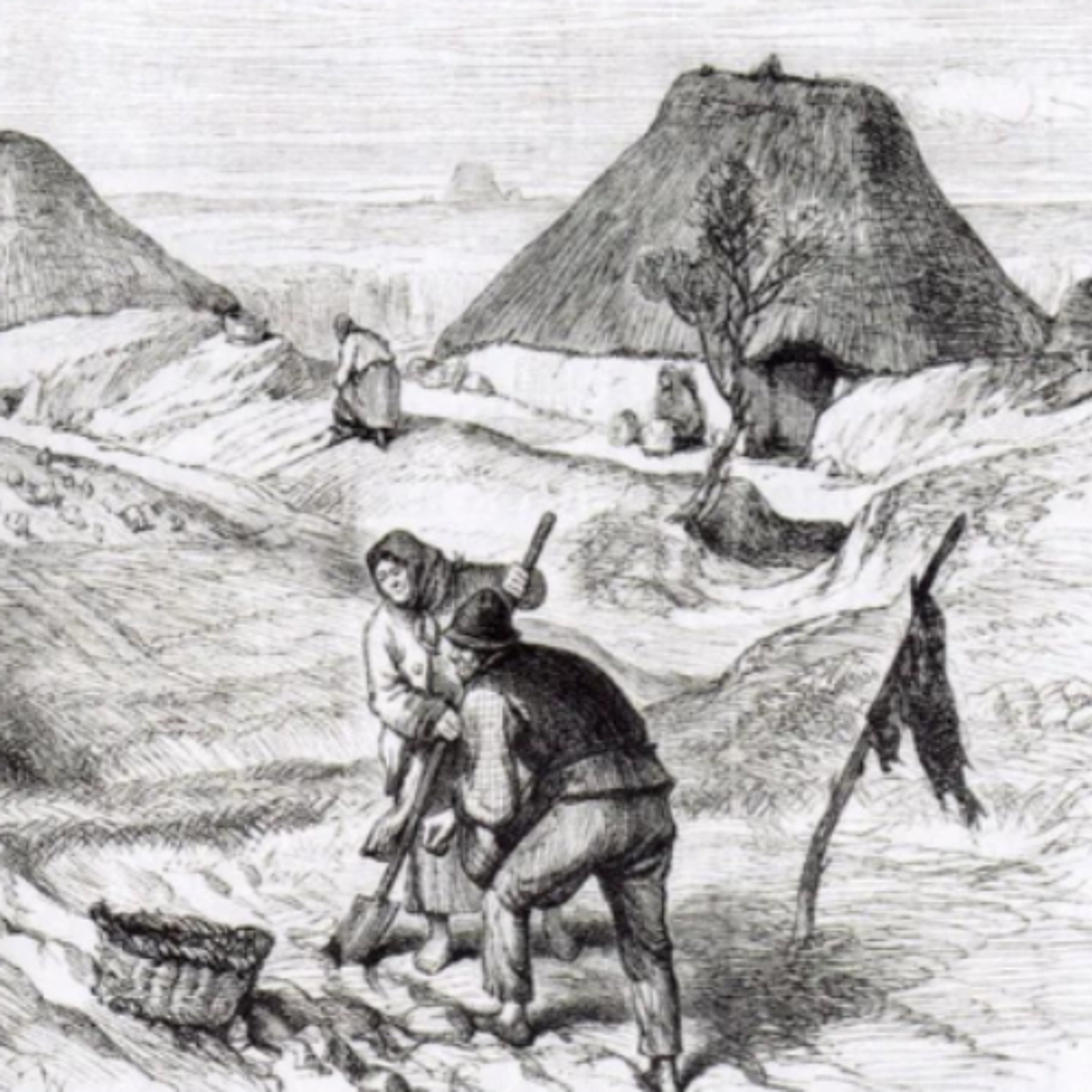
Photo (c) Colm Liddy
Hosts & Guests
Transcript
But joining me now, and delighted to have the company of the local historian and author,
Column Lady, who's with us for our latest installment of Clear History and Focus,
good morning to you, Column.
Good morning, Alan.
Thanks very much for popping into studio, and we are in the 19th century, and this week's
chat focuses on the decade before we get to the famine.
So the 1830s and begging to live in 1830s, Claire.
So I guess by that title alone, it wasn't exactly a food-filled existence for people in
Ireland prior to the famine.
That's right.
I suppose the fundamental fact is that if you start the clock in 1741, when there had
been a previous famine, that over the next century, the Irish population went from 2.5
million to 8.5 million, exponential growth, such as you would rarely see.
And at the same time, our ability to feed people was actually going into reverse.
Industrialization in Ireland went backwards for most of that period.
So you just had people working away on the same finite amount of agricultural ground.
And you've got, of course, no form of social welfare whatsoever, such that a lot of people
just stay alive, have to beg for food every day.
God, all those elements you just mentioned, it really is a recipe for disaster, isn't it?
It is.
And as bad as it was nationally, Claire was way worse.
The rate of increase in Claire was double-dash of the national average.
If you look at the censuses of like 1821, it's the first one, and then there's one in
1841, over that just 20-year period, the population of Kilmehal increased by 77%.
Kilmehal, 82%, go up to Fenor, same number, 82%.
Around Blackhead, not exactly the world's most agriculturally viable place, 90% increase
in population.
Again, now this is in a 20-year period, and then finally, taking the prize is Nuky, who
in that 20-year period, increased population by 368% for God, Nuky's.
I was, can we put our finger on as to why, and as you say, Blackhead, not exactly very
agriculturally great spot, was it just people who haven't bigger families, people who
were moving to these areas, because there wasn't opportunity for the males, where what
was leading to these huge increases in population?
Yeah, I suppose the death rate of from, you know, kind of epidemics, such as smallpox,
had decreased around that era.
So more people were living, but yeah, it's quite frightening, we'll say, just how many
children, you know, each family we're having, and the potato was somewhat, you know, keeping
it all afloat.
But like you had poverty from day one at your birth, most clear people during this era
lived in wretched mudhots.
What I mean now is like that it's literally an eagle who made out of mud, that's what
you're living in.
In one room, in Claire, there was 38,000 of that type of house, which represented 85%
of all houses in Claire, like even you see old stone cartridges now, you know, the ruins
of them.
Those, those were the lapel luxury, you know, because it, what, what you can no longer
see is the mudhots, because they of course melted into the ground eventually, but most
people were in those, and you were a baby born in that sort of environment in a tiny
little damp mudhots, really only fit for pigs, and the stillbirds at that time was 20, 20%
and over the next few years up to the age five, a 40% of children died.
I'm not surprised, but if you got to flies, you probably would live a long enough life
in poverty.
Because I mean, in that environment, you're more likely to pick up all sorts of conditions,
the ailments, diseases, and of course, I mean, if these families, they're so poor,
this is their, these are their homes, they don't exactly have the money to be bringing
children to doctors or any of that kind of thing.
No, absolutely not.
I mean, the ordinary, hardworking people of that time, the laborer class who had no land
and just had to work for a farmer, they, at best, were getting eight pence a day.
Eight pence a day was the standard wage.
And worse than that, they wouldn't even be employed for the whole year.
Farming is an extremely seasonal and cyclical occupation.
So they would be quite idle.
You'd be doing well if you were employed for seven months of the year.
And the rest of the time, you just had to absolutely not spend any money because that
was the state of employment.
That is a difficult scenario, nearly half the year to try not spend money.
I mean, I suppose to just spend the other half conserving as much of it as possible.
But of course, you have to live in that part of the year as well.
And I guess that left people with very few options because given the title is begging
to live in 1830s, Claire column, that that was really their only record, record of action
begging.
Indeed.
So let us walk the time they, they distinguished between very, you know, elaborately
all the different types of beggars that there were.
So you first of all have the deserving type of beggar.
So what happens if one of these laboring men gets ill and cannot do his work, you know,
for any serious length of time through injury or whatever?
He's obviously, there is no social welfare and his wife has to keep the show on the road.
But the maximum amount of wages a woman can earn is three pence a day.
So no, you know, there's your gender pay gap, eight pence and three pence.
So it simply isn't possible for a woman to independently run a household.
So what she has to do instead is gather up the children and each morning walk around
a little bit of the parish begging.
And what you do is you walk up to the households around and just stand outside the gate, looking
mournful really, you know, until they come out and give you a few pedators.
It's all, of course, in kind, there's rarely is that money, it's, it's pedators.
And bizarrely as well, quite a lot of old people also had to do that.
They were so poor that you would often have a scenario where the old man, you know,
who has given his house to the sun, the sun can afford just a boat to let him stay,
but cannot afford to feed him.
So you have old people just going for a stroll every morning to get their few pedators
for the day.
I mean, look to, you know, obviously we're in a tricky situation at the moment, cause
living and fuel crisis and everything else and there are people who are finding it hard.
But when you hear about the island of two centuries ago,
I hold a heart.
Next we have the able bodied beggars.
So these are, you essentially have an every parish, Claire, cause I mean, they kind of went
a commission arrived in town in 1834 and kind of took questions, you know, from each parish
and Claire.
And there was 50, generally speaking, about 50 beggars per parish who were just full-time
beggars.
But they would bring around a little sack, get the pleasures they needed, and generally
speaking, actually wind up more than they needed, which they would then sell to other people.
It's kind of crazy.
Talk about paying it forward.
But these beggars actually, if you like, the more professional-style beggar, was often
welcomed into people's homes.
He was a bringer of news, you know, he was, they were generally more charismatic sort
of fellows who wandered around and incredibly, they would often get a bed for the night with
the family.
As you know, all of the people in those days slept in one bed in the corner of their
little hut.
And generally speaking, elder stutter is near the wall, then the next stutter, then the
next stutter down to the baby, then the wife, then the husband, then the youngest son,
up to the other son at 10.
Just people at home listening, and they're like, I don't think it's that bad.
He's on the outside, this is just, you know, how it's done.
So also we have traveling beggars.
So in County Claire, by this period, you have quite a bit of the gentry going to tourist
spots, such as Kilkie, Spanish Point and Lahinch, they, you know, they were really becoming
great places to go.
And obviously it's a good place for beggars to go.
So people would pass through Claire from all over the country to go there.
Some of them were known to fake injuries.
It was quite, they were known as Bachuk, and they would pretend to be lame, you know,
to try and, and you'd find them also at markets and fairs.
And other person who needed help, just, not just in money, was the widow, because she
would often find herself with a small patch of land and not be capable of, you know,
tilling it to the, so you would, in fairness, you would find people who were so generous,
a bunch of young men in the area would go to her farm, for instance, and pick all the
plaitos or do all the weeding, do all the plowing from time to time.
Now, that was the case for widows, there was sympathy for widows, superficially similar,
but not similar, was the case of any woman who dared to have a child out of wedlock.
She was generally shunned by the community, getting no charity.
In fact, not all on that, she was more likely to be evicted from the small hovel that she
had, because she might be a danger to the morals of the community.
Generally, the family would try their very best to make the man in question marry her,
either through money or violence, and if that didn't work, she was kind of stuck, because
as they within the community, she could have no peace.
So typically, unfortunately, what happened is women like that would just have to go to
a parish far away, where they weren't known, and they could pretend to be a widow, because
a widow is acceptable, and unmarried mother is not acceptable, so sadly, that's one often
happened.
Okay.
What else do you want to let the listeners know about this situation?
Well, it was a non-sustainable situation, because tragic thing, as well as so many people,
like literally a few thousand people in Claire, at least, who every day have to beg.
And furthermore, they get their stuff, nosh from rich people, not whatsoever.
It's from fellow poor people, people who are barely have more than themselves.
That's who has to pony up the actual gentry, and indeed, any kind of strong farmer, he
would generally have his gait closed, and nobody got to come up the avenue to him.
So it was really just the poor feeding the other poor, you know, a completely unsustainable
situation.
Oh, my God.
I know that, as far as even in the modern world, that hasn't changed the rich, stay rich,
and they're likely to get help from the poor as well.
Thanks for bringing that to us, Colin.
I presume, given we're talking about begging in the 1930s, Claire, we're edging ever closer
to the key event of the last number of centuries in Ireland.
We are.
We're getting there, but you can see that from this context, there's an inevitability
to what we'll be coming next, because there's so many people, so vulnerable, you know,
ordinary life involves quite a bit of starving, never mind, then, when an actual disaster
occurs.
So, yeah, that's coming down the track, if you have a chance, we look forward to that.
Thanks for joining us as ever.
If people want to check out more of what you do and what you're about, you do have
an online shop.
I do indeed.
It's called Shop in Ireland.
I just columnility on that.
There's all sorts of snazzy t-shirts there.
I have one with a number of cows on it in front of Runes, which is a very happy one, so
Colin, thank you very much.