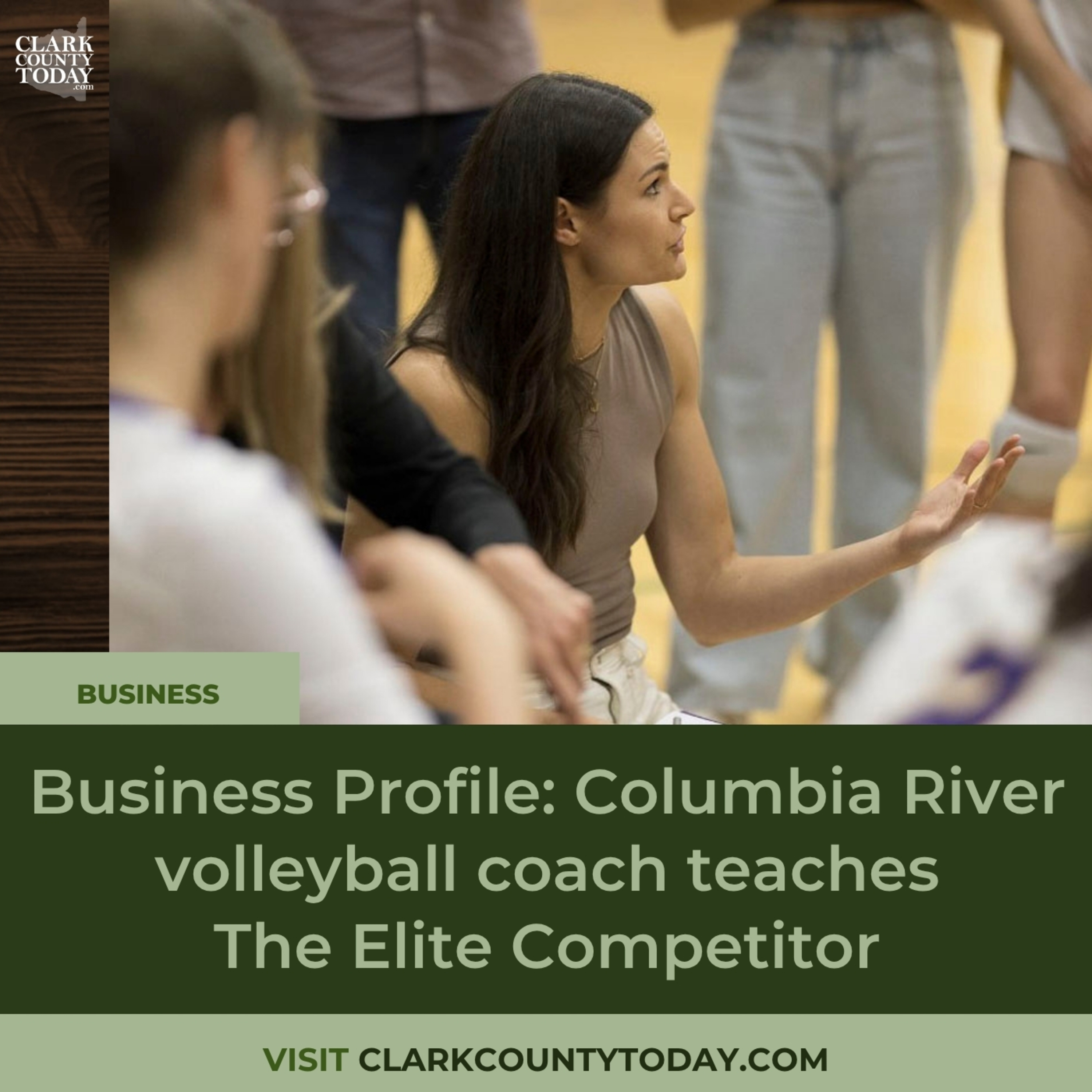
Bre Smedley, four-time state volleyball champion with Columbia River, co-founded The Elite Competitor to equip student athletes with tools to manage athletic pressure, stay engaged in sports, and develop off-the-court leadership. The program includes monthly live calls, digital clinics, and training for parents and coaches. https://www.clarkcountytoday.com/business/business-profile-columbia-river-volleyball-coach-teaches-the-elite-competitor/ #sportsbusiness #youthathletes #leadership #volleyball #clarkcounty #elitesports #mentaltraining #vancouverwa #seattle #studentathletes
This story was written by Paul Valencia with ClarkCountyToday.com.
There might be a big game soon, and the athlete might need tips on visualization.
Or maybe a mistake was made in practice, and the athlete could use some positive reinforcement.
Athletes put an awful lot of pressure on themselves.
In many cases, too much pressure.
A business based in the state of Washington, with a major connection to Clark County, is there to help.
Athletes, parents, and coaches from across the country are on board.
Bree Smedley is the co-founder of the elite competitor, a company that equips users with the tools to master the mental side of sports.
That would be the same Bree Smedley who coached the Columbia River Rapids to four consecutive state volleyball championships.
The original concept centered around helping girls and young women stay in sports.
Research has shown, Smedley said, that many youngsters were turning away from sports, with one of the reasons being from the pressure to perform.
Young athletes don't always have the tools to handle that pressure.
Help, in fact, is just a text away using the elite competitor, or a group chat, or any number of resources the company has put together for easy access.
Play Stay Lead is one of the initiatives launched by the elite competitor.
We want girls to play their sport and enjoy their sport, Smedley said.
That's going to keep them in their sport, stay, and that's going to develop them as leaders outside of their sport.
Play Stay Lead is really the foundation for why we do what we do, Smedley added.
The company's website certainly is directed to reach the female athlete and parents.
At the same time, many of the same tools to teach girls to handle pressure can help boys, too.
Parents who signed up their daughters for access to the elite competitor found that their sons would also benefit.
The elite competitor now has programs for all athletes.
It turns out that one of the brightest minds in coaching of any sport in Southwest Washington had a major battle with self-imposed pressure when she was an athlete.
Smedley was six feet tall as a freshman in high school, and coaches wanted her to play basketball and volleyball.
She liked volleyball more and then began to excel at the game.
She eventually was getting attention from college programs and scholarship offers.
You would think that would kind of be the goal, right?
And I knew it was a good thing, but I was adding a lot of pressure to myself as an athlete to play at the next level, Smedley said.
It got to be too much for her.
She quit after her senior year of high school, telling others she was burned out.
I just thought it was a better decision for me just to quit right now and disappoint people in this moment than to go on and play for four or five years and disappoint people for not being as good as I thought I was, she explained.
It turned out it was just a break from volleyball.
Her career was not finished.
She attended Western Washington University and watched every home match.
She still loved the game after all.
After her freshman year in college, she approached coach Diane Flick Williams and relayed her story.
The coach asked Bri to join the team during an off-season practice.
That led to a walk-on invitation.
Bri would learn quickly the key to success for Flick Williams.
She didn't just coach volleyball.
She coached the whole athlete.
She would bring in resources to help the athlete with the mental and emotional side, Smedley said.
I realized that, hey, I'm normal.
Every athlete experiences this.
Smedley would spend three seasons playing volleyball and ended up on scholarship.
A true success story.
Her college coach planted the seeds that would eventually lead to Columbia River's success.
What Smedley learned from Flick Williams, she instilled in her teams at Columbia River, but not at first.
Smedley as a new teacher and coach had to learn a lot as well.
Two years in a row, Columbia River volleyball lost in winner-to-state loser-out matches.
The results stunned Smedley because she knew her teams were talented enough to advance.
Physically, we have all the things to go far, but we mentally could not pull it together when things got hard.
Smedley said, Smedley would end up becoming certified to teach mental training to players.
The following season, she introduced mental training as a daily feature at practice.
The girls took to it really well, Smedley said.
We frame it as a competitive advantage.
It is not just volleyball, it is the whole picture.
We haven't missed a state tournament since, Smedley said.
It just became a staple of our program.
This is what we do.
We train for pressure moments.
Soon, Smedley wondered if she could help more than just her own athletes.
Bray and her sister-in-law, Christina Smedley, based out of Seattle, joined forces to create a streaming program that athletes can use across the nation.
That was back in 2018.
In 2021, Smedley left teaching to focus on the business.
She remains the volleyball coach at Columbia River.
The business has boomed with athletes all across the country signed up with the program.
College and high school coaches are involved as well.
I did not go to school to become an online business owner, but quickly learned how to market and sell an online business, Smedley said.
Brett Smedley, Breeze Husband, and the former football coach at Columbia River also is part of the business.
The elite competitor runs a boys boot camp now, led by Brett.
The elite competitor has a couple of brands now, one for athletes and parents, and another for coaches.
There are online clinics and presentations.
The elite competitor reaches out to athletes multiple times a month, and the athlete can reach out any time to the elite competitor.
Plus, twice a month, athletes are invited to a live call with other athletes to hear from a guest speaker or to just share what they are going through during their sports seasons.
The elite competitor reminds coaches and parents that sports are supposed to be fun.
They are difficult.
They are challenging, but they should still remain fun.
Also, it should be emphasized, Smedley said, that sports is not an identity.
Sports are something that they do.
It's not who they are, Smedley said.
For more information on the elite competitor, go to elitecompetitor.com.