About this episode
Also, Maureen Corrigan reviews the novel Exit Party, by Emily St. John Mandel.
Subscribe to our free weekly newsletter
Follow us on Instagram
Subscribe to our YouTube channel
Check out the Fresh Air Archives
See pcm.adswizz.com for information about our collection and use of personal data for sponsorship and to manage your podcast sponsorship preferences.
NPR Privacy Policy
Get every episode summarized
Each time Fresh Air publishes, we email you a written briefing from the transcript — the topics, who appeared, and any specific claims, with the ad reads skipped.
Email me new episodesFree for 3 shows. No card needed.
Hosts & guests

Transcript ready
562 searchable segments. Every word is indexed and playable.
Full transcript
Fresh Air — How Sept. 11 changed American life. Machine-transcribed; use the interactive transcript above to jump the player to any line.
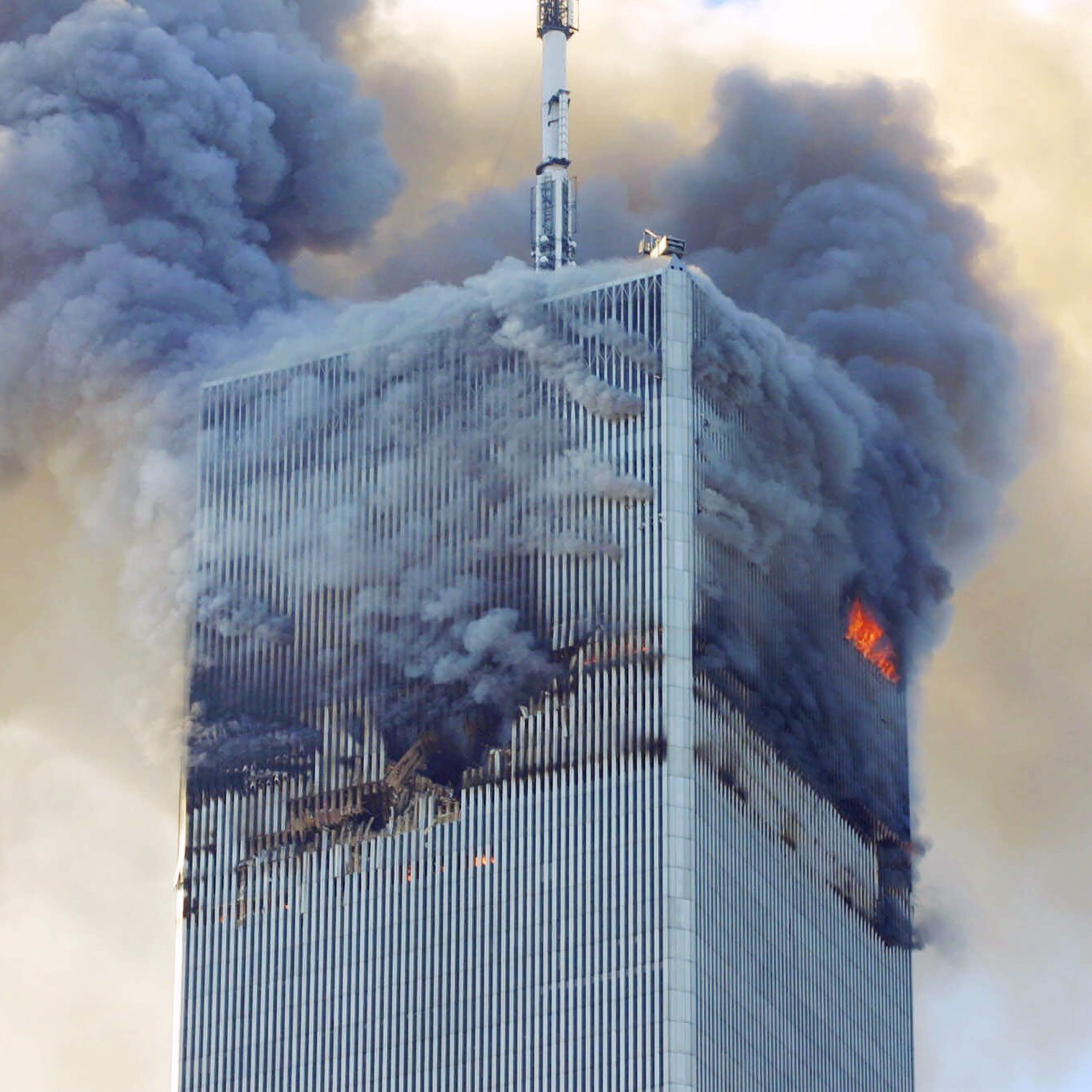
This week on Consider This, the researcher who just resigned from anthropic, why he believes AI is a threat to humanity. Very soon, these things are going to be so capable that if they decide to go rogue, it's not going to be good. Plus, his view of what guardrails could look like this week on Consider This from NPR. This is Fresh Air, I'm Tanya Mozli. 25 years ago this week, we were left trying to understand what September 11th would mean for our lives. 19th-terrace hijacked four commercial planes flew to the World Trade Center in New York and won into the Pentagon while the fourth crashed in a field in Pennsylvania. The attack brought down the twin towers and killed almost 3,000 people. In the weeks that followed, President George W. Bush urged us to go back to work. Get on planes, go shopping, take our families to Disney World. The message was that even as the nation went to war, life at home, but go on as normal.
It did not. My guest today, writer Richard Beck, traces how the country we live in now was shaped by the nation's response to that morning. Cameras scan our faces at the airport, flat cameras, log our license plates. Many of the top grossing films of the last 20 years are about armored men saving cities from terror. An ICE, an agency that did not exist before the attacks, built to fang terrorists. Now sends agents into court houses, workplaces, and homes to carry out immigration arrests, with more people in detention than at any point in the agency's history. This week, a petition signed by nearly 100,000 people, what Zoran Mamdani, New York's first Muslim mayor, to be excluded from the ground zero ceremony on the anniversary. Richard Beck was 14 on September 11, and came of age in the America built afterward. He's a senior writer at Inplus One and the author of Homeland, The War on Terror and American Life.
And Richard Beck, welcome to Fresh Air. Thank you so much for having me. So Zoran Mamdani makes September 11 an official day of remembrance. And almost immediately, there's a fight over whether New York's first Muslim mayor should even be at ground zero. What does that tell you about where we are 25 years later? I think the first thing it tells you is that since September 11, Islamophobia has become the most tolerated, most accepted form of bigotry in the United States. Because nothing else could explain people's objections to Mamdani being at the ceremony. He's the mayor of the city. He's an extremely popular mayor of the city. You know, it's outrageous. The suggestion that he should be excluded for no reason other than the fact that he is a Muslim. I think that there have been periods since September 11, where the depth and the intensity of the Islamophobia that pervade the country
have receded somewhat, or people have just tried to ignore it. But it has been there steadily for the last 25 years. And it has not yet been confronted with sufficient force to root it out. I actually can still see the image of former President Bush standing at a mosque. It was several days after the attacks and telling the country that Islam is peace. And then we fast forward to today. And there was this Pew Research Study just released that shows in March of 2002, that was six months after 9.11, 25% of Americans believed Islam was more likely than other religions to encourage violence. And today, that number is 51%. Why do you think that it got worse? I think that the generalized bigotry of the Trump administration and the MAGA movement
has played a major role. You know, of course, you remember that one of the first things Trump did when he became President for the first time was to announce his Muslim ban, the travel ban on people from several majority Muslim countries. I think that when you talk about George W. Bush and that Islam is peace speech that he gave, it gets it one of the real contradictions of the war on terror as a whole, which is that on the one hand, the war on terror clearly had elements of a revenge mission. You know, and Islam was portrayed as an inherently violent religion and the hijackers who perpetrated the 9.11 attacks had to be understood as motivated solely by the religious fanaticism and by nothing else. So there was this effort to portray Islam and Muslims as this group of sort of unthinking savages who you couldn't reason with, you couldn't persuade, you couldn't bring them around to, you know, seeing things in the American way. And so they just had to be dealt with using force.
At the same time, because we invaded Afghanistan and Iraq, there was a contradictory simultaneous effort to portray Muslims as helpless victims of their fanatical governments who were yearning to be liberated by the Americans and then live just as Americans did. I think that those two impulses, these simultaneous ideas that Muslims are in courageable savages while also being victims in need of American rescue, that has never really been resolved. And to some extent, you can still see both elements working in the country's politics. You know, going back to Mayor Maldonney, this petition that is out there, his answer to all of this has really been reassurance. I think he said during his last speech in the days before this upcoming ceremony that I will proudly honor the families and we will never forget. And that's actually the only message a Muslim as you write can make publicly since 9-11,
to reassure, not to argue, to not to be critical of the war on terror. You describe Muslim student groups who wanted to debate the war on terror and found that they couldn't. What happens to a Muslim in this country if they argue? Yeah, one of the immediate effects of the way the country reacted to September 11 was there was this broad-based political and social effort to essentially make it impossible for Muslims to act as citizens, by which I mean, as you point out, participate fully in political debate, discuss and criticize the country's law enforcement practices, discuss and criticize its foreign policy. You mentioned Muslim student associations at universities. Many of them found the kinds of events they could put on were sort of anodine. Here's the holidays we celebrate. Look how non-threatening we are. Here's why Muslims are just as American as anybody else. You know, I'm just thinking also maybe how two things can be true at once
because at the same time, Muslims have also never been more visible in American politics. So we have Zoran Memdani, who runs New York. We have Abdul El-Sahid, who won a Senate primary. There are Muslims in Congress who are critical of Israel on the House floor. And yet, Americans have never been more likely to say Islam encourages violence. What do you make of this? I mean, is it basically that the second thing is a reaction to the first as well in addition to what you were saying about the rhetoric from MAGA? Yeah, I think that's probably fair to say. Certainly back in the 2000s, you did not have nearly as many prominent Muslim Americans holding elected office. And I think that the emergence of these prominent figures like Mamdani, like Abdul El-Sahid, Ilhan Omar, I think that part of the recent re-intensification of Islamophobia is a reaction to those people.
And the idea that a Mamdani should be criticized because he hasn't said enough, spoken out enough against Islamist terrorism, it almost feels like a throwback. That's the accusation that used to be thrown at anyone who criticized the Bush administration's policy in the early years of the war on terror. More recently, the accusation that you see getting thrown around constantly is this kind of cynical deployment of anti-Semitism accusations. The really intense effort to make Abdul El-Sahid look bad because the streamer Hassan Piker, who is also not anti-Semitic, has supported his campaign. The anti-Semitism allegations today are what is primarily being used as the cudgel to say, keep your mouth shut, don't talk about this stuff. Abdul El-Sahid called Israel's war in Gaza a genocide. And so then after a synagogue attack in Detroit, he said hurt people, hurt people. And now he has basically spent the last two weekends apologizing to Jewish Democrats,
some of whom say that they'll now vote Republican. And the vice president is calling him very, very evil. Yeah, I mean, again, you notice that it's a tricky line he has to walk. If he feels that he wants to apologize for those remarks, that's fine. But I don't think he should expect that that will satisfy the people who have been coming after him. I also think that it's really telling the intensity of the Islamophobia, the demonization, not just criticism, or we have political differences, but vice president advances use of the word evil, right? Like that's moved beyond the discourse of we disagree about America's policies with respect to Israel. We have different views on whether the U.S. should support Israel. We have different views about whether Israel's actions in Gaza have been legitimate war crimes, et cetera. Calling him evil is something else entirely. And I think it's something that has roots, deep roots that go back to the immediate post-9-11 period.
I want to ask you the question. We've all asked each other for the last 25 years. Where were you on September 11th? I was a freshman in high school in suburban Pennsylvania, just outside of Philadelphia. It was the end of my first period class, which had a very lazy teacher who would usually get tired of teaching about 10 to 15 minutes before the bell rang. And so it would put on a sports center so that he could watch sports highlights from the previous evening. So on September 11th, he did that like normal, but instead of sports center, it was a live feed from ABC News. And it was surreal because we had no context. We didn't know what was happening. And it was just this helicopter shot of the twin towers with smoke coming out of one of them. And just a couple minutes before the bell rang, we watched the second plane smash into the second tower live. Then the bell rang. We were sent off to the rest of the school day.
And my high school administrators made the kind of crazy decision, I think, not only to have the rest of the school day as normal, but they told teachers that they were not to discuss what was happening with students, not to have the TV on. And so all of us spent the day trading rumors in the hallways between classes, trying to find out what was going on. And I remember quite vividly that by the time I finally got home, which would have been, I don't know, maybe three in the afternoon, my understanding was that the twin towers, the White House, the capital building, and the Pentagon had all been completely destroyed. And then, of course, my parents had come home from work. We put the TV on and just watched the news for the rest of the day until 11 or midnight or so. You understood the war on terror to be a bush thing, basically a Republican project. And then you graduated from college into Barack Obama's first year in office.
What did that time period reveal to you? That was a very destabilizing period to live through in terms of my own political development. And I think this is not just true for me. I think that's true for lots of people around my age, because as Bush's second term was coming to an end, the standard way of interpreting the war on terror was that, you know, Bush was this idiot commander in chief. He had all of these Machiavellian people working for him, Dick Cheney, Paul Wolfowitz, John Ashcroft, et cetera, who were trying to implement, you know, this insane regime change in Iraq, trying to remake the entire Middle East, you know, driven by hubris and this neo-conservative nationalist paranoia. And Obama very much ran as someone who was going to put an end to that madness. He had been critical of the Iraq war from the beginning.
He touted that fact over and over again. It's a big part of why I think he was able to defeat Hillary Clinton in the primary because Hillary was constantly having to explain why she had voted for the authorization for use of force in Iraq. But Obama, it's not that he said he was anti-war. He had a quote that I think I'm not going to get it exactly right, but he said something like, I'm not against all wars, I'm against dumb wars, right? So he was basing his stances on the idea that he was smarter, better informed, more thoughtful than, you know, the swaggering gang he was hoping to replace. But when he became president, my expectation, I think a lot of my peers' expectation was that we were going to get out of Iraq, we were going to wind the war on terror down. We were going to have some accountability for the people who had developed and implemented the torture program and the CIA's rendition program, you know, at black sites around the country.
And it became clear pretty quickly that in fact almost none of that was going to happen, you know. He did reduce the troop numbers in Iraq to an extent, but he surged more troops into Afghanistan. You know, he gave the war in Afghanistan a new lease on life and it wound up running for another, I mean goodness, a decade plus. You write about how he swapped Shackin' Off or Drone Strikes and Targeted Killings, tripled ISIS budget, deported some 3 million people, and when asked whether he'd prosecute Bush officials over torture, he said he wanted to look forward. This moment was a very pivotal moment in your politics and did you feel Obama's warrant error maybe was in a way more dangerous because it was quieter? I don't know if it was more dangerous than Bush's version, but it certainly wasn't less dangerous. And it became clear over time that he was not seeking to end the war so much as he was seeking
to no longer allow it to be as spectacle. A Bush had made 9-11 and the war on terror, the centerpiece of his entire administration. That was supposed to be the meaning of his presidency was the war he was waging against global terrorism. Obama came into office and his calculus became, well this war is going to continue, but I don't want everyone to be talking about it all the time. I don't want it to be visible all the time. I don't want it to be on the nightly news all the time. So something like the huge increase in the use of drones, that helped Obama's project because it reduces the number of American casualties that are happening. You're still killing plenty of non-Americans abroad in Pakistan and elsewhere, but those people don't make the news in the same way that flag-draped coffins rolling off a plane do. It was this impulse that Obama had to rationalize the war, to institutionalize it, to bureaucratize it when I think what was needed was for it to end.
There are all sorts of ways that we have changed, our communities have changed, that it's happened at such a pace over 25 years. We may not even notice it. I mean, you bring up how towns wrote ordinances against things like teenagers gathering and there are now cameras in public spaces. It makes it harder for us to get to know each other spontaneously. That's just one. And then there is how Congress handed war to the president under Bush and then Obama. The government has made itself harder to reach. We see the ways that ICE has morphed itself under the direction of the president to be an immigration enforcement arm. But many Americans might look at this list and see four separate stories and some of them are about our safety. Make the case that all of this that we're talking about is one story about the ways that 9-11 has actually changed our world. I think that one way to start to see those things as part of a single story
would be to think about this idea of public space. And there has been a real serious degradation of public space. And I don't only mean that in the literal sense of like parks and plazas. In Lower Manhattan, I talk about a study that two academics carried out in 2009 or 2010, I think, where they looked at two neighborhoods in Lower Manhattan, the Financial District and Civic Center. And they said how have the public spaces in these places changed since September 11? And they found that in the Civic Center, something like 15-20% of public space had just been closed off. It no longer existed. And if you expanded your definition of public space to include areas that were just much more heavily surveilled or where access had been restricted rather than completely done away with, it's more than a third. In the financial district, where there are very, very few government buildings,
there'd been this huge expansion of spaces that had been converted into what urbanists call security zones. If you walk around the new World Trade Center complex, it's sort of an eerie experience. It becomes clear quite quickly that it's not a real public space. There are cameras everywhere. There are police everywhere at all times. And at the same time, the huge increase in executive power that has happened since September 11, and all of the presidents we have had since September 11 have participated in this and amplified it. The power of the executive has increased at the expense of the power of Congress, right? And of the three branches of the federal government, Congress is the one that is supposed to be most open to democratic input. So when Bush decided to launch the war on terror, basically on his own initiative, and there was kind of a, at the time, a kind of show of congressional debate,
and yes, Congress did pass an authorization for use of military force. But people in the Bush administration were making it very, very clear, both to Congress and to the American people, that this was going to happen, whether Congress signed on or not. Since then, Congress has often been far too willing to abdicate its role supervising how the foreign policy of the United States is conducted. And if Congress is absenting itself, if Congress isn't bringing its full institutional weight to bear on these policy questions, well, then by definition, American citizens have less of a say in the country's foreign policy. Our guest today is writer Richard Beck. We'll be right back after a break. I'm Tonya Mosley, and this is Fresh Air. This week on Here and Now Anytime, 25 years after 9-11, we asked you how your life changed. I did not appreciate that day how much September 11th would come to shape my adult life.
We also talk about the long shadow of Islamophobia still hanging over the country. Listen to Here and Now Anytime on the NPR app or anywhere you listen to podcasts. On Dear LifeKit, our team answers your listener questions with time-tested advice from past episodes. But we don't always agree. Opposite! No! That's not what we thought. What if he's the one? Oh my god! What? Listen to the latest juicy episode of Dear LifeKit on the LifeKit podcast in the NPR app or wherever you get your podcasts. Hi there, I'm Brittany Loose. And not to brag, but I host a really fabulous podcast. It's called It's Been a Minute. I love making it, and I think you'll love listening to it. Over the last year, hundreds of thousands of listeners have been tuning in, and I gotta say, if you haven't yet, you're missing out. Listen to The It's Been a Minute podcast from NPR today. This is Fresh Air, I'm Tanya Mosley, and my guest today is writer Richard Beck.
This Friday marks 25 years since the September 11th attacks, and Beck traces how the country's response to that day, the wars on terror, and the politics at home, reshaped nearly every part of American life, and ways most of us no longer notice. Beck is a senior writer at the Literature Politics and Culture magazine, in plus one, his first book, We Believe the Children, Exam in the Daycare Sex Abuse Panics of the 1980s. His second, Homeland, The War on Terror in American Life, argues that without 9-11, Donald Trump could never have become president. All right, let's get to your big argument, Richard. You write that if September 11th had not occurred, Donald Trump would never have become president. Make the case. For me, the central fact of the war on terror, or the most important development politically, that happened as a result of the war on terror, was the rise of what I call impunity culture in American politics,
which is this idea that political figures don't get held accountable in a material way for wrongdoing anymore. I think that you could see the beginnings of this impunity culture with the Bush administration, with the torture program and Abu Ghraib, and Obama's decision not to prosecute any of the people who were involved with that program. And I think it can be easy to forget if you didn't live through it at the time. It can be hard to understand the release of the photographs out of Abu Ghraib was really shocking. And if we can just slow down just to remind people what happened with Abu Ghraib. Abu Ghraib was a prison in Iraq where the US military was holding people it detained after invading. People working inside Abu Ghraib were abusing and torturing their detainees in really quite sadistic ways.
Things they were doing seemingly for their own amusement, as well as for other reasons. But in 2004, 60 minutes got a hold of photographs that had been taken of the abuses, including a very famous photograph of a hooded man standing on a box with electrical wires trailing down from his hands. His hands were outstretched. It's sort of a crucifixion pose. But it became clear very quickly that these abuses were widespread, that the Bush administration had carried out a complicated and sustained legal effort to make mistreatment and abuse of detainees legal using the kind of horrifying euphemism enhanced interrogation techniques, things like waterboarding. So when this became public, it was an enormous scandal. It sort of had a single stroke destroyed the idea that we had invaded Iraq out of a genuine desire to liberate the Iraqi people.
You know, it revealed the invasion of Iraq as part of a larger revenge mission. You could not have a more open and shut case of some people need to go to jail for this. And when Obama, shortly after he'd been elected, he didn't interview with George Stephanopoulos and was asked, are you going to investigate or prosecute people who were involved in it? And he started out by saying, well, I don't believe that anyone is above the law. However, I also think we need to move forward. And I can just remember hearing that, however, and feeling my heart sink. Well, I mean, the Pentagon called it a few bad apples and a handful of those soldiers did go to prison. Why wasn't that from your view accountability? Because the abuses didn't happen because a few bad apples decided they wanted to abuse people. I mean, individual anger or sadism did play a role, but it was a conscious project undertaken
at the highest levels of the Bush administration to put this in place. You know, the CIA's rendition program, the black sites where people would be held indefinitely without being able to contact a lawyer. And it's people who are still held at Guantanamo who we can't release, they say, and who can't be prosecuted because they were abused or tortured as part of their interrogation process, which means there's no chance of a successful prosecution. Going back to President Donald Trump, though, give me the straightest line you can draw, like one thing that happened in 2001 and one thing that President Trump would go on to do with it. Well, I would say the huge expansion of the country's immigration surveillance and enforcement apparatus that happened after September 11, that is the basis for what ICE has been doing
around the country since Donald Trump became president again. And I note early on in the book, there's a line that people talk about with respect to wars, the US fights, that's always irked me a little bit, which is this idea about how wars come home. You know, how the violence that a country like the US carries out overseas will eventually work its way back into the country's domestic social and political life. And that just doesn't apply to the war on terror, because before we had anyone in Afghanistan, before there was a campaign to draw up support to invade Iraq, the federal government was rounding up Muslim immigrants around the country, like immediately after September 11. It's something like 1200 arrests, for sure, maybe as many as 5,000, almost all of these for minor immigration violations. Certainly, no terrorists were captured as part of this. But that apparatus, the way it got built up, you know, including with things like the
Patriot Act, which was passed soon after September 11. Trump has certainly put his hands on that machinery and put it to use. You write that what was done to Muslims, this degradation of citizenship, it has really become the template that got expanded to other people. So somewhere along the way, the enemy out there really became the enemy within. Yeah. And if I could just go back for one second to impunity culture, the reason I brought that up first when you mentioned Trump is because part of Trump's appeal to the people who voted for him the first time was that he didn't pretend to be a good guy, right? There's that famous line he has about I could shoot somebody in the middle of Fifth Avenue and nothing would happen to me. You know, George W. Bush was kind of notorious for misbeaking, you know, and would get caricatured is stupid or, you know, but the Bush campaign could
never in a million years have survived something like the Donald Trump access Hollywood tape, where he bragged about sexually assaulting women. Trump is getting away with stuff on a weekly or even daily basis that when I was a teenager would have ended someone's political life in an instant. So that's why I do focus on impunity culture. Mm-hmm. You know, I'm also just to drill down because, you know, these ice roundups are now a part of our daily lives, the texture of many communities. And, you know, Trump did not run on terrorism. By the time he was running for president, we were far from that early 2000s period, 2015, 2016. He ran on deportation. Would ice be arresting 50,000 people a month if 9-11 never happened? I know that could be a crew question, but it also is
drawing this line, trying to draw this line to your argument. Yeah, you know, like you say, you can't prove a counterfactual, but I certainly think that the immediate post 9-11 period laid the groundwork for what ice is doing. And I also think the broader emotional frame of the war on terror has encouraged this idea that there are enemies within who need to be rooted out. And this is not unique to the United States. It's not unique to this moment in history, but the war on terror had two ideas about where the enemy was, right? There are these terrorists living abroad around the world who need to be pursued and hunted down and brought to justice, meaning killed. And there are also enemies within. There are sleeper cells. There are people plotting more domestic attacks. And that idea that there is a generalized enemy within against which we must always be on guard, you know, that has been reinforced in all kinds of ways in American life over the past 25 years.
Literally just the way it feels to be in public spaces today. You're just constantly receiving this messaging that like there could be a threat here, something bad could be happening here. So certainly the war on terror laid the foundation for Trump and the MAGA movement to be able to say, yeah, America's problems are being caused by all these people living inside the country who hate the country and want to bring it down and want to leach off of its benefits. You know, his line about Mexican migrants being rapists, that has a, yeah, I would draw a fairly straight line from Trump back to the cultural and social and political climate after September 11. My guest is writer Richard Beck, author of Homeland, the war on terror in American life. We'll be right back. This is fresh air. I haven't seen my son since 2012. This is Deborah Tice. The disappearance of her son Austin is one of the biggest missing person
cases in the world. What do you want from me? I should have the mystery. I know that my son is somewhere alive. Listen to Where is Austin Tice from MPR's embedded and BBC Radio 4 on the MPR app or wherever you get your podcasts. This week on Wait-wait-wait, don't tell me we talk with our panel Mo Rocca, Shane Torres and Annie Rowerda about the latest trend in dating, smelling bad on purpose. This Firmone Maxing is just not bathing. Yes, yeah. So this is like when the Uber came out and they're like, it's not taxi, it's right, Chair. Don't miss our full conversation and the rest of our games. Listen to the Wait-wait-wait, don't tell me podcast to me in PR app or wherever you get your podcasts. This is Fresh Air. I'm Tonya Mosley, back with writer Richard Beck, his book Homeland, traces the country's response to September 11th and how that response reshaped American life. Something else is happening in our country right now as it relates to surveillance. There are these flat cameras. There are the license plate readers that police departments have
put up on light poles and thousands of towns and people are now pushing back. Some people, their news reports that people are sawing them down, splashing them with paint. Over 100 cities have now canceled their contracts this year and it seems to be not a left or right thing. I mean Tucker Carlson and Hassan Piker are both now against them. What do you think is going on? I think occasionally over the last 25 years you have had these moments where it just all starts to feel too invasive, the ways in which we get watched as we go about our daily lives. There was a moment of that when the whistleblower Edward Snowden revealed the extent of the NSA's mass electronic communications surveillance program. Of nearly a million phone calls yet. Yeah, I think part of the reason that that's become such a flash point is that
you know we're on our computers and our phones and I think everyone when you go on to an internet browser or if you text somebody or if you call somebody, everyone's got that little voice in the back of their heads that like well for all I know someone's watching. But most of the time you don't get any signal that someone is actually watching right. It's something that's in the back of your mind but you can ignore it once you get used to it which is not to say I support mass electronics surveillance but it is just something that can kind of proceed into the background of your daily life. The cameras are a little different because they're visible you can see them looking at you and I think this is also tied to the growing movement we're seeing against data center construction and I think many people have an intuition that you know oh will they say these data centers are just going to be used for to build a better chat GPT so that AI can help us even more than it's already helping us. But if you look around your town and you see flock cameras going up everywhere and you also see a huge data center going up it's not unreasonable to worry that
actually I think these data centers are going to be used to further intensify the degree to which my community is surveilled by who knows who it could be the government it could be private corporations and I think right now we're in a moment where where the frustration kind of boils over and people find themselves wanting to say like enough and I think it's far too early to say impact if any it will have but certainly it's something that people are really starting to worry about again. Well correct me if I'm wrong in this interpretation but you told my producer Monique that the reason mass surveillance never really worked and the past was that there was just too much of it and the government was collecting more than really basically any human could sift through that was the problem for 20 years but now we have AI. Does this mean in some way potentially that the surveillance state is about to get a lot better at its job? I think the people who run the AI
companies certainly hope that that's the case. I'm not an AI expert so I couldn't tell you the only you know sphere in which I'm encountering AI from a position of expertise is as a writer and you know I will say that AI's ability to write well or coherently has not improved at anything like the rates that we were promised when the technology emerged. I think there is a lot of hype about AI's capabilities coming from people who stand to benefit financially from that hype and I think it's hard to know what's going to happen going forward but when you say does this mean the surveillance state is about to get a lot better at its job? What do you understand its job to be? Right. That's the question. What is that job? You know if you say that its job is to find out who committed crimes that's one thing but if you say that its job is to
prevent people from organizing activism or groups or projects you know critical of the government or that might oppose the government in some way that might be a more realistic understanding of what the surveillance state understands its own job to be and I'm not sure that most people in the US want the surveillance state to get better at that job. I think that one thing that's hard to understand if you didn't live through it or if you haven't you know spend a lot of time reading about it is just how politically repressive the climate immediately after 9-11 was. It just became impossible to say anything mildly critical of the US government and its policy without being portrayed as a terrorist sympathizer. You know there's an episode I recount in my book where less than a week after the attacks the New Yorker published an issue containing a series
of reflections on them from its contributors and Susan Sontag in a short paragraph wrote and I'll just cherry pick a few sentences. She wrote the disconnects between last Tuesday's monstrous dose of reality and the self-righteous drivel and outright deceptions being peddled by public figures and TV commentators is startling depressing. The voices licensed to follow the event seem to have joined together in a campaign to infantilize the public. Where is the acknowledgement that this was not a quote cowardly attack on quote civilization or liberty or humanity but an attack on the world self proclaim superpower etc etc and she ended by saying let's by all means grieve together but let's not be stupid together. Sontag at no point in there said that America deserved the attacks she didn't do anything to excuse what al-Qaeda had done but she was critical of the way that the media had been discussing it and it's kind of instant jump into self-concellation
as opposed to trying to think through what this meant and as a result she became one of the most hated people in the country basically overnight. You couldn't say anything other than this is the most cowardly most horrible attack that's ever happened America must do everything it can to hunt down those responsible and we must all support the government in its attempts to do so. What do you think that that lack of discourse or allowance of dissent create and us? I think the message that's sent to ordinary people and that kind of climate again has to do with this degradation of citizenship because if you know the only things you're allowed to say about an event are that what the government does is right well then there's no discussion to be had and you shouldn't participate and so it's telling people don't bother debating what's going on because you can't do anything about it and if you say anything we don't like we'll turn you into a public figure of ridicule and mockery and anger but I also think that there are consequences within
government to this kind of repressive atmosphere because the people in government who are forming foreign policy are supposed to be able to actually talk about what the root causes of things are because they're trying to solve real problems and if all they're allowing themselves to say is this was a dastardly attack you know and we have to pursue the people who carried it out to the ends of the earth you're not likely to come up with a foreign policy that's going to do a good job of addressing the root causes of something like September 11th. Richard Beck I really appreciate you taking the time to have this conversation with me and your book thank you thank you so much. Richard Beck is a senior writer at in plus one an author of homeland the war on terror in American life coming up book critic marine corgan reviews exit party by Emily St John Mandel this is fresh air hey what's your problem no seriously are your grocery bills too high are you spending too much time
on your phone maybe you're searching for a new job or you're trying to figure out how to set boundaries with your family whatever's on your mind life kit has you covered with three episodes every week on health money mental health and so much more listen to the life kit podcast in the NPR app or wherever you get your podcasts. Hey it's Mike Danforth executive producer of weight weight don't tell me here's a great way to get the perks of being an NPR producer without doing any of the work join NPR plus with NPR plus you get extended interviews inside looks at your favorite shows and more all while supporting NPR and never having to pull an all nighter or if you work on one of the new shows and all morninger sign up at plus dot NPR dot org. This is fresh air fans of Emily St John Mandel's speculative fiction call the elaborate interconnected universe she's constructed in novels such as station 11 and the glass hotel the Mandelverse book critic marine corgan says that an exit party the Mandelverse hits uneasily close to home
here's our review Emily St John Mandel is a novelist celebrated for among other things her prescience station 11 her best-known novel was published in 2014 when the pandemic hit globally in 2020 critics and readers began to remark on how station 11 anticipated the pandemic given that its dystopian plot is set in motion by the outbreak of a worldwide virus let's hope that Mandel's gift for writing prophetic fiction is overrated because here's the opening phrase of the opening sentence of her latest novel exit party in the first spring after the collapse of the United States fortunately for all its darkness exit party lights plenty of signal fires along the shore to keep readers open to possibilities that may lie ahead the plot here like the plots
in the previous three Mandel novels I've read is ingenious eerie and complex but not so complex it dampens curiosity here's the briefest of teasers in the spring of 2031 a 48 year old woman named Ari recently released after 18 years in prison goes to a party in Los Angeles with her roommate Gloria the Los Angeles they live in is an anxious place given the violence of recent history we're told that the United States had come undone following a coup d'état several states had seceded within a week of the coup and war had broken out within the month now the fighting had subsided for the most part and Ari had been released into an uneasy aftermath the occasion for the party is this new relative peace in the city but as the two women and others
sense there's something wrong with the party it has extra people because some guests seem to be duplicating themselves towards the end of this peculiar evening the host a sweet man named Kareem enters his kitchen which doesn't have an outside door and disappears forever years later another attendee confides to Ari I think the party was also a door without giving too much away I'll also say that the doppelganger theme extends not just to people but also to a country there's another United States in this novel one that's driven not by malicious and fortified state borders but rather one that's been suffocated into a tranquil surveillance state where we're told voting was no longer required and the president would one day be succeeded by his son a character who's
grown up in this alternative US but is now beginning to doubt its legitimacy tells us that the thing about living in a place like this was how hard you had to work to not see the obvious Mendel knows she doesn't have to belabor her topical social commentary it's of an unsettling piece with everything else that's packed into the three parts of this capacious novel for instance there's a subplot about a painting that reappears in locals across time and space the painting is entitled swan dive and it depicts a pair of feet disappearing into a dark ocean not the most reassuring of images exit party also unexpectedly veers into an action escape adventure in which ari must figure out how to get herself and a partner out of the US two steps ahead of a gunsmuggling
cartel they've ripped off admittedly a little of the energy goes out of exit party when tough resilient ari leaves center stage but maybe there's comfort in Mendel's weird and arresting vision here of a universe in which time is porous and people are duplicated in somewhat altered form in such a universe maybe another america is waiting to be born to morine korrigan is a professor of literature at george town university she reviewed exit party by emily saint john mandel tomorrow on fresh air the wnba is having a moment stars like kateland clerk aija wilson and angel reese are packing arenas the league has new leadership and the fight over trans athletes has pulled women's basket ball into the culture wars
i hope you can join us to keep up with what's on the show and get highlights of our interviews follow us on instagram at npr fresh air fresh air's executive producer is sam brigar our senior producer today is tori samadin our technical director and engineer is aadry bentham our engineer today is adam stanna chef ski our interviews and reviews are produced and edited by phyllis myers reberto marie bouldenado lorne cringesol monique nasaret susan yakundi and abalman and niko gonzales whistler our digital media producer is molly cv nesper they a chaliner directed today's show with terry gross i'm tanya musley looking for love one new york event promises to find you your perfect match using palan tier though not affiliated with the actual software company they can sue me i could lose everything but it would all be worth it is at least two people here have a spark so no pressure
the facts myths and dark jokes surrounding palan tier listen a plan of money on the npr app or wherever you get your podcasts on npr's wildcard podcast actress julie and anderson says she's looking forward to getting old there is part of me that has always slightly fantasized about being in a in a in a home watch or listen to that wildcard conversation on the npr app youtube or wherever you get your podcasts support for npr and the following message comes from the robert wood johnson foundation r double ujf is a national philanthropy working toward a future where health is no longer a privilege but a right learn more at r double ujf dot org
More episodes
More from Fresh Air

Best Of: Life in the Mojave Desert / Director of ‘The Uprising’
Fresh Air

Stories of survival & loss at Ground Zero
Fresh Air

How the WNBA became a political prop in the culture wars
Fresh Air

Casey Gerald says ruining his reputation saved his life
Fresh Air