Loading...
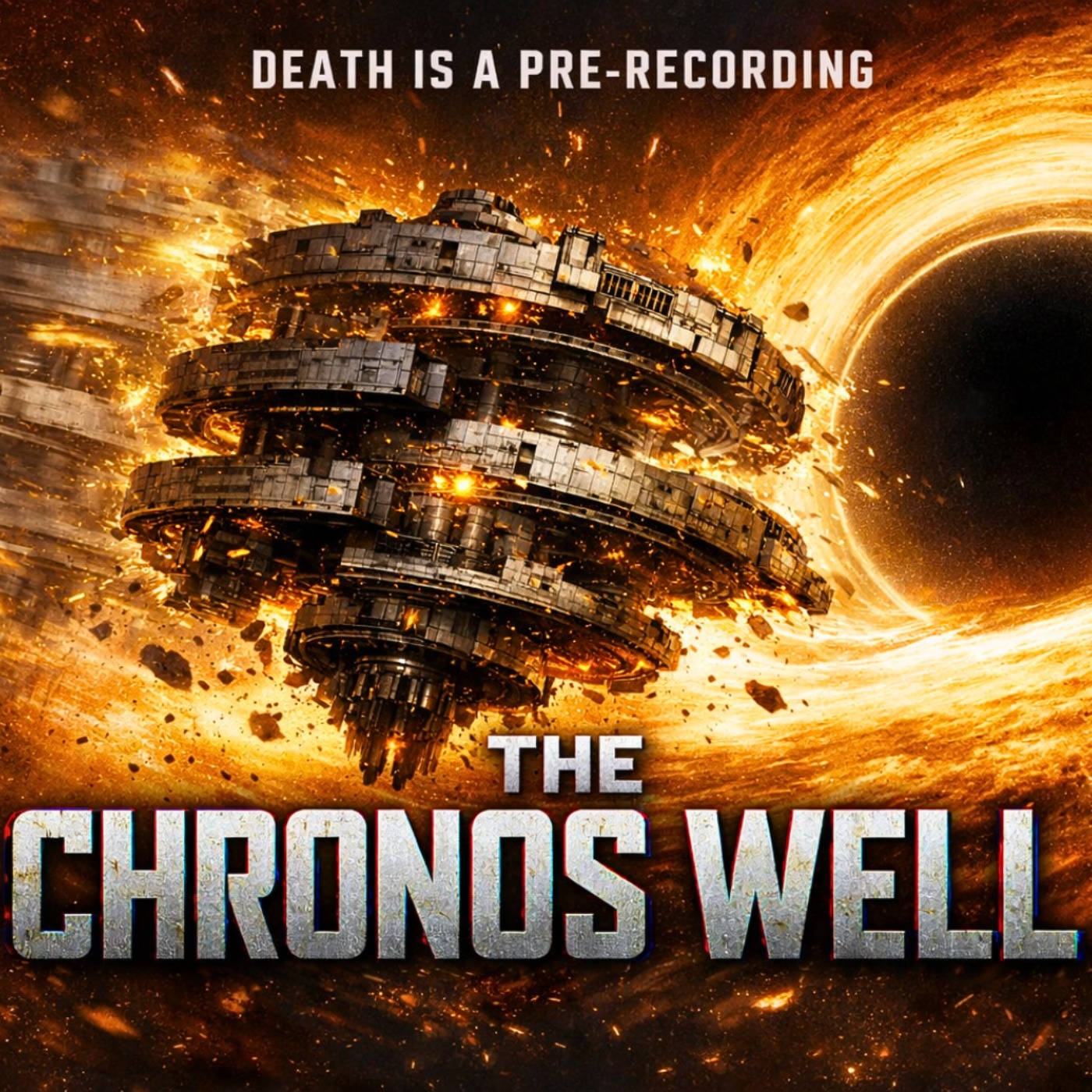
fictionscience
I Work At A Station Orbiting A Black Hole. We Can See The Future | Sci-Fi
About this Episode
Spotify Template:
📖 Written by Galactic Horrors:
A research station orbits deep in the gravity well of a black hole, its decks staggered at different depths so time runs at slightly different speeds from level to level, and key personnel wear experimental “anchor” implants to keep their senses aligned. The station’s sensor suite records more than images: any event that crosses a set threshold of stress or pain automatically imprints itself backward along the local timeline, so the crew begin receiving live feeds of evacuation scenes that haven’t happened yet, bodies slamming through bulkheads, alarms screaming, corridors bending like soft metal. When orbital decay suddenly accelerates, the navigation team realizes there is only one safe burn window to escape the well, and the timestamp on that maneuver matches perfectly with the worst of the evacuation footage. Simulations hint at a terrible rule: if they don’t let certain deaths and injuries play out as seen, the math goes nonlinear and the whole station is likely to tumble past the point of no return.
Using the future footage to dodge hazards only makes things worse: doors that were open in the recording are sealed now, fires they avoided erupt somewhere else, and every attempt to “improve” the timeline spawns new clips of more grotesque outcomes. Then the real horror arrives in person, future-echo versions of crew members staggering out of misaligned elevator doors and maintenance shafts, their bodies stretched and twisted by tidal forces, bones and organs smeared along time so that parts of them are seconds ahead or behind the rest. These doppelgangers know exactly when and where the recorded disasters occur, and some try to force events to match the footage while others, half-mad, try to stop their own deaths by dragging coworkers into “safer” paths that don’t exist. Bit by bit, the crew understand that the monsters they see people screaming at in the recordings are just themselves, flayed and spaghettified by the black hole and flung backward along the light they’re watching.
As the decay rate climbs and anchor implants flood their owners with flashforwards of their own last moments, command falls back on triage: the escape pod manifest must match the footage or the models predict even worse spacetime distortions, but everyone on the list has a face and voice begging to be changed. The protagonist is forced into an impossible choice, honor the recorded deaths to preserve a slim chance for some to escape, or tear up the manifest and gamble that breaking the script will free them from the black hole’s grip, knowing that if they’re wrong, the next wave of future footage will just show their own bodies screaming in new and inventive shapes as they fall in forever.
⚠️ Content Ownership Notice:
All stories, artwork, thumbnails, and animations featured on this channel are original creations of Galactic Horrors. I do not accept or feature submissions from other creators. Unauthorized reproduction, redistribution, or re-uploading of any content from this channel, in any form, is strictly prohibited and constitutes a violation of copyright. Legal action may be taken against any parties found infringing these rights.
📜 Fictional Work Disclaimer:
This story is a work of fiction created for entertainment purposes only. The events, characters, and organizations portrayed are entirely fictional, and any references to governmental bodies, entities, or individuals are not intended to represent reality. Any resemblance to actual persons, living or dead, or real-life events or organizations is purely coincidental.
#scifi #scifihorror #creepypasta
Disclosure: This episode includes AI-generated elements.
Hosted on Acast. See acast.com/privacy for more information.


Transcript
Youth Mental Health is a complex challenge that requires comprehensive solutions.
We must strengthen after-school programs.
We must make digital literacy tools available in our schools.
We must work with mental health professionals to support children.
And we must empower mentors, educators, and parents to keep kids happy.
Learn more about our commitment to finding lasting solutions at EmpowerOurFutureCoalition.com slash Solutions.
Paid for by the Coalition to Empower Our Future.
Texas and Peas Extra, see full terms at MintMobile.com.
The station is always falling.
That's the part nobody outside the gravity well community ever really grasps.
Called a platform doesn't hover or hold position above Golgotha.
It falls. All the time. My job, the thing I've done six shifts a week for two years station
relative is to make that fall take longer. I shape the descent so precisely that it turns into an
orbit, falling with just enough sideways velocity that you keep missing the thing you're falling
to ward. I correct the drift. I adjust the trajectory. I keep 60 people and 400,000 metric
tons of instrumentation on the safe side of a math problem that offers no second attempt.
It's good work if you don't mind a job where the penalty for error is spaghettification.
The morning it started, 0700 command time which is 0700 and roughly four seconds on sensor deck.
I was running the weekly decay audit. Orbital numbers, clean dependable, the kind of task where
your hands keep moving while your mind wanders. Called as orbit had been degrading at about 0.03
meters per shift since the last thruster correction. Routine. I'd compensated for worse in the
first six months when the attitude jets still carried a bias nobody could account for and I was
pushing corrections every 48 hours. Bren Hurst leaned over my console on his way to the navigation
bay and dropped a ration packet on my desk edge. You skipped third shift meal again. I ate. You swallowed
a stim tab. That's not food foil. He tapped the packet twice. He tapped things to mark them as
noticed and kept walking. Bren was senior navigation officer. We'd worked adjacent consoles for the
full two years, which in gravity well time meant we'd aged about 11 hours less than the original
mission briefing predicted. He was the kind of colleague who made routine tolerable, competent enough
that I never had to check his work, dry enough that conversation never felt like a favor.
He kept a running count of how many meals I skipped during a decay cycle. The number was high.
I ran the audit. The numbers came back elevated. The change was modest. Small enough that the
automatic systems didn't flag it or drag Commander Olesk out of his morning review.
But the decay rate had jumped from 0.03 to 0.18 meters per shift overnight. Six times higher,
with no corresponding change in solar wind pressure or station mass distribution.
I flagged it, filed the report, and started modelling the correction burn we'd need if the rate
held. It held. By midday command time, it had climbed to 0.24. I carried the numbers to Olesk in
person. His office sat at the top of the command ring, where the gravity gradient was shallowest and
time ran closest to external reference. Olesk was a compact man with a shaved head,
and the particular stillness of someone who'd commanded remote postings long enough to stop
performing authority. He read my figures, asked two questions, both technical, both sharp,
and told me to have a correction profile ready by end of shift. How much margin do we have,
he asked, weeks, if the rate stabilises. And if it doesn't, then I'll have a different answer
tomorrow. He nodded. I went back to my console. The rate didn't stabilize. The footage arrived at
1640 command time. This part matters, because everything that came later distorted people's memories
of those first minutes. Most of the crew now believe they recognised what they were seeing
immediately. They didn't. Nobody did. The temporal resolution array was called as primary instrument.
A sensor suite built to study information behaviour near the event horizon.
It recorded across what Dr. Verity Castan's called stress windows. Regions where gravitational
frame dragging was strong enough to imprint high energy events backward along the local
light cone. In practice, that meant the array could capture faint traces of violent phenomena
before they occurred, if the events were energetic enough. We'd used it for two years to study
accretion disc flares and tidal disruption events. The data came back noisy, partial, abstract,
wave forms, spectral signatures, models. What appeared on the array at 1640 was not a model.
It was clear, high resolution, full motion footage of colder platforms searing corridor
during what was obviously a catastrophic evacuation. Emergency lighting coated everything in deep
red. The corridor's port side wall was buckled inward. Structural ribs exposed like broken
fingers. Bodies moved through the frame, running, staggering. One man crawling with his left arm
bent at an angle that meant the elbow joint had failed entirely. Alarms were audible in the data stream
and beneath them a sound I couldn't immediately place. Metal deforming under sustained tidal load,
a grinding low frequency complaint from the station's bones. Castins was the first to identify it.
He was tall and angular. Castins was his family name Verity, his given name, and he'd published
the foundational stress window paper six years before Calder launched. He stood in front of the
main display in the sensor operation center and watched the footage loop three times before
speaking. That's us, he said. That corridor is C11. The structural damage matches asymmetric
tidal loading during rapid orbital descent. He paused. This scene is in our future.
The room absorbed that in layers. A junior analyst suggested a sensor malfunction.
A sensor deck technician, a heavy-set man named Parrick, who'd been fighting the same
sink error in the array calibration for three weeks, said the data integrity looked clean.
No artifacts, no corruption. It was the clearest signal the array had ever produced.
The stress threshold. Castins murmured almost to himself.
Imprint energy scales with trauma, physical destruction, injury.
He gestured at the screen where the man with the broken arm was still crawling.
This exceeds anything we've recorded from accretion events.
The imprint is strong enough to resolve individual faces.
And it was. I could see faces. I recognized two of them. Olesque arrived within minutes.
The footage carried a timestamp. An internal station clock reference embedded in the emergency
lighting cycle. Castins matched it to the orbital decay projections I'd filed that morning.
The timestamp fell within a 37 minute window 18 days from now.
The same window my models had already flagged as the most efficient interval for an escape burn
if the decay continued to accelerate. The same window we'd need to leave.
The next six hours were the kind of focused high pressure work a well-trained crew does
instinctively once the situation has clear edges. Olesque convened the department heads.
Castins laid out the stress window mechanics. I presented the orbital projections.
The crew took it in with the grim composure of people who had volunteered for a deep gravity
posting and understood at least abstractly that the mathematics of black holes did not
negotiate. The argument when it came stayed practical. If the footage showed events that hadn't
happened yet, could we prevent them? Olesque authorised a test.
Bulkhead C-11, which the footage showed failing catastrophically, would be sealed and reinforced.
If the evacuation recording changed, we'd no intervention could alter the future.
If it didn't, we'd know we were looking at a fixed record, events that would occur regardless.
Chief Engineer Maro Shail handled the reinforcement himself. Shail trusted metal more than
math. Barrel chested, scarred hands, a habit of arguing with anyone who outranked him.
He sealed C-11 with structural bracing rated for triple the load we'd seen in the recording.
Solid work. The bulkhead held. Four hours after the seal, new footage appeared on the array.
The new recording showed a compartment two sections away from C-11, a maintenance bay that had
been intact and unremarkable in every previous frame. Now a fire had devoured it.
The suppression system had failed or been overwhelmed. Three crew members were visible,
trapped behind a jammed pressure door. Their movements increasingly frantic and then increasingly
slow. I recognized one of the faces, sensor, technician, parake. The man who'd confirmed the
integrity of the first footage and who was, at that moment, alive and working a deck below us.
Castan's ran the analysis overnight. He presented it to Olesk and to me at 0400, his expression
drawn in a way that went beyond fatigue. The stress budget is conserved, he said.
The total energy of the evacuation, the structural failures, the injuries, the deaths,
is constrained by the gravitational dynamics of the burn window. It's a boundary condition,
prevent one event and another manifests to compensate. The total cost stays the same.
Olesk sat very still. So these disasters aren't just predictions, he said.
Their requirements. The math doesn't distinguish between those concepts, castan's replied.
Olesk ordered all intervention attempts, halted pending further analysis.
Shale hurled a wrench across the engineering bay hard enough to dent a cabinet when he heard,
but he didn't argue. Even Shale could read the footage. I should have stopped there.
The problem, my problem, the specific floor that Bren had diagnosed years earlier without
naming it, was that I couldn't accept an outcome that wouldn't move. A trajectory that refused
optimization felt to me, like a model I hadn't completed yet. That wasn't pure arrogance,
though there was plenty of that. It was the basic orientation of my training. You identify variables,
adjust them, and run the model again. If the answer stays bad, you haven't found the right variables.
I waited until the navigation bay was empty. Second shift had ended. Bren had signed off with his
usual tap on the console edge. Done, noted, handed over. I sat alone with the projections and the
stress window data and did the only thing I knew how to do. I didn't see a bulkhead.
That felt blunt, inelegant. A bandage slapped over a gauge instead of a fix.
I went after the underlying mechanical cause, the tidal loading asymmetry that collapsed C-11 in
the recording. If I adjusted the station's attitude during the approach to the burn window,
a small precise rotation that redistributed the gravitational gradient across the structural frame,
the asymmetry would drop below the failure threshold. C-11 would endure. The fire in the maintenance
bay would never start, because the compensating stress wouldn't rupture a power conduit.
I built the model. It was a clean piece of work. The attitude change was minor, well within thrust
a capability, and the projected stress distribution looked smooth across every section of the station.
I ran it three times. It held three times. The total energy budget stayed fixed, but spread across
the structure in a way that stayed below catastrophic thresholds in most sections. No single point
of catastrophic overload. I fed the model into the navigation systems predictive buffer. New footage
arrived on the array within an hour. In this version, C-11 held. The maintenance bay remained
intact. No fire. Parick lived. Bren Hurst, however, lay in B-ring. Pinned beneath a structural
beam that hadn't appeared in any previous recording. The beam had sheared loose from a ceiling
junction, my attitude adjustment had loaded differently. A junction that in the original footage
endured quietly because the catastrophic failures elsewhere drew energy away from it.
My elegant redistribution had given that stress nowhere else to go. It went down through a beam
into a man I'd worked beside for two years. The recording didn't spare detail. The resolution was
high. I saw his face at the moment of impact and the few seconds that followed. I deleted the model.
I purged it from the predictive buffer. The footage on the array did not change. Once recorded,
a stress window imprint persisted regardless of whether its cause still existed in the current
branch of events. Castins had explained that on the first day, the array captured potential
futures weighted by trauma energy, and the imprint remained as long as the energy signature stayed
above threshold. My model was gone, but the footage of what my model would have produced still
looped on the array beside the original recordings, another entry in the catalog of ways
called a platform might die. I told no one. Two days passed. The decay rate climbed.
Castins revised his stress window models, folding in the new footage my intervention had generated,
though he chalked it up to a secondary imprint cascade, a natural byproduct of the increase
ingredient, not anything human. I let him. The crew absorbed the b-ring footage the way they
absorbed the maintenance bay fire, with the tired grinding resilience of people learning that each
new day brought a new way to watch themselves die. Bren watched it. Of course he did. The whole crew
had access to the array feed. He studied it with the same professional calm he brought to navigation data,
watching his own death under a structural beam in a corridor he walked every shift. He never
mentioned it to me. I don't know what it cost him, and I didn't ask because asking would have
meant sitting across from him and pretending I didn't know why that beam existed at all.
Shift hand off. End of second watch. He tapped the console edge and got to his feet.
Numbers look worse, he said. Olesk is going to want a revised burn profile by morning. I know.
He gave me the look he used when my answers got too short, a quick assessing glance not suspicious
just paying attention. You eating? Yes. Liar. He walked out. I sat with the console and the quiet
and the knowledge that I had killed him in a future that no longer existed, in a recording that
would outlast both of us, and that the version where he died under that beam carried my signature
in the math. The first doppelganger arrived on deck 7 at 0300, six days before the burn window.
A maintenance crew was inspecting a service shaft that ran between the habitat ring and the
lower sensor arrays. The shaft was narrow, unpressurized during off hours, accessible through a chain
of manual hatches that required physical cranking to open. The lead technician, a wire-required man
named Toby, who'd been on call since commissioning, reported that one of the hatches was already open
when his team arrived. Not forced. The section was already vacuum-isolated, cranked from inside.
What climbed out of the opening moved wrong. The initial call described a crew member in some kind
of distress. Maybe injured. Maybe disoriented from anchor implant failure. Maybe in acute gravity
sickness from crossing too many decks without adjustment. The damage control team that responded
found something worse than any of that. The figure had started as human. That much was clear.
It wore a colder issue duty uniform, though the fabric was stretched in some places and wrinkled
in others, as if the body underneath had been reshaped while the clothing tried to adapt.
The left arm was longer than the right by nearly 15 centimeters. Fingers elongated. The joints
unevenly spaced. The torso was subtly off. Broader on one side, ribcage asymmetric, as though the
skeleton had been pulled in one direction by a mechanical force.
Big news. Boost mobile is now sending experts nationwide to deliver and set up customers new
phones at home or work. We're going on tour. Not a tour. We're delivering and setting up
customer's phones, so it's easier to upgrade. Let's get in the tour bus and hit the road.
No, not a tour bus. It's a regular car. We use to deliver and set up customer's phones at
home or work. Are you a groupie on this tour? We deliver and set up phones. It's not a tour.
Oh, you're definitely a groupie. Introducing Stortador. Switching in a new device with expert
setup and delivery wherever you're at. Delivery available for select devices that boostmobile.com.
Knock knock. Who's there? A boost mobile expert. Here to deliver and set up your all-new iPhone
17 Pro designed to be the most powerful iPhone ever. You call that a knock knock joke.
This isn't a joke. Boost mobile really sends experts to deliver and set up your phone at
home or work. Okay, it's just that when people say knock knock, there's usually a joke to go with it.
Like I said, this isn't a joke. So the knock knock was just you knocking. Yeah, that's how doors work.
Get the new iPhone 17 Pro delivered and set up by an expert wherever you are. Delivery
available for select devices purchased at boostmobile.com. Terms apply.
The head sat at an angle that suggested the cervical vertebrae had been rearranged by something
that understood anatomy only in terms of load paths. The movement was worse.
The figure's right hand gripped a railing. A section of railing that had been removed
during a refit two months earlier. The fingers closed around metal that didn't exist anymore,
curling into a fist around empty air with absolute confidence.
The left hand moved at a different speed, reaching for a wall panel, while the right was still
closing on its phantom railing, as if the two limbs lived at slightly different moments and were
only sharing the same body by coincidence. It tried to speak. The sounds arrived out of order.
A final syllable first, then a fragment from the middle, then a noise that might have been a name.
Hard consonant, soft vowel, cut short. The sequence hinted at language but never quite assembled
into it. Toby's team backed away. Damage control cordoned the section. The figure kept moving
along the shaft corridor, gripping railings and panels that matched a layout the station hadn't
used in weeks, navigating a version of colder that no longer existed. Someone on the team recognized
the face, pulled up the crew manifest on a portable terminal and matched the distorted features
to a file photo. Senior Technician Dayab, sensor deck. Currently alive, currently on shift,
currently two decks below, running calibrations on the array that was still looping footage of
disasters that hadn't occurred. They woke castings and brought him to the cordoned section.
He stood in front of the figure for four minutes without speaking. When he finally did,
his voice had the stripped down tone he used when the math was very bad and very certain.
Tidal spaghettification, he said. Differential gravitational force along the body's length,
strong enough to elongate tissue and bone. This is what a human body looks like in the later
stages of infall toward a compact mass. He paused. Dayab hasn't undergone that. Dayab is downstairs.
So what is it, Olesk asked? He'd arrived within minutes, wearing the expression of a commander,
absorbing information faster than he'd like. It's the same mechanism as the footage,
stress window imprinting, the array records data. This, he nodded toward the figure which
was still feeling its way through a corridor that no longer matched its memory, is physical.
The imprint energy is high enough to project matter backward along the light cone.
Future state matter. Dayab's body at the moment of greatest tidal stress, thrown back along
its own timeline and deposited here. The corridor went quiet. The figures mismatched
hands continued their separate tasks, gripping and reaching with misaligned purpose.
The crew will see the footage, Olesk said, and they'll see these things in the corridors and
someone will connect the two. Yes. How do I tell 60 people that the monsters on the screen are them?
Customs didn't answer. He lacked the rank and, frankly, the vocabulary. So did I.
But standing in that corridor, watching a version of Dayab who had already fallen into Golgotha
tried to walk through a station that had already been remodeled, I learned something the
recordings alone hadn't taught me. The array wasn't showing us a hypothetical future.
It was showing the station's death from inside, narrated by the bodies of the people who
would die in it, delivered early because the black hole didn't care about sequence.
In gravitational terms, everything that was coming had already happened. The light was merely
catching up, and I had reached into that machinery and made it worse. The proof was still looping on
the array. The man it showed dying would ask me tomorrow if I'd eaten breakfast, and I would lie.
Over the next four days, eleven more came through. They appeared from elevator shafts,
maintenance hatches, ventilation junctions, any transitional space where the station's structure
formed a gap between decks. The pattern was architectural. Castins explained it with frame
dragging geometry. The doppelgangers materialized along paths where the gravitational gradient between
adjacent levels was steepest, because the stress window mechanism needed a tidal differential to
project matter backward. In practice, they arrived in the station's seams, places where one time
rate met another. The second emerged from an elevator gap on deck four. The car sat between floors,
locked by an automatic safety brake during a routine power fluctuation. A gap of about half a meter
separated the car's roof from the deck four landing. The figures slid through that gap torso
first, moving at a speed that didn't match its own body. Its legs remained in the shaft, visible
and motionless through the opening, still waiting for the command to move. While its arms were already
in the corridor, reaching for a crew member named Buller, who was standing by the doors, it said her name,
or part of it. The first syllable landed cleanly. Va, and the rest broke apart,
consonants arriving before the vowel they needed, the stress falling on the wrong beat.
It reached with one hand while the other stayed locked in a gripping motion from some earlier
moment, fingers closing around a handle or tool that no longer existed. Buller was a stocky calm
woman, who ran atmospheric systems on the habitat ring. She'd been aboard since the first crew rotation.
She stepped back, hit the wall, and stayed there. She didn't scream. She said very clearly,
that's gable, that's Lieutenant Gable. Then his hand is wrong. Both observations were accurate.
The figure matched Lieutenant Leisander Gable, a structural engineer currently on shift in the
lower ring. The hand she'd singled out was wrong in a way that took a moment to see. The
fingers had the correct length, but they thickened toward the tips instead of narrowing, as if tidal
forces had reversed the taper on each digit. The joints still functioned. The fingers still curled.
The geometry was inverted. Damage control moved Buller away. Security sealed the elevator bank.
Gable, the living one, was not informed. After the Diab case, Olesk had said a policy.
No one would be told about their own doppelganger unless operations required it.
The reasoning was blunt, knowing that a tidal sheared copy of yourself was roaming the corridors
wouldn't help you do your job and might stop you from doing it at all. The policy lasted about 36
hours. Then the doppelganger started recognizing people. The third and fourth arrived together
from a maintenance shaft on Deck 6. They tried to move in unison, but their bodies operated at
slightly different temporal rates, so one lunged while the other was mid-stried, creating a staggered
arithmic gate, like two drunks attempting to share one set of legs. One of them identified
later as a future echo of a power systems technician named Grau, walked straight into the
mess hall during second shift meal. Twenty crew members were eating. Grau's doppelganger crossed
the room in that halting time-smeared gate and stopped at a table where three junior analysts sat
with their trays. It studied each of them in turn. Then it reached out and pushed one. A young man
named Cortez toward the door. The shove wasn't violent. The motion was unmistakably purposeful.
It wanted Cortez to move. Cortez moved. He scrambled out of his chair and backed into the corridor.
The doppelganger followed with one hand extended, guiding or herding. It's damaged mouth forcing
out syllables that almost arranged themselves into go. There. And something that might have been
a section number from Calder's internal grid. Security intervened. The doppelganger resisted,
not with force but with persistence. Reaching past the security team toward Cortez,
its ruined hand opening and closing, like something that had been given one task and lacked the
capacity to abandon it. They locked it in a storage compartment on deck six. Through the sealed hatch,
Cortez heard tapping. Regular intervals. A rhythm he eventually recognized as the timing
pattern for the emergency assembly tone. The signal that sent crew to their rally points during
evacuation. It was trying to direct him to his evacuation station. The place the footage showed
him standing when the disasters started. They're trying to make it match. Castan said.
The briefing room was packed. Olesk had called department heads plus senior staff,
14 people in a space designed for 10. I stood against the back wall with a portable terminal
under my arm, running decay projections in the margin of my attention while Castan's talked.
The doppelgangers are future state projections of crew members at the moment of maximum
tidal stress. Their bodies smear across several seconds instead of occupying a single point in time.
Their perceptions smear too, so they experience the present, their own future, and intermediate
states simultaneously. He pulled up a structural diagram of the station. Their behavior points to a
single imperative. Position the present day crew to match the recorded footage. They push people
toward the places they need to be for the evacuation to play out as recorded. And the ones that
push the other way? Shail asked. He sat with arms crossed, scarred hands gripping his elbows.
He'd spent the last shift welding barricades across three elevator shafts after a doppelganger
tried to drag one of his technicians toward a plasma relay junction. The same junction we'd
seen overloading during the burn window. Some resist that imperative, Castan said. Their
neural smearing includes an awareness of their own death, partial and fragmented, but present.
Those ones try to alter events instead of enforce them. They pull people away from their recorded
positions. That sounds like an improvement, someone near the front said. It isn't. Every
displacement from the recorded configuration triggers compensating footage. The same conservation
rule as the bulkhead test. Each successful change by a resisting doppelganger produces new
casualties elsewhere. He didn't raise his voice. He didn't need to. The room understood.
Dr. Castan's, Olesk said. The burn window. 12 days. The decay rate. Accelerating.
Foil has the current figures. All eyes slid my way. I brought up the projections.
0.61 meters per shift as of this morning. The curve is non-linear. If this trend holds,
we lose stable orbit in 14 to 15 days. The burn window at day 18 is still viable, but the margin
is shrinking. If we miss it, the next window is at 23 days. By then the decay will have brought
us close enough to the event horizon that the tidal differential between command and sensor deck
exceeds the central spine's structural tolerance. In plain terms, Olesk asked,
although he already knew. The station tears itself apart before we can fire the engines.
One window, he said. One window. He turned back to the room. We prepare for the burn.
Dr. Castan's, I want a full timeline of the footage. Every recorded event in order,
with the structural and mass distribution implications for the escape trajectory.
Shale, stop welding barricades. I need engines ready, not corridors blocked. Foil refined the
burn profile down to the minute. Shale uncrossed his arms. Commander, you're asking us to,
I know exactly what I'm asking. Those things are dragging my people into position like actors
on a stage. You want me to stand down and let them. I want you to keep the engines running.
The barricades aren't stopping the doppelgangers. They're emerging from structural gaps we
can't seal without breaking the station's thermal expansion design. Olesk met his glare like a man
who'd made worse calculations. We cannot defeat the geometry of this well. We can leave it.
And the ones the footage says don't leave. He didn't reply.
The silence answered for him. The manifest arrived two days later.
Castan's built it with three analysts, working frame by frame through every piece of footage the
array had captured. The method was painstaking. Identify each pod launch, cross-reference mass
signatures with crew weights, match visible faces and uniform markings to personnel records,
and map the structural state of each pod bay at launch time to determine which bays were usable
and which were destroyed or blocked. The result was a spreadsheet. Names in one column,
pod assignments in another, launch sequence in a third, 41 names, 19 blanks.
Hi, everyone. This is Karin, the voice of Simon Fairchild from the Magnus Archives.
And today, I want to talk to you about Boost Mobile. Some things quietly drain you,
like an expensive phone bill trapping your money month after month. Here's a quick money tip.
Stop paying a carry attack. When you bring your own phone and switch to Boost Mobile's $25
unlimited forever plan, you can unlock up to $600 in savings. That's money that belongs in
your life, not trapped in a phone bill. Reclaim those savings for something you're actually into,
an EMF meter, a thermal camera, or whatever strange corner of the universe you're currently
exploring. Visit BoostMobile.com to unlock your savings and take back control. After 30
gigabytes, customers may experience slower speeds. Customers pay $25 per month as long as they're
remain active on the Boost Mobile unlimited plan. Boost Mobile January 2026 survey comparing average
annual payments of AT&T, Ryzen and T-Mobile customers to 12 months on the Boost Mobile
unlimited plan. For full offer details, visit BoostMobile.com. Youth Mental Health is a complex
challenge that requires comprehensive solutions. We must strengthen after-school programs.
We must make digital literacy tools available in our schools. We must work with mental health
professionals to support children and we must empower mentors, educators, and parents to keep
kids happy. Learn more about our commitment to finding lasting solutions at EmpowerOurFutureCoalition.com
slash Solutions. Paid for by the Coalition to Empower Our Future.
In the same overcrowded briefing room, the file waited on each department heads terminal.
He didn't read the names aloud. He didn't offer commentary. He said,
this is the pod configuration the footage shows surviving the burn. Dr. Kastan's models indicate
that deviation from this lineup introduces trajectory errors that compound past recoverable limits.
I am ordering compliance. Then he left, so people could read. My name was there.
Pod Bay 3, second launch wave. The mass matched. My face was visible through a viewport in one of
the later recordings. The data, the math, and the whole itself, indifferent and non-sequential,
had already recorded my survival. Bren Hurst's name was absent. I had known. The B-ring footage,
my footage the one my model had created, showed clearly that Bren died in the corridor serving as
the primary accessway to pod Bay 3. The structural collapse that killed him was the event that cleared
rubble from that accessway. His death opened my path. Without the collapse, the corridor remained
blocked. Without that corridor, the pod bay stayed inaccessible. Without that pod bay, I joined the
19. I sat in the briefing room after Olesk left and read the manifest four times. Each reading I
hunted for a different escape hatch. An error in the mass calculations. An overlooked route to
pod bay 3. A misidentified face in the footage that might mean the assignments were wrong.
Every reading landed on the same answer. The crews split along a line so clean it could have
been cut with a laser. On one side, Olesk, Castins, and roughly two-thirds of the crew,
including most of those with names on the manifest. Their position was arithmetic. 41 people could
survive if the recorded events played out as shown. If deviation warped the trajectory beyond
tolerance, everyone died. The choice lay between some and none. On the other side,
Shale, a cluster of engineers, and a scattering from every department, including several whose
own names sat on the manifest, but who refused a survival bought with scheduled deaths.
Their math focused on the 19. Those people were being asked to die on a timetable.
The footage made every one of those deaths specific. Faces, locations, timestamps.
This wasn't a distant triage. This was walking up to a man whose name you knew,
and telling him the exact corridor and second when a beam would crush his spine,
then expecting him to stand in place and wait. Shale argued with anyone who would listen,
and several who didn't want to. He cornered me in the navigation bay on day eight,
filling the narrow space between console banks, speaking low enough that only I could hear.
You've seen the models, he said. Castan's is conservation rule. Every tweak triggers a compensating
disaster. Yes, but he treats each tweak as an isolated change to a fixed system. What if the system
isn't fixed? What if a large enough deviation, coordinated, simultaneous across multiple sections,
pushes it into a phase transition? You're talking about a different regime, I said. A gamble.
Call it what you like. You're still rolling dice with 60 lives. He leaned closer. Your friend
Hurst isn't on the list, foil. I didn't answer. You've got the best trajectory models on this station.
You've been running corrections for two years. If anyone can find us an alternative, there isn't one.
The words came out faster than I meant. Shale heard the speed and the flatness and something
underneath, something he couldn't label, but I could. I wasn't claiming there was no alternative
because I'd exhausted the search space. I was speaking as someone who'd already found one.
The math doesn't offer a clean exit. I've checked. He studied me. How recently?
Recently enough. He left. I don't know whether he believed me. I'm not sure it mattered.
On day seven, the anchor implants began to fail. Fail isn't quite right. They functioned
exactly as designed. The implants synchronized their wearers perceptions to a consistent time frame
despite the gravity gradient. The problem was that the gradient had steepened enough to drag
stress window imprint energy into the implant's operational range. The devices couldn't tell the
difference between routine cross-deck timing signals and the backward propagating trauma data,
now flooding local space time. The implants started receiving the future.
Ensign Mora, a communications officer on Commandec, was the first to report it. She sat at her
station, monitoring the external relay for a routine check-in with the support vessel at the
system's edge, when she stopped mid-sentence and clamped both hands to the sides of her head.
She didn't cry out. According to the colleague beside her, she went still for six seconds,
then lowered her hands and said, I just watched myself die. She described it with the crisp
detachment of someone narrating a scan, a corridor on deck five during the evacuation,
emergency lighting. She was running. Something followed her.
Tall, wrong-moving parts of it arriving before the rest. It caught her shoulder.
The hand that gripped her was human in shape but temporarily distorted. Fingers closing in sequence
instead of together, pinky first, then ring, then middle, each digit fractionally ahead of the next.
She felt the grip. She felt the pull. Then the vision dropped her back at her station with
her hands on her head and her colleague asking whether she was all right.
Kastans reviewed the implant log. The flash forward had lasted six seconds by the station clock.
Mora's subjective experience ran two or three minutes. The implant had received a dense burst
of stress window data and processed it as sensory input, feeding it straight into her visual
and somatosensory cortex, with the same fidelity it normally used to synchronize cross-deck perception.
It gave her the experience of her own recorded death, Kastans said. First person, full sensory.
Three more crew members reported similar flashes within 12 hours, then seven more.
Implant wearing crew simply endured the episodes between tasks, flinching at irregular intervals
as their own deaths arrived unannounced in the middle of conversation, calculation, or sleep.
One man, a reactor tech named Dol tried to cut his implant out. He used a maintenance blade,
a short heavy tool for scoring insulation panels. He got through the skin and part way into the
subcutaneous housing before pain and blood loss dropped him in the reactor access corridor,
where a passing crew member found him with the blade still in hand and a slick of red running
from behind his left ear to his collar. Medical patched him. The implant still functioned.
The flash forwards continued. I had my first on day six. I was at my console, refining the burn
profile Olesk had requested. The numbers were clean. The trajectory was tight. I was thinking about
thrust vector tolerances when my vision went white, then red, then slid into a scene I recognized,
pod bay three, launch cradles, harness straps, the vibration of pre-ignition through the deck plates.
I sat in the pod in my assigned seat, the same one from the footage, through the viewport,
the station fell away, then the visor cracked, the bay was gone. I was in a different branch,
when I knew intimately, the model where I'd saved Bren, the one where B ring held and the pod bay
didn't. De-compression, fast, air tearing out of me in a way that felt less like exhaling
and more like being emptied. My face in the viewport, distorted by pressure difference,
eyes open and aware for a few seconds longer than I wanted. The vision lasted 11 seconds on the
wall-clock. I counted afterward, fingers biting into the console edge hard enough that my knuckles hurt.
The implant had shown me the death from my deleted model, the future I had built and erased.
It still lived in the stress window data, still imprinted on the light cone,
as real to the physics of the well as any outcome we hadn't erased. I understood then what
castons hadn't spelled out. The array didn't record a single future. It recorded futures,
plural, weighted by trauma energy. Every model I'd run, every intervention anyone had attempted,
every deviation that had summoned compensating footage, all of it sat in the data.
All of it imprinted. The implants couldn't tell which branch would happen and which might.
They delivered every branch that carried enough pain. My deleted model was still killing me,
11 seconds at a time whenever the implant caught the echo.
Bren found me an hour later. I was still at the console, still gripping the edge.
He pulled a chair from the adjacent station and sat. He didn't speak at first. That was one of the
benefits of working with someone for two years. Silence developed texture. This silence carried
the weight of one person waiting and the other knowing it. I saw the bearing footage, he said.
I looked over. Not the original, the new one, the beam. He said it like he read trajectory charts.
It hit the array the same night you stayed late. Castons logged it as a secondary cascade event,
residual imprint from the elevated gradient. He paused. That wasn't residual, was it?
I could have leaned on the cover story. It was solid. Even castons believed it.
Nobody else had a reason to connect my late shift to the new recording.
Bren wasn't accusing me. He was asking. No, I said. He nodded. The way you nod when
reality matches the suspicion you wish you didn't have. You ran a model. It redistributed the
title loading. C-11 stayed intact. The maintenance base stayed intact. The stress shifted to a
ceiling junction in bearing and the beam came down. He sat with that. The console beside a
cycle through standby displays. Orbital parameters updating every 30 seconds, numbers ticking
upward, a process that would kill everyone aboard if it continued long enough. Harlan.
He almost never used my first name. From him, it sounded slightly formal, as if the professional
frame could no longer contain the situation. Every time you try to fix this, I die in a new way.
I know. I've died under a beam. I died in the original footage in a corridor collapse.
Castons showed me a tertiary cascade variant this morning, where I'm caught in a pressure loss
event in the bearing junction. That one doesn't have your fingerprints on it yet, but given the pattern,
that version isn't mine. Fine. Someone else contributed that one. The point remains.
He leaned forward, elbows braced on his knees, hands loose. Stop trying.
Bren, I'm not asking you to abandon me. I'm asking you to stop designing fresh ways for it to
happen. Every model you run generates more footage, more versions, more detail. My implant showed
me the beam version this morning, full sensory, nine seconds of steel hitting my ribcage while I
try to get my arms up. He raised his hands, long fingers, the hands of a man who'd tuned instruments
for years. I felt it, Harlan. Right here. The implant made me feel my ribs break. Your model did
that. There was no answer that wasn't an indictment. He was right. Every iteration I'd built had
produced new footage, new deaths, new feedstock for his implant to inject into his nervous system
in nine second bursts of first person agony. My compulsion to optimize to keep nudging the
trajectory had become ongoing torture for him. The manifest has me dead in bearing during the
burn, he said. I've read that recording frame by frame. I know the timestamp, the section, the
approximate duration. I can live with the scheduled version. I can't handle the variants, the alternates.
Every time you push a new model into the buffer, a fresh version shows up in my head,
and I have to endure a death I wasn't even officially assigned. He rose. So stop. Whatever you
think you're going to find, it isn't waiting at the end of these runs. The search is worse than
the answer. He walked out. I sat with the quiet and the console and the softly climbing decay rate,
0.68 meters per shift, and thought about the particular cruelty of a system that recorded every
hypothetical death with the same fidelity as the real one, and delivered all of them to the person
who would have died that way via a device bolted behind his ear. I ran one more model. I ran it
because I couldn't stop. The floor wasn't strategic or technical. It sat in the same place as the
skill that made me good at my job. An orbit is just a fall you keep correcting. Stop correcting and
you fall. I didn't know how to stop. This model was the most sophisticated work I'd done in two
years on colder. I folded in every variable I had, the conservation rule, the evolving tidal
gradient, the doppelganger emergence pattern, the link between intervention energy and compensating
feedback. I built a trajectory that embraced all of it, not a one-off fix, not a simple redistribution,
a complete integrated alternative to the recorded evacuation, a sequence that satisfied the
constraints while delivering a different outcome. Brenna live, Beering intact, pod bay three
accessible via an alternate route. I ran it six times, it held six times, the math was clean,
the trajectory stayed inside tolerance, the stress budget balanced. I had found what I'd been
chasing since the first footage, a clean exit. I fed it into the predictive buffer. 40 minutes later,
the footage arrived. In this version, Beering remained standing. The alternate route to pod bay three
was clear. Bren moved through the evacuation. The stress budget redistributed across three
sections of the station that, in my model, absorbed the load without catastrophic failure.
Pod bay three launched. I was not in it. The recording showed the bay from two angles,
an external perspective from the array and an internal view from the Bay's own monitoring system.
The launch clamps fired. The pod separated. In my assigned seat, the one I occupied in every
previous version, Brenna hurst settled into the cradle and pulled the harness across his chest.
The bay decompressed three seconds after launch. Not the pod. The bay. A structural failure in the
outer wall caused by the stress redistribution my model required to spare Beering. The pod
escaped. 12 people behind it in the second wave died in decompression. The recording fixed
them all in perfect detail. I sat among them. Second row, third from the left. Viser cracked,
face frozen. My model hadn't saved Bren in addition to me. It had saved him instead of me.
The conservation rule allowed exactly two outcomes. Bren dies in Beering and I escape in pod bay three,
or I die in pod bay three and he escapes in my seat. I stared at the footage. My own face on the
screen. Dead. The cracked visor. The way decompression had tugged at the skin around my eyes.
My hands still locked around the harness straps. Fingers frozen in the position they'd held when
the air vanished. I deleted the model. I purged the buffer. I shut the terminal, stood and
walked to the navigation bay's observation window, where the black hole hung in the lower field of
view like a dark lens contorting the starlight. And I pressed my forehead to the glass until my
breathing slowed. I had found the alternative. It worked. It was clean. In that solution, Bren lived. I
died and all the numbers closed neatly. I erased it. Not because the math was wrong. Because the
math killed me. That was the whole reason. I didn't trade places out of principle or hard one
respect for the equations. I chose myself. Bren's life did not outweigh mine on the scale I carried
in the back of my skull. A no amount of professional language or elegant modeling could disguise that.
I went back to my console. I opened the manifest. My name in the survivor column. The empty space where
his should have been. I closed the file. I did not open another model. Six hours isn't long.
On colder platform, with orbital decay dragging us deeper into the well at a rate I could watch in
real time, six hours felt like a held breath no one could sustain and no one dared release.
I spent the first two hours on the burn profile. Final refinements, thrust vector alignment,
ignition timing, pod launch sequencing, all tuned to the 37 minute window the decay curve and
the footage agreed on. The work was familiar. The kind of math that let my hands keep moving while
the rest of me stayed numb. Oles could place me at a secondary navigation console near pod bay three,
close enough to monitor the burn and close enough to reach my assigned pod when the sequence started.
It was a practical choice and I suspected a leash. He wanted his trajectory specialist exactly
where the recording showed him, doing exactly what the recording showed him doing. I didn't argue.
The manifest had my seat. The models had my seat. Every alternative that put someone else in it was
gone. At T minus four hours, Oles could dress the crew over the intercom. His voice was stripped of
anything that might be mistaken for comfort. He read the timeline. He read the launch sequence.
He didn't read the manifest. Everyone already knew whether they were on it.
But he repeated the compliance order in language without gaps. The recorded events would proceed.
Interference with the timeline would count as endangering the survivors.
Security was authorized to restrain anyone who tried to stray from their assigned position.
He paused. The intercom stayed open. Through the static I heard one breath and then another
before he said, I won't pretend this is fair. It is survivable. For some of us, that is what I can offer.
The channel closed. Through the deck plate grill below, I could see crew moving in the navigation bay.
Some walked quickly, angled forward, as if speed could outrun thought. Others moved slowly.
One man. I couldn't see his face from above. Only his shoulders and the back of his head
stopped at a corridor junction and stood there nearly a full minute before someone touched his
arm and nudged him on. At T minus three hours, Shail made his move. I saw it in the engineering
telemetry before the announcement. Shail and eleven others, seven from his staff, two reactor
techs, two structure specialists, had barricaded themselves in main engineering on deck nine.
They controlled the primary thrust systems, reactor safeties, and attitude adjustments.
They disabled remote overrides with physical disconnects at the consoles, leaving command powerless
to retake the engines without cutting through the barricade. Shail's plan matched the one he'd
pitched me. A coordinated, massive departure from the footage spread across enough systems
to overwhelm the conservation mechanism. He intended to fire a competing burn with different
vector, timing, and mass configuration, hoping to shove the system into a new regime where the
recorded timeline broke down. We had already seen this weeks earlier. It was one of the evacuation
clips, a thrust event from deck nine, poorly timed, producing an asymmetric load that snapped
the lower ring. Back then I'd catalogged it as one more disaster. Now, I knew its author.
The footage had recorded Shail's rebellion the way it recorded everything else, as part of the
ledger. His mutiny already sat in the stress budget, pre-balanced, and indispensable.
Olesk dispatched a security team. They reached the barricade and reported that Shail had welded
the main hatch from the inside. Cutting through would take at least 90 minutes. The burn window
opened in three hours. Leave him. Olesk said on the command channel.
Custens. Does his burn alter our trajectory? A pause while Custens ran the numbers from the primary
sensor station two decks up. Negative. That thrust event appears in the footage. The escape
trajectory already incorporates it. The competing burn fails and the structural collapse it causes
provides part of the mass redistribution we need for the pod launches. His people?
The recordings show the lower ring depressurizing after the collapse. All 12 engineering crew
die there. The footage has already assigned those losses. Silence again. Long enough for everyone
on the channel to picture the same scene. Confirmed, Olesk said. Maintain burn profile. All stations
hold. Shail would fire his engines, collapse his section, and kill the people who had followed him,
and the only result would be exactly the structural damage the escape required. His rebellion carried
load. The recordings had needed someone to shatter that ring, and Shail had stepped into the role
without realizing it was already written. I thought about his hands. Scard, thick, convinced that
metal told the truth. In three hours, those hands would rest on controls that did exactly what
the math predicted. The metal would fail exactly where and when the math required, and neither his
sincerity nor his fury would move the outcome by a kilogram of thrust. At T minus two hours,
the doppelgangers converged on the central spine. They came from every deck through elevator shafts,
maintenance crawlways, service hatches, ventilation junctions, every seam in the station.
Castins had argued that they followed gradients of stress window energy, drifting toward regions
where recorded events were densest. The central spine, tying together every ring and housing
the primary structural members that would bear the tidal loads during the burn, was the brightest
node in that network. From my console near pod bay three, I could see into the spine through a
reinforced observation window. What moved there no longer looked like injured crew. The tidal
gradient in those final hours had grown steep enough that the newest arrivals were barely human
in outline. Bodies stretched to twice their height and squeezed to half their width,
skin drawn tight and splitting along lines that followed the field.
Joints slipped and resettled in sequence as different parts of the same limb reached different
moments. The longer you stay alive, the longer you can enjoy boost mobiles unlimited
plan with the price that never goes up. So here are some tips. Do not parallel park on a cliff if
you want to enjoy an unlimited plan with the price that never goes up. Do not mistake a wasp
nest for a piñata if you want to enjoy an unlimited plan with the price that never goes up.
Do not microwave a hard boiled egg if you want to enjoy an unlimited plan with the price that
never goes up. Stay alive and enjoy unlimited wireless for $25 a month forever with boost mobile.
After 30 gigs customers may experience lower speeds customers will pay $25 a month as long as
they remain active on the boost mobile unlimited plan. With its two juicy beef patties,
three slices of melted cheese and tangy big-arts sauce, the big-arts is what happens when you
start making a McDonald's burger and never stop the big-arts. The most McDonald's McDonald's burger
yet for a limited time. Hey, this is Adam Grant, host of Ted's podcast,
rethinking with Adam Grant. Let me share with you why smart finance leaders turn to bill.
They know that clarity isn't just helpful, it's strategic. As the intelligent finance platform,
Bill uses AI to automate the busy work for nearly half a million businesses so they can focus
on intentional growth. Eliminate the friction and start scaling with the proven choice.
Visit bill.com slash proven to talk with an expert about automating your business finances
and get a $250 gift card as a thank you. That's bill.com slash proven. Terms and conditions apply
see offer page for details. Faces elongated into arrangements that still contained eyes,
nose, mouth, jaw, but rearranged them. Features sliding across bone as gravity pulled
tissue into directions flesh had never met before. One stopped at the observation window.
It pressed a hand to the glass, palm flat, fingers displayed, casual, almost social.
The way a colleague might lean during a conversation. The hand was wrong. The fingers ran too long,
each moving at its own tempo. Index finger tapping lightly while the ring finger was still
finishing a curl. Through the stretched and displaced features I recognized with a delay that felt
like dropping the face of Ensign Mora, the communications officer. The first to report a flash forward.
She was alive two decks above at her station. This version of her had already passed the horizon.
She looked at me through eyes that were the right color and the wrong shape. Horizontally stretched,
irises pulled into ovals, and her mouth formed words. I heard nothing through the glass. Her
upper and lower lips moved out of sync, one syllable behind the other. She moved on. The
procession continued. Watching them, I understood what the people in the recordings had been screaming at.
The monsters in those clips, the shapes the crew ran from and fought and died trying to avoid
with the same raw material as us. The footage had been showing us our own deaths from both sides at once.
The living and the dead. The crew and their echoes sharing the same corridors because the whole
ignored before and after. T minus 90 minutes. My implant fired again. The cut from present to future
was as abrupt as ever. A clean splice into a different sensory reel.
Pod Bay 3. My seat. Harness across my chest. Preignition vibration. The station dropping away in the
viewport. Then the cracked visor. The decompression. My face. The sequence shifted. This time the implant
showed a perspective I had never inhabited. Bearing. From above. Looking down through a structural gap
at the junction where the beam would fall. Bren walked through beneath me, heading toward the
after damage control station. The corridor was intact. The beam was in place. Then the view slid
and I was somewhere else. In a pod inside a launch cradle, hands on harness straps. But not my hands.
Bren's. Longer fingers. Thinner than mine. The familiar callus from instrument work on his right palm
visible even in the imprint. The vision faded after nine seconds. I sat at the console,
hands locked on the edge, counting my own breathing. The implant had delivered a composite.
The bearing corridor from a vantage point I'd never occupied. Then the pod from inside his body.
The futures tangled where our paths crossed. Or the implant was reminding me with the
indifference of a machine that only saw data streams. That the seat beneath me belonged to
another branch as well. And that the only reason I inhabited it was because I had deleted the
alternative. I released the console. Flexed my fingers. Checked the burn profile. The numbers remained
clean. The decay rate followed my predictions. Which meant the window was exactly where I'd placed it.
Which meant the sequence of disasters would roll out on schedule. I checked the numbers again.
They were the only things left that still responded when I touched them. T-62 minutes.
The first recorded event hit. A power relay on deck four overloaded at the precise time stamp
the footage had forecast within the margin of the station clock's own error. The overload
cascaded through a secondary junction and ruptured a plasma conduit in the adjacent service corridor.
Technician Ruiz posted exactly where the manifest placed him. Took the full discharge across his
left side. The damage control channel carried the report in clipped, rehearsed language.
Deck four. Section seven. Plasma discharge. One casualty. Technician Ruiz deceased.
Structural damage contained a service corridor. Main power unaffected. I listened and watched
the burn telemetry. Trajectory alignment. Nominal. Mass distribution. With intolerance.
The first death had already been paid for in the equations. The numbers balanced.
Four minutes later, a pressure seal on deck six split along a weld line.
The two crew in the section died before they could reach the emergency suits on the far wall.
The report arrived. Two more names subtracted. The station's mass shifted exactly as
predicted. The trajectory held. Compliance turned out not to be a single moment of acceptance
but a continuous surrender. Repeated with every new call from damage control.
Each new confirmation that the model was devouring actual people and remained on track.
Twelve minutes into the sequence, shale fired his engines.
Thrust translated into a structural groan through the deck plates.
On my telemetry display, the new thrust vector appeared as an orange line diverging from the
planned burn. Angled wrong, timed wrong. Strong enough to talk the lower section but too weak
to break the weld's grip. The recordings had been precise.
Shale's burn produced exactly the asymmetric load the lower ring couldn't absorb.
The collapse was quick. Telemetry showed a cascade of red indicators blooming across deck nine
and adjacent sections. Structural failure, pressure loss, thermal breach, power cut.
Twelve seconds from first crack to total depressurization.
The engineering channel went silent. Shale and his eleven vanished. The station shuddered.
The thrust cut, trajectory data flickered, recalculated and settled.
The missing mass from the destroyed ring nudged the center of gravity upward by the exact
amount the burn profile required. Shale's failed gambits slid into place as scheduled input,
like a planned correction. Green indicators everywhere.
I watched those green indicators and pictured the wrench dent in his cabinet.
A small angry mark on the metal now floating in a rubble field in a dead section the equations
had always required. T minus 38 minutes. The burn window opened. All stations, burn window is open,
or less said over the intercom. Escape sequence initiated. Pod launches commence in 22 minutes.
All personnel moved to assigned positions. This is not a drill. The last line was habit.
Nobody on colder thought this was practice. I secured my console, transferred the active telemetry
to a portable terminal and headed for pod bay three. The route was short, 40 meters of corridor
from the navigation alcove to the pod bay's forward access. The path crossed the junction where
B ring met the central spine. The same junction where, in the footage, Bren's death cleared the
rubble blocking the aft side of the accessway. I walked. The corridor was intact,
evenly lit. The overhead beam at the junction sat firm in its mount. In 16 minutes,
according to the recordings, the tidal stress propagating through the frame during the burn
would push that junction past its limits. The beam would drop. The corridor below would collapse.
Anything beneath it would be crushed, and the rubble pattern would shove wreckage away
from the aft access, clearing the route to pod bay three. I knew the geometry. I'd studied it.
On the schematics, I'd trace the collapse zone and calculated my own position at the moment of
failure. I would be past the junction inside the pod bay's forward airlock behind a pressure door
the rubble never reached. 30 meters of corridor separated my survival from Bren's death.
I would hear it, but not see it. The pressure door had no window. I paused under the beam.
The corridor stretched forward toward the pod bay, and back toward the damage control station,
where the manifest placed Bren. The beam above me was a quiet line of steel,
bearing its load. 16 minutes. I kept going. The doppelganger's thickened in the spine
as the burn sequence progressed. Through the observation windows lining the corridor to pod bay three,
I watched them crowd into the core. Dozens now jam together in configurations that defied any
ordinary anatomy. Some stood twice normal height and half normal thickness, others bent double,
joints reversed and re-reversed as different parts of them obeyed different clocks.
The tidal gradient had pulled faces into vertical streaks, eyes dragged into slits,
mouths an open line of teeth and soft tissue. Their movements had lost almost all resemblance to
human gate. They twisted rather than walked, unfolding and refolding around each other as if
squeezed through invisible funnels. One stepped out of a maintenance hatch into the corridor
ahead of me. Closer than any I'd seen. Close enough for individual fibers in its duty uniform
to show. Stretched thin over a torso drawn like taffy. Close enough for the ID badge to be
legible despite the warped photo, Sutter, B. It stood between me and the pod bay. Its body moved
at two rates. The upper half swayed with slow, almost lazy motion, while the lower half locked
in a trembling stance, legs braced against a deck it clearly felt out of phase with mine.
The head, Bren's head elongated, jaw dragged toward the sternum,
cranium stretched upward into an oval, turned in my direction. The mouth opened.
Sound came out in broken pieces. A vowel, a stop. Another vowel, then intact enough to cut
through the distortion. HAL! Half my name, in Bren's voice stretched through a device that
warped time and tone together. The pitch dipped lower than it should have. The consonant landed
half a heartbeat behind the vowel. But the cadence was his. Some fragment of the man I'd worked
beside for two years had clung to this shape and still knew who I was. I stepped right. The corridor
left enough space to pass. The doppelganger turned to track me. Its body rotating in stages.
Torso, then hips, then legs, until it looked like a figure being wrung out. It reached.
The hand that extended belonged to a geometry that shouldn't have functioned. Fingers too long,
joints flexing in sequence instead of together. I walked past. The tips brushed my sleeve and closed
on empty air. I didn't look back at his face. Twelve minutes to launch. I reached pod bay three's
forward airlock. The pressure door was open. The bay beyond glowed with active systems.
Launch cradles powered harnesses waiting. A young crew member I didn't know yet sat in the first
row. Already strapped in, knuckles white on his harness. Two more were climbing into the second
row. My seat was in that row. Third from the left. The harness hung ready. I stopped in the airlock
and turned. The corridor stretched back toward the bearing junction. 50 meters of clear deck.
At the far end, beyond the junction, I saw movement. Silhouettes heading after toward damaged
control in accordance with their assignments. One of them matched Bren's build. I couldn't make
out his face from here but I knew his walk. Unhurried. A little flat footed. The gate of a tall man
conserving energy on long shifts. He was moving toward the aft station. Still working.
The overhead beam sat in its junction. 40 meters from where I stood. The station's frame
creaked around it as the tidal stress climbed toward the recorded threshold.
Nine minutes. I could reach him. 40 meters at a jog. 15 seconds. Enough time to grab his arm and
drag him back past the junction before the beam dropped. The recording showed nobody else in the
collapse zone. If I moved him, the beam would hit empty corridor. The rubble would still clear the
accessway. My route to the pod would remain open. The only variable would be Bren and the conservation
rule would react. Somewhere else on the station, someone would die in a way the existing footage
didn't show to balance the new configuration. Or the trajectory would wobble. The altered body
count at the moment of launch shifting the center of mass just enough to bend the escape curve
into the well. Or the deleted model would assert itself. The clean one. The solution that worked
every time. In that branch, B-ring held. The alternate corridor stayed open. And Bren walked
into pod bay three. Sat in my seat and lived. In that branch, I didn't. Eight minutes.
The beam groaned. A long, low sound transmitted through the structure. The same anthem I'd first
heard in the recorded C-ring collapse. Metal approaching its limit. I looked at the beam.
The corridor. The line of Bren's back receding. The calculation didn't run on a terminal.
It ran in the oldest part of my nervous system. The part that makes decisions before the conscious
mind frames them as options. Risk. Cost. Survival. Thirty-seven minutes of precise trajectory work on
one side and one person walking away on the other. I already knew the result. I'd known it since
I deleted the model. I turned back into the pod bay, walked to my cradle and pulled the harness
across my chest. The straps felt stiff and cold, recently inspected. Someone had checked them
within the last hour. A small adhesive tag with initials I didn't recognize clung to the buckle.
I cinched the straps. The harness locked. Through the airlock, the corridor remained visible.
I could still see the junction. I couldn't see Bren anymore. He'd passed out of my line of sight,
deeper into B-ring, toward his station. Six minutes. The young crew member in the first row clamped
his harness with both hands. Eyes fixed on the launch status panel. The two beside me sat rigid
and silent. Nobody spoke. The quiet in the bay carried the particular tension of people waiting
for something they already understood and didn't dare name allowed. Four minutes. The intercom crackled.
Pod bay three launch sequence in four minutes. Confirm harness lock. The young man in front
fumbled his confirmation switch. I found mine by feel. A small mechanical toggle on the left side
of the cradle, cold under my thumb. I flipped it. A green light appeared on the bay status board.
My seat registered as secured. My mass locked into the trajectory. Three minutes.
The beam gave up. I heard it over the still open airlock. A tearing roar rather than a single crash.
The sound of metal unzipping from metal under a load beyond design. The deck bucked. The airlock frame
flexed. Dust and fragments rushed along the corridor like a slow grey wave and broke against the
threshold. Pieces skittered inside, flaking insulation, twisted shreds of paneling. A scrap of
something that might once have been part of the junction slid up against my boot. The pressure
door cycled shut, an automatic response to the breach. The corridor vanished behind reinforced
steel. The sound dropped to a weak vibration in the hull. I stared at the closed door.
Somewhere beyond it, the rubble pattern was settling into the shape the footage had shown.
The accessway lay clear. My path was open. The cost was pinned under that beam. One minute to launch.
I thought about the nod. End of shift. Every shift. Tap on the console. Brief glance. The
motion of a man confirming the numbers were sound and the handoff complete. I'd seen it so often
it had blurred into the background, a reflex. In the bearing corridor, minutes before the beam,
he would have walked past the junction where I'd stood. He would have seen me in the airlock.
He would have known precisely where I was in relation to the thing about to kill him.
And he would have given me the nod. I knew that the way I knew orbital mechanics.
Not because I'd modeled it, but because two years beside him had taught me his operating habits.
He wouldn't yell or beg or accuse. He'd acknowledged the configuration, treat his own death like a
change of watch. He would make it easy. That was the worst part. Accusation would at least have
marked the moment as monstrous. The nod simply said, this is how the numbers worked out.
Launch. The cradle kicked. The pod tore free of its clamps with a metallic bang that echoed through
the hull. Acceleration pinned me to the seat. Through the small reinforced viewport,
colder platforms slid away beneath us. I watched it fall. The station was coming apart.
The tidal forces that had been steepening for weeks now pulled the structure perceptibly
along its vertical axis. The rings, designed to maintain fixed separations, stretched,
upper decks pulling away from lower, the central spine elongating like something on a rack.
Habitat sections bent and twisted. Light still burned in some compartments.
In others, the hull had ruptured and atmosphere vented in crystalline plumes that scattered the
accretion discs light into brief, sharp rainbows. The doppelgangers were visible too.
In the spine corridor, through observation windows that hadn't yet shattered, elongated shapes
still moved. Tall, thin streaks backlit by failing emergency lighting. From this distance,
through the viewport, they looked like figures in a distorting mirror, still moving,
still trying to navigate a station dissolving around them. The pods thrust lifted us up and out,
telemetry on the portable terminal in my lap glowed green.
Escape velocity in 90 seconds. The window held. The curve was true. The lower ring,
shales ring, tore free and began its own infall, tumbling end over end as the gradient ripped it
into pieces. The upper rings followed, peeling away one by one, each separation marked by a
brief flare of venting gas and a spray of fragments the disc turned incandescent.
Colder died in segments, from the bottom up, falling into Golgotha, with the slow inevitability of
a process that had begun the day we first inserted into orbit, and was only now being allowed to finish.
The moment of escape ticked past. The terminal confirmed we'd cleared the wells grip.
The black hole shrank in the viewport, collapsing from a horizon filling presence to a dark circle,
then a dot, then a subtle distortion in the background stars I could almost hide behind my thumb.
I was alive. The harness held me. The seat cradled me. My mass sat exactly where the manifest
had assigned it, and behind us falling forever into a singularity, lay the station, the beam,
the corridor, and the man who had given me the nod. The pod was quiet. Engines cut to coast.
The young crew member in the first row had unclenched and was staring at his hands like he'd never
seen them before. The two beside me breathed shallowly, not speaking. My anchor implant fired.
One last time, a final burst of stress window data, captured in the seconds before the station
crossed the horizon, intense enough to reach us even here. Nine seconds, full sensory, the sharpest
image it had ever delivered. Bren Hurst, whole and uninjured, walking into pod bay three,
same unhurried gate, composed expression, clean duty uniform. He stepped into the second row,
third seat from the left. My seat. He turned, sat, and pulled the harness across his chest.
His hands, long-fingered, calloused from years of instrument work, tightened the straps with
the routine movements of a man who had run pre-flight checks his entire career. The harness locked,
a green light glowed, his mass in the cradle, his trajectory in the math. The pod launched,
through the viewport the station dropped away, intact, rings holding, be ring undamaged,
corridor uncollapsed, beams still in place. The trajectory was clean, indicators flashed green.
Bren Hurst escaped Golgotha in the seat I currently occupied,
wearing the harness around my shoulders, gripping the straps beneath my hands.
The vision ended, nine seconds. I sat in the same seat wearing the same harness,
hands on the same straps. Every physical detail of my present moment matched the vision,
except the occupant. In that branch, the man in the cradle was him, not me, the adjacent line,
the other answer, the one my erased model had solved for. The implant went quiet.
The data stream from called as array was finished. The station had passed the horizon. No more
signals, no more new recordings, no more futures. I sat in the pod in the place that might have
belonged to someone else and looked at my hands on the straps. There was nothing left to calculate.
The alternative existed. The man who would have lived in my place was dead.
The numbers worked. I was alive and the cost of that had a specific face and a specific walk
and a specific little tap on a console at the end of each shift. No amount of stress window
physics or smooth orbital curves would ever convert that cost into something solvable.
The stars beyond the viewport held. The accretion discs glow faded behind us.
Ahead, the support vessel shone as a small point of light, growing slowly brighter,
promising rescue, recovery, debriefing, and the long paperwork of survival.
I unclip the portable terminal. The burn profile still filled the screen, every parameter green.
I shut it down and set it on my lap, screened down, and wrapped my fingers again around the harness
straps that Bren's hands had gripped in a version of events I could have made real and chose not to.
The pod carried me forward. The black hole diminished behind. The solution was neat,
and I understood that I would carry it the way you carry something that fits so exactly
against your shape you forget, most days, that it isn't part of you.
Until some ordinary moment, a shift handoff, a tap on a console,
a colleague asking if you've eaten, throws it into relief again, and the full weight returns,
and there is nowhere to set it down.
More from Galactic Horrors
View all episodes →
I Am The Last Human Scientist In A World Ruled By Aliens | Sci-Fi
Galactic Horrors
Mar 25, 2026·1:07:41·pending

We Found A Graveyard Of Ships In Deep Space. Something Is Very Wrong Here | Sci-...
Galactic Horrors
Mar 25, 2026·1:00:21·pending

