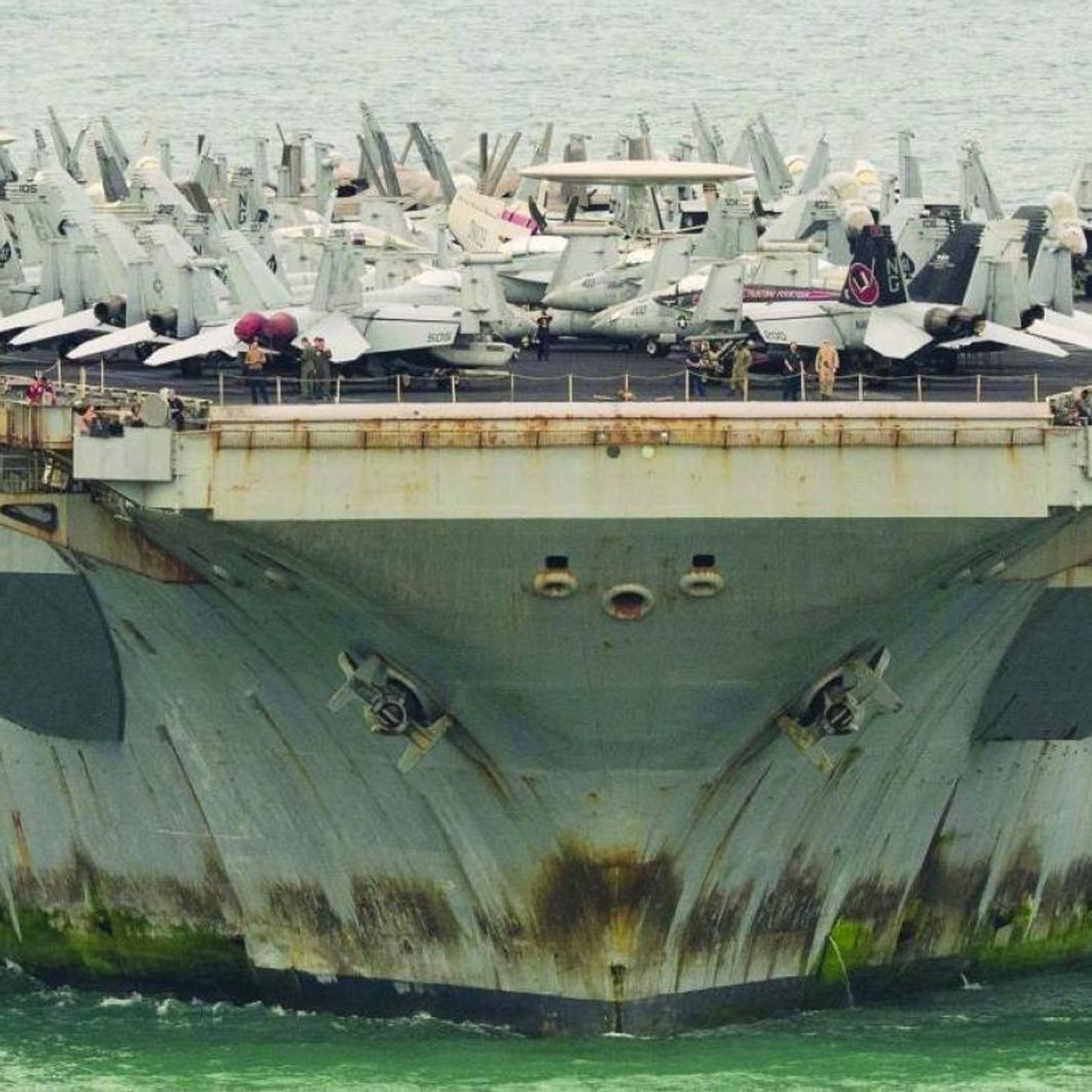
In Thailand, USS Abe Lincoln covered in rust after 286 days at sea
About this episode
Become a supporter of this podcast: https://www.spreaker.com/podcast/today-magz--6737390/support.
Don’t miss our latest episodes! Please follow me to stay updates with fresh news everyday. Let’s keep the support this podcast to stay updates news everyday.
Get every episode summarized
Each time Today Explains publishes, we email you a written briefing from the transcript — the topics, who appeared, and any specific claims, with the ad reads skipped.
Email me new episodesFree for 3 shows. No card needed.
Transcript ready
134 searchable segments. Every word is indexed and playable.
Full transcript
Today Explains — In Thailand, USS Abe Lincoln covered in rust after 286 days at sea. Machine-transcribed; use the interactive transcript above to jump the player to any line.
The US Air Sabre Hamlincan aircraft carrier has pulled into Thailand after being deployed for nearly 300 days, including for operations in the war in Iran. And observers are noting it's covered in rust from Bautistan, experts say the state of the ship is not unusual as sounding off the rust is impossible at sea. Well, a former US Navy captain, though, saying the preservation work would take up to 30 days. CNN's Ivan Watson reports. Just look at the rust, coding an American aircraft carrier as it arrived at a port in Thailand this week. The USS Abraham Lincoln wrapping up what has been one of the longest deployments in US Navy history. Some 286 days at sea, much of that spent involved in combat operations in the Middle East, supporting the ongoing US war against Iran. And if you take a look at the ship back in January, and today you can just see this rust
along the hull of this 1100 foot long warship from Bautistan. Now some Navy experts say that this is not actually that much of a surprise, that Navy ships will start collecting rust in these areas after just two months of operations in the ocean. It's going to be a lot of work for crew members to clean this up. This is going to be now this port visit to Thailand, the first time that thousands of sailors and Marines are getting to set foot on dry land really since winter. And one of the officers on board had this to say about that. We're very, very happy to be here. Thank you Mr. Mayor for bumping us. It is a well deserved break for all of the crew and we really look forward to our time here to get a little rest. And perhaps in the cases of a lucky few, there were relatives waiting on shore to greet their loved ones.
I just can't wait to see her smile. I can't wait to hear mom. I know that's the first thing she's going to say. Well for more on this, Kevin Liptak, joining me live from the White House. Can what are we hearing from the Trump administration on this? Well they have defended obviously this record long deployment of the Abraham Lincoln. They have hailed the work that the sailors did over the course of those 286 days. But it's hard to avoid I think the symbolism of this now rust-covered ship heading back home. It sort of appears as if it's kind of limping back into port after what was I think a very strenuous deployment. And certainly the morale problems that we saw over the last month or so in the final days of this deployment. I think symbolized in the state of the ship at the moment, even if Navy experts say that that is perfectly normal for something like this, for something that has lasted this amount of days.
Now, President Trump has talked previously about rust on Navy ships. He doesn't like to see it. And actually the Navy Secretary John Falen, who actually stepped down earlier this year, talked about getting phone calls in the middle of the night from President Trump complaining about the way that certain Navy ships looked because they were too covered and rust, encouraging him to get it fixed very, very quickly. And so even though this is normal for these ships and for these aircraft carriers who have been at sea for so long, I don't think that President Trump is necessarily going to like the imagery of this ship heading back to port in the state that it is in because of what it perhaps represents about the state of the conflict itself, which has now gone on far longer than he once predicted. He said it would last six weeks and it would now pass the six month mark because it doesn't look as if there's any clear indication of how it will end at this point, no obvious durable solution to reopening the straight-of-form moves.
But all I think will pose both problems for the administration but also an opening for the president's critics who have been wary of how he has been handling this conflict writ large. But certainly for the sailors, it is welcome news that we're heading. So I'm fascinated by that. The images at least aren't likely to play well either with or for Donald Trump and given the growing pressure on the Pentagon. I wonder how all of this is landing with Trump's base and the wide of Republican party. Yeah, and you do hear, you know, mounting concerns among Republicans, particularly those who are in vulnerable races ahead of the midterm elections, they want this war to be over with. And if not over with, they want it to at least recede into the background for the next two months or so before voters head to the polls. They recognize that the war is very unpopular. It started off unpopular, which is a rarity for American conflicts abroad, but it has only
gotten more unpopular in the months since. And so when you listen to Republicans and particularly those who are close to the White House and are trying to send a message to the president, they really want this to sort of be put on the back burner. They don't want a major escalation in the months before the midterm elections because it was only going to serve to remind voters that gas prices are higher than they were before the conflict. There doesn't seem to be any sort of victory in terms of strategic objectives that the president laid out at the start of the conflict. And so there is a real desire for the president to move past this, but it's not clear that that has sort of broken through to the president. You know, you still see periodically, including this week, the back and forth strikes with Iran. And it seems as if that's the president's strategy going forward is to launch these sort of periodic retaliations with Iran. And obviously Iran knows that the president is facing these political pressures and can read as well as anyone else the polls about the popularity of the war itself.
And so some real concerns, I think, among the president's allies about what this might pretend for them politically heading into the midterms. Join us now with some perspective on all of this as retired US Navy Admiral Gary Ruhner. Thank you so much for joining us. Admiral. I mean, what do you make of this period they've had a way in how unprecedented it is? Well, first, Max, I'd say that I couldn't be more proud of the men and women on the Abraham Lincoln, but also on all of the ships that are part of that strike group. It really has been an epic deployment when you consider that they've operated in three different regions of the globe. I have been involved in very high intensity combat operations. It really speaks well for those who serve and for our ability to project that much power. When I talk about the concerns that we expressed about the poor living conditions on board,
what should we read into that? Surely being on board for such a long time is going to be difficult anyway. Right. Living conditions, does that concern you? Well, it does, but I think one of the problems that we faced in the Gulf where we had our logistics organization enterprise, if you will, all focused on locations within the Gulf. It really has inhibited the ability to keep the ship supplied with fresh vegetables and food and refrigerated items. That has been a significant load, particularly on this strike group and the others that are operating there, which I think just indicates the fact that the crew has performed so well, even when there have been shortages of things that you and I and others just take for granted. That has been an issue. It's one that there's a little doubt in my mind that
we're working mightily to try to figure out how we can best supply the ships that are going to be there, because even if we were to go into a ceasefire today, there would still be the requirement for the presence should the situation break down. We really need to get set for the long haul in that area, operating at sea at distance from logistics points. I'm absolutely certain that work is not going right now. It really is the key naval asset, isn't it? There is concern that the American military is spreading itself too thin, because facilities like this would be needed if there was an unexpected challenge that came towards the military. You concern that the navy in particular is being spread too thin at the moment. I do believe it is stretched thin. We are smaller than we should be, and the operations there have demanded a lot of our ships.
We've extended the deployments, and the navy is looking at longer deployments. Obviously, we want to try and bring the length of those down, because there is a correlation between how long people are deployed and the conditions in which they're deployed and the ability to retain and attract great people. That is something that we really have to pay attention to, and look at ways to not only support the people that are serving today, but really looking very, very hard at how do we build up the navy to the numbers that we need to be able to sustain these operations, not just in the Middle East, but I would argue with the situation that we have going on in Europe with Russia, the potential for conflict in the Western Pacific. We really need to think, and the nation needs to
invest in a navy that can provide the power and the reassurance in many different areas around the world. Okay, Retard US Navy Admiral Gary Raffer, thank you so much for joining us. On this momentous day for that incredible carrier, thank you for joining us.
More episodes
More from Today Explains

TD Bank targeted policy measures could spark Canadian investment supercycle
Today Explains

'There's not a lot of faith in Washington' Economist says he's 'worried' about c...
Today Explains

RCMP sergeant on sleeping Tesla driver ticketed by police
Today Explains

Trumps Irish Ballroom hits a SLUGGISH roadblock
Today Explains