Loading...
About this Episode
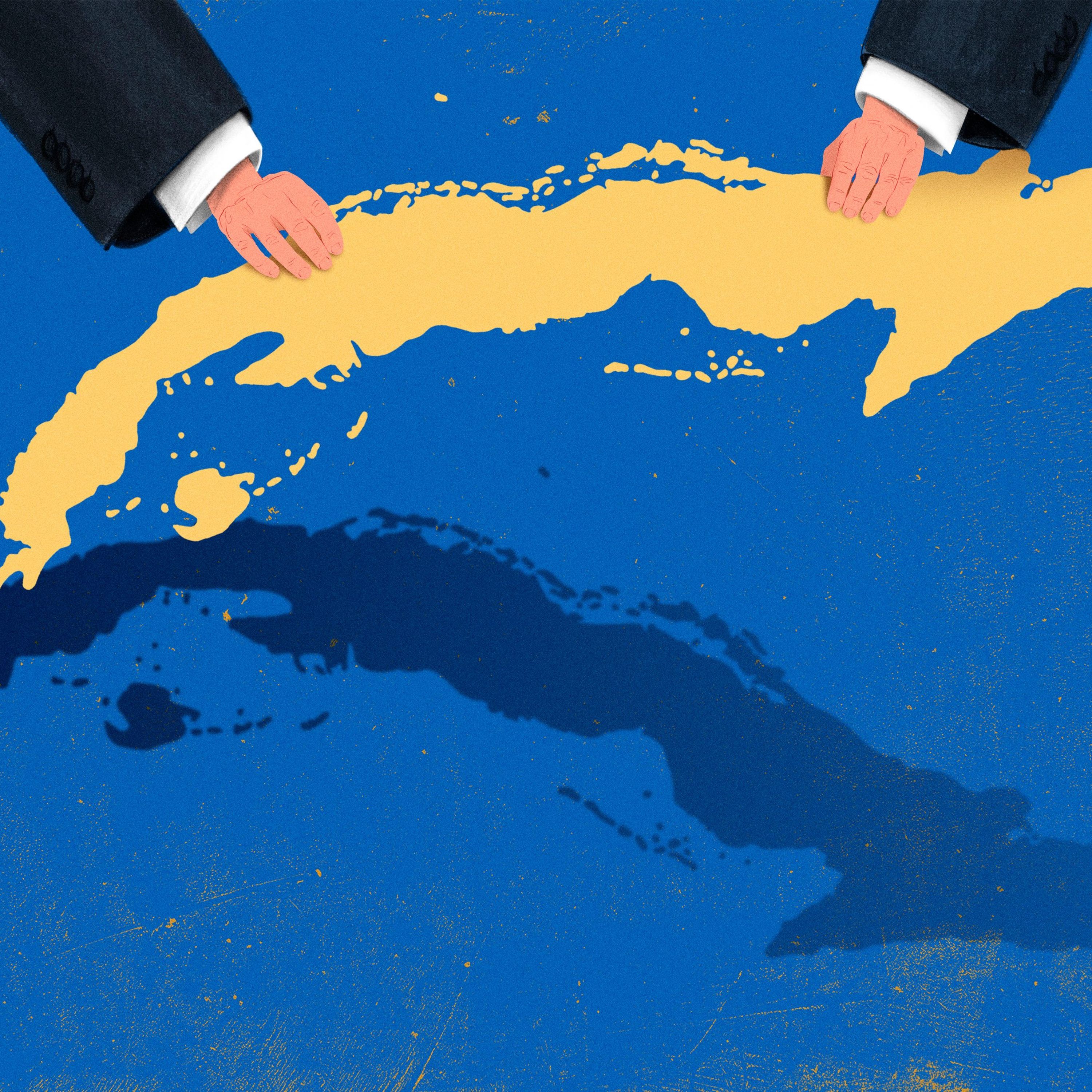
The staff writer Jon Lee Anderson has reported from Cuba for many years, and recently wrote about the deteriorating economic conditions on the island. His newest piece for the magazine dives into the potential outcomes of Donald Trump’s desire to pursue regime change. Anderson explores the economic impact of the United States blocking Venezuelan oil from reaching Cuba, which could be a death knell for the Communist government. Anderson and David Remnick discuss the current negotiations between the two countries, Marco Rubio’s strategy, and what cards the Cuban government might still hold. “They’re going to go into this,” Anderson suggests, “like maybe a canny poker player.”
Plus, the historian Ada Ferrer won the Pulitzer Prize for her 2022 book, “Cuba: An American History,” and she has one of the clearest views of the long and vexed relationship between the island and its giant neighbor. Ferrer left Cuba as an infant, coming to the United States with her mother in 1963 when Fidel Castro’s regime was arguably at its peak. David Remnick talks with Ferrer about the impact of U.S. sanctions, the economic collapse of Cuba, and what Donald Trump’s threat of a “takeover” means to the Cuban people and to Cuban Americans in the U.S.
Further reading:
- “Have Cubans Fled One Authoritarian State for Another?,” by Jon Lee Anderson
- “What’s Behind Trump’s New World Disorder?,” by Daniel Immerwahr
New episodes of The New Yorker Radio Hour drop every Tuesday and Friday. Join host David Remnick as he discusses the latest in politics, news, and current events in conversation with political leaders, newsmakers, innovators, New Yorker staff writers, authors, actors, and musicians.
Hosts & Guests

Transcript
Life's busy.
Don't let banking slow you down.
Whether you're paying bills,
setting savings goals,
or just splitting the check.
Atlantic Union Bank makes managing your money easier.
With helpful people and user-friendly tools,
we make sure banking with us fits you.
Call, visit us online,
or drop into an Atlantic Union Bank branch today.
Atlantic Union Bank.
Anyway, you bank.
This is the Chase Sapphire Lounge of Boston Logan.
You got Clamp Chowder, in New York,
30 Martini, over 1300 airport lounges
and one card that gets you in.
Chase Sapphire Reserve, now even more rewarding.
Learn more at Chase.com slash Sapphire Reserve.
Cards issued by JP Morgan Chase Bank,
and a member FDIC, subject to credit approval.
Few things are as uplifting as the greatest moments in sports.
And nothing brings us together quite like team USA
at the Olympic Winter Games.
From NBC Universal's iconic storytelling
to the innovative technology across
finity and peacock,
Comcast brings the Olympic Games home to America,
sharing every moment with millions.
When team USA steps onto the world stage,
we're not just watching.
We're cheering together.
This winter, we're all on the same team.
Comcast, proud partner of Team USA.
This is The New Yorker Radio Hour,
a co-production of WNBC Studios and The New Yorker.
Welcome to The New Yorker Radio Hour.
I'm David Remnik.
Since the beginning of this year,
President Trump has turned sharply
from his promised focus on domestic issues,
America first,
to a series of foreign military adventures
that have shocked many of his own supporters
and much of the world.
In January, there was the invasion of Venezuela
and the seizure of its president Nicholas Maduro.
Then came the threatened invasion of Greenland.
And now there's a war with Iran
that has engulfed the Middle East,
killed many hundreds of people
and threatens the entire global economy.
And yet, no sooner was the bombing of Iran underway
that Trump and some of his allies
began teasing a new move.
Taking Cuba,
that'd be good, that's a big honor.
Taking Cuba.
Taking Cuba in some form, yeah.
Taking Cuba, I mean,
whether I free it,
take it.
I think I could do anything I want with it.
You want another truth.
They're a very weak intonation right now.
The U.S. is effectively shut off Cuba's oil supply
and the electrical grid had a near total blackout last week.
New Yorker staff writer John Leanderson
has been to Cuba countless times in his career
and his most recent trip
followed the invasion of Venezuela.
I spoke with John Leanderson this past week.
John Leanderson.
John Leanderson.
John Leanderson.
John Leanderson.
John Leanderson.
John Leanderson.
John Leanderson.
John Leanderson.
John Leanderson.
John Leanderson.
John Leanderson.
John Leanderson.
John Leanderson.
John Leanderson.
John Leanderson.
John Leanderson.
John Leanderson.
John Leanderson.
John Leanderson.
John Leanderson.
John Leanderson.
John Leanderson.
John Leanderson.
John Leanderson.
John Leanderson.
John Leanderson.
John Leanderson.
John Leanderson.
party chief. And he has served, well, how shall I put this creditably as the face of the
ongoing regime? And he's not had any easy time of it. There's been, you know, as we know,
a huge economic downturn in Cuba, et cetera, the falling apart of relations in Trump one and now Trump
two. Biden did nothing during his four years to alter the things in Cuba for better or worse.
So DS Canal is a kind of, yeah, he's a working, he's a working stiff really and doesn't have a huge
amount of respect from the population, but nor is he seen as particularly evil. He's seen as the
the frontman for the regime, which continues to be controlled from behind the curtains by the
an elderly Rao Castro and his family. So Rao DS Canal, you know, he won his re-election three years
ago. So he has two to go. He has to leave office in April, 2028. He won his re-election to give you
an idea of the kind of politics on the island with under the slogan of Gondini, that continuity,
which, you know, doesn't appeal to people under 30 years old. And, you know, he's uninspiring.
But uninspiring, the description you've given me when we've talked on the phone and in your coming
piece about Cuba is of a Cuba in desperate straits. People are leaving and leaving and leaving.
The streets are filled with garbage. That's right. There's blackouts all the time. The economy is in
desperate straits. Events in Venezuela and elsewhere could not have been all that encouraging. So
continuity seems a kind of a grim way to put it. Yeah, exactly. But you have to put into
context that this is a regime that presents itself as the revolutionary continuation,
which includes notions of sacrifice. In a way, there's analogies here to Iran, right? This idea
of sacrifice, a common enemy, you know, the Yankee imperialist empire just there over the sea,
as ever, oppressing us, you know, increasing numbers of Cubans don't believe that anymore.
But they have little agency to alter the situation. And DS Canal, you know,
always succeeds in disappointing. He even defers almost as if Raul Castro was the supreme leader,
you know, as Iranian presidents do. So back to your part of your first question,
you know, what does it do to remove him? Zip because he has no real power. But I think for someone
like Trump, you know, he's, well, as we know, he's rather simplistic. So he thinks we got
rid of Madura. And now it's mine, Venezuela's mine. If we get DS Canal out of there, it'll,
it'll look good because he's the top guy. I have to say though, John Lee, the war with Iran is not
going particularly well. It's chaotic. It's the rationale for has never really been explained
coherently. The entire Middle East is in a state of chaos. How do Cubans perceive this situation
where the American president, the midst of all this, gets up and rather blindly starts talking
about regime change through the good agencies of the United States in Cuba. I think that the
quagmire of the US in the Middle East, because of the Iran war right now, plays into the hands of
Cubans that are having to negotiate their survival or whatever with the Americans. They have, you know,
a few days of oil supplies left. The Americans have been blockading them ever since they captured
Madura on the 3rd of January and not been allowing any other energy supplies to come into Cuba
for the government's use. So they're in the sort of 14th round and it kind of gets the ropes here.
They have to figure out how to get the Americans to give them some fuel. And of course,
as a front end, which is, you know, as we've heard through leaks, Marco Rubio basically wants
an economic opening. He's not going for regime change, but a kind of Madura-like thing where they
find a del sea and its regime kind of succession, stabilization. They don't want chaos in Cuba,
so, but the tail end of that, of any package they are going to try to force the Cubans to agree to,
will include some kind of notional political succession or transformation. The Cubans are very
unlikely to agree to that because that would mean negotiating themselves out of existence.
And as people on an island, they have nowhere to go. So, yeah, they won't face bombs or guns like
the Iranians are right now. It'll be more, we think, more like Venezuela, but these are people
who have spent the last nearly 70 years conjuring up strategies to survive, you know, American
strategies of containment, outright hostility, attacks, and usually bested them. And also
negotiations. So, if I'm them, I'm thinking to myself at Americans, I've gotten themselves into
a mess over there. This plays to us. So, let's spin out the negotiations. Let's do some economic
concessions, which we're already seeing talk about. But let's tread water on the political thing.
You've been to Cuba a million times over your life. You wrote a terrific biography of Che Guevara.
And you've made two especially recent trips to Cuba, one in May and one in the wake of the
invasion of Venezuela, much more recently. Just give me a sense of what it's like to walk around
and be in Havana and other cities and towns in Cuba compared to previous trips. What's it like?
Oh, gosh. I mean, look, since 2021, there's been an exodus, you know, nobody knows exactly,
but anywhere up to 20% of the population have left. It is incredible. And of course, it's an island,
people have to pay to leave. And therefore, you can imagine if it had land borders, you know,
how many more would have left it, maybe similar to Venezuela, where about a third of the population
has left over 10 years, right? Because of economic collapse. But primarily young people and
anybody with skills. So you might be a doctor with a heart cardiac specialist in Havana,
and you end up pushing some ancient person around Miami in a care home. And that's the kind of,
or driving an Uber somewhere. And that's kind of what's happened to a lot of Cubans. So when I first
went back, I hadn't been in a while. I was struck by the emptiness of Cuba. And I went to Havana
and three other towns in the interior. And everything was just empty. There was no people. I really felt
the exodus. And, you know, I visited old friends, you know, the ones the friends I have are mostly
quite old people now. Some have died, some have left their kids have left. Many of them are being
sustained by the remittances their kids can send work for wherever they're living Spain,
the United States. And the houses around them are empty and also inhabited in some cases by
also elderly people because their kids and grandkids have left as well.
When the Soviet Union collapsed, there was a period that Cuba really struggled because they had
been subsidized and propped up by the Soviet government. And then the Venezuelans stepped
into the breach. And there was a relationship there that helped Cuba get from day to day.
That's right. How is Cuba getting by at all? What's the economy?
Yeah. I mean, I lived there during that period, David, in the early 90s when the Soviet,
you know, rug was pulled out from them. And, you know, people went from driving cars to
riding bicycles. And in the countryside, they went from tractors literally to oxen. And the
average Cuban lost, I don't know how much of their body weight. And there was a lot of suicide.
And it was bad. It was bad when I was there in the early 90s. Then they, as you said,
Venezuela stepped in, Chavez and Fidel formed this, he was Chavez, the late Venezuelan,
want to be really acolyte of Fidel Castro. And they did this oil for expertise deals. So,
you know, Venezuelan oil that began this was 25 years ago for Cuban expertise in everything from,
you know, doctors to teachers to sports instructors. And of course, intelligence and military
security guys. And that's what's ended with Maduro. So comparing that period of the early 90s,
following the Soviet implosion to the period now, there are differences. But also many similarities.
These long blackouts, for instance, just yesterday, the national grid collapsed for the
umpteenth time in Cuba. The whole electric grid went down in Cuba for how long? Yeah.
I don't know exactly, but sometimes back in, I think it was October of last year, it went on for,
almost a week. You can't get gasoline for lover money. And some people with dollars on the black
market find ways, of course. But basically, there is no fuel. They haven't received any entry
months. So that's disappearing. Johnny, what does somebody like Marco Rubio, who seems so influential
when it comes to Cuba policy and the Trump administration? What does he want? What are these
negotiations with the Cubans about? The package, as I understand it, that the Americans want,
start with a sweetener. That is to say, you open up economically to investors,
be nice to private enterprise, which will help you anyway, and will allow us to sort of invest
and da da da, and make money. And we will start to allow fuel. It might even be, we will sell you
the Venezuela fuel you used to get for free. And then you'll owe us. So the point what they're
trying to do is basically make a Cuba dependency of the United States in the same way that Venezuela
is now a neo-dependency. And this new imperialism has Trump's name all over it. Yesterday when he
talked, he was like, I can do whatever I want with it. He didn't say we the United States. He said,
I, it's all about him. Is there any way in the world you envision a better future? What would have
to happen? There does have to be a shift by the party. You know, it's it's look in Cuba. The
communist party. In Cuba. Yeah. Yeah. Exactly. I mean, look, yes, you do have to have joint
ventures. You already have an entrepreneurial class in Cuba. So there's already an island wide
networks of conspiracies evading state control, right? So you need to legalize that. You need to
bring it out to the surface. Cubans are currently resourceful people as they've had to be. And
you know, like people everywhere, they want to live good lives and want to make money. So you might
as well get over yourself and let them do that. But that means that that's the end of your ideology
and which is already at the end of its rope. But it's also the end of the communist party inevitably,
no? I would think so. Yeah. Yeah. The fact that it's remained as long as it has has to do with the
fact, I think a lot of it's geographic. The fact that it's an island, you know, it's just harder to
change things on an island. However, this could be tougher than the Americans think, even Rubio,
whom I think has adopted a interestingly, a more sophisticated policy approach with both
and a zone in Cuba than I would have expected. But it's got this, you know, imperialists kind of
veneer, which one wonders, really, is that going to work forever? You know, this idea of making
countries dependencies in this new era. Will it last beyond Trump? And I think that they may be,
as we've seen with Iran, the Iran intervention, you know, this arrogance, a hubris, a kind of
denialism about history and human nature and a lack of knowledge about other countries in their
past. And so quite apart from whether or not the Cuban Communist Party goes down the ditch,
I don't think there will be too many lamentations about it in Cuba. There will still be residual
nationalism that's going to rear its head. And at some level, it may well cause these negotiations
to be difficult, more than difficult, and strung out over time. And on the one hand, the Cubans,
who are having to do these negotiations, are looking at Iran and they're thinking,
the Americans are in this quagmire. This benefits us. On the other hand, they're thinking,
we've got to get some energy supplies somewhere here. So they're going to go into this like maybe
a cany poker player. And they're handicapped because of the fuel thing. But on the other hand,
they may have some resources that the Americans can't see right now. And one of those resources,
it may sound paradoxical, is the fact that, you know, there's already been some protests and some
unrest on the island that could spread further. Yes, that threatens the regime. Of course,
but they have the ability to suppress most of it. However, it's also a threat to the United
States because if chaos begins in Cuba and the people they want to stabilize it, i.e. the remnants
of the Communist Party and the military, you know, are incapable of controlling that chaos.
You have chaos not, you know, not 700 or 800 miles away as is Haiti, you know, but 90 miles away.
And you could be seeing, you know, a re-immigration flood to the United States if there's real chaos on
the island. John Lee Anderson, thanks so much. Thank you, David.
At Lidos, we make things smarter and more efficient. From reducing in-person weight times at the
Social Security Administration by 73 percent, to already being done with this ad. Lidos,
making smart smarter. Bringing your business dreams to life takes heart and about a thousand
decisions a day. That's why Atlantic Union Bank's knowledgeable bankers are here for you,
with the right guidance and customized solutions to help you reach your business goals.
So whether you're planning your next move, upgrading your space, or scaling to me demand,
we make sure your business is ready for what's ahead because we are big enough to support you,
yet small enough to know you. Atlantic Union Bank, anyway, you bank.
The day begins at the Chase Sapphire Lounge by the club at Boston Logan Airport. You get the
clamped shoulder. In San Diego, it's tostatus. New York, espresso, martini. It's 10am. Why not?
It's the quiet before your next flight. The shower that resets your day. The menu that lets you
know where you are. This is access to over 1300 airport lounges and every Sapphire Lounge by the club.
And one card that gets you in. Chase Sapphire Reserve, now even more rewarding.
Learn more at Chase.com slash Sapphire Reserve. Cards issued by JP Morgan Chase Bank and a member
FDIC subject to credit approval. Few things are as uplifting as the greatest moments in sports.
And nothing brings us together quite like team USA at the Olympic winter games from NBC
Universal's iconic storytelling to the innovative technology across Xfinity and Peacock.
Comcast brings the Olympic Games home to America, sharing every moment with millions.
When team USA steps onto the world stage, we're not just watching. We're cheering together.
This winter, we're all on the same team. Comcast, proud partner of team USA.
This is the New Yorker radio hour. I'm David Remnick. We're talking today about the United
States and Cuba and the Trump administration's threats lately of a take over there.
Trump would certainly not be the first president to intervene in Cuba. America's troubled
relationship with the island goes back centuries. To get a clear review of the relationship,
I spoke with the historian Otto Ferrer when the Pulitzer Prize for her 2022 book, Cuba,
an American history. Ferrer herself left Cuba as a small child, coming to the United States with
her mother back in 1963 when Castro's regime was arguably at its peak. I spoke with
Otto Ferrer this week about what a military campaign would mean to Cubans and to the large
Cuban American population in Florida and beyond. So, Donald Trump said this about his intentions
toward Cuba. It may be a friendly take over. It may not be a friendly take over. It wouldn't
matter because they're down to as they say fumes. That's what President Trump has said. How do you
react to a statement like that? Well, they are down to fumes. He's assuming there's a difference
between a friendly take over and an unfriendly take over. In my opinion, there's no such thing as
a friendly take over if Cuba. And if you know any Cuban history and any history of the relationship
between the two countries, you can't listen to those words and not cringe. John Leanderson was
just there for us and is about to publish a piece about what he saw and what he heard. It's
pretty desperate. My guess is that you speak to people there as best you can. But tell me. Well,
I mean, what it's like. It feels total. You know, it's just there's a sense of hopelessness,
of there's a complete lack of confidence that the current government in Cuba can find a solution
to anything. And you know, it's affecting every realm of daily life. And it's gotten worse since the,
you know, Trump has, you know, tried to have cut off the shipments of oil to Cuba. It's gotten a
lot worse over the last three months, but it was already, I mean, it was already devastating.
You already had hospitals, parts of which were crumbling literally. I know someone,
in Cuba, this was in December of 24, who needed hip surgery because she fell and broke her hip.
The family had to provide the prosthesis. They had to buy it on the underground market themselves
because the hospital couldn't provide it. They had to provide medicine. They had to bring sheets.
They had to bring food. The other thing they had to provide was blood because the hospital
could not keep stores of blood. The government can't even pick up garbage. And that was true even
before, right? So there's a sense in which there, there's a lot that a lot of basic services that
they can't provide. The responsibility for that failure is at the feet of the Cuban government,
at the feet of the United States. Where do you place it? Both. The Cuban people are so
desperate right now that they are much less interested in the question of who's to blame.
In some ways, they don't quite care who's to blame. They just want something to change. So I think
that's the mood right now. In terms of what I think, the U.S. embargo is a policy that has
harmed the Cuban economy. There's no question about that, right? From the very beginning,
it denied Cuba access to its major and natural market, right? 90 miles away.
Cuba turned to the Soviet Union and found salvation there, right? But in some sense, there was never
it never became an economically independent nation. It relied on the Soviet Union for decades.
The Soviet Union collapsed. It sent the Cuban economy into a tailspit.
But then Venezuela stepped in with oil, right? But there's no, there's no saviors anymore.
If you look at what the Cuban government has been investing in over the last years,
there's tremendous investment in the tourist industry, but remarkably surprising little
in things like agriculture or infrastructure or even education, health and so on. So they've made
decisions that have contributed to the current crisis.
The state of Florida and its politics has been for years influenced by Cuban Americans.
And the usual stereotype of that is that they're quite conservative, especially on this issue.
Are they still? Absolutely. I think Cuban Americans would, a majority of Cuban Americans would
welcome some kind of action by Trump and Rubio to force a change in Cuba.
I think what many people don't think about when they think about Cuban Americans is how
diverse the community is not politically necessarily, but in terms of when they arrive.
So most Cuban Americans, most Cuban-born people in Miami arrived in the very recent past.
That means that they grew up in a communist society. They went to schools, they recited poems about
Che Guevara or their parents did. They came out of that system. And this ongoing developing crisis
over the, in some ways over 30 years, but very, very in an accelerated manner over the last five or
six years. What that means is that the people who are eager, many of the people who are eager
for that kind of action from Trump and Rubio aren't these old Cuban Americans who lost property
60 years ago. It's people who had never had much property to be taken. And that also means that
that distinction that's traditionally drawn between Cubans on the island and Cubans here is not
quite as meaningful as it was decades ago. Now, Cubans fleeing the Communist Party had enjoyed
protected status, immigrating to the U.S. But now we're supporting record numbers of Cuban people
with some of those Cold War protections revoked. What do Cuban Trump supporters think about that?
I mean, you're right. The Cuban Adjustment Act, which had afforded Cubans advantages that
nobody else had, it's still the law, technically, but it almost doesn't matter, right? Because Trump
is doing things that he's acting as if the law didn't exist. There are Cubans languishing in places
like alligator app, the trials, including a cousin of mine. There are people who came in under Biden's
humanitarian parole program. And those people, you know, all received self deportation letters.
And I think what was, I know, actually, that what was happening before the invasion in Venezuela
was that Trump was losing support over that. And you got a sense from talking to Miami,
people in Miami, political leaders, activists that, you know, and I heard it that he was going too far,
that they thought he didn't mean them, that he thought he was going to go after criminals,
but he was just going after people who were working and, you know, and so on and so forth.
But I haven't heard that so much since the attack on Venezuela.
About a decade ago, Barack Obama, as president, visited Havana, and he removed Cuba from the
list of state sponsors of terrorism, that's a decision that Donald Trump eventually reversed.
That was a moment of real optimism, both in Cuba and in the United States, about Cuban-American
relations. How are those moves received at the time, and how are they remembered among Cubans today,
that that that moment of decade ago?
I was there when Obama visited, and in all my visits there, I have never seen the sense of
excitement and hope that I saw when Obama was there. People were on the street, people were,
you know, eager to see him, eager to watch everything he said on television.
I ran into people who said things to me like, you know, I remember talking to this older woman
who said she watched this speech on television, and she referred to him as my president.
And yeah, there was a sense that's, you know, the relationship between the two countries
has been so hostile for, you know, 67 years, that that moment just seemed like the possibility
of something new and something different. And now seems to polar opposite. I mean, I have to think
if you're sitting in Havana today, or anywhere in Cuba, and you watch what happened in Venezuela,
and you listen to Marco Rubio and others talk about the
imminent or almost inevitability of American action in Cuba, the sense of anxiety
has to be really horrible.
The anxiety isn't just about Trump, and it isn't just about Marco Rubio. The anxiety is about
the fact that they haven't had electricity maybe in 36 hours, whatever little food they had is
gone, hospitals are sending people home because they can't do surgeries, right? So in some sense,
the sense of hopelessness about that, about the current situation,
means that more people are willing to take a change no matter where it comes from.
And I think that is new. So if you think about the Cuban population now, and maybe I forget the
numbers, maybe a third or born after the fall of the Soviet Union, they've never known a Cuba
in which you could achieve well-being, not luxury, but well-being without access to hard currency,
without access to remittances from abroad, without some kind of reliance on an underground
market and shady deals, right? So the crisis now is happening after 30 years.
But I want to be clear about what you're saying. You're saying people would welcome a change,
they're desperate for change. At the same time, you're not saying they're
eager for American intervention in the way that Marco Rubio hints at it.
I don't know that a majority is eager for Marco Rubio to invade. I can't say that.
I think more people than ever are willing to count on that as a possibility and even as a short-term
solution. And I'm hearing that. That's going to be taken advantage of.
Yeah, I do worry about that because I don't think a solution will ever be US intervention.
I don't think that. I don't believe that because I'm someone who has studied US Cuban
relations forever. And I know what US invasion and US intervention and US meddling, I know that
history. One of the words or one of the phrases that keeps getting used is something about the
liberation of Cuba, a free Cuba. Historically, the US has not acted in the interest of a free Cuba.
From the 19th century, it tried to impede Cuban independence at every turn. In the 1820s,
when Latin America became independent, it specifically wanted to avoid that for Cuba.
Then in the mid-19th century, in the 1850s, they supported the government and
independent Americans supported invasions of Cuba to liberate it from Spain and then attach it
to the US as slave states. This is when slavery still existed. In 1898, you get the Spanish-American
war in which the US intervenes in Cuba. Most Americans may not realize that what preceded that
was 30 years of struggle for Cuban independence. And the US went in. But then it staged a military
occupation for almost four years and left only when Cuba was willing to accept something called
the Platinum Amendment, which gave the US the right of intervention. The revolution happened in
1959 and the US tried to intervene again at multiple points. You know, they had the Bay of Pigs.
April 1961, a CIA-sponsored invasion of Cuba, which was manned by Cuban exiles. And, you know,
before it happened, like I thought of this when Trump was kind of suggesting that Marco Rubio
might be the next president of Cuba. At the time, people in Washington, you know, in the White
House were slapping themselves on the back, saying Bobby Kennedy was going to be the next mayor of
Havana, right? These kinds of predictions are not unprecedented. So in some sense, that's part
of the background. That's why any historical knowledge makes you skeptical of a statement like
Trump's. You have family still in Cuba? I have yes. I have family still in Cuba. How do you talk
to them? How is it possible to speak to them? Can you have phone conversations or is it by WhatsApp?
How does it work? WhatsApp. It's all WhatsApp. And what are the conversations like?
Well, I mean, a lot of the conversations, some conversations are about, you know, health,
right? I have a cousin right now on the hospital. Sometimes they need medicine and I have to figure
out ways to get the medicine. You know, a lot of it is things like that dealing with day-to-day
practicals. With day-to-day emergencies, yes. I actually have family that left Cuba and they
moved to Spain. So many people are going to Spain. So there are these private bus companies. Well,
I don't know what they're doing now with no gas, but they were doing this, you know, before January.
These private bus companies that just go from one town to another picking people up and just
taking them to the Spanish consulate and the Spanish embassy. So there's so many people doing it
that it's become a business. Last time I was there, which was two years ago, I said a little over
two years ago, I spent a lot of time with someone who is a poet, who was kind of driving a car to
make extra money. And one of the things we talked about, and I've noted this, I've noticed this over,
you know, 30-some years of traveling to Cuba, is that, you know, you get tired of
watching people leave. You're happy for them, but you get tired of saying goodbye. And I've
noticed it myself that the people, many of the people who I was friends with in the beginning
are no longer there because they've left, and you make new friends, and they leave. I reached out
to him in, can't remember when, late last year, he always told me he would never leave. And he's
now in Spain, he's living in Madrid. Something he said would never happen.
Adifra, thank you so much. Thank you.
Adifra Rare is a professor of history at Princeton University, and her book Cuba,
an American history, won the Pulitzer Prize. Her memoir, Keeper of My Kin, is Do Out in May.
That's it for the program today. Thanks for joining us, and I hope you'll join us next time.
The New Yorker Radio Hour is a co-production of WNYC Studios and The New Yorker.
Our theme music was composed and performed by Merrill Garbiss of Tunearts, with additional
music by Louis Mitchell and Jared Paul. This episode was produced by Max Paulton, Adam Howard,
David Prasnow, Jeffrey Masters, Louis Mitchell, Jared Paul, and Ursula Summer,
with guidance from Emily Boateen and assistance from Michael May, David Gabel, Alex Barish,
Victor Guan, and Alejandra Decket. The New Yorker Radio Hour is supported in part by the
Turina Endowment Fund.
It's you. Call, visit us online, or drop into an Atlantic Union bank branch today.
Atlantic Union Bank. Anyway, you bank.
Ever walked past a place for rent and wish you could just take a peek inside?
Maybe even explore the layout, envision the natural light streaming through the windows,
or plan where your vinyl record collection would go. At apartment.com, you can.
With tools like their 3D virtual tours, you can see the exact unit you could be living in.
Really envision yourself in your new home with apartment.com. The place to find a place.


