About this episode
Get every episode summarized
Each time Today in Focus publishes, we email you a written briefing from the transcript — the topics, who appeared, and any specific claims, with the ad reads skipped.
Email me new episodesFree for 3 shows. No card needed.
Hosts & guests

Transcript ready
289 searchable segments. Every word is indexed and playable.
Full transcript
Today in Focus — Is Trump trying to buy votes? – The Latest. Machine-transcribed; use the interactive transcript above to jump the player to any line.
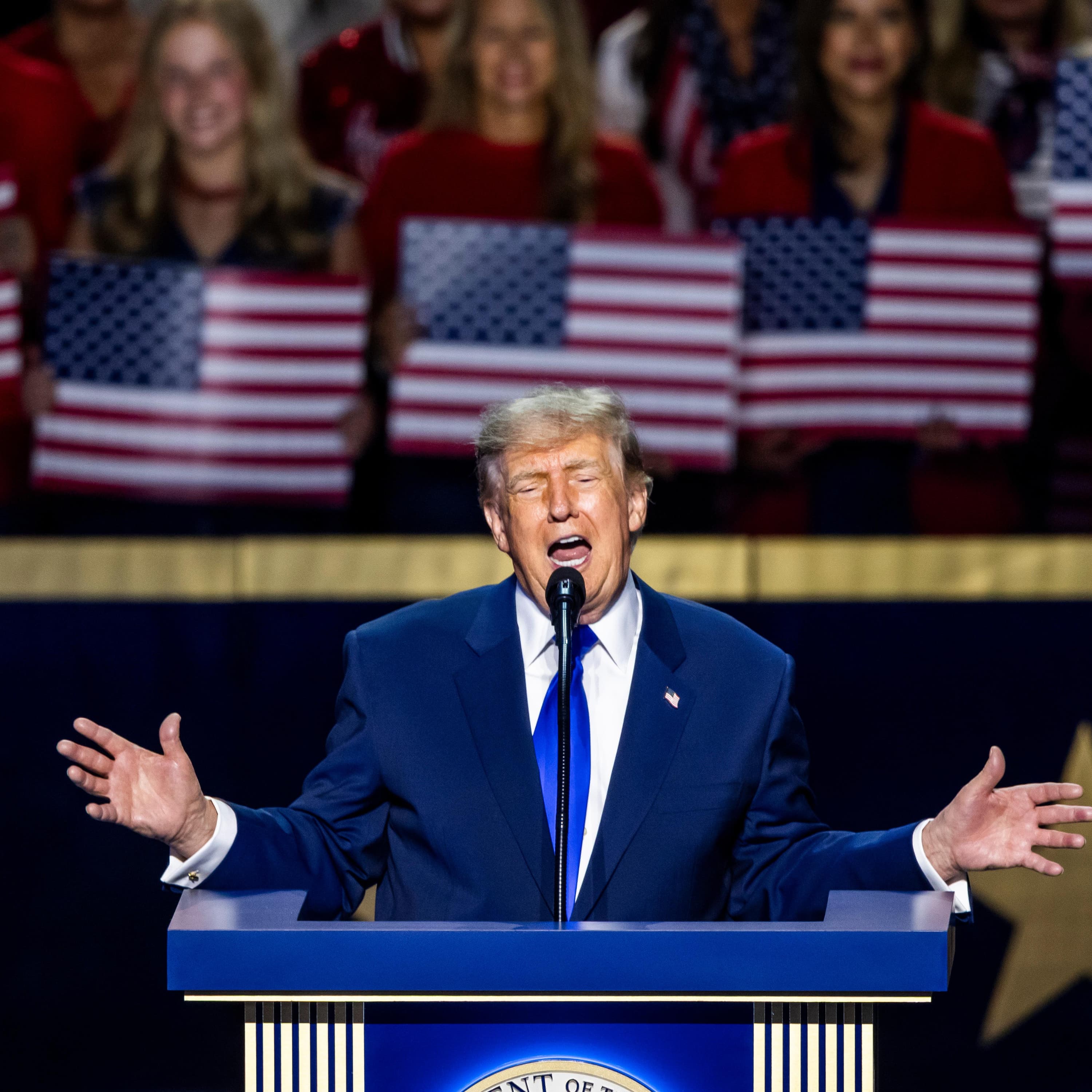
This is the Guardian. It's a bit of a promise, a bit of a kind of stop to the mega-faithful who are inclined to believe what Trump says. I will issue a dividend to every adult citizen in the United States of America for $5,000. But it is a gamble and indeed a lot of Republicans distance themselves from that event. They didn't want to show up. From the Guardians today, I'm focused. This is the latest with me, Lucy Hough. Donald Trump has given this mammoth two-hour rambling speech at the first ever Republican mid-term convention. Deva Kavak, or you're one of our global editors, he pledged during this speech that every American would receive $5,000 if the Republicans win in the midterms in November. Before we come on to what that means and if it's legal,
it shows a president who is clearly very under-confident about his chances in November, right? Highly see. Yes, I think that's right on two fronts, both the fact that this event was held at all. As you say, it's the first ever for the Republicans. The Democrats have held conventions years and years ago in the 70s and 80s. Three times, I think, and decided never again. And it wasn't a good idea in the long run. But Trump not to be put off by precedent or learning from previous history, perhaps, has decided to go ahead with this. And very much it is happy place, as my colleague David Smith put it in his piece today. It's a place where the Maga faithful were there in the front row, the crowds, the adoring crowds are there. He could speak at length, as you say, in quite a rambling way and not necessarily be held to account for the truth or a veracity of his statements. And it does definitely feel like one of the biggest reasons for doing this is to rally the crowds ahead of the midterms.
As you say, there was this very grabby headline about him promising this incredible amount of money for each American if the party manages to retain hold of both the Senate and the House. Yeah, and this comes at a time when Trump's personal poll ratings are absolutely tanking, a poll published in the FT this week say that only 33% of registered voters approve of his performance. I mean, obviously the midterms, they're not voting for the president, but it does show that the president is rattled about the Republicans' chances in the midterms. And this $5,000 pledge to every adult American citizen feels like an incentive to vote Republican in November. How on earth would it work? Yeah, I think it raises all sorts of difficult questions as to how it would work and the logistics of it. As often is the case with Trump, he was very light on detail on how this would work.
Economists think this would cost well over $1 trillion, which is no small amount even for the biggest economy in the world. You know, the legal question is an interesting one because it's very clearly against federal law to offer payments in order to try to influence the way someone's going to vote in an election. That's pretty clear. But if Trump and his team can sort of frame this, as actually they have tried to in the past, as a sort of general sort of economic pledge for all Americans, then it becomes a bit more tricky legally to challenge it. You know, we did see Trump in this sort of when doge, in the sort of heyday of doge, and I need on must, trying to sort of supposedly eliminate waste and government spending. Trump at one point promised that the profits from that would go to the American people via paychecks. And that I think is still, we've never seen that actually transpire in reality. So how this would work, there's little detail on that, but there would definitely be obstacles to come
if he did try to implement this. Yeah. There's healthy on days of doge and Elon Musk and the White House. JD Vance followed up, I think, with sort of trying to clarify a bit more about the detail, because my first thought reading this last night was like, is this going to go to Jeff Bezos? Does Jeff Bezos need $5,000? Arguably not. There is this suggestion that it wouldn't go to the super wealthy and that it would be paid for by US tariff revenue. So as you say, they found kind of like a clever work around. But can the American economy cope? Because as you say, it's being reported that this could cost in excess of $1 trillion, the annual deficit in the US is already nearly at a $2 trillion. There has been a huge cost of living crisis. Inflation is soaring as a result of the Iran war. I mean, could he perhaps this $5,000 is designed to address that and address the cost of living crisis that people are facing? I mean, I think that's right. I think, as a sort of headline grabby point, Trump's hoping
with a promise like this, he can alleviate some of the sort of economic pain that Americans are sort of feeling or at least have the promise that this could alleviate some of the pain. The cost of living remains the number one issue, really, as a voting issue or the sort of polling sort of suggests that. And it's probably the reason behind his plummeting popularity because Americans don't feel better off than they did at the start of his presidency this time round. So absolutely, I think this is totally designed to appeal to that crowd. But as you say, in real terms and real economic terms, that's no small sum. And it would have a knock on effect, experts kind of say, undoubtedly, on the national debt, on the budget deficit, could have an impact on inflation although it's hard to measure exactly what that would be. And that is definitely something he wouldn't want to see. So again, it feels like, as things stand, it's a bit of a promise, a bit of a kind of stop to the mega faithful who are inclined to believe what Trump says. And who may be being hit hard by the cost of living crisis
in particular, but whether it would actually work in practical real terms in the long run is a very open question. Yeah, and it also seems to be in a way an admission that the Iran war has caused huge economic damage. He spoke about the fact that the Iran war was unlikely to be over by the November midterms. The Iran war is extremely unpopular in the United States. You know, Trump having been a president who previously said it's the end of interventions on the global stage. And yet he's got trapped into a situation that he can't seem to get out of that is causing real pain. Yeah, and I think what's sort of interesting in the last few weeks is we've seen a slight sort of pivot, if you like, in his administration and indeed he himself last night, acknowledging that the war won't be over by the time the midterms happen. And I think that's a reality that the Trump team has now had to confront head-on. For a long time, there was a lot of denial that every time we obviously had an attempt to assist fire, which then broke down very quickly.
But there's been a outright denial at times of the fact that there is still a war going on. But now we're in a place where it feels like Trump's had to acknowledge that the war won't be over. And so the strategy seems to have shifted slightly to trying to just downplay its effect and its impact. And so one of the things he said last night was that things will get better economically. Or prices will go back down as soon as the midterms are over. So vote for me and it'll all be fine in the long run. But the key concern for Trump and his team about the Iran war at this stage, I think, is less about the actual crisis in the Middle East or multiple crises. This has caused across that region and sort of devastated that region in ways that it really didn't need. And much more about its impact on the American people at home. Yeah, yeah, exactly. And so in terms of the Democrats, how are they polling at the moment? And how likely is it, do you think, that they'll take both the House and the Senate in November or one of them?
So that's the sort of golden question, isn't it? We have to generally be suspicious of polling generally around the world. We've seen lots of examples where it hasn't quite come true. But none more so, perhaps, than in the US, both with Kamala Harris. And obviously when Trump won the first time round, which came as a big shock against Hillary Clinton. So polls, especially when it comes to Trump, are not always the reliable indicator that they may have been at one point for American elections. But that said, the feeling is that the Democrats have a reasonable chance of taking the House. The Senate is a bit more of a toss up. I think there's polling in recent days that suggests that's, again, moving in the Democrats favor. It's by no means guaranteed. And we know things can happen in elections quite late in the day to change the game, change the calculus. But it's very conceivable. They will take at least one chamber. I think Trump is a president who, more so than any other, does not see himself as of the party.
And in any way, in debt to the party or the Republican party, he sees himself as a sort of independent candidate who his party is beholden to. And in many ways, that has sort of proven to be correct. For him. But he will face hurdles, legislative hurdles, if he does lose control of the House and the Senate. And it's definitely something that will make things harder for him. Even though he clearly has made it clear he doesn't see himself beholden to Congress in a way that other presidents might have done. Yeah. And to that point, I mean, Trump sort of has become the Republican party, or he's formed it in his image now, hasn't he? And that's felt true for over a decade now. The days of George W. Bush feel like some sort of bygone time. He's both putting this pledge of $5,000 if the Republicans win in the midterms. But he's also saying, also said, imagine that I'm on the ballot. You're voting for a Republican governor's
and send it to this, but it's me you're voting for. But actually, with his popularity so low, that could turn out to be kind of a liability. Yeah, it's a high stakes gamble. And I think you're right. That statement could almost sum up what last night was about, really, you know, it was the Trump show. It was very much his appeal putting himself front and center. But it is a gamble. And indeed, a lot of Republicans who are actually on the ballot because, of course, Trump is not himself. Distance themselves from that event. They didn't want to show up. You know, he was sort of claiming last night there were massive crowds and everyone was clamoring to get in and it was a sold out event. But as our reporting team in the US have sort of reported today that that's really not the case. And indeed, Republicans were staying away from the event too. Republicans who actually are on the ballot. And, you know, there's a real sense that in this campaign, generally, there's been a lot of candidates who've not really talked about Trump. They've sort of avoided him as a sort of talking point and focused more on sort of attacking their opponents. Because his popularity is low.
The reason for that primarily is the cost of living crisis, which has been massively exacerbated by a war, as we were just saying, that was started by Trump. It is high risk to do that. It feels like last night was designed less to perhaps sway the kind of swing voters who often determine elections and more to rally the faithful who do like him, do still believe in him, to get them to come out and vote in a way they sometimes don't in midterm elections. You know, they're always there for the presidential ones but it can be harder to drum up support for the midterms. And it feels like this was maybe a play to them rather than those swing voters who will have those concerns about the cost of living and his association with what's caused that in their mind. Well, we don't have much longer to wait the midterms fast approaching, Defica. That's right, start to remember. Thanks for having me. That's it for today. My huge thanks again to Defica Bat. And if you haven't already, I really recommend listening
to the second series of the Guardian's chart topping Black Box hosted by Michael Safi. I cannot recommend it highly enough. The new season explores people's relationships with AI chat bots and how they're quietly reshaping our lives. All episodes are out now, such Black Box, wherever you get your podcasts. Thanks for listening to this episode of The Latest. Today I'm focused on back in your feeds as usual tomorrow morning. The latest will be back tomorrow night. This episode was produced by Angus Neal. The senior producer was Ron Rungoven. The executive producer was Zoe Hitch and it was presented by me Lucy Hough. I felt like I was cheating. It was an overwhelming feeling of guilt. The first chat GPT generation have finished their studies. Some never really started. I can't lie, I still do not feel like any of us should be getting that degree. Black Box, the chat bots, a new series from the Guardian Investigates about the strange things happening
between AI and us. The whole series is out right now. Search for Black Box, wherever you get your podcasts. This is The Guardian.
More episodes
More from Today in Focus

The young and healthy Dutchman who moved into a care home
Today in Focus

Why is Trump silent on UK sanctions against Israeli West Bank settlements? – The...
Today in Focus

Inside Reform UK
Today in Focus

UK condemns Israeli settler ‘ethnic cleansing’ in West Bank – The Latest
Today in Focus