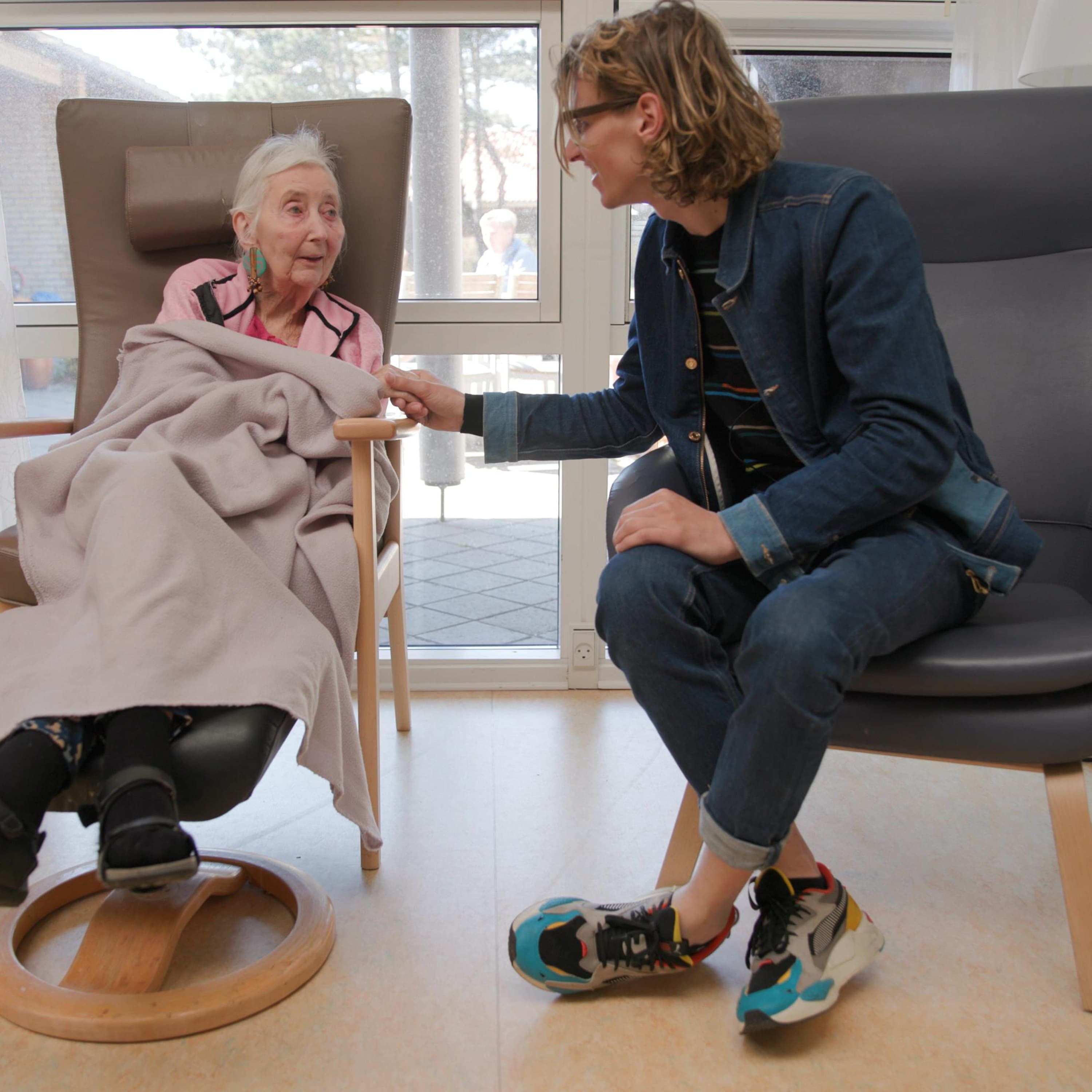
About this episode
Get every episode summarized
Each time Today in Focus publishes, we email you a written briefing from the transcript — the topics, who appeared, and any specific claims, with the ad reads skipped.
Email me new episodesFree for 3 shows. No card needed.
Hosts & guests

Transcript ready
382 searchable segments. Every word is indexed and playable.
Full transcript
Today in Focus — The young and healthy Dutchman who moved into a care home. Machine-transcribed; use the interactive transcript above to jump the player to any line.
This is the Guardian. Today, meet the young and healthy Dutchman who moved into dementia home and is now campaigning for radical changes in elder care. Everything Galeer says one thing and it's actually something totally different. See, not everything is what it sounds like, but Hotels.com? It's exactly what it sounds like. Go to Hotels.com to choose from hundreds of thousands of hotels, instantly get up to 20% off with member prices and earn rewards on every stay. Sign up for free and book today. Hotels.com. It's all in the name. Growing up in the south of the Netherlands, Tune Tobis was pretty young when he decided he wanted to care.
I was 17 years old and I had an internship in a nursing home because I was studying to become a nurse. He'd never been into an old people's home before, but in some respects it was just like he imagined. There were communal areas with arm chairs facing the TV, care workers buzzing about, but then he crossed a thresholds into an area where the doors were secured with the code and the residents were locked inside. I was walking onto the closed ward, those doors are opening and it felt like I ended up in a surreal, nobody's land. The closed ward is an example which really illustrates how we have lost the plots when it is about supporting quality of life. The residents of the closed wards were not criminals. They just had dementia. And as his nursing training progressed, Tune starts to think there was something fundamentally wrong with locking these people up. I asked all my colleagues would you like to live for yourself and then almost all my
colleagues said, hell no, if I get dementia, I want to live in a better way. So how can we change this for the better? And it gave him an idea. When I finished my studies, I decided I want to live in a nursing home myself to experience what it is like to live here. H. 21 and his peers were living in grubby student house shares. Tune moved into the locked ward of a home in Utrecht and then another in Amsterdam. The other residents became not just his housemates but his friends. They shared meals together, secret beers, a bathroom. During more than three years living in the homes, Tune became convinced there is a better way to care. And in a new book and documentary, human forever, he explains how. From the Guardian, I'm Helen Pitt, to Dane Focus. Should we give people with dementia more and not less, freedom?
Welcome to Dane Focus, Tune. I've got to say I am so intrigued by the idea of a 21-year-old guy moving into a dementia home. Did you just wake up one day and think, by, I'm not going to live with friends my own age, I'm going to move into a care home? Or was it an idea that developed over time? Yeah, it was not just suddenly, but I'm very thankful for the organization which gave the permission because I descend them an email with the question, am I allowed to live in a nursing home? And surprisingly, they said yes. Because no one asks to live in a nursing home, especially not when you're 21 years old. So, in the Netherlands, we don't have a shortage of money, we don't have a shortage of rooms, we have a shortage of staff of humans. So that made it possible for me to live there. But they said yes, because they saw the value of this inter-human connection between me as a young person and all the people living with dementia, my housemates. And that ended up in a beautiful journey where I've met people who really became best friends.
And that was very special to experience. Yeah, and I personally, I am absolutely terrified of getting dementia. Both of my grannies had dementia. I really remember visiting them in their homes. I hated visiting them, actually, because they were such depressing places, quite frightening places, in a way. And that's why I found your film so refreshing and interesting and kind of confronting to watch, really. But I think before we go any further, could you just explain for us what dementia is and how it's different from Alzheimer's? Because people often use those two terms interchangeably, but I think they're slightly different. Is that right? The dementia is an umbrella term for many different diseases if you ask a doctor. And Alzheimer's dementia is one form of dementia, is the most common form of dementia. And Helen, when you say I'm absolutely terrified about getting dementia myself, I also understand what you mean. When people feel terrified about dementia, people feel mostly terrified about the stigma of loss.
And of course, dementia can be really painful, but so many people I've lived with told the most painful we face is not the dementia itself. It's the fact that people start treating us as the other. Yeah, and I say that I'm terrified of getting dementia a lot of a job, but I think an equal number of people are actually in denial about it. And that is in spite the fact that one in five of us has a chance of developing it. And as we all live longer, that number will probably only increase. And the number of sufferers is set to double in the next 20 years to an estimated 81 million people worldwide by 2040. But could you just tell us a bit more to the nursing home that you moved into? Do you remember the first day that you arrived with your bag looking around you and thinking, this is my new home? Oh, absolutely, Helen. I had a room with 21 square meters. I was sharing my bathroom with people living with dementia. So also my toilet, but also my living room and the kitchen of the nursing home.
It was a home with 130 residents and only the experience of going to the same toilets as people living with dementia was so useful because it really learns me how we are creating differences in institutions. The fact that we as carers have a different toilet than the residents. Also, for instance, when it is about the coffee, the carers can often get capuchini from a different machine. And we as residents were drinking filter coffee. I was living on the wards which had a coat of a door. So everyone with dementia was kept inside. We were not allowed to eat soft boiled eggs because people were scared that we were massively dying because of the soft boiled eggs. So why? What's I don't understand why would a soft boiled egg be dangerous? Because of a possible salmonella infection. Or another example is, well, we are now in summer and sometimes it's about 30 degrees. But when it is about 30 degrees in a nursing home, sometimes they have a heat protocol
and the heat protocol says it is not allowed to bring people outside because of the heat. It could be dangerous. So they weren't being taken out a company either? They were stuck in that. Yes, but the result is that I was sitting next to my housemate Muriel. She was born at Curacao, a tropical island, and she was not allowed to go outside while enjoying the heat is part of who she is. It's part of her identity. So it really shows that our system very often focuses on endless risk analysis. My colleagues will absolutely recognize this. And in terms of you actually living in the home, how did that affect your social life, your romantic life? I love this question, Helen. Does everybody ask you that? Did you get laid? I get it so well because people say, this is so strange. Like, why would you start living in a nursing home if you're 21 years old? And then most of the people of my age would ask me, how do you do it if you want to take someone
home? And then I ask, what would you do? And then people say, I would just take someone home. Like, why wouldn't you? It was my only home. So yes, I could take people home, but I have to be honest, Helen, people were very often scared when they were walking on the clotheswarts and seeing people with dementia. But I was sleeping, for instance, in a two-person's bed. So when I look at my housemates, they were all sleeping in a hospital bed. So there were some differences and they really illustrate the changes we have to make. If we want a place to feel like a home, we have to organize it like a home. Were your housemates in the nursing home jealous of your freedoms that you were allowed to bring somebody back, that you had a double bed, that you had the code for the ward? Of course, some of my housemates were really aware about the fact that I had privileges. The code was 2017. It was the code of freedom. So I was able to go outside, to go to the university,
to go to the supermarket, for instance, like all those normal things people do in their lives. And when I came back very often, odds my housemate, Otte, we came one of my best friends. He was waiting for me and he was waiting for the stories. Until I should also introduce the second person on our call, you're with your longtime collaborator, Jonathan De Young. And you too, as I've already said, have made a really moving and I think also quite comforting documentary. Which looks at the different ways people would dementia-recared for around the world. How do other countries deal with dementia and what can we learn from them? The film is called Human Forever. There's an accompanying book which is out soon in the UK. So Jonathan, you were also a teenager, I think, when you got interested in the topic of dementia,
when you were working as a bus driver transporting people with the disease to and from a day center. How did that affect you? Yes, of course. For me, as 18-year-olds as well, you think like, hey, I know everything about life, but then when you enter a closed ward, it's something so different. And it was actually also quite shocking because I thought, okay, I know people can grow old, you can grow older in a healthy way, but in this way where people were wandering around in circles, sitting at the table the whole day watching television, it was kind of a scary image. And so when it became a film making in 2018, I created my first documentary series about dementia. When I came across town a few years later, it was really for me like, hey, I can tell this story through a young lens, through a young perspective. And in the documentary you shot Jonathan, human forever, we see ad. And it's very abyscene. One of Tyn's housemates. Tell me about your bond.
When I just met Ott, he felt very depressed. Like, he didn't make any contact with me, but in the time we were living together, like more and more, he started coming to my room. We were sitting next to each other for dinner. And in the end, we got such a strong connection that every day he came to my room. I heard the sound of his walking. It was a certain rhythm. And then he came to my room and he asked me, do you want to watch soccer with me? And then we always drank a beer because he knew I had real beers in my room. He was not allowed to drink real beer during the week, only in the weekend. You should also be able to enjoy my beer. Yeah? Oh, good luck. Yeah. And so he didn't want to date again, Ott. Yes, Ott didn't remember the name I had, but he absolutely remembered the feeling we gave to each other. And that's what matters most. And was it how it feedo Tyn knowing that your housemates were at the end of their lives?
And that you might soon have to grieve them just as you're getting to know them? Was that difficult? The easiest answer would be to say yes, but the reality is no, because I knew that my housemates were passing away. I'm the only nursing home resident who actually survived a nursing home. Of course, I feel very sad. I also accepted fully because I saw that the quality of life was not that high anymore. Yeah. And let me take you to one specific example. My neighbor was my housemate, Ellie. She was in her 90s. She was living with dementia. And on a certain moment, we developed a very strong friendship. And when Ellie passed away, every morning, I went together with Ott to her room to drink a coffee. That was our routine to grieve together. Yes, I feel sad about losing precious friends, but I don't feel sad about the fact that my house mates passed away because that is the reality.
And everyone working in the system knows this. Let's talk about the journey that you two made around the world to look at how different countries approach dementia care. What questions were you hoping to get answers to? We were really on a quest. The thing that we were really were aiming for were hopeful initiatives everywhere around the world, where also during the research, they were opening up with two arms like Jonathan. Please come to our country because we think the Netherlands is always the best and why are you coming to us? Because you're a de-example in the world together with Sweden and all those kind of things. But we still like, yeah, but also when we ask the people here, they feel excluded. So are there different ways of approaching people with dementia or a different way of
to see what's the good quality of life? And that was really the goal. In the UK, certainly, we are in thrall to the Scandinavian countries. And basically, all good metrics seem to emanate from Scandinavia, the Nordic countries. And you two did go to Denmark, didn't you? To a nursing home that looked very beautiful in the film, by the sea, overlooking in a dilic coastline. Tell me about life there and the residents that you met there. What we saw in Denmark, for instance, is that they had a very strong focus on the lively environment. So we have visited a home and they had real plans, they had real dogs, they had a garden where people could go outside, people could sit at the campfire. I don't know if it's the perfect care. There's a lot of places around the world, but I think it really works here. And I think by doing this way, we reduced almost all medicine and we never used sedatives. And my first reaction was,
oh wow, this is very special because we would never see this in the nursing home I live in, because in the nursing home I lived in, we only had fake plans. Why did we have fake plans? Because we were afraid that people with dementia are eating real plans. So it could be poison. And what about the real dogs? Like, do care homes have fake dogs? Yeah, so we have, for instance, robot dogs or robot cats. Just make it a normal home with cats and dogs and just if we want to have a virus. Yes, yes, yes. But the core of what they are doing in Denmark is a real, lively environment leads to lively people. If you have a dead environment, it leads to dead people. So if you don't have any stimulation in the room, people will just sit at the table, lay their head on the table and that's their life. In dementia care, we very often say, well, we shouldn't over-stimulate people, but we could also ask the ethical question, are people living with dementia still allowed
to be overstimulated? Because you also might be overstimulated now and then in your own life. Tell me about it. People with dementia could this be as well? There's a bit in the film where it may or may not be in Denmark. And there's a woman who's asleep very peacefully and there's a cat just lying on her. Is that in Denmark? It was Denmark. It was Denmark. Yeah, and there was just something so lovely about that. Yeah, and my granny's care home, they wouldn't have been allowed that. And also, you mentioned that them round a campfire. Again, with my granny, when she was still living at home, we were so worried about her even cooking anything because we thought she would leave the gas on. I think a lot of people might hear dementia, patients, and an open fire and think, God, that's dangerous. How would you react to that? Really also what you saw in Denmark is that they approach the facility that the people live in as an extension of normal life. What we've heard throughout the four or five years that we were working on a film, everybody, when you come to a good quality of life, wants to extend their normal
life as best as possible. And of course, as best as possible is really nuanced sentences as well. Also in Denmark, that's why they had good food for a brush fire. And of course, there's somebody sitting next to them, one of the carers, but we are all afraid that they would jump into the fire. Of course not, because people know it's fires. We are so focused on extreme things that we hear about extreme symptoms that we hear, that we are start denormalizing everything about normal life. That's what really stands out in Denmark. And the easiest thing to say after this is, yeah, that's beautiful, but we don't have the money. Realizing this change is not only about more money, because the example of the cats which lays next to the woman, it doesn't cost a euro or a pound more to let the cats lay next to the person in bed. And it even saves money because you don't have to give them a pump, the sleeping pill at night. So we in the Netherlands, we spend the most
money in the whole world on social care. It's 4.1% of our GDP, so it's 18 billion euros. And even here in the Netherlands, we can't seem to buy happiness. And I think anybody who's visited a nursing home would have seen examples of behaviour that might seem quite strange, sometimes frightening, people losing their inhibitions. And there's a bit in the film that got me where you show a woman who's lying on the floor and tell me about that, because I think it's a very interesting example. Yeah, there was also in Denmark, was in in another nursing home, but they also had the same fishing about trying to facilitate people in their wishes. And they had a, on the floor heating, and the woman who was lying on the floor, she was always going there on the same spot. At first, everybody was like, how shall we pick a robot? And the woman told them, like, no, it's really nice because I feel warm.
So they said, it's okay. If you think this is a good quality of life, then we should facilitate it. No matter if it looks funny to us, those small things matter the most for people who are living their day in, day out. I guess suppose even in Denmark, there seem to be limits to the autonomy and freedom that the residents were enjoying, because the home was still surrounded by a big green fence, wasn't it? And is there any way around that having some sort of secure fence to stop people escaping, leaving? Oh, I hear you saying the word escaping. Yeah, I know. I hesitated before. If someone with dementia walks outside, we call it escaping, but if I walk outside, we call it walking. And I have so many examples of this use of language. If my housemates were listening to music, we would very often call it music therapy, or if they were petting a dog, we would call it animal therapy. Yeah, therapy dogs, yeah. Yeah. If I'm playing a game, we would call like, he's playing
chess. But if my housemates are playing a game, we call it brain gymnastics. So the language we use is it's it's it's surprisingly saying so much about our views and yes, within the home in Denmark, they had a beautiful realization of the vision, but despite the tender loving care and the idyllic surroundings. Here too, freedom for the residents stops at the gate. But still, they had a fence around the nursing home. So we met Kate and Kate wanted to go outside, so which she was standing at the fence, I want to go out. I will not. I will I will not. But why was the fence still closed? Not because the nursing home didn't want to open the fence, but because the society and especially the municipality was scared about what could happen. Because if an incident occurs, the first
public reaction would be who is guilty? Yeah, who's fault is it? Who let them out? Who is responsible? And this really shows the culture of fear. If the fundament of our system is fear, then we create a system which protects the system itself, but which is not protecting people with dementia. So I'm very sure Helen, within five years, also the fence in Denmark will be open. You think? Really? That's the direction of travel. Absolutely. In the Netherlands, over 500 homes, care homes have opened up the closed wards. And if something happens, for instance, when somebody walks out the door, has an accident, of course, then we should say it's a consequence of a good quality of life. And I can make it very concrete with an example that's really in a nursing home just around the corner. Anika, she's called, is she still, I saw her two days ago walking besides my house. And when her children came to the nursing home, they promised her mother that she could walk
because that was her biggest hobby. And then of course, the nursing home said, that's that's that's pool. That's not possible, but the family insisted that she could walk. And then the nursing home said, okay, if you say we take responsibility of everything that happens when she walks out, it's fine. We go to the municipality, they talk to the mayor, and the mayor said like, I love it. And then the result of sharing the responsibility was really that she has already four years now, walking three, four times a week to the center of the village, buying flowers with her own bank cards, what's also very special when it comes to dementia. And she has such a good quality of life that I really think it's possible to change within the system if we are brave enough to talk about what is really a good quality of life. And then we want to share the responsibility. Coming up, what if we didn't need these nursing homes?
Our Chief Technology Officer is an AI, and our human team reports to that AI. Meet your new manager, there an AI chatbot. These fired people, the AI boss has fired human employees? Yes, for lack of performance. Black box, the chatbots, a new series from the Guardian Investigates, about the strange things happening between AI and us. The whole series is out right now. Search for black box wherever you get your podcasts. A lot of the hope in your film I found from the chapter where you go to South Korea, a place with the lowest birth rate globally, and a country that is understandably worried about the burden of their aging population. And in fact, they are on track to become the oldest population in the world before too long. And there, they are really treating dementia as a preventable disease in many
cases. And you spoke to some South Korean experts. According to the latest evidence, 40% of dementia is related to modifiable lifestyle environmental bus gravis factors. They have this thing called the finger model to try and prevent dementia. What is that? Finger is the first study in the world showing that it is possible to prevent cognitive decline with the finger. The finger model is based on five fingers. The first finger is exercise, stay active throughout your whole life. Also, be cognitive active. So stay socially connected. It is really important, especially when you grow older. People are becoming more isolated easily. So stay connected. Healthy food. What's healthy for your heart is healthy for your brain. Socially active together with others and vesicular risk control. How it works in practice is that in South Korea, they have over 220 dementia centers where people follow the superbrained program. Based on the results of physical, cognitive, and
vesicular tests, people with a higher risk can follow the 24-week digital program with a focus on lifestyle change using the five pillars of the finger methods. Over 40% of dementia, specifically Alzheimer's dementia, is preventable. It doesn't say that if you get Alzheimer's dementia, that you have a bad lifestyle. So we have to be clear about this. I think the message of superbrained is very hopeful in order to support prevention when it comes to dementia. Yeah, I think that's really important. As I said, I think a lot of people do just see dementia as a terrible fate that they have absolutely no control over. Of course, for some cases, people, as you said, it's not necessarily anybody's fault. But this idea that such a large percentage of dementia can be slowed or prevented entirely is a message that I think hasn't got through to many people in the UK yet. I know why, because the dominant narrative of
dementia focuses on fear. In the UK, you hear so often sentences like, the MENHA is the UK's biggest killer. And those sentences are spread by organizations which are claiming to be the voice for people living with dementia. And at the same time, those organizations say, we want to create a future where dementia no longer devastates lives. The question we could ask ourselves is, is dementia always devastating the lives? Or is it also the effect of the stigma which devastates lives? I'm knowing everything that you both know now after spending all of these years traveling the world and talking to carers and people with dementia. Are you afraid of developing it? I'm not afraid of getting it. Of course, I want to grow old the best way I can. But if I get it,
hopefully people will listen to me and facilitate me and I wish us to stay in my community for as long as possible. He's also, if you're still in the film, is Rob. He was a cardiologist, one of the best in Europe. And on the day that he got the diagnosis, he told me the first thing that he told me, he said like, don't think after I got my diagnosis, none of my colleagues called me ever again. And I was really heartbreaking for me because that's exactly the point that not the condition is the worst, but it's how society treats us. I can't answer the question whether I'm faithful of living with dementia because there is not one person with dementia. There are so many different possibilities people have. I also saw that people with dementia can have a great quality of life. I'm really afraid of ending up in, for instance, a dementia village, which is sometimes seen as an example of how it could be done differently. I visited one of those with fake little shops
from the olden days. I am very afraid of ending up in an artificial environment, of going to a fake supermarket or a fake theater. I'm very afraid of ending up with thickener in my drink because people are afraid I might end up choking in a beer I would love to drink. But this has nothing to do with dementia. This is about the way we are treating people in our care system. I don't wish people to get dementia. Also, my own grandma was living with dementia. But I also saw that we as a community, we as the people around her were still able to support her quality of life in the best way possible. The aim of living well is not to make people happy. If you look at the websites of care organizations, you always see happy people smiling broadly and the idea which is created by this is come to us because we can make you happy. We don't want to spread the narrative that quality of life
is only about being happy because being allowed to feel sad, being allowed to feel alone is also part of being human. Quality of life means accepting risks which are inherently bounded to someone's life. If we build systems based on zero risks, then life will be zero as well. Well, Tim and Jonathan, thank you so much. It's been really interesting to talk to you. Thank you so much. Thank you. That was Turn to Abyss and Jonathan De Jong. Their new book, Human Forever, Searching the World for a Better Life with dementia will be available in the UK on 17th September. Their film, Human Forever, is currently available to stream in the Netherlands, Japan, Brazil, Belgium, Germany, Austria, Switzerland and France with other territories to be announced soon. If you enjoyed this episode and of course, I hope that you did, perhaps you'd consider leaving us a review. We really enjoy hearing what you think of the show and it also helps other people
to find us. And that is all for today. This episode was produced by Sasuke Collett and presented by me, Helen Pied. Sound design was by Brian McNamara. The executive producer was Sami Kent. We'll be back in your feeds this afternoon with the latest. This is the Guardian. This message comes from Jackson. Taxes aren't something you can only think about once a year. With investments,
planning for tax days year round. Fortunately, Jackson offers tax-efficient products. Visit jackson.com for more information on how our products can make your tax bill a little bit less painful. Jackson is short for Jackson Financial Incorporated, Jackson National Life Insurance Company Lansing Michigan, and Jackson National Life Insurance Company of New York. Purchase New York. Forming a business seems easy until influencers, Reddit and AI give different advice. Legal Zoom helps get it right the first time. Visit today. Legal Zoom provides access to independent attorneys and self-service tools. Legal Zoom is not a law firm and does not provide legal advice. Your will or trust shouldn't be in the wrong hands. Cobble together from an AI answer or a generic template. Legal Zoom was built to help with your situation. With self-guided tools or the assistance of an attorney without the price tag of a traditional law firm, 2.2 million families made their will or trust with legal zoom. Yours can be next. When you need a legal hand, visit legal zoom. Legal Zoom provides access to independent attorneys and self-service tools.
Legal Zoom is not a law firm and does not provide legal advice.
More episodes
More from Today in Focus

Is Trump trying to buy votes? – The Latest
Today in Focus

Why is Trump silent on UK sanctions against Israeli West Bank settlements? – The...
Today in Focus

Inside Reform UK
Today in Focus

UK condemns Israeli settler ‘ethnic cleansing’ in West Bank – The Latest
Today in Focus