Get every episode summarized
Each time SpaceTime with Stuart Gary publishes, we email you a written briefing from the transcript — the topics, who appeared, and any specific claims, with the ad reads skipped.
Email me new episodesFree for 3 shows. No card needed.
About this episode
Sponsor Details:
This episode is brought to you with the support of Insta360 - the game changer in 360-degree camera technology. Capture stunning moments with the Insta360 X5, which records 8K 360-degree video. To bag a free invisible selfie stick with your purchase, head to store.insta360.com and use the promo code SpaceTime!
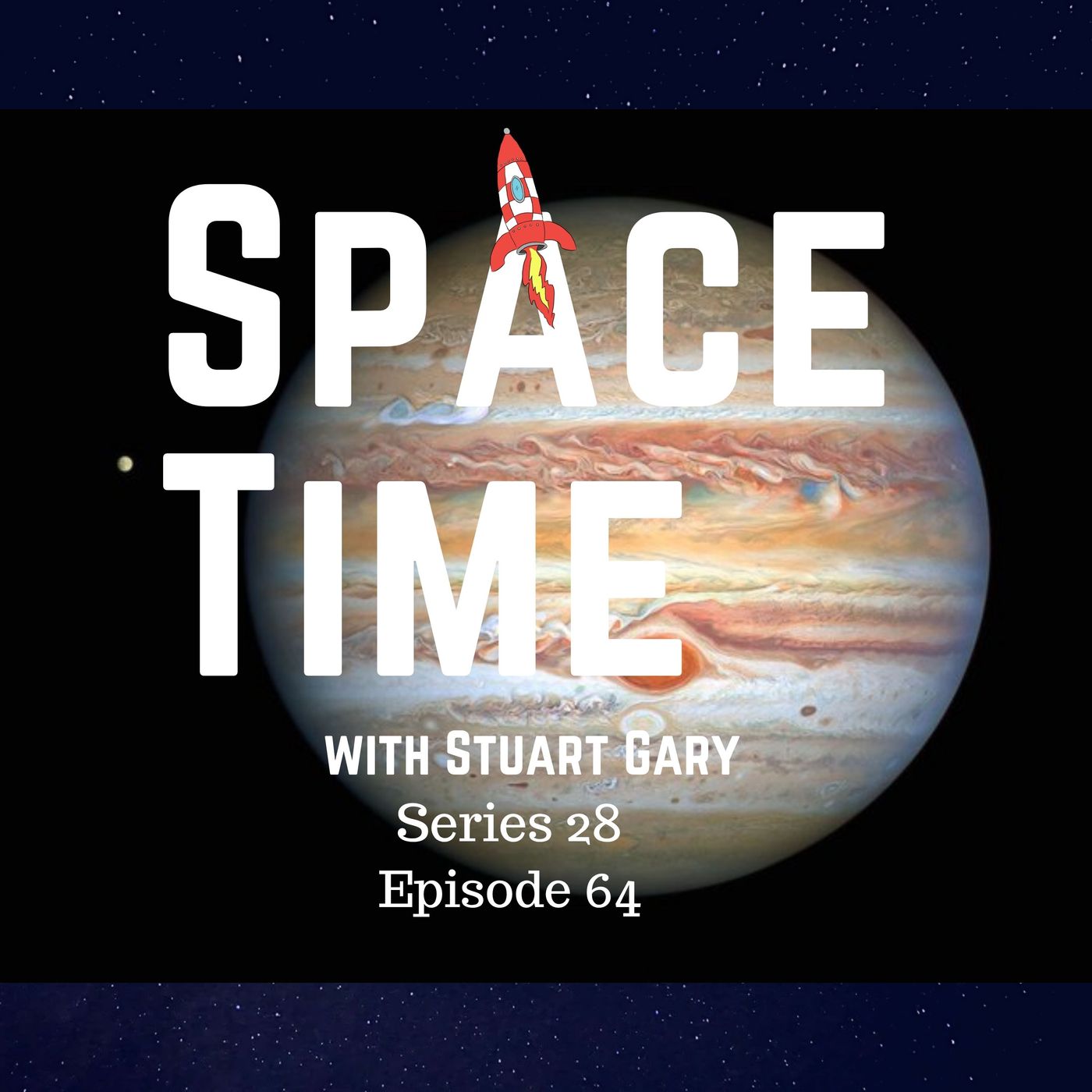
In this episode of SpaceTime, we uncover remarkable revelations about Jupiter, lightning-induced gamma rays, and groundbreaking achievements in spaceflight.
Jupiter's Magnificent Past
A new study reveals that Jupiter, the solar system's largest planet, was once twice its current size and possessed a magnetic field 50 times stronger than today. Researchers, led by Konstantin Batygin, used the orbits of Jupiter's small moons, Amalthea and Thebe, to deduce these findings, providing critical insights into the early stages of planetary formation. The implications of this research could reshape our understanding of gas giants and their formation processes across the universe.
Gamma Rays and Lightning
In a groundbreaking discovery, scientists have detected intense flashes of gamma rays produced by lightning strikes. This phenomenon, known as terrestrial gamma ray flashes, occurs when lightning accelerates electrons to near light speeds, resulting in bursts of radiation. The study, published in Science Advances, sheds light on the high-energy processes occurring in Earth's atmosphere, enhancing our understanding of lightning's power and its effects on our planet.
Precision Formation Flying in Space
History has been made in Earth orbit as two spacecraft from the European Space Agency's Proba 3 mission successfully flew in millimeter-perfect formation for the first time. This precision alignment is crucial for studying the Sun's corona, allowing the two satellites to simulate a single large spacecraft. We discuss the technology behind this mission and its potential to revolutionize solar observations.
www.spacetimewithstuartgary.com
✍️ Episode References
Nature Astronomy
https://www.nature.com/natureastronomy/
Science Advances
https://www.science.org/journal/sciadv
Become a supporter of this podcast: https://www.spreaker.com/podcast/spacetime-space-astronomy--2458531/support.
00:00 This is Space Time Series 28, Episode 64 for broadcast on 28 May 2025
01:00 Jupiter's original size and magnetic field
12:15 Gamma ray flashes unleashed by lightning
22:30 Precision formation flying in space
30:00 Science report: New contact lens technology for night vision
This episode is brought to you with the support of Insta360 - the game changer in 360-degree camera technology. Capture stunning moments with the Insta360 X5, which records 8K 360-degree video. To bag a free invisible selfie stick with your purchase, head to store.insta360.com and use the promo code SpaceTime!
In this episode of SpaceTime, we uncover remarkable revelations about Jupiter, lightning-induced gamma rays, and groundbreaking achievements in spaceflight.
Jupiter's Magnificent Past
A new study reveals that Jupiter, the solar system's largest planet, was once twice its current size and possessed a magnetic field 50 times stronger than today. Researchers, led by Konstantin Batygin, used the orbits of Jupiter's small moons, Amalthea and Thebe, to deduce these findings, providing critical insights into the early stages of planetary formation. The implications of this research could reshape our understanding of gas giants and their formation processes across the universe.
Gamma Rays and Lightning
In a groundbreaking discovery, scientists have detected intense flashes of gamma rays produced by lightning strikes. This phenomenon, known as terrestrial gamma ray flashes, occurs when lightning accelerates electrons to near light speeds, resulting in bursts of radiation. The study, published in Science Advances, sheds light on the high-energy processes occurring in Earth's atmosphere, enhancing our understanding of lightning's power and its effects on our planet.
Precision Formation Flying in Space
History has been made in Earth orbit as two spacecraft from the European Space Agency's Proba 3 mission successfully flew in millimeter-perfect formation for the first time. This precision alignment is crucial for studying the Sun's corona, allowing the two satellites to simulate a single large spacecraft. We discuss the technology behind this mission and its potential to revolutionize solar observations.
www.spacetimewithstuartgary.com
✍️ Episode References
Nature Astronomy
https://www.nature.com/natureastronomy/
Science Advances
https://www.science.org/journal/sciadv
Become a supporter of this podcast: https://www.spreaker.com/podcast/spacetime-space-astronomy--2458531/support.
00:00 This is Space Time Series 28, Episode 64 for broadcast on 28 May 2025
01:00 Jupiter's original size and magnetic field
12:15 Gamma ray flashes unleashed by lightning
22:30 Precision formation flying in space
30:00 Science report: New contact lens technology for night vision
Get every episode summarized
Each time SpaceTime with Stuart Gary publishes, we email you a written briefing from the transcript — the topics, who appeared, and any specific claims, with the ad reads skipped.
Email me new episodesFree for 3 shows. No card needed.
Hosts & guests
No transcript yet
This episode has not been transcribed. Request it and it moves to the front of the queue.
More episodes
More from SpaceTime with Stuart Gary

Comet Births and Neptune's Secrets
SpaceTime with Stuart Gary
Sep 11, 202622:27completed

Molten Planets and Solar Storms: Unveiling Cosmic Wonders
SpaceTime with Stuart Gary
Sep 9, 202634:16completed

Dark Matter Signals and Lunar Origins: Exploring the Universe's Mysteries
SpaceTime with Stuart Gary
Sep 8, 202625:39pending

Discovering Blazars and SpaceX's New Spaceport
SpaceTime with Stuart Gary
Sep 4, 202618:54pending