About this episode
How_the_I_Ching_created_binary_code
Get every episode summarized
Each time ÆON imminent 🧬 🌀 publishes, we email you a written briefing from the transcript — the topics, who appeared, and any specific claims, with the ad reads skipped.
Email me new episodesFree for 3 shows. No card needed.
Hosts & guests

Transcript ready
316 searchable segments. Every word is indexed and playable.
Full transcript
ÆON imminent 🧬 🌀 — Liebniz I Ching. Machine-transcribed; use the interactive transcript above to jump the player to any line.
I want you to try a little thought experiment with us today. Okay, I'm game. So, take a look at the smartphone in your hand or, you know, the computer screen you might be staring at right now. Right. Beneath that sleek glass, the colorful icons, the smooth video, every single function is running on binary code. Just endless streams of zeros and ones. Exactly. Microscopic streams making like billions of calculations a second. Now, what if I told you that the invisible thread connecting all those zeros and ones stretches back to a 17th century German philosopher, the ancient Chinese I Ching, and the biblical Garden of Eden? I mean, it sounds like the plot of some wild historical fiction novel. It really does. But welcome to The Deep Dive. Today we're pulling from a seriously fascinating lecture and Q&A session by the scholar David Lloyd-Dusenberry. And our mission for you today is to trace the totally bizarre, beautiful, and frankly completely accidental origin story of binary code. Yeah. We are going to explore how a massive cross-cultural misunderstanding ended up fundamentally changing
the architecture of our modern world. So okay, let's unpack this because it's a lot. It is a lot. And what's fascinating here is that we look at our highly mechanized digital world today, and we assume it's the ultimate triumph of cold, secular math. Right. Just pure logic. But the foundational language of literally every piece of digital technology actually stems from this deeply theological, almost mystical quest to find a perfect, divine language. Which is just crazy to think about. And to trace that origin, we actually have to leave Europe entirely, right? Yeah, we have to drop right into the imperial cordon Beijing. This is late 17th, early 18th century. Under the Kangxi Emperor, who is just an absolute powerhouse. He actually holds the record as the longest reigning emperor in Chinese history. He ruled for 61 years. Yeah, 61 years. Yeah. In his rule, the imperial court wasn't this closed-off fortress. It was a bustling, truly cosmopolitan hub of cultural exchange. Yeah. Right. Because you had this huge presence of European Jesuits, deeply embedded in the emperors
in our circles. And we have to, we kind of have to strip away our modern assumptions about what a missionary was back then. Oh, absolutely. They weren't just handing out tracks on street corners. No. These Jesuits were top tier scientists, elite mathematicians, astronomers. They were basically serving the Chinese Empire as technical advisors. And they earned that place through sheer technical utility. The Chinese Empire obviously possessed vast knowledge, but the Jesuits brought specific European scientific advancements that the emperor found, you know, really valuable. The details from the source material are just so charming here. Yeah. You have this Flemish Jesuit, Ferdinand Verbiast. He's not lecturing the court on theology all day. He's actively instructing Chinese engineers on forging lighter cannons. Right. Practical science. And on top of that, he's building this complex water fountain in the imperial gardens that's like mechanically connected to a musical organ. Which is amazing. And then you have Tomas Pereira, a Portuguese Jesuit, spending his time teaching the Kanksi
Emperor how to play his favorite Chinese tunes on a European harps accord. It's just such a vivid picture of two worlds blending, but that blending had massive political implications too. It did, because the Jesuits proved themselves so indispensable, they were given positions of immense diplomatic trust. Which leads us to a really crucial historical anchor, the 1689 Treaty of Nurchinsk. The treaty between China and Russia. Exactly. This completely shifted the global perspective. It was China's first international treaty as a sovereign nation reflecting European legal norms. Right. Because before that, the Chinese emperor held the mandate of heaven. He was the sole center of the universe, and everyone else was just a tributary. But here, they're interacting with the Russian Empire as one sovereign state relating to another, and negotiating that required a massive linguistic bridge. Because the Russian speak Russian and the court speaks Menshu and Chinese. Right. And translating complex international legal concepts directly between those languages was
a diplomatic nightmare. They needed a neutral, highly precise language to draft the binding documents. So the Jesuits step in. And they draft the official, legally binding copy of the treaty in Latin. Which is blows my mind. The first treaty China ever formed with another nation was written in the language of the ancient Roman Empire. It really encapsulates how interconnected the world was getting, and the Jesuits were constantly writing home to Europe about all this. Yeah, they're detailing this incredibly sophisticated, scientifically advanced empire in the east. And because of that, European intellectuals had a bit of an identity crisis. He realized they weren't the sole center of civilization anymore. Right. And this brings us to the guy who becomes obsessed with China, got freed of Wilhelm Leibniz. Leibniz was arguably the most brilliant polymath of his age in Germany. He was completely captivated by these reports. He actually jokingly called himself Europe's Bureau of Address for China. If you wanted to know the latest Chinese science or culture, you wrote to Leibniz.
He even published a book called The newest Things Out of China. His interest wasn't just casual exoticism. It was fueled by a massive crisis in Europe. The religious wars, right? Yeah, Europe had been torn apart by brutal conflicts like the 30 years war, millions dead. And much of that pledge was fueled by theological disputes, which came down to differing interpretations of translated special. Right. Because human language is messy, words are ambiguous. Exactly. Translation caused literal wars. So early Enlightenment thinkers like Leibniz were desperately searching for objective truth, a better way to communicate. And their solution was to look backward. They had this theological belief that humanity used to possess a perfect language. The language spoken in the Garden of Eden. Right. The idea was that before the fall, humans and God communicated flawlessly, no ambiguity, so they're trying to reverse the fall and recover this pristine knowledge. And what's interesting is how they conceptualize this perfect language. They realized that phonetic language Alphabet's representing sounds is the root of the
problem. Right. If I say a word, you might interpret it totally differently based on your dialect or culture. I love the analogy from the Q&A section here. Imagine if the original, Edenic language wasn't spoken at all. Think about how we share stuff today. If I want you to know what I'm looking at, I don't spend five minutes describing it. You just air drop a photo to my phone. Exactly. I just air drop it. Edenic language might have been like that a direct visual or even telepathic transmission of pure concepts, which explains whether or so obsessed with non-alphabetical writing, Egyptian hieroglyphics, Chinese idiograms. When Leibniz looked at Chinese characters, he saw a system that bypassed spoken speech. Two people from different regions of China couldn't understand each other's spoken dialect, but they could read the same character for a mountain. The symbol represents the concept directly. To Leibniz, that felt incredibly close to the Edenic ideal. But there's a problem. Yeah, Chinese characters are highly functional, but there are tens of thousands of them that's incredibly complex.
So if spoken language is too messy and idiograms are too complex, Leibniz pivots, he decides the only true universal language is math. Math is totally objective, two plus two is four, whether you're in Berlin or Beijing. But how do you notate it? How do you write down math so it's as simple as possible? Leibniz spends the late 1680s and 1690s just grinding away at this. He looks at our normal base 10 system, which gives us 10 puzzle pieces, the digits 0 through 9. Right, and we use columns for 1s, 10s, 100s. He tries base 4, trying to simplify things. But then, in 1696, he has a breakthrough. He figures out that the absolute simplest way to express any number is base 2. Here's where it gets really interesting for us today. He realizes you only need two digits, 0 and 1. A binary code. Instead of columns for 1s, 10s, and 100s, base 2 uses columns for 1s, 2s, 4s, 8s. So the number 3 isn't a unique symbol. It's 1, 2, and 1, 1 written as 11. And 4 is written as a 100. He invents binary code.
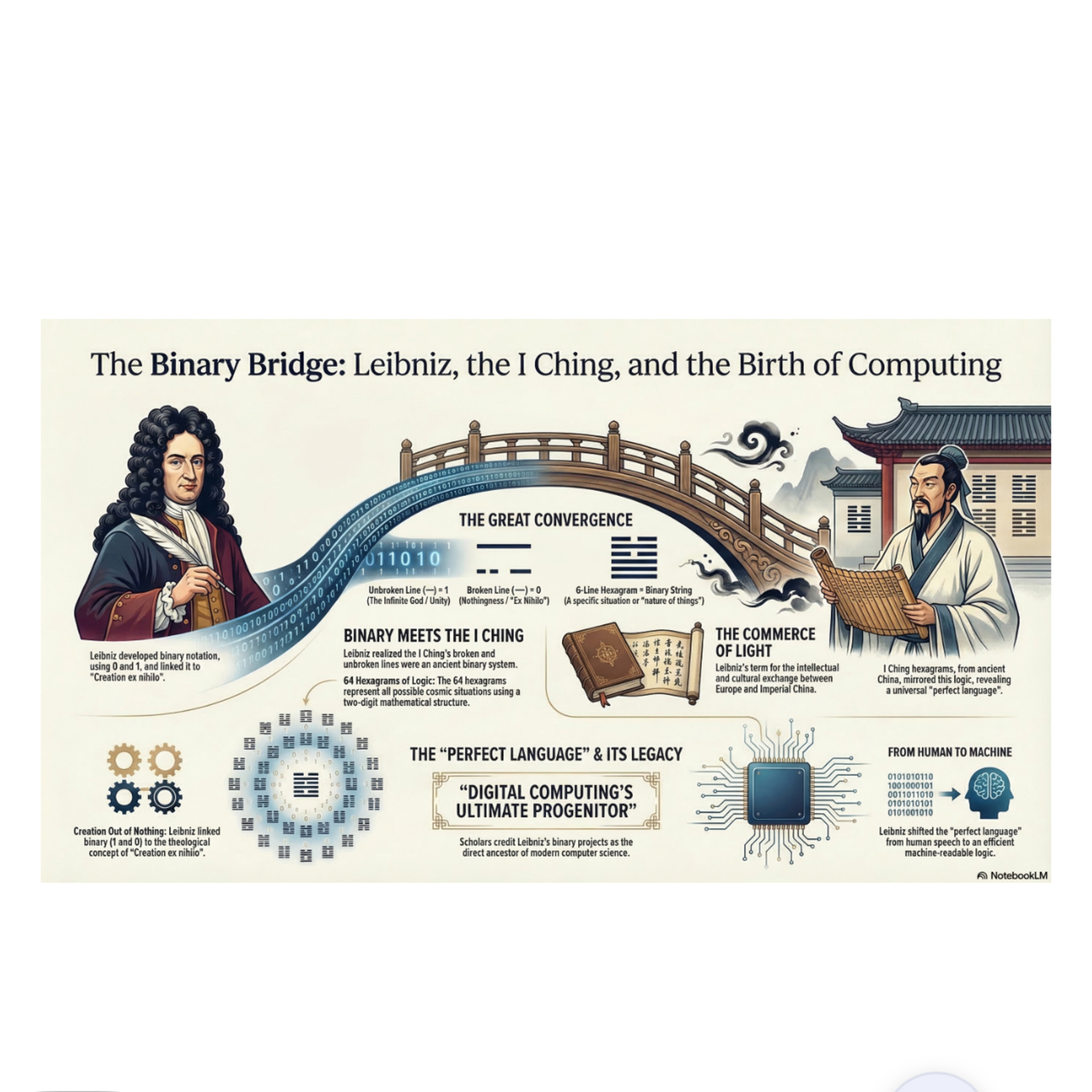
He proves you can build infinity using just a toggle between two states, presence and absence, 1 and 0. And he genuinely believed he had mathematically isolated the universal language of reality. But he needed proof. Right. And just invent it, he has to prove it's ancient divine knowledge. He needed evidence that ancient humanity understood the binary nature of the universe. And in 1701, that proof basically landed on his desk. The care package from Beijing? Yes. Joaquin Bouvet, one of those Jesuits who had been with the Ken Chi Emperor, returns to France with 40 volumes of texts. Knowing Leibniz's obsession, Bouvet sends him a Latinized copy of the E-Chain. The ancient Chinese book of changes. The picture of this Leibniz unwraps his text, opens it up, and starts studying the 64 exagrams. And visually a hexagram is just a stack of six horizontal lines. But the lines are either solid and unbroken, or they're broken with a little gap in the middle. Leibniz stares at these lines and makes just the most spectacular misinterpretation in human history.
His math-obsessed brain looks at a solid line and says, that's a one. And she looks at a broken line and says, that's a zero. He immediately thinks, this is binary. The ancient Chinese new base two math, thousands of years ago. He was completely thrilled. But it wasn't just about math, it was about theology. He believed the Chinese had preserved the Judeo-Christian mystery of creation. Griacheo, ex nihilo. God creating the universe out of nothing. Exactly. In his mind, God is the infinite one. Before creation, there was nothing, which is zero. God breathes into the void and their interaction creates everything. So when he sees the itching, using ones in his lo, to describe all the situations in the universe, he literally thinks it's mathematical proof of the book of Genesis. And this fuels his grand ambition, the commerce of light. Right. He won an intellectual exchange with China. He felt Europe could learn practical administration from China, but Europe could give China back this lost metaphysical truth. He thought if he showed the emperor that the itching was actually a proof of the Christian
God, it would spark a massive religious conversion. Okay, wait. I have to push back here. We talked about this from the Q&A part of the source. Wasn't it itching historically used for fortune telling? Well, absolutely. It was a divination manual. Right. Like tossing coins or yaro stocks to decide if you should plant crops or go to war. How did this hyper-logical German philosopher, Reckon-Syle, ancient fortune telling with a pristine mathematical proof of God? It's a huge contradiction. Ducenbury addresses this. Leibniz basically adopted a theory of cultural degradation. Meaning he thought the math came first. Precisely. He and the Jesuits theorized that ancient Enlightened Sages wrote it purely as mysterious theology. But over millennia, later generations supposedly lost touch with that purity. So they basically assumed the divination stuff was just a corruption? Yeah. They viewed 18th century fortune telling as just the messy, superstitious residue left over after the original perfect language was forgotten. Which is incredibly convenient for his theory.
He just brushes away the lived cultural practice of millions of people because it didn't fit his math. And, I mean, let's give the listener a blunt reality check here. He was totally wrong. So wrong! The lines don't represent what I know. Not at all. As modern scholars and even some of his contemporaries knew, those lines represent Yin and Yang. The interconnected forces of the universe, light and dark, masculine and feminine, not the Christian God, and absolute nothingness. And the dating of the text was vastly different from what he assumed, too. His entire historical foundation was a misunderstanding. But the legacy of that specific mistake is just wild. It's unparalleled. Duzenbury actually brings up Umberto Eco's 1993 research on this. Eco points out this profound, tragic irony. Lideness spent his life searching for the perfect human language. To unite empires and talk to God. Right. He actually created, was an incredibly powerful, inhuman language. The machine language of digital computing. Exactly.
Humans don't think in binary. We think in messy metaphors and emotions. Only machines can efficiently speak his perfect language. His deeply theological quest, birthed AI and algorithmic processing. Breath-taking irony. He wanted to give us a way to talk to God, and instead, he gave us the microchip. And that transition from theology to technology sparked a huge philosophical debate. The invention of binary really cemented the toolbox view of science. Right. Let's talk about the toolbox versus the romantic view. Because this dichotomy from the Q&A is so compelling. The toolbox view essentially says the entire natural world is computable. Everything. Biology, physics, human behavior, if you dig deep enough, you can chop it all into bits. Atomized sequences of zeros and ones, everything is just a switch that's on or off, true or false. The romantic view of science aggressively pushes back against that. The romantics argue that life and the mind are unities. You can't just chop them up. And ironically, this brings up liveness, his own concept of monads. Oh, right.
Yeah, he believed the universe was made of monads, these indivisible, soul-like unities that are deeply interconnected. Which totally conflicts with the atomized, chopped up nature of the binary code he invented. The romantic perspective says if you reduce a living organism or human consciousness to a string of zeros and ones, you destroy the very essence that makes it alive. You lose the ontological depth. And that clash feels so urgent today, you know? Look at the listener's phone right now. We're surrounded by AI models that mimic human thought, write poetry, generate art, all using that exact same binary toolbox. It forced you to re-evaluate every device you own. It really does. Every app, every text message, every piece of software running the modern world is cascading from a 17th century European philosopher, misreading an ancient Chinese text because he wanted to prove the book of Genesis. A quest for spiritual perfection accidentally yielded the ultimate tool of utility. It's just incredible. Let's quickly recap this journey for everyone because the historical domino effect here
is crazy. We started with Jesuits writing Latin, Friedies and China. Which sparked a crisis in Europe. Then we had the fantasy of telepathic, idemic languages. Which led to math as the perfect language and the invention of base two. And the misinterpretation of Yin and Yang as ones and derives. And finally, the accidental birth of digital computing from a deeply theological mistake. It really proves how messy and fundamentally human art technologies history actually is. Our most logical, flawless systems were born from just massive misunderstandings. And yet, it leads to this really provocative final thought drawn straight from Leibniz's original quest. Yeah, because despite all our advanced AI, despite our perfect machine languages and digital networks, pure computations still has a limit. You can't answer the big ones. Exactly. Binary code can calculate anything. But it can never answer the fundamental metaphysical question of existence. Why is there something the one rather than absolutely nothing, the zero? Which is exactly what Leibniz was trying to answer in the first place. It all comes full circle.
So the next time you power up your device or open an app, just take a second, ponder that mystery. You're holding a piece of history born from a beautiful mistake. Thanks for joining us on this deep dive. We'll catch you next time.
More episodes


