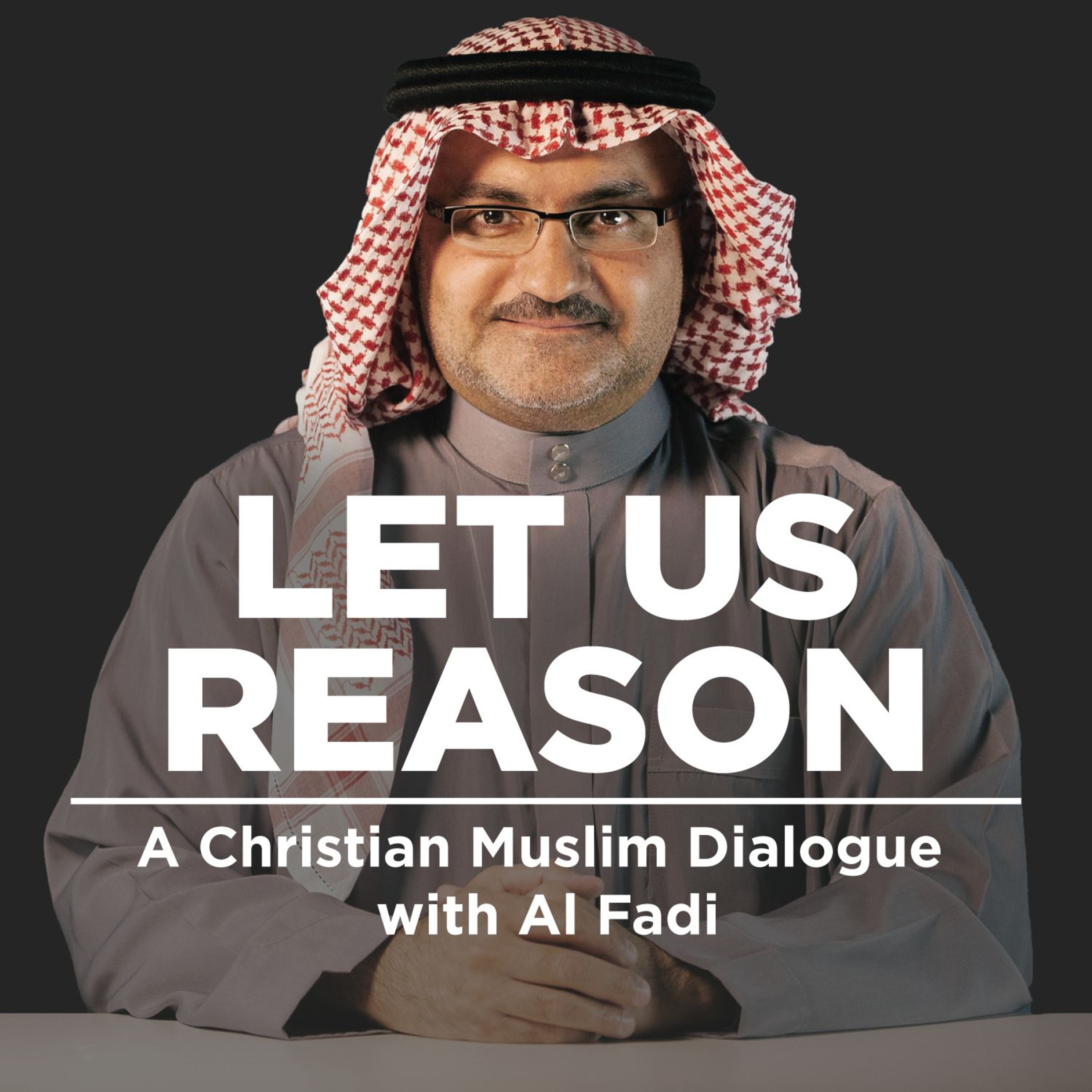
LUR - 3-28-26 - EP16
About this episode
See omnystudio.com/listener for privacy information.
Get every episode summarized
Each time New Podcast Let Us Reason - A Christian/Muslim Dialogue publishes, we email you a written briefing from the transcript — the topics, who appeared, and any specific claims, with the ad reads skipped.
Email me new episodesFree for 3 shows. No card needed.
Hosts & guests
Transcript ready
309 searchable segments. Every word is indexed and playable.
Full transcript
New Podcast Let Us Reason - A Christian/Muslim Dialogue — LUR - 3-28-26 - EP16. Machine-transcribed; use the interactive transcript above to jump the player to any line.
Welcome to Let Us Reason, a Christian Muslim dialogue with host Al Fadi. Let us Reason is a unique show utilizing theology, apologetics and evangelism to reach Muslims for Christ by comparing and contrasting Christian and Muslim doctrines. And now your host, Al Fadi. Well hello everyone, this is Al Fadi and I would like to introduce to you a brand new video series that we will be doing with our dear friend, Brother Mel. And as you know of course Mel focuses on historical criticism or let's call it source criticism when it comes to Islam. In fact, his website or I would say his YouTube channel called Origins and we'll let him
talk a little bit about that. But today's episode deals with a new topic. We're going to call it Mahmet, an Arabian prophet or a Jewish Messiah. So that's basically the theme that will be followed in this particular video series. And with us here right now, joining us virtually, our brother Mel's to shed some light on this topic and also walk us through some overview of what we will be basically exposed to throughout this video series. Mel, welcome brother, it's always good to have you. It's great to be back. So I suppose we're kind of progressing on the path to discovering what happened in the early 7th century. We've got thankfully lots of clues to help us kind of unpack what likely happened. And we're talking about Mahmet, right? In this case, we're talking about Muhammad and who is he? Yeah, I suppose the key thing is once we start talking about Muhammad, we've already started
to accept the standard Islamic narrative because that's one particular vocalization of the word which, you know, for an English speaker, you would just simply see as M-H-M-D. Right. But that can be vocalized in lots of different ways. That's great. So, for example, M-M-D, M-M-D, M-M-D, and when we see the term used down to the centuries whether it be in French or Latin, it's kind of obvious that before it ever became Muhammad, it was being used in a way like M-M-D or M-M-D, you know. So that in itself is kind of an indicator that there is an early tradition that's been changed, that's been hidden. And I think it's worth going back and thrown away all these assumptions and trying to figure out who this person is or was. And the mystery is really, is it one person or is it a kind of combining of different figures in that seven century period?
A lot of people say that, and they base this on the standard Islamic narrative, is that this figure was in a pagan society and somehow, through the revelation of an angel, he got all of this knowledge from Judaism and Christianity and so forth. If, unless I accept Islam, I can't accept that idea. I just don't believe that there was a person who got a revelation from an angel. Not because I don't believe that that can happen, but simply because the message just doesn't sound true to me, you know, the actual theology is convoluted and contradictory. So I have to go for a natural explanation. And so that leads me to look for the geographical place where someone could acquire that sort of knowledge. And it's probably no surprise to the viewers that I don't think it was in Mecca, which is essentially placed in the middle of a desert with no culture, no society, no libraries,
none of the things you'd expect to have a person who has all of this knowledge. So that's really the focus of the series. We're looking at some of the clues found in this Islamic narrative, assuming that even a false narrative will let a few things slip through the gaps. So the analogy I'm going to use in this series is that it's a glitch in the matrix because if for those who may have seen the movie, even if you create a hologram, something is going to slip through, something is going to kind of indicate, actually, there's another story behind all of this. So this isn't necessarily saying, or we can now trust the standard Islamic narrative, no, it's more a case of even even a fraudster can let things slip, they can make a mistake and I'm here to kind of just zero in on those little mistakes where they reveal a little bit too much to indicate there's actually another story. And that's what I'm hoping to do in the series.
And tell us also about the connection between Judaism and this approach that we are taken here for this particular video series, like for instance, you talk about the Jewish struggle between the Tel, when it comes to Tel Mood, the Babylonian Tel Mood and all that kind of stuff. And then you mentioned something about Salman Al-Farci, of course, but from a Jewish perspective, if you can shut some light on that because we will zoom in on each one of these topics separately. Yeah. So in terms of the Tel Mood, in the early parts of the seventh century, there was a big dispute between different sects of Judaism. There were some that leans towards the old Tel Mood, which is called the Jerusalem Tel Mood. And in that sort of point of view, they don't particularly like oral traditions being added to their understanding of the Torah. They want to go back as far as possible to like a pure understanding of the Torah, whereas
those over in the east in Iraq, they tend to go for the Babylonian Tel Mood, where there's lots of oral traditions. And that seems to be the backdrop to the Kran, as we'll see, there's a seems to be reference to particularly those Jewish leaders in Iraq. And we'll see them very clearly. Sometimes they're going to be really obvious. And for example, the Galut, and we're going to see what is meant by the Galut. It's a really prominent Jewish leader, as we'll see. But it's according to Sanders' Islamic narrative, they've come up with a completely different understanding of it, which I consider, when you look at the context, it's wrong. So that's going to be a bit of an eye-opener. In terms of Salman al-Farsi, I'm going to suggest that he is an ex-lark. And I found some examples of glitches here, where the standard Islamic narrative has actually
let the cat out with the bag here with Salman al-Farsi, and given us enough clues to who he was. He tells us exactly who this person is. And I can't believe they've let this be true. They say, they should have got rid of this if they wanted to keep their stories straight, but they've given us enough to actually place him in a particular context so that we can identify who he is. And it will be a surprise, I'm sure, to many people, that the person who is referred to a Salman al-Farsi is a Jewish ex-lark, and that's huge. Why is Muhammad, supposedly an Arabian prophet, a companion of a Jewish ex-lark who lives way up in Iraq, it makes no sense? For much of his life, he was in around Jerusalem, and then later in his life, he moves over to somewhere in the vicinity of Baghdad.
So that doesn't fit in with the overall story. So that's kind of where we're heading in this series. That's wonderful. Also, we still have time to wrap up this introduction to the series. Again, everyone who's joining us right now, we are talking about a brand new video series with Brother Merrill. We will be talking where we will cover some different views concerning the person of this, let's call him, according to Islam, they call him Muhammad, but obviously it's Muhammad, you know, that's the word that we will be zooming in on. You mentioned something interesting that we will also highlight during this series about the word Ozeir, as mentioned in the Quran, where in fact it could be Azeez, actually, and you even provide a manuscript evidence to support that. Tell us a little bit more about that. Yeah, so, according to the Sandra's Islamic narrative, the Jews believed that Ezra was the son of God.
That's what the grant is. Correct, yeah. Oh, sorry. Yeah, that's what the Kran says, or at least the version of the Kran we have today. But actually, it never made any sense because if you go and ask any Jewish person, is this what you believe, or is there any record of Jews ever believing this? They say, no, this is nonsense. So that's, so there's a big question mark over that, then that's, that's nothing new. But as someone pointed out to me, if you add a dust above the word, a die-critical mark, suddenly you find that the word is Azeez. The word Azeez means strong, you know, like a strong figure, but it also has a similar meaning as the word MacMet. So it can mean, for example, the praiseworthy or the lovely, there's a bit of an overlap. It's another messianic title. It's a less well-known one, but it's one that can be used. It can be used more often in centuries ago, but it's, it's fallen out of use. But if you look at the context in this, in this surah where it's mentioned, it talks about
the Jews say that Azeez is the son of God, where is the Christians say the Messiah is the son of God. Well, if we know that it's Azeez and not Uzair or Ezra, now it makes sense. So you're talking about two messianic titles, or two terms for the Messiah, you have the Christian one and the Jewish one, and now it makes sense. It's like perfectly intelligible, whereas this alternative name, Uzair, that even the translators can't make sense of it, so they have to turn it into Ezra to make some sense out of it, you know. But actually, it's not Ezra, and we, of course, manuscript evidence to actually point this out. What's really interesting was that I started with the hypothesis that it's, that it was probably Azeez first. And to my surprise, Odin Lafontan, who's a French scholar, met contact with me and he said,
Amel, do you realize there is a document, there is an old manuscript that has Azeez in the text? When something like that happens, it confirms we're on the right track. That's right. So it means that, from whatever reason, that's probably because there was a lack of consistency with the die of critical marks, you currently have a crans that are different from the early crans, and this is not insignificant, there's a huge difference in meaning because of just one dose of the difference, you know. And I think the world of difference. That manuscript is housed at Corpus Choranica, if I remember. That's correct, yeah. So people can see it. It's not like you're disclosing something that only you or, you know, someone else have the access to, but people can go and view it. And hopefully when we talk about that, we will shed the light on it. So rather that's exciting. I'm looking forward, of course, to the start of this series. What would be the first topic that we are going to zoom in next episode?
So the first topic we want to look at is the different Jewish leaders that are mentioned in the crans. So these are going to be obvious, and some of them are going to be a little bit coded, but it's going to be an eye-opener to see what is actually going on. So we can see then that it's about a debate among Jews, rather than a pagan talking about Jews. It's quite a different take on us. Wonderful. Thank you so much. And again, everyone, thank you for joining us. You've heard this basically introduction and next episode of this series, we are going to begin our series by talking about some of the Jewish hierarchy or Jewish leaders, and we'll take it from there when it comes to the person of Mahmed. Are we talking about an Arabian prophet here, or are we talking about a Jewish Messiah, and we will present the evidence to support this contradiction. Thank you for listening. We'll be right back after this message. We're listening to Let Us Reason with Al Fati.
We depend on the generous gifts of our supporters to produce this program. To join us in this work, go to patreon.com and search for Syra International. That's C-I-R-A International. You can also donate through PayPal. Go to syrainternational.com to learn more. Your support will help us continue introducing Muslims to the Gospel of Christ. Now back to Let Us Reason. Hello everyone, this is Al Fati, and I want to welcome you to the start of this video series that we have provided an overview of last time with Brother Mel, which has to do with what we called Mahmed, an Arabian prophet, or a Jewish Messiah. Today we are going to take a closer look at some of the coded references in a Quran related to Jewish leaders or Jewish hierarchy. With us here to unpack this is Brother Mel, who's joining us remotely. Mel, thank you again for your work, for your research, and we're excited really to have you
to address this topic. You and I have done a couple of series in the past. One of them has to do with this title Mahmed, basically, which could be read Muhammad, could be read Mahmoud, like you said, and it could be read in a variety of ways, so I'm not really so sure why we have to take just what the Islamic reading is, which basically the daqritical markings were added at a later time. So what is it about some of these codes that are found in a Quran concerning Jewish hierarchy that we would like to decipher now for our viewers? Okay, so I think the key thing here is that you have to imagine if the Quran was written by an Arabian prophet, way down in Mecca, why is he referring to these Jewish leaders that are a thousand miles away up north in Iraq and Israel and Syria makes no sense? So maybe Muslims want to tell me that they have amazing technology in the seventh century, they can actually zoom up to the north.
Maybe they have got telephones back then or the internet, but I don't think so. I think it makes more sense that the fact that the Quran is referring to these leaders suggests proximity to those leaders. I think that's the most plausible explanation. It's a bit of a stretch to tell me that somehow Muhammad has an awareness of these leaders that are a thousand miles further north just makes sense. So, without further ado, we'll look at the coded references in the Quran to the Jewish hierarchy. So I'm going to be looking at the Jinn, the Nazi, the Kufar, the Galut, the Talut, and I'm also going to be referring to these places or things, Ilyun and Sijin. And a quick summary is that the Quran in large part is a reflection of internal debate amongst various Jewish sects, broadly aligned either to the Jerusalem Talmud and the Babylonian Talmud, which we mentioned in the introduction. So, AJJU's offers us a historical background to why these Jewish leaders are being referred
to. It was a conflict that began with the first Geyon of Surah in 609 AD, a Geyon is a leader of the Jewish academy, which is otherwise known as the Yashiva. So the Geyonim were in conflict with other rabbinic Jews and also with Karraid Judaism. So Karraid and Haran Jews accepted the Torah, but were against the accretions of oral traditions as practiced by the Babylonians, and there were sectarian conflicts between the Karraids and the rabbinic Jews in Alexandria in 641 AD. So between 609 and 641 AD, there was an internal conflict between two sets of Jews, one who wanted to add oral traditions and one that wanted to stick with the Torah. So that's kind of important in terms of understanding why the Quran is interested in these leaders. So some examples of the Yashivas are Surah and Haditha.
Some people looking at the name Surah would say, I wonder if the chapters in the Quran are called Surah for a reason, it has got nothing to do with that or is that just a coincidence. It may be, but it's worth noting. So the first one, the Gen, there was a person referred to as a Dean or Gen, and they were the rabbinic Jews, and they actually started in the 7th century exactly at the same time that the standard Islamic narrative say that the Quran was written, so that's the backdrop. The Babylonians replaced the Jerusalem Nassie, who was like the top leader, and was the main judge for Judaism, with the Abbot's Dean, which is the father of the court, the Roshbeth Dean, the head of the court, the Dayan, which is the rabbinic judge, and Chavir
Bettein, who is the friend of the court, or experts in law or science. The Kran is really scathing about the Gen, and I came to the conclusion that the Gen is referring to these leaders, and I contacted the AJA Jews and discovered that he had come to this same conclusion, and had written papers about this, which kind of made me think, well, I think we might be onto something here, so the second leader is the Nassie, and now the standard Islamic narrative gives you various explanations for this text. Corn to some, the word Nassie means the post-bony. Corn to others, it's referring to the women, but the Nassie is a famous word as saying the Pope, because the Nassie is the top Jewish leader, you know, it literally is the Jewish prince, and has got a similar power to the Exelarch,
okay? So in that context, it seems that the referent of the Nassie here in the context of his replacement by these judges that we mentioned, the Gen, so even if we take the translation as given, indeed, the Nassie has led to an increase in disbelief by which those who have disbelieved or led further astray, they make its lawful one year and unlawful another year to correspond to the number made on lawful by Allah, and thus make lawful what Allah has made on lawful. It's a bit confused in the translation there, unless we get like the earliest version of that text, it's probably impossible to decipher what it meant, but it does seem to be talking about the issue of law there, and that's exactly what the Nassie was involved with. He was the top judge for the Jews, and the Gen were the replacement of that. If you were someone who lived in Israel at that time,
you'd be giving out about the fact that your Nassie has been replaced by these Gen who live in Iraq, in the Jewish academies. That was a major source of conflict at the time, meaning like religion is already here, correct? Exactly. So there was a conflict as we said in the background, so the Quran seems to be siding with the Nassie against the Gen, that seems to be the backdrop. Now, the other one is the Kaffir. Now, if you ask most people what does Kaffir me or Kufar just say it means infidels. Now, according to St. Murad, who helped me a lot with the the meanings of Arabic, the word in terms of its etymology means covers, so it occurs 491 times in the Quran. According to AJ Jews and others, the argument is that the rabbinic Jews linked with
the Babylonian Talmud are covering up the meaning of the Torah with their oral traditions, hence their nickname, the covers. Odin Lafontan comes to a similar conclusion that the word Kufar refers to covers and that the complaint is that the rabbinic Jews are basically adding their oral traditions with their Babylonian Talmud. So that's what's going on. And basically, I mean, the word Kaffir or Kaffir, it's when you're atoning for something, you're covering your sin, basically, and the day of atonement, your own Kapoor is the day of covering. And, you know, I would say, I want to play the devil's advocates here, even an Islamic scholar could argue and say, yes, we call him infidels, but we mean they covered their belief in the true God and accepted something different, you know, so that's how they would look at it. Yeah.
The problem for them though is if you only take the word in isolation, then yes, you could, you have a plausible explanation to give. But unfortunately, the Quran offers another synonym, similar to it, where it's unmistakable that who is being referred to, which leads us to this one here, Talut. It's part of a rhyming pair with Galut or Jalut. Talut refers to the Gaeon name, who are the Yashuva leaders, are more broadly to rabbinic Jews. And the reason why they coined this term is to do with Talut. It's the Aramaic word from the root TLL, meaning cover. So Talut is very similar to Kaffir. It has a sense of cover. So this word is coming from the Aramaic. So that's why you kind of have two distinct words here. And it's a very nice plan
words because it also is used as the name for the prayer shawl that they cover over their head. So if you're trying to use a word to disparage someone, it's a very good plan words. So it is used, for example, in a Biblisist context, for example, in Surah 2, 247. And it's used in conjunction with Galut or Jalut, and that's going to be important to confirm that we're on the right track in terms of what's been referred to here. I see that we are really approaching almost the end of our first episode. And we still have quite a few to do in terms of these terms and names. Would you like for us to pick it up from here next time? Yeah. So if you can just recap with maybe take one minute to recap to what did it mean that we went through titles and terminologies like this? What was the
purpose behind that? Yeah. So the purpose is once we identify who the people are that's been referred to, what is the role? That gives us a lot of contextual information. Without the correct context, we cannot understand what the Quran is actually on about. Right. So we are building this foundation now for the context behind these terminologies as used in the Quran. So we begin to decipher them that way. Exactly. So essentially, we are offering the foundations for a proper tassier of the Quran so that you can actually get a correct understanding of it. That's that's the purpose behind all of this. Yeah. Wonderful. Thank you so much, brother. Thank you everyone. Next time, we will pick it up from here where we will talk about additional terms used in the Quran, but we will give the other meanings for them in terms of explaining the context. And once we begin to look at them from a contextual standpoint, you will begin to see this process of deciphering
what they might have meant versus what is accepted today. Until next episode, everyone, have a blessed day.
More episodes
More from New Podcast Let Us Reason - A Christian/Muslim Dialogue

LUR - 9-12-26 - April EP9
New Podcast Let Us Reason - A Christian/Muslim Dialogue
LUR - 9-5-26 - April EP8
New Podcast Let Us Reason - A Christian/Muslim Dialogue
LUR - 8-29-26 - April EP7
New Podcast Let Us Reason - A Christian/Muslim Dialogue
LUR - 8-22-26 - EP6
New Podcast Let Us Reason - A Christian/Muslim Dialogue