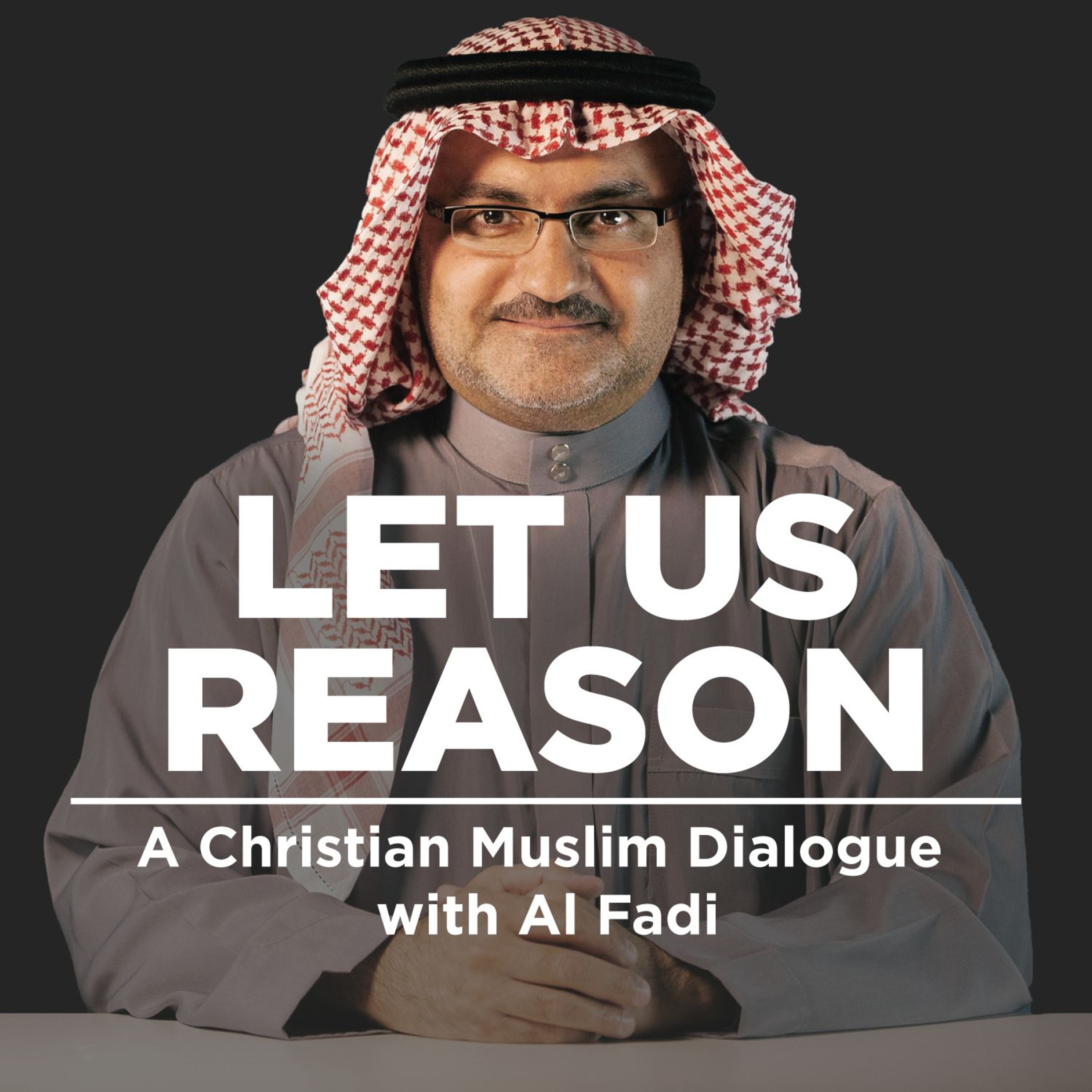
About this episode
See omnystudio.com/listener for privacy information.
Get every episode summarized
Each time New Podcast Let Us Reason - A Christian/Muslim Dialogue publishes, we email you a written briefing from the transcript — the topics, who appeared, and any specific claims, with the ad reads skipped.
Email me new episodesFree for 3 shows. No card needed.
Hosts & guests
Transcript ready
488 searchable segments. Every word is indexed and playable.
Full transcript
New Podcast Let Us Reason - A Christian/Muslim Dialogue — LUR - 3-7-26 - EP13. Machine-transcribed; use the interactive transcript above to jump the player to any line.
Welcome to Let Us Reason, a Christian Muslim dialogue with host Al Fadi. Let Us Reason is a unique show utilizing theology, apologetics and evangelism to reach Muslims for Christ by comparing and contrasting Christian and Muslim doctrines. And now, your host Al Fadi. Hello, everyone. This is Al Fadi and I pray and hope that you are finding this series about the attraction to Islam or the attraction of Islam or why Islam is attractive meaning for someone to be sympathetic to it as a religion to convert to. Or at least, you know, you find some apologists who defend Islam, whether they are followers of Islam or not, and yet, sadly, when you dig deep into these reasons that are provided
in this case, 12 specific reasons that were given to Dr. J when he was doing his master's degree at Fuller Seminary, he sent a questionnaire asking questions and received responses out of which he classified 12 reasons. We've covered so far six of them and today we're going to address reason number seven, which is the testimony of Muslims. They are beautiful people. Now no doubt Muslims are beautiful people. My mother is still a Muslim. My sisters are still a Muslim. My family and cousins are still a Muslim. They're beautiful people. But being a beautiful person, being a nice person doesn't mean you're saved, doesn't mean that you are guaranteed heaven. All it means sometimes is that you come from a nice upbringing, you come from a good culture and this applies to a lot of people. We meet a lot of people who are nice and wonderful and therefore I know I've met a lot of Hindus that are nice. I've met a lot of Sikhs that are nice. I met a lot of Buddhists that are nice. Does that mean I'm going to follow their religion just because they are nice people? It's wonderful that we have some godly or qualities given to us by God.
We have love in us sometimes. We have actions in us that represent the character of God, but of course that was marred because of sin, but in Christ the Holy Spirit in us began to restore these godly qualities in us. Let's take a look at this reason with Dr. Smiths. Dr. J. Yeah. Number seven. Testimony of other Muslims, not surprising, not surprising. I think testimony in every category, whether in any ism with any philosophy with any religion is hugely informative and huge, powerful and some of the things they said, a lot of times they were saying it was when they had a roommate or somebody who came in, especially the students who they had roommate from Saudi Arabia, they were just enamored with how moral they were and how disciplined they were. Some of them looked at the Imam and they saw how great the Imam was and they love the attitude of the Imam or their teacher in class. They love their honesty and their trustworthiness, they said. The example of Muhammad himself was a huge boom to them because everything they saw about
Muhammad. They wished that they could follow, they could as a moral guide, as a paradigm as the model for all of Islam, they wanted to do the same as Muhammad and then of course other celebrities and they would name a few celebrities that they were acknowledged, I wish that I could be like them. So that is understandable. Now, what's your comeback on this? You've given it a little bit already. What would you say if you were hearing this from a Muslim context or from a, you know, I'm going to go straight to the jugular, okay? Let's use Muhammad. The Quran says that you are an example to mankind, right? And that the fact that we have to follow Muhammad's example. Okay. Well, let me ask a question then. If you're a male, you would love to follow Muhammad's example by sleeping with woman whenever you want. You would love to own woman as your right hand basically slaves, you know, your right hand possession. You would love to marry four wives and so on and so forth.
Why am I talking about this? Because this is a straight forward answer about the character of Muhammad, how he viewed marriage and relationship between man and woman, right? Well, let's talk about a female Muslim. Would you really like for your husband, basically, who followed the example of Muhammad to marry two wives? Forget about four. The Muslim woman told my wife basically straight forward, I would not like to see my husband marry to two. It's okay, but my cousins, you know, husband married two, but I would not like for my husband to marry two. Why is that? He's following the, you know, is any following the example of the prophet, basically a beautiful example and so on and so forth. So what I'm saying is it's again, it's a subjective thing. It depends on who you're asking and if they truly understand what they mean by I follow this example or that example. Let's look at the Middle East today, okay? Who is causing the most chaos in the Middle East? Religious groups. Notice, religious groups, most of the other hoods and their offshoots, for instance, like
Hamas. You have ISIS who are celifis, you know, and you have the Hezbollah who represent the Shia. Are these supposed to be after the model of Muhammad? In one of the causing chaos that is global, actually, that is causing life to be lost, innocent people to be harmed. Many are becoming refugees. Why is that? I thought Islam is a religion that is modeled after the beautiful life of the prophet and it taught peace. I'm just being blunt here and I'm sharing these obvious examples. Yeah. Good point. And I think this is something that needs to be underlined. You can always find good examples in every religion, in every philosophy, in every area of life. It doesn't matter who you are, you always find good people. I think that's... They're a good atheist. They're a good humanist. They're a good Mormons and Joe, and this is... I have this everywhere I go. They're always good people. But they're also bad people, too. And you don't follow religion because of that. Now, number four, and this is number seven, so it's not the top of the list.
I understand that. But there are also terrible testimonies. What are you going to do with ISIS, or Hamas today, or the Boko Haram in Nigeria, or the Al-Shabab in Somalia, or the Al-Qaeda, which came out of... Yeah. ...certainly came out of Saudi Arabia and also Egypt, but then it's work in Afghanistan. I mean, there are so many groups, the last Qari Taiba out of Pakistan, these groups that are doing so much damage. And maybe it's one of their inspirers. In fact, all of their inspirers. He is the one that pretty much said, follow the book, follow the man, read the book, book the man, the book the man. And he was the one that said, to read the Quran, and when you look at the Quran, it is full of violence. It's full of misogyny. It's full of bad example of what not to be. And that's the good book. That's the good book. That's the peaceful book. That's the paradigm for everybody itself. So be careful about testimonies. Testimonies can go both ways, right? If you want to follow good testimonies, fine. But then there's what happens when the next testimony is a bad testimony, and then you find out that bad testimony actually follows the Quran better and follows Muhammad's example better.
Exactly. I would suggest that that's usually the case. I would suggest that ISIS is actually more Islamic than anything other groups that I've met so far. I would say, okay, there would be the same. Boko Haram. They're all good examples of what exactly Muhammad did. Now I would suggest also that there is a difference between what you see here and what you see when you're away. For many of these, they said they're roommate from Saudi Arabia. When he was here, he was such a paradigm of what was good. And I say, yes, but what was he like when he's home? This is a case. This movie called Not Without My Daughter, a real story that happened with a woman who was here in the United States. She fell in love with a medical student from Iran. And he was just the nicest man she'd ever come across, the most generous, the most endearing personality. She fell in love with him, married him against their parents well, and then went back to Iran with him. And as soon as she got back to Iran, he became 180 degrees because of the influence of
the culture. And the family, he was away from the family. You're one thing with in the family. And she no longer had a relationship with her husband. Her relationship was underneath the mother-in-law, his mother. She then became the master over her. She became a slave to the mother-in-law. But this was never seen. She never saw this when he was in America. Lot of, I know enough a lot of Arabs when they come here as students. They leave the Arab before they leave, they're actually went off to their cousin. So when they come here and they say, yeah, I'm single. They can say that. But they have the American women or a lot of these women who are here in the West don't realize that they will always be the second wife, not the first wife because you want to keep the wealth within the family. It's a practical application of how that works. So that makes sense that they were enamored by their roommates. They were enamored by certain teachers. Celebrities. I would be careful about celebrities because celebrities, what do you do with people like Mike Tyson or Mike Tyson is not the type of person you want to be.
He bites people's ears off. But other ones that they claimed, I remember when I said, what are some celebrities you were looking at? And they said, Jacques Elou. I said, yes, but he was not a very good practicing Muslim. In fact, he did everything to make sure that he did practice Islam. He just liked the philosophy of Islam. He said, what about Neil Armstrong? He said, Neil Armstrong was a very good Christian. Neil Armstrong did not claim that. No, he claimed. You claim he was a Muslim because he saw, when he took a pack, the backside of the moon when he took a picture of it, there was a big fissure there. And that proved that the moon had been split. It's amazing how the God of Islam hides things always. He doesn't show it to us. He just hides it in the back. Isn't that fascinating? And it's also to me, I love what you have done. And that is, if you're going to look at good testimony, want you to look at the best testimony of Muhammad himself, when you're right, you have to go back to Muhammad. When you look at his biography, you need to be careful with which biography you're looking at. Don't read Karen Armstrong's biography because that's terribly sanitized. Armstrong, this Catholic nun who hates Catholicism, said so at the very beginning, I only kept
what I wanted to keep him throughout what I did like. So that's a sanitized version of Muhammad. But when you read the real biography by Alfred Guillaume, which actually comes from Frederick Nia, a fact that Wuston fell from the 1860, that is not a easy reading. It's terrible to read. Certainly what Muhammad did to the Jews in Medina, the Banocai Nuka, the Bano in the deal, especially the Banocais of family in 627, taking 800 of their men and slitting their throats in one afternoon, just because they wouldn't support them in their battle, in the battle against the trench there, in the battle of the trenches against the Meccans. So that is not an example I would want to use today. And yet he is the prime example for all Muslims, not the roommate. Its Muhammad has to be their example. What he did to his wives, what he did to, certainly, you know, look and see what he didn't have just one or two or three or four wives. He had 12 wives. What was the special, basically, permissions, you know, to do more than what he even, you know, permitted the Muslim men to do? Absolutely. He didn't follow his own tradition. He sure didn't follow his own scripture.
And then, look and see what he did to us a bit in Marwan, this poetist who wrote poetic verses against him. He had his, who met his disciple to go that night and stab her through the heart while she was suckling her baby. She had six kids, came back the next morning and told Muhammad what he had done. Muhammad turns to him and says, bless it or you for what you have done for your prophet. So the other thing is if you're going to use them as examples, see if he is, if he even fulfills the four criteria that we find in the Bible for a prophet, he didn't, he didn't come from the prophetic line. So that would strike number one against him. He didn't do anything to prove he is a prophet. You have to do a miracle or a prophecy, he didn't do either. He kept on apologizing for not doing so. He, if you look and see his tradition, look and see what he was revealed. Look at the chronicles full of contradictions for what we see. All the other prophets said before him. And more importantly, he didn't even know God's personal name. What kind of prophet is that? So be careful if you're going to use a testimony, don't use that prophet and don't use those roommates because they're always going to show you they can go both ways. And Muhammad is the worst testimony just because he's just not relevant for day. And that's why I went straight to Muhammad.
I mean, if you want to follow a good example, there you go. Here's your man. Here's your man. Much better example. Amen. Well, brother, we've covered so far seven reasons and we still have basically five more that we will continue to unpack. And everyone, as always, please continue to comment on these episodes. Send us your interactions with, with not only us, but with others. Send us any recommendations, send us any clarifications. We appreciate the fact that you are taken the time, not only to watch, but hopefully you're sharing it with others as well. Again, whatever we do, we want to do it in love, we want to do it in kindness. We're not here to try to, you know, denigrate Muslims, we're not here to try to make it sound as if we are against Muslim people. We are doing everything that we're doing myself and Jay for years because we love the Muslim people. That doesn't mean we have to agree with Islam. And we're talking about Islam here, not the Muslims. Thank you, Dr. Jay. Thank you, everyone. This is Al Fati. God bless. We'll be right back after this message. You're listening to Let us Reason with Al Fati.
We depend on the generous gifts of our supporters to produce this program. To join us in this work, go to patreon.com and search for Syrah International. Let's see IRA International. You can also donate through PayPal. Go to syrahinternational.com to learn more. Your support will help us continue introducing Muslims to the gospel of Christ. Now, back to Let us Reason. Hello, everyone. This is Al Fati and I hope that you have been enjoying this video series on the attraction of Islam so far. We have covered with you a number of reasons why the people that were surveyed by Dr. Jay Smith indicated why Islam was attractive to them. Today, we're going to take a look at yet another reason. This is reason number eight. And basically, it is Islam's rationality, Islam's rationality. With us here in studio, of course, to unpack this is Dr. Jay Smith. Dr. Jay, welcome back. And what is it about Islam's rationality that was attractive to those that you surveyed? It's similar to the one we did earlier on simplicity.
If you stop and think, if Islam is man-made, which we not, well, no, it is man-made. It is about a man-made as you can get. When men create religions, they put God way up here, totally other, totally distant man down here, a need of a God. And that God, the Creator, doesn't have any relationship with man. That's what every animistic faith starts at. It's very impersonal. And therefore, you placate your God by doing lots of works. You work off your salvation. Islam fits right into that mold. Therefore, it's rational. From a man's perspective, it is absolutely rational. You can see, I'm not surprised at this came up. I'm not surprised at the simplicity argument came up. Because man understands man. If it was irrational or if it was above understanding, in other words, like the Trinity. Trinity is the first thing they always should have thrown me. This doesn't make sense to me. And I said, well, obviously, to you, it doesn't make sense. This is something that would be above man's really reasoning, because of the fact
that it is so sophisticated, which suggests to me, this is something that only God could have thought through. Because that didn't think through. It shows that there is something especially unique about God that man has never been able to create or recreate in this case. So rationality was not a surprise to me. But this is what they're saying. I just want to go through the, and I'm quoting them. This is not me saying it. This is what these fellows and these gals who are interviewed said. First, right at the top is Trinity. That just doesn't make any sense. It's not rational. I said, exactly. You think God would be rational at the entirety of God's presence and his ability and who he is, you would understand. If you can understand it, you pretty well could create him, couldn't you? That's right. And I remember bringing back that to them. He said, that would make sense that he's not rational to you. But you know, the more you think about it, and I will get into that in my response to it. And I want to see your responses. And this idea that God would come down to earth in carnation doesn't make sense to them. I said, Oh, that's interesting. That's fascinating.
But I understand why we're going to get to that. This idea of we would be imputed what other people said. How could we be imputed with Adam and Eve said that they said, that just is not fair. That's, that's, that is not rational. It's, it's, it goes against everything of justice. It's not just that we'd be imputed. Their response for their said, I'm responsible for why you said, you're responsible for your own said. Great. I love these, these, these viewpoints. And this idea of, therefore, since if we are simple, why do we need to have redemption? Can't God just forgive us? That would be simple. That's rational. Yes, it is rational. That's man's way of thinking, understanding, all right, through there. Water baptism didn't make sense to them. Why do we need to be dipped into a water and brought to it? And they, they completely was lost on the symbolism of that. And then this idea of cataclysms, why would you need to have cataclysms, they said? Why do you need to learn? Obviously, these are Catholics from a Catholic background and to learn all these dictums that have to memorize them and then be tested on them. And these complicated traditions, they didn't like these complicated traditions.
They didn't like the Eucharist. They didn't like these liturgies that they heard in services. And the idea that religions have to evolve and the latest and the best is Islam. Therefore, that, that's rational to them. They could see that Islam would be the one that God finally brought down as the one that corrected everything that went ahead to them. That was totally rational. So seeing these, just go right through them. How would you respond to them? Okay. I mean, obviously, the Trinity, I understand what the Muslim mind thinks about that. As you've heard it, probably, they think three gods. And that's immediately idolatry right there. So it's their inability to understand what is the doctrine in a first place. But here's the sad reality. It's the fact that they've never met a Christian who can explain it even. And that's why it becomes even more complicated. I mean, you have Christians, probably, that will use the one plus one plus one or the Christians that will talk about the egg on the shell and the gas and the water. And I mean, we start simplifying things like this. In their mind, they look at God as holy, which something I would like to give credit to them.
But at the same time, like you mentioned earlier, this holy God in their mind should not really be doing most, if not all, of what the Bible talks about in terms of his love and humbleness and humility and so on and so forth. So I can understand, really, this one is a tough one because anywhere you look at it, it takes the power of the Holy Spirit to help someone who is truly seeking, appreciate the Trinity from a salvation standpoint. Because think about it, brother, without the Trinity, without the member of the Trinity, I don't think you and I will be safe because only the sun who came to die on a cross is now the perfect sacrifice on my behalf. God will not die. We get it. But taking on the form of a human and coming to earth, to model righteousness to us, but on top of that, be our sacrifice, to take away our sin, that's extremely important. But yesterday, I think you mentioned something interesting, I mean, I meant the other episode. You mentioned something interesting about the fact that when it came to the Quran, you have Allah and you have the Preserve tablets, you know, next to Him.
And then that was, you know, basically revealed on earth, you know, I mean, that's a form of Trinity. Is that rational? What about the idea of rubbing and touching and kissing a stone, you know, taking away your sin? Is that rational? I mean, if we want to talk about rationality, I mean, there is so many other things that we can actually poke holes in, you know, in any religion for that matter, not necessarily just Islam. The believe in the incarnation, like I said, it's hard for a Muslim mind to understand how can God, who is holy, who is in heaven, who is above the heavens, who is in a throne, as the Quran says that he sat on his throne. I mean, apparently he sat on his throne since the day of creation, somehow is willing to humble himself and come down to earth. This is really rather surprising to me because anyone would love a story of a powerful person, humble in himself, to come down and be with his subjects, a king, you know, or someone of authority. But somehow, for the Muslim mind, it's extremely complicated to believe that God can do something like this. But yet, the Quran tells you that he was at the burning bush, stuck into, for instance, to Moses, that Allah himself came down here, at least according
to the Quran, to announce the birth of Jesus, to give basically, you know, the spirit from him, to speak his word into, or, you know, cast his word into her womb. So there is some level, I would say, of contradiction here in the mind of Muslims, water baptism, unless you understand really the meaning behind it and the symbolism of it, you're not going to appreciate it anyway, catechism, that's really surprising to me because Islam has its own version of catechism. You have to memorize things and you have to apply things and if you can't tell what it is, you have to go and ask someone to tell you. So what's the difference? You mean, it's still the same thing you can call whatever you want, but the last one is really surprising to me also. The evolution of religion is rational. Do you have any idea how much, how damaging this to the character of Allah? As if you were saying that God was imperfect and perfected himself over time, realize his errors and began to learn, like, lesson learned, that's what we call it, you know?
Yeah, yeah. Well, this is good and you're, you're, many of the things you brought up, I brought up as well, you can see we think alike, that's good to know that we're very rational, you and I, every rational because I wasn't like this until I accepted Christ. Isn't that interesting? Because actually these are very rational. If we are human beings as that are, we have personality, we are very social animals. Where do you think that personality that's social is, that idea of loving or having mercy to another, where does that come from? It would have to come from God himself. Knowing that we are made in his image, that would make sense, which suggests that in order to be loving, you have to have an object to your love. If that is the case, where did that object to God's love exist if he's just a monad before Adam and Eve were created? So that could not have come from Allah, this monad that exists eternally as a unit, that could only come from a triune God here. The Trinity actually makes sense, hugely made, it's much more rational. That explains why I'm personal, that why I am social, where I am loving because my God always internally within the Trinity, the God the Father has always
loved God the Son, who's always loved God the Holy Spirit, eternally has so, if we're made in his image, that explains it to me. This idea of also not coming to earth, when I talked to Muslims on this, what they're saying is he would be corrupted if he were to do so. And I always like to take him back to Surah 20 and Surah 27. In the Quran, who do you think was in the burning bush? That was Allah in the burning bush. He calls himself, this is Allah who is speaking to you. Take off your shoes, you're on holy ground. You can only be on holy ground where God is. So there is the incarnation within the Quran itself. Exactly. At that time, was he corrupted at that time? No. Interestingly, there is only one person in the Quran that is interrupted. That's chapter 19, verse 19, who is Jesus, as God coming to earth. And this idea of redemption and atonement, redemption, even they say, chapter 6, verse 164, chapter 3, verse 38 in the Quran, it says very clearly, nobody who bears sin can bear another sin. So there is a bearing of sin, but you have to be sinless to bear another sin. Exactly. It's internal to the Quran itself. Exactly. So I would say,
that's true. I can't bear your sin because I'm sinful. You can't bear your own sin because you're sinful. But he who was sinless, he does not bear sins. He can bear your sins. And who do you think that was? Chapter 19, verse 19 again. It's right there. It's the only one who can bear our sins because he is incorruptible. That's why the Quran answers that problem for them. Baptism, I'm, and this is something that I, if they don't understand this being, being dipped into, from sin and coming up completely different, you get dipped in, you get washed, and you come up complete. That's the symbolism of baptism. It's not the baptism that eradicates the sin. It's nothing more than a symbol of what we're doing when we are being, giving our lives to Christ. He eradicates that sin from us. What better, what better symbolism than the baptism itself, that whole function. So these, this idea of evolution, dude, that's fascinating. You're right. And I like what you say, how can God keep evolving? How could he keep doing that? But I always, I said, what about their own scripture? Chapter 2, verse 106, chapter 16, verse 11, 101, in scripture itself, it has abrogation. The law of abrogation are in those two verses. That which you get, we give something
better. So months to not sick, that abrogation is endemic in the Quran. Therefore, they're going to have a problem when they read that. And I would suggest that the foolishness of the cross, the cross itself is not irrational. It is absolutely, it is the one of greatest things of mankind. What can better love can we have than to give our life for another? That to me is absolutely rational. It may be not rational for them because they like to take people's lives. But in my case, I love the fact that my lord and my savior gave his life for me. And God wasn't surprised about the response he says, the word of the cross is foolishness of the world. I mean, God knows how people going to think, but you are absolutely correct. If I can figure out God, might as well be God myself. I must be glad myself, and that's exactly what animistic traditions are. And I would suggest that's what Islam is. It is a man-made religion, totally rational to men, but not at all what I want for. I want something that goes way above man's thinking that only God would be able to impute of us. But even if it is rational to man, is it rational to humbly? Shafaihi? Is it rational to
Maliki? Is it rational to Hanafi? I mean, you see what I mean? Hanafi, Hanbadi, Maliki, and Shafihi. And keep going. And I would say one more thing. This idea of imputed of sin, they did like that. How could I be in response from those sins? I should look at chapter 7 verse 24 in the Quran. Adam and you are up in space. They're in that garden of Eden. They're thrown out of that garden even. Are you up there right now? The fact that you're on earth means that you're imputed with that sin. Everybody is on earth. We're all imputed. It's endemic to the Quran. Exactly. You've not dealt with that yet. And even if they say Allah forgave him, okay, well, why aren't you back? Yeah, I was right. Yeah. If you're tested like them, then why don't you now pass it? Why aren't you back up the garden of Eden? You can't talk about irrational. That's irrational. Yeah. Well, thank you brother. And we will catch you guys soon in the next episode as we discuss another reason. Until then, everyone, have a blasted day.
More episodes
More from New Podcast Let Us Reason - A Christian/Muslim Dialogue

LUR - 9-12-26 - April EP9
New Podcast Let Us Reason - A Christian/Muslim Dialogue
LUR - 9-5-26 - April EP8
New Podcast Let Us Reason - A Christian/Muslim Dialogue
LUR - 8-29-26 - April EP7
New Podcast Let Us Reason - A Christian/Muslim Dialogue
LUR - 8-22-26 - EP6
New Podcast Let Us Reason - A Christian/Muslim Dialogue