Get every episode summarized
Each time The Trialogue publishes, we email you a written briefing from the transcript — the topics, who appeared, and any specific claims, with the ad reads skipped.
Email me new episodesFree for 3 shows. No card needed.
About this episode
“In this show, guests from across the political spectrum and from all over the world share their views in their own voice. While the Stimson Center seeks to provide access to a wide variety of perspectives, it does not endorse any particular position.”From the transcript
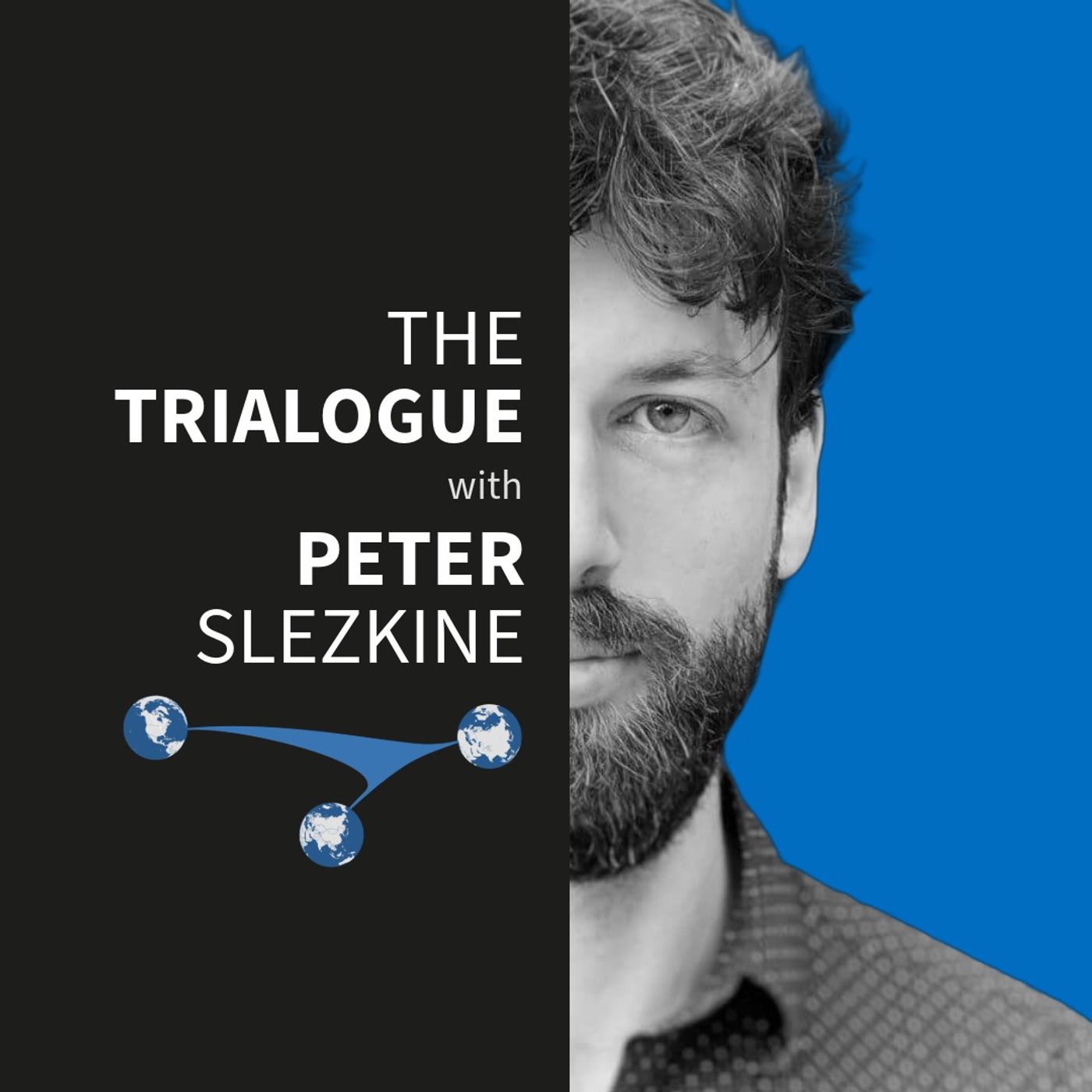
Mark Leonard, Co-Founder and Director of the European Council on Foreign Relations, joins Worldviews with Peter Slezkine to discuss Europe’s evolving identity, the current state of the transatlantic relationship, prospects for ending the war in Ukraine, and the future of Europe in a changing global order.
Listen and subscribe on Apple Podcasts or Spotify to stay updated with the latest episodes!
*The Trialogue Podcast is hosted by the Stimson Center and produced by University FM.
Timestamps
- 00:00 - 1:00: Introduction
- 1:00 – 2:45: Brief biography
- 2:45 - 8:10: The creation of ECFR
- 8:10 - 11:15: How is the European project defined?
- 11:15 - 13:20: How did Brexit change Europe? / What is the role of Russia in Europe?
- 13:20 - 15:55: What is the nature of the transatlantic relationship?
- 15:55 – 25:55: Did European integration turn out as hoped?
- 25:55 - 28:35: Europe’s strategic errors
- 28:35 - 35:15: Is there a “European identity?”
- 35:15 – 41:10: How US foreign policy galvanizes Europe
- 41:10- 46:05: From a project of peace to a project of war
- 46:05 – 48:00: How does Europe want to end the war in Ukraine?
- 48:00 - 50:00: Can European unity survive peace in Ukraine?
- 50:00 - 54:00: How does nationalist populism threaten European unity?
- 54:00 - 57:30: Will the US resist an increasingly autonomous Europe?
- 57:30 - 1:01:30: What is the fundamental unit of international politics?
- 1:01:30 - 1:01:49: Outro
Hosted by Simplecast, an AdsWizz company. See pcm.adswizz.com for information about our collection and use of personal data for advertising.
Get every episode summarized
Each time The Trialogue publishes, we email you a written briefing from the transcript — the topics, who appeared, and any specific claims, with the ad reads skipped.
Email me new episodesFree for 3 shows. No card needed.
Hosts & guests
Transcript ready
650 searchable segments. Every word is indexed and playable.
Full transcript
The Trialogue — Mark Leonard: Europe in an Age of "Un-Order". Machine-transcribed; use the interactive transcript above to jump the player to any line.
Welcome to World Views, an interview series on international affairs with guests from around the globe. I'm your host, Peter Sleskeen. In this show, guests from across the political spectrum and from all over the world share their views in their own voice. While the Stimson Center seeks to provide access to a wide variety of perspectives, it does not endorse any particular position. We leave it to the listeners to judge the validity and value of the views expressed by the guests. I hope you enjoy the podcast. My guest today is Mark Leonard, co-founder and director of the European Council on Foreign Relations. In the interview that follows, we discuss Europe's trajectory over the past two decades, the ever complicated question of European identity, the state of transatlantic relations, and much more. Everyone should also make sure to grab a copy of Mark's new book, Surviving Chaos, Geopolitics When the Rules Fail. I hope you enjoy the episode.
Mark welcome to the podcast. Great to be here. So let's begin with your bare bones bio. You're half English, half German and went to school in Brussels. Did I get that right? That's all correct so far. So pretty much perfect pre-Brexit European. Well, hopefully not a bad post-Brexit European as well. Well, I'll define what Europe is in a moment. But did you grow up speaking German? Did you acquire any French or Flemish in your time in Belgium? Yeah, so my mum is German and her mother used to live with us at home for the first 10 years of my life. So they would speak a lot of German in the background. But my mother has a very complicated identity because she was a German Jew who was born in hiding in France. So she spoke French as her first language and then she spoke German when she went to school there when they went back to Germany and then she married my dad when she was 18 and speaks perfect English.
But as a result, she wanted us to have a kind of clearer, more grounded identity. So we only spoke English at home, but I learned French because we moved to Brussels when I was six years older and that was the kind of language of the playground. And then I always had German in the background at home and started learning German properly when I was 12. So my German is not as good as my French, but they're all kind of family languages. So English, French, German are the three dominant languages in the other European or non-European languages? Nothing, no living languages unfortunately. Which of the dead ones, Greek, Latin? I would be angry at the Latin. We started the Latin at school. Well, so let's talk about the European Council on Foreign Relations, which you direct and which you founded in 2007. How did that come to pass? What was the organization intended to do? What happened was I have spent a lot of my career working around politics, think tanks,
journalism. My first job was working in the British Parliament when the monstrous treaty was going through doing a lot of work on the kind of development of the European Union. And then after university, I went to work very briefly at the economist and the think tank running the European program called demos, but I also did a project on rebranding Britain which started a big debate about cool Britannia in the UK. And through that I ended up running another think tank anyway. I did various things like that. I brought a lot of the thinking I developed together into a book which was published in 2005 called Why Europe Will Run the 21st Century, which was a response to a big debate. Now it looks like a quaint sort of marital tiff between the US and Europe, which came around the Iraq war. But a friend of mine, Bob Kagan wrote an essay called Paradise and Power, which was basically arguing that Americans came from Mars and Europeans came from Venus.
Well, it was a sort of widespread mood that Europeans would slightly weak and pathetic creatures. And I decided to write a book celebrating the creation of the European Union in a way that it had given me and my generation totally different life chances and possibilities from my parents generation whose lives have been very, very much shaped by war and genocide and other kinds of European tragedies. But that book was a bit of a quarter arms at a time when Europeans felt that they had a different idea for how the world should be organized to that which was being championed by the Neocons in Washington and by other kind of great powers. And lots of people were sort of asking me what I was going to do about this sort of vision. Through that sort of process, I got to meet and engage with a lot of other people around Europe. But also together with my friend, Maple Van Aurenya, who was then working as advocacy director
of the Open Society Foundation, got into a series of discussions which led to the creation of the European Council on Foreign Relations. The idea behind that was to see Europe as a sort of prototype for a global open society. And to help Europeans punch their way in the world. And our kind of assessment was that Europeans had a lot of resources, big economy, lots of diplomats, a lot of military spending. But that they were underperforming on the world stage partly because European Union was a collection of kind of small and medium-sized countries that didn't have very much of a strategic culture and to the extent that they had one. It was very national which meant that they kind of looked at the world from a position of kind of weak decision takers rather than countries that could shape decisions. So the idea was to create a different kind of think tank, but could play a similar role to a role that the Council on Foreign Relations played in moving the US from being a sort of introverted
giant to a country that was engaged with the world. So we created this institution with three pillars, one which was a think tank and it started out quite small, but there now about 150 people who work for that, which was meant to be full of policy entrepreneurs, people who want to really shape the future, but also people who can think big ideas and reframe debates and come up with fresh ways of understanding and imagining what was possible for Europe. And then to couple that with a council of leaders from around Europe, so we started with 50 founding members, but there now over 300 and a lot of them have either been presidents, prime ministers, foreign ministers or serving in those functions at the moment, or they're people who are public intellectuals, people who are thinking about what you can do in the world or activists. And then the third pillar was to have, rather than having an office in Brussels, that we would establish offices in the biggest capitals around Europe. So Berlin, Paris,
London, Rome, Madrid, Warsaw, and we also have an office in Sofia. And now it's almost 20 years on we even got a little mini office in Washington, DC, but that's more for us to be able to understand the kind of big changes taking place in the US rather than an attempt to influence Washington from the inside. So I should make sure that Jeremy knows the influence is not part of his mandate. He is allowed only to observe and analyze. He's there to observe and analyze and try and influence Europeans to get their act together and to make sure that they respond to the real US rather than the one in their fantasies, which I think has been one of the problems for European approaches to America that there is a sort of full sense of familiarity and a transatlantic community that's done a lot to help Europeans get America wrong at critical points in its history. Well, that is an invaluable intervention. So when the European Council on Foreign Relations was
founded, did you seek to define Europe strictly and has that definition changed over time? Or has there always been more or less fluid? So in my book, I kind of have a very normative idea of what the European project is about, which is a different way of thinking about how domestic societies and foreign policy could be organized. But it was very flexible. In fact, there is a chapter about the kind of fuzzy borders of Europe. And that was very much part of the ethos when ECFR was founded. We had this will be expansive idea about the reach of Europe. So at that time, there were big debates about Turkey joining the European Union and everybody was in favor of allowing Turkey to apply and have kind of pushing that process forward. There was also debates about the European future in Ukraine and in other countries that had just been through colored revolutions at that time and how Europeans needed to sort of engage it. It was a different world where people thought the borders didn't matter that much. They were being
eroded rather than being the kind of crucial focal points both for politics and for geopolitics that they are at our time. So we didn't spend a lot of time trying to think about what the geographic borders of Europe were. We saw it more as a sort of community of fate and a political community and maybe with slightly fuzzy edges. But it's still basically the central element was the European Union, which was expanding, which had candidate states, which might become members in the future, but that presumably was the foundation in the central focus. So the policy that we were trying to influence was basically the European Union. But from the beginning, we don't have an office in Brussels and we have an office in lots of different countries. So we had quite a fluid idea of Europe, which at that time some of the big foreign policy successes of the EU weren't driven by the EU25 as it was back in 2007 when we started. But by the three Britain, France and Germany and
you had other little mini-lateral groupings taking forward different things in different areas. And we saw that as Europe as much as the EU27 and the Brussels community. So it was quite a sort of pragmatic idea of Europe. But the European Union was this all important focal point of it. And it remains that today. But we do a lot of work in the UK and other countries that are not in the EU in Norway with the Norwegian. So we're not a Brussels-based think that we're not an EU institution. But we do see the European Union as an important community of fate. And also the EU has created a lot of instruments, which are increasingly important for geopolitics, as a result of its big market and the regulations that it's introduced and its ability to negotiate as a peer with other powers on trade or technology and in other areas as well. What I didn't mean that you would focus on a European Union exclusively as an institution at the expense of member states. But the member states who make up the European Union are the core
or perhaps the extent of what you had in mind when you invoked Europe. And then there are those on the periphery or beyond the periphery who were perhaps in the anti-chamber in might one day join the major club. But then the picture seems to shift when the expansion ceases in some cases is replaced by contraction. So how did Brexit change the equation? Yeah, look, then various things were changed the equation, right? So we launched in November 2007 and actually our first report is about Russia. It's called a power audit of EU-Russia relations. So we are paying Russia on the outside of our, it was an object rather than the subject, right? From the beginning, but we did spend a lot of time thinking about how you could actually have a expansive enough idea of Europe to incorporate Russia, Turkey, other powers that were necessarily going to join the European Union. But we're part of the security space that we're all kind of
inhabiting. And anyway, less than a year after we launched, there's the war in Georgia. And so, you know, these sorts of issues kind of get raised quite quickly. So actually, after about three years of operations, I wrote together with Ivan Krustev and a couple of other colleagues, a report called The Spectre of a Multi-Polar Europe, which was trying to reanalyze the European space and say, right, it's not just about the European Union, but you have three kind of integration projects. Russia won a Turkish one and then an EU centric one. And that what we should be thinking about is how you can have a coexistence of these different projects. And the right kind of competition between them as well, because we were worried that it would end up becoming militarized. And we thought it would be much better if you could have different types of competition, which were less militarized. And that was quite a controversial thing to write and to publish within our community at that time, because it was there was a much less unitary idea of what Europe should look like. It was a more plural idea of Europe. What about the United States? So, Russia, clearly outside of
whatever boundaries a fluid Europe might have, you mentioned that the Genesis, the book was in part a reaction to Bob Kagan's distinction between a US that was Mars and Europe, those Venus, but they're not only sort of separate and contrasting entities, but also part of a single structure to a large extent that this Europe emerged within a larger American order or underneath the umbrella of American hegemony. So, did you see Europe as separate from the United States and the US was an external power that served to bring in to relief what was peculiarly European or was Europe in some sense nestled within this larger transatlantic entity? I mean, it's an empirical fact that the EU was built under an American security blanket and that the US was one of the champions of European integration, but at the same time already back when we launched a lot of what we were talking about was the kind of emancipation of European thinking within the West, right? So,
also in 2010, I think we published a report which Jeremy Shapiro who's now in our Washington office co-wrote with another colleague Nick Whitney called towards a post-American Europe. So, we were thinking about how to take Europe from a position where it was infantilizing itself and almost kind of vassalizing itself towards being able to take more responsibility for its interests and it wasn't necessarily an anti-American thing. It was just based on our view that Europeans and Americans have some stuff in common, but they also have different interests that it's not really like a viable strategy to expect 300 million Americans to be bankrolling the security of 500 million Europeans indefinitely and that Europeans would be better able to take care of their interests and to be a good partner to America if they built up the capacity to think independently and to defend themselves. So, with that, something that we've been pushing for consistently,
it's definitely true that you mentioned Brexit. So, 2016 was a kind of big shock to ECFR and took us from what we thought of as kind of ECFR 1.0 to what we started talking about as ECFR 2.0 and that was a mix of Brexit and Trump, which I think did bring the European project into a very different space. But the root of our approach to the US, I think, were there from the beginning. You mentioned already your book from 2005 why Europe will run the 21st century. The sailing hasn't been particularly smooth since then for Europe or I suppose any other region and you have discussed and described this turbulence in subsequent books, your age of unpeace, how connectivity causes conflict published in 2021 and surviving chaos geopolitics when the rules failed published just months ago. So, perhaps we could look at that two-decade trajectory with a particular focus on Europe. And I wonder what you think you got right in 2005,
the arguments you made then that have held up, what did you get wrong and what have you had to fundamentally reinterpret and where might you have been right if only a couple breaks have gone differently. Right, essentially the book, as I say, grew out of a particular moment in Western geopolitical history, which was the conflict over Iraq and Bob Kagan had written this essay, which I remember reading a review of it, which was trying to say empirically he's wrong, there's some like Martian Europeans and some Americans are kind of nice people and therefore it's not right. And I thought this is kind of very trivial way of trying to respond to it, that actually more interesting thing would be to take his argument seriously, but to kind of make the case for like for Venus and to explain why what Europe was doing was actually quite miraculous and amazing and worth celebrating in its own right. It was a kind of love letter I suppose to, a project as I said before, as made my life unimaginably different from that of my parents and their parents,
my father was British, he was evacuated when he was eight years old, didn't see his parents for several years during the Second World War, his father fought in the First World War and his entire regiment had been killed, he was the only surviving member of this because he got gasped at the right time and was in hospital when they were all kind of wiped out. And on my mother's side of the family was far more tragic than that. She was born in Heiping, but a lot of people ended up in camps and there are family members spread out all over the world, that kind of level of dislocation and that existential threat is something which just lives with a family in kind of shapes your whole experience and your identity. So the fact that I grew up into a peaceful Europe where the borders were disappearing between France and that people were thinking about doing geopolitics in a totally different way where instead of building up armies and thinking about a balance of power between countries, they were pulling their sovereignty into fearing in each other's internal affairs, trying to resolve conflicts through the courts and through politics rather than on the battlefield
and that the map of Europe had been kind of changed in a totally extraordinary way with waves of countries coming out of dictatorship and having an ability both to anchor their political trajectory but also to catch up economically with the kind of wealthiest countries of Europe. That felt miraculous to me, but with something that was misunderstood both by people outside Europe and then also a lot of people within Europe because a lot of people in Europe saw the goal as building a kind of united states of Europe and just trying to but basically turn it into a federal state whereas I thought this was something much more exciting. It was very novel form of political organization which was much more a network than a state in the making. So I found this lovely quote from Boulvelierie about how we we hope vaguely we dread precisely that basically the energy of the EU was essentially escaping from a kind of horrific past but it wasn't a blueprint, there was
no clear sense of where people going it was a process of trial and error of creating the facto solidarity. It was a very improvisational project, very flexible and I found that really really inspiring. And your faith hasn't been shaken by the economic crisis in the internal contradictions that became clear as a result and Brexit in the remarmament drive now which seems to be pushing in a direction of greater centralized power as opposed to this pure network form of organization. I mean do you believe that what you were describing then still applies to the form that exists today? Actually yes, like in the essence of it absolutely and by necessity because they're more you enlarge the EU and the messer it becomes. It would be incredibly brittle if you tried to create a kind of centralized structure with a president and a constitution and stuff like that. Actually interestingly a few months after my book came out
there was an attempt to pass a European constitution which was rejected in a referendum and people saw that as a kind of disaster. But actually I I think in a way reinforces my central idea about what's special and wonderful about the EU. Anyway I think that we discovered a huge number of kind of blind spots of liberalism and particularly neoliberalism which were entrenched in the EU and almost constitution-ized through some of the attempts at building Europe. So the way that the euro was built where you took a lot of important decisions about macroeconomic policy out of the political sphere and constitution-ized them. I'm very very critical of that and I think that was a big mistake and there are lots of policy mistakes which were made. But actually on a lot of these issues the trajectory I think has been a positive one because people have been moving towards greater flexibility. They've learned the lessons from the catastrophe of the euro crisis where a lot of the lessons. And then there are other big problems which came out during Brexit which is for
example free movement is something which is both enormously empowering for a lot of people who can go and work in different countries and have opportunities which are unimaginable for their forefathers and mothers. But at the same time you create a lot of stress on societies you have large movements of population and the elites in the UK for example would been totally blind to what some of the downsides of that might be. And you know there's one of the big reasons there was so much opposition to British membership and why there was a majority against it. So I think there are kind of important lessons like that that have been learned. But by and large. Although not by the British because ironically immigration increased after Brexit didn't it. Well we can go into more details on that but as we talk about how my thinking's developed I've become much more open-eyed about the dark side of interdependence and connectivity and how a lot of the things that I think have a very positive side in terms of creating wealth and opportunity and giving your access to things that you were in other ways. Do if you do it in the
wrong kind of way can also damage large percentage of the population who make you vulnerable to interference or blackmail from other countries etc. So I have become more kind of new-assed in my attitudes towards interdependence but I still feel quite good about that first half of the book and I think that those lessons are part of the sort of trial and error thing. And I think that's one of the challenges for politics is just to do better on these things rather than thinking that you're better off by blowing up the whole system. Where I think I was not in the right place when I wrote that book was that I had this very polemical title about why you're all run the 21st century right. And the idea there was this sort of attempt to universalize what I think was an amazing regional experiment which grew out of very particular political circumstances and economic circumstances and was quite contingent. As I said it was a very experimental thing. It wasn't
built according to a blueprint could have ended up in other ways. Some things worked well. Other things had to be abandoned like the European Defence community. So it's a very contingent thing that got created. But I wrote the book as if this was going to become universalized and I had like four ways that it was going to be universalized which is the sort of second half of the book. And one way was through enlargement is definitely true. The EU grew from 6 to 12 to 15 to 25 to 27 to 28 and then that to 27 again. And that process I'm skeptical was going to go very much further. At the time I wrote the book there's a chapter called Europe at 50 question mark. You know there was a kind of expansive idea that enlargement could continue and that you could take in a lot of the periphery. The second way I talked about Europe changing the world and expanding was through what I called the euro sphere which is another bunch of countries around the European Union that may not be in it but that we're somehow kind of linked to it through the neighborhood policy
and other things like that. And I saw European values and more as and ways of working spreading osmotically to these group of countries in the euro sphere. And I was very influenced by the color revolutions and the fact that lots of people in Georgia and Ukraine were kind of going around waving European flags and had kind of European aspirations. And the EU was also trying to develop a set of approaches to these countries in its periphery. We've spoken a lot in the past and I'm sure will in the future about Europe's relationship with these countries that many of whose citizens would love to join the European Union but they have a different set of relationships to Russia and to other players from many city of the West in European countries. I think that maybe the complexity of those sorts of relationships were not properly understood by a lot of people including me back in 2005. And then the third kind of way I saw it expanding. Then coming to Munich and basically stating it explicitly was not enough to clarify the stakes.
Well I think that there are a huge number of errors that Europeans have made in managing their relationship with Georgia, with Ukraine and with other countries and with Putin and with Russia right you can feel libraries with the strategic and tactical errors that have been made. But I also do think that if Ukraine wants to set a different path for itself. I don't think that it's just up to Putin to decide whether that's a legitimate or an illegitimate thing. I think there are lots to be discussed in the world. Of course because you can say that you believe an outcome to be desirable or that populations should make their own choices but these choices have consequences. Sometimes conflict is one of them and that of course does not seem to have been anticipated at this early stage that you were just describing. So this is exactly right. Well it's sort of was slightly anticipated. For example on Georgia in 2007 I was writing things with other colleagues saying that stuff could go wrong and that Europeans needed to understand that
and take responsibility for what was going on and trying to kind of deter those sorts of things. And on Ukraine together with Ivan Krasdev. Well how did that stage what instruments of deterrence did you possess? In Georgia, putting troops on the ground. I mean that we could literally do that in 2007. We sent border missions to mold over. There was a level of European expansionism. But the difficulty which you had on these things is that Europeans were in denial that their actions were geopolitical and would be seen as geopolitical. They were treated as if countries should be able to make their democratic choices and from any you perspective we were kind of neutral observers and it was kind of technocratic questions. And I think that's the the kind of biggest sin is a kind of lack of imagination about how other people are going to be looking at even if that's true and not just hypocrisy and a lie.
It's very naive to think that's how it's going to be perceived by other players and that was definitely criminal the way that Europeans didn't really understand how their actions would be seen. And if you are behaving in a way which is obviously geopolitical and political, then you've got to be willing to put the resources in to back it up and to think about what the consequences might be. And I think that was something that Europeans would absolutely not willing to do. And before we get to the actual sort of practical policies or white instruments, Europeans might be able to apply. I think it's interesting to come back perhaps to the question of European identity or the definition of Europe because at that earlier moment when Europe felt that it was perhaps a universal model, it was expanding, it was a neutral observer. Then the question of identity is not so acute. You don't have to really wonder who you are if the borders are fuzzy and always expanding and potentially the whole globe will be reorganized according to the European model. But once Europe recognizes itself as a geopolitical actor,
one-sips borders become clear and in some cases militarized, then there's a much more important distinction between inside and outside. And the question of who belongs to the community of fate that you invoked earlier is much more central. So how is that community created? Is it just an accident that a certain number of countries ended up in the year at a certain point and others are outside of it? And that's the community. Is it a particular cultural or historical heritage? How do you define Europe once it becomes a geopolitical actor that must understand itself as a distinct entity operating in a big and complicated world? That is basically where we're at at the moment. I don't think it's set either. It's an evolving thing. I think there's a lot of contingency. If you go back to the 1980s and you talked about who in Eastern Europe could end up being in the European Union, I think most people would think Yugoslavia was more likely to be in the European Union than Bulgaria, for example, or Romania. So I think there's
a lot of contingency about it. I don't think there's something inherently more European about Bulgarians than there is about people who used to live in Yugoslavia. And there's quite contingent of some bits of former Yugoslavia in and other bits are out. I don't think there's a kind of iron law, which means that some of these countries should be on one side and not on the other. And it's definitely true that people's mental maps have massively evolved. So if you go back to 2021, I think most European leaders would have put Ukraine in a kind of buffer zone between the EU and Russia and saw it as a divided country where some people had sympathies towards the West, maybe majority of people and other people look much more towards Russia and to the Soviet heritage of Ukraine. And obviously the war is totally changed. Ukraine's self-perception, but also the perception of of EU leaders and quite a lot of EU citizens. It doesn't necessarily mean that Ukraine will be in
the European Union, eventually it might do, but certainly that's not a kind of short-term prospect. But I think it has changed people's ideas. I think the war, the full-scale invasion has fundamentally changed the idea in many countries of who's in the community of fate and the security community. And I think Ukraine is now much more part of the same security community as the EU rather than the kind of buffer zone between Russia and the European Union. So I think these things do change. They have something to do with external actors. So the full-scale invasion was quite an important motivator, but also the way that the Ukrainians reacted and what they want to do is quite important. And then obviously countries that are near Ukraine have got important and absolutely critical views. Interestingly, most of Ukraine's neighbours very much want Ukraine to be in the same security community as them, but very few of them want them to be in the European
Union itself for economic and other kinds of reasons. So at least in the next few years. But I think those questions about who's in and who's out have now become absolutely essential and much more central to the European project than they were before. And it's partly to do with the war in Ukraine, but I think the importance of borders also came out of the Arab uprising and the refugee crisis in 2015, which created my bigger debates about the importance of borders and managing borders. But it's also I think partly a productive enlargement of the European Union as well. A lot of countries from central and eastern Europe have got a very different set of attitudes towards diversity and ethnicity and race and maybe more weirdly in their reaction to the kind of utopian socialist past that they have. They're going back to a more 19th century, early 20th century idea of what citizenship means, which is maybe a bit more with
an ethno nationalist as a result of that. So I think these are things which are all being contested and a lot of European politics now is about trying to define these things like who are we? What are we? What is the meaning of borders? Who should be on the inside? Who should be on the outside? How much of your penis is a kind of civic or political project and how much of it is about blood and soil? And these are contentious issues in many European countries at the moment. Yeah, well the question of identity is central to domestic politics in all the major European countries. I mean every European country across the board I suppose. But could you just describe your own mental map at the moment? You don't have to define Europe on one dimension alone, geographically let's say, but it could be sort of as a security arrangement, as a community of fate, as an economic union, as a political project. What kinds of Europe exist as far as you were concerned and as far as your position as director of a European council for relations requires
you to have some sense of your jurisdiction. So even though questions of borders have become much more central to the EU and European policy than they were beforehand, we still have a, I think as you were suggesting, an idea of kind of multiple Europe's, right, which makes sense in particular situations and to deal with particular issues. It's true that there are a sort of core of countries that are involved in many of these Europe's, Germany where I'm sitting at the moment. It's in like most of them and other people come and go depending on what it is you're talking about. And the years also building more kind of flexible relationships with other powers. So like, you know, on some issues, it's working very closely with Canada and with Japan and with Korea, countries that share particular ideas about how the global economy should be organized, about how it will be. Really quickly on that point, because this is sort of Karni's middle power speech. But my sense is that that grouping only makes sense because of the American alliance
system, which has brought them together. And it seems to me that those connections fall apart if the United States is taken out of the equation. Well, I think that it's definitely true that the connections come out of that thing. And I think they're quite thin, right? I don't think that the middle powers is a meaningful community that can build anything in the way that they can. The Germany, and Korea and Canada are only held together by the fact that they are part of America's alliance system. And if that falls apart, the other solidities, which some might invoke, seem very flimsy. I agree. I don't think they're very thick identities. I think that's one of the big differences between the European Union and other kinds of plurilateral, multilateral arrangements is there's a thick set of common interests, values, norms, and you know, there are also a lot of divisions and competition between it. But it's a much thicker and more meaningful community than the like the G6 is, for example, the G7 minus the US. But the G6 does
have a Pepsi. If you've got a kind of rogue America that's going around bullying its allies and putting tariffs on everyone, there's quite a lot of hedging you can do together. And I think those sort of hedging communities are increasingly being used. And there are big dilemmas. I use this term about the EU went from being a peace project for the first few decades of its existence to becoming a war project after the full scale invasion of Ukraine. And I don't mean that it's a war project across the board. But what I mean is that the main driver of integration was about responding to the threat from Russia and then that sort of got expanded with Trump's second coming and the China shock. There is a sense. Trump's second coming will really appeal to his own sense of mis-economic purpose. He'll like that phrase. But basically, I think there is a kind of sense that the EU is now much more of a security community that does create an existential question for countries
like Ukraine and the UK, for example. Like are they in or out of this security community? And I think this is against any which is still being kind of litigated. So Ukraine is trying to get into everything and it may or may not succeed in getting into everything. I mean in Poland, they complain actually that Ukraine's got more than most candidate countries have got and the goal should be to kick Ukraine out of this single market a bit more and to create a little bit more space rather than necessarily integrating them more across the board. The UK is going for a bit of a psychodromer at the moment. My own kind of hunch is that the question of British membership of the EU will come up probably even before the next general election in the UK and that you could very well see major parties promising to join the EU in the next election. I want to have a referendum but I think that as Europe becomes more integrated in these different areas whether it's around supply chains around energy around sanctions around anti-coefficient instruments, questions through
a technology and other things like that. It's going to become a much sharper dilemma for countries that are not in it that which are in Europe. Given the kind of unwinding of the traditional American and alliance system, countries that thought that they could somehow hedge between Europe and America will find out much harder. Joyce and from a UK perspective you can obviously have much more influence over the direction of the European Union than you can over American foreign policy no matter how much people like your accents and invite you to their cocktail parties and other things. That access doesn't often translate into influence on biggest use which are in the national interest. I think the security community is going to be kind of rewritten. I think Ukraine is going to be very much part of that. I think the UK is going to be part of that. On the economy, Europe is going from a liberalising force towards one which is much more about economic security and how you deal with this much more fragmented global economy and weaponised
global economy. Then there's questions through it like Europe in terms of borders and migration how you can externalise your borders and build refugee centres and things like that. There are going to be questions to do with technology. A lot of what it is to be sovereign now is about which platforms are allowed to operate in your countries, what happens to data. But I suspect the core will be probably the European Union and your hub and spokes approach to other players outside. I think there will still be, even if Ukraine is on the inside in a lot of these different communities, you are going to have buffer states between the different projects. I hope that part of this process is also going to be eventually a rethinking of the European Union's relationship with Russia and with Turkey which has been tragically neglected and where you've had a real thinning out of the political and other
channels of communication which I think is really irresponsible and dangerous actually for the long term security of the continent, the quality of contact, whether it's in political terms, in military terms or in other terms, it's just not good enough to guard against accidents, escalations, unnecessary instability in our neighbourhood. I think the case for having much dickadilog is much stronger when there's a war going on than it is in times of peace. But unfortunately diplomatic direction of travel has been the opposite to that. That's interesting because you were saying that Europe has transformed in some sense from a project of peace to a project of war that it has understood itself now as a geopolitical actor. And if that were the case, then one would imagine European elites engaging in more traditional forms of diplomacy with adversaries, large neighbours and so forth along their extensive periphery.
But as you say, that's not occurring because despite the rearmament drive, there seems to still be a basic assumption that principles prevailed because they must and that the liberal order will survive whether Russia attacks it or the United States leaves it again because it is valuable enough to deserve to exist. So is that too much of a caricature? And also, what are the dangers in Europe becoming a project of war? Everybody seems to take for granted that we are not necessarily. Do you think that it could harm the European project of taking too far and do you think that it will have to ultimately take place within the transatlantic structures that were built for this purpose? My sense is that Europe is going through an identity crisis as much as a security crisis at the moment. And what you described, I think, was very true if you're a couple of years ago. But I think there has been an evolution.
And I agree with some of your critique of the middle powers idea, but I think where Kani obviously had a point was that we're talking about a rupture of the transition in international relations. And I think that is something that Europeans have been very slow to wake up to and to accept, because they had so much of stake in the old order. And it's therefore very painful. There's a lot of grief management that's gone on, rather than necessarily preparing for a world without that order. I think that Europeans have done quite a lot internally in some areas. I think the moves towards rearming and a much more developed than some of the other elements, like the diplomatic strategies which you were talking about, it's very much work in progress. But I do think that the direction of travel is clear, which is towards a Europe that is going to need to get to a situation where it can defend itself without America, at least in conventional terms. I think even on the
nuclear front, you're going to see more and more attempts to develop ways of working amongst Europeans to hedge against American withdrawal. So I think those are debates which are going to develop. So we're spending quite a lot of our time and energy helping Europeans think more geopolitically about these different things. I do think that there's been a big failure of allowing the breakdown of direct talks with Russia to take place. The idea that's the Wicoff and Jared Kushner and or JD Vance are going to go and bat for European interests in discussions with the Russians is I'd say a heroic one. And nobody else is going to stand up for European interests if Europeans don't do it themselves. You need to have channels of communication. But is it part of the problem? Just a fundamental difficulty of deciding what the European interest actually is in this case in positive terms, in who might be positioned to represent it.
So obviously it's not Kushner Wicoff or Vance, but we've already heard names floated around. And beyond the name, you need a position. And it seems like it would be extremely complicated for the Europeans to come together and decide what single message they might want to convey to Russian counterparts. Europeans have got totally different histories, geographies, and economic relations with Russia. And that's been the case forever. That's why I'll first report. Ever was this parallel day of the Russia relations where we said that Russia had divided the EU more than anyone since Donald Trump's felt split into new and old Europe. That's what we wrote in 2007. And interestingly, what's happened since then since 2007, has she's been quite a lot of convergence amongst Europeans. So I think they're less divided now than they were back in 2007. Very few people would have predicted that 20 packages of sanctions would get agreed and that you'd have Europeans standing behind these different policies.
But at the same time, it's been a very reactive agenda. And I do think there's a failure of imagination to think about what kind of endgame I think everybody knows that this war can't go on forever and ever. Everybody knows that it's quite unlikely that Ukraine recovers all of its sovereign territory. And everyone knows that it's unlikely that Europeans or anyone else is going to recognize Russia's annexation of bits of Ukrainian territory. So you're going to have to have some sort of settlement from a European Union perspective where you have a Ukraine that feels reasonably secure in its borders and doesn't think that this is just the prelude to a series of forever wars which keep coming back in the future as defensible borders is able to arm itself and defend itself properly is kind of integrated into the European security community in different ways. But where it doesn't control all of its dejure territory. And then you're going to need to have
ways of engaging with the Russians and reassuring them about certain things like probably that Ukraine won't be in NATO and various other things. I think that people know about a lot of the things which are going to have to be part of a deal. But it's interesting that the divisions that you're talking about have stopped European countries from playing an active role in resolving something which is much more central to their security than it is to America's security or anyone's security apart from Russia's and Ukraine's. But it is an existential issue for at least the third of EU member states to get this right and to make sure that it's done in a way that is sustainable. So that shows I think how immature Europe is as a geopolitical community that thinking about these kind of difficult compromises that you're going to need to make is harder than carrying on funding a very destructive war which is both gotten in always human cost but also very large economic and other costs for everyone involved. Do you feel a certain amount of anxiety
about the so-called day after that European consolidation at the moment is largely or exclusively the product of these wartime conditions? And in a post-war scenario many of the contradictions will resurface that many complicated questions will have to be answered and that leaders are a little worried about this common purpose losing force once some kind of difficult and ugly compromises reached. I think that a lot of the driving force of European integration is about dealing with kind of dangerous and complicated world out there and I think Russia is part of it but I don't think it's the whole of it right so I think that China will still exist. The US will still be a complicated partner for Europeans so I think there's plenty to keep Europeans together. I think what I was more worried about is yeah this complicated situation where the sort of stuff that I was
praising when you asked me what I liked about my book initially this idea of a cosmopolitan European project that was moving away from ethno-nationalism and coming up with different ways of working together. A lot of those things are in contradiction with what Europeans have had to do in order to enter a kind of wartime phase and I think it's a kind of necessary thing and actually all policies have to balance these different things and my kind of solution to the contradictions in my first book was basically moving from a universalist idea of Europe to a more of a kind of particularist idea of a European exceptionalism right that you build this sort of Kantian fortress in a Homsium world and that you make up this bigger distinction as you were saying between what happens within the EU and what happens outside the EU and I think what happens within the EU is much more fragile than I thought back in 2005 as well so I think there is a kind of big fight to make sure that many Le Pen doesn't win in France and the IFD don't come to
power in Germany that Nigel Farage doesn't become the next British Prime Minister. Can you just spell out why that would be a problem for the European project? I mean because the era of the Eurosceptics the sort of very aggressive Eurosceptics is over Malone one in Italy and became a big time European and Atlantisist one could imagine Le Pen undergoing the same transformation and how does your vision of Europe as a whole determine your priorities when it comes to the particular politics of the member countries. I'm speaking in a personal capacity right this is not the ECFR official position nobody speaks for ECFR anyway it's like a collection of people who've got their own views I'm just speaking for myself right but my kind of well view is that one of the big advances of what's happened in Europe in the last few generations is moving from a situation where people defined identity in quite exclusive ethnic blood and soil sort of terms towards a much more civic
idea of what identity is and that these are identities that people can join and that they can be part of national identities for example the work I did on Britishness was very much about trying to define a kind of post-ethnic version of Britishness which people could join and which was compatible with Britain being a kind of European country and having multiple identities so therefore having a kind of ethno nationalist party with some sort of white supremacist mission coming to power I think does run against what I hope would be the philosophy of the policy that I would like to leave you so even if Euro skepticism in the sense of like if Marine Le Pen doesn't want to leave I don't know what Marine Le Pen is going to do in power anyway but I think you're probably right that she really has moderated a lot of her positions in terms of leaving the euro and leaving the European Union and she probably won't necessarily do all of those sorts of things but I think that the kind of Europe that emerges if you have people who
have a kind of racial or ethnic idea or have identities is very different from the idea of having a more kind of set of civic identities which see a degree of hybridity and cultural cross-pollination as kind of positive rather than threatening things so that's why I worry about these sort of parties as much as whether or not they like Brussels it's more about how they define their identities there are other people in my social sphere and maybe even my colleagues also will worry about their attitudes towards Russia or China or things like that but for me I'm much more worried about the whether they define identity and then also a lot of these parties have got quite majority instincts and that is something which is kind of worrying as well for the fabric of the EU which has been a project that has tried to defend minorities and ensure a degree of pluralism and my worry is that if you don't have structures which safeguard a degree of pluralism then the whole
becomes much more fragile and is more likely to break up right but I don't think that's a short term threat it's not like they'll leave the euro but I think that they could end up weakening some of the moral and ethical and to philosophical foundations of the European project and I think these are legitimate political battles you know they're ones that one can win but it's not a given and what's happening in a lot of different countries in Europe at the moment is you're having these sorts of debate about who we are what our identity is which are being linked up with questions about distribution as well as these things always are yeah well the identity question is an interesting one we've dwelt down it quite a bit but it seems like it's no longer a question of tribalism versus universalism but different levels of identity and an exclusively racialist or nationalist identity would obviously preclude the construction of a very coherent European identity but that that second question still needs to be answered in its own right but two final questions
one you said that Europe should learn to defend itself absent America now all the discussion is about NATO three point oh but the burden shifting framework assumes that the burden is the same do you believe that at some point in the stage of Europe increasing its autonomy decreasing its dependence on the United States United States might think oh shit this is no longer about just shifting burdens but losing an asset or losing our ability to control outcomes now we are going to actively or in some other fashion oppose this trajectory in Europe well that's basically what American policy makers have done in a kind of soft and friendly way for like my entire lifetime is to try to stop that quest for autonomy in different ways and to increase the dependence of Europeans on the US and they've had willing subjects on the European side because most European countries didn't want to spend a vast amount of their GDP on defense so you know
it was the kind of Faustian bargain which you had after the Cold War but I think it's running out of juice because it's both more expensive to the US than it used to be there are many more demands on the American person they were beforehand America's relative power and weight and ability to do stuff in the world is sort of shrinking there are more more trade-offs when it comes to material to political attention and other things so and it's just not a particularly important space I think the role of Europe in the American strategic engineer is going to carry on shrinking over time and at the same time from a European perspective the state's quote really not working as well anymore it was kind of working all right when you didn't have like wars take you place in the continent and where countries didn't fear that they might be occupied but at the moment there's a lot of instability in Europe and there's even more fear about future instability and that is
leading countries to take on very expensive burdens and like Germany's a very powerful example of that as a country that was absolutely delighted not to have to spend 3% of its GDP on on defense for most of the last few decades and now it's doing this I fear that Europe is my overshoot a bit because I don't think Russia is a threat of the same scale as the Soviet Union but you know I think that there is a long way to go before they do kind of overshoot and I think that they need to focus much more on building up their capabilities than on passifying Donald Trump with arbitrary spending figures which they're meeting but yeah I mean it's definitely true that once you have capabilities you look at the world in a different way and it is not impossible that Europeans become less herbivorous and create a lot of chaos in their neighborhood they're also questions about what kind of a power Ukraine might be after a settlement. Final theoretical question what do you
believe to be the essential elements of international politics today the nation the state the individual empire civilization in which of these categories do you think is most useful when considering future of Europe. I think obviously individuals are always going to be kind of important and in some ways more important and empowered partly because a lot of them have enormous resources people like Elon Musk and Jeff Bezos and other people are able to do a lot of stuff with wider implications outside of their countries but I still think that the main unit of international relations is going to be the nation state. I think that empires is maybe quite useful in the sense that they have kind of messy and poorest borders and I think that we are going to see a lot more fragmentation and a much more complicated and plural world than the one that was around during the Cold War and in the post-Cold War era and if you have a modern idea of empire which can include things like
the European Union but also other kinds of gatherings which are maybe built some around regions maybe some around particular technologies I suspect the city state will be less important than we thought it was going to be in the 90s and the early years of this century and civilizations is very striking how much civilizational discourse there is and I think that reflects the fact that we're coming to the end of a kind of era where Western universalism held a lot of purchase on the world and we're seeing much greater fragmentation so people are looking for models which came before the West which is like why you're getting all this civilizational thinking. To my mind the civilizational thinking often mass the crises of the different civilizations rather than something which is particularly unified and I think all of the big civilizations are going for a kind of massive crisis in Islam they've been having a kind of crisis of religiosity in Russia
there's a kind of crisis of imperialism in China there is this big crisis around growth what happens when you no longer have this level of economic growth in America it's a kind of massive crisis of democracy and what it means to think of yourself as a kind of democratic country in the European Union there's a crisis of soft power which we've been kind of talking about earlier so I think it will definitely seem more civilizational discourse but I'm not sure whether these civilizations are going to be kind of unitary players I think when they have nations behind them as in the case of Iran or China or Russia or Turkey those states are going to be really important players and I think that they're increasingly going to want to set their own paths and channel their own ideas about what happens and they'll probably express themselves in civilizational terms but I don't know if that makes them a civilizational state or whether it just means that they're a big nation state
which is rejecting kind of Western intellectual and cultural and political and Germany I think that's definitely going to happen we're going to see a much more multi-polar plural world when it comes to the level of ideas norms cultures operating systems a lot more complexity yeah well just as Iran or Turkey sort of lay claim to civilizations that extend beyond their borders now the United States as an empire of sorts is laying claim to all of Western civilization so we will see if Europe manages to create an area of its own outside of a reimagined American hegemony but let's end on the note of all civilizations declining equally we didn't get to China and the EU which you know more than anyone about but it's good to have something to discuss next time around so thanks so much thank you very much thanks for listening to World of Use make sure to subscribe with the show so you don't miss out any episodes world of uses hosted by the Stimson Center and produced by University FM
More episodes
More from The Trialogue

Fyodor Voitolovsky: Russia's Vision for Ending the War in Ukraine
The Trialogue
Arvind Gupta: India's Rise as a Digital Power
The Trialogue
Arne Westad: Why Today Looks Like 1914
The Trialogue
Hossein Kanani Moghaddam: Iran’s Outlook
The Trialogue