About this episode
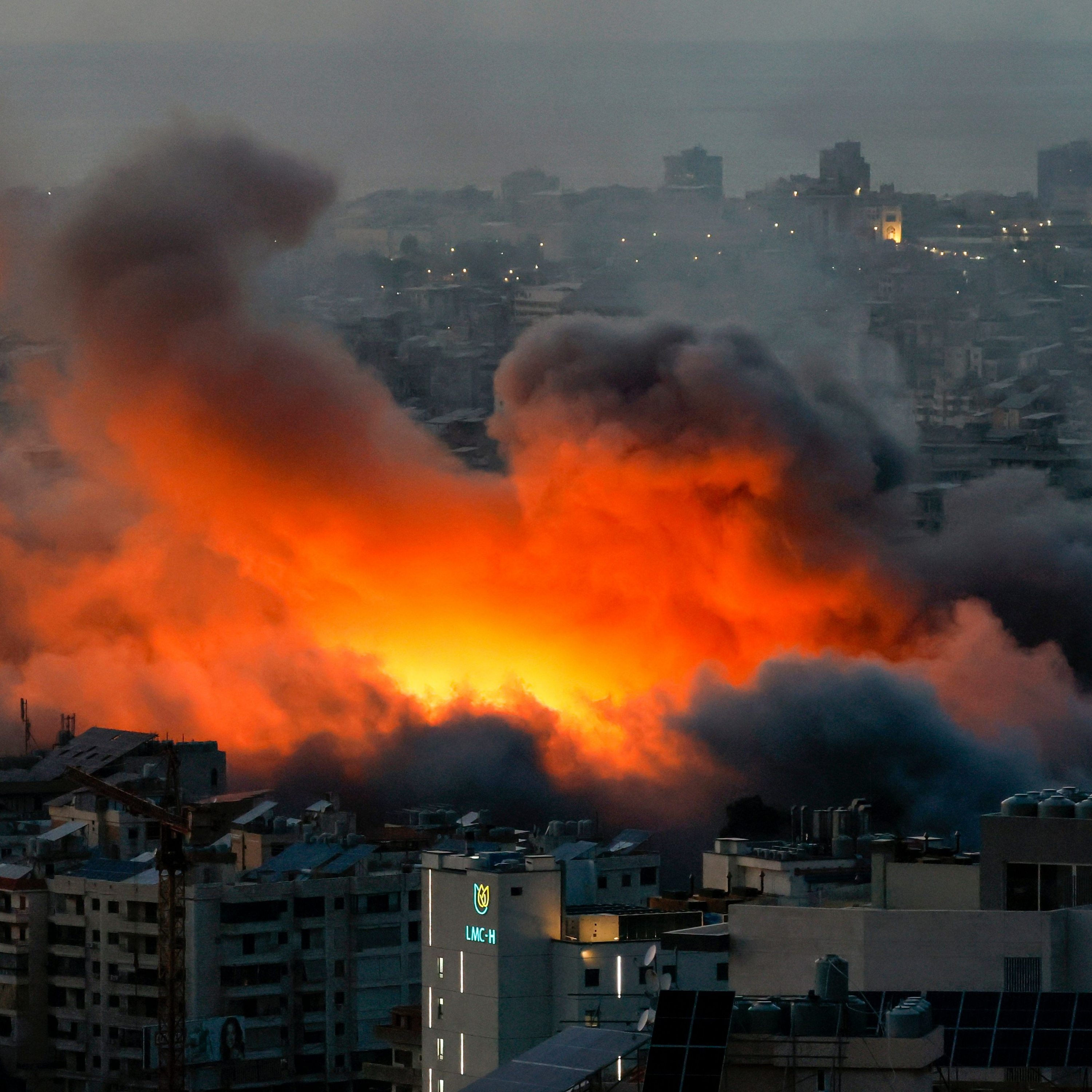
Israel bombards Beirut and Tehran and many people are being displaced. We hear from the restaurant owner keeping the ddors open for her customers despite the explosions.
Also, Ed Butler finds out why hundreds of trafficked workers were released from scam centres in Cambodia, only to end up wandering the streets of the capital without a way back home.
And we dig into the growing numbers of young Roblox millionaires.
Get every episode summarized
Each time World Business Report publishes, we email you a written briefing from the transcript — the topics, who appeared, and any specific claims, with the ad reads skipped.
Email me new episodesFree for 3 shows. No card needed.
Hosts & guests

Transcript ready
405 searchable segments. Every word is indexed and playable.
Full transcript
World Business Report — Middle East crisis: Israel bombing Beirut. Machine-transcribed; use the interactive transcript above to jump the player to any line.
This BBC podcast is supported by ads outside the UK. The best B2B marketing gets wasted on the wrong people, so when you want to reach the right professionals, use LinkedIn ads. LinkedIn has grown to a network of over one billion professionals, including 130 million decision makers, and that's where it stands apart from other ad buys. You can target your buyers by job title, industry, company, role, seniority, skills, company revenue, so you can stop wasting budget on the wrong audience. It's why LinkedIn ads generate the highest B2B return on ad spend of major ad networks. Spend $250 on your first campaign on LinkedIn ads and get $250 credit for the next one. Just go to LinkedIn.com slash broadcast. That's LinkedIn.com slash broadcast. Terms and conditions apply. Today's episode is sponsored by Smart Travel, a podcast from Nerd Wallet. You know that one friend who always finds the best travel deals, picks the right credit cards and somehow ends up in first class for the price of coach. Smart Travel is like that friend, but in podcast form.
Nerd Wallet's travel journalist sought out what's worth paying for, from lounge access to travel advisors to hotel loyalty programs. Make your travel dollars work harder. Follow Smart Travel on your favorite podcast app. Pitti, the people of Lebanon tonight, some 300,000 of them forced from their homes. They mean honey, we're sleeping here in the streets. Some are sleeping in their cars. We are homeless. Trapped between an Iranian-backed militia and perhaps an invading army. I want Lebanon to be for the Lebanese, and I don't want neither Hasbollah nor anyone else. We want to live in peace with everyone. This is World Business Report from the BBC World Service. I'm Ed Butler and today amidst the intensifying bond barbment, we're hearing from a restauranteur in Beirut, who's determined to stay open, come what may. We're also hearing from a former big oil chief executive.
And finding out how you make a million, playing roadblocks the computer game. Explosions like this one have been lighting up the night sky over Beirut, southern suburbs. In recent hours, the Israeli military has said it's carried out multiple waves of air strikes, targeting the Iranian-backed Hezbollah militia. The resulting death toll is now over 200, according to the Lebanese authorities with some 300,000 people homeless or displaced. This is Jamal, he's one of those who's fled to the capital from the south of the country. We're sleeping here in the streets. Some are sleeping in their cars, some are sleeping on the street, some on the beach. We are homeless. They displaced us and we left. This is what they call displacement. I've never slept on the ground like this in my life.
I've been forced to sleep like this. No one even brought a blanket. They said tomorrow, after tomorrow. And this is Sarah, a university student in Beirut. Her kid, Shimon Shmabul, of course, it's unacceptable. And honestly, as Lebanese, what confuses us most is that we don't know who's side to be on. Both of them, as they say, are more oppressive than the other one, oppressing us as Lebanese. That's why people can't find a way to console themselves over how things have got to this point. Well, the two parties she's referring to there are Israel and Hezbollah, both of which appear to be approaching a final military showdown at the moment. The Justice Minister of Lebanon is Adel Nassaro. Our position is that Hezbollah is dragging Lebanon in a war because Hezbollah is considering itself as part of the defensive system of Iran and it is doing so at the expense,
at the lives of the Lebanese citizens and their properties. Well, to get a sense of where all this humanitarian chaos has left ordinary Lebanese, I've been speaking to Aline Kanakian. She's a restaurant her based in downtown Beirut. Oh, yeah, we're not sleeping. The suburban Beirut is like 10 minutes with car. You have every place is being bombarded right now. There are thousands of refugees I'm reading on the streets of the city. Is that right? Yes, they gave an ultimatum and they are more than 35 villages. And then yesterday they gave also the threats to the suburban Beirut. The suburban Beirut is heavily populated area. So you have all the people on the street. The government opened all the governmental schools to be used as shelters. They are not ready to be used as shelters. It's cold. There is no beds. There is nothing. The basic needs are not available.
And these shelters that they open are all filled. So there is no more places. So the people are sleeping either in their car or on the street. There is thousands of people sleeping on the streets. And your restaurant is still open? We're opening just to be there, just to make sure that everything is still okay. But there is no customers right now. No one there is to go. I'm like I'm in the middle of Beirut. No one there is to go there and sit. Is it safe still to be trading? In the vicinity of the suburban, it's not. I don't know what is safe. Right now, they are threatening before they are bombing. Some day night, they bomb without threatening. The ashafia part, my restaurant part, we do not have any Hezbollah members or any activities. So maybe this is what we can call safe for now. Honestly speaking, we don't know who's coming in in this area. So they might follow someone with a car and you might be next to that car.
But it's a war after all. It's not a clean thing. What if someone from Hezbollah came into your restaurant? You will not know. Wherever you have Hezbollah people, it is not safe at all. Then you could be a target. Exactly. We don't know all the members. They know better. We're not happy to have Hezbollah. None of the Lebanese are happy to have Hezbollah. Hezbollah is not Lebanese. It's not from us. They are taking orders from Iran. Exactly. And they proved it. You know, when Lebanon was attacked, they didn't answer. Now that Iran is attacked, they're answering. So it's obvious. It's nothing to be hidden. Are you not considering leaving the city yourself? I'm Lebanese. I was born, raised and studied here. I've been doing business here. Where do you want me to go? What is your hope right now? That ends as fast as possible. That it's not something that we will go back to where we are. It's been since I'm born, we have this problem.
None of the time we fix the problem. Did the ceasefire or something? But we never fix the problem as it is. So I want Lebanon to be for the Lebanese and governed by the government and have the Lebanese army. I don't want neither Hezbollah nor anyone else to be in Lebanon. From one militia to another country who will invade you, we don't want neither. We want to live in peace with everyone. The Beirut restaurant, Aline Khanakir. Well, there is tonight intensifying bombing over Iran as well. Crude oil prices today reached $93 a barrel. The highest level since autumn 2023. In an interview with the Financial Times, Qatar's energy minister said that the war with Iran could push the price as high as $150 a barrel because of difficulty getting crude out of the Middle East. Saad al-Qabi warned as well that the war could force the Gulf to stop all energy exports within days. One man who's navigated an oil company himself
through a fair few Middle Eastern crises is Lord John Brown. Iran BP from 1995 to 2007, speaking earlier, he told me it is easy to see the oil price now rising quite a bit further. We may lose 14 million barrels a day, which if it stays like that for some time, and people will see no chance of it being restored for a little while, then indeed it will make the price of all rise quite significantly. We could lose three to four days of stocks and history shows when that happens, the price of all definitely goes above $100. Definitely. And there is that feeling, isn't there? I mean, the energy minister, Qatari Energy Minister, pointed to this, that we could also reach maximum capacity for storage in the Gulf where they are having to stockpile their resources, their production because they can't get it out. And when those storage facilities fill up at that point,
they're going to have to shut down production, which could have longer term ramifications if and when anything can restart. Right. When it could, I mean, stocks will, you know, tanks will go to the top and production will have to be shut in. I think you have to do that very carefully. I've done that myself. You need to pick the most prolific wells. First, the ones which don't need a lot of assistance to work. And you go down and shut down very carefully. Always with a mind that you're going to open up again. I think the problem is bigger with natural gas, liquefied natural gas, which also comes through the, the streets of Wilmers, is more difficult when you start shutting down the liquefaction plants, which you will need to do. It probably faster than you need to shut in oil because there's less storage for liquefied natural gas. And so that's actually one of the reasons why the price of gas
has risen much faster and further than the price of oil because there isn't storage for gas. So right now gas in Europe, for example, is about six times as high as the price of gas in the United States. And that has implications on electricity and industry and all sorts of things right now. You were running BP at the time of the second Gulf War, weren't you? Does this have bring back memories of that time? It does. I've been through actually several of these crises in my, in my career one way or another. And so you do need to keep the supplies running. We have an obligation in Europe to make sure that supplies, of course, they're very few times when we actually run out of product. And there are huge lines in petrol stations. Is $150 a barrel really realistic?
Well, it's possible, but I think it's foolish to suggest that we can forecast the price of oil at the stage. It's a bit random. But the price of oil has been up there in real terms in the past, not for long. And it does have implications on households and individuals because the price of things that they need going up and it eats into the household budget. Will some of the oil majors be laughing today because they are not exposed while those that are not exposed to Middle East and oil? Well, I hope they won't be laughing because I think there's a big human cost to all of what is going on at the moment. They will make more profits, though, definitely because the price of oil will go up, the price of natural gas will go up and therefore their margins will go up and they will make more money. From a business perspective, what's the takeaway of this crisis for countries and for energy majors do you think?
Well, it just reminds us that volatility is here to stay in the energy market. Certainly, how they've been enough crises in the Middle East and there are plenty of signs of instability in the Middle East to say this is not the last time this is going to happen. Lord Brown, listening to that with me is Chris Lowe. He's the chief economist at FHN Financial in New York. Chris, I mean, before we get deeper into this, I'd like to play you one other point that Lord Brown made when we were talking about other oil-producing economies that could do well out of this conflict in the Middle East. High oil prices are good for the United States. Generally, increases GDP. It's not good for bits of the economy. Equally, it's good for the economy of Russia, as they have indeed now relaxed sanctions on Russia all going to India, so they can produce more. Good for US and Russia, he says, Chris, I suppose it's stating the obvious,
but there will be winners as well as losers in this situation. Yeah, absolutely. And not surprisingly, given his experience in the industry, Lord Brown knows what he's talking about, I think what's really interesting watching the markets today, well, this week, in fact, is that traders here in the US seem to be betting that because the oil price increase was so dramatic and so fast, the impact on households, the negative, will be bigger than the positive boost to the oil producers. What I think is striking in my experience, since oil production really took off in the US about 10 years ago, every time we've had a sharp increase in prices like this, they bet the same way. And every time, in fact, the US economy accelerated. As for Russia benefiting, India is a huge market,
if they're given the green light to buy Russian oil, they will buy. Yeah, I mean, the US Treasury Department has temporarily sanctions to allow India to buy Russian oil currently stranded at sea. The Treasury Secretary Scott Besson said this waiver will allow oil to keep flowing, but won't make that bigger difference to the Russians because it's just the stuff at sea. I mean, what's your take? Yeah, I mean, there's some truth to that. Although, look, they're not being paid for the stuff at sea and they will be now. It will benefit the global economy, though, because if India is buying from Russia, they're not buying elsewhere. That means lower prices for everybody else, relatively lower. Okay, one quick last thought, US job numbers. They didn't look great, did they? They were awful. And the market looked at them reacted as if they were awful and then rethought. And I think the reason is we've got a ton of other data suggesting employment actually
improved in February. The way the government does the survey, it's one pay period very early in the month. Most of the southern US was still iced in. That's unusual. And it looks like people just couldn't get to work. So chances are we get a rebound in March. Chris Lowe, thank you very much. Sure with World Business Report from the BBC World Service. Now, in other war-related news, the US Treasury has announced a $20 billion re-insurance facility to restart maritime cargo and oil commerce. The DFC Chief Executive Ben Black and Treasury Secretary Scott Bessond unveiled the plan. It follows a directive from President Trump to help support global shipping. Laurie and Larrocco is the global supply chain report of the CNBC. I asked if she thought the plan would help to get shipping moving again. I don't think it's going to help the insurance market. You have to have tankers buy into this where yes, I can get the I can get re-insurance or
I can get the or cheaper insurance. It's more about the seafarer lives. They do not want their vessels getting blown up and everything is so fluid that you have owners from around the world you know looking to weigh that risk to show you the impact of of this war. They've only had 44 to 45 vessels transit last week. That's a 90% decrease of what they normally have. How are you going to convince these owners and operators to change their calculation and moving these vessels through the strait? It's people over profits. It's interesting a clutch of vessels I was reading in the Gulf under enemy fire have adopted a ruse using transponders to declare themselves to be Chinese. I guess the hope is that they won't get shot at if they do that. Well it just depends on in terms of the the friendly fire. I mean you can change your signal but there's also a lot of
damning of signals where it's very hard to see even the the true positions of vessels. The safety of that region even if you're moving and you're beacon because every vessel has a beacon that way vessels know where you know where they are. It's a safety mechanism but as a result of the war you do have vessels turning off their signals and also as you pointed out changing their origin if you will to try to play safe. So how is cheaper insurance or re-insurance going to entice them to go through the waterway? It's still way too risky and that's what I've been told in terms of mitigating that risk. L'Oriane L'Orocco. That's the sound of crowds of Indonesians gathered outside their embassy in Penampén last month seeking safe passage back to their home country. There are some of thousands of former scam workers who found themselves released from criminal compounds
recently where they were mostly being forced to sell fake investment schemes to people around the world, people like you and me. There are reports of murder, rape and torture inside these compounds according to Amnesty International which has identified at least 53 inside Cambodia alone with perhaps hundreds of thousands of people trapped inside them. The Prime Minister Hun Manet says his government is leading the way and cracking down on the scam centres. The scam net work is destroying our honest economy. It's put a better petition on Cambodia, distract tourism and investment. So this is the reason why we need to clean this out so that the real economic activities can be promoted. Export-oriented, manufacturing, auto industries, IT, this is more beneficial for our economy. Cambodia is Prime Minister but is this the whole story? Cambodia itself stands accused by rights groups of fostering the scam network itself which may now be
generating more than half of Cambodia's GDP. The crackdown according to investigative journalist Nathan Southern who's in Penampén has only come about now after the pressure from the US, China and other regional powers. Pressure from China was coming at the same time as pressure was coming from the United States. There was also a lot of pressure from South Korea and from Japan to curb the scam trade and Cambodia needed to project an image to the world that it was not a base for scam operations. So what they did was they launched this quite enormous so-called crackdown on scams across the country. They have deported around 30,000 people right now. They are sending 400, 500 Chinese people out each day. They have hangers by the airport that are just full of thousands and thousands of people taken from scam compounds. The scam economy in Cambodia,
it's possibly worth around 60% of the GDP. So they're projecting a very strong image of cracking down. It still doesn't strike me as a genuine crackdown. It looks like what could be happening as a consolidation of control of this multi-billion dollar business that got so out of hand that it was starting to harm the economy of Cambodia. You mentioned all the people who have been sprung from these scam centers. Many have been deported. Now a lot of those I guess are either the Chinese kind of gangsters who are in charge or they could be people who've been trafficked to work inside them. I mean, are you seeing many of those people, nationals from all around the world who are who are now literally trying to find their way home? Cambodia is in a complete humanitarian crisis that nobody is talking about. There were at least 150,000 people, human traffic and force to scam
inside Cambodia up until a few months ago. The numbers are likely much, much higher. As this crack down began, no one has been labeled as a human trafficking victim. There is one shelter that exists in the entire country. There are thousands and thousands of people just roaming Cambodia right now with no visas, overstays on their visas, no passports, no money. The doors of a scam compound that opened up and they have just fled. Some have been found in the jungle and in cowsheds and in Pompein, the capital city, there are people just roaming the streets, desperately trying to find the way to get home and they can't. That's extraordinary. Are they talking? Yeah, they are, they are sharing their experience of what happened and say these scam compounds and the stories of torture and an abuse or a horrific the stories of how much money was being made by these groups, but how little of any these people were able to keep are incredible. But their
main issue is just absolute desperation of what possible way there is to get home. There's a assumption that international organisations are going to come in and pay for the airfare. So people are even handing themselves into police stations, thinking they'd be arrested and deported and they're being turned back and the police are saying, we'll come get you when we want to find you. And they're at enormous risk of re-trafficking because these compounds are continuing, but they're building up in more quiet remote parts of the country and they are recruiting a hard on these people who are even more desperate than they were when they were traffic from Uganda or from Myanmar or from wherever it was. So we are just seeing most of the top-level criminal groups have just moved operations to Laos where our Myanmar, Sri Lanka, many operations from the same change criminal groups are growing in Madagascar and Uganda. This is growing across the world. It's just shifting its operations and it's
instantly fluid industry. There's no consular help for these people, diplomatic help. There are no African conscience or embassies in Cambodia. It's really down to what of individuals are trying to help. Some of the NGOs have been cut so hard from U.S. aid cuts that there's just not enough money in the pot to pay for the airfare for these people to get home and it's shocking the absence of international organizations or support or even a conversation about this humanitarian crisis. Journalist Nathan Southern in Pnon Penu says he's now crowdfunding to pay for some of the migrants flights home. Now in case you're not aware, the famous gaming platform Roblox is where teens, or really some of them, get to create games of their own within an invented digital universe. It's got some 85 million regular users and now some of them are using it reportedly to make
up to $400,000 a month. They're doing this by creating and peddling games within the platform Roblox paid out $1.5 billion to game creators last year. Let's speak to Jenny's football dashie of the CEO of Love Spun, a Roblox user-generated content platform and she's herself a brand collaborator based in Texas. Hi Jenny, remind us simply for the uninitiated how Roblox works and how you make a game on it. Hello, hello and thank you so much for having me. So on Roblox and how works, basically Roblox provides both anybody who wants to join the platform a free space. You don't have to pay to jump in and just to the game dev. Even if you're a novice creator or somebody who is well-versed in the universe, it's a free platform for you to be able to create on
whether you have to pay or not. There must be thousands of games out there, right? How do you promote and spread your own to make $400,000 a month, for example? There's so many avenues from social media to Roblox themselves. They promote mostly high, performative games that they're feeling that are doing really well on the platform, but also TikTok is a huge thing in Roblox and the Gen Z and everybody the whole world. So TikTok is a great way, Twitter, and of course, Roblox themselves is the best way to definitely. I use as paying subs or is it advertising that's paying for all of this bananza for teen game creators? Say again. Is it advertising that's funding all this? I think if it's advertising, it might be self advertising, so I don't know if a creator
or a developer might want to invest to advertise to get a bit more view. How much of you made out of it? Oh gosh, I don't necessarily want to disclose that, but a lot in the sense that I would love to be flying off to a million different countries and different things like yachts and all these luxury things, but for me, it's helped me a lot in family, so in just supporting. You can always dream, Jenny. Thank you for being with us. That's it for us and we'll business report. Thanks for listening. The best B2B marketing gets wasted on the wrong people, so when you want to reach the right professionals, use LinkedIn ads. LinkedIn has grown to a network of over 1 billion professionals,
including 130 million decision makers, and that's where it stands apart from other ad buys. You can target your buyers by job title industry, company, role, seniority, skills, company revenue, so you can stop wasting budget on the wrong audience. It's why LinkedIn ads generates the highest B2B return on ad spend of major ad networks. Spend $250 on your first campaign on LinkedIn ads and get $250 credit for the next one. Just go to LinkedIn.com slash broadcast. That's LinkedIn.com slash broadcast. Terms and conditions apply.
More episodes
More from World Business Report

Global shipping threatened by Houthi military advances
World Business Report
"It's like somebody turned the faucet off" - gas prices keep inflation high
World Business Report

China’s President to travel to the BRICS summit in India
World Business Report
ECB hikes rates to 2.5%
World Business Report