About this episode
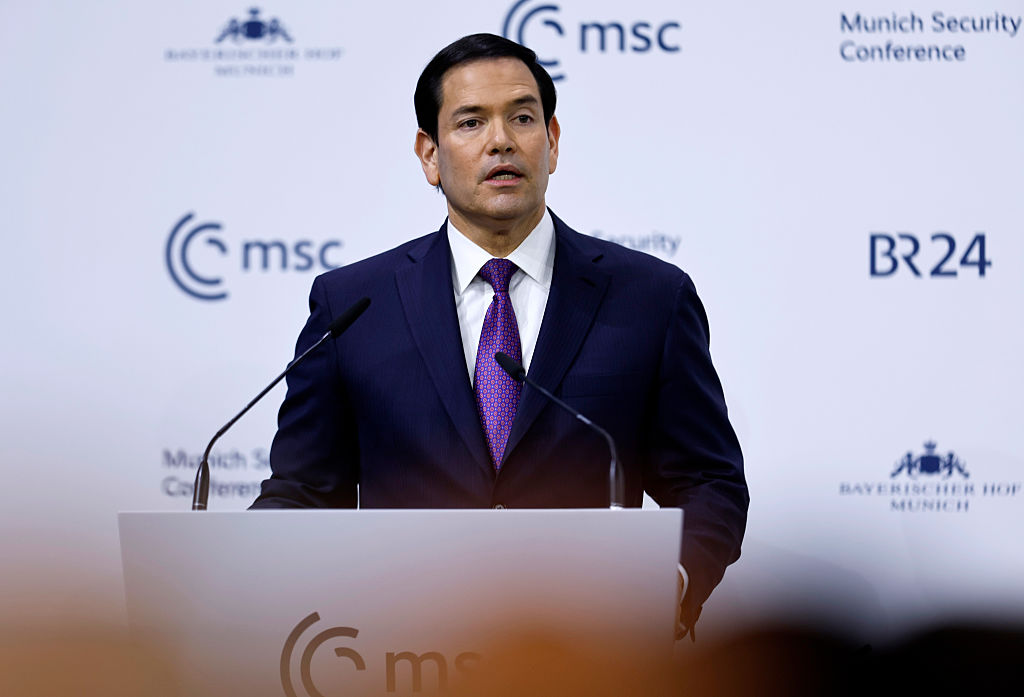
On today’s edition of The Briefing, I discuss the Munich Security Conference and Secretary of State Marco Rubio’s speech there, if ‘western civilization’ is past tense, why a country’s moral principles will always be religious, and Russia’s return to poison warfare.
Part I (00:14 – 11:43)
“It’s Like Davos, But With Guns” — Another Historic Meeting for the Munich Security Conference and Another Historic Speech from the U.S.
Part II (11:43 – 16:14)
Secretary of State Marco Rubio’s Speech at the Munich Security Conference: This Was a Truly Important Speech, and the Globalists Didn’t Like It
- Remarks by Munich Security Conference (Secretary of State Marco Rubio)
Is ‘Western Civilization’ Past Tense? The American (and European) People Must Decide If We are a Continuing Line of Western Civilization
- Europe Today Looks Different From the One Trump’s Team Describes by The New York Times (Jim Tankersley)
There is No Religious Neutrality: A Country’s Moral Principles Will Always Be Religious, But May Not Be Christian
Part V (20:46 – 25:05)
Russia is Back in Poison Warfare: Five European Countries Release Statement That Aleksei A. Navalny was Killed By Synthesized Frog Toxin
Sign up to receive The Briefing in your inbox every weekday morning.
Follow Dr. Mohler:
X | Instagram | Facebook | YouTube
For more information on The Southern Baptist Theological Seminary, go to sbts.edu.
For more information on Boyce College, just go to BoyceCollege.com.
To write Dr. Mohler or submit a question for The Mailbox, go here.
Get every episode summarized
Each time The Briefing with Albert Mohler publishes, we email you a written briefing from the transcript — the topics, who appeared, and any specific claims, with the ad reads skipped.
Email me new episodesFree for 3 shows. No card needed.
Hosts & guests

Transcript ready
293 searchable segments. Every word is indexed and playable.
Full transcript
The Briefing with Albert Mohler — Monday, February 16, 2026. Machine-transcribed; use the interactive transcript above to jump the player to any line.
It's Monday, February 16, 2026. I'm Albert Moller and this is The Briefing, a daily analysis of news and events from a Christian worldview. Well there are meetings and then there are meetings. We talked recently about one of the most interesting and frankly, alarming of the international meetings. And for a long time, there's been a lot of attention on the meeting of the World Economic Forum at Davos precisely because it is a meeting of the most powerful globalists in the world. Something interesting always happens and you're always, you're always aware of the fact that something more interesting and more troubling may have happened and it wasn't reported. But an even more important meeting these days took place just over the last several days and it wasn't in Davos and Switzerland, it was in Munich and Germany. This meeting has gone on for decades, but it has taken on a very increased importance in recent years and we're talking about the meeting that has to do with national security,
the Munich Security Conference. And as some have described, this is basically a lot like Davos, except the distinction is, this is Davos with guns. Now one thing to notice is that in times of relative peace, Davos gets all the attention, it's the center of all the most interesting conversations. But when you are at a time of war, the Munich Security Conference looms far larger. Furthermore, different people are in the room. And for example, you have a lot of people wearing suits, you don't have so many people dressed Hollywood, you do not have people so much dressed for a snow vacation. Instead what you have a very serious people, very serious people, the suits on the one hand and the uniforms on the other. And what you're talking about here is a gathering largely of NATO military leaders, certainly of European and North American military leaders. And you're also looking at political leaders, you're looking at the top military brass and you're looking at the top politicians and they're in a room together. You also have at least at this last meeting an unprecedented number of the United States
senators who are there as well, particularly those senators with responsibility for national security and also for in affairs. It's a very, very interesting meeting always, but it doesn't always get a lot of attention. It got a lot of attention last year. And the reason it got so much attention is because it was the first Munich Security Conference after the beginning of the Second Trump administration. And the speaker that the administration sent to the Munich Security Conference last year was Vice President JD Vance. And JD Vance basically took NATO and European leaders to the woodshed. And surprisingly they didn't like it. One of the points the Vice President Vance made in last year's address that got so much attention was the fact that the United States of necessity is tilting much of its interest and concern to other parts of the world. Now that sets the United States apart. And you also had leading figures, including the president of Germany who recently commented that he is aware that the United States has pressing necessary military and foreign relations
priorities looking far away from Europe. And in particular, the Vice President made clear president. Trump has made clear Secretary of State Marco Rubio has made clear. The United States is tilting much of its attention to the long term strategic challenge posed by China. And thus, what you see is something which echoes in some ways the situation during World War II. In World War II, you had the European or the Atlantic Theater of the War. And then you had the Pacific Theater of the War, the Pacific Theater due to the surprise attack. At Pearl Harbor, December 7, 1941 by the forces of Imperial Japan. And so the United States and our allies, but the United States in particular just think of the geostrategic location of the United States. You had the the war against Imperial Japan in the Pacific Theater and the war gets Nazi Germany in the Atlantic Theater and the and the Northern European Theater. But of course, it became a world theater. But the point is the United States had to make strategic priorities back in 1941.
And in 1941, even though America's formal entry into World War II came after the surprise attack by Japanese forces at Pearl Harbor, the United States, along with their allies, did not make the Pacific Theater the issue of highest priority. Rather, the realization was that Hitler and the Nazi Empire had to be defeated before there could be a full concentration of Allied efforts against Imperial Japan. And that was simply because the clear and present danger to the entire civilization order was more acute given Nazi Germany than Imperial Japan. It would have to be dealt with, but in its time and sequence. Well, over the course of the Cold War, the main issue, clearly the main issue for NATO, the North Atlantic Treaty Organization, and for the United States in particular was aligning combined strength against the ambitions and the aggression of the Soviet Union and World Communism. And so there was during the Cold War, a face-off between the USSR on the one hand
and its allies and the United States and its allies on the other hand. Now, that's not to say that we're very important geostrategic concerns as America looks to the east and to Asia. But the fact is that the national security of the United States was not fundamentally challenged from the east in terms of Asia as so much from looking at the Soviet Union, which by the way straddles both the east and the west. But nonetheless, the focus was in, the Atlantic, the focus was in, especially the likelihood of a land war between the United States and our allies and the USSR and its allies there in Europe. And so that had so much of the attention. And of course, then you add nuclear weapons of ballistic missiles and all the rest and you can understand how all of this gets very hot very fast. It was a Cold War, but there were hot moments and the danger of a hot war with thermonuclear weapons was always in the background. Well, as I mentioned last year Vice President Vance went to Munich and he
basically delivered an ultimatum. He chastised the European nations for failing to contribute enough even to their own obligations concerning their mutual defense. And he basically said that they could not count on the United States to bail them out if they will not rise to the occasion themselves. I'm not going to go back in detail. Device President Vance's address last year, let's just say that there were almost immediate reports, especially coming from European authorities that they thought that the entire the entire allied NATO project could fall apart. Now, it's also clear that the United States understands that it is not in our own national interest, nor in the interest of our concerns internationally, to have NATO weakened much less to fall apart. But it's hard to express the frustration that the United States government has felt for decades, given the fact that European leaders and European nations, including our allies and NATO have fallen so far behind their own minimal commitments during much of that time
to our common defense against a common foe. And you look at this and you recognize that what was said by the Trump administration, you need to know, was at least thought by many previous presidential administrations in both parties. And so there were some very interesting moments over the course of the last year where there was some realization of what is its stake. And there was a lot of stake given the fact that Secretary of State Marco Rubio was going to represent the administration this year just on Saturday, Valentine's Day, at the Munich Security Conference. I want to give primary attention to what Secretary of State Rubio said. But I do want us to understand the stakes were incredibly high. And it was very interesting that Rubio was sent. The president himself did not go. President Trump did not go. He did not send the vice president instead. He sent the Secretary of State and the Secretary of State Marco Rubio is uniquely equipped in this sense to deliver an address, peer to peer, to so many of the diplomatic and military colleagues who were
there present in the room. The Secretary of State began by affirming the NATO alliance. He said, quote, we gather here today as members of an historic alliance and alliance that saved and changed the world. He went back to the founding of the conference in 1963 and pointed to the fact that Europe at that time was divided between the Soviet domination and the allies in terms of democratic self-government. But then he went on to say the world has changed actually several times over since then. He spoke of the collapse of the Soviet Union and then he said, but the euphoria of this triumph led us to a dangerous delusion that we had entered. And he said here, quote, the end of history that every nation would now be a liberal democracy that the ties formed by trade and by commerce alone would now replace nationhood that the rules based global order and overuse term would now replace the national interest. And that we would now live in a world without borders where everyone became a citizen of the world. End quote. Okay. So that included much of what Vice President Vance said the year before. But he put it in, let's just say a package in which
he began by affirming the NATO alliance and American commitment to the NATO alliance. But then he went on to go at what he said was no views term the rules based global order. You need to understand that the globalist, the cosmopolitan's have held to a worldview. This goes all the way back to the enlightenment philosopher, Emmanuel Kant and his idea of a perpetual peace. It's the idea that you could have rules that would obligate all the nations of the world. This rules based order would increasingly dominate more and more of the world such that borders really didn't matter so much national interest really doesn't matter so much. Instead, this this global agreement, this cosmopolitan concord would take place. Now President Trump has just pointed to the awkward fact that there is no such thing. And President Trump has done it in his own inimitable way. Vice President Vance went to the Munich Security Conference last year and speaking of this rules based global international order, he said it does not exist. Now in a, let's just say less formal way.
Secretary St. Rubio said more or less the same thing. He spoke of a rules based global order. He said it was an overused term. And then he said more or less whatever it was, it is now over. He says, quote, this was a foolish idea that ignored both human nature and it ignored the lessons of over 5,000 years of recorded human history. And it has cost us dearly. He spoke of it as a delusion. And then he said it led to a dogmatic vision of free and unfettered trade, even as some nations protect their economies and subsidize their companies to systematically undercut hours, shuddering our plants, resulting in large parts of our societies being deindustrialized, shipping millions of working and middle-class jobs overseas and handing control of our critical supply chains to both adversaries and rivals, end quote, really strong language presented in a very statesman-like way. And the Secretary of State, who has long experienced in these issues as the United States Senator, especially on committees and in leadership on these concerns, he handled
this with incredible ease and he handled it with incredible conviction. He knew what he was doing. And that's one of the reasons why I want to get to the meat of his speeches, one of the reasons why, at the end of the day, an awful lot of the people who didn't like Vice President Advances speech didn't like this one either. Here are some of the things the Secretary of State said. He said, quote, in a pursuit of a world without borders, we opened our doors to an unprecedented wave of mass migration that threatens the cohesion of our societies, the continuity of our culture and the future of our people. We made these mistakes together and now together, we owe it to our people to face these facts and to move forward to rebuild and quote, no, I just want to tell you, those are some of those controversial words. The US Secretary of State could have spoken in this context just a few paragraphs later. He said this, quote, for the United States and Europe, we belong together. America was founded 250 years ago, but the roots began here on this continent long before. The men who settled and built the nation of my birth arrived on our shores,
carrying the memories and the traditions and the Christian faith of their ancestors as a sacred inheritance, an unbreakable link between the old world and the new. He continued saying this, listen carefully to this quote, we are part of one civilization, western civilization. We are bound to one another by the deepest bonds that nations could share, forged by centuries of shared history, Christian faith, culture heritage language ancestry, and the sacrifices our forefathers made together for the common civilization to which we have fallen air. End quote, I think those are some of the most important words in recent American diplomacy. They are incredibly strong words and every one of these words, every one of these phrases fulfills a function. And at least many of these made a point that well upon reflection, even though presented in such a statesman-like manner, many in Europe did not like what the Secretary of State said. And neither did many in the media and others who were absolutely committed to this more globalist vision, and absolutely allergic to the very claims that the Secretary of State was making.
Now, he went on to speak of de-industrialization. He said it wasn't inevitable. It was a conscious policy choice. He says that it has to be reversed. It has to be undone. He then went on to say, quote, mass migration is not, was not, isn't some fringe concern of little consequence. It was and continues to be a crisis, which is transforming and destabilizing societies all across the West. And he called upon the nations to address that. He spoke of border control, quote, but we must also gain control over national borders, controlling who and how many people enter our countries. This is not an expression in xenophobia. It is not hate. It is a fundamental act of national sovereignty. And the failure to do so is not just an abdication of one of our most basic duties, odore people. It is an urgent threat to the fabric of our societies and the survival of our civilization in itself. Now, here's what's really interesting. If those statements had been made in this same context, 50 or 60 years ago, they probably would not have made headlines. And that's because there would have been an almost, well, if not absolute consensus, then an overwhelming consensus
about the very things the Secretary of State was speaking about. And what you have here is the fact that you see a shift in the thinking of so many among the leadership class in the West. I'll just say Western civilization, basically, to say we can have all the goods of Western civilization and undermine them at the very same time. The reason why they were so angry about Vice President Vance's speech, but now also about Secretary Rubio's speech is because it makes significant claims about Western civilization. It places the nations of Europe, especially the member nations of the North Atlantic Treaty Organization and North America in a common culture. And that common culture is named as Western civilization. And I'll just simply say that I think a civilizational understanding of history is absolutely essential. I also want to say that many, especially in the ideological left, reject such a thing from the very beginning, even though it was the way their own universities taught history as recently as their own their own degree programs as a matter of fact. This is a
recent but overwhelming reorientation of the American academy in the American intellectual class away from Western civilization towards something else. And as a Christian, I want to say it's the secularization of the culture that has to be basic to this. And that secularization of the culture is why so many people were offended when the Secretary of State actually mentioned not once, but twice, not just twice, but three times. The Christian faith that binds European and North American nations together. And you know, that turned out to be something that many in the American media class simply couldn't take. But at this point, I then want to turn and look at a report from Munich by Jim Tankersley of the New York Times. I told you a lot about how this is seen. And he begins by basically trying to deny or at least to undermine the idea that there is any such thing as Western civilization as we think of it. He says this quote, there is an Afghan grocery store on the box outside the main train station in Munich. Halal food counters are sprinkled around the cathedral spires and beer halls, nearly one of every three residents you meet in town is not German.
End quote. Okay, so I am in no position to say that's not a fact. But you'll notice it's it's presented here, not just as a fact, but as an argument. Here's where it becomes clear quote, it's a decent approximation of what many European cities and European people look like today. And a different Europe from the one the Trump administration says it wants to be friends with. End quote. So at least this is a clear drawing of lines. Here you have someone who says the Europe that the Trump administration wants to be allies and friends with is a Europe he says that no longer exists. He then went on to say this quote Marco Rubio, the US Secretary of State tried to sue the year of friction between the United States and its transatlantic allies on Saturday at the Munich Security Conference. His speech there reiterated America's commitment to Europe, but wrapped it in historical and cultural ties that seemingly exclude large sections of the current European population. End quote. Now this gets to the heart of of something we just have to talk about it far greater development at some point. And that is what it means to become part
of a civilization. And so one of the things that the Trump administration and frankly vice president of ants and Secretary Ruby are pointing out that when people move to your country that doesn't necessarily mean they're joining the civilizational project. And and that's the concern the Secretary of State was bringing. But now I want to go back and look at how this report from the New York Times basically tries directly just to to confront the Secretary of State, the Trump administration's approach here. And as Christians, we need to pay close attention to this. This is what tankersly writes in response quote. Christianity is declining across much of the continent. In the Europe's three largest economies, Britain, France, and Germany, less than half of residents now identify as Christian, according to survey data by Bertelsmann Shipton, a nonpartisan foundation, the ranks of the religiously unaffiliated or growing according to data by the Pew Research Center and others. He goes on to say that a decade-long influx of migrants in the Middle East and elsewhere means the share of Muslims across Europe has ticked up that's his language to about six percent.
The Jewish population is actually declined slightly, remains below one percent. Okay, so you see here by the way that there is the suggestion that whatever Western civilization was, it's past tense, that's a was. Now, now Europe is representing some kind of new civilization. And you know, this is going to get down to one of the most basic arguments the American people are going to have to have. And eventually we're going to have to decide as a nation one way or the other. Are we a self-conscious continuation of Western civilization? I will argue that must be how we see ourselves or do we see ourselves as an ever-expanding experiment that can be committed to these principles in one generation and to an entirely different set of principles in the next. Because that is exactly what does it take here? The Secretary of State put his finger on it, named it clearly, said it calmly. And so almost immediately you had to press say, this is a different attitude than we had last year. And then they heard the speech and they said, wow, this is an even more highly targeted argument. We don't like it any better.
Now, we're going to have to come back to this. But when people say, you know, Western civilization, that that's a project that's radically changing or it's being displaced by something new. And then when you use the word Christian and you say Western civilization really was forged out of Christianity, it was it was a Christian project. And people say, well, now, you know, increasingly people aren't Christian. The Christian has to hear that and understand the fact that they're not Christian, that's very important. But it's also important to know what they're not and what they are at the same time, which is to say that there's this modern secular dream that there's some kind of religious neutrality, which is just unaffiliated or neutrality or the nuns in a way, yes. But the human heart is going to be based upon some very important principles. Those principles are going to take on some religious character. That's extremely clear in the scriptures. And so we just need to know, honestly, okay, if Christianity is being replaced by something, what is that something? Okay, while we're thinking about this, let's just remember what is at stake.
And let's remember that freedom has enemies. It always has had enemies. And one of those enemies right now is Russia. And you have a very important news report over the weekend. And it is officially coming as a statement from Britain, France, Germany, Sweden and the Netherlands. So this is not a fringe statement. This is a statement from the government. Once again, of Britain, France, Germany, Sweden and the Netherlands. What are they saying? They are saying that forensic evidence tells us that Alexei Navalny, the Russian opposition leader who was killed in a Russian prison two years ago, was most likely. And let me read to this to you from the telegram. It was most likely killed by a poison that's based in a toxin found in a South American frog. As a telegraph report begins, quote, Alexei Navalny was killed with a toxin developed from an Ecuadorian frog on the orders of Vladimir Putin, proving that Russia possesses illegal chemical weapons. And this was in Britain. The British government has revealed the scientist, quote, concluded that the Russian opposition leader was assassinated with a poison 200
times stronger than morphine. The 47 year old man was murdered there in a Siberian prison after he had had a lot of outspoken criticism against the Russian president. But after his death, biological samples were surreptitiously taken from his body and smuggled to the west where the forensic evidence indicated he was killed by poison. Listen to this, quote, the poison described as one of the deadliest on earth was first discovered in Ecuadorian dark frogs. However, the lethal chemical cannot be produced if the creatures are in captivity, away from tropical and humid forests. So Russian scientists, quote, painstakingly researched and they were able to develop a synthetic version of this deadly poison from a dark frog in Ecuador. And the five governments concerned here said this could only be undertaken by a government and in particular, the government of Russia. And it means that Russia is back in poison warfare. Where has been for a long time? So it reminded me of a headline that appeared years ago. And this has to do with 1978. So let's go back to 1978. So we're not talking about
Russia. We're talking then about the Soviet Union. And you had a defector named Georgi Ivanov Markov, who died in a London hospital of a form of blood poisoning. And before he died, he claimed that he had been stabbed with an umbrella by a stranger who bumped into him on the street in London. Turned out, by the way, all that was true. And so there he had a biological weapon in a pellet in the pointed part of the umbrella. It was pressed against the man's skin. The infectious agent was injected. And I mean, just look at this. We're talking about something that sounds like a James Bond movie. But truth, once again, in a sinful world is stranger than fiction. By the way, the statement officially from these five countries made one very clear comment. And that is that this particular toxin found in Ecuadorian dark frogs, avoid those, by the way, is not naturally found in Russia. In a fallen world, this is just the
kind of thing that happens. But it takes a very sophisticated, very wealthy foreign power intent on doing malevolence to synthesize this kind of a toxin from an Ecuadorial dark frog. In stories like this, in reports like this, coming from five authoritative allied governments, what is revealed here is nothing less than the face of evil. And also the awareness that in all the diversity of all the animals that God the creator placed on this earth to his glory, but to our alert, there are also toxins coming from poisonous frogs. You have been warned. Thanks for listening to the briefing. For more information on my website at AlbertMotor.com, you can follow me on extra twitter at going x.com forward slash AlbertMotor. For information on the Southern Baptist Theological Seminary, go to SBTS.tv. If you have information on voice comments, just go to voicecomment.com. Today I am in National Tennessee, and I'm going to show you in tomorrow for the briefing.
More episodes
More from The Briefing with Albert Mohler

Monday, September 14, 2026
The Briefing with Albert Mohler

Friday, September 11, 2026
The Briefing with Albert Mohler

Thursday, September 10, 2026
The Briefing with Albert Mohler
Wednesday, September 9, 2026
The Briefing with Albert Mohler