About this episode
Part I (00:14 – 08:45)
What Is The Question? In 6-3 Ruling, SCOTUS Rules Trump’s Targeted Tariffs are Unconstitutional
- Justices Strike Down Trump’s Tariffs by The New York Times (Ann E. Marimow)
- Learning Resources, Inc. v. Trump by The Supreme Court of The United States
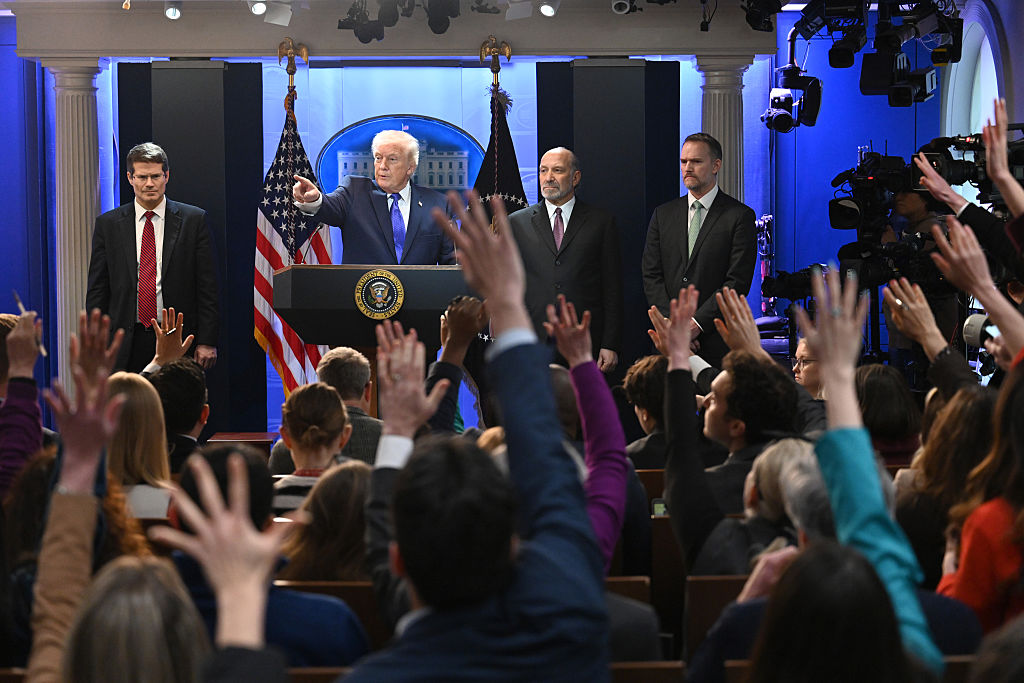
President Trump’s Angry Press Conference: The President Provided an Important Leadership Lesson After the SCOTUS Ruling – Don’t Respond Out of Anger
Part III (10:16 – 15:28)
SCOTUS Made a Big Mistake: The Justices Should Have Addressed the Question of the Billions of Dollars That the U.S. Has Already Collected – What Now?
Part IV (15:28 – 21:05)
The Arrest of Former Prince Andrew: The Disgraced Prince of Britain Was Arrested For Suspicion of Sharing Government Secrets
- The Former Prince Andrew Never Should Have Forwarded Those Emails by The Atlantic (Helen Lewis)
We Need to Press for a Moral Reckoning with the Epstein Files: There is a Healthy Moral Outrage in Response to This Story
Sign up to receive The Briefing in your inbox every weekday morning.
Follow Dr. Mohler:
X | Instagram | Facebook | YouTube
For more information on The Southern Baptist Theological Seminary, go to sbts.edu.
For more information on Boyce College, just go to BoyceCollege.com.
To write Dr. Mohler or submit a question for The Mailbox, go here.
Get every episode summarized
Each time The Briefing with Albert Mohler publishes, we email you a written briefing from the transcript — the topics, who appeared, and any specific claims, with the ad reads skipped.
Email me new episodesFree for 3 shows. No card needed.
Hosts & guests

Transcript ready
420 searchable segments. Every word is indexed and playable.
Full transcript
The Briefing with Albert Mohler — Monday, February 23, 2026. Machine-transcribed; use the interactive transcript above to jump the player to any line.
It's Monday, February 23, 2026. I'm Albert Moller, and this is The Briefing, a daily analysis of news and events from a Christian world view. Well, Friday was a big day. The entire weekend turned out to be filled with news, but Friday was one of those days that the Supreme Court released a major decision, and it's one of those decisions that changes just about everything, at least in terms of the immediate political landscape. And we're talking about the tariff decision, a six-three vote by the nine justices of the Supreme Court against the Trump administration, directly against the president's plan, and the president's practice about tariffs. Now we need to think at so many different levels here, Christians need to think very carefully. Number one, we're talking about big moral issues, big economic issues, big constitutional issues. So let's just determine first and foremost, what in the world did the court rule on? I mean, the headline in the New York Times, justices reject Trump's tariffs in key blow
to his trade policy. Okay, that's not exactly wrong, but it's certainly not exactly right. The justices on the US Supreme Court don't officially care about tariffs at all. They don't care if the president puts them on, the president takes them off. What they care about is the constitutional authority. The statutory authority in this case, and of course, ultimately the constitutional authority. Now here's where things get really interesting. So whenever you have a Supreme Court decision like this, you need to ask the question, what did the court rule and on what question did it rule? The court always takes a question. What was the question in this case? The question was this, does the president of the United States have the constitutional and statutory power to apply these tariffs under the International Emergency Economic Powers Act in 1977? Now, that's IEPA, by the way, if you ever hear that, IEPA is just the acronym for International Emergency Economic Powers Act of 1977.
And so that's what the president used, and the president claimed an economic emergency so that he would have the constitutional and statutory authority to apply these tariffs. Now the Supreme Court, by a six three vote, turned that down. They basically said straightforwardly that there is no such authority for tariffs in that law that is assigned to the president of the United States. And you'll recall that in our constitutional system, under Article one, it is Congress, the legislature, that has the power to tax. Tax questions are essentially to be taken back. The statutory questions in one sense at all, spending authority back to the Article one powers of the United States Congress. Now through specific statutes, Congress has basically transferred some of that authority, usually within limitations and short term to the president, to the executive branch. Now why would Congress do that? Well, it's because Congress isn't sitting in its office 24-7. That's one of the facts that makes the presidency different.
The presidency is online all the time. The Article two powers of the president are invested in a human being, the nation's chief executive and commander in chief. And of course he employs many other people to work with him and by congressional authority have all these different branches of government, the administrative state. They all basically come back to the White House and the White House can respond quickly something Congress just buys very design really can't do. Now Congress can, in a case of a national emergency, summon the power to declare war at times, but you have to really go back to World War II and to one small incident after that to find even that kind of speed, that kind of authority. Instead, you're really looking at Congress conceding some of its power and its authority to the White House, but not without limitations. The argument made by the plaintiffs in this case is that President Trump exceeded those statutory limitations in applying these tariffs. And by the way, he applied these tariffs in an incredibly arbitrary way and he admitted
that's what he's doing. He stated right up front, that's what he's doing. He was applying tariffs as a matter of the exercise of his leadership to basically change the economic landscape in such a way that he could protect certain American industries. He could at least promise return certain American jobs. He could equalize what he said was a very unfair trade landscape and in many ways the president was right about the unfair trade landscape. The problem is that almost never in American history does applying tariffs in this kind of way make the situation long term better. It can often make it worse, including contributory factors that led to the Great Depression. But all right, let's just remind ourselves the New York Times headline is misleading. The Supreme Court justices did not make a decision on tariffs. At least officially they don't care about tariffs. They care about the Constitution and about statutory law. And you have the Chief Justice of the United States, John G. Roberts Jr., writing majority
opinion in this case. That tells you something about how important he saw this question to be. It's a constitutional question and you have a six three vote. And again, it's not a six three vote on whether or not there should be tariffs or even particular tariffs or the entire system of tariffs. It's about legal and constitutional authority, particularly that statute, the International Emergency Economic Powers Act of 1977. What did the majority find? The majority found there is no such authority for the president of the United States to be exercised in this manner on the matter of tariffs. What was the evidence they brought forward? The text of the act of the statute. The other thing they brought forward is the fact that no previous president since 1977 had either applied tariffs under this authority or claimed the power to do so or even talked about doing so. And so you have here a situation in which president Trump would, and this is a part of his MO. This is his his his mode of operation. He stretches the limits. He tests the boundaries.
He actually in some cases acknowledges that's exactly what he's doing. He is exercising executive authority to the fullest extent in these issues. And then in some cases, he presses a bit further to see if he gets pushed back. And in this case, the Supreme Court majority six three, including three conservative justices, including two that he appointed himself in his first term, they voted against him effectively in this matter. Now I think it's unfortunate that it gets framed to this way. But in a political context, well, it's unfortunate, but it's going to happen. So far as the president sees it, he lost. And I guess he did. His policy has been struck down. But we just need to remember that the tariff issue is something he has argued very vociferously. It appears that decades ago, he really came to this very settled conviction on the matter of tariffs and the unfair trade situation to which the United States have been subjected. Long before he came to the White House, he was committed to applying this tariff power
to the fullest. And yet he has run up against very significant obstruction right now. Now the president came back and said, okay, then if not under IEPA, the international emergency economic powers act to 1977, then under a 1974 statute, which is section 162 of the trade act of 1974, he says, if not under IEPA, then under section 122, he's going to apply and across the board 10% tariff. And then by Saturday, he said, no, it's a 15% tariff. Okay. So why then was the president upset? It is because that's a far more restrictive situation, far more restrictive. You're talking about a blanket set of tariffs. The president doesn't want blanket tariffs. He wants targeted tariffs. He wants to be able to say to pull in here to your tariff. He wants to be able to say to China, here's your tariff. He wants to change it if he sees that change in the national interest. That's been taken away. And not only that, he's been talking about 100% tariffs, 150% tariffs. The limitation here is 15% and it is only for 150 days.
So after 150 days, this presidential authority on tariffs expires and Congress would have to put them into place if they are to continue. That's an open question right now, especially when you're looking at the midterm elections coming up in November and the fact that especially in swing states, well, this could swing. It could be very popular one day, very unpopular the next. It's a very volatile situation. Now there are a couple of other things I think that need to be said. And the president takes all these things very personally. That's very clear. And he gave a press conference, came out and made a statement to the press that I believe was quite unfortunate. And it's just a leadership lesson. I think we should consider. I want to tell you I certainly am considering it. And that is we ought not to hold a press conference when we are that angry. And because when you do, you say things you shouldn't say. The president of the United States questioned the patriotism of those who voted as he sought against him on this.
And he questioned their patriotism, he even said they were an embarrassment to their families. That's the kind of language that isn't helpful in this kind of discourse. It's really not helpful. It certainly doesn't make President Trump look more presidential. It instead, well, anger comes out looking like anger, regardless of the context. And in this case, it was quite vindictive. I don't know if the president has any regrets about it. I can still be tell you the president's generally almost universally don't act that way. I'm not saying they don't think that way. I'm also not saying they don't act that way behind closed doors. There's evidence just given presidential memoirs and White House accounts that numerous presidents have gotten just as angry and expressed it just as vociferously. To do so in front of the press, publicly and personally attacking justices of the Supreme Court, justices in the case of two of them, he had appointed. Now, and the reason for that is it's very easy to misconstrue the Supreme Court's responsibility
here. The Supreme Court justices are fully open to any debate about whether or not they did the right thing. But we do need to remember what the thing was. In other words, they weren't asked our terrorist a good policy. They weren't asked to use support president Trump. They were asked, does this statute allow a president to act in this way? And this is where words matter. Here's where Christians have another dimension to this we have to think about. What do we want Supreme Court justices to take as the basis for their ruling? What they think, I care what they think, but that's not the most important issue. What should be most important is the text. This is where Christians understand the text is actually the thing. The statute, its language, its sentences, its words. The constitution of the United States, its sentences, its words, its original intent, its textual meaning. This is where we understand that a liberal approach to the constitution says, you basically make your argument and find a way to make the words work in terms of the constitution.
Or you try to find some interlogic or in the case of one rather infamous decision from the 1960s, you just talk about the number of emanations, which is kind of feelings you get from the constitution. We shouldn't have people on the bench for their feelings about the constitution or their feelings about what's right. Frankly, we shouldn't have anyone on the bench for their feelings about tariffs. It should be about the text, the text of the law, and the text, most importantly, the constitution of the United States. And this is also where American citizens, and I speak particularly to American Christians as citizens, we've got to keep our eye on what's at stake. We also have to keep our eye on the future, which is to say, we have children and grandchildren, we care about the America they're going to inhabit. We care about whether or not our constitutional order will be perpetuated for them. We care about whether or not someone following after President Trump, frankly, from the liberal direction, could just also test every boundary and push everything as far as possible.
And frankly, I think we're probably looking at that happening. We need to be ready to have the arguments against that, but we can't honestly just come up with those arguments when they're convenient. When we have a liberal or progressive or leftist in the White House, we've got to be committed to those principles when it comes to the meaning and the interpretation and the authority of law and the constitution, and we've got to hold ourselves to them as well. Well, there is a lot of associated mess with this. But one thing, I think the Supreme Court made a huge mistake in this decision. I don't mean the way it came down. That's just history. That's the way it came down. I am saying that when they don't answer a question and don't even attempt to answer a question like what do you do with the massive billions of dollars that have ordered and collected in tariffs, well, then they're setting up litigation that could last far longer than President Trump is on the White House. And that's a horrifying prospect. And you can almost count on the fact that there are going to be so many lawsuits filed.
There'll be so many cases coming before the courts. As if the courts aren't already day-loosed with all kinds of litigation and questions, I think it would have been very helpful if the justices on the court had addressed that question. And I think this is where some of them may think, hey, we only really address the question we see is most pressing an inherent in this situation. I think the way history unfolds so fast, the Supreme Court had better think about the fact that when it sends a big question like this into chaos, it's going to be a responsibility for that as well. That's about all we probably need to say on tariffs. Although that's the biggest news story, I think, in terms of constitutional importance certainly as we went into the weekend. But there's one other aspect just about tariffs. And that is that a tariff is a form of tax. You can call it whatever you want. It is still a form of a tax. If you have a 10% tariff, then that adds 10% on the American side to whatever is being bought. And sometimes that's really important because tariffs are put in place because there's unfair competition or for some other political reason in which the administration, the government,
and in this case it does take Congress long term, says, you know, it's in the national interest that we do not allow this country to send in these cheap goods to put out a business in American industry. So in other words, there's a logic to it. But it is a tax and eventually this is where I just want Americans to understand. Eventually if there is a tax, you do pay it. I don't care what you call it. If there's a tax on corporations, the corporations will get it from you in the prices they charge. If it's a judgment against some sector of the economy and you say, well, good, we don't have to pay it. Well, just eventually understand that the average citizen and the average consumer ends up paying most of these judgments one way or the other. These companies don't just take it in overhead and say, never mind, eventually you're going to pay for it. All right, the other big story going into the weekend really took place in Britain on Thursday. And that was the arrest of former Prince Andrew, currently Andrew assorted names then
mock botten Windsor. He was arrested. Now in Britain, arrested means pretty much because of the way common law operates. But it means pretty much there what it means here that doesn't mean you're charged with a crime. It does mean that you've been arrested and taken into police custody. And in this case, taken in for questioning. And this, this was big news. It would be big news anytime, anywhere. But when you're talking about the second born son to the former Queen Elizabeth II of Great Britain, you are talking about a big story. When you're talking about Jeffrey Epstein as a part of this story, you're talking about a big story. Once again, we need to isolate the questions. Let's isolate the question. Was the former Prince Andrew arrested on charges related to sexual misbehavior, sexual crimes, sexual abuse connected to Jeffrey Epstein and his circle? The answer to that is actually no, but with an interesting hook. Why was the former Prince Andrew arrested? It was because in the release of massive amounts of material, about three million pages
of material by the US Department of Justice. And that was in response to a law passed by Congress, a law that required the release of that information. And you know, some of it was redacted. That's controversial. Some of it wasn't redacted. That's controversial. But a lot of it was digitally searchable. And there was immediately found material in Prince Andrew. Okay, here is a background story. All right. Here's a go. Years ago, before the Trump administration, even the Biden administration and the Justice Department was trying to get testimony from Prince Andrew. And quite frankly, the United States government had dirt on the British prince, big time dirt. They could not get cooperation in arranging for an interrogation of the British prince. So well, let's just say all that material got released to the public, three million pages of it. Why was Prince Andrew or the former Prince Andrew arrested? It is on suspicion that he misused his public office when he was a special UK trade representative
and he almost assuredly did. And here's what's interesting. Did he pass to Jeffrey Epstein material that was private government, British government possession? Did he thus basically betray his own country and instead send something like that to Jeffrey Epstein? By the way, in Britain, this will be the second head to roll, so to speak. The first was Peter Mandelson, who was at the time, the US ambassador to the United States. That's the most prestigious ambassador ship in the United Kingdom. And he was already known to have been an associate with Jeffrey Epstein. He went down, yes, because of the revelation that his relationship was far more substantial that had been admitted. He also went down because it appeared by emails that he had been leaking private, sensitive, classified government material to Jeffrey Epstein. And so here's the interesting thing. And this just shows you how sin works. It also shows you how a criminal justice system works. Big lessons here, even in the United States for the Epstein investigation and for the judgment
that needs to come. Number one, sometimes you get people finally at the point of a criminal investigation and a criminal prosecution and even a criminal guilty verdict. Sometimes you get them on a crime that wasn't at all your first concern. Now, I want to tell you where you see this most graphically. You see this most graphically in terms of investigations with criminal charges, especially during, say, the middle decades of the 20th century going after organized crime. And the fact is that it was often very difficult to get enough evidence, to get enough witnesses, to get enough material to bring charges on murder and bank robbery and all those things, criminal conspiracy, which the law enforcement officials were absolutely certain that organized crime leaders were involved in. They knew it. They could wire tap them. They could, they could intercept the mail. They could do everything, but a lot of times they just didn't have what is legally necessary to bring a case that would lead to a criminal conviction. So an awful lot of these guys actually went down on tax evasion.
You know, sometimes if you can't get them on murder, you can't get them. And clearly that's a more serious charge morally. You can't get them on bank robbery. You can't get them on drug running. You can't get them on booze sales, you know, during prohibition. What do you get them on? You get them on tax filings. You get them on tax evasion. And what's really interesting right now, and this is where the Christian worldview, which is always interested in crime, do you realize that the origin of the crime novel really comes down to Protestant Christianity and Roman Catholic authors, and the concern for how to explain evil. And so the detective novel, the crime novel came out of that worldview, especially in the English speaking world. We'll talk more about that if you, if you care about it sometime. It's a really interesting story. And it's because Christianity says eventually justice will happen. If it's the justice of God on the day of judgment, eventually all things will be revealed and everything will be judged, everyone will be judged. In the meantime, we also understand that it is impossible to pass out perfect justice,
but you know, even imperfect justice is better than no justice. I think that's where a lot of the Epstein momentum is going to shift in the United States. And it needs to. There is justified anger on the part of the American people that so many men, in particular, at its men and women, just think of Julian Maxwell as it's it, but especially men, they're too many men who are horribly guilty, they're powerful men, they're connected men, and they've been redacted and they've been protected, and they need to be exposed. And you know what? That is absolutely right. That is a healthy, righteous moral mandate. How exactly that happens is beyond my understanding, simply because I am not in a position to know how many millions of pages are available out there, what they would disclose. I will tell you, the American people have demonstrated, I think, sufficient moral intensity that they're not going to let this thing drop. I'll just simply say, I think that's a very interesting moral judgment. You know, in a day of moral relativism, isn't it interesting to know that when it comes to something like this, Americans don't respond with a relativistic response. They respond with, we want justice.
A lot of people are asking, well, why did this happen in Britain? Why isn't there a similar accounting here in the United States? And this is, I think, I think it's largely a question of timing. And it is because in the release of those materials, well, my goodness, there are guilty emails having to do with national protected information and print entry. And I'll also tell you that if you're a reporter or you're an investigator and you're going to Google this stuff out of three million pages, you're going to put in names like print's Andrew before you're going to put in some of the other names. I do believe the reckoning will come. I hope it will come. I think we need to press for it to come. And when it comes, I think it's going to be a situation in which, once again, there are going to be some people who go down for something that you didn't see coming, like exposing national secrets to Jeffrey Epstein rather than being involved in the sex crime ring. And so it's going to be very interesting to see how this goes down. But again, I think there's a healthy moral impulse here. I do think some of it's unhealthy. Of course it is speculation, fascination and all this, the tabloid kind of stuff.
That's not particularly helpful, but you know, the moral outrage sometimes is very healthy and in this case, I think the American people are going to press their cause. As the British people are now pressing their cause. And this is where the situation in Britain means that for the first time in centuries, going back to Charles the first, a British royal of this tatcher has been arrested by law enforcement authorities. I guarantee you, this is a huge issue, even raising the question of whether it will destabilize the crown. And you think that's a radical thing? We'll just understand that in the early decades of the 20th century, most of the monarchs of Europe, the monarchies themselves fell. I don't think that's going to happen in this case, but you know what? I don't think the British people will ever look at the House of Windsor the same way. Again, because of this. I'll disclose with a headline that I think discloses a very great deal. It's a headline that states the obvious, but sometimes the obvious is really deeply interesting.
So here's the obvious. The Atlantic. Helen Lewis is the writer of this report. Here's the headline. The former Prince Andrew should never have forwarded those emails. Okay. That's clear. That's really clear. He never should have forwarded those emails. But he did. And you know what? I am absolutely certain that he forwarded those emails, believing that it would never be found out and he would never have to answer for them. I guess well in that, there's a parable for us all. Prince Andrew should never have forwarded those emails. But he did. Thanks for listening to The Briefing. For more information, go to my website at Albertmoor.com. You can follow me on extra Twitter, but go into x.com forward slash Albertmoor for information on this other map, just the logical seminary, go to spts.edu. Pre-informational boys college, just go to voicecollege.com. I'll meet you again tomorrow for The Briefing.
More episodes
More from The Briefing with Albert Mohler

Monday, September 14, 2026
The Briefing with Albert Mohler

Friday, September 11, 2026
The Briefing with Albert Mohler
Thursday, September 10, 2026
The Briefing with Albert Mohler

Wednesday, September 9, 2026
The Briefing with Albert Mohler