Loading...
religionspiritualitychristianity
Monday, January 5, 2026
About this Episode
This is The Briefing, a daily analysis of news and events from a Christian worldview.
Part I (00:14 – 05:33)
Trump Wasn’t Bluffing: The Apprehension of Former Venezuela President Nicolás Maduro
Part II (05:33 – 15:37)
The Historic Complications of Venezuela and Its Politics: There is a Long History Here
Part III (15:37 – 22:22)
This Action in Venezuela Raises Big Questions: Was It Lawful and Constitutional for the U.S. to Take This Action in Venezuela? What About International Law?
Part IV (22:22 – 26:20)
Where Do We Go From Here in Venezuela? It Is Not At All Clear What “Running Venezuela” Means
Sign up to receive The Briefing in your inbox every weekday morning.
Follow Dr. Mohler:
X | Instagram | Facebook | YouTube
For more information on The Southern Baptist Theological Seminary, go to sbts.edu.
For more information on Boyce College, just go to BoyceCollege.com.
To write Dr. Mohler or submit a question for The Mailbox, go here.
Part I (00:14 – 05:33)
Trump Wasn’t Bluffing: The Apprehension of Former Venezuela President Nicolás Maduro
Part II (05:33 – 15:37)
The Historic Complications of Venezuela and Its Politics: There is a Long History Here
Part III (15:37 – 22:22)
This Action in Venezuela Raises Big Questions: Was It Lawful and Constitutional for the U.S. to Take This Action in Venezuela? What About International Law?
Part IV (22:22 – 26:20)
Where Do We Go From Here in Venezuela? It Is Not At All Clear What “Running Venezuela” Means
Sign up to receive The Briefing in your inbox every weekday morning.
Follow Dr. Mohler:
X | Instagram | Facebook | YouTube
For more information on The Southern Baptist Theological Seminary, go to sbts.edu.
For more information on Boyce College, just go to BoyceCollege.com.
To write Dr. Mohler or submit a question for The Mailbox, go here.
Transcript
It's Monday, January 5, 2026.
I'm Albert Moller, and welcome to a new year for the briefing, a daily analysis of news
and events from a Christian worldview.
The world never seems to have a shortage of issues it throws at us, but in particular
today I thought we'd be talking about Mayor Mom Donnie.
That is to say, Zoran Mom Donnie, now the new mayor of the nation's most popular city.
We began with a bang, but we're going to have to talk about that tomorrow because of
international developments.
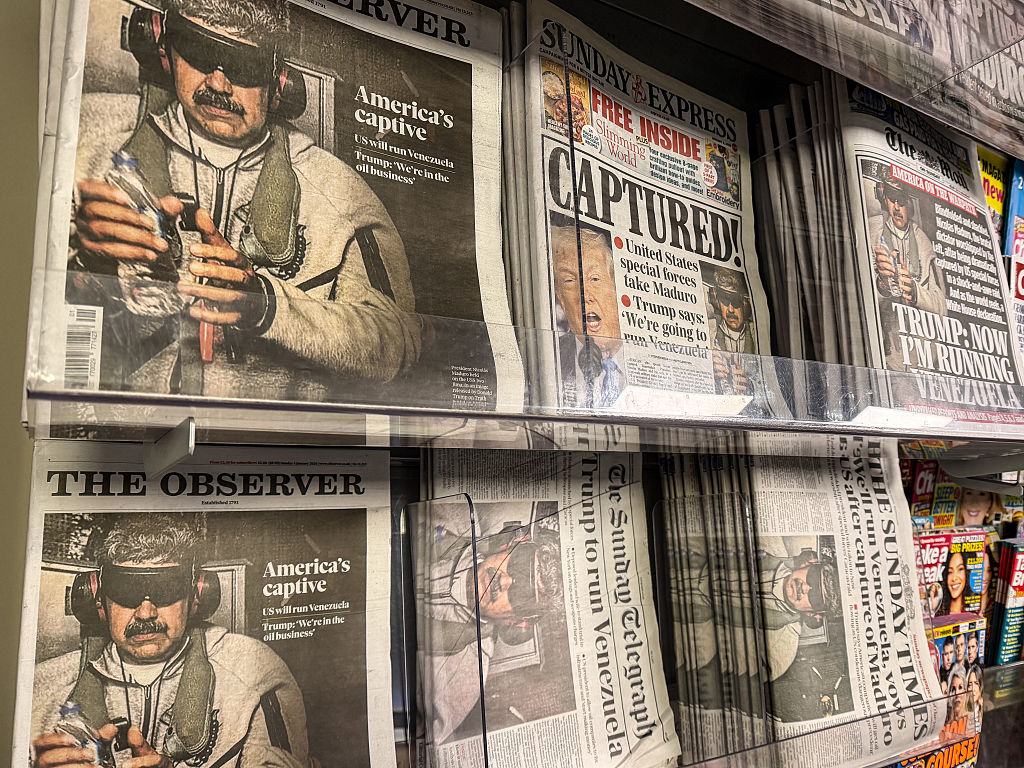
And of course, the big story that demands our attention is that Nicholas Maduro, the
former strongman of Venezuela, is now sitting in an American jail, so is his wife.
This takes us back to last Friday night, early Saturday morning, when it turns out American
military forces, special forces.
In this case, specifically, the Army's famed Delta Force went into action and without
losing a single American life, US forces arrested, apprehended, and then extricated the
former president of Venezuela.
In just a matter of hours, he went from taunting the United States, which had amassed a massive
military presence around Venezuela, including the USS Gerald Ford, the world's largest
aircraft carrier.
The fact is that President Trump wasn't bluffing.
Trump had warned Maduro that he needed to get out of Venezuela as far back as 2017
in Trump's first term.
When Trump came back into his second term, there were a couple of things that were very clear.
Number one, Venezuela's problem was considered to be an American problem.
And when it came to President Trump, he clearly had set his aim at removing Nicholas Maduro.
And it was also true that Maduro's fate was at least partly set by the fact that President
Trump nominated then Florida Senator Marco Rubio to be the nation's next secretary of
state.
Marco Rubio, who comes from a Cuban heritage, knows firsthand what a communist strongman
looks like.
And in the case of the leftist Nicholas Maduro, very much in coordination with Cuba and
very much tied to Cuba's autocracy as well.
The appointment of Secretary Rubio, who was also serving as the president's national
security adviser, meant that Trump had set a team in place, and that includes the Secretary
of War and others ready to take action.
Now one of the things we're going to talk about is the fact that Donald Trump, when he
was a candidate, even before he was a presidential candidate, was criticizing, especially Republican
presidents with internationalist ambitions.
He criticized both of the president's Bush, George H.W. Bush and George W. Bush for their
misadventures as he saw it on the world scene.
He declared that if he were to be elected president, there would be an end to this kind
of constant interventionism, in particular what he called unnecessary wars.
But even as a Trump policy is becoming more clear, it seems evident that he is very much
opposed to international interventions in the shape of protracted wars.
He is very much for strategic military strikes, just ask over the course of the last several
months.
Iran, Iraq, Nigeria, and now of course most famously, Venezuela.
It was very clear that the president was sending a message to Nicholas Maduro, get out
while they're getting out as good.
It was suggested that America would allow Maduro to escape to a neutral third party country,
where presumably some other strongman dictator would give him some kind of coverage.
That's the kind of thing that has happened routinely, particularly when it comes to troublesome
leaders in Central and South America.
But Maduro either didn't get the message or didn't want the message.
He actually at one point taunted the American president with American pop lyrics.
But even as he was saying, don't worry, be happy, his days were numbered.
And all that came to an end is we now know Friday night and early Saturday morning.
We now know that Maduro and his wife were very close to escaping into a so-called safe
room when they were apprehended by U.S. Special Forces.
In a Trump basically announced this to the world, no surprise here, with a tweet or
a social media post at 4.23 AM Saturday morning.
So Americans went to sleep.
Most people around the world went to sleep on Friday night, woke up with a new political
reality.
By Saturday morning, the U.S. Attorney General was saying that Maduro and his wife would
soon face the full wrath of American justice.
Now all this is very satisfying in moral terms.
We understand exactly who Nicholas Maduro is and who he was.
We'll be looking at his political trajectory shortly.
But the most important thing for us to remember is that he was a major agent of international
evil and made him around the world.
He had cited very much with Russia, China, Iran and other very bad actors.
And of course, all you have to do is remember the Monroe Doctrine and United States Foreign
Policy to understand that that would run Venezuela directly into conflict with the United
States of America, regardless of who would be serving as president of the United States.
But it is also important for us to recognize that even as, I believe, was totally justified
for the United States to take this action.
And the action was absolutely textbook and remarkable.
The fact is that the story is still unfolding.
The big question, of course, is what happens after the removal of Nicholas Maduro.
And in order to understand that, we need to go back in history a bit.
First of all, why are we talking about Venezuela?
Most Americans are not very interested in foreign policy until we have to become interested.
And that's the case right now in Venezuela.
Venezuela was one of the first portions of what became known as Latin America to gain
European attention.
It was colonized by Spain as early as 1502.
So recognize how early that is.
Remember the old song in 1492, Columbus sailed the ocean blue.
So we're talking about 10 years later what is now known as Venezuela was already under
claimed by Spain.
It was named Venezuela, which in Spanish means the new Venice, because the waterways reminded
the Spanish of Venice as a city that was more in their imagination than anything else.
If you can understand why the name stuck.
In 1528, this is a part of Latin American history that most Americans just don't think
about.
In Venezuela was taken over by Germans, in particular, by authorities within the area
of Augsburg in Germany.
They gained the charter and remember that Charles V is the emperor of the Holy Roman Empire.
Now, remember Charles V is also the emperor of the Holy Roman Empire who had preside over
the heresy trial of Martin Luther in Verms.
So we're talking about a lot of history coming together in connection points here.
It would be Charles V who would assign that particular designation.
The Germans had a very large population just in terms of the kind of colonization that
was going on.
But the fact is the authorities in Augsburg basically gave up and gave the charter over
to the Spanish crown.
Now remember the Spanish crown is also Hopsburg in terms of the dynasty.
So all of this is tied very much together.
And the Spanish decided to make the most of this new Venice.
And it was transferred to the Spanish monarchy.
And that was pretty much the history.
It was a colony of Spain until it declared its independence from Spain, along with other
Latin American nations in 1811.
So fast forward, 1502, and then that German period beginning in 1528, shortly thereafter
back to Spain in 1811, Venezuela declared its independence, but it was basically considered
a part of Colombia.
In 1821, Grand Colombia, as it was known, was granted its independence, but it would
be only in 1830 that Venezuela would be recognized as a separate national entity.
So its national history goes back in particular in terms of that continuity to 1830.
In the 19th century, it was basically known for a succession of military regimes.
And that was very much the case throughout this portion of Central and South America.
And Bolivar was himself one of the heroes of Venezuela's independence.
And so you can understand a very strong national identity, very strong historical influence.
And by the way, later, under strongman Hugo Chavez, under what would be declared to be
the fifth Venezuelan republic, it would be renamed the Bolivarian Venezuelan republic,
harkening back to Bolivar, considered to be something like the George Washington of South
America.
You have to fast forward to 1958, more recent history there in Venezuela, when there were
again constitutional revisions and a succession of governments.
But fast forward, and let me just remind you of something, and that is that during the
period of the 1930s and in the 1940s, American and European authorities were mostly worried
about Central and especially South America falling into the hands of far-right governments,
and even fascist and not-seat governments.
Now all of that was basically turned around by the time he reached the 1960s, the 1970s,
the 1980s and 90s, when the big fear, especially among Americans, is the rise of leftist governments,
openly Marxist, and in some cases not only socialist but communist governments in much of this
area.
It's a politically tumultuous region of the world.
It is now, it basically always has been.
It is also a special area of American concern.
I mentioned the Monroe Doctrine, and let's just remind ourselves of that.
President James Monroe in 1823 warned primarily European nations to stay out of South America,
indicating that the entire Western hemisphere was to be understood as under American control.
That was strengthened in 1904 with the development it was known as the Roosevelt Corollary,
that's President Theodore Roosevelt, who said that the Monroe Doctrine should be extended
to the right of the United States to intervene in Central and South American governments when necessary.
By the way, little footnote here, the Monroe Doctrine might well have been called the Adams Doctrine,
since it was future president, then Secretary of State, John Quincy Adams, who developed and wrote the policy.
But it came under the Monroe administration, bears the Monroe name, the Monroe Doctrine,
and then we come to understand that in the course of the 20th century, the United States,
believed more and less strongly in that doctrine.
And of course, that was because the United States was incredibly distracted,
particularly in the 20th century with two massive global wars.
In both of those wars, South America was a concern, particularly in World War II.
But after World War II, the United States was looking at the arrival of the Cold War,
the big threat coming from the USSR, and the South America took a decided back seat.
Perhaps even a third tier seat.
And I'm going to come back with some huge problems for the United States.
When it came to Venezuela, the United States was very concerned about a decidedly leftist turn.
And in this case, if not communist, certainly socialist under the leadership of the man known as Ugo Chavez.
He was a military officer.
By the way, he had attempted a coup in the year 1992.
It had been arrested, and Venezuela and authorities would no doubt later regret.
They did not take stronger action.
But he would later interpolitics again, and he would become president of the nation in 1998,
as I said, declaring it the Bolivarian Republic of Venezuela.
He said about in a decidedly anti-American pattern.
And when I say anti-American, I mean he was associating himself directly with America's most
virulent enemies.
And so you have basically the bad guys of international world politics and even criminal organizations,
you think about Russia and China.
You also think about Iran and some other nations, including Islamist terrorist organizations.
You're talking about a lot of connections that caused the United States one huge nightmare.
Ugo Chavez was a major problem because he also had influence beyond Venezuela throughout
South America.
He was presenting a decidedly anti-American agenda.
And he eventually would die.
But before he died, he appointed his own successor, that successor was Nicholas Maduro.
That's the man who with his wife was arrested Friday night Saturday morning in Caracas.
What in the world's going on here?
Well it was a big question even for the followers of Ugo Chavez at the time.
Basically on his deathbed, Chavez had announced that he wanted Maduro to follow him.
Maduro is a former bus driver with no really evident qualifications.
He had entered politics.
He served in the legislature and then he'd become foreign minister under Chavez.
He eventually would become vice president to Ugo Chavez, but as in so many other cases,
that was not considered an immediate stepping stone to the presidency.
But in the case of Nicholas Maduro, it was largely because of that deathbed instruction
coming from Ugo Chavez.
It was the popularity of Chavez that led to Maduro's election.
It was not Maduro's own personal popularity.
It really didn't exist yet.
Once he was in office, however, he went about setting up his own cult of personality.
He declared such things as what he called the vice ministry of supreme happiness.
It sounds like something coming from Maoist China.
But instead it was coming from Nicholas Maduro.
He also followed Chavez and associated with China, Iran, Cuba and Russia.
He got into international narcotics trafficking.
And remember that when you talk about Venezuela, it is the most all-rich nation on earth.
It should be an extremely rich nation, even with the fact that undoubtedly there were
others who had been extracting wealth out of Venezuela.
The fact is that a competent government in Venezuela operating in terms of the stewardship
of those resources for its people could make Venezuela very, very wealthy, rather than
tragically poor.
I mentioned the fact that President Trump had indicated even in his first term his determination
to get rid of Maduro.
And I also mentioned the fact that the Secretary of State, in his second term, Marco Rubio,
very much a determined opponent of Cuba, of Venezuela and anything associated with them.
You look at all this and you recognize the stage was set.
And then, of course, you had all the direct military action, the attacks upon the boat
suspected of drug trafficking, the incursions into Venezuelan waters, the military action,
even in Venezuela just days before this extraction effort.
And then you had, again, the presence of such a vast naval armada, a United States president
does not put those kinds of military assets offshore a nation like Venezuela unless that
American president intends to take action.
In that sense, the lack of action on the part of Nicolas Maduro seems almost irrational.
Nonetheless, he evidently thought that he was safe, or at least safer in Venezuela than
elsewhere, that turned out not to be the case.
And of course, he is now safe in a sense in an American jail.
Now there are huge questions that come up from this.
There's some legal and constitutional questions.
Let's look at the legal questions first.
First of all, was it lawful for the United States to take this action?
Well, just in terms of its own national security, the answer would be yes.
That's not to say there won't be controversy in the international context, and especially
under what's claimed to be the operation of international law.
We're going to talk about that in some detail.
The fact is that there are a lot of people, the United Nations and other places who are
going to say that the United States did not have the right or the authorization to take
this action.
Now some of the same people who are going to be saying that are going to be silently
glad the United States took this action.
And that includes certainly the neighbors of Venezuela and many others for that matter.
What's going on here?
First of all, what in the world is international law?
Now as Christians, we understand there is a law of nations that is there because of
the law, the moral law that the Creator has put in place to which everyone, and that
means not only every individual, but all nations are accountable.
But when it comes to the codification of that law, it turns out to be problematic
and numerous directions.
Number one, who has the right to say what that law is?
That's the easier part of the question.
You have international organizations, especially in the 20th century.
You have the rise of groups such as the United Nations.
We'll just take that as an example.
And the United Nations, in terms of what it expressly commits itself to, is often on the
right side of what if it does exist, would be called international law.
And in one sense, it does exist as positive law.
Now for Christians, that's a very important thing to understand.
Positive law is different than natural law or the law of creation order because positive
law is something that is created by human beings.
Now of course, as Christians, we would believe that the responsibility of a human government
is to put in place laws that are consonant with the divine law, the moral law.
And you know, when you look at such statements as international commitments when it comes
to the United Nations and the United Nations obligations, much of it looks very good on paper.
The problem is that the United Nations is exactly a parable into itself.
It can't deliver on its promises.
It can't even deliver on its own commitments.
And especially because of the way it's set up, the United Nations basically says don't
do that.
By the time it says do that, it's usually too late, too awkward, and too ineffective.
To put the matter bluntly, no president of the United States had any time since the origins
of this, really with Frank Dillon or Roosevelt in the closing months of World War II.
By the time you get to president Harry Truman and others, no American president would ever
put American security at risk and up for vote at the United Nations.
So when you're talking about international law, we recognize that the United States
has formally withdrawn from some of those fora and some of those courts precisely because
the United States understood there was no way that justice could be achieved.
And that in many ways there were ample opportunities for justice to be corrupted or denied.
But the United States has never said that international law doesn't exist, but the United
States is, as other nations are, particularly large nations with global interests, very
reluctant, indeed, extremely, ultimately reluctant to surrender national sovereignty to any
kind of such global organization.
Well, what about the United States?
Congress, doesn't the U.S. Constitution say that it is Congress and Congress alone, which
has the responsibility to declare war and the answer would be yes, that is exactly in
the text.
The precise language, Congress bears the responsibility to declare war.
But Congress hasn't done that in any formal sense since 1941.
That means World War II, right after Pearl Harbor.
And that doesn't mean that that's been the end of American military actions.
Since then, one way or another, those military actions have taken place without any declaration
of war.
I repeat, since 1941, part of that is simply due to the fact that events are taking
place too fast.
That was particularly true with the advent of the Cold War and the nuclear age, when
you had intercontinental missiles that could be launched, there was no time for Congress
to be consulted, much less, for Congress to offer a declaration of war.
And so we're looking at a very changed world situation.
And if anything, the digital age has only accentuated that.
But there are another big problem in the United States, and that is the fact that Congress
has busied itself with other affairs.
And even though Congress makes a lot of noise when a president of any party takes almost
any military action, there is at least at some point some questioning that comes from
Congress.
But Congress basically is unwilling to put itself on the line on these very questions.
Or if it does, it does so only after protracted debate.
And often when the matter is no longer particularly relevant.
In turn, what Congress still controls is the purse.
And that is the power of the purse, the power of the budget.
And so that's one way that Congress could take an action with any kind of protracted military
mission that it found unacceptable.
It could simply cut off the authorizations for spending.
That became an issue during Vietnam, particularly in the waning years of Vietnam.
On the other hand, seeing a retrospect, Congress wasn't very effective even then, even
with that.
When you look at these big questions, you also find echoes of history.
Our minds immediately go to 1990, the presidency of George H.W. Bush.
In that case, the action was the American removal of Panamanian strong men, Manuel Noriega.
And that took place.
The military action began in late 1989, who's apprehended in the early days of 1990.
How's that for another haunting parallel?
Right here in the early days of 2026, then it was the early days of 1990.
Manuel Noriega was removed from office.
The United States forces remained in the area for some time.
I was a journalist at the time.
I was one of the first journalists in after the fall of the Noriega regime.
His commandancy is still smoldering there on the ground.
I had one of the very first interviews with the new Panamanian president, Guillermo Indara.
And it became very much a chain situation in Panama.
The big question is not what just happened, but where do things go from here?
That was true in Panama 1990, as I say, it's true right now in Venezuela in 2026.
And there are huge problems on the ground.
The president indicated that America is going to be very much involved in his words, running
Venezuela in the short term.
It's not at all clear what that means.
Secretary of State Rubio is indicated.
It doesn't mean Americans actually running Venezuela.
And it is an unanswered question that leads to a list of unanswered questions.
The vice president who was in place and has now recognized as the acting president is
basically just a mirror image of Maduro.
So if she remains in place, it's unclear what exactly has been gained.
On the other hand, a signal has been sent.
And the United States has made very clear it's not going to accept the kind of behavior
that was demonstrated by Nicolas Maduro.
And so it's going to be very interesting even in the next few days, especially in the
next few weeks, to see what does and doesn't take place.
But I will say, even though every action like this is questionable and will be questioned,
I think in the verdict of history, acting in this case, it's a far better thing than
not acting, especially after so many years of bluster, so many years of warning, moving
this entire military naval flotilla off of Venezuela, some kind of action was necessary.
And this kind of action.
It's hard to predict the effect of it, long term, short term.
But one thing I think is certain, and that is that somewhere, someone, a military strong
man of some sort and some nation in the world is filled with him, is sleeping not so well
tonight, because he's asking the question, who's next?
So many people are looking for a settled conclusion to these matters.
Christians are among those who understand that in a Genesis 3 world, with so much mayhem
and evil set loose, we're never going to have a situation in which we have a perfect
pattern, even if we had it for a moment, it wouldn't last.
Our job is to try to make that pattern as clear as possible, as righteous as possible,
to fulfill the stewardship as much as is within our national stewardship and within the
reach of our allies, to try to oppose the evil and to support the good, that's more
than one nation can do, more than one nation can accomplish, but the United States has
a particular stewardship.
And in this case, as I say, I think it's very, very clear that removing Nicholas Maduro
and in this case, also arresting his wife was absolutely justified.
Where will it lead?
That's the big question.
And that one's going to have to be answered.
It's one we can't answer today.
I think we can answer, however, the other question, which is, what would have happened
if this action had not been taken?
And the clear answer is, Nicholas Maduro would still be humming his pop tunes in Caracas
as the strong man of Venezuela.
And that, just saying it out loud, is unacceptable.
This is better.
Where does it lead?
Could be better.
Could be about the same.
Could be worse.
The action taken by the United States in this special military action is, I believe, justified
and could lead to justice and righteousness.
It's going to be a hard road ahead.
No one should doubt that.
But in a broken world, Christians understand that it is good to take a step towards healing
at least a part of the brokenness.
This step is only a first step in that sense, but you know what?
It was a step.
We've got a lot to talk about in days ahead.
Thanks for listening to The Briefing.
For more information, go to my website at Albertmolar.com.
You can follow me on Twitter or xbagoinex.com forward slash Albertmolar for information on
the Southern Baptist Theological Seminary, go to spts.edu.
For information on boys college, just go to boyscollege.com.
I'm speaking to youth in Davenport, Florida, and I'll meet you again tomorrow for The
Briefing.