About this episode
Part I (00:14 – 13:49)
This War Didn’t Start Saturday: A History of Iran’s Islamic Republic
Part II (13:49 – 19:20)
Iran Had to Be Stopped: Iran’s Development of Nuclear Weapons Was Unthinkable for the West — And Especially for Israel
Part III (19:20 – 24:03)
This Is a Limited Military Action — The U.S. Does Not Want to Govern Iran
Part IV (24:03 – 25:45)
We Must Pray for Peace in Iran: And We Must Pray for a Better Future for Iran’s People and the Entire Region
Sign up to receive The Briefing in your inbox every weekday morning.
Follow Dr. Mohler:
X | Instagram | Facebook | YouTube
For more information on The Southern Baptist Theological Seminary, go to sbts.edu.
For more information on Boyce College, just go to BoyceCollege.com.
To write Dr. Mohler or submit a question for The Mailbox, go here.
Get every episode summarized
Each time The Briefing with Albert Mohler publishes, we email you a written briefing from the transcript — the topics, who appeared, and any specific claims, with the ad reads skipped.
Email me new episodesFree for 3 shows. No card needed.
Hosts & guests

Transcript ready
377 searchable segments. Every word is indexed and playable.
Full transcript
The Briefing with Albert Mohler — Monday, March 2, 2026. Machine-transcribed; use the interactive transcript above to jump the player to any line.
It's Monday, March 2nd, 2026. I'm Albert Moeller, and this is The Briefing, a daily analysis of news and events from a Christian worldview. History can change in just a matter of minutes, maybe even less. Americans woke up on Saturday morning to discover that we are at war with Iran. Military efforts began early morning in Iran, Saturday morning, and involved the Armed Forces of both the United States and Israel, and the scale, frankly, it's still pretty staggering. We knew of the massive American buildup of military power there in the area surrounding Iran. We knew that the president had been very frustrated with lack of progress in peace talks with Iran. We knew that Iran was bulking, at backing down from the enrichment of their uranium and other materials, and basically they were unwilling to back off from at least the capacity of building a nuclear weapon. And by the way, events of the last couple of days had demonstrated why Iran drew that
line and why Israel and the United States had to go over it. We look at this and you recognize that history does change. Life can change. The trajectory can change. And indeed, by the time the end of the day came on Saturday, it was well attested and even confirmed by the Iranian regime that Iran's supreme leader Ayatollah Hamine was dead. Not only that, but members of his family. And we then came to understand why the events unfolded as they did. The timing is very important. But before we get to the timing of the military effort itself, we need to talk about two things. The history behind it and the big worldview issues behind it. And then let's go ahead and say we need to talk about the politics of the contemporary situation as well. All of this is playing in to the big picture. All of it needs to be considered in worldview analysis. First of all, why in the world are we talking about this at all? If you talk to most Americans over the course of American history and mentioned Iran, they
would have some distant knowledge that Iran was a nation. But they might actually refer to it as something like Persia, simply because so much of it is in the region of the former Persian Empire and the dominant language is Persian. But as you're looking there at Iran and you're looking at the entire area there, what we now call the Middle East, the fact is that that was considered for most of Western history near Asia or the near Orient. And yet it's always been a very volatile area. But it hasn't been particularly volatile for Americans. It was quite volatile in the 18th and especially in the 19th century for the British Empire, precisely because the British Empire possessed or at least controlled so much of that territory. So when you think about all the British soldiers in their beautiful uniforms and all the different divisions and all the rest, a lot of that was deployed in places such as Afghanistan or other places in what we now call the Middle East or the Near East, just in terms of the
efforts by the British Empire and its forces to put down rebellions as they were called at the time, nationalist movements in particular. And this takes us back to the emergence at the end of the 19th century in the beginning of the 20th century of that part of the world in terms of nation states. And in the aftermath of colonialism and with efforts of so many people in these nations to overcome colonialism, it became a very, very volatile area of the world indeed. But frankly, it always has been in a larger civilizational sense. And that's because if you basically draw a line from China to the west to Europe, you're going to have to go through this area. It includes the ancient Silk Road. It has been volatile and contested for most of its history. It is also, of course, the seat of empires. And if you go back, for example, into the Persian Empire, you're talking about biblical times, Old Testament times, and you're also talking about the unfolding of history in this area. It's always been crucial.
But that was before the modern era emerged. And in order to understand that, you have to look at the breakup of empires in particular of the British and the French empires after World War I. So let's just fast forward in history. Because at the end of World War I, the Ottoman Empire fell apart. The Ottoman Empire had been the dominant Islamic civilization for centuries. Of course, we're talking about Istanbul. We're talking about Turkey. But it was then known as the Ottoman Empire and it was a vast Islamic empire. But it was also a Sunni Islamic empire. So when you're talking about Islam, you're talking about the Sunni Muslims being the dominant group. And you're talking about the Shiites, roughly 12 to 15% depending on the count, being the minority of Muslims. But you know what? Americans came to know the word Shiite in terms of Shiite or Shiite Muslims because of the Iranian revolution in particular in the fall of the Shah of Iran in 1979, into 1980
and beyond. And that means we have to look a little bit more closely at this history. Because when we're talking about Iran now, the reason we're talking about it is because of the establishment of the Salafid dynasty in 1501. So just in the beginning of the 16th century. And from that time onward, it was basically a Shiite Islamic civilization of one sort or another. Now in this case, it's important to recognize that Shia Islam has a prominent sense of the apocalyptic, and it has in recent times been tied to zeal for rule by religious clerics known as Ayatollahs. So you're looking at various forms of Islamic offices, the Ayatollahs, particular here in Iran, in Shiite Islam in the Iranian form. The basic divide between the Shia and the Sunni went back to the contested succession in Islam after the death of Muhammad. And there are also other issues. But nonetheless, one of the problems with Americans thinking about the difference between Sunni and Shiite is because the Islamic terrorism that came with the Islamic revolution in Iran,
that coming from Shiite or Shia Islam, led a lot of Americans to believe that terrorism is basically a factor or a function just of the Shiite minority. But that's not true. As a matter of fact, Wahabiism and some of those extreme forms of Islamic terrorism, including the Islamic State, basically come from the Sunni majority. But that's another story. It's just to say that when you're looking at Iran, you are looking at a volatile area that is held now for centuries to a very apocalyptic understanding of Islam and has had a hunger for theocratic Islamic State. But in the aftermath of World War I, you had the development of what was known as the Palavi dynasty. And this was under the two Shaws of Iran. The first of them was Riza Shah Palavi. And the second one was Muhammad Reza Palavi, who is now known to most people simply as the Shah of Iran because he was the Shah who had to flee and eventually came to the United States after the Islamic revolution. The most important thing to recognize is that the second Shah in the Palavi family, he
was competent at oppression and not competent at much else. Studies of unrest had arisen and for, except about four years of his reign, he was ruling as an autocrat. By the end of his reign, he was certainly an autocrat. He was an autocrat who had been buttressed in power quite honestly by the Western nations. The Cold War had something to do with this because Iran, well, it's crucial real estate when you consider how close it is to Russia. And frankly, it also has a great deal to do with oil. And so by the time you put the oil markets together, the strategic location of Iran, you can understand why the British and the Americans, maybe even particularly the Americans wanted to keep this dynasty in power. But by the end of the 1970s, it was clearly falling apart. Now there are other things going on here that most Americans did not have any clue about. For instance, the rise of more extremist forms of Islam. Now they were never gone.
They were always there. But one of the interesting things about the Ottoman Empire that had been headquartered there in Istanbul is that when he had a very strong Ottoman Sultan, the Sultan could deploy these kinds of methodologies when he wanted to, but he could also repress and control them. And of course, he could do so until he couldn't. And again, by the end of World War I, the Ottoman dynasty basically ends. If you go back to the 1950s, and especially the 60s and the 70s, there was a very strong resurgence of nationalism in much of what was called the Third World. That is to say, not the world directly allied with and controlled by the Soviet Union, nor the world directly controlled by or allied with the United States. The Third World, sometimes more recently called developing nations, were those that were, well, they're sometimes described as not aligned. That didn't mean that they actually weren't aligned, that just meant they weren't formally aligned. But you also had within these movements, within these nations, you had, well, movements
to try to topple someone like the Shah. And behind that were various forces, including communists in Iran. And when the unrest really started to break loose in Iran in the 1970s, frankly, it was not at all certain that the direction of something after the Shah's reign would be anything like an Islamic theocracy. But that's exactly what happened. And that was because of Ayatollah, Rahulah, Khomeini. And he is simply known to most Westerners as Ayatollah Khomeini. He had been a major irritant. He had been a teacher of Islam, Ayatollah, fulfilling that authoritative teacher role. And he had been a severe critic of the Shah. He was eventually set into exile and eventually that exile ended up in Paris. But with the weakening of the Shah's reign, it became clear that the Ayatollah might be able to seize an opportunity. And when he got on a chartered 747 and landed in Tehran in what was built as a glorious return, millions of Iranians turned out into the streets.
And that included millions of students who have been radicalized in ways many people in the West did not recognize. So when you talk today about radical Islamic extremism, and frankly, that basically means Orthodox Islam, when you talk about that, most Americans now have an idea of what you're talking about. But as it true in the 1970s, Americans had to learn pretty fast and with very painful lessons. The enmity between the current Islamic regime and shortly after being able to gather power, the Ayatollah Khomeini, he declared it to be an Islamic theocracy and Islamic state. And so it is the Islamic Republic of Iran. And he put himself, of course, in the central role of being the Ayatollah who was the supreme leader. And that meant virtual rule by his own dictate. And that also meant a very virulent opposition to the West, which by the way was clear in the Islamist literature, whether it was Sunni or Shiite.
But Americans got a fast lesson in all of this when the Shah was toppled, when the Ayatollah came to power, when all of a sudden Iran became an Islamic theocracy and Islamic Republic. And Sharia law was put into place in its most extreme form and anti-Americanism basically took hold big time. And that anti-Americanism had to do with the fact that Americans had supported the Shah. That anti-Americanism had to do with American corporations, including oil companies that were deeply involved in Iran. It was very easy for what had been an American partnership to become something that was basically a projection of America as the great Satan. And later when the Shah of Iran, who had been an exile, developed cancer and needed treatment, then US President Jimmy Carter allowed the Shah to come to the United States for medical treatment. That set off an absolute disaster. You had students take control of the US Embassy in Tehran there in Iran.
And for 444 days, they held Americans captive there, 52 Americans. They became a nightly news event Americans were highly invested in this and it had a great deal to do with Jimmy Carter losing the presidential election of 1980 to then former California governor Ronald Reagan, who won one of the biggest landslides in American electoral history. From that point on, we're just in general terms, relations between the United States and Iran became very bitter, very tense. The regime in Tehran turned Iran into one of the most destabilizing forces in the world, sponsoring terrorism on a scale unprecedented in human history. Okay, America was the great Satan, but Israel was the great enemy that had to be destroyed because it is a Jewish state on what the extremist there in Iran declared to be Islamic territory. And so from the very beginning, Israel and the United States were the center of the hatred of Iran in terms of its Islamic theocracy.
Now over time, this became ongoingly a matter of state-sponsored terrorism. And one of the great fears of the Americans and by the way, our European allies and other allies around the world who want to be quiet right now, they don't want to be loud, but they have a lot of stake in this as well. The development of nuclear weapons by Iran was simply unthinkable. It's something that the West, meaning Western civilization, the nations of the West, could not allow to happen. But it wasn't at all clear exactly how Iran could be prevented from developing nuclear weapons. The big issue was the enrichment of uranium to something like a weapons grade quality. And that's why when you look at the last several presidential administrations, they've been heavily involved in trying to restrict Iran to the enrichment of the uranium far short of that weapons level or weapons grade level. And that's exactly what it turned out. We were not very competent at doing because even as the Iranians would sign on to various
agreements, well, their word was not something the Americans and our allies could count upon, not at all. And this is where we were also dependent upon intelligence coming from the Israelis. And that's because Israel has an existential interest there in Israel's own part of the world that is far more acute than the United States, which is after all thousands of miles away from Iran. But it was also known in more recent years, not only that Iran was seeking to develop nuclear weapons. And the lesson from Iran is the lesson that if you have nuclear weapons, it's very hard for a Western nation like the United States to topple you. But it was simply unthinkable to Americans and our allies that a nation like Iran, which was pledged to the extermination of Israel, for example, and the opposition to the United States all over the world. It was impossible that Iran could be allowed to develop a nuclear weapon. The second thing Iran was known to be trying to develop was long-range ballistic missiles.
And by the time you had a Iran with a nuclear weapon and long-range ballistic missiles, perhaps capable of hitting the United States, that was a game changer. The United States was never going to allow to happen. By the way, just given the way things work in a fallen world, you also have commonalities where you really don't expect them. So it's also true that the last thing Russia wants is to have a nuclear-powered array. Any more than China really wants North Korea to have nuclear weapons. It's just something that unfortunately, neither the United States nor China could prevent, but here's the thing. The United States learned some bitter lessons when it came to North Korea. And the biggest lesson was you have to stop this process at an earlier stage because once they have weapons grade uranium, it's very difficult to prevent the construction of at least one nuclear weapon. Once that's done, you have a nuclear power. The news also came in recent days that China itself was considering selling hypersonic
missiles to Iran. China had Israeli intelligence and American intelligence working separately and together. And when it was discovered sometime in the early morning hours on Saturday that the Ayatollah and the senior leadership in terms of the military of Iran would be meeting in one place with some satellite meetings as well, both nations decided to strike. But it was Israel that played the lead part in the aerial bombing and the attacks upon Tehran and those other targets. And by the middle of the day on Saturday, it was very clear in the United States that the Ayatollah had been hit. Okay. So just looking at the worldview clash, it's not just a clash between Western civilization forged in Christianity and an Islamic civilization. It's in particular between a terrorist power and there hasn't been one on the scale of Iran ever in terms of modern history. And it's pledged to exterminate Israel and to oppose to the death Western civilization.
So you're talking here about a worldview clash that is acknowledged by both sides and at least from the Iranian side was understood to be a fight to the death. And that, by the way, explains why Israel and the United States decided if it was going to be a fight to the death, they were going to strike first. Now here's where you have to update the American politics because here's how you look at the landscape right now. You have Republicans who are generally lighting up with President Trump. President Trump ran on a platform of not starting extended wars that would be long military entanglements. Now arguably he has now undertaken one of the biggest military operations of the modern era of American history, whether it will lead to a protracted military effort is not yet known. The president in himself is talking about weeks and perhaps you can add those up to a few months, but we're also looking at the fact that the president's ability to act as commander in chief unilaterally does have a time stamp on it.
If Congress decides to invoke its authority through the War Powers Act on the democratic side, you've got an awful lot of duplicity here. Now, I want to be honest in a fallen world with contested politics, you might have at least some Republicans criticizing a Democrat if he were in office doing the same thing. However, that's not exactly equal and that's because the Republican Party is more inclined to support this kind of military action than the Democratic Party in general. But the Democrats, at least many of them, are now openly calling out the president of the United States. Now did he do something that he basically ran against, ran against doing? The answer is yes. Was it in the American interest? I think arguably given the history it was. Not by the way, when you have people saying that this was unprovoked, well, that's just absolutely ridiculous. Now, one of the rules of Christian Just War theory is that any effort rightly undertaken must be defensive. But that's the point. And by the way, if you listen carefully to what President Trump has said, America does
not want to control Iran. America does not want to possess Iran. America is not after Iranian oil or Iranian anything. It is after the removal of a hostile government and the president of the United States called out to the Iranian people reminding them that this might be their only opportunity for a matter of generations. But and this is the point we just have to consider. It isn't at all clear that the situation after this military action will be better than the situation before it in political terms. And that's because politics requires a certain social cohesion. It requires at least some level of social trust, unless it's going to be some kind of military government, some kind of dictatorship, it's going to require democratic habits that the Iranian people at this point have not been trained in and should not be expected now to possess. We have to hope, however, we have to hope and pray that somehow the Iranian people will seize power and seize the initiative.
At the very least, it might be a situation in far deadlier terms than what has happened in Venezuela. The president had the American military strike and even arrested Nicolas Maduro who was the president of Venezuela brought him back to face the court of justice in the United States. But the United States left in power at least some of the regime, some of the government that the Maduro had put in place and yet the White House says it can work with. Something like that could happen conceivably in Iran. At the very least, it could be a better situation, both outside the country and inside the country that has existed for the last 40 years or more. It's almost impossible to describe how repressive the Iranian regime has been. It summarily executes thousands of its own people. It has no freedom of the press, no freedom of speech. It is an absolute Islamic totalitarian state. It is declared to be an Islamic republic under the direct rule of Sharia law.
And if you are looking for an example, a textbook example of the repression of people and quite frankly, the results of a worldview, all you have to do is look at Iran because the evidence there for almost a half a century is irrefutable and it's horrifying. Many observers believe that in the aftermath of active hostilities, military action, it is likely that some element of the former government, such as the revolutionary guards, which was the military unit that was closest to the Ayatollah, it might seize power in some sense. But the reality is that by the time you look at the attacks and the military action over the course of the last several months, not to mention the last several years, just even the last several months, much of the senior military and political establishment has been eliminated by this military action. We don't know how in the world this is going to turn out. I think it's clear, however, that this qualifies as a defensive action when you consider all of the terrorist attacks and all of the subversive plots and all of the violence that has been
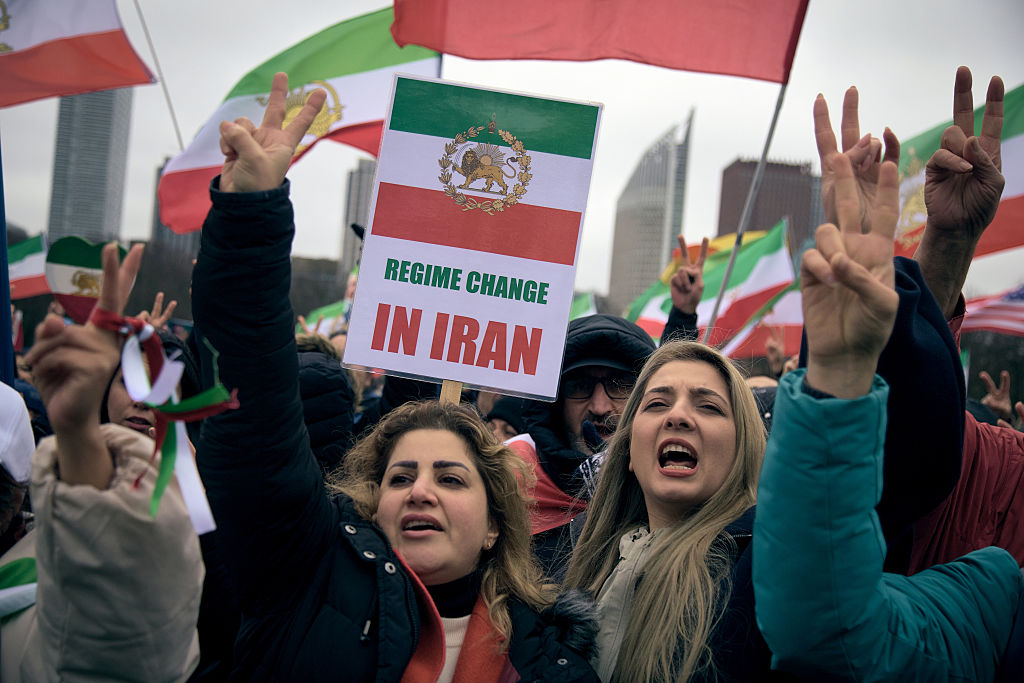
unleashed by Islamic terrorism originating in Iran, there was plenty of justification for some military action. Not to mention the fact that the regime itself was tottering and you had thousands of Iranians who went out into the streets, including many Iranian young people demanding political change, and just over the course of the last several months, the theocratic regime has cracked down and also been handing out destinences. President Trump had warned the nation that it had better not moved towards executing those who have been given destinences, but it's all just a part of the same picture. If it wasn't this issue today, it would be another issue tomorrow, and there's nearly a half-century of experience with two Ayatollahs, by now it's very clear to any honest person where that kind of experiment is going. It's good news that Ayatollah will not be a part of the future. Any way you look at it, we just have to say that's good news. The massive attacks undertaken by Israel and the United States have started a process
of remarkable change, but we don't know where that change is going to lead. We need to pray for the people of Iran. We need to pray for American and Israeli armed forces. We need to pray for peace, but peace is not just a stop to the current hostilities. It is the creation of a better situation for long-term stability and peace not only in Iran, but in the entire region. We also have to hope that the Iranian people, one way or the other, can take advantage and rise up in this situation and this opening. President Trump said in his address to the Iranians, he said, quote, this is the moment for action. Do not let it pass. One final thought, it is not likely that whatever comes out of this is going to resolve all the issues and all the sudden there will be a workable civil society in Iran and in Iran that exists in peace with its neighbors. But in a fallen world, Christian realism reminds us, based on our biblical understanding of sin and how human beings operate, if there is out of this a better situation that
could lead to an incrementally better situation that might lead over time to a better situation, that itself is an opportunity rightfully seized. And eventually, whatever happens in Iran is not going to be determined by outside forces, but the people inside the nation. Thanks for listening to the briefing. For more information, go to my website at AlbertMolar.com. You can follow me on Twitter or x by going to x.com forward slash AlbertMolar for information on the Southern Baptist Theological Seminary, go to spts.edu. For information on voice college, just go to voice college.com. I'll meet you again tomorrow for the briefing.
More episodes
More from The Briefing with Albert Mohler

Monday, September 14, 2026
The Briefing with Albert Mohler

Friday, September 11, 2026
The Briefing with Albert Mohler

Thursday, September 10, 2026
The Briefing with Albert Mohler

Wednesday, September 9, 2026
The Briefing with Albert Mohler