Loading...
newsdailycommentary
Nova Scotians aren't accepting cuts to their arts and culture
About this Episode
Nova Scotia Premier Tim Houston announced more than $130 million in budget cuts to several supports and programs, including sports, healthcare, climate change, and Black, Mi'kmaw and Gaelic communities. Although he's reversed more than $53 million in grant cuts, the arts and culture are still left to fend for themselves.
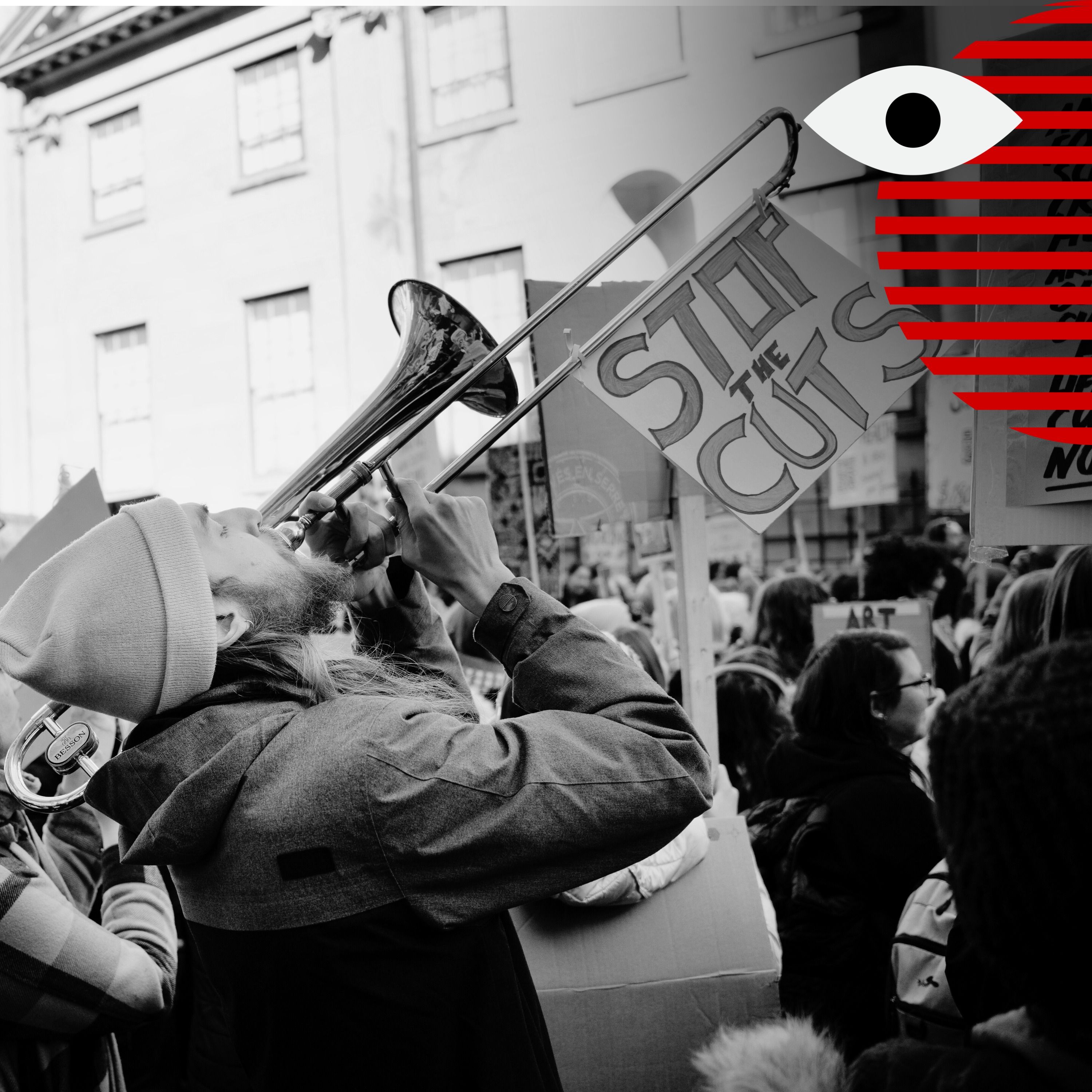
Protest against the cuts overall have broken out across the province, even making their way to the Oscars following Tamara Deverell's production design win.
Host Caryn Ceolin speaks to the Oscar winner herself, a BC native who lives in Nova Scotia, to discuss how government grants to the arts help put Canada's name on Hollywood's map. Then, Caryn is joined by Sébastien Labelle, a Nova Scotian actor and the artistic director of Mayworks Kjipuktuk/Halifax, about the ripple effect of Houston's proposed cuts, and why he's calling the move 'smoke and mirrors'.
Learn more about Mayworks Kjipuktuk/Halifax here: https://mayworkskjipuktukhfx.ca/
We love feedback at The Big Story, as well as suggestions for future episodes. You can find us:
Through email at [email protected]
Or @thebigstory.bsky.social on Bluesky
Hosts & Guests
Transcript
Frequency podcast network, stories that matter, podcast that resonate.
In the Oscars press room, moments after winning her golden statuette, Tamara DeVerald
used her moment in the spotlight on Hollywood's biggest night to send a message to the government
back home.
You know, arts are really important.
I'm living in Nova Scotia right now, which is getting arts cuts by our provincial government,
which is making it really difficult to support artists like me and Shane who need to grow,
who, young people who need to learn, art is important.
It's essential to our human culture and well-being.
The Cape Redden based production designer blasted Tim Houston's PC government for its
proposed cuts to grants for arts and culture in this year's budget.
Provincial governments all across this country are facing steep, record-breaking deficits
and now weighing tough decisions on spending cuts, putting funding for one of Canada's
most important economic drivers in limbo.
I'm Karen Siolin and today on the big story, we're exploring how cuts to the arts have
a ripple effect that hurt the economy.
First I'm speaking to Canadian production designer and one of Nova Scotia's newest Oscar winners
Tamara Deverell.
Then I'm joined by Sebastian Label, a Nova Scotian actor and the artistic director of Mayworks
Jabuktuk, a Halifax organization promoting the intersection of labor, social justice
and art.
Tamara, thank you so much for making the time to speak with me today.
I really appreciate it.
No problem.
Thank you.
Firstly, congratulations are in order.
You've just taken home an Oscar for best production design for your work on Frankenstein
that is truly incredible.
Congratulations.
If you could for a moment, just reflect on what that moment winning the Oscar meant to
you.
Well, you know, I was saying to Shane Vue, who was my con nominee and decorator at the
time, you know, I turned to him at one point, I said, if we win, we worked really hard for
this.
We really did and our whole team did.
And so I think the biggest meaning is to actually be recognized for that work is a
huge honor.
The thing that strikes me the most is I don't work alone.
I work with a fantastic team.
So really for me to win is for a whole bunch of people like everybody on the film is a
winner.
After winning that Oscar in the press room, you use the opportunity to condemn the government
of Nova Scotia for cutting millions of dollars in grant programs from this year's budget.
Mainly going to affect the province's art sector.
Why did you choose that moment to make that statement?
Because I'm passionate.
I'm passionate about the arts.
I mean, I didn't, you know, I'm standing there with an Oscar and how did I get there?
I got there through arts education, through culture, through, you know, grants for films
that I did, government grants for films that I did when I started.
And there's young people out there trying to start in the industry.
And they're being deprived of the same thing that I that got me to where I am.
So yeah, I'm going to use the Oscar to raise my concerns and my voice.
And you know, part of the reason I moved to Nova Scotia was because of the arts and culture.
And it's, you know, and I'm also co-chair of the Inverness County Center for the Arts.
And we have no money.
Like, that's our core funding, those provincial grants or not for profit, we're not, we're
not here to make money.
We're here to share art.
And that's really important to me.
Yeah, can you shed a little bit more light on why Nova Scotia was the place you chose
based on its, on its arts community?
And then also how your organization is going to feel those cuts?
Well, I mean, we looked everywhere.
My husband and I were living for most of our careers in Toronto.
And we wanted something different.
And I'm from the West Coast.
We looked at the West Coast.
We looked at the East Coast.
We looked around Ontario.
We looked in Quebec and we just, we had friends here, close friends.
And we kind of fell in love with just the, the natural surrounding beauty, the people.
I love the fact that there was a little local, very charming arts center that there's music.
And, you know, there's music throughout the winter we're finding, you know, there's
stuff happening all year round, you know, to kind of expose in the summer because there's
a great tourist industry.
But along with that, there are many visitors.
We have a lot of friends who are artists from New York.
There's people like Philip Glass, Joan Jonas, famous artists, Richard Sarah, who've been
coming here.
Robert Frank.
I mean, I'm a huge Robert Frank fan, as is my husband, you know, those, those artists really
drew us to the area.
And those artists are here because of the natural surroundings and because of the beauty and
the isolation and all those things that Cape Breton has.
And you are also among those names as an Oscar winner now.
I guess can you tell me a little bit about how those provincial grants in particular helped
to get you on the Oscars stage?
Like, what can you tell me about how those grants have helped you progress in your own
career?
Well, I've worked on many films that are, that little films, not big films like Frankenstein,
as I worked my way up in the career that were funded by telefilm, by provincial grants,
by, you know, I mean, this is mostly on Ontario, maybe a little bit in BC.
But I did do early on.
I did do a couple of films here that were out of companies working out of Montreal, but
they were funded by telephone.
So those things effectively made me able to work in a career that is a money-making career
to be honest.
It's, it's big industry.
And I guess that's part of the point is that, you know, it's still, it's still a form
of art, filmmaking.
I think our film, Frankenstein, was very artfully, very handmade, handcrafted, very well done.
So, you know, all those crafts people that work with, with me, are artists who get grants,
you know, they're working artists.
They do the, they do the films for the money, but to, to, to do their own art, they, they
rely on grants.
So I'm, I have a community of people that I'm surrounded by who really rely on, on those
grants for their livelihood and to be able to create art.
And you know, it's not, art and culture is not discretionary.
It is essential to the human, you know, to our human story.
How will future talent in your assessment feel those cuts?
They'll feel it in art education, you know, just from a grassroots level at, at our
Inverness Center for the Arts, we, we are volunteer run now.
We can't hire the, the right staff that we need to run effectively.
The youth and senior programming that we, we wanted to do, we won't be able to do that.
And to me, that's important.
Like supporting the youth in the arts is, is really crucial.
And it's not just to have a career like me as production designer in a big film.
It's, there's all kinds of facets to the arts.
There's all kinds of ways to have a career and to make money and to, to live and to
improve society.
You mentioned earlier that your organization or the Inverness Center for the Arts, that,
that, that it has no money.
I mean, tangibly taking away more of it, like what, what is that going to mean?
Well, a lot of the programming we were hoping to have, we won't be able to have.
We've had to cancel a music series, the Sunset series.
We're going to be asking for our membership to pay more money, which I hate to do.
But we're going to be asking, like, all over the place for more money.
And it's, you know, it's a sad state of affairs when, you know, arts organization that
actually draws tourists and visitors into the province and indicate Brent and isn't
being properly funded.
It, you know, it shows, it shows the government is really thinking about the future and,
and, and the economy of our province.
I mean, if you want to speak in purely economic terms, terms, we, we attract visitors.
We're part of that mechanism, that industry of, of tourism.
Mining is not such a big thing in paper.
And now, as we all know, so the tourist trade is kind of the mainstay for a lot of people.
So, you know, if there's no arts and crafts or not as much, people are less inclined to come here.
And then that's a drop in hotel rentals, in restaurants.
I mean, I don't need to list it all.
We all know how to fix this.
Yeah, there, there are certainly a knockoff effects.
And, and as you've just described, like arts and culture is fundamental to any city or community.
But why do you think, to borrow your own words, why do you think the government views your
industry as discretionary and not essential?
You know, I, I don't know.
I, I honestly, I can't answer that.
I mean, I think, I, I, I think there's a lack of understanding.
I think it's about big business.
It's about the stuff that, that I see the government putting money in, mining, fracking,
things that I don't agree with.
I don't think they're listening to the people because I don't know a single Nova Scotian
who isn't going, yeah, we need more arts education and, and it's crucial.
And it's so woven into the fabric of, of, certainly for, of Cape Redden and of, of all of Nova Scotia.
I mean, I'm just sort of seeing this repeat kind of having flashbacks to when they, they cut the,
the tax rebate for the film industry in Nova Scotia and the film industry died.
And we were lucky that we had a lot of talent, talented people.
Left Nova Scotia came to Toronto, worked in the film industry there.
Nova Scotia should consider themselves extremely lucky that they came back some of these people.
And that the film industry is actually doing very well here.
And the economy from that, the, the, the money from that film industry is spread throughout all
of Nova Scotia, you know, the various places they shoot, the rentals they get, the restaurants,
the hotels, the housing, all of that is essential.
So it is kind of, to me, a repeat performance by, you know, the government of, of making
uninformed decisions. And, you know, nobody asked them to lower the HST. Nobody asked them to take
the tariffs off the bridges, all these things that were little things, little things that,
really, they could have kept and they could have kept arts funding. So there's a thousand arguments.
Why? But I'll never understand.
Given that you've brought this issue to Hollywood's biggest stage, I just wonder if anyone has
reached out to you, like policymakers or politicians or otherwise, you know, who've, who've maybe
sought your input. No, I'm, I'm waiting for them to, to call me and congratulate me so I can,
I won't say, I don't, I won't say what I was good, what I'm thinking. But, no, you know,
it's funny how, you know, because I've only been here a short while. We've lived here part
times for the last eight years. And since Frankenstein, I've really been living here full time. And,
but, you know, a lot of Nova Scotians have, and a lot of Cape Bretoners are very proud. And I,
now I'm one of the team. I'm, I'm of this place. And, but I don't feel that welcome from the
government. But I will keep speaking up. So they can call me and I'll just give, I'll give them a
near full. Yeah, well, what would you say to them? But everything I've just said to you,
the importance of arts. And I sincerely mean it, you know, and I think it's a fool's game to,
to not, to, to not fund arts. It is what sets us apart from all the other animals on this planet.
We have art. We make books. We write. We draw. We create. We make films. You know, it's,
like to me getting an award, okay, it's great. But like that, that too will pass. But I, I had a whole
career based on being an artist, being artistic. And, and I'd love to see other people have that
opportunity. Before I let you go, I read that you've proposed a really interesting way to find
new sources of funding, which involves your Oscar. Can you tell me a little bit about that?
Yes, I got to, I got to, I'm going to bring it to the board. I'm sure they'll all be thrilled
because I'll bring the Oscar. But I did a talk recently, actually, at the Iverness county
center for the arts on, on my design in Frankenstein. It was a fundraiser. I raised 650
hard earned dollars for my, you know, one and a half hour talk. People came, they loved it. So I
thought maybe I'd do a repeat and then we'll charge a next to five dollars. You can hold the Oscar.
Hey, I'd pay that. I'd love to feel the weight of it. It's very heavy. It was not, it was a
tough night of first world problems carrying that thing around. I think I pulled my shoulder cuff.
Oh, I bet. Tamara, I will leave it on that note. Really appreciate your insight. Congratulations
to you and your team again. Just a phenomenal achievement. Thank you so much.
After the break, I'm joined by Sebastian Lebel, a Nova Scotian actor and the artistic director
of May Works, Jabok Tuk, to discuss how the arts can actually help fight a budgetary deficit.
Sebastian, thanks so much for making the time for the conversation. Today really appreciate it.
Well, it was my pleasure. Thanks for having me. Could you begin just by painting a picture for us?
How do the arts currently contribute to Nova Scotia's economy?
Well, the arts and culture sector contributes in many varied ways, economic and social ways.
Actually, the arts and culture sector does so much to a community, to a province, to a society
that's actually kind of hard to know where to begin. It's a broad question.
Yes, it is a broad question. But what we know comes from countless studies that have been made
about the impacts of the arts on our society. And so, if we were to talk about economics,
the Canadian Chamber of Commerce, working with the business and arts and the Canada Council for
the Arts, recently released a report which demonstrated very clearly the positive economic impacts
of the arts and culture sector across Canada in every province and that any dollar made or any
dollar invested in the arts sector has an incredible return. On the national scale, the study
showed that for every dollar invested in the arts, there's $29 in return of generated economic
activity. It's also demonstrated that the arts and culture sector is actually one of the most
dynamic sectors, economic sectors in terms of GDP, outpacing any other sector in terms of growth.
In Nova Scotia alone, the sector employs or generates 22,000 jobs across the province and that's
more than agriculture, forestry, and fisheries combined in our province. So, it's really not
insignificant. And in 2024, the arts and culture sector generated $2.6 billion to our GDP
here in Nova Scotia. So, it's massive the economic activity and return to an economy to a society.
If we're talking about the more social or qualitative impacts, then there's again been countless
studies to demonstrate the positive impacts of arts and culture on both physical and mental health
and on social cohesion and community well-being. And all those things are really necessary
antidotes to pressure on the health care system, in particular, the mental health care system
by really kind of alleviating the systems of the mental health crisis that we're living in
across the country. And it also reduces a lot of pressure on the justice and policing systems
by supporting social cohesion and community well-being and people feeling like they belong in a
community. So, that's just kind of a broad picture of some of the things that arts and culture
bring to us. Also, very positive impacts on education, both in terms of for kids in school,
having arts and culture engagement in school as a way to explore certain ideas and express
themselves and learn, but also in terms of using arts in curriculum. Like, for example,
there's more and more studies about the positive impacts of the arts or using the arts in
health care training for people who work in health care using the arts to better communicate
build empathy, but also understand the challenges that not only individuals on a case by case face,
but as a broader on a broader social systemic level as well. And yet, despite all that,
the Nova Scotia government has just announced a provincial budget that includes the elimination
of millions in grant programs, but the bulk of those cuts are going to be targeting programs
that artists and art organizations benefit from. I guess just tangibly, how will those cuts
materialize? Like, what will they look like? Well, what we know, I mean, the cuts haven't come
into effect yet. Yes, of course. But already, even in anticipating those cuts, there's already
kind of a chill across the sector in terms of people willing to make investments or take risks or
start new projects and stuff like that. Already, organizations have been told not to apply to
certain grants because they're not expected to exist in a month's time or even a few weeks time.
So there's already an impact even before the budget has been passed. But what we know if the
budget is passed is that across the entire gamut of programs available to artists and arts
organizations that there are cuts ranging from 20% all the way to 100%. So we know that depending
on what level of operating support that you're receiving as an arts organization, if you're a
recipient of that kind of support, you can expect either a 20% or a 30% out to your ongoing support
from government. So that's a huge reduction. And there's many programs like artists in the schools
and artists in communities that support artists going into schools or doing programs with the
elderly or with disabled folks, those kinds of programs are being eliminated completely.
The entire funding is being eliminated, which means that those projects or those programs will
no longer be able to continue. Will those organizations, I suppose, more broadly be able to sustain
themselves because as you mentioned, like a 20% to 30% reduction is huge. Yeah, it's huge. I mean,
it really depends on the organization. There are some organizations that will be able to make
some adjustments, finding different revenue streams or just contracting their activities
to adjust to the reduced budget. And there are some smaller organizations who maybe face with a
decision of do we keep trying or do we just fold, move somewhere else or do something else.
So it really depends because this is so across the board and impacts across the sector.
It's yet to be seen what exactly will be the impacts are and really depends on a case-by-case
basis. But certainly the smaller organizations are more vulnerable. The emerging artists or
the artists who come from typically underserved communities, so equity-seeking artists certainly
will face disproportionate impacts because their ability to withstand this kind of withdrawal of
support will be much more harder. And as you mentioned, it's to help the government tackle
an overall deficit of I think something in the area of $1.2 billion. I read your article on the
issue for the Canadian Center for Policy Alternatives in which you argue that arts and culture can
actually help fight a budgetary deficit. Can you just explain how? I mean, there's two things.
On the one hand, as you mentioned, like the excuse being used is that the province is in a
$1.2 billion deficit of the governments on making because when it came into power there was no
deficit. It was the healthiest economic situation that the province had found itself in a long,
long time. And now the government has kind of basically driven us into the ground with this
$1.2 billion deficit. And it's using that excuse to cut $130 million in arts and education and
community services programming, which is really a drop in the bucket of that deficit. So it's not
really making a dent in the deficit to cut all these programs. And if we're talking about the
arts alone, then that's 0.08% of the budget as a whole. So saying that making these cuts
this to help the deficit is really smoking mirrors. It's not helping solve the problem
with the deficit. Not only that, but it's actually cutting a revenue generator at the knees
or pulling the rug right up from under us. As I talked about earlier in this interview,
the economic return on investment in the arts is huge. And it's a huge economic driver.
And so really the arts are part of the solution of taking on a deficit. Not only by generating
economic activity, creating jobs, creating revenue for the industry itself, but for industries
surrounding support industries like the service sector, but also by expense reduction by
alleviating the pressures on the healthcare system and alleviating the pressures on the justice
system. So those are all things that contribute towards alleviating budgetary pressures.
So by cutting the arts, not only in a way that doesn't help really the bottom line in the immediate
sense, because of the scale of the deficit and comparison to the cuts, but you're actually
cutting a revenue chain. The premier here says that he's focusing on revenue generation. That's
why he's looking at the oil and gas sector and the mining sector to make investments rather than
but those are sectors that do not have the same economic growth GDP growth as the arts and culture
sector as was demonstrated by that study by the Canadian Chamber of Commerce. It's also projects
that are decades in the making. So it's a long time before we would see any real revenue generation
from those industries. And a lot of that revenue goes to shareholders that are not people
located in our province or it's profit that's concentrated very narrowly in these corporations.
Whereas in the arts sector, we're up and running as it is and we're through at the province,
we're in communities, we're generating all this revenue and it's revenue that stays in our
communities that helps people here and creates employment here throughout the province including
in rural areas. So it's really nonsensical this narrative that the current government is spinning.
As you've just laid out like the contribution the arts makes is is not insignificant
and yet the government said that the need now because of this deficit is to focus every dollar
on resources that make these are their words not mine. The biggest difference in a community like
education, like health care, what do you make of that argument? Well, I certainly investment
education and health care are really important but I think it's a false dichotomy to always fit
the arts against health care or against education because the arts as I've indicated previously,
arts are part of the health care solution. They're part of the education solution. Investment in
the arts improves educational outcomes and it allidates the pressure on the health care system by
improving physical and mental health in our communities and social cohesion and new well-being.
Really, it's not this or that it should be this and that investment in both so that the
health care system and the education system and the arts sector, all these sectors can collaborate
together towards a really holistic path forward towards solving a lot of the crises that we find
ourselves and by doing so also reducing our deficit. Sebastian, I really appreciate you sharing that
and appreciate all your insight today. Thank you so much. Well, thanks so much for your
interest. I really appreciate it. And that was the big story. We're curious to know what you make
of Nova Scotia's budget cuts and if you've been affected. Send us your thoughts on Blue Sky at the
Big Story or by email at helloathobakestorypodcast.ca. If you have an episode idea, be sure to send it
our way too. The Big Story publishes every weekday morning and don't miss big headlines are
daily five-minute news show hosted by my colleague, Regesh Dave. You can listen to that right here
on the Big Story feed. I'm Karen C. Olin, catch you next week.


