Loading...
leisureautomotive
Nowling on Data Cleansing, Karr on Web SEO, Beauregard on Financial Risk | Daily Dealer Live
About this Episode
Today's show features:
- Jeremy Nowling, Sales and Implementation Director at Rohrman Automotive Group
- Doug Karr, Principal SEO at Overfuel
- Michael Beauregard, Supervisory Special Agent at NICB
This episode is brought to you by:
Overfuel – Dealers: You’re torching $30 of every $100 in marketing spend when your site flunks Google’s basic performance test. Why keep using outdated website technology that's killing your profits? Overfuel is the new technical standard in automotive websites, proven to grow sales by 30%+. Whether you need more revenue or better support, they’ve got you covered. Go to https://overfuel.com/ and use code CDG500 in the comment box for $500 OFF.
Check out Car Dealership Guy’s stuff:
CDG Circles ➤ https://cdgcircles.com/
CDG News ➤ https://news.dealershipguy.com/
CDG Jobs ➤ https://jobs.dealershipguy.com/
CDG Recruiting ➤ https://www.cdgrecruiting.com/
My Socials:
X ➤ https://www.twitter.com/GuyDealership
Instagram ➤ https://www.instagram.com/cardealershipguy/
TikTok ➤ https://www.tiktok.com/@guydealership
LinkedIn ➤ https://www.linkedin.com/company/cardealershipguy/
Threads ➤ https://www.threads.net/@cardealershipguy
Facebook ➤ https://www.facebook.com/profile.php?id=100077402857683
Transcript
We're doing better as a result of social media presence.
It doesn't do those three things, man.
It's on the chopping block.
It's in return on investment discussion.
Hey everybody, welcome back to another episode of the Daily Dealers Live.
I'm your host Sam Darken.
Thanks for choosing to be here right now this Monday, March 23rd.
We've got a heck of a show coming up today.
We're talking about the stuff that's quietly costing you millions right now and a lot
of dealers in automotive.
Don't even see it.
First up, Jeremy Nolan is celebrating a grand opening of sorts, 20 store showroom on Amazon.
He went live last week and he's here to share us, share all about it with us.
Doug Carl from Overfuel is exposing why 92% of dealer websites are failing.
There's the millions of lost and how that's killing your traffic, your leads and your conversions.
We may ask Jeremy about this as well.
He's an expert on such things and then finally we wrap up with Mike Beauregard from the
NICB who's walking us through the fraud schemes hitting dealerships right now and the red flag.
Some of our teams might be missing today's all about data, digital showrooms, risk and
how to fix all of these.
Let's get into it and first today's auto industry headlines.
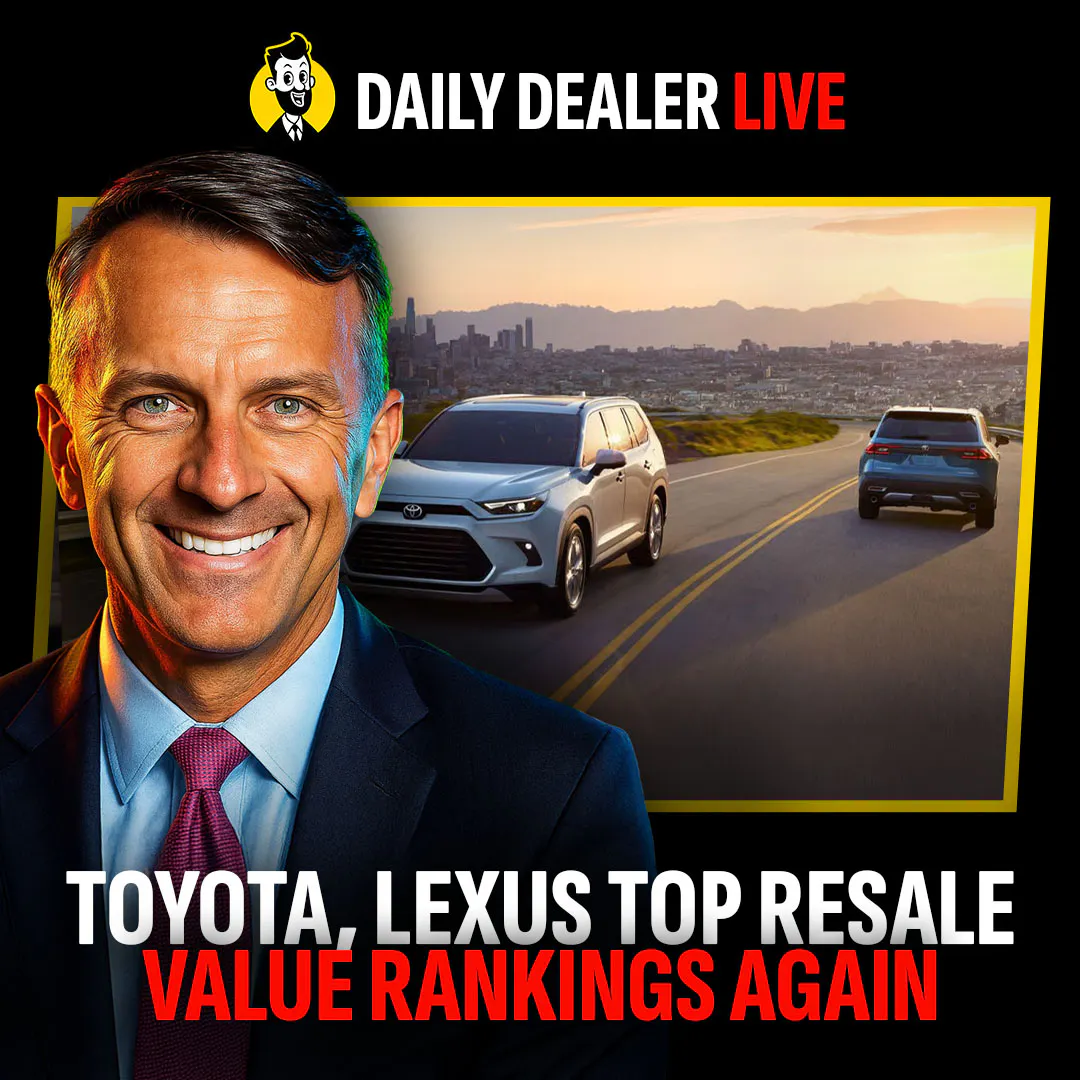
First up today, Toyota and Lexus topped Kelly Bluewood's annual resale value rankings
again in 2026, props to them makes it to it as 10th consecutive win and Lexus is 5th
straight.
More specifically, Toyota led eight of 16 mainstream categories with an average resale value of 53%
while Lexus topped three luxury segments at 47%.
For context, the average 2026 model year vehicle retains just 45% of its value after 5 years
with vehicles in KVB's top 10 holding 55% or more.
For dealers carrying these brands, that data is a useful selling tool right now given that
affordability is the dominant concern.
Shifting to other OEM news, Stellantis announced that Dodge G-Bram, Fiat and Maserati bev customers
can now access Tesla V3 and V4 superchargers in North America.
And as an aside, if you've checked out oil prices lately and all going on in the Gulf
of Hormuz, this is coming at a good time when some consumers might be reconsidering electric.
Owners of those Stellantis vehicles need an NACS to CCS-1 DC adapter, which is available
through Lev certified Stellantis dealerships or you can go to mopar.com.
Naturally, this gives Stellantis dealers more leverage in EV conversations, particularly
around range anxiety, which that's been one of the stickiest objections in this segment.
Now with an update on some unfortunate news, Hyundai has recently recalled nearly 70,000
Palisade SUVs in the US and Canada following the death of a two-year-old girl in
Akron, Ohio earlier this month. Reports say the child was pinned by a third row power seat
while her mother and another child were in the vehicle. And because of this, the recall
covers certain 26 Palisade and Palisade hybrid models with limited or calligraphy trim packages,
where the second and third row power seats may fail to detect a person and continue moving
after making contact. Hyundai says it's working on an over-the-air software update
expected by the end of March, with that permanent fix still in development.
For dealers, expect heightened customer concern around this nameplate and stay close to
Hyundai on messaging and remedy timing. And finally, we turn to the CDG Bicell Tracker for deals
to close out today. Carlock Automotive Group made its first move to Indiana, closing on
Carver Toyota of Columbus on March 19th and renaming it Carlock Toyota of Columbus. Meanwhile,
in Houston, Gilchrist Automotive picked up Team Gilman Chevrolet on March 16th, renaming it
Gilchrist Chevrolet and adding a Metro Houston footprint to a group that already owns more than
20 Texas stores. Out in California, Hello Auto Group closed two back-to-backed investors,
Hello Subaru, and Hello Mazda. Actually, I think those names are great. A Valencia in Santa
Clarita sold to Jerry Siner dealerships. We know them well. In fact, they were on a Subaru segment
in the past. And Garwati Auto Group, respectively, both closing within a day of each other in mid-March.
And finally, Lapis Automotive out of Houston tripled its portfolio in one move, closing on four
liver more stores, Porsche, Audi, Land Rover, and Honda from UManski Auto Group on March 17th,
bringing the group to six rooftops in two and a half years, props to Todd and the entire team
there. And that's our CDG Bicell update, bought to you by the CDG Bicell tracker,
which you can find all the time anytime 24-7 at CDGbicell.com. And that's our wrap on today's
auto industry headlines. Well, what a week it's been. What a week it's going to be going to our
social stream, which is a light this morning. Eager K says Carvana made another acquisition of
a CDJR store in Massachusetts from my friend. Lowercase Gordon now and talks to acquire another
store in Westward mass. The plan is to establish premises in every state. They're looking to corner
the market with CDJR dealerships. Not every state allows Carvana to put their vending machines.
So they found a loophole buying up new car franchises like CDJR dealerships. And we'll tackle
that topic in coming episodes. But Stellanis' partnership or a seeming partnership with Carvana
is super fascinating in terms of what their intent is, how far they're going to distribute,
and how that impacts the overall retailer world. So as a reminder, we're streaming live across
all CDG social media platforms today. You can post your comments in wherever you are. And they'll
come into our dashboard. We'll bring them into today's conversation. We've got a heck of a
conversation. I think we're going to spur a lot of talk about one thing in particular. We're going
to talk a little bit about the brand new showrooms that Jeremy Noling has created and opened 20 to be
exact just this past week to go for more information. Let's go straight to Jeremy Noling.
Sales and implementation director at Rorman Auto Group. Jeremy, welcome back to the show.
Hey, what's going on, Sam? How are you?
It's always good to have you here on the daily deal of life. So for those that may not know you,
just tell us who are you and what do you do out there?
Jeremy Noling, sales and digital retailing along with implementation director for the
Rorman Auto Group. I work with all 20 stores on innovation, tech, leadership, accountability,
you name it. It's Monday. So we'll see what we're jumping into tomorrow.
You know, and you and the Rorman Group are very forward thinking. Ryan's been out there on social
media and out there at any DA. I think he's going to a soda here in the next few weeks.
And he's very open in talking about his tech stack. A lot of people have been fascinated by that.
We may talk about your CDP and cleansing data and the percentage of data that's bad.
But before we do that, you open 20 new showrooms. Talk to us about how you open 20 in one week,
basically. And what have the results been thus far?
Well, maybe one week to launch, but it was a process that our CFO and another one of our
directors, Ryan, we put together over a period of 60, 60, 90 days, building Amazon storefronts.
So with Amazon, we have 20 storefronts that are now live like other sellers that are selling,
you know, everyday products on Amazon. So pretty cool experience.
So you said the first batch went live on Friday and then they've been going through the weekend,
you were a part of and you can see right here. So this is the way it looks. Talk to us a little
bit about what our producers are showing up on the screen right now.
Yeah, so I mean, really it's very comparable to a third-party marketing page.
In this instance, you can go end to end where the consumer can find their vehicle,
see the price, go through all the options of financing and products,
check out completely and then arrange a pick up to take place at the dealership on where
that vehicle is housed at. And so we went live in Illinois at the beginning of this month,
our Indiana stores, those 10 just went live last week. We've already had a consumer check out
from beginning to end, take delivery at the store. We received our funds and we actually have
a couple deals work and I literally was just on the phone 30 minutes ago with our key
a team because there's a consumer wanting to lease a vehicle now. So it's really
starting to work well for us. And could they transact the leasing through the
Amazon Auto Platform as well? Yeah, so with Hyundai, you currently can. Kia is
start currently going through the setup. So there's four OEMs that just went live with new cars.
So Kia allows you to list your vehicles Subaru Mazda and then obviously Hyundai.
Okay. So you were part of the Hyundai pilot that began maybe a year or so ago. What do you say
to the dealers that say, hey, it was underwhelming. There wasn't a lot of sales activity in the
Hyundai world when Hyundai made its debut on the new car franchise on Amazon Auto.
You know, Sam actually wild enough, we didn't go live with new Hyundai's back then.
We waited to see what the hype was like and we actually were approached and we were really
interested in the use cars going live. But as part of listing our use cars, we were allowed to
list the new cars and now we see the gain that could potentially come from having new cars listed
live on Amazon. So you held off participating in the initial pilot on the Hyundai new
to just kind of validate it. What did you see in the use space that led you to believe, hey,
this will work. We're going to jump on not just tow in the water. You brought all 20 stores.
We did. Yeah. So, you know, obviously you anywhere that you can have your vehicles listed in today's
environment is as a positive sign. But when you think about the players that were up against now
on the virtual showrooms, the carvanas and the carmaxes and companies like that that allow a consumer
to go into end-to-end on the transaction, why wouldn't you want to be on there for that consumer
experience? And when you think about the millions of consumers that currently have a garage or a
prime account, our inventory potentially is now in front of all of those customers as they search.
Yeah. So walk us through for the dealers that haven't seen this.
Customer goes in, they can go end-to-end in their Amazon Prime app. So just you can do it on your phone,
you can do it on the website. And basically, can I transact 100% of it at your stores in
Indiana and Illinois? Yeah. Yeah. Wet signatures need to be done at the dealership.
What are those wet signatures? Yeah. For like Indiana odometer statement, title application,
any dealer facing forms that are not inside of the platform, those would be signed at the dealership.
But other than that, I mean, it's just a regular online deal. And what about the finance step?
So customers, often times you'll see value in the products that are offered in the finance office.
They're intangible products. One of the challenges or criticisms of Amazon or any other
completely online process is the attachment rate isn't as good on FNI. What have you seen early on
and how is FNI addressed as a step on Amazon auto? Yeah. So as I said, we just went live. We did
sell our first vehicle. That consumer did choose to purchase gap insurance. But again, it's taken
the experience in allowing them to drive it. Just as we would, a consumer walking in the front door
that says, hey, I want to ride a check, but I don't want to buy any products. So again, there's a lot
of education that goes for the consumer to be able to make the decisions on whether or not that
product is beneficial to them. And again, it's not about wanting us to be in control. It's allowing
the consumer to still be in control. Us sell the asset and then earn a customer hopefully
in service down the road. So customer comes to your store to pick up the vehicle. What does the
process look like there? I know early on there was an idea of having a dedicated spot, maybe even a
dedicated uniform that had the Amazon auto has that been pulled through this final iteration.
And then you talk about retention. How do you retain that customer? First, what does that
process look like? Yeah, so the consumer can choose to have a full delivery or no delivery at all.
And if they choose to have a delivery, we're going to walk them through the service department. We're
going to walk them through the features. You know, Romanize it, right? And just making an overall
great experience for the consumer. What we're not going to do and what is not allowed is we're
not going to try to sit that customer down. And because they didn't choose a warranty online,
try to start pushing warranties on them. That's not the model and that's not what that customer wants
to experience. And so for our first delivery that we did, that customer was phenomenal.
Beginning to end, worked for a company down in downtown Chicago, drove out to the dealership.
She didn't want to be videoed as our first Amazon customer. Fantastic. That's way she didn't
part of that. But you know what? The rest of the experience was phenomenal. We had balloons,
a bow. They were welcomed by everybody and celebrated. And now we're on to other potential
customers now. You could argue that that customer, depending on what their buying habits are,
that might be a concuss for you, right? Because they may not have in the past driven to the suburb,
Shamburg, for those that know is about an hour drive. If you're coming from the city,
they may have chosen something closer to home. What do you think attracted that particular
customer to the experience at your store via Amazon versus a more traditional method?
It's tough to tell what attracted her. I mean, obviously it was a used vehicle that they sought
out on Amazon. And they just found the listings submitted their information. The price met their
needs. Because again, that price is what I have it listed for on the website. So it's just
everything aligned for that customer. There was no negotiations. It was, it was seamless.
So you mentioned that you can either get a delivery or not. Did she opt in for the
delivery or out? Opted in for the delivery. So we went over the pictures and everything on the car.
So is there a separate CSI for new cars anyway from the OEM, from the factory on Amazon
delivered vehicles if they opt out? Are you still held accountable to that standard? Do you know?
Yeah, that's a good question. I don't know that. I don't think that any new car customer is going
to show up at the store and say, I know everything about it. I think by the time that they've completed
the checkout, we've created a little bit of rapport with that customer through our back-and-forth
communication. And nobody's going to turn down understanding the new technology on the $60,000
car that they just purchased. So as you sell the car and you get the customer data, you want to
own that customer for life, right? You want to provide such a great experience that they're
committed to the Roman organization. How do you do that on a deal where the entire transaction
was transacted in the app? And you're kind of the very last step. You've got the balloons, you make
it exciting. They accept or decline the delivery. How do you retain the customer longer term?
Well, I mean, obviously the consumers still existing in our DMS and our CRM. So we're still
going to continue to try to earn that customer's trust and get them to visit our service departments
by continuing to send out the coupons and specials in the experience of what they received during
that delivery to know that they can still experience all of those benefits years ahead with that trust
and partnership. All right. Several questions coming online, which is great. Eager K says,
big congrats on the new acquisition. Eager K goes on, says, F and I menu introduction online for
every deal with full disclosure should help. And is there a menu in that step?
It's not necessarily a menu. It's like any DR tool that's out there on the market right now. So
when you think about like a roadster or an upstar, it allows the consumer to check the products,
be educated on the products and make the decision that's best for their transaction. So yeah,
it's all the information is there for them to decide on.
Another comment from Paul Salzman that I have a pricing question on use cars. Paul Salzman
comes into the chat says, is Amazon charging for this yet on the new or the use site? No.
Yeah. Are there plans? I'm sure there will be a model for it. We've discussed what that model
looks like. It's nonexistent so far. So again, if we're all paying for all the third parties right
now, why wouldn't we again want to take advantage of the one that has millions of customers
when they already have their PII and all their buying habits for free for whatever period of time
that is. And so that we're ready. I mean, think about it, Sam. We all remember when Carvana was
trading for $3 a share and they were selling our cars. Think about the model five years down the
road or three years down the road when more and more consumers believe in that end-to-end purchase
and our store friends have been live for years, gathering reviews and building a model process.
Well, my curiosity goes to the next question from yoga cars. Yoga cars says,
do dealerships trust Amazon long-term? IE Amazon basics came to compete with all partners
selling on Amazon. What would you say to the trust issue? That's a special. Yeah. Again,
Amazon's not looking to get into the auto industry. They're looking for the store friends.
So again, they'll look for media dollars. They'll look for advertising benefits.
They're looking for the consumer gains and understanding that consumer's garage.
But Amazon's not ever going to have 20 different brand new OEM locations on there.
Think about you went into it at the intro of the show like Carvana just acquired another
new car dealership with a goal of getting one in every state. I mean, this is our biggest
competitor right now and this is allowing us to compete against Carvana.
What you said, their goal is to get one in every state. Do you know this for fact?
Well, I believe that's what you said at the intro of the show was. Oh, did I?
Oh, I thought you said it was their goal to get a new car franchise in every state.
Okay. Now this is how I read it. Hannahed a fact check me and put it in slack.
I will see that. So listen, use car pricing is fascinating, right? It fluctuates continually.
As vehicles age, some dealer groups and dealerships have a pricing strategy or a pricing
decreases. I'm fascinated by use car pricing on Amazon because what's your pricing strategy
on those use cars? It's the same strategy because they pull that inventory feed directly from
our merchandising tool. And so it's the same price on Amazon as it is the third parties and it is
on our website. So again, I think the consumer's just choosing the experience that doesn't require
that back and forth with the dealership. They can just check out if they're okay with the price,
check out, pick it up later. Yeah. And so there's an integration between, I know you don't use
Viotto. I think you guys use tech. Well, techians are DMS, but we use Viotto as our merchandising.
Okay. So the Amazon tool, I think it's eight is, I can't remember who it is, but it would pull
the pricing data. So as it goes up and down, it's going to change and that pricing gets dished
up to the consumer, right? And then all the pricing's the same across all platforms. It's all fully
disclosed. How do they deal with dock fee in the app? Just curious. Everything's new. Yeah,
everything's told up inside of A to Zink, all of your taxes, dealer fees. If you have any accessories
on the vehicle, it's all in closing. Did the first new customer have a trade in?
This one had no trade. Okay. Do you own the trade if they did? We at the first right to the trade,
yes. Okay. And then if not, then Amazon would pick it up and they would distribute it
based on whatever method they do. That's correct. What do they do with the use car, actually?
I don't even know that. I'm curious. It's wholesaleed out through a partner. So
it's like a not manheim. It's the other one. Like an ACV or something.
ACV actually is the one. And it's okay. They allow that a little bit of range.
Customers praise value, but yeah, we get the first right to it. Very cool. Paul Solzman comes
back into the chat and says, the legacy advertising focused listing services should be concerned.
And I thoughts on that, how does this change the game in terms of marketing and reach
by distributing vehicles or at least making them available on Amazon?
You know, for me, I believe again that our vehicles should be listed everywhere if we're
trying to earn a consumer's business and trust. So right now it's, you know, you get lost in the
pages. So think about two different buyers. So one buyer is going down the Google route, which
takes them to cars.com and traders and all the third parties. And now you're lost in between,
you know, 30,000 use cars for sale within a 50 mile radius. But yet you go to Amazon,
that type of shopper, they end up on Amazon autos. And now you have an audience of maybe 3,000
use cars for sale. I'm going to fear a lot sooner and we'll give the transaction quicker.
And actually to the comment about trust between dealers and I think that's almost irrelevant at
this point. Amazon has trust with the consumer. And I'm not saying dealers don't trust. I think
they do. But Amazon, I just think Amazon has the trust of households. I mean, we all go on there.
We all buy there. We all know how the pricing works. What is the return policy actually, by the
way? So I buy a vehicle from you used on Amazon. Amazon is infamous and famous for their return
policy. It's easy to return something. Is that the same on this platform? It is. It's a three day
return policy. And again, you know, speaking like a car van or a car max, they have a return policy
of seven days or 10 days. So a three day return policy on an asset. I'll take that. Hopefully,
again, we've already met that customer's trust needs in once and what they're looking for in a
vehicle. And we should that happen at all. And then you know, the details behind it, like, is
there a per mile charge? Or is it just you? I believe it's up to 500 miles or three days that
the customer can return the car. And hopes of if that customer did choose to return that vehicle,
we can switch them to another asset would be my hope. Yeah. Through the Amazon app or is that
open? It's probably open, right? Yeah. Well, we would love to have you back on the show to talk
in particular about how this is working. I you know, uh, what would your message be to dealers that
say, Hey, I get it. I get the appeal. I get their distribution truly is elite. And no one else
really has a distribution channel like Amazon. But what do you say to the dealers that a little
little gun shy saying, Hey, their own advertising efforts are going to yield better results than
than going through a channel like that? You know, honestly, I would say on those, you can
challenge those against your third party close rates. Whereas this is an end to end transaction.
The only ones that you're handed off are the ones that they couldn't obtain the financing through
the lenders that Amazon has set up. You as a dealer are retaining all the profits. So you keep all
your profits on convincing the products and the vehicle. So like, what do you have to lose? And I
guess the other question would be is you can continue to wait. I'll love it. But you have the
advantage during all your listeners probably had something delivered from Amazon to their house
within 24 hours or past seven days. So there's just so many pluses to this.
You mentioned lenders. How many lenders do they have signed up?
And that's above and beyond the captive, right? So right now, the OEMs that are captive that
are doing this for the new side, it's Hyundai Ford does Ford do it through the new side?
Ford has their certified vehicles on, which I'm sure at some point you will likely see new
new Ford's on here. Kia, Mazda and Super Brawl Live. So all three of our Hyundai stores and all
three of our Kia stores are fully live on here. Have you heard any data from them that says, hey,
here's the number of customers that prefer to go end-to-end without any communication by a dealership
employee that want to fully execute on that start to finish? I mean, Amazon's quietest kept with
some of the data, which is I'd completely understand. But we do know that there are dealers that
are delivering vehicles, new cars on this specifically. And at the top of that page that he was
showing, one of the cool things that Amazon is doing right now, it's for not their prime month,
but if a customer buys or leases a new Kia throughout the month right there, go ahead and pause.
If you buy a new car, you get a $1,250 Amazon gift card. The customer does. So like, I'm
welcome beyond any OEM incentives. You get $1,200 bucks to buy or leashable. Why do they do that?
Because they're not charging you a fee. How do they make money right now? What does Amazon's play on?
You know, when you think about it, they're driving hype, they're driving experience,
and then they're earning a customer on their platform as well that went from buying,
you know, laundry detergent to buy a brand new vehicle on the platform.
Ah, yeah. That would be my thought, but I mean, it's retention.
It is retention. And I'm a very loyal prime customer. I know my daughter is as well, my son,
and you know, I think that at some point, this is going to be a new model. As we've learned from
the, you know, hundreds of thousands of vehicles that Carvana has already sold online.
Yeah. All right. We want you back to talk about this. I just want one follow-up item from your
last appearance here on Daily Deal Live. You talked how you had audited two and a half million
of your CRM records and you told us on that appearance that 48% of the records were bad.
You cleaned them all up. You created a CDP, a data lake. Ryan's talked a lot about that. You began
marketing to those. Give us the financial impact to the organization of now having that cleaned
up data and now marketing and selling to 100% legit data as per this new platform.
Yeah. We're not at 100%. It's still working through trying to find additional profiles to clean
and or a pen for us. But we are up to about 1.8 million valid records with emails and phone numbers
and obviously almost 100% of where the customers live. For us, it's led to seeing open rates of 30
and 40% on emails that we're sending out through the CDP, which is powerful.
What was the rate before? Well, man, I tell you, it was low. I mean, obviously,
with some marketing companies, we all know. But we use now orange media. Orange media handles all
of that for us. They provide us with all these good open rates broken down by audience.
Whereas with my CRM or most CRMs that are out there, it's a one to two percent, maybe three percent
engagement rate open rate customers. So for us, the click through rate is phenomenal. The open
rate is great. And you're getting that message to the customer more than likely than what you
were prior. So your most significant KPI increase is the open rate and the engagement.
Probably tough to quantify the impact. I'm fascinated. You cited the number of records.
You're not at 100% record cleansed. Why is it taking so long? Why is it such a long process?
Well, you got to think some of them you're not going to get records for. So if someone's deceased
or if let's say it was a business email and and that business closes down, you're not going to
get that new email for a business, right? But you will continue to gear at or more and more emails
as your customers go to file their taxes or update their profiles or things of that nature.
For us, it's been beneficial because I don't just have Sam Sam dark at Gmail. I know Sam dark at
Gmail Yahoo, your work email and everywhere else that I can reach that. And I score all of those
emails inside of my snowflake because all of those can't be stored inside of your DMS. So
I'm going to I'm going to get you one way or another. Sam, I'm going to get that. All right,
CDP data lakes, clean data, Amazon auto opening, 20 showfronts. What's the next thing you're working on
as we wrap up last question today? Oh man, we've got so many things that we're working on.
Let's just go with it. Spring selling season and we're ready to rock and roll. Maybe
the lemon automotive group. I love it. We're going to have you back at the end of the show for
the round table. Hang out. Jeremy Nolling sales and implement implementation director at
Roland rallying auto group. Go Purdue. Yeah. Norman automotive group. Yeah, that's what I say.
There you go. All right. We'll have you back at the we'll have you back at the end of the show.
Thanks for being here, Jeremy. All right. Thanks again. All right.
All right. It's always fun to talk to Jeremy and learn all the cool things they're doing at
the Roman auto group, including now, opening those 20 stores on Amazon. So let's talk over fuel
before we get into our next guest days, episode is brought to you by over fuel. Most dealership websites
suck. They're slow clunky and hated by both shoppers and Google. Well, over fuel cracked the code.
Lightning fast AI powered sites built to attract. Convert and dominate every search experience.
Is a time for a new website. Go to over fuel.com and use code GDC 500 in the comment box for 500
bucks off. Props to over fuel for supporting today's content, including that phenomenal conversation
with Jeremy at the Roman auto group about all things Amazon auto and data lake CDP. He's always
fun to talk to. And by the way, I appreciate his complete transparency. That was a question
we didn't get asked is what makes you so bold to come out and all of automotive and be so
transparent about everything you're up to. I believe it's probably similar to how we do things
as regular, which is the more transparent you are, the more you learn from others, they learn from
you. And at the end of the day, executing on stuff like this is or getting value from all this
is all about execution and not everybody is willing to execute, especially on some of the new stuff
that's going on out there. So thanks for being on the show. Let's turn now to Doug Carr,
principal CEO at over fuel. Doug, welcome to the show. How are you, sir? Great to be here.
Good, good to have you on the show. So hey, for our daily deal of live audience that may not know,
you tell us who you are and what you do out there. Well, sure. I joined the team of over fuel
about a year ago. I had worked in the SEO field across GoDaddy, Angie, Dell, a ton of different
companies. And I saw what these guys had built within the dealer industry. And I said,
oh, I really want to be a part of this one. So I am their main guy for SEO work there. And
we have a study that we just released that we're going to talk about today that's really exciting.
All right. Let's go into it and you say 92% of dealer sites failed Google. What's actually broken
with the websites? It's an interesting thing. When we talk about page speed, Google is talking about
user experience. That's ultimately what they mean. And so a lot of people, a lot of people think
about speed as being quote, a ranking factor. But really, it's a user experience and a visibility
factor. And so what we see is this our entire industry is right with problems where we're not
meeting the considerations and the expectations of our consumers. We're feeding them slow sites that
they have difficulty navigating. They can't find what they're looking for. It's slow loading.
It's slow to syndicate through all these other outlets. I loved what Jeremy was talking about
there. And so that's the key problem is that Google is saying, hey, your site has to be fast.
But the reason why they're saying your site has to be fast is so that your engagement is high,
your engagement on ad, your engagements on your map pack, your engagements on your website,
your engagements on your syndication. All of this has to be a high speed experience
that is just easy for the user to navigate. What's killing the speed? Why isn't speed just
a given in 2026 with so many tools and there's so much technology? There is quite a bit. One is
just technical debt. So we have older CMS sites that basically took the market by storm,
10, 15 years ago. And they can't really take advantage of some of these new technologies to
revamp their sites. The second is features. So we, you know, chatbots and 360 are probably key
ones there that they will just kill the user experience and speed on the site. And then there's
common ones like people put multiple Google Analytics tags on their site or Google Tag Man
or scripts on their site. And everything starts to degrade the speed of the site.
So speaking of that, Patrick Block Motiventures comes into the chat and says the amount of pop-ups
on dealer websites is brutal overall. So March 2026, Doug, what steps could dealers take to speed
that up so that they get out of that 92% of failing sites? I mean, the thing that they need to
watch and remember, 92% are failing. That means there's an awesome opportunity for a dealer to
really transition and change their digital showroom and get visibility. I mean, we're talking
1.4 times the chances of ranking number one on a keyword, 22 times the traffic that they can get
to their site just by just by moving that speed up. And so what they really need to watch is
every time they're implementing something on their site, they want to take a look at that site
and look at the page speed score. Okay. And what's a good page speed score? Well, Google
has its own, you know, basically model. They have a pass fail. It's a 90 or above is basically a good
and we're focused on mobile. Mobile tends to be where a consumer starts the customer journey.
They do move to desktop a lot in auto, but mobile is really that core one that we're focused on
when we're talking about, you know, where can people move the needle? Okay. Is this just dealer or
is it all the vendor partners that are part of this problem too? You mentioned all the pop-ups
and the bulletins and the anxieties and the integrations and there's so much of that now. We have
an incredible opportunity to fix this across the industry. We have actually worked with multiple
chatbots engines. We believe in chatbots. We believe that pop-ups sometimes enhance and engage the
user that may not have otherwise. And so we believe in those things, but the problem is is when
that degrades your site speed, it degrades how many people are coming to your site. And so it's
great that you can convert more, right? It's like putting a great salesman in your showroom,
but nobody can get to the showroom. All right. So what's the worst in March of 2026 feature or
plugin? You mentioned all the different plugins that are out there that kill conversion today,
the dealer should be wary of if it's set up right. Some chatbots are just incredibly degrading to
a site as soon as somebody puts it on it. You got to remember that your website is coming from a
single domain or a single host. When you pop up a chatbot, you're doing multiple things. You have
to talk to their host. If you have to talk to their website, if they're not doing things like
compression and using content delivery networks and all kinds of things to optimize their code and
compress their code down, that round trip just takes a ton of time. Sometimes more than your entire
web page takes. Now, and then they're moving stuff on the page. So if you've ever been to a web
page and you start to see things shifting around and moving and popping up, those things are really
aggravating to users. And so if they can optimize that speed, we've even taken some of the chatbots
and just said, Hey, please don't auto pop up. Turn that on and continue to watch your conversions.
And just by doing that, we see an increase in conversion rate and increase in speed,
which increases ranking, which increases visibility, which by the way is an auto pop up chat thing.
Is that even like, if I want more information, I'm going to go ask for it. To me, if I get too many
little pop up things when I'm trying to get into a site, it's really annoying because you've got
to clear it. I mean, if I need a chatbot, I should be able to go find it. So I think it's one of
the things that dealers really have to test. And the good ones, I think, are they're very good at
kind of preceding the customer journey saying, Hey, notice that you're researching this page,
you know, would these things be of interest? And so now you've captivated that audience,
but just the blank, you know, in your face, what's your name? What do you, you know, they can be,
you know, ours is, Hey, test it, test it, test it, test it, and see whether it's making a
difference. The problem that we do see is that a lot of these chatbot providers talk about the
conversion rate after, after they installed it. So the problem is, okay, you increased by, let's
say, 15% conversion rate, you increased the problem was you lost three quarters of your traffic
because you no longer rank. So which, which one is, you know, really helping you out?
All right. So to our general manager and our dealer audience who's watching right now,
what's one thing that a GM could do this week to fix the problem? First of all, you've got to
know it's there, but then what do you do to fix it? Yeah, you wanted, you want to do a page speed
insights test of your site. How do you want? Yeah, you want, and it'd be careful because a lot of
people do that and they don't have origin mode, which is basically you want to look at your entire
site. Your VDP is a destination page. So testing your home page really is just one factor. Most people
are landing on your search result page or your VDP, and that's what you want to be incredibly
fast. So test the VDP page. Test your entire site because the journey is right, that's the journey.
Someone goes to a VDP, then they go back to the search and they're navigating and they're
going in circles until they find what they need. And so you have to test the entire site.
And it's important to note that improving your page speed is a 28 day cycle. So from user
experience is basically a Google monitors what performance you have. If you increase your page speed
and pass today, you're not really going to see the results for another 28 days of where you
find when the rankings. So it's a big deal. And we've heard that often on the show that it's a long
term game. You've got to make consistent moves over time because Google counts only the consistent
effort towards goal. But something we've talked a lot about on this show, Doug, and we appreciate
you giving us the insight into page speed and how to fix it in some typical strategies. We've
talked a lot about SEO and Geo lately. How would you explain and plan English the difference between
SEO and Geo in March of 26? Well, I would say this that if you were a great SEO person 10 years
ago, maybe let's say five years ago, you're absolutely doing everything that Geo requires today.
Schema tagging and structured data on your site, incredibly fast website, incredible user experience,
syndication of your website, syndication of your listings, being on all the directories. Jeremy
talked about being where the customer is. When you think about AI, the biggest problems that we've
had with AI today is hallucinations and basically giving out false information. So AI is hungry
to validate hungry. And so you can no longer think about your website as your website is
central to the spoke. It's no. It's everything is central. And so you have to make sure that your
name address phone number, your nap and citations are everywhere. All of your information and profile
information is everywhere. And so when we're working with clients, that's what we're working on
their Google business profile. They're working on Bing. We're working on listings management. We're
working on their website. We're making sure it's all consistent. We're syndicating all of their
vehicles everywhere. And we're doing ads. So we're making sure that everywhere the customer is,
the data is absolutely repeatable, verifiable, fast, and structured so that AI can really devour it
and give it back. So as I'm creating that SEO content for my website, can I use AI generated
content? Or there's, I've heard an idea that that handwritten human-made content is
preference by AI. And that to me seems fascinating. I would say that's not true.
Okay. Personally, and we see it with our with our clients, just like everything else, humans
can be good and humans can be bad. What I will say is this, how you prompt and prep and provide data
to AI to produce that content is what makes it rich. And so we have we have fuel bot, for example,
where we take the bin, we have every aspect of what that vehicle is about. But we combine that
with location data. We combine that with obviously review data and everything else. So we create,
we utilize AI, but we're utilizing a number of sources to make a really rich thing. That's
pretty hard to compete with if you just gave that to a copywriter. Yeah. Yeah. That's fascinating
that there is some difference, difference of opinions. And I thought when I first heard this,
that AI would preference AI or human generated content, to your point, not everybody writes good,
right? So those that have a challenge with that are going to not represent their best selves. AI
could do it better, but I feel like there's a human need for more gent authentic human made content.
And I think people generally prefer the human made content. I can usually tell things that are
created by AI, right? We definitely want the we definitely want the dealer's voice in their
and verbiage and you know how they present themselves and how they differentiate themselves.
That's absolutely critical to the sales process, right? Yeah. All right. Last up question,
we appreciate your time on the show sharing perspectives on imports of page speed and making
sure that you're creating your correct SEO content. What's the cost of not addressing page speed?
I mean, you know, there are price some dealers that might say, hey, you know what, 92% of dealers
are have slower than ideal slides for Google that aren't providing the elite experience.
8% have a little bit of the benefit, but my gosh, you're with 92% of rest of automotive. Why not
just, you know, go back to selling cars, right? Focus on the showroom floor, Doug.
Well, Shift Digital has done a number of studies on this on what it actually costs, but you know,
for every dealer, obviously, it's different. My question to a dealer is that if you could get 22
times the high engagement visitors, your digital showroom, what is that from a price standpoint?
And I'll say this, when I go to these dealers, they've bought incredible real estate at Crossroads
where there's tons of traffic. They've built this incredible showroom. You know,
they have their coffee, you know, station and everything else. And then they have a digital showroom
that nobody sees because it's slow and sluggish and everything else. And my point is everybody's
on digital first. So you're just hiding your showroom when you're not, you know, when you're not
making it a superior user experience and fast. I need to ask Jeremy about this, but you know,
maybe when the shortcomings of automotive today, you know, he's opened his Amazon auto showroom is
we calculate all those digital costs as the cost per vehicle sold. We don't do that to your point
with physical facilities, right? To your point, their beautiful physical facilities. And those are
just fixed costs that just exist. But in online, it adds up per vehicle and that ends up being
staggering. Yeah. Why did Amazon get where they were? Incredibly fast websites, right? I mean,
that's the Amazon is probably the king at producing the fastest user experience. And so maybe we
should follow suit. Yeah. And on that comment, I can't imagine a better bike job. Principal CEO,
Doug Carr, over a fuel. Thanks for joining the show today. Great, great, be in here, Sam. Thank you so
thanks. Thanks for the conversation. Yeah. You know, a lot of great comments online from dealers
talking about the websites, but my favorite obviously is the number of popups on dealer site or
brutal. And I couldn't agree more with that. And you know, we transitioned from Amazon auto and
online to the speed of websites to the speed of the bad folks out there trying to steal our stuff.
Let's go to Mike Beauregard, super visory, special agent at NICB. Mike, welcome to the show.
Thanks, Sam. Appreciate you having me on. Hey, Mike. So I've been in the automotive industry for
decades. And back in my time at Zurich, you know, we sold antithep products, etch some others.
We always quoted NICB stats, but I never actually ever met someone from NICB. So tell me who you are
and what does NICB do and why is it such a credible resource for folks when they're trying to figure
out theft in the world today? Oh, we might have lost Mike, but I'm sure he'll be back in just a
moment because what I want to ask, what I wanted to ask and I can hear you, Mike. Can you hear us now?
All right. As soon as Mike comes back, we'll see him on screen there. There he is. All right.
Who is an ICB? And what do you do out there, Mike?
It's the it's the third guest challenge, which we're running up against again today, I think.
So let's give our producers just a moment. David FriendCon says, thank you, Doug.
That's reference to Doug's insight. And then Marv 48 comes into the comments.
This question for you on, how can a store best or praise a car service?
Here is over 300 cars a day. Oh, you can hear me now. Fantastic.
I'm waiting for you to pop back up on screen. There you are.
There you are. Mike, tell us what you do. What does NICB do?
All right. You know what we're going to do. So Mike is having some technical difficulties.
And you know, this is one of the challenges of live programming. Last time we went through this,
I learned I just need to give everybody a little bit more time because he will be back.
They can figure this stuff out. But NICB back in the Zurich days, we used to sell etch.
And we quoted the etch statistics for theft. And it helped us develop value in the product of theft.
And what the reality with automotive theft today is that vehicles have gotten more expensive.
Bad actors have become become much more sophisticated with AI and other technologies.
And the the lure of theft has become almost undeniable for the bad actors out there trying to
take stuff. And so the intent with Mike today is to bring him in and have a conversation on
what are the sorts of theft and fraud schemes that are hitting dealers the hardest.
And how are organizations like NICB assisting dealers to identify those thefts and to fight those
thefts? And you know what I'm going to do because we are at 10 minutes to, I'm going to bring Jeremy
Noling back on and actually bring Jeremy back up. And then if we do get Mike, we'll bring him in,
we'll do a round table conversation. Jeremy, what's up? We got you back. Actually, you know what,
if Doug Carr is still there while they're working out Mike, let's bring Doug in. We'll do a we'll just
do a little round table here so we don't kill kill all of our time because we've got so much
conversation. So if Doug is still around, let's bring him up. If he's not, all right, we're going to
bring him into our third box. You know, I got to tell you, Jeremy, I drive the producers nuts
because I am not a fan. When we run into technical difficulties, it's like, let's go. Let's
pivot. Maybe let's go. Let's pivot. So what I'd like to do is I'd like to bring Doug back in,
Jeremy. And I'd love to, I'd love to get your perspective on what Doug is talking about on
web speed, page speed. What, what have you identified as a problem in March of 2026 as it relates
to web speed, page speed, and how have you dealt with that at the Roman auto group?
Yeah, I mean, think about it. So like if your page drops, you could potentially lose that
customer. I mean, if that customer starts to fill out a lead form, and then they go back 30
minutes or 20 minutes later and they hit submit after they need that, that customer's lead likely
isn't getting into your CRM. So we partnered with our friends at four eyes on that product. So
we now capture if a customer doesn't get all the way into your CRM and it identifies it and gives
you that customer. Yeah. Doug, is that a problem? Is that, are you able to identify folks like,
is that's a need a capability that's needed within automotive to be able to see people that bounce
off that don't aren't able to successfully engage with our apps? Absolutely. And if you can't
identify the customer, you can at least identify who has bounced and who has exited, you know,
and you see that I want to reiterate too. We talk about the website a lot, but you see it everywhere.
You see it on map pack. If someone clicks over to your website and it's slow, they click back to
the map pack and find another dealer nearby. If they click on your ad and it's slow, or your ad
doesn't even show up because your page speed is slow, so your ad score is slow, so you don't get
prominent, you know, ranking on your ads. You see this everywhere. It's a trickle-down effect that
basically impedes every part of your sales. So, let me ask you this, Jeremy, you come on shows
like this and you openly talk about, hey, what are the challenges that you're encountering at
Roman? I talked a little bit about this in my segue, and you and Ryan both are very transparent.
Why do you do that? Because everybody out there in automotive is hearing these ideas and these
best practices, and there are probably some that are running towards trying to accomplish and achieve
the same thing, and that's competitive, right? I think, Ryan and I, you know, and for that matter,
a majority of everybody in our group, you know, we've all been watching the transition,
take place in the motive, and it's not going to slow down. So, the more that we can help,
other dealers adapt to the newest model, or the latest process, or the newest tech that's actually
working, you know, I think that that makes us all better. And it actually helps us to strengthen
our relationship with vendor partners, because then they're more adaptable to getting everybody
to work together to make the auto industry better. We're usually the last to evolve in all aspects,
and for customer experience, but, you know, some of the, the vendor, of course.
Are we Jeremy, meaning auto dealers?
A lot of dealers are tend to be the last to a day, and I'm sure that there's somebody
shaking their head no right now. I'm never getting on Amazon. Okay. Let's see how that works out
in the next few years. Well, you know, I think some are slow to adopt, but also some kind of
hold out with hope, right? Hoping that, hey, they can still, and you know, it's interesting. I think
part of the debate is who's going to control the customer, who's going to control the data,
who's going to control the experience. And at the end of the day, it's 100% the wrong question.
It is the wrong.
Data is, data is everywhere. Everybody has it. What I want is, I want that customer to say, hey,
I really want to come into, I'll say Ziegler, particularly where we share a footprint. So it's
very fine line. I want them to say, hey, I want to come into a Roman store, a Ziegler store,
and I want to have an experience with you all. And in sharing data helps us achieve and accomplish
that whenever we refuse to share with our vendor partners, OEMs, that's where you get a fragmented
process, right? And you know, you asked me a question before the break, and you know, one of the
things that we're working on is, you know, how do we get, how do we get back at the independence?
So, you know, you had Zach on last week, and like he said, it's 50 bucks. It's 50 bucks, right?
Yeah. Yeah. We're continuing that 50 bucks campaign across all of our stores. It's doing great.
I'm at a store right now. They have almost a three day wait for oil changes. It's insane. But,
you know, to continue to evolve together, I think it strengthens all of us together.
And you got to have a fast page speed, right? Mike, to deliver on that. So Mike, or I'm not Mike,
Doug, Doug, Doug, our principal CEO at Overfuel, we're going to do now as we've resolved our tech
issues. So, Doug, thank you for being on the show. We're going to flip Mike in, and then we're going
to have Mike and Jeremy join us. Thank you so much for being here and being patient through
our technical difficulties. So, we'll make that switch. Jeremy, hang out with us. Sure.
And we're going to bring Mike in. You know, it's 2026. We landed a man on the moon, and now we got
our three, three screen. All right. Get it up. Jeremy, hang out with us here, because I think we're
going to have an interesting rant table conversation here. Mike, just tell us what on earth is the NICB
do, and how do you help dealers prevent fraud in the world? Absolutely. So, NICBs have been around
for over 100 years. We're a nonprofit organization. We're funded by our partners,
insurance companies, finance companies. You mentioned a few of our Carvana, ACV, all member companies.
And what we do is we partner with the insurance companies in law enforcement, and we try to get
cases worked by training education. And that's where I think love this format. I love this
the idea, because although car dealerships are not and actually member companies, the finance
companies, the insurance companies are. And if we can stop the fraud on the front end rather than
to deal with it on the back end, where people have already lost their product, or they lost the
financial interest, that's what we come in. All right. So, March of 2026, first round table discussion
here, Jeremy and Mike, what's more dangerous in March of 2026, bad data or fraud?
I think it's both. You have to pick a side, Mike. And by the way, if you don't say theft,
that's going to be very disappointing. We have so much fraud right now in California throughout
the country. What is the most alarming form of fraud that you're seeing from a trend?
Are there any new fraud trends out there? Yes. So, what's really popped up? It's been going on
for a while. It's a lane hold of fraud, where they go out and purchase a vehicle or lease a vehicle
within weeks of purchasing or leasing the vehicle. They get the lane holder washed off the title,
they get a clean title, or quote unquote a clean title, and then they go sell it to a dealer.
And this is how we're talking hundreds and hundreds of cars, organized groups. And it's all over
California that I know, but I know entire country has the same problem. What can dealers like Jeremy
and me do to prevent that from happening? So, on the selling part, a lot of what's going on,
they're giving their right information, names, address, data birth, all that. A lot of them from
out of the country. They have a great credit score. And so, everything checks out,
but I don't think they're doing enough on the employment side. Just because you bring in a
paycheck stub saying you've been with a company for 15 years, making $15,000 a month,
technology is here, right? I can have any document. I've seen incredible kinds of titles coming in from
China. Drivers license. It's amazing how much fraud and that is coming in that has made overseas.
So, big, big problem. You know, you cited a couple of things. Document fraud and AI is
getting good at helping bad actors create false drivers license, in proof of income, all those
things. Why in 2026 aren't there better tools to help lenders and even us dealers validate things
like income residency and whatnot? We shouldn't in 2026 have to validate that with a paycheck stub.
That just makes no sense to me. Jeremy, am I wrong? Again, we're the last to everything. So,
let's just be last to this experience as well. Why is that, Mike?
You know, I'm not sure. I think there are some things out there. I know for drivers license,
there's companies that have machines that you can put in state license from all the states and
federal IVs and validated it right away. Carmex uses that every day. Yeah. So, that's one of them,
but the identity theft, that's a tough one because, you know, as we talk about this, dealerships
are all about customer service, right? Yeah. Long-forcement looks at people a little differently
than dealerships do. So, that's why I think it's a great partnership that long-forcement has or
should have with dealers. And I don't know if Jeremy, you have any long-forcement that comes and does
training regularly or people like all of the taskwriters that come and talk about trends. I think
that's a big, big partnership that I think we're missing. I have some great partners here. I'm
here because one of the partnership, Dennis, who recommended me to come on this program. Dennis
Kingerich, yeah, he's a huge fan. He's been on the show many times. Dennis and Tolley, so, yeah.
Yes. And it's one of the things that he incorporates into his compliance training is he hasn't come out
to talk about things going on. I bring out people from out of that task force.
Funny story, we just finished the compliance training. We were talking to one of the employees.
They had lost a van several weeks ago. The detective I had within an hour had the car recovered.
So, having those relationships and emails to leverage those is huge. And I think that's where
the deal is need to go. So, Patrick Block Ventures comes into the chat says, does the NICB
have APIs to hit to help with fraud and theft validation? You're not selling a product. You're
selling the data. You know, we're a member companies that come in. We connect long-forcement,
the insurance companies, the prosecution. We use our experience. I have 30 years with
top point out troll, 25 of you put that. So, I get a question of claims and I'll work those
up into good cases and then bring them to long-force for prosecution. All right. So, Jeremy,
this is, you know, when you talk about Amazon Auto and you talk about opening this virtual showroom,
it seems to me that all the tools Amazon has to validate. They've probably got fraud tools
written into the tool. At the end of the day, customer can go start to finish.
Do tools like Amazon Auto start to finish? Do they change the way we think about fraud, theft,
and bad actors within the auto buying space? Yeah, I mean, when you think about it, Sam, it's
it also takes it back to this is that person's actual prime account as well. But more importantly,
yeah, people are still doing the validation of that customer. So, we're not delivering the
car to the customer's house. We have one designated champion at each store who greets that customer,
verifies all of their income, it required driver's license. Everything that we normally do on
any other transaction is still taking place at the dealership. Yeah, very cool. Do you think digital
tools, Mike, will make fraud less likely in the future? Will AI and digital retailing tools
reduce instances of fraud down the road or will they increase it? Well, you know, technology is
always good, but there's always ways that the criminal element takes it and use it in a bad way.
It's like car dealers. Yeah. You remember the the old days where we had a metal vent plate with
rivets? Yeah. That's gone. It's all my large stickers. And how easy is it for the modern-day
crook to get a nice computer print out of my large sticker? And it's so easy. So technology helps us,
but it's also taken to the criminal side. Mike Beauregard, Supervisory Special Agent at the
NICB and Jeremy Noling, Sales and Implement Ditation Director at the Roorman Auto Group. Thank
you both for being on Daily Deal Live for the special round table. Thanks for being here. Thanks for
having us. Have a great day. Thank you. Hey, and I apologize for some of the technicalities. We'll
get rid of those little gremlin sitting in the tech side of this thing eventually sooner or later.
But to you, we appreciate you for watching Daily Deal Live where we break down the biggest
moves in the car business as they happen. Don't forget, we're live every Monday, Wednesday,
Friday, which means this men, this Wednesday, 1 p.m. Eastern, tune back in. I think we've got
Scott Painter with Drew Car coming on. We'll talk a little bit about the FTC letter that
rocked automotive a couple of weeks ago. So if this is your world, hit like, hit subscribe,
turn on those notifications so you never, ever miss a beat. And we'll see you next episode. Thanks
everybody.
You


