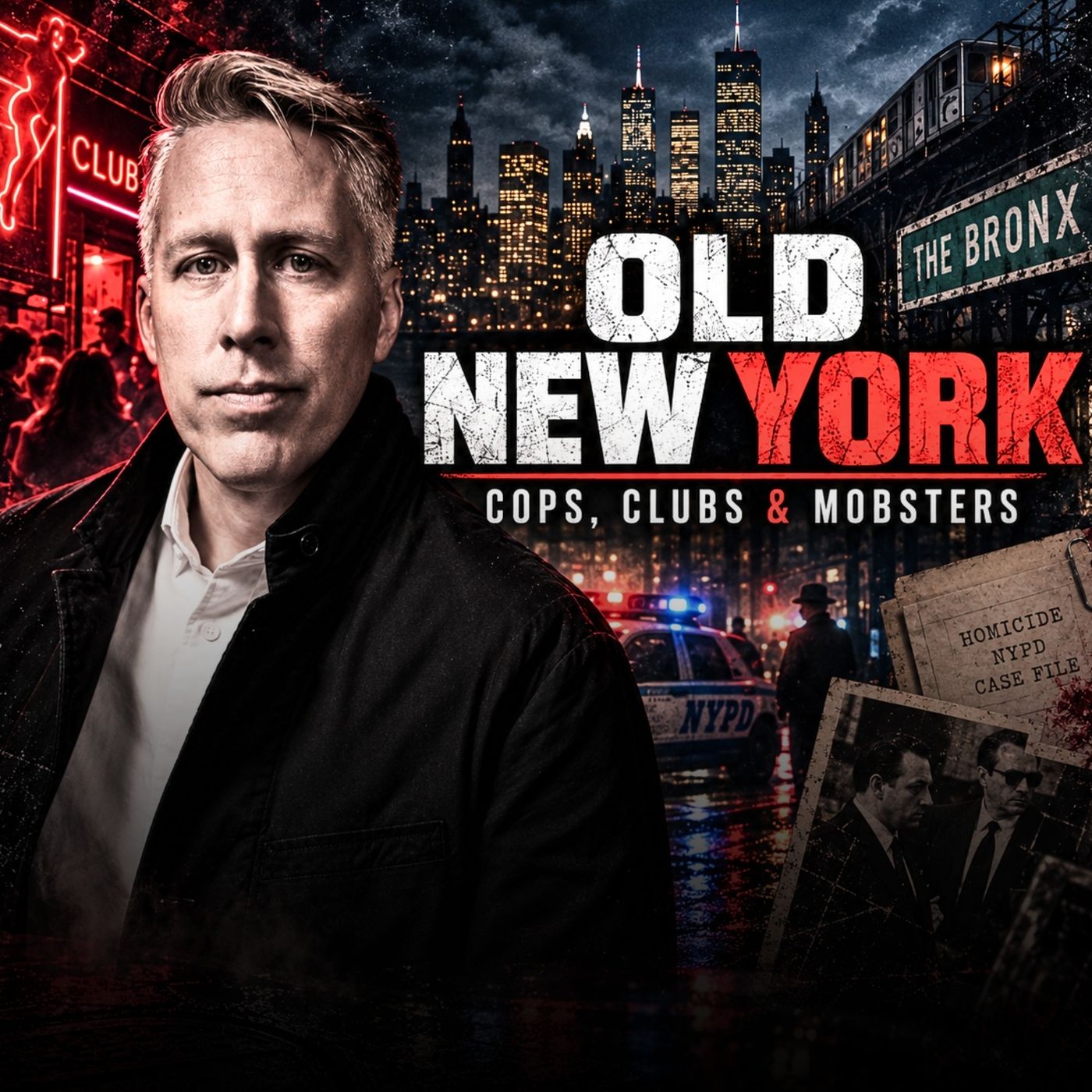
NYPD Detective on Murder, Mobsters & Old New York | Jason Allison
About this episode
Get Jason's book "The Killing Yards" here:
https://a.co/d/09pXcZeT
or here:
https://www.penguinrandomhouse.com/books/830859/the-killing-yards-by-jason-allison/
Today's Sponsors:
GhostBed ⬇️
https://www.ghostbed.com/house
FOR 10% off!
Blue Chew ⬇️
https://bluechew.com/
Get 1 month free when you buy 2 of BlueChew Gold with code "HOUSECALL"
For ad free video and audio and access to live streams and Eyes On Geopolitics...JOIN OUR PATREON!
https://www.patreon.com/c/TheTeamHouse
To help support the show and for all bonus content including:
-live shows and asking guest questions
-ad free audio and video
-early access to shows
-Access to ALL bonus segments with our guests
Subscribe to our Patreon! ⬇️
https://www.patreon.com/TheTeamHouse
Support the show here:⬇️
https://www.patreon.com/TheTeamHouse
___________________________________________________
ORDER JACK'S NEW BOOK "THE MOST DANGEROUS MAN"
⬇️⬇️⬇️⬇️⬇️
https://www.penguinrandomhouse.com/books/803651/the-most-dangerous-man-by-jack-murphy/paperback/
Subscribe to the new EYES ON podcast here:⬇️
https://www.youtube.com/@EyesOnGeopoliticsPod/featured
__________________________________
Jack Murphy's book "We Defy: The Lost Chapters of Special Forces History" ⬇️
https://www.amazon.com/We-Defy-Chapters-Special-History-ebook/dp/B0DCGC1N1N/
——————————————————————
Or make a one time donation at: ⬇️
https://ko-fi.com/theteamhouse
Social Media: ⬇️
The Team House Instagram:
https://instagram.com/the.team.house?utm_medium=copy_link
The Team House Twitter:
https://twitter.com/TheTeamHousePod
Jack’s Instagram:
https://instagram.com/jackmcmurph?utm_medium=copy_link
Jack’s Twitter:
https://twitter.com/jackmurphyrgr?s=21
Team House Discord: ⬇️
https://discord.gg/wHFHYM6
"Karl Casey @ White Bat Audio"
00:00 – Start
01:18 – Growing Up in the Bronx
06:07 – What 1980s New York City Was Really Like
09:02 – Crime, AIDS & Giuliani’s New York
14:31 – The 1990s NYC Club Scene
22:20 – Why Jason Became an NYPD Officer
24:39 – Starting Out as a Bronx Patrol Cop
28:21 – Street Racing, Prostitution & Hunts Point
31:08 – CompStat, Quotas & Policing by the Numbers
36:51 – Joining the NYPD’s Anti-Crime Unit
41:55 – Narcotics, OxyContin & Making Detective
49:14 – Becoming a Bronx Detective
53:34 – Working Homicides & the Victims True Crime Ignores
1:03:19 – Cooperators, Federal Cases & Building Bigger Investigations
1:08:08 – The Suitcase Torso Murder
1:09:08 – How Detective Work Changed With DNA, Cameras & Body Cams
1:22:39 – The Murder Case That Ended With a Severed-Head Selfie
1:26:19 – Joining ATF & Going After Armed Robbery Crews
1:29:28 – Tracking a Watch Store Robber Across the Country
1:34:04 – The Murder Case That Stayed With Him
1:38:39 – Surveillance From an NYPD Helicopter
1:46:17 – Retiring After 20 Years in the NYPD
1:55:05 – Trying to Reinvent Himself as a Writer
2:01:23 – Crime Fiction, Male Readers & the Writers Who Influenced Him
2:02:29 – Discovering His Half-Brother Was Also an NYPD Detective
2:08:10 – The Departed, Ambition & What Drives Criminals
2:14:29 – Russian Mafia, Israeli Organized Crime & the Diamond District
2:17:42 – Writing The Killing Yards & Recreating 1990s New York
2:19:22 – What Jason Is Writing Next
2:20:24 – Closing Thoughts
Become a supporter of this podcast: https://www.spreaker.com/podcast/the-team-house--5960890/support.
Get every episode summarized
Each time The Team House publishes, we email you a written briefing from the transcript — the topics, who appeared, and any specific claims, with the ad reads skipped.
Email me new episodesFree for 3 shows. No card needed.
Hosts & guests
Transcript ready
2,588 searchable segments. Every word is indexed and playable.
Full transcript
The Team House — NYPD Detective on Murder, Mobsters & Old New York | Jason Allison. Machine-transcribed; use the interactive transcript above to jump the player to any line.
Hey folks, I'm Jack Murphy. This is the teamhouse and I'm here with our guest today, Jason Allison. He's the author of the Killing Yards, which will probably be out as you guys are seeing this September 22nd. It is a release date. It is a noir detective novel. I mean, it involves the police, but it also involves the 1990s club scene. The Russian Mafia, the Israeli Mafia. I mean, everybody's got a hand in these clubs. And there's a pretty epic conspiracy unfolds in the book. I really enjoyed it. It's interesting that you set this in the 1990s. I grew up as a kid in the 90s. And now I'm seeing my generation have this very nostalgic view of the 90s, which it really isn't a nostalgia. It's like it wasn't as great as you think it was, guys. You're a little bit older than me. And you were a professional or an adult and then becoming an NYPD detective.
So you have a little bit of a different sort of perspective on the 90s, I think, than many people my age do. Yeah. I mean, I grew up in the Bronx. Where'd you grow up in Sleepy Hollow, New York? Oh, okay. I lived not too far from you for a long time. But yeah, like I grew up in the Bronx. And I'm 50 now. So in like, I became a cop in 1998. And before that, though, in addition to being a cop in this city and the detective, I was a club kid. And so you're living that Bohemian New York City lifestyle? No, I was the bridge and tunnel trash that was trying to get into the clubs that couldn't get into the clubs. Because I was never cool. Because I didn't drink and I didn't do drugs. But the good thing about that is I was able to watch all the stuff that other people did. And so you kind of remember it and that when you're young, you know, whatever you're doing when you're young, you kind of becomes formative, right? Sure. Like, I don't know how old you are. I think I heard on that episode. You were like 19 when you joined the military. So that becomes like, that's concrete now for you, that era for the rest of your life.
And that era for me was concrete. And also, I don't like doing research very much. And I don't know, like for your novel, I don't know how much research you had to do because I think my envision of you is that it's all in your head. For that novel, yeah, I wasn't research intensive. And I also got to the point as a writer where I realized like, if I'm really digging into the literature, trying to find details to put in the book, I'm probably overwhelming most of the readers like that. It's more than they want. I just saw an Instagram reel with Harlan Coban. He writes suspense. And he's talking about I hate research and I advise his writers not to do research. And he said that the reason why is because more research you do, the more you want to put it in the book. Right. And so it kind of slows everything down. So I, I mean, I like doing research. And it's a big part of my other job in journalism. But I get what he's saying. Like you have to be very careful about that. I think when you're writing the novel, I know a lot of stuff. Right. And are you just using the book to show off how much stuff you know, right, you know, as opposed to like telling a story and doing something for the reader or whatever the case. Yeah.
Well, we'll get into it deeper. But you know, you spent how many years on the police force 20 years and one day. Wow. And mostly as a detective. Yeah. Probably about 16 years doing investigations less than two years in uniform. I learned early on that I wanted to get out of uniform. Um, stop pumping the radio. And I've noticed and we were talking before we started like there seems to be a common through line with the guys and women that you have on that in the military that wanted to do like rangers or green berets or special ops or whatever the case might be. And it's because you don't want to do the boring stuff. Sure. Yeah. That's true. And so like I wasn't good at anything. I wasn't a great student. I was not a good athlete. I wasn't cool. And so I realized that like if you volunteer for stuff, sometimes they give it to you. So I got out of uniform shortly after 9-11.
So so you tell us a little bit like where you grew up in the city, right in the Bronx. Yeah. Yeah. So give us the non nostalgic unvarnished view of growing up in the Bronx in the 1980s. What was that like non nostalgic view is I was the only white kid on my block. Um, and we lived it was me, my mom and her parents. So it's three generations in one bath walk up. And I don't say that to like play like a poverty card, but just that like that's just the way it was. And at the time when you were growing up, you don't know your poor. Sure. But looking back now, I'm like, oh man, we were poor. Um, I mean, the Bronx in like the 70s, like parts of it looked like Berlin after the war. Yeah. So there was the first, the first command I went to where I lived. I'm not like I'm not claiming that like I grew up in the heart and streets of the worst neighborhood in the Bronx and I survived. Like that's not true. I grew up in a neighborhood called Kingsbridge, which wasn't bad. I had a good time. I had a lot of friends, all different kinds of people. I had very few issues.
Um, the only reason why I said about being the only white kid is that's just how it was. Sure. And now I live in a place in Massachusetts where I don't see anyone who isn't white. And so you do start to get to realize maybe this comes with age. It's like when you are on the other end of that, and you're the only person who looks different, that affects how you engage with people and that affects how you view the world. Sure. And I hope that it's made me softer and more understanding in my old age. I don't know if it has, but I try. Um, but yeah, the first command I worked in, which was the four one, uh, famously or infamously, you ever hear of the movie four to patchy the Bronx? I've heard of it. Paul Newman can wall based on a real story. Yeah, that it was called Little House on the Prairie. And famously, the station house is still standing 1086 Simpson Street because it was the only building on this block. That wasn't rubble. And like I, I, I, I, I listen to your episodes, I watch your episodes and guys are talking about like, you know, places in Afghanistan or rock that were just leveled.
And it's just rubble and Kate and destruction. And it's like, yeah, if you go back and you look at photos of the Bronx in the 70s, it was a, it was a hellish place, man. Yeah. Yeah. Um, and I mean, the 1980s New York was also like, the city was going bankrupt and went bankrupt in the 70s, right? Yeah. Forward to next, forward to city drop dead when they were looking for a bailout. And then you, I mean, tons of crime, street prostitution, things that are kind of like, I mean, I'll ask you a little bit about that later about how crime has changed in the city. But I mean, 1980s into the 1990s, I mean, the city was different. It was a little cedar. It was much cedar. Yeah. And I try to get that out in the novel. But I remember like there's, there's an incident that stays with me is we were going on a field trip to the intrepid. Yeah. Which was the, if you work a boy, yeah, it was, it was the coolest museum in the city. And we're on a, a yellow school bus driving through Manhattan. We were on the west side out by the Hudson yards.
And there were prostitutes walking the streets. This is like 10 in the morning, unabated, just sex workers going at it. And our teacher said to us like, I forget how old I was, but it was great school. And she said, now you boys know not to talk to these women, right? And I'm like, well, I don't talk to any women because I'm like, I don't know 10. These girls are married to the streets. Yeah, but these, these women specifically, I'm like, they dress differently. They're intimidating. I'm not ready for this yet. But that stays with you. And to this day, that image of like the, the past's walking the streets untouched unchecked. You know, that, that made it into the book. And but that made it into like, you know, your memory of what the city was. And yeah, it was a much grimey place. Maybe not. Like gentrification has a lot of negatives. And I think it's overwhelmingly negative mostly because it pushes working class people out of places where they can live. But at the same time, like I remember a guy getting shot around the corner from where I lived. I didn't see it. We came across the aftermath, but the dudes lying there bleeding out. And I don't know if he lived or not.
And uniforms are waiting for for a bus to roll up. And I'm like, huh, we didn't see that all the time, but it was much more frequent than that it is today. And so you're a kid now, I mean, as you become a teenager in your early 20s in the 1990s, right? Yeah. And by that point, I mean, the city had was still changing. I mean, but as you talk about in this book, you know, Giuliani and the tough on crime and all that stuff is starting to come around. But I mean, the other side of it too is that AIDS really wiped out the sex working like down in Times Square and all of that was a part of it. What were you experiencing? You know, I mean, like so much of that I get from kind of I was living through it, but you don't know in the moment there's some cops stuff. You know, you're really young. You don't know what you're living through while you're living through it. And it took me a very long time to realize how damaging the AIDS crisis was to this city.
Yeah, yeah. To like the artists and the music scene, the gay community, community, what that sex workers, prostitute, like it was life changing. And I think the other thing that people don't realize that might be hard to envision now in New York City that, you know, just elected a democratic socialist mayor is that only in 1994, New York City elected a Republican hardliner law and order guy who has since become a little crazy. Mooney tunes. Okay, maybe a lot crazy. But like Rudy Giuliani was a lone who's a US prosecutor, who's a US attorney wanted to go after the mafia, a lot of go after the mafia. There was a whole theory of criminal justice back then called broken windows. Yeah, I want to tell people about that. Yeah, that's where like stopping frisk comes from and stuff, right? Right. So stopping frisk comes from a court case called Terry Viohile. And it authorizes a police officer who has not probably caused but regional suspicion that a person is about to has just is about to or is in the commission of a crime.
And you can stop that person and make inquiries. And that based on the inquiries might go up and you might search a guy, you might toss him, you might arrest him, depending on what you find or it might go down. You might be like, oh, this dude's just coming back from getting himself a beer at the bogie. And what happened in New York City is the broken windows theory. And I'm going to I'm sure the intellectuals will explain it better than me. But basically the theory is that if you have a building in an urban setting and kids are just taking up rocks and wing and rocks at the windows and those windows break. And no one replaces the windows. It creates an air of lawlessness and disorder. And a big thing that Giuliani ran on was this notion of the city is a place of disorder. It is a city of chaos. And before what's totally wrong wasn't totally wrong before him. You've heard the term fear city. Yeah. Okay. So in the 70s, they were giving out the I think it was the police union. I hope I'm getting this right. I think it was a PBA was giving out flyers at the Port Authority bus terminal where people getting off the bus that said welcome to fear city.
Because the place the city of like, if you ever seen taxi driver, you did not cut through Central Park in the 1980s at night. No, like that was not a thing. Even into when I started going out, there were blocks. If you walked in Manhattan, there were blocks that you skipped. If you needed to get crossed town, it's like, all right, we can't go down 31st. But 29th is good. We can go down 29th. And it was this weird sort of knowledge that like before the internet, before social media, you don't know how you knew this. But everyone kind of knew it. It was almost like the zeitgeist. Like you don't go down that block and there were culture. Yeah, it's just the culture. And yeah, so the city elected Giuliani who ran on the loan order platform who instigated a riot in city hall park involving off duty police officers. And they the whole thing take the bridge because there were, you know, a bunch of cops basically storm the Brooklyn bridge, take it over. And so they on duty cops who were trying to police this off duty cop event. They're not really putting their hands on anyone.
And so that became a whole thing and there were a whole bunch of guys disciplined administratively, but no one was arrested. But yeah, the city elected a guy that that's how bad it was to give you some perspective of there were 2100 people murdered in 1992. I think this year so far, there's like 149. Wow. That's a lot of bodies, man. And count the nonfatals, the ODs and stuff like that. Yeah, that doesn't count that doesn't get the when I say nonfatals, I mean like everyone who gets shot who survives. Like that's a whole other category. And I think a big thing. This is another issue with the drop in homicides. And we're getting ahead of ourselves. But the advent of battlefield medicine coming into urban hospitals is incredible. Yes, keeping people alive. It took a long time to get cops to carry turn a kids man longer than it should have. But they do it now. So I'm out eight years and it's changed a lot, even in that eight years. I'm ancient now. But like I never know when I knew carried any sort of medical supplies.
The whole thing was, you know, God forbid your boy gets hurt. You throw him in the RMP and you get him to Lincoln. And then as soon as you get stabilized, you get him the hell out of Lincoln because you don't want to spend any more time in Lincoln than you have to. But they will save you. If you're shot, they will save you. You get upstairs. So kill you. What was the club scene like in the 1990s as you're a young guy trying to get into these exclusive joints. So I made it into tunnel a few times. I made it into limelight. I think once it was selective. Like, you know, it was the whole. It wasn't quite studio 54, which I think most people have an image of sort of these pictures. If you go back, you can find them online of like Steve Rebellion and Trigger who own the place basically picking who they want from the crowd. Oh, based on looks or based on knowledge. Yeah, it was like you have a look. You're in. You have a look. You're in. And some of the other clubs got like that to an extent. But you could get in the problem. I always had like women could get in much easier.
But if you were dudes, they wanted the ratio right. And so if you're a bunch of guys going out if they're six or seven of you, you're waiting exactly. Bouncers don't want to be dealing with with you guys coming in when they could have like four or five ladies are going to bring coming in. Um, man, I'm trying to pull up an article I saw. I think it was in New York magazine. I'm not finding it though. But it's about a female club owner in the 90s. And she set up like this super like exclusive place. There's only 20 tables inside. I was just going to ask if you knew that one or not. I didn't a lot of my club knowledge. Like I went to these places like I said, it was never cool. I'm not. There's no stolen club valor from me. Okay. But I my first wife because cops and military get out of have at least two wives. Sometimes sometimes three. We should all be so lucky. Um, hopefully I won't be that lucky. I love my wife very much.
Um, my first wife was in the club industry. Okay. Cool. And she was a publicist for and I think she still is for big time DJs. Like I've had Christmas dinner with international DJs. And I got to see how these clubs run. And this is more into the mid 2000s like 2005, 2006 around there. So it's. The scene has changed a little bit. It's a little more corporate. It's a little more professional. But the nature of running a club hadn't changed. And that's why I picked up a lot of like I said, because I don't like doing research. So I'm just going to pull from what I know. Um, but yeah, the the people that run the clubs are fascinating people man. They're businessmen and women. But it's a really strange industry and it's very. Uh, bunker. Everyone knows each other. You can't screw anyone over because everyone, you know, you can you got on or your contracts. But just like fill in these clubs, especially before social media, the notion of like street teams of given you get like a bunch of young kids, you pay them however much you pay them.
Go put up flyers, go put up posters on like construction sites at three in the morning. And that's how they got the word out. You know, this neighborhood, we're in right now. It's actually a big club scene. There's all these like warehouses here clubs and raves and stuff like that. So there's a club. This is what happens when you get old and you forget names, but there's a club where a guy died recently. And then there was a report. And I think it's in Brooklyn. I think it's in this neighborhood. Um, where there was a couple like a couple of gay club goers goers died. And they weren't sure if it's like a serial killer. But they. Yeah, they always that. Is that like mirage down. Yes. Marage. Yeah, yeah. That's right. That's right down here. It's over by new new town Creek. It's where people keep drowning. Exactly. Yeah. There are these allegations that there's like a serial killer on the loose because, you know, a lot of these kids would have to climb over like six, seven foot tall fences to get into the canal in the middle of the night. Like you're already tripping balls. Are you really doing that or not? Right. But, but apparently it keeps happening. Yeah, it's weird. Like there were very few later when I worked homicides. I learned that they're at least in New York for whatever reason.
And there's been studies done on this that not a lot of serial killers in New York. It's on a Sam famously. Um, but that seemed to be a phenomenon in more rural areas. And now the whole idea is that like serial killers exist, but DNA and cameras and ubiquitous surveillance stopped them before they get the serial kill part. They're just killers. Right. Right. So. But yeah, I mean, the club scene was always just a place of intentional depravity and like anything went. Very, you know, fall of Rome stuff. And I dug it and I was jealous of it. Cause I didn't drink. And I was shy and I wasn't good with girls. And I would see people. I didn't even want to dance. Cause you have that image. Like if you're, if you're, if you're sober all the time, you're like, oh, you look stupid. Don't do this. Don't do this. And so always a guy on a wall. But you would get to see everyone. Like, let him loose. And you're like, man, I wish I could be like them. That's what I got out of it. I just picture in my mind that I'm not sure if I'm trying to do this. I'm going to be like, I'm not sure if I'm going to be like, I'm going to be like, I'm not sure if I'm going to be like, I'm not sure if I'm going to be like, I'm not sure if I'm going to be like, that, that club scene in American psycho. It's not far from it. I think, I think in the novel, you know, because that the movie, I love the novel. And the movie, yeah, for different reasons. Yeah. And I'm pretty sure they go to tunnel in the novel. I don't know if it's specifically identified in the movie. But
was owned by Peter Gation, who owned most of the, he owned Linelight, he owned Club USA. I think he owned palladium, but he was a Canadian, French Canadian who ended up getting evicted from the United States of America for, I think, tax evasion. But the story, like, some of the stuff that happens in the novels kind of inspired by what he went through, where they went after him for running an open-air drug market. And he went to trial in the Eastern District, and he won at trial, and he got his place back. But then, you know, the lifespan of clubs is just so fast. They fire, and then they burn bright, and then they die. This is also the era where, like, all that stuff is picking up in, like, the meatpacking district and everything, right? Yeah. So, tunnel, I keep mentioning that, because that's, like, the anchor, and also that's kind of where I placed my fictional version of tunnel in the novel. But that was on, like, 27th and 12th, right on the water. And meatpacking starts a little bit south of that, and meatpacking ends up kind of becoming a little more, a lot more bougie, especially down the line, yeah.
Yeah, yeah. So, whole house and everything. It's such a joke. But there's, like, that gap, like, I have this huge cultural gap, where, like, when I was a civilian, yeah, yeah, yeah. And I was, not cool, but I was aware of what was, and then you become a cop and you're putting it into a time capsule. Yeah, you, and I don't know if it's, like, that in the military, maybe it isn't. No, it totally is. Okay. But we become institutionalized and you just become cloistered from the rest of the world. And there are guys who go out, like, I went out even as a cop, like, but it was, it was different. Yeah. Yeah, you're seeing the city differently. And that's the thing, like, you know, because we're, we're shooting this in Brooklyn. I came down here. I don't live here anymore. But when I used to live in the city, I was always on edge. And not for, like, situational awareness. I give a lot of guys, we were joking before about, like, I've never shot a gun. I've never shot anyone. And you have every other guest that's been in this chair talking about. So we were getting in a firefight and I'm like, shit, I can't mess with that. I, I got nothing.
But like, you're always on edge. You're always just in case, because something like Times Square could go off, like what happened yesterday or two days ago. So you're aware of it. And then you retire and you go through that transition to civilian life. And now I come back and I'm like, now I can just enjoy the city. And I can view it as like, oh, it's artsy. And there's interesting people. And it takes on a different tone. Don't alert this episode is sponsored by Bluetooth. Guys, what do women want? Need stability, reliability. Be her rock with Bluetooth. They're sponsoring the episode today. And they're sponsoring your bedroom performance. That's right. With Bluetooth, you're not just having sex anymore. You're putting on a show. Your weiner is no longer just an organ. It's a star athlete. You're like a slugger in the 90s. Juice up and ready to knock it out of the park. Break a record with your piece. Your penis is basically Mark McGuire in the 1998. Bluetooth gold is better sex and a tablet. They combine four ingredients in one powerful solution.
Two ingredients get you rock hard physically and two support arousal and desire in the brain. It works fast and it lasts. Guys have a complete experience in the bedroom with Bluetooth gold. Because a reason Bluetooth is the number one brand for better sex experience it yourself at Bluetooth.com. And we've got a special deal for our listeners right now. When you buy two months of Bluetooth gold, you get the third month, month free with promo code house call that's promo code house call, H O U S E C A L L. All one word link in the description. You also receive an additional 10% off plus free overnight shipping on your first order. Visit Bluetooth.com for more details and important safety information. We thank Bluetooth for sponsoring the pod and your bedroom. If upgrading your full sleep setup has been on the list for a while, Ghostbed's fourth of July sale is the time to actually do it. Right now you can get $250 off mattress bundles, which means you can add cooling pillows, cooling sheets or an adjustable base and still come out well ahead of what you'd pay anywhere
else. And as a team house listener, you get an extra 10% off on top of that using the code house. Ghostbed is a family owned company with more than 20 years of mattress making experience. Their background is in manufacturing. So every product in their lineup is built with the same focus on materials and construction rather than marketing spend and inflated markups. Every Ghostbed mattress is built with cooling from the ground up and their pro core support layer, which reinforces the center of the mattress where your body puts the most weight. Don't take it from me. They've got more than 100,000 positive reviews from people who made the switch and didn't look back. Matresses are made in the USA and Canada and come with a 101 night sleep trial, fast and free shipping and a warranty up to 25 years, twice the industry standard. Not sure where to start. Head to Ghostbed.com slash house and take their mattress quiz to find the right mattress then build from there.
Go to Ghostbed.com slash house and use the promo code house at checkout. That's ghostbed.com slash house promo code house. Some exclusions apply, seaside for details. So what happened that made you go from trying to get into tunnel, place like that to wanting to be a police officer? It was a good job with benefits. I don't know. Like I said, I've listened to a bunch of your ups. It seems like there are guys that like, there seems to be like a through line, not with everyone, but with a lot of people, how they grew up and how they find themselves in these elite regiments in the military. There's very few people who grew up in like a six bedroom house that become enlisted people in the military. I think the notion was, for me as a kid, police work seemed interesting. You were outdoors. It was different every day.
The pay was good. And the benefits, like health insurance. And it was a pension and you could leave at the end. And I found that interesting just from like, what else am I going to do? I went to college which I have a degree in criminal justice which mine as well, like fucking water balloon. They might have given me at the end because it's about that useless. I can't do anything with a criminal justice major other than be a cop. But yeah, I took that. I came out of college because you needed two years of college at the time. I don't know if you still need it. But I did see today on the train ride down that the NYPD just raised the age that you can take the test to become a cop to 42. Yeah, I think it was 37 was like this city entrance exam. It was 30, it was when I came on, it was 35 and my company sergeant was 37 and he got a extension or he got graced into it because he was in the military.
Those guys. And he was also an artilleryman in the military which meant, and I don't want to shout, but everything that he said was very loud. And so the whole time nine months in the academy and he's six inches away from me and he's going, we're going to lunch now. I'm like, oh my god, military men don't ever be in the artillery. But yeah, they raised it to 42. So I think that speaks to maybe recruitment issues. So you go to the police academy and I mean, what was your first assignment in NYPD, your beat cop? Yeah, well, I was in uniform, I was in patrol. We call him, you're running a sector car. So I don't know how deep into the weeds you want to go in this stuff, but like every, every city's broken up into 76 precincts and every precinct is broken up into sectors, patrol sectors. And theoretically, you're supposed to ride around your sector all day long.
And so we use a different fanatic alphabet than you guys. We have Adam Boyd, Charlie David. So you would get a sector. And again, in theory, you would have one sector car per sector. And in reality, it's like, all right, I roll call Murphy, you're four one Adam Boyd, Charlie David, Eddie Frank, Ida, because you can only turn out two cars for a precinct that's like a two mile square. But yeah, I was in uniform. I got bumped to midnight pretty quick because someone else needed four to 12s, which when you're young, that's what you want because you get off a work 1130, you go to the bars of the clubs, we call them four to fours. And then you come back, you get to sleep all day and you come back at four for a young guy. That's awesome. So they sent me to midnight, which I hated at the time. But in hindsight, it was a blessing because no one wants to do work on the midnight, almost everyone's trying to sleep. And the precinct I went to, which was little house on the prairie for Apache, it got
decimated by the feds in the early 90s. So the place was dead. I remember looking up at the board and this was the same thing where I became a detective in a squad, which was the adjoining precinct. And they would say up on the board and on a white board, they would say the homicides 15 years ago, 10 years ago, five years ago, last year, this year. And they would always track those numbers. And the homicides 15 years ago were like 79. And this is in two square miles. And then the homicides, when I got there, were like six. So the place was dead. And what are the feds cleaned the place out for? Rico, they come in and the FBI and the DEA, because all the violence was drug related. There's like, surpeco shit going on in this precinct back in the day. Oh yeah, I mean, that was famously, he worked, Frank Serbco worked in the, I think it was called like the plain clothes, you know, forget what it was called, but it became after the
surpeco and the sort of the commission that came out of that, they reorganize a rename and it became the organized crime control bureau. And part of that was narcotics fell under that. And the majority of the violence, especially in the early 90s, was driven by crack. And the crack wars in the 90s are what drove those 2,200, 100 homicides a year. And so eventually, because it's always like, what's the flare up? What's the issue? And then eventually they bring assets to bear on that issue. And so the feds came in, DEA, FBI, and they rounded up people, they recode, a shit ton of people. And you know, the crime fell off. Because the other thing I, you learn, is that 95% of the crime is committed by like 5% of the people. And if the thing that kept me warm at night is that most people go to work and come home and they're trying to get by. Yeah, they're not going to swing an axe into your back or something. No. And but that 5% can wreak havoc and they did.
And so yeah, I was in uniform. I got an opportunity to like, you know, make some robbery collars and that's about all you could hope for when you're in uniform, maybe some stolen cars, GLAs. And we had a big issue with street riddee thing. It was very fast and the furious back then because it was industrial. And on like Saturday night, we'd get like four to 500 cars rolling in. Holy shit. Where was this again? This was in Hunts Point. Okay. That's why I was a cop in the four one. And because also famously talking about before, the hookers on Hunts Point on HBO. I don't know if you ever heard of it or so. That was a documentary show where they would interview. They would essentially do ride along with like prostitutes working on Hunts Point. And that was our precinct at that time. Because there were areas that were industrial that after like, you know, 12 o'clock got taken over by, you know, the street racers and the and the prosts and the pimps.
And everyone coming in to, you know, get a rubbed tug. So we would just have cars circling the block and circling the block and you get all these guys coming up. They're in suits and ties and they're like driving home to Scarsdale. And it's like making a pit stop. Yeah. Yeah. I got to take care of something. It's, I have a friend who works in an industry that will remain nameless for this purpose. But I mean, just again, like how things have changed in the city. A buddy of mine was explaining how in his industry in this business, Midtown Manhattan, executive business executives working in those sky rises. He was like, it is totally normal for those dudes to go in like bang a Russian hooker. And one of these massage parlors and then just come back to work and then go home to their family at the end of the day. Like that just happens all the time. And I mean, it's interesting how like all that stuff has kind of been pushed off the streets. It's still there. It's just not visible. Yeah. I think the internet's made that a lot different too now in terms of what you can order up and sure.
You know, it's, and I guess that's good because the whole thing is like, if you ever watch the wire. Yeah. Okay. So, you know, I think it's a lot of the things that I've been doing in terms of how it depicts like an urban organism kind of functioning because they went after everyone in the wire in terms of like calling out hypocrisy and nonsense. And you know, there's a, I forget what season it is, but they create hamster dam. Oh, yeah. Yeah. Which is essentially like, we're going to let people get high, but only in this area. And the idea is that then you can kind of argue or politicians can argue that, look, drug arrests are going down here and violence is going down here when in fact all you're doing is kind of concentrating in a certain area. And I think that sort of they play with the numbers like Comstat. And if you've ever heard of that, it's essentially a numbers driven system to address crime, but Comstat statistics can be manipulated. Is this where like the quotas come out of that, the quotas that didn't exist, but they
did. So, quotas are weird, right? It's like I was never told you have to produce anything, but by the same token. Okay. So, I don't know. This is where like you kind of both sides initiate, right? Majority cops I know don't want to do a thing. And I will go to my grave saying that. And I'm not saying like I'm better than it's just like the majority of cops that I knew wanted to do their eight hours and 35 minutes and they wanted to go home. And maybe they had other gigs, but they didn't want to make collars. They didn't want to write summons is. And I didn't want to write summons either because for the most part they're asking you to like summons the working guy and girl for like rolling through a stop sign, which I had sergeants order me to do numerous times. And that's not cool, but it's a money, it's a revenue generating. Yeah. You want to go after criminals, not a, you know, right tickets. Right. And we had on the day tour in the 4-1 when I was a cop. There were guys assigned to those, you don't see them anymore of those three-wheel scooters.
Oh yeah. The meter maids. So we had like uniform armed POs, members of the service that had to write 50 parkers a day. Oh, he's shit. 5-0. And they had to, and they did that to keep their gig. And the gig was you work, you come in at like 5-30, you go home at 2 and you're all Saturday and Sunday. And when you dangle a carrot like that in front of someone, it motivates. Yeah, I mean, it's still like that, I think. And I mean, I've seen even, they got members of the New York City Parks Department out writing tickets for people in the morning. Like for what? Parked on the wrong side of the street, alternate side parkers. Oh, like parkers? Yeah, yeah. I mean, I can, not to jump ahead, but they were towing, I was a union delegate for a little while for the DEA, for the detectives union. And they were towing unmarked cars belonging to like these are department autos that are double parked at courthouses because people were complaining that around the courthouse,
especially in the Bronx, Bronx courthouses is in a fairly busy area. And you would get cops who would double park out there. And so for a while, IEB started towing these cars. Here's a problem with that. Sometimes, yeah, you get a cop who's lazy and doesn't want to walk. And so he's leaving his department auto there, not that we get them assigned, but a lot of times, what we're running it in is we make a lot of a recipe court because guys show up for other cases. Right, right, right. And more than once, I would have, I'd get a phone call from a guy who's like standing on 161. He's got a guy in cuffs with his partner and their car is gone. And getting that back is like a four hour deal, even for us, because there's forms that got to be filled out. So yeah, like I get it, like people need to show that they're doing something, but I don't know where that stops. I don't know where that ends. Right, right. If you incentivize it, like, are you incentivizing them to go out and invent crimes at a certain point, right?
Right. And like later on, I would, in the squad, I would see the opposite, like, like guys like choosing to what we call shitt can stuff, just because they didn't want to deal with it. Right. They don't want to fill out the paperwork, which I never got because he's with the same people who complain about this. No one complains more than maybe, I don't know, maybe people in the military complain, but cops complain more than any human being on the planet. And you would have the guys that would complain. They're not paying us enough. They're not, they're not treating us right. And then an old lady would come in and say, I just got my purse snatch and that same detective who was just complaining that they don't pay us enough is like, you're not going to get your purse back. I got a sit you here. You got to look at all these photos. You really want to do that. You're going to be here for hours and then you got to go to court. And then the woman would be like, well, I don't want to deal with that. It's just, you know, when you chalk it up to like living in New York. And I would say to these people, dude, you want to screw the city, take every report you can and show, show the city like what's happening.
You can't be complicit with the numbers going down while complaining that you're not getting treated right. Because you're part of the problem at that point. I sound whole ear to the dial. I don't know how that's going to go over. I always think there's that line in the departed. What is Matt Damon's character? He says something like, no one's more foolish than an Irish cop. Yeah. Yeah, I mean, there's a very, you know, the joke is that like there's a very fine line between crop and criminal. And I think that maybe it's because we're exposed to them so often. And like later in my career, I spent hundreds, maybe not hundreds, but I spent tens of hours in windowless rooms with guys that had killed like four and five people and you just get their whole life story. And that kind of humanizes them in a way. Like there's very few. There's only one legit, what I think was a legit sociopath, even though I think that phrase is falling out of favor. But the majority of people that I dealt with that were killers were just born into horrendous
situations. That's not to say that what they did was right or justified or rational, but like you can kind of be like, oh, I get it. If you're born in a prison, right. And your father's dead and your mother's doing 10 years behind the April start. Yeah, for sure. So at what point do you take the, you have to take an exam to become a detective, right? So from the four one, I went to a unit that was called patrol borough Bronx anti-crime. And I can't call it what it really was because it was street crime by another name. And street crime unit was made famous or infamous in every see the movie Night Hawks with Sylvester Stallone. Yeah, yeah. Okay. So street crime was a plain clothes gun unit that started many years ago. They based out of Randall's Island and they were a decoy unit. And there was the logo of the street crime unit was muggable Mary.
And it was a dude who would dress up like an old woman and sit on a train doused in alcohol and wait for someone to try to rob her. And then you would pinch him. Okay. So then the street crime unit as things evolve, they kind of, there was an offshoot called the taxi unit, which is probably more elite than than any of us. Not to say that I'm not putting myself in any elite framing it by any stretch. I was very lucky to work with a lot of good cops. But the street crime unit also infamously was responsible for the killing of Amidu Diallo. Oh, yeah, yeah. Okay. He was like, was it a keychain or a wallet? A wallet that he had. Yeah. And then he thought it was a gun. Right. So that incident, sort of the backstory of that is there was a serial rapist hitting the Bronx. And what street crime and later the unit that I came into, which was street crime by another name, is that you would flood certain areas.
They would look at crime trends and saturation patrols. Yeah. And the idea is to get guns. That was the whole thing. And when I came into the unit, it was based in the Bronx task force, which is if you ever go up the Bronx on the dig and just north of the Ankey Stadium, there's a very old precinct on the right. If you're going northbound, right before the GWB split. And that was where our office was. And in that office, we're just these court boards with Polaroids. And I mean, hundreds of them. And all these Polaroids are all the guns that the unit has gotten. And the whole idea is that you wanted to get on the wall. You got to get on the wall. You got to get on the wall. And you got to get guns. You got to touch steel. And so I was lucky. I was active in uniform. And I made it into this unit. And I only reason I made it into this unit was it was the aftermath of the Diallo situation. No one wanted to go there. So I put in and it was like me and another guy. It was like a scene as a career killer at that point. Yeah, it was also like that the idea was is that like cops are very good at thinking
everyone's out to get them. And so why would you put yourself in a situation in a unit like that where you could potentially get hurt, either through your own stupidity, or sometimes like, you know, you do something that's not necessarily stupid, but you get in trouble. And so I was in that unit and I learned a ton from like really good guys that were very specific about who they stopped. And they were very good at watching people for a long time and noticing patterns of behavior. Because getting a gun is fine, but then you got to articulate legally what led you to it. Right. The probable cause and all that. Right. And the first arrest I ever had in that unit, I was with a different supervisor. That supervisor went after money and Klauvaus. You know what Klauva was? Klauva was a Dominican kind of phrase for a trap in a car or a house. Oh, gotcha. Okay. So at the time you had drug dealers coming over from Washington Heights and they would run
across the one eight one bridge in like a lot of times Chevy and Pallas and they would add these vehicles registered to semi colons. semi colons essentially like it's a you register vehicle to Jack Murphy LLC. And on the registration, it's not to a person. It's to a semi colon LLC. So we call those semi colons. And if you got a car with a semi if you got a car with a semi colon, there was a chance that you had something do a little investigation. You talk to the guy if he can't answer if it's he's saying it's not his car. Maybe do a little more investigation. And I had a sergeant who did a search. He found like $12,000 and like a crack, a fragment of cocaine. And I explain this to the assistant district attorney in the Bronx in the next morning because you write up your case and basically you get on the phone and you're like, hey, this is what happened. And then they write up in half a day. But you sign it and that's that. And I say what happens? My first, I've been in this unit like two days and she listens to me and she goes, listen
officer, I'm going to write this up. But this is probably the worst probable call statement I've ever heard in my career. And I was like, oh, this is a great unit to be in. And so, you know, I don't remember what happened with that case, but basically, yeah, the rest of the next two and a half years trying to get guns and the way I got to detective was I went to narcotics because if you go to narcotics after 18 months, you get the shield. Got you. And I hated narcotics. I don't know. Because much like writing summons is to the working man, narcotics where I was, which was the 40, which is the very southern tip of the Bronx, which is also where I became murder police later. We didn't know it at the time. We're talking about like, you don't see the forest for the trees sometimes when you're in something. We were, I was in narcotics at the height of the oxy cotton wave. And so everyone that we were arresting in this area, most part, not everyone, but majority
people we arrested were buying percussuts and Xanax and vicodins, we call them sticks. They were all pills. And these were like, these were not people that were going to go stick up a bodega or like engage in a turf war. These were like 55 year old women that weighed like 300 pounds that had like back problems. And the issue became a big deal in this neighborhood because you still have like people that are living there and you got kids that are trying to go to school, but it sort of congregated in this precinct. And so we would go out and scoop like seven, eight, ten these people a day, like four, three days a week. And I didn't see, it wasn't what I wanted to do. Like I like going after what I thought were crumbles. I got to know you're still young at that point. You're like, I can make a difference. I'm going to fix this city. And so I tried like hell to get out of it.
Plus the other thing from a more practical point of view, I spent a lot of times looking at assholes, a lot of strip search, a lot of prison purses, a lot of Bronx wallets. And everyone gets strip search and now you need a warrant for that. When I was there, you did not. It was people got strip search as a matter of course. And he searches everyone. Yeah. And no one smells good. Everyone's going to the hospital. These people are like, you know, on the last legs, but they will never die. It's this weird sort of like, never world where these people have a ton of diseases for because they're just living a life that isn't healthy. But also there that will live to be a and it's just with their just unkillable. And so I just got tired of dealing with this. And everyone smells and it's just we would do like what we had some crack sets and stuff that we would work and some dope was kind of sort of still big. It was mostly pills and I hated it. And I hated doing search warrants up there because I listen, said this a bunch,
but you listen to the precision with which the guys and women that you have on the show, they talk about like CQB. Is that a term? Did I get that right? Yeah, yeah, yeah. OK. And so they're getting into a get into a room or a house somewhere in Fulusia, I don't know where and it seems like so precise, right? Like everyone's got a job. Everyone knows you clear that corner. You clear this corner. Narcotics does a search warrant in the projects. It is a clown car of chaos, man. If that if we get the door off the hinges because project doors are might as well be like castles. If you can get the door off the hinges, what you're trying to do is get to the toilet before they flush everything. And there's no organized sort of tactical precision. And it just becomes everyone we need to get a positive, right? Because you get a search for it. You've got cause to be there. The undercover buys or CI, a confidential form and has bought it this apartment because so much of it is moved indoors because of flooding the streets, which was a byproduct
of the Giuliani and broken windows is for a long time uniform cops could not make drug arrests. And then they took those handcuffs off and so all the drug deals that went out on the street moved indoors. And so we would do these search warrants and all you want to do is get a positive. You want to get one bag of crack because that shows that you were good. It was a good faith effort. And everyone was afraid that if you knocked the door off the hinges and you didn't find any drugs, you didn't find any paraphernalia. You opened yourself up to civil liability. And so that's why it became whoever's worn it was, whoever whatever detective was like, we got to get a positive. We got to get a bag of crack. I mean, when you say civil liability, I've never heard of a police officer being like personally sued. Don't like the unions really step in at that point. You're indemnified. At least you were then, but it is not an enjoyable experience. I'm sure it's not. And like I've been served papers a number of times mostly by people that were in prison.
You can extrapolate from that what you want. But yeah, you do have to go to a corporation council and even though they are the city attorney, you're always kind of like, do you believe me? Are you on my slide? We had years ago we had Danny Colson on the show who was career FBI. Yeah, dude, really interesting guy. And he was telling a story about CQB back in the good old days. He came into the bureau during the J Edgar Hoover years and he got assigned here to New York City and he said him and his crew of G-men, they go to like, serve a warrant. They like kick down the door, bust it right off its hinges. They go in, they clear the whole place and they can't find the guy. And like, well, we had someone watching. We know he went in here. And they spent like 15 minutes looking through this apartment over and over again and they realized he's underneath the door. But they knocked down. Yeah, man, it's wild.
We've had guys like hide behind kids and like, you know, they're in the throw a kid at a guy. I had one guy do that, not to make to another guy. Did you have the guy that had the tiger in the apartment? No, don't. If you had a tiger in apartment, I would have politely closed the door and said, you have a good day, sir. That's like a famous New York City thing. Yeah, that had a full grown tiger in his apartment. Yeah, that was an ESU job, I remember. No, like I didn't. We had times, we had tough times, I said about like, if you can get the door, if we had a hydro ram, did you guys have those? We didn't use them back then. These were like a, I don't know, a suitcase that weighed 80 pounds and then it had a brace and you would put it on the door and it would literally spread the door jam. And the, okay, so. And then theoretically, you boom, you hit it with the manual ram, door flies open, you're in no problem. Every now and then that hydro wouldn't quite spread it far enough, but it would get to a point where you couldn't knock the door and then it's stuck and you have a gap, you can't get in, you can't reach the door. And then you're talking to the person inside and you're like, just let us in.
Just try to unlock the door and let us in. Sir. Yeah, sir. And people would do that. They're like, I just, I just find whatever, man, just come in here. So yeah, I got out in narcotics as soon as I could and that's how you made detective. Yeah, I got my shield in narcotics. I was in Brooklyn for a while. A blur, I don't remember any of it. I did not know where I was going. I don't know directions, compass points. I was out of, lost in the sauce. I got back to the Bronx. I get out of the Bronx and I go from the narcotics team. I was in work the foro, which was a southern tip of the Bronx and I made it into that detective squad. Because I knew there was crossover because so many, so many shootings and homicides that did happen were involving drugs. So there would be a lot of crossover between what we were doing and what the squad was doing. And not to backtrack quickly, but like I remember, the reason why I wanted to become a detective was when I was in anti-crime and we're in plane clothes and your whole job is get guns,
get guns, get guns. We had a C.I. and that C.I. calls us one day and his buddy got kidnapped. And I never know this before, for kidnapping, my God. And so we talked to the guy and we're like, oh, this is out of our depth. None of us know what to do. And so kidnapping is a federal crime. Yeah, I think, what are the laws with it? If you got to move them across straight state lines, this one wasn't charged in federally. But there's a major case unit. So there's like a protocol and you call the major case unit, the detective showed up. And they're like, all right, thank you very much. And they take our C.I. and we never see him again. And like a week later, I'm in the complaint room in the Bronx, which is where all the cops go to write up their complaints with the DA. You sit with the DA and a cubicle that smells terrible, filled with bedbugs. And you write up your aff david. And I'm sitting there waiting asleep as we are. There's a guy cross from me and he's looking through the paper and I see the photo of the complainant. And the witness, it was our guy. And I'm like, hey, did you?
And he's like, yeah, we found that guy. We made collars on it. And in my head, I didn't want to ask, but I wanted to ask, like, how do you do that? How do you go from like, hey, my boy got kidnapped to finding the people building a case and getting them arrested? And I just thought that was fascinating. And so I wanted to know how you got from like A to Z. And so that's why I wanted to be a detective. And also, like I've said, I'm not really a gun guy. So I wasn't going to ESU or wasn't traversing the Brooklyn Bridge. I'm not dangling outside of a skyscraper. Like, I could sit behind a computer. I can talk to people. I'm good at that. So that's what I did. And what was the, I mean, there are different types of detectives, right? That do different types of work. I mean, where did you kind of start off at? So in a detective squad, every precinct in the city has a detective squad. And so they're upstairs and they catch everything that happens within that precinct, at least initially. And some cases might get turned out to like other units, like, uh, bank robberies would
go at the time to, uh, joint bank robbery task force. Although there was, uh, there were rules with that. Like if a gun was displayed, it would go to bank robbery task force. But if it was a note, the feds didn't want it. So it stayed with major case and then you'd get people, you know, pissing on each other about who gets to take what. But generally we catch everything from threats made over the phone up to murders. And the way it works in the city, and I'm not sure if it works out wait now. But the way it works in the city is that if you have a DOA, you have a guy gets killed. And I catch it. And then there's a homicide task force that works out of every burrow. And their job is to assist the squad detective. And so you're sitting up on Simpson Street, which is the place, little house on the prairie that I said before, they all work out of there and they get a phone call. And so now you get paired up with a guy that works out of the burrow and he's catching cases from all over the Bronx. And obviously it's a bit of a let's spin of the wheel there in terms of who you get to
work with. And so there's dynamics and personalities at play. And so one of the first questions we ask is we'd be at a crime scene. It's like, oh, it's a homicide. And inevitably the first question is who's catching from homicide. And if it's like, oh, it's this guy and you're like, oh God, what's with that guy? So then yeah, you too, essentially you're pulled off the catching schedule for two weeks and you just work that homicide. But you catch everything from everything that gets reported, everything that is left open to the squad. Well, we're some of the more memorable ones for you. My homicides were never the kinds of homicides that would ever make it into a Netflix true crime doc. Well, on order episode. Yeah, because my victims were not what true crime aficionados want to be interested in. These junkies and stuff. These were young men, mostly black and brown. These were not like young white women. And I think part of my issue with true crime is that we seem to have a predilection for focusing on a certain kind of victim.
Yeah, it's almost pornographic. Yeah, it's a little gross, I think. And most of my victims, most of them, were not like objectively good people, almost certainly like very rarely does a true innocent victim get killed. Like this woman that got stabbed two days ago in Times Square, it's a horrible, it's a tragedy. Most of my victims chose a certain kind of life or they were born into a certain kind of life and they were living that life and it was violent and it was criminal. And you know, sometimes that you get got you get got you get caught slipping and some like my guys got caught slipping. But that doesn't mean that like they don't merit an investigation. Right. I was going to ask like, is that a thing within the police force like, you know, this person wasn't a citizen, we're not really going to look into it. You hear that a lot and I've never really seen that. I think even I said before about like, you know, little old ladies getting turned out
because they got a purse snatch and they were lazy. You dudes, they were lazy dudes, they were stupid dudes. There were people that just weren't good at their job. There were people that had six families with three different women and so they didn't have time to do an investigation. But I think for the most part, everyone gives it their all and it comes to like serious stuff, especially homicides. You want to close those. But the motivation I always thought and maybe this is just my own cynicism speaking is that every time someone gets killed, the killer is saying to you, if you're catching, I'm better than you and you're not going to get me. And like I never had this, I never had this notion like there's a guy named Vernon Gerberus or Golbreath. I'm going to get that name wrong. But he wrote, he was the CEO of our squad before I never knew him many years ago, but he wrote a number of books called Practical Homicide Investigation. He literally wrote the book on like modern homicide investigation and he was famous in the
world of homicide investigation. And he used to say, remember, you work for God. And I never bought into that and maybe that's my own atheism at play. But like I always just didn't want to lose. And maybe that's not an answer that like someone wants to hear in terms of like, I'm working for the city. I'm going to, the citizen deserves justice. And yeah, that's true. But I always approached it as like, I'm going to get you because I'm better than you. Some personal motivation isn't bad necessarily. Right. Like I don't know. My grandfather was in the military during World War II. And like he didn't, he didn't fight Hitler because Hitler was evil incarnate. I mean, that can be true. Two things can be true. But like he fought for the people next to him. And I've seen that. I don't know how true that is and movies or like, you know, a band of brothers. But like you end up, maybe you start out fighting for a cause, but you end up sort of like,
it becomes much more intimate. Yeah. Yeah. So, yeah, for me, like the motivation was, I just wanted to arrest murderers. And so we ended up, so many of our cases, we like, the biggest case that I was kind of involved in ended up encompassing like six or seven murders and like 30 shootings. It became a rico case. But at the time, Ray Kelly was the commissioner. And Ray Kelly didn't like working with the feds because of stop and frisk because there was a lawsuit that ended up curtailing stop and frisk. It was a whole thing. Kelly and mayor. God, this is what happens when you get all. I hope you can edit this out. Mike, thank you. God damn, that looks terrible. But yeah, Kelly and Bloomberg dug their heels in on stop and frisk saying that it brought crime down, which it did. It also resulted in a lot of young people getting stopped and searched that maybe didn't
deserve it. So then you have a philosophical question, which is where is that line drawn? Like yeah, we're stopping people from getting killed, but are you alienating a whole generation of kids who are just getting hassled by the cops? And like I've heard you talk about that with some of your guests about like what you're doing overseas, which like, are you just creating another generation of terrorists? Not to equate like kids in the Bronx with terrorists. I don't, I'm not saying that, but I'm saying like you just had an episode with a guy who didn't like the cops. What's his name? The kid from Texas. The episode just dropped, but he said that like he got him and his father got stopped by the cops. He ended up becoming a cop after he got out of the military. Gardinho. Yeah, yeah, yeah. And so he's like, I didn't hate it the cops. And so you kind of get that. But yeah, we ended up having, we encompassed all these cases into one federal case and we worked with you as Southern District, US Attorney. And it became like 35 people got arrested.
I could be wrong. What was this a gang? Yeah, it was a gang war. It was basically, there were kids from the Portland projects, Portland houses. They had beef with kids from two other projects down in the little further south. And what you had is they would just throw rounds back and forth at each other. And sometimes people that aren't involved, civilians get hit. We had a city councilwoman son get caught in the crossfire. He survived Chinese delivery guy. He survived. But like there's tons of others. But yeah, it was just this. It started out as a drug beef, but then it became respect. And it became like rap songs and like, you know, sound cloud drill, drill tracks and maybe not drill, not then, but but it became a lot about respect. And it's like we just got beef. And our member, when we when we took the case down and you end up getting cooperators, and if you want, I can talk about how that works. But you get cooperators and you talk to them at length. When you say cooperators, do you mean snitches?
It's an ugly term, Jack. I prefer I operate in a professional manner. And I believe that someone who sees the light and decides that they want to atone for their sins. Before or after you gave them the third degree. Well, funnily enough, I didn't flip this kid. The kid that sent the whole case, busted the case wide open was flipped by two female US attorneys who were probably two of the best deterrent prosecutors I've ever dealt with, who they he was locked up on rikers for something else. And they went to him independent of us because we couldn't get we couldn't break him. He laughed in our face. And these two women went out to rikers and they're like, we're from the feds and you're going to go to jail for the rest of your life. You don't tell us everything. And the kids like, all right, I'll cooperate. And the truth was, we didn't have the case at that point, but he just they saw the train coming because the biggest thing with the feds is the sentencing hammer that they wield. And this has become an issue along racial lines, the notion of the sentencing guidelines
in the federal court system. And I think also in the state with the rock, fell or our drug laws, differentiate between crack cocaine and powdered cocaine. And there are people that are that will argue that the reason why that is is that white people use powder cocaine, upper class, white people who have money. And crack cocaine is a poor person's drug, a black and brown person's drug. If you want to equate that also poor white people. And so therefore, the difference in sentencing laws, which are much harsher for crack cocaine are therefore racist. I think what those people fail to realize is what I said earlier in the 90s, those 2100 people, they got murdered and God knows how many people got shot. I don't have the number in my head and survived. Those were the crack wars. Crack was a drug that precipitated in same levels of violence. And in response, lawmakers addressed the violence. That's what they were trying to target. And so, you know, we ended up charging crack laws.
We ended up encompassing these two or three different groups. And we built cooperators, but basically when you cooperate with the federal government, when you're charged, you're about to be charged. And you throw yourself on the mercy of the federal court system. God help you. God help you. Samy the bull. Famously. Samy the bull, Gervano. The guy who ended up cooperating. Thank you. Against John Gotti. You have to come clean for everything you've ever done in your life. Open Camano. Yeah. And the reason why is that if we find anything that you don't tell us about, we'll tear up your 5K letter. 5K letter is basically, there are no promises made. You know, you'll always see how it's like your plea bargain kind of thing. Not even that. It's basically what a prosecutor will do is they'll write a letter that says, Jack Murphy provided substantial assistance to the federal government in the following investigations. And then that gets given to a judge. A judge takes this into consideration when sentencing a defendant.
Now you've already pled guilty. In this case, the kid that they went and they talked to it at Rikers, I want to say he killed three people that we knew of and he shot others. And he was part of this gang. So we recode the whole gang, the racketeering and corrupt organizations law. And so theoretically, a judge could look at this and still be like, no, Jack Murphy is a psycho. I'm not giving him a deal. You're getting 20. They use months in the federal system, which is confusing as hell to cops that can't do math because at the end of these trials, and we had a crazy trial, they would sentence like 487 months. And me and the other, my partner, or like 12, how many, what is that? And inevitably these brilliant attorneys would turn to us and be like, relax. It's like 38 years, idiot. But yeah, you're essentially you cooperate. You have to say everything you've ever done. Even if you're not being charged with it. And we had issues before trial came up where there were people who did not admit to certain things that they did.
And there was one guy in particular who was going to testify and the night or the a few days or the night before he was going to go on. I remember being in downtown in one St. Andrews and we got him in a room. It's like 10 o'clock at night and we got a video. And I don't know how this didn't come out. But it's him handing off a gun to another kid at shooting and he held that back. And we're like, who is this? And he's like, I don't know, kind of looks familiar. We're like, bro, that's you. And finally, he's like, yeah, that's me. Because we had like three other people telling us, oh, yeah, that dude was there from that. He can tell you. But yeah, that ended up closing out. I don't even remember. I don't want to inflate numbers. But it closed out a ton of homicides and a bunch of shootings. And then after I left and went to another unit, 10, my career, other detectives came and it built off of that case. And that was actually the first case in the federal system.
There's case law on this where postings to social media were used against. Really? Yeah, there was a guy who posted getting up on my space talking about the murders, Facebook at the time. But not just like posting photos, posting, sometimes they post YouTube of like guns and stuff. And then you get into like the forensic examination of like, there's a photo taken. And then through the background, they're in front of a window. And you can't tell what they're where they are. But through the window, you can see a particular like water tower. And the angle of the water tower and the building. And then you go to where he lives, because he's like, I don't know where that was or something. But you get into this minutia of what you have to prove. And then you take a photo from that spot where he was standing. And it's like, oh, it was his apartment where the gun was because you can argue, oh, is that my boy's house? It was his piece. I don't know nothing. And then you take a photo and you're like, no, no, this was his house. And so you can match the water tower.
And it's, yeah, you can run off into the weeds in terms of like what is required. What was like the craziest case that you caught? I'm not going to say one of mine because most of mine were fairly run in the mail. In terms of run of the mail, I mean like as far as murder's can get shot for salaciousness. I worked on this, but everyone worked on this come into work one morning. And there's a night watch. Okay, so we go home at one in the morning. And then the next shift comes in at eight in the morning. So from one to eight, the whole burrow, every burrow is covered by one set of detectives. And they respond to heavy jobs, whatever that might be. And they start the investigation. And then they give you a bunch of paper and they're like, I'm going to bed. And then you have this baby that you got to raise to adulthood. And so there was a guy super comes out at like six in the morning, you know, whosin' down the sidewalk.
And there's a garbage, there's a luggage rolling bag in the garbage. And he's like, ah, tell these people not to do that. And he goes over to it and he kind of moves it super heavy. And he looks and there's like what appears to be blood leaking from it. And he's like, oh, that's not good. He's a super in the Bronx. He knows this stuff. And so he calls the cops, cops show up. And there's like a torso in the suitcase. And he doesn't have a torso in a suitcase. Come on. Every now and then that happens. Torsos will occasionally show up. Actually, the murder, that kind of sort of also inspired the torso killer. No. This guy, Michael Aleg, there's a club kid. They could chop the guy up. They dumped him in the river. They dumped him in the Hudson in a suitcase. Su-K's washers up on a Staten Island. Kids playing on Staten Island find the suitcase, open it up. Oh man, dead body. But I digress. So the wheels start rolling. We don't get a lot of severed Torsos, you know, like the old New York post headline, headless body and topless bar.
Yeah, yeah, yeah. So the wheels spin up and this was even then video was kind of starting to be pretty ubiquitous. Like most of our cases revolve in video. I have no idea how crimes are solved before DNA and security video. But good old fashioned detective work, Jason. By beatings administered. With to within an inch of a lot of handcuffing people to fire hydrants. Also, you know, the other thing is that like back then, I think, and I was just talking about this with with a writer friend of mine is that I think before the advent of DNA and cell sites and facial identification, we were as a society, we accepted, okay, we're going to accept what the police tell us on the stand. And I think that was like a social contract. And I think people suspected that some still a lot of that. It's so much hard. I don't know. Like when you go to jury duty, they ask you like, do you think a police officer would take the stand and lie?
No, who the who in the fuck would say no, I don't think that would ever happen. I think so I think you're not accounting for fear. Because I know like yes, absolutely. I agree with you. But I think in the modern environment, I would hope the other thing is you can't account for is that people are stupid and cops are no smarter than anyone. Corruption exists in every industry, you know, to include law enforcement. I don't I don't disagree with that. But I also think that nowadays there is a level of fear of prosecution for something like perjury. And there were incidents that put the fear of God into people I know. We do put cops in jail sometimes. So there was a cop, there was a detective who caught a case shooting. And he worked the case and on like New Year's Eve, the guy gets arrested. Because a lot of times detectives also don't go out and necessarily grab the guy. There's all these other units at home. Right, right, right. And the guy gets caught. This guy was out. It was like New Year's Eve, I want to say, might be wrong.
But he had a couple and he comes in and he talks to the kid. He tries to get a statement from the kid. I think he does. I don't want to get the story wrong. But he talks to the kid without marandoising him. Yeah. And he gets up on the stand and he's asked during hearing. It would be like a map hearing or a done away hearing or a way to hearing. I forget the anyway, hearing to determine the admissibility of the statement. And he's asked like, did you talk to him before marandoising him? No, absolutely not. And the judge gave this guy a bunch of outs. Is it possible that you did and you forgot? Absolutely not, sir. Is there a world in which this might have happened detective? No. The kid that got pinched was pinched by someone else and he didn't get tossed really well and he had his phone on him. And no one tossed him because the detective that came in would came from home and he was out doing his living his life.
And he came in and he didn't toss him. And so this kid sitting in there with a phone on him and he recorded this interaction on his phone. And this is before AI when you can argue, it's phony. Made it up, he got my voice. And that guy went to jail because he perjured himself. And I think that incident, I forget when that was, it was when I was in the detective squad so it was between 2007 and 2014. I think that opened up a lot of eyes to like, we should really be on top of this stuff. We should know what we're talking about, don't you think? And so I think even now in this day and age, I'm sure there's still happens, but you're on camera all the time. Yeah, body cams. But the body cams are like, they proved that the police are doing the right thing like nine times out of 10, you know, when complaints come down. So that was the thing when, because body cams were coming in when I was there and everyone's like, oh, we don't want them.
This terrible. And my attitude, that'd be a good thing for them. Yeah, my attitude was guys, let, let people see what we're dealing with on a daily basis. Like it is K and you still get guys who do the rolling things. We've seen it, you know, shootings and, you know, horrible incidents across the country. But like for the most part, if you're not a moron and you're acting in good faith. And in terms of like how, how situations change and how there's progression in terms of. Escalation of violence or deescalation violence. I've mentioned this incident that just happened in Times Square with this mentally disturbed woman. I presume they have two people in Times Square right outside the substation. The cops around her. They taser the taser as no effect. They're ordering her to drop the knife. She doesn't drop the knife. They shoot her and she does. She, she like from what I read, she came at one of the officers with the knife and even verbalized something like, I'm going to kill you. I mean, at that point, yeah, it is what it is.
But it shows you like in years past, would someone have just came out and just dropped that woman without saying it was. Yeah, probably. Like famously, there was, I forget how long ago this was. It was an incident outside the Empire State Building. And there were two cops off do. There was a shooting and there were two cops off do, or no, they were on duty. But they were working like a paid detail, which is like, you're in uniform. But you're working like over time to protect a building. But you're for presence, you're in uniform. I think this, this they were on paid detail. And they confronted this guy and they let like 15 rounds go and they hit like six civilians that were not involved. And so something like that happened in Times Square like 12, 13 years ago. Yeah, I never like. There were guys I worked with that wanted to shoot someone. I was not one of them because I'm not a good shot. And neither were they. Most cops are. Do you know how they teach us to shoot? I don't know what they shoot like once a year, right?
The qualifies. Why is he here? You shoot 50 rounds at like 50 runs told. Well, I forget the breakdown. But it's like seven yards, 15 yards, 25 yards. And then they added three yards because most engagement or right up or like from the hip, like where we are. And the 25 yards in a city as there's 10 million people in New York City. I couldn't hit, I couldn't hit the yellow target that is not moving or waving and gun at me. There's no way I'm to I'm taking a crack. I don't know the scenario that I would ever like chance a shot at 25 yards. And that's how they teach it. They don't teach you combat. They. Some of the special units get like sort of like building and you sort that Hogan's alley sort of some munitions. And I think that's really useful. But yeah, it's very static and it's very they teach you to pass. Yeah, they don't teach you to be in a go. It's not their job to be gunslingers either in fairness.
Yeah, of course. Yeah, I didn't know if. Yeah, it's going to screw anything up here. But yeah, at the same time, you know, if you're carrying a lethal weapon as a part of your duties and if you do have to deploy that weapon, you know, the results can be catastrophic. We're told from from jump. We're told you have to account legally for every round you fire. You fired 60. We carried 16 rounds in our duty weapon plus 15 in the magazine one in the chamber. If you fired 16 rounds, you need to be able to say, why did you fire round number nine? Right. And who the hell is going to remember that in a firefight? Yeah, like and thank God I never had to fire. I never came close to shooting anyone when I was a detective in the squad. I arrested most people without handcuffing them. You talk to most people. Get them in the car. You give them a you give them a spiel for something else. You have them accompany you a lot of times with homicides. You're like, take a ride with us. And I was just shocked at how many people go.
So the story about the torsha the torso. I'm sorry. I got way off. No, it's okay. We find another piece of luggage not far away containing the head, the arms. So now we have a as one does more or less an entire human body. It's kind of a sad story. I shouldn't make light of it, but you know cops and military very dark senses humor. And so we start working the video back. So you get to where it happened where they dropped it. And so now you're doing a video canvas. And you find the first video and there was a chief of detectives who thought that every video system was like in Manhattan. It's like in a nice air conditioned room and you're sitting behind a desk. And you're like, you know, you have you're like on the matrix and you're you're getting into it. And in the Bronx, a lot of these video systems, these DVRs are like up in the ceiling tiles. They're in a basement and standing water. They haven't been chained.
The dates are off and you're trying to do the math where it's like, okay, today is September second. This says it's August 15th. Yeah, like the leap year in the daytime savings of rolled over. Yeah. And you're like, oh man, how do we figure this out? So then you start seeing like, okay, now we got the guy who dropped it. But it's just a person. It's not like you can't look at it because the other thing that people realize is that you can have video of someone. And you can see his face, Luigi Mangione, let's say. And you're like, oh, okay, I know that guy. That's Jack Murphy. But you need someone to come into court and to grand jury and say, I've known Jack for 14 years. We served together in Iraq and at Fort and Sir Fort here. I'm sorry, I don't know any forts. Like I know Jack Murphy and that's him on that video. But you need someone to say that you can't just look at it and say, that looks like Jack. Let's go grab Jack and run him through. So it's just a person at this point. And then you just track buildings.
And you're following this person and you're building like a pat at like the route. And hopefully you don't lose him and you don't get run out of coverage from a building or from a bullet cam or from a traffic cam or something. And we track him back to a project apartment or project building. I just had a curiosity like as far as distance, like how far were you able to track this guy back using static CCTV cameras that were in the neighborhood. The whole way, I think, yeah, there were like a bunch of us. Like again, this isn't like I walked in and said, I'm gonna track this like a bunch of us are canvassing. But I mean, like how far would it be? Oh, it wasn't very far. Maybe it's been a long time. Less half a mile. Oh, okay. Because the other thing is that like if you're lugging a human body in a rolling bag uphill, this is a hilly part of the Bronx. And you're not fit. You're not you're not game match fit right now. You know, you're not going to be like, I'm going to take this body all the way over there. Because the other thing is there's a chance that maybe a cop might stop you.
And you're your roller bag that's trailing blood. Hey, what's in the bags, sir? Not what you're. I don't know. But yeah, it's less than it. It wasn't a long distance. Not at all. So we track them back to the project department. And there's video at the time in the project department, which was fairly new because a lot of certain only certain projects got wired from video, which is another messed up thing. Is that like we had to know the one of those weird like how much privacy do you want to give up versus how much safety do you want to have. And there were certain projects that didn't get video for a long time. And the four of us had the highest concentration of housing development, public housing in the city. Like we had tons of housing. And this particular building had video. And so we were able to get this guy rolling out with his boy. And we're able to show the video to a few people that we trust. Generally, you show it to like if you show it's if you ask maintenance workers or supers, you don't ask them like who is this like your first question is like you have any problems in the building.
And if they say no, no problems, no problems. You don't trust them. But if they're like, I got a guy in on apartment 4D who's slinging heroin every morning, then you're like, have a seat. You and I are going to talk because you can trust that guy. And also hopefully you can do something for him to help clean up his issues. But his housing development maintenance workers and people. And I don't remember how we got how we put a name to the face, but we did. And at that point, you have him coming and going and you're able to track him to an apartment. And he was brought in again, one of those things like, hey, you want to come talk to us. And once again, I'm shocked. I'm shocked that anyone confesses. And I have a theory of the confession. I'll get to later. I don't know how long we go. But he gets talking to he gets brought in and we're able to kind of match the timeline. We're getting there close. And he had a boy with him, a friend. And the friend is a little more concerned about the situation than the main guy.
And the friend is like, I'll tell you a little something. We went to Brooklyn yesterday and we bought a sawzall. And so now the next thing is because you got to corroborate. Now I'm in, he didn't know where he was because he was a Bronx guy. But he knew like generally the neighborhood. So now I'm walking around Brooklyn going into every hardware store, saying like, can I see your video? Can I see your video? Can I see your video? And eventually we hit on him and we see these two guys buying sawz. And I've to make a long story even longer. It's kind of a sad story. This kid was young. He was taken away from his mother. Put into foster care was raised in foster care. Didn't have a good time in foster care as I would imagine most New York City foster kids don't. And he and his mom just ended up reconnecting and he just went back to live with her was the mother's apartment. And they've been living together for a short amount of time.
And he had some issues mentally and he decided he was going to kill her. And after he killed her, he called his boy, put the body in the tub. And he called his boy and said, I need help. And his boy came over and was like WTF, but also sure it's at the hardware store, get some tools. And so they chop up the body in the tub. And so we get a search warrant and crime scene shows up and crime scene sprays that lumen all. And then they hit the black light. Place just blows up like a nightclub. Oh my god. And so it's like, hey, this is pretty close. And then we get a search warrant for his phone. And this is before phones were kind of impregnable. And they can still force phones. I think I like I said I'm out of the game a long time. So I don't know. But this was in the days of Android phones. And and he had a photo on his phone of him holding up his mother severed head.
And a selfie like this. I think at that point you've caught him red handed. And I said, boy, I'm no detective. But I think we got us a murderer. And of course talking about cops being cops, that photo was on the cover of the New York Post the next day. Holy shit. Because there's nothing cops love more than sending a photo of some sketchy crime scene to a journalist. And that became kind of kind of a big deal in terms of like, you know, it's every murder said. At some point, every victim is someone's kid. In a nine week trial, were you in New York for Hurricane Sandy? Yes. Okay. So our trial was ongoing when Hurricane Sandy hit. And it was nine weeks and federal trials. I've learned this writing novels. I want to write my first book that didn't sell shocking was really accurate. And I had an agent tell me this sounds like it's really accurate to what police work is.
And that's also really boring. And there's nothing more boring than a trial, especially federal trials. A lot of, a lot of procedures will all in everything. But after that case, that was a kind of a big deal within headquarters. And they were very happy that this got done because it was one of the first of trying to work with the feds again in that capacity. And I was lucky to be a small part of it. And the feds were the Bronx robbery was having a lot of problems with the DA's office in the Bronx and trying to get them to charge robberies, gunpoint robberies. And there are a number of reasons for that. A lot of it was just like trying to get IDs. Guys are masked up and like you're trying to like work cases where how do you how do you end up if you don't have DNA? How do you put these people at these places? And Bronx DA, which is kind of difficult to work with sometimes in terms of prosecuting criminals.
Bronx robberies have a big trouble. So they had started an ad hoc relationship with ATF. And ATF was able to charge Hob's act robberies. And Hob's act robberies is any the robbery of any anything money or anything that impacts interstate commerce. So these books that you have here were all printed out in New York State. So if you rob a liquor shop. Yeah. So I've interfered with interstate commerce. And so what they started doing independent of me, I didn't know about this because I'm still in the four all at the time working my shootings and homicides. If they built a relationship with Southern District, the US Attorney's Office. And they were they were charging Hob's acts and they were taking these cases from the Bronx and they were bringing them there. And so they wanted to formalize this relationship. And with ATF, they signed a memorandum of understanding, which I guess you guys deal with. Yeah. It's just an agreement between two organizations. Yeah.
I know. My cop. What do I know? Where they started this unit called Sparta. And for the last four years, I got my own take on car. I got to work bankers hours. And we just investigated citywide. And we were talking about these any like gunpoint robberies of like basically commercial establishments. But then we started using that as a way to get into like not organized crime in the sense of like the Russian mafia. But like these crews that were also in addition to doing robberies. They were also shooting people. They're also murdering people. They might also be involved in like, you know, stolen goods. How does that work? I mean, you're saying it's not organized crime per se, but it's organized on some level. But when I say like organized crime, I think that triggers a certain perception of my father or something. Right. And so yeah, these are like like crews, because this is the other thing is that they started calling they didn't want to call gangs gang. So they started calling crews. And a crew is like a more loosely organized version of a gang.
Symantex in my mind. But like, yeah, these are organizations that engage in crime for some financial benefit. But they're not sort of the traditional. What you expect. Yeah, pledging, omurta and all this kind of stuff. Exactly. And so these these and and also on the other hand, we ended up with a lot of like heroin addicts who were doing these robberies, which was another thing to talk about like legalizing drugs. But that's a fallout that people don't necessarily want to deal with is that yeah, there are most road dealers are not violent. But you do get people that are addicts who are like, I need to feed my addiction. I'm going to rob 13 hair salons and the Bronx at gunpoint. So yeah, basically you start building these cases and you're either trying to charge Hob's acts because the the sensing hammer is so huge. Or you're using that as a way in to close out other cases that couldn't be closed out otherwise. And like that, that was wild because I ended up traveling the whole country.
We went, this was, I was telling you offline. I needed to have like cool stories because everyone that sits in this chair has like cool stories way cooler than mine. But I track a guy who robbed in the admit town, you rob the watch store, smashing grab in the middle of the day. And we tracked him to Stockton, California. So we jump on a plane, who the fuck comes from California to New York or not go over a watch store. See all the way around. Here's a New Yorker. Oh, and he fled to California. Okay, I got what I didn't know because he figured they were looking for him. Right. What I didn't know is that Stockton at the time had a lot of like empty houses that were getting bought up. You would probably know this more than me. There was a lot of like Chinese emigres or Chinese money that was buying houses in Stockton. And there were a lot of just empty houses that were being purchased by Barnars from mostly from China. And this is back in like 2017, 2016. So we go out to Stockton, we're up on his phone because you get a search warrant for phone.
So we know like kind of like where the phone is, but there's accuracy issues with regards like how accurate you get. And eventually we track him to a house where it's me, a US Marshal from New York. And we hook up with the regional test force from California. And so we're talking to these guys and they're like, all right, we stopped the car that came out of the place. And we're like, it's this guy in there. They're like, yeah, he's sorry. So we were pretty good that this dude's in there. And so the Marshal's from California saved me. What do you want to do? I'm looking at him. I'm like, I want to knock on his door. Welcome. What do you want to do? And they go, no, no, this is the Northern District of California. We don't knock on doors. I say, excuse me. So I'm with a New York City Marshal. Same agency, but in a different district, he's out of Southern District in New York. And there are different rules for how these this agency operates. And there's different rules. What I learned for every federal agency, depending on the outlook of the judges within a particular district.
And the judges in the Northern District did not like. Enforcement actions of federal crime. I'm kind of being silly and sarcastic, but basically they didn't want anyone like knocking on a door or taking a door off its hinges. So me and the other Marshal, it's got Billy. What is going on here? No, I know. How do you guys do that? I knock on the door. If he doesn't come out, we take the door off its hinges. We find him and we arrest him. They go, no, no, we're going to do it our way. So what they did, and I'd never seen this before. And to this day, I'm just out of my mind. They surrounded the house. These are single family detachments, which we don't have much of in New York. And they get on the speaker. Watch, robber. Come out with your hands up. We know you're in there. And me and the New York Marshal looking at each other were like, did we just step into like a movie? What is going on here?
This goes on for 20 minutes. I go up to the Marshal. I'm like, this is real. No offense. I know you know your business. I'm a guest. Thank you for helping us. I want to knock on the door and I know this works. I'm like, this ain't going to work. This guy, I wouldn't come out. About 10 minutes later, door opens up. The guy comes out. Does the whole thing hands on his back? Or shirts or the hearts on them? Yeah. They, they click them up. And I'm like, that was the weirdest thing I've ever seen. Because in New York, you have an arrest warrant. You know, the reason that he's in there, I can take that door. You know, they made us do that in Iraq and Afghanistan, eventually. We call that a tactical call out. Come out with you. Yeah, that's what they called it. That's exactly the term. Yeah. Yeah. Like, come out with your hand. Did they listen? Sometimes. And other times, you know, there's, you hear stories like they'd send out the women and children. They're like, ready to get it on. Oh. Yeah. Yeah. Yeah. That's probably a bad sign, right?
Yeah. Yeah. But the dudes don't come out. Yeah. I was just listening to the drive down to Louis Sassado. And he was thinking about how, at a certain point, the women would separate from the men. And the men would be like, okay, we know we're going to get, you know, we know that you're not here to kill us. So just put the flex cuffs on me and take me in and we'll deal with it. And it became very almost business-like. Yeah. Yeah. It's a norm. And people get used to that bizarre man. So you finished out your career working with the feds, cruiser and with ATF. Yeah. Any other big cases for your retirement? We had a lot of like, the robbery cases, whatever reason in terms of like, when you say big, like. Like the cases to me that I think that stand out are the cases that don't make a lot of news. And there was a kid, actually, I give you this one. There was a kid, Derell, register is the victim's name.
And he was the only child of a working couple from up in the North Bronx. And Derell, to make extra money, was driving like an off the Bucks cab this before. Lift and Uber. And so he would just like, you know, you could hire him. If you didn't, you grow up in New York, we didn't have a car. I didn't have a car growing up in New York City. And if you knew someone with a car, if you knew like, hey, I can hire you for like the night, I'll throw you like 40 bucks to try him around. And so this guy drove a dude around, turns out that dude was a bad dude from the four six area. And he had a big medallion on his neck. And he came into our precinct and they were by a bodega. And some of our bad guys that we were investigating in that federal case is before we took them down. They wanted that medallion. And the kid didn't want to give it up. And the robbery was going on from the driver's side window. And the kid that they wanted to rob was in the passenger side.
My victim is in the middle drive the car civilian like working dude, young kid. And the kid didn't want to give it up. And the guy outside the window was like, oh, yeah, pop, pop, pop. And he hits the, of course, the guy that they were trying to rob gets one in the ass and survives. And the kid driving the car gets hit like through the heart dead. This is his family's only child. And I've told a lot of parents that their child was dead. I've told parents that their child was dead because the police shot him. I've worked police and ball shootings. And that radically alters your opinion of how you approach criminal justice. And I think it's easy to discount certain victims. But when you have to tell someone when you are the person knocking on the door and you're like, I need you, I need you to sit down. They know right then. And I had to tell this woman this and I felt terrible.
And it took us forever to charge this, but this got wrapped up because we had, we had video, we had everything we knew we knew, we did it. And that kid that did that was the same kid that ended up stabbing another guy homeless guy. And that was my one murder that I never charged is he had a homeless guy in his own building. Just because this is the kid that I said was a sociopath. Because I spent time with him and I think there was something truly wrong with that guy. But I was not able to charge that homicide while I was there. And there were other detectives who came on who were working these federal cases and kind of, you know, you realize that you're, you're spoken of wheel. And there are other people that are will carry on. And they built a case many years later where they were able to, they were able to finally charge that guy. And I remember I was being there at the set and sing this is many years later, six, seven, maybe.
Because that's the other thing the feds do is that you're able to, you're able to close cases that would otherwise not get closed. And I was sitting next to the mother and set and sing happens. It's always anticlimactic. You think it's going to be like the end of untouchables. I've never seen a movie the untouchables. Judges banging the gavel and the music swells. It's never like that. It's very formulaic. And she goes outside and it's the whole way and I go outside and I'm like, you know, we, I didn't arrest the guy. I just want to be here. She's like, this is all good. But um, Daryl is still dead and I will never have another child because she was of a certain age. And uh, that's not a sexy story. But I think it is kind of a story that like there's a lot of violence that doesn't get reported by the news. And that that stuff happens every day. Or like the fallout, you know, the follow up what happens in the aftermath of that.
Yeah. And you know, that was that was one that hung with me. The only other case I did. I was sitting on like a light note or to go out on something a little lighter is we were tracking a when I was with ATF. We're tracking a robbery crew that was going to rob scrap metal company because this guy would pay all his workers or he this guy would set all his accounts in cash. And so at some point I have to go up an aviation, which is helicopters. Exciting. Yeah, I get to go up and so I wouldn't I'm like, this is a thing that. I've learned movies and I've learned from listening to your show that military guys love movies. And so we get in the helicopter. And basically what I was going to do is we're going to follow we had information on where this guy was going to go. And the route he was going to work and we're going to tell him from up top this before we had drones. And this is going through Brooklyn and Queens. All the industrial sections. The helicopter so spinning up and I was going to be the guy and like black Hawk down that's controlling the firefight from up top.
I'm the link between the guys on the ground because the guys flying the they don't call them. They don't call them choppers. They yelled at me for that. They call whatever the hellos or whatever they call their flying the plane. They don't do communications. I'm there for communication to link to the guys on the ground. And the the rotor spins up and I go, fucking Irene. And these guys looked at me and I swear if they could have thrown me out right then because in black Hawk down. I you know, just see that movie a hundred times and that was like the the go word. I think in the movie. I don't know if that's in the real story, but at least in the Ridley Scott movie. You know, the go word was Irene and Jeremy Piven. I think I think our helicopters overseas on a couple missions. We had a helicopter that had the same call sign like super three six or something like that. Oh, that's that's not what you want. Oh, man. That's bad stuff. We get up and so this is kind of an anti-climatic because the robbery didn't go down.
But I said to the guy, I said to the pilot and the co pilot. I'm like, Hey, if this guy breaks containment down below, what do we do? And they go, we track them. We cannot run any car. Like we can stay up here for God knows how long. I go, okay, great. I'm like, what if he bails on foot and they go, we're going to set down and you're going to chase him. And I'm like, that's funny. And they look at me though. They you think we're joking. So we're cops, man. We did just because we're up here. Like if we can find a spot to put down, you won't put down. You go after him. And in my head, I'm going, that's awesome. And pardon me. He's going nuts, man. You had find like what a like a cemetery. Like where would you even put a helicopter down in New York City intersection? Probably. Oh my God. That's just what you need is to see me jumping out my rangers hat and like trying to. I've never seen that. I mean, I've seen like, you know, area ambulance landing on the side of the highway before I've never seen NYPD put a bird down in the middle of the city. They claim. And again, I don't know how many stories these guys are running past me.
They probably get off on this stuff because we're all thinking it's cool, but they claim that they it's been done. Maybe. Maybe. So what ended up happened with that case? Um, they, that one was at my case. That one ended up the robbery never happened. So it's basically with the other thing that we did is we did like in addition to rot to pass robberies every now and then. CIs would come into information about like, hey, I know that they're going to knock over this warehouse that's housing like, you know, DVD players. Use that for an example. And then we would set up on these places. If we had enough intel, we would wait for the robbery to go down those didn't happen nearly as much. But back in the day, this is this is before me there used to be a unit in the NYPD called the loft and safe unit. I think it's a loft and safe. And what these guys used to do is that liquor stores getting knocked over three, four times. This is we're talking like the 50s of the 60s liquor store gets knocked over three times in a week.
The liquor store owner makes all these complaints. They get the loft and safe unit and these guys are all like like stone cold killers at work in this unit. And so what they do is they put the cop behind the counter with like a shotgun. And the fourth time the guy comes into rob the place. Loft and safe is like through underneath the counter and he just you know, perforates the guy. And that's how it was. But yeah, it was a different different game then I did laugh. You know, I'm looking over here that's a I don't know if you can see it on the video, but there's a photo of a guy carrying like an M4. Oh, Mr Rogers. Is that Mr. Roger? I can't say it's Mr. Rogers. So when he was a lurp and Vietnam. Was he actually now? Oh, okay. Good. You just nearly blew my whole perception of the man. But when I was in ATF, they they used long guns for like rest ones. And we got trained up with like long guns. Let me tell you there's nothing worse than giving a bunch of M4s to idiot cops who have never like fired a long weapon before. And saying like sending them out there to qualify.
But we would do these search warrants and we would they would bring these guns. We would have like two of these weapons on arrest warrants. And I'm like, I don't understand why you're bringing these. They've ATF did not work with them bunkers. Did you guys use bunkers? Bunkers. Shields. Oh, no, no. Okay, so neither did ATF. You guys are probably too like fast and yeah, I mean, we're also explosively breaching the door and going in. I mean, doors and we were playing an offensive game. Okay. So yeah, so we we do that the way the way PD does it is like if he was doing an arrest warrant, they have a bunker. Right, right, right. And a stack and everything. Like I was talking about before in narcotics, you know, we never stack. We just had a bunch of clowns just flooding an apartment. There was no coordination. But with ATF, we start training with the federal system and they're very into like, you know, like you're up close and we look we used to do our guns out like this. And then we got taught about like weapon control and bring it in tight and retention. Yeah, yeah, and all that. And that wasn't taught to us initially. I'm like, all this stuff is good.
But then I would have like two ATF aid. We never deployed M4s in the city. But ATF guys would would rack bring those things on arrest warrants. And we're in like these tight confines and there's a people above us below us on either side. And all I was thinking was God help us if we got like these rounds go because I'm guessing those things can go right through drywall and for sure drywall. Yeah, even like a like a stud. Maybe they can get through. I don't know. Probably a fret and a fragment and a wooden two by four. Okay, so this shows you how much. But still you're right. It would zip right through walls and a lot of these buildings. And not only that like most of what we're doing is like hands on like grabbing people and you're like not necessarily fighting, but it's like a physical engagement. And I did not see the sense in bringing this weapon out like that. I'm like just we need just hang guns. But ATF deals with different things in different parts of the country and you know one of the ATF agents I worked with worked a case in Florida. And they were going to talk to someone and they were driving up this long driveway.
And there were different colored posts at regular intervals. And he said to I wasn't there for this, but he said to his partner is like what is this in the partner I think was from Florida. There's like, oh, those are yardage markers. For the guy in his house to see how far out if the feds were coming in that he wrenched it out ahead of time. Yeah, which is a disturbing thought. So I get it if you're using those weapons and you know, other types of encounters, but in the city, I never saw the sense. And so when you retired, I mean, what were you feeling at that time? Was it like a relief to retire like the stereotype is, you know, the cop from Staten Island that retires and moves down to Florida because he hates the city. What were you feeling at that time? The worst day of my career was a day of fall for retirement. Because this was the only thing I'd ever did. I became a cop at 20 right at 22. Right out of college. It was the only thing I was ever, I mean, I, I hope I was good at it.
I tried to be good at it. I loved it more than anything. I mean, I love my wife now, but like, I loved the work. I love the camaraderie. I love the ball breaking and the day that I filed, which is a month before you retire. So there's like this weird interregnum when you're like a dead man walking. But you go down to the Woolworth building, which is where the pension section is down in Lower Manhattan. And they basically tell you, okay, these are your retirement options. If you choose this, this is how much money you get. This is how much money you get. There's like different ways that you can work out how your pension works. And then, you know, they're like, okay, so on this date, you're going to go down to headquarters. One police boss that you're going to turn in your shield and you're, you'll get a different ID card. And before that, you'll turn in all your gear that you have to turn in, most of which we own because they make you buy it. And that's it. You're good. And so the guy's like, all right, thanks for your service. Take care. Next. And I walked out into the lobby.
This is like on the 18th floor. And there's like, oh, there are these windows. And the windows don't look out. There's like another building right next door. And I remember getting laid-headed. And I'm by no means the toughest guy in the room, believe me. But I never felt this sensation of. Angliceness and fear. And I don't know. I mean, I've heard some guys talk about it on your show. Because you become institutionalized, right? And I had a plan for what I wanted to do. And I was going to write books. And that only took what seven years. But I had a plan, but we were moving away. We're moving to Massachusetts. And like, your whole life is, as you know it, you've just put a timer on it. You pulled the pulp. Right. Yeah. And you said you only did eight years in the military, right? Yep. Was it relief for you to get out? Yeah. Oh, okay. But you said, like, you got like so many people that, like,
Rangers, I would imagine, people that like served in these kinds of positions have probably seen and done a lot more than what I did, obviously. But like, guys that have done, if you've done it, if it's your whole career and your whole life, like it's, it's jarring. Yeah, it is jarring. I mean, it was very jarring for me. It was just, I was also like pretty unhappy, I think, with the job by the time I left. So it was like, I knew I needed to go do something else. You were, you were still a Ranger when you left? No, I was in special forces when I, when I got out. Would it be okay? Can I, can you tell me what the difference is? Yeah, like just as a, as a, as a, yeah. So they're two totally different units. Okay. Ranger battalion, there's, there's three Ranger battalions. They're airborne light infantry unit. They go out and conduct direct action raids, airfield seizures, jump out of airplanes. They're, they're the hammer, you know, go out and smash things. And special forces operates totally differently.
They operate in 12 man teams, it's a small team's. And their speciality is unconventional warfare, counterinsurgency. Jobs that require a certain amount of finesse. You know, you're going out and you're talking to people. Actually, some of those cop skills, you know, come into play there, where you got to go out and build a relationship with the community. So an, an SF can do direct action also, but they're designed to be more versatile, I think. Okay. And you were in that when you left. Yeah. Now, you would become disillusioned. Yes, for sure. So then for you is, is probably a good thing to, I knew I couldn't do that for another 12 years. You know, so it was sort of a relief to finally be out of there. Okay. That's, then you see that, that's the other thing is that like there are cops, many, but not all, um, uniform cops, that they hate the job. They hate the work, they hate the people, they hate the city, they hate everything.
They're just balls of hate, but they want that pension. So now they're just going to stick around and be miserable for 20 years as opposed to you, who, yeah. And then when they retire, they hate being at home with their wife. So they got to go, you know, be the door man at a club or something like that. Yeah. I don't know, man, everyone that I know, like there were guys that left work and they became, uh, blue blazers, these, uh, CSL's court security officers down at court. And when you start doing that, you're working weird hours and you're in regular schedule. And at that point, I'm like, if you have a halfway decent gig and you want to work, it makes more sense to stay, but I can't get into anyone's head. You can't like, yeah, describe what they should not do. Like I, I miss, I went through, not to get heavy, but some guys have gotten heavy on, and on the show, like I went through a pretty, I went through a pretty dark time for a couple years because we moved and I didn't know a lot of people in Massachusetts.
All my people were here. And God bless my wife. The only reason why I could retire is because she has a business and that business is going well. Um, and I was pounding away the keyboard, trying to learn how to write novels and getting rejected by agents. And eventually I, I came out of that and I don't know what it was, but there is a period of like, okay, that portion of your life is over. The other thing, right. The other thing that they tell you is the minute you retire, the day after you retire, you become irrelevant. Because you can no longer do anything. Like my phone would ring. I'd be on vacation. I'd be in, in Florida. I'd be wherever I was and I get a phone call about a case. And it makes you feel like within this tiny little sphere of the world that you have some importance or some value and you're doing something. And I got a lot of like self worth from that. Yeah, I noticed with men, especially don't do very well in retirement because now you don't have the job.
You don't have the, whatever sort of status you may have had beforehand. And now they're sitting there watching Fox News all day and the mental health, the physical health all starts to go downhill pretty rapidly. There was a machine. It's different now, but there used to be a, there was a finest messages. This is this internal messaging system. Now it's moved to email. But when I came on, it was like a teletype with the ball. You know, and every day you'd get finest messages of like retired MOS members of the service is what we call retired cops who have died. And so what, what you would have is you would have the name. The date they got hired, the date they retired and their date of death. And every day this would come out in the morning. And you would see for some people, like they only made it like six or seven years into retirement. Yeah, yeah. And if you don't have something to do, like my wife and I don't have kids. I don't think you have. Yes, I do. Oh, you do. I'm sorry. So yeah, my wife and I don't have kids. So I can put energy into that. Like we have a golden retriever, but that's not the same thing.
And so if you don't have something to do, you just sit around the house or you drink or. Like you said, you just just become angry and I didn't want to be angry. I wasn't angry as a cop, thankfully it was not my demeanor, but like. Yeah, I feared becoming. Like someone who did not. I've done this. This is why I fear was and this why I wanted to write a book. I wanted to create something. It's stupid. It's a small novel. It's a small thing, right? It's not a big deal. But you built something because nothing. I don't. I can't speak for you. I can't speak for the military. But like what I did created nothing. You know, I understand what you're saying. It's like when you get out, you want to like carve out your own identity. And like this is my thing now. Yeah. Yeah. And I would introduce people and you know, we'd go out and we meet people. And like my wife has a business. It's very successful. And so she can have that to talk about. And there's like, well, what do you do? And it's like, well, I would say like I'm writing, but I used to be. This. And I would lean on that as a crutch.
And I'm like, I used to be important in some way. I used to have value. And I for a long time, I went through this. This place in my head where I'm like, I have no value. How did you come out of that? Because it sounds like, you know, it was a long process to get to getting a book published. So in the meantime, you're toiling. And the shadows here. I'm writing a lot of bad books. I'm getting a lot of it. That's the other thing. Because like you've learned. Is that publishing is a. Holacious place for like mental health. And all you just get a rejections. And I wrote this is my. Fourth novel. Two. I wrote two. They were terrible. I wrote a third. It got an agent. It went out on submission. And in publishing. If you're trying to sell a book, you get an agent. And then the agent tries to sell it to an editor. Sometimes what hopefully it sells. It didn't sell me in that agent part. And then you move away. And now I'm going to get a book. And I'm going to get a book. And I'm going to get a book. And I'm going to get a book. And I'm going to get a book. Hopefully it sells.
It didn't sell me in that agent part. It weighs. And now you and I share the same agent. And he took me. I wrote this book. And he took me on as like a reclamation project. And I think. I think all of my social outlets. Came from police work because you get bunkerred. And you become institutionalized. All of my friends were cops. And then you retire. And then you retire. And you move away. And now zero of my friends. I have zero physical friends where I was. And I became friendly with a lot of people in publishing. And writers and stuff. And they're decent people. And good people who open their minds and doors and call me stuff. And they've become friends. And really good friends. But I always felt like I wasn't doing the thing. Like I felt like a wannabe. And I said. And I've had like some short stories published. And you know, I got like a regional award for a short story. And I was. I was making headway. But I felt like until I physically produced a book. Like I just felt like I was a poser.
And right around the time I started to get traction. And I got an agent. It's the time that I kind of came out. Because I'm like, OK, maybe I can do this thing. And it kind of gave me a little more. Affirmation that like I wasn't. I was like, I'm done. Done. But yeah, like I have a friend who's got 29 years in. And he's in wrong time. Aside. And he'll tell me stuff about what's going on. And you know, you still get that itch where you're like, oh man. I'll be cool to do that. But you also realize like. You know that that life is behind you. Yeah, yeah, exactly. So what was the third book, the one that you almost sold. Does that bear any similarities to this one at all? Only in the time it was set. It was it's actually I mentioned Amidu Diallo before. But that that notion of like looking for this legit. It was called the Spider-Man rapist in the Bronx. And that is who they were looking for on the the night that they encountered because we like climb up scaffoldings and
fire escapes and shit. Yeah. And he had one fact about that guy. Yeah. He was a student at the Zonic construction way back in the day. And he was a teacher there. Really? Yeah. Yeah. Well, world. The Spider-Man rapist was your teacher. He ended up getting caught and convicted down the line. But yeah, I wrote I wrote him one night. I'm going to sound like a like a real literary schmuck now. It was what a writer friend of mine called a Bill Doug's Roman. Or I'm not pronouncing that right. But it was a very term to describe a novel that essentially describes the formative or spiritual awakening of a mean character. Okay. This makes me sound like I'm a writer. You and I were writers now. We can say these words. I'm probably pronouncing it wrong. I'm almost certainly. But basically it was a one night novel about a hunt for this guy. It sounds cool actually. I liked it. I was proud. I'm still proud of it. I would still like to see it come out. It has a decent twist ending.
But that the agent I had at the time sent it to like four editors and didn't bite. And he's like, all right, this book's dead. And I was like, what? And so then I wrote this. And I sent that to him. And he was like, uh, it's isn't for me. So I said, okay, it's, you know, we'll spark part ways. And then I found Alec our agent. And Alex, I yeah, I love it. But it took him. Should it took him like 16 months to sell it. God. What do you think the, I mean, is that just like normal in the industry, like that kind of, um, toiling away to get to a success, to get to a yes. Or is this like something, do you think there's something, I mean, I know this is kind of a shitty question. But do you think there's like something about the type of fiction, not that it's bad, but like the genre or something that the industry just isn't interested in right now? I think it's like readers. So now you're getting into like a question that that I've been tossing around in my head a lot. How many men do you know read fiction? Not a lot.
When I grew up, my grandfather is of the great, the World War II, the greatest generation. And he read novels like for fun and for pleasure. And the majority of people that buy novels are women. It's like 80% of you. And so now you get to a chicken or the egg question, right? Like there are people, right, are men not reading because we're not producing books for them. Right. Or is it that men just don't want to read novels? And there are guys like Dave McCloskey is writing, he's a dude writing espionage fiction. Jack Stuart, a good friend of mine. He's a top gun, naval aviator. He just put out a Tom Clancy novel called Pressure Depth. That I'm 200 pages into that. It's awesome. But then the other question that I toy with is women are also more willing to read widely. Like I think there will be that. I think there are more women that will read this. Not to say this is a dude's book. I don't know if you can say that. But there's like the whole notion of like suspense fiction, which is essentially what I describe.
And I'm not saying that as a pejorative. But like a suburban woman discovers that her life is not what she thought. Yes. The book, you know, the work of literature about the middle aged men appausal woman discovering herself. Like that there. I mean, I'm nothing against that if there are readers who enjoy it. But there are much fewer men who are going to cross over and read that type of work. Then the other way around, I think you're right there. Like it. But then that that gets to me. Like I'm not like I'm drawn to a certain. I realize I read a lot of male novelists. I read a lot of fiction. And all of my novelists, my novel heroes are men. And I don't know that's not intentional. That's just how it's worked out. But like James Elroy, George Pelicanos, Richard Price, John Likare, they're men. And I don't know if I'm searching for something because I never knew my father. And actually, if I don't, I don't know if you want to push it, but there's a funny story about my father. And I have brother. I did not know I had. But basically, I don't want to digress.
You can edit this out if you want. But basically, when I was a detective, there was an operation called the real-time crime sentence. So I arrive at a scene, there's a dead body. I call this unit down at one police plaza. And I say, this is what I got. This is where I am. And then this guy, this is in the advent before like ubiquitous smartphones. This guy or girl would run the location. And he's running the witnesses. And so when I get back to the office, I have all this paper of all these checks already done for me. It streamlines the operation. Okay? I never knew my father. My last name is Allison. I'd been told unreliably that I had a half brother who was on the job. Really? Same last name. I never met him. I go back. So you start getting to know these people. You know, you call real-time crime often enough. It's limited number of people. And you never see them. They work at one police plaza. You're out in the field doing whatever. And there was a detective, Allison. Keith Allison up there. And I ended up dealing with him a lot just because our shift's overlapped.
So I'd call him and like, Keith, what's up? It's blah, blah, blah, blah, blah. Many years later, I come to learn that he and I share a father. And we never really discussed this on the phone. Even though I think we both kind of maybe thought it. And I'm kind of weird with family. And I'm kind of weird, I guess, socially, too. A chief one's called me socially quirky. But this detective, who he and I share a father, which is now legit, like, undeniable fact, he ends up marrying a crime novelist who's published by the same publisher you and I are published by. So for years, I'm talking to this guy. And at first, we didn't know him both. And then we kind of figured out. And then, you know, we did, I did ancestry.com. Because I was curious. And turns out I'm an Oldsterman or on my father's side
from Ireland. I don't know where you're from. You're people. I have no idea, but a woman in Ireland told me, I'm probably from Cork. Okay, I've been to Cork. It's a nice city. It is a nice place. Yeah. Well, Belfast, not as much. Not so much with the Belfast. But one day, not that long ago, I get an email from ancestry that says, hey, Keith Allison, I hope he doesn't mind. I'm using the name on here. But, you know, your second cousins, your link to this person genetically. And so that was like the kind of confirmation. And, you know, in full disclosure, he made efforts to like connect with me. And I haven't responded to those efforts. And I don't know, it's because my father was an alcoholic and I never knew him. I don't know what told me back. But it's more my own issues that I guess I have. Yeah, man, that story didn't have the happy ending.
I kind of thought it would have. No, man, but I mean, yeah. It's a small world. Yeah, it is. But yeah. That's wild. Yeah, I'm sorry. I had to get that in because it's just, it's a wild story that, that just in terms of how weird it is and things like that, because I never knew why I became a cop. Like, I just wanted to, it turns out that oddly, it was also in the blood. It's so weird. It's very strange. Yeah. All right. So, tell us about the Killing Yards. This is a novel that's going to be out September 22nd. Yep. I paraphrased it in your own words. What's this novel about? Uh, it's novels about the hottest nightclub in New York City. Fixional, obviously, fictionalized version of a tunnel of tunnel nightclub, which was huge at the time. And, um, Jimmy Lentner owns the club, but much like Ian Trigger, who is a former owner of Studio 54,
the real life owner of Studio 54, who has to felony conviction. He cannot own anything with the liquor license. And so, Jimmy has to run this place with his wife, Michelle. And, uh, Jimmy used to traffic cocaine. And he went away for it. And he comes back. And he is trying desperately to run a clean club. And it is impossible in New York City at that time to run a clean nightclub. And it is basically, it's a gritty noir about him trying to keep control of his club and fending off Mayor Giuliani and a very motivated, uh, young NYPD cop. And even his own right hand, who's running his own schemes underneath Jimmy's nose, and he doesn't know it. And, um, you know what? I like in it. I don't want to use this. I use this aspirationally, but like I pitch this to Alec as like East Coast James L Roy, um, because he's such a huge influence.
And, um, yeah, it's essentially, it's odd because Crooked Lane, our publisher, is kind of pushing it as a police procedural. Which, not really. Not really. But I think what it is is I wanted to write, I wanted to write a mystery-ish, or at least a crime novel. But you can't just do it from the perspectives of a cop because they're so used to, like readers are so used to like Michael Connelly and Louise Penny, and there are so many people who do it so much better. And so I think I just wrapped it up on what else do I know, and I know clubs, and I know this city. And, um, yeah, it's essentially, uh, the best description is the, it's a gritting war. Yeah, yeah. I think it fits very nicely into the noir or crime genre. Um, one of my favorite scenes in the book actually was, you have, right, a scene about, this is a young cop, young NYPD cop, um, ambitious, uh, in a sense, motivated, got something to prove. He has a chip on his shoulder.
Um, and I kind of love this idea, like I recently rewatched the departed. And what fascinates me about that movie is that it's this kind of like lazy bureaucracy, lazy cops like you talk about, you know, just trying to get their pension, you know, putting their time in. But then you have these two guys, you know, Leonardo DiCaprio and Matt Damon's characters. And the problem those two guys have is that they're too fucking smart. And they're too ambitious. Yeah. And they want to get stuff done. And they end up causing chaos and all kinds of shit inside the system that would probably not have happened if they were just dumb lazy ass hole cops. Yeah. It's like, I've always thought that like all crime comes from a place of either want or, or bitterness or jealousy. And I don't mean want in a physical like I, I want this model like, I mean like a, like, I can be yours for the right price. Like I want, um, standing. I want respect. I want, um,
I want to be a person of import. I want to be a man who matters. And I think that's specifically with men. I think men do criminal shit for totally different reasons than why women do criminal shit. And I think with us it usually comes from a place of insecurity. Yeah. Yeah. But yeah, like I, I was just curious about like a, like a, because I'm straight. I didn't know what at the time and it makes me sound cooler than I was, but I was straight. I guess I am straight edge. I've never had a drink. I've never done drugs. Um, and I was always just curious like to put, like there's a little bit of that cop car. Ben, there's a little me of me in him. Um, but then there's also a little bit of the Jason Patrick movie, um, Rush. I don't ever saw that. I don't think so. It's great. Him and Jennifer Jason Lee. It's probably 30 years old now, but he's an undercover cop and they, and he gets hooked on it. I think heroin. And it's a descent into that night. I wanted to see how that would go. It might, my favorite or one of my favorite scenes in this book is when they bring the police officer,
they bring, they bring this guy in to get drug tested. And he's like, Oh, dude, I'm so fucked. And he goes in there and it was it like the DA come then and just black males that ever living shit out of him. Because everyone, that's the thing. Like everyone. I don't know if you can, I don't know if you can tell, but I'm a fairly cynical son of a bitch. Um, and I think everyone is trying to get ahead, especially in a city like this. Yeah, yeah, yeah. Everything's up for grabs. Everyone has a hustle. Everyone has an angle that they're trying to play. And like that, the DA agent character is a Valero. Um, she's got her own thing. And she, and everyone has their own thing. And I don't know, did you outline your novel? I mean, with like bullet points, it's not a real outline. But like it kind of went where I wanted to go. Maybe. Yeah, I think so. Okay. And that's what I do. And I like, I don't, Don Winslow. I don't know if you know him in the novelist. Yes. So he told me once I was lucky enough to have dinner with him a couple of times.
And he told me to you outline. And I said, no, and he goes, good. And I said, why? And he said, because if your characters don't surprise you, they're not going to surprise any of any of your readers. Yeah. And so I kind of was like, oh, that sounds, I'm doing it right. Um, but yeah, like I would tell, I tell my wife like, oh, yeah, you know, today I wrote this thing and this one character decided to do this and she wouldn't stare me. And she's like, you realize you wrote the character, right? I'm like, no, no, you don't understand. You know, these characters, they form a personality. And then they do things that you wouldn't expect them to do. And she would stare at me some more and say, you wrote the characters. And I said, okay, we will agree to disagree on this point. Yeah, yeah. No, it's coming from someplace inside you, but there's like a sort of internal logic that you're following that brings the character to a certain place. Yeah, or it's their logic, or you try to get in their head. And I think, I don't know for you, but like I think writing fiction, and definitely reading fiction, forces you to have a bit of empathy. Mm-hmm. And that's the thing talking about like men do men read.
It's like men like to read history and military history and biogra. And I love to read that stuff too. But I've heard there's a historian by the name of Dominic Sandbrook. And he's a great podcast called The Rustus History. And they also have a book podcast. And they were talking about Atoni Morrison novel. And he said that she's able to convey the horrors of slavery through a fictional story so much more effectively than reading a nonfiction book in red than it's with people. Right. Because you localize the story in terms of like news. And you relate to it on a personal level, right? Like this is a person, this is happening to not like an entry in and then cycle pd. Exactly. Yeah. You look at Wikipedia and you're like, oh my god, 6 million people died in the Holocaust. But if you take one story, yeah, I don't know what 6 million means. I can't visualize that. What Stalin say? One death is a tragedy. 6 million is a statistic. Yeah. And quantity is a quality of itself.
Napoleon? No, no, that was Stalin also. That was Stalin too? Yeah. I wish I had the knowledge-based people to trade witty aphorisms back and forth. Axeems. Yeah. And also the novel. I mean, it fits into that noir genre because there's a lot of players in the game. You know, the one club, it turns out it's the Israeli Mafia that has their hooks into it and then the rival club, the Russian mob, has their hooks into it. And now there really is like a turf war going on between the two. So that comes from back when, because ecstasy is a big deal in the book. And ecstasy was just kind of sort of getting big and a matter of fact, it wasn't, per se, illegal in New York state at that time. Like it wasn't specifically listed in the public health law. But ecstasy came into the country mostly from two places. It was either Israel or Amsterdam. And I was sitting there and I'm like,
huh, what do I want to do here? And I'm like, I went to junior high school with a lot of, with a lot of Jewish friends. I went to junior high school in a Jewish neighborhood in the Bronx. And so I kind of got to know a lot of like, you don't generalize, but New York City is a city of ethnic enclaves. And so you get to know how different, different cultures kind of function. And I just knew, or I felt more familiar, more comfortable writing, you know, like from the Israeli point of view. So I started doing some research on that. And you start going down rabbit holes. And in reality, I got to write a book about the Diamond District next, because that's another place it is bizarre. We had Diamond District robbery actually. That was pretty fun. And those are some of the like the only people who can get a concealed carry permit in the city, right? Yeah, because every gun in New York City, the reason why you go after guns is that you go to other places when I was with ATF and local cops didn't give a shit about guns.
They were cared about drugs. But the assumption is everyone has a gun. And growing up in New York, like no one has a gun. Every gun you come across, I never came across a legally owned fire arm in New York City. 20 years policing, I was in a gun unit, I was homicide, ATF, like doesn't exist. And then you go down south. And I go down south, we go to a restaurant in Jacksonville. And we're working with ATF and Jacksonville PD. And I'm talking about like the prevalence of guns. Because I'm sitting in the back seat of this ATF car and there's two ATF officers. And they're looking at me and they're looking me up and down. I'm like, something wrong. And they go, do you have anything that says police on you? And I go, no, why do I want that? Because like up here we operated, you run silent, you run deep. Even though I'm a white dude, you try to throw hoodie on, you throw a hat on, you try to blend as best you can if you're in plain clothes. And I'm down at Florida, it's 187,000 degrees. And they have all these police, different police identification,
like Velcro patches up on the roof of the car. And they tear one off and they go, do me a favor, stick this on your chest, tear another one off, stick this on your back. And I said, why am I doing this? Because I don't want to be known. I'm going to go up there and I'm going to, and they go, no, no, no. If Jacksonville PD doesn't know your cop, they're going to shoot you. And I said, what? And they're like, yeah, they shoot people. Because a lot of people have guns here. And I guess it's, you know, I don't know if it's different. It's a different culture. Let's just say that. And they're like, you don't want to be seen just walking around like that. They're not going to ask you. And so I was like, oh, it's a different beast. Okay, I'll put these on. And then we wind it up again. That guy, you know how we got him? Because I knocked on the door. And then I said, is Johnny here? And they said, oh, yeah, he's in back. And I said, bring Johnny to me. And I didn't have to stand outside with a bullhorn saying, come out with your hands up. So the book is due out September 22nd.
What else do you want to tell people about this? Just like, you know, if you're, if you're into like, Jordan Harper, if you're into a, then it's a pain. If you're into, if you don't mind the colorful curse word, popping up every third or fourth page. And you want like a slice. If you want to understand why New York is what it is today, I think you have to start here. And I think you have to start. You could even go back to the 70s. But I think what I tried to do was give people a sense of a time and place. And I think that version of New York is gone. It's never coming back. But I do think it was hella interesting while it was there. And I hope I just, I hope I did it justice. So I hope people will go and check it out and then preorder on Amazon. In preorder. Amazon Barnes and Noble, wherever you order books, there'll be sign copy of my local bookstore that I love is called tick comes book shop.
They will have autograph copies, the mysterious book shop in New York City. Yeah. And there's going to be an audio version for those of us that spend time in the car. Do you want to promote the event too? Oh, we can like, hey, man, if anyone tell people about it. Yeah, if anyone's coming out to, if anyone's in the New York City area and you want to come out, I would love to meet anyone who's reading books in 2026. And I would like to shake your hand and thank you. We're going to be doing a book release event in the mysterious book shop in Lower Manhattan. It's 58 Warren Street. It's going to be on the 22nd of September at six o'clock. I'm going to be talking to a really good novelist named Adrian McKinney, who's a New York Times bestseller. He's another Oldsterman. He's an Irish guy who writes thrillers, but he also writes these incredible detective novels set in the troubles in Belfast. He's written like nine of them, I highly recommend it. It's called the Sean Duffy series. Cool. Yeah, he's a really good writer. So we're going to be talking and hopefully people will just, my wife's going to be there.
Just one person show up. That's all I want. And it sounds like, you know, you're really into this. This is your fourth novel. You're still writing what's next for you. Yeah, the parts are something totally different because we have the same age. And you're writing a sequel to the Jeremy Lopez. Yeah, yeah. So I have a sequel plotted out my head to this. And I have a third book plotted out in my head. But I'm I'm revising. I'm on the tail end of revisions right now of something set in the modern era. Something darkly humorous. You know Shane Black is. He's a screenwriter. Have you ever seen the movie The Nice Guys? No. Okay. Iron Man 3. Yeah, look up. Leafle Weapon. Shane Black is like famous for writing these like huge spec scripts. They got a lot of money back when Hollywood had money. But yeah, something that's like overtly, darkly humorous. I kind of pitched it as a Robert Cress meets McHarrin who writes the slow horse series. It's basically two guys that are really bad at their jobs.
And I know a little something about that. So that's all working on now. Awesome, man. So I hope people go check out the book. Go pre-order it. Any final thoughts here before we get going Jason? No, I mean, just that I can't believe I'm in the team house, man. I hope it happens. Yeah, man. Dreams come true. Dreams do come true. I know all I kept thinking was my god. I have no gun fights, no halacias. I never got went down in a helicopter. I got hit by an RPG. And I said, if anyone's still watching at this point, I hope we were entertaining, you know? Hell yeah. No, definitely. Also a great shame, black movie, kiss, kiss, bang, bang with Robert Downey Jr. and Val Camer. I'm seeing that in a rep theater. I bought tickets for it already. They're screening it on December 13th in Massachusetts. Incredible movie. Great movie. Now this is first movie back when he went, RDJ was almost uninsurable. Yep. And if you guys want to grab Jason's book, the link's under description. Yeah. So thank you, everyone. And we'll see you guys next time.
Thank you. Hello, everyone. If you're here in this, you are not a member of the Patreon. You can get your hands on ad free episodes that come out early. And you can ask us questions. Maybe we'll answer them. You can also watch the team house podcast completely ad free and early. And you can also watch it live as we interview our guests. And it's the best way to support the channel. So if you can, if you're open to it, you can go to patreon.com slash the team house. That link is in the description. We appreciate the supporters. And we hope you would consider being one. So it's patreon.com slash the team house. Thanks guys. Thanks.
Thanks.
More episodes
More from The Team House

Inside the Pentagon on 9/11 | Ambassador Matthew Klimow
The Team House

Army Special Mission Unit Operator | Erick Miyares (throwback ep)
The Team House

Is Washington Negotiating Russia’s Terms to Ukraine? | EYES ON GEOPOLITICS
The Team House

Fake Jobs, Real Spies: China’s Online Recruitment Machine | EYES ON GEOPOLITICS
The Team House