Loading...
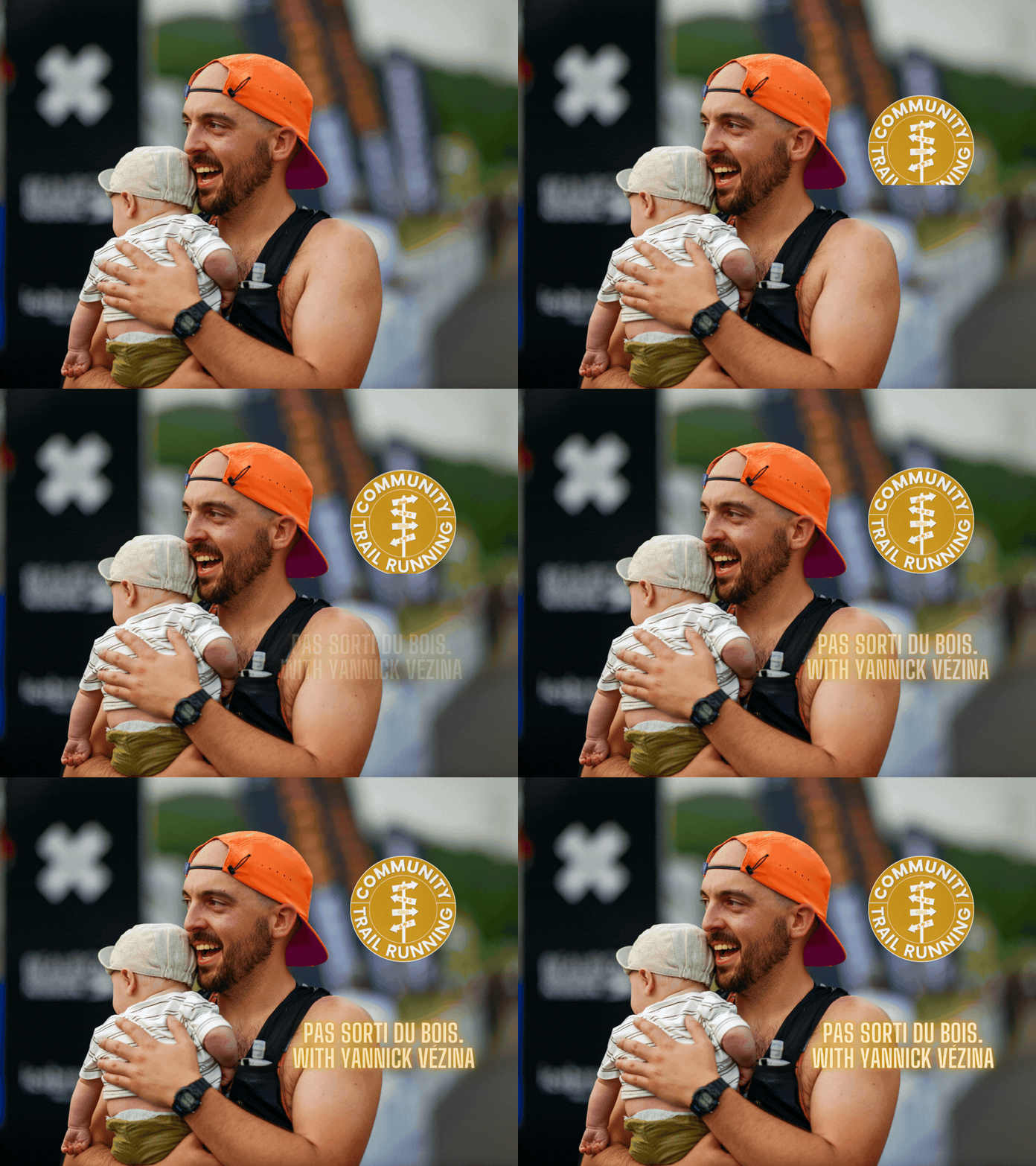
About this Episode
Yannick Vézina is the host of Pas Sorti du Bois, the Canadian Podcast Awards winner of Outstanding Francophone Series, and he joined me to chat all about himself and his show. It was so awesome hearing about his love for the trails and how much he enjoys his show and the community. I really love that his show and ours both won awards, as I think it shows what great shape our sport is in here in Canada. After speaking with Yannick, it’s obvious how much he loves this space!
I hope you enjoy the chat as much as I did. I’m so excited and proud to be a part of this great community, and it’s because of folks like Yannick!
The Miller Minutes
Pumped to be back with Andrew again, as we work towards Fat Dog 120. This month, we catch up on how February went, how March is looking, and why I need to run a 100k event in June. I love working on The Miller Minutes with Andrew!
The Last Episode
The Trail Running Film Festival
Next week on the show
As the official media partner of the Trail Running Film Festival, we are incredibly excited to feature the filmmakers here on Community Trail Running, and we will start that next week!!
Monday, March 9 - Friday, March 13, you can expect an episode every day. We will get you excited and ready for the coming festival season. We can’t wait!
Listen where you listen
Spotify: Click Here
Apple Podcasts: Click Here
Music by Paolo Argentino from Pixabay
We’re on the journey to 2,000 subscribers. Please help us get there!
If you enjoy this podcast, I would really appreciate it if you could like, share, subscribe, or comment! I’m trying to make this the best trail running podcast it can be, and I certainly appreciate your time. Thank you all and happy trails :)
Get full access to Community Trail Running at communitytrailrunning.substack.com/subscribe
Hosts & Guests

Transcript
Hello and welcome, Bonjour et bienvenue, this is the Community Trail running podcast.
I'm your host, Adam Lee.
Thank you for joining me once again, so many podcasts out there and I so appreciate
you spending a little bit of your time with me.
This is episode 181, we have Yannick Vesana from Puzzle or T Du Bois on the podcast.
We're not out of the woods just yet and we're getting into them today.
That chat with Yannick was so fun.
There were two trail running podcasts nominated at the Canadian podcast awards in December,
Yannick's and Hours and both of them won, Hours for Outstanding Sports Series and Yannick's
for Outstanding, Frank Affon series.
And I think it says a lot about how much love there is for our sport in this country.
And the community around it can't wait to share the chat after a little bit of housekeeping.
We're back this week with the Miller Minutes as Andrew Jackson with me towards my goal
at Fat Dog 120, spoiler alert, I'm an idiot.
Last week we had Fred Jeffery from the Hillbilly Hustle on the show.
That was so much fun hearing about his event and what running around their part of Vancouver
Island is like.
Check it out if you haven't already.
Thank you for subscribing, rating, reviewing, sharing.
You continue to do all of it for community trail running.
I appreciate it from the bottom of my heart.
Get over to community trail running.com and you can find a discount code for our trail running
film festival screenings and subscribe there if you haven't already.
Those film fest screenings are coming fast.
Vancouver is only a month away and nearly 80% sold out.
Alberta is two months away.
We'll be announcing our talent and performers in the next short while there.
We're really excited for that.
Get your tickets now.
It's going to be a great hang and next week is film fest week on the podcast.
We're going to feature five of the filmmakers from this year's festival.
I'm always excited for this on the show.
We have so much fun hearing from all of them.
So watch out for that as we'll have an episode every day next week.
It's enough of the preamble for today though.
Let's get ready for Yannick Vesna, but first, let's start with the Miller Minutes.
Welcome to the Miller Minutes.
This is Andrew Miller.
I'm Adam's running coach and I'm here with Adam Lee.
How are you doing today, Adam?
I'm doing great.
Andrew, I can't believe it's been another month, but such is life.
How are you doing?
Good.
Yeah, I'm doing pretty well and I've been pretty happy with your training the last month.
It's been a good month.
I had, as we talked about last month, of course, real life does show up here and there.
And I did miss a long run, which I was a little bummed out about.
And you got me right back on the horse and were like, it's never going to be perfect.
Let's just keep moving forward.
And I think apart from that little blip, once again, it was a pretty consistent month.
We hit a lot of workouts.
And I was as I was telling you before we started recording, I had quite a bit of personal
stuff going on with the podcast and everything and still managed to really get in a lot
of the calendar.
So I think February went from my, from my side, I was really happy with it.
I agree.
I thought February was very strong.
And I think, yeah, I was very impressed.
Even before you told me it was a really busy month for you, I thought the training was looking
really good.
Had you're very consistent, yes, you did miss one long run, but that's reality.
Like everyone's going to miss some runs.
You could be sick.
You could be busy.
There's so many things that can get in the way.
You're never going to have a perfect, perfect build up to a race.
You're never going to have a perfect training.
And that's, that's just how it goes.
So I felt like you did a really good job, recognizing that and getting right back to it
and training and not dwelling on the fact that you missed one run.
And the next weekend looked really good.
The weekend after that looked really good and that's brought us to today this weekend.
And yeah, things have been looking very good.
It's been nice to have the mid week workout runs.
I call them, I call them all intervals, even though they're always not necessarily
interval runs.
But we mostly did like four, six minute hard efforts or four, eight minute hard efforts
with a couple of minutes in between this month.
Those were really fun.
They break up the week.
They kicked my butt a little bit too.
And I like tying it back kind of to the missed long run.
It was like, I had the next workout to look forward to and I thought it went well.
And those are, those are really fun for me and ways to keep my focus going as we work
through it.
Yeah.
I think the workouts are an important thing that we've added in this month.
That was something more that we added on since January.
So I was very happy to see that you were doing those and doing a good job with those.
And yeah, we've been doing a lot, like I think the typical workouts you're doing are three
by eight minutes with a couple of minutes rest or four by six minutes.
So it gives you about 24 minutes of total work in terms of the higher intensity work.
And I think for the training intensity that we're looking for, that's a reasonable duration.
And I think that's one thing people need to keep in mind is what is the training intensity
that you're looking for and oftentimes with these interval workouts or these higher intensity
workouts, you're looking for a high intensity.
So you have to be able to reach that high intensity.
So in order to do so, you can only do so much at that intensity.
And I find probably 20 to 30 minutes depending on where runners at how fit they are to reach
that, the intensity that we're looking for with your training, that's reasonable.
If you go too much beyond that, you start to slow down.
You try to hold the same intensity for 45 minutes in hour.
It's just not going to happen.
So I think being realistic with what you can do in training is important.
And you've been doing a very good job of hitting that and training and doing a solid
job with that.
So nice job.
I appreciate that.
It's been nice to be able to check in with you over email too.
And here's what's going on and you get back to me.
And I like that relationship we have as the month goes and now we have March to get into.
So what are we kind of looking for as spring, as spring springs?
Here we go.
Yeah.
So I think January was a lot about building a solid base and building that consistency
in February was about adding in those interval workouts and building up the volume of your
long run.
And March is going to look like a continuation of that.
So we're going to try to keep building up the volume of your long run.
And we were talking a little bit before that you've been actually able to get up into
the mountains a little bit because you've had this new melting out a little bit earlier
maybe here a little bit less this winter.
At least for certain parts of the country.
Or for certain parts that I should say.
So yeah, taking advantage of that is great.
And we're going to start to try to make that long run more and more specific for fact
dog.
So getting in a lot of elevation gain and building that longer and not building the volume of
that long run up.
So we'll get longer and longer.
And I feel like that's the direction we're heading in already.
So we're going to see a continuation of that into March.
And then with the workouts, the workouts will continue.
But again, we probably won't actually build the volume of the workout that much.
We're just going to look for steady progression with your pace because we're trying to keep
that higher intensity.
So maybe we could stretch to 30 minutes.
I won't really be inclined to go beyond more than 30 minutes of work though because at
find that's usually the point where the quality starts to drop off.
And then you're no longer getting to those higher training zones that higher training
effort that we're trying to reach.
And I've got a little loop that I like for that workout on Thursdays.
It has a couple of hills involved with it.
Is that is that something that matters for those workouts?
Should I be trying to be getting hills included or is it should be flat for those for
those tempo high tempo runs?
Is there preference for either or?
So I would say doing it on more runnable terrain.
So I would avoid steep hills and I would avoid anything that's too technical anything.
That's going to really slow you down.
And the point of that is when you are doing those interval workouts, there's kind of two
things you're working on.
When you're building that higher endurance, like your glycolytic system, as opposed
to your aerobic system, it's just a different type of metabolism when you're working at
that higher intensity.
But the other big thing, especially with running, is your mechanics.
You're building the mechanics to actually run fast.
And I think people forget about that sometimes because you can get a really high intensity
effort going up a really steep hill, but you're not really developing your running mechanics
to actually run fast at all.
We've got one stage to hit before we get to fat dog because I didn't have the quite
the right qualifications because I just blasted through the sign up phase, didn't read
it properly.
So shout out and apologies to race director Eric Bird, I'm getting myself organized.
Yes, that's okay.
And yes, we do need to do 100K before fat dogs.
So you're looking at one weekend in June, probably early June.
And I think that would work just fine.
I think the timing for that for fat dog would work really well because you have plenty
of time to run the 100K, recover, learn from what you did in the 100K.
And I think that'll be key is that we can have a chance to learn from it.
But it does put us on a little bit of an accelerated schedule to get you ready for
June, which is okay.
But yeah, it's just something else we have to contend with, which is fun.
It is fun.
And I appreciate doing the journey with you, Andrew.
I'm excited for the next month, and I think importantly, and what you make sure we do is
we keep our eyes on the target each day and not getting out too big.
So I am excited for August, but I'm also equally excited for each week workout in March.
Thank you for leading me along this journey.
I'm really excited for fat dog because you've made a lot of progress already since the
start of the year, since we started working together.
And I'm really excited to see what the next six months is going to bring.
I think that's all we have for you guys today.
So this is the Miller minutes.
Thanks for listening and we'll see you guys next time.
Today's guest is the award-winning host of Paso di Du Bois, Yannick Vesana.
Paso di Du Bois won the Canadian podcast award for outstanding francophone series.
And I can't wait to hear more about it about Yannick, about all of it today.
Yannick, welcome.
Merci.
Merci beaucoup.
Thanks Adam.
It's my first after 260 plus podcasts where I'm hosting and in French.
Now I'm on the other side of the microphone and it's an English show.
Excuse my French to your listener, but I guess that it's part of the way of having a
trail running podcast across Canada.
We have all types of accent and languages.
That's what that was fun with Canada.
Right.
The language of champions is universal.
Yannick and that's what we are.
You know, exactly.
I love it.
Oh, we certainly are so excited.
It's an honor for me to turn it around on you and we will start with you before we
talk about the podcast.
Give us a little idea who you are and how trails are part of your life.
Yeah.
I'm 34, 35 years old now.
I'm the father of a three year old son and I've been running for about 17 or
18 years, but more seriously in the trails doing all trails for the last eight years.
I guess I just love it.
I mean, there's something I often say in French is like, I'm going to Jouet Dalbo
play in the wood.
I sometimes I'm just out the door and I just tell my girlfriend, I'm going to
play in the woods.
I'm not going for a run.
I'm not going for a training run.
It might be a training run.
It's always a training run, but it's playing in the woods.
It's just jumping over roots and having fun solo or with friends.
Love the community.
I was coming from road running and OCR.
You know, when back when Spartan race were a thing, a big thing.
And I just remember running in an event here in Quebec City.
And I was running a portion between two obstacles, I guess.
And I remember thinking there must be a sport where there's no obstacle.
It's just running into woods and there was something way bigger than OCR.
They already existed and ever since 2017, 2018, I left for the trails
and never got back to anything else.
I'm not doing cross-training.
I'm just running every opportunity I have just because I know I should do
cross-training, doing ski or bike, but I just love running so much at that.
That's all I do.
I can completely relate to that.
I love the playing in the woods thing too.
Like I think I think that speaks to a lot of people.
Did you grow up?
Is that something like you grew up in the woods outside, adventuring
and sad?
Is it new to you as an adult?
Now, I mean, Quebec City, we're very lucky.
It's a urban city.
We're like 700,000 people.
So it's a big city, but still we have woods all around the place.
15 minutes from downtown, East, West, North, South.
We have woods and my parents are big sports enthusiasts.
Like they played a lot of sports.
They're not trail runners, but every opportunity we had, they had.
We were going into the woods, no walking in National Park.
I remember growing up in my street that was like a vacant lot.
Like there was two or three houses that weren't there back then.
It was just woods to us five, six, seven years old.
That was like a whole forest.
I mean, it's there's two house there, I guess.
So it was small, but and my parents back then in the 90s,
they were just like, let's go play and have fun.
And we had no rules and we were just having fun into wood,
like building T.P. and just building stuff.
I remember I was eight years old.
My father was giving me nails and hammering go, go have fun in the woods.
So it was always there to move to my parents always told my sister and I that we,
we need to do sport and we love that.
We tried pretty much everything.
I tried a lot of team sports, individual, individual sports.
But when I discovered running and trail running, that was like a lot of that
through sight.
And is it that expression?
Yeah.
Yeah.
So that was that and never looked back since then.
I, you know, trails, the trails will set their hooks deep.
Yeah.
Right.
And pull you in and again, clearly they did.
But then shortly into your trail journey, because Paso T. Duboisf is started in 2020.
So that didn't take long.
So how does that come about?
That was the pandemic.
I was listening to a lot of American podcasts and I love ginger runner
life.
That was my big inspiration.
And I was just like trail running was getting more popular in Quebec,
but it was still small.
I mean, it's crazy to think that eight years ago, that was a small sport.
Because right now it's huge.
It's getting really huge all over the world and Quebec, especially.
But back then we must have like 15, 12, 15 events.
And there was a big sense of community like we have right now, but with less
people and during the pandemic, I was just like, I need to connect with people
because right now we can't connect.
And I was listening to all these American podcasts that I love that was really
laid back like drinking a beer, having a conversation, doing like long
versions of podcasts, just talking about what we love.
And that's how I started.
I remember thinking, I mean, we're going to do some Zoom calls.
I'm going to record that, put that on Spotify.
And if I do 20 episodes, that'll be great.
Like, and now six years later, it's five and a half year later, 260 something
episode later, I'm still there.
It's crazy to think that it was just a pandemic project just to do something.
And now it's, it's a huge part of my life.
And, you know, clearly, you would have found a groove over five and a half
years, of course.
And you've got a wonderful set up I was commenting before we started recording
that it's great having a podcast around because it's going to sound great.
And of course, you have the set up.
But was that something that came naturally?
Was the technical side difficult to learn?
Was any of, was there a learning curve to any of it?
Or were you just a lot of YouTube videos back when we couldn't ask an AI
but because that didn't exist or I mean, it was mainstream.
I stated communication.
I work in communication.
I work for smaller places where when you're the, you know, communication advisor,
you do everything social media to strategy.
So I, I learned how to work with audacity in college.
But that was it after that.
I started with a small USB microphone and it was only Zoom calls.
So it was easy.
I mean, my guests had whatever they had as a microphone, but I had a decent one.
And then like when I started doing face-to-face interviews,
that was harder with the USB microphone I had.
So I started to invest a little bit.
And then I remember I'm very, very lucky.
I have the same official partner for the podcast since they won its snack and
nutrition company.
And I remember like they were at some point that the owner, William,
was an amazing guy.
He just told me, you know, the promo code is doing really fine.
We're not paying you enough.
What do you need?
And I was like, well, maybe a real microphone kit and said, we got it.
So it's crazy.
I mean, six years later, they're still there.
But that was like, it shows how these guys are.
It's they're not just about like the profit or anything.
I mean, their company, but still it was, they were there
for this moment.
And it was them until maybe maybe if you want to like do have something
more professional for tech on the technical side, well, we got you.
But for the rest of it, it's mostly tutorials.
And like right now I have my groove like you say, but it was a lot of trials
and errors as some of the first in the 20 episode, the first 20.
There's a couple of them where the sound is shitty.
But I mean, you learn and people were there every week.
I'm proud that I never invested one dollar in the promotion, the marketing,
the marketing posts on Facebook and stuff like that.
It just grew organically one person after another to now a big community.
And it's crazy to think that it all started six years ago.
And it was just one brick after another without a business plan, without a plan.
Period.
And I just went with, I mean, my my life is really intense.
I mean, I have the job.
I have a son.
I have like a family time, professional time.
I'm running as much as I as much as I can.
A lot of things are planned.
The podcast is not that plan.
And that's why I think the passion is still there.
I never feel the pressure to like, I need to do an episode this week.
I mean, I've done that for four years in a row, like episode every week.
Now it's maybe two every three weeks, but the community is there.
So I can do pretty much whatever I want.
I try new style of it is out and new concept.
And people are following and I'm trying stuff and people are there.
So that's crazy.
I mean, it's, it's a big, big creation process.
And I love every second of it is, is creation something?
Like, you know, you talked about being outside too and like building stuff.
So is that something that you've always kind of enjoyed too?
Is, yeah, I studied tea there.
Theater in, in, in, Sejit, something we have in Quebec that you guys don't have.
But it kind of an in between between high school and college.
Okay, we go to college, like, like less, longer than you guys.
Like it's a shorter time college because we have Sejit before.
So I've studied drama theater.
I've worked in that, that's fear.
I've always like written stuff and doing like directing plays and stuff.
So creation has always been part of what I do.
I love my job.
There's one part of creation.
Like my brain is doing something creatively during the day, but I don't.
I mean, it's a big company for where I work for.
So I don't like decide everything and that's okay.
That's normal in a professional company.
But that's what I love about these sites project.
I always have side hustle like a friend of mine.
I was always saying, whatever it was, theater project, writing project,
and now the podcast is running, it brings something different creatively
because I can do whatever I want and that's the fun of it.
And having sort of the writing background of the production too,
I'm sure helped build the confidence of like actually sitting down with someone too,
because it's one thing to like think about it.
But then you have to sit down and talk to someone and interview and put them out there.
Exactly.
But that was easy.
I started with two people that I already knew and it kind of set things up.
Like, okay, this is my style, I guess, because I'm doing all my post production.
So I have to listen to myself and it's a torture every week because we hate hearing our voice.
But, but I mean, I've done theater direction.
So I'm critical with people I was working with.
Like, when I'm listening to radio and the host is like, I'm like, oh, you should have said that.
I mean, I'm critical, I'm keeping it for myself,
but I'm also very, very critical of what I do.
So the first hundred episodes were a learning curve where I was doing post production,
but also seeing, okay, I'm saying that too much or I'm saying this like, it's a wrong way.
I should have gone this way and I'm just like learning and being tough on myself.
But I guess is how I learn.
Absolutely. That's how we all learn.
More repetition is always better.
And you'll get better over time.
You get smoother.
I think I have the same thing.
I listen back and I go, why would I say that?
And oh, I said that again, but it is what it is.
And the wonderful thing is we're featuring our guests.
So people are here to listen to you and I have that to hide away from.
But what I wanted to get into is, you know, you talk about the lessons learned
and growing to where you are and taking on any side project you want.
And one that you shared it out before we started recording as well,
because you're excited about it.
Anytime someone's excited about it, I want to get into it too.
It's the trail calendar and it sounds simple.
But like you said the first couple of years you were running,
there's 12 to 15 events.
Tell us what that calendar looks like these days.
I think it was between 10 and 12 events back then.
But I started, like, there's a lot of big events.
Like because we have big events that host an international competition.
We know them, but there's a lot.
There are also a lot of small events.
And at some point I was thinking, what can I add to possible?
I'm doing like live contentoring events and races
and talking about Western states and hard rock.
And I went to these races, UTMB, hard rock and do life coverage.
But it's always close to the podcast side of it
of doing interviews and talking about stuff.
But what can I do?
And I was started thinking about having a website
because after four years I still have no website,
like it was just going on the Spotify stuff or whatever.
So I started working about it and I asked,
what can I bring to it?
And there's a blog, but it's all the articles that I'm bringing back.
There's a couple of things like link and stats about the podcast.
And then I had an epiphany.
I said, there's no calendar for trail running events in Quebec.
There's race calendar for any type of running events.
And that's great.
Most of the trail running events are there.
But there's so many road races that you just get the trail running events
get drowned into all of this.
And it's okay, that's their goal.
But I want a really fun experience for people.
What are we looking for?
We're looking for distances.
So I have a filter for distances.
And we want to map.
So you see the map of Quebec and you can see all the dots.
And now to answer your question, there's 62 dots right now on the 2026 calendar.
So 2025 was a better version of the calendar.
Because there's so many small events that they don't necessarily have a website.
So people had to feed to me and say,
oh, we have that event.
And we have a 10, 15 and 25 K.
Okay, I'll add that.
And it's a lot of work, but it's really rewarding when people tell me,
I've done that race because I found it because of your calendar.
And I love it.
That's what I want to do.
I mean, it's free events are there and they don't give me a dime.
And that's not why I do it.
That's not why I want.
I just want to help people.
There's 10, 15, 20 people, 20,000 people.
Sorry, people running trail in Quebec.
So these people needs to see all the events.
And don't not only the not just the big ones.
Because the Tramble by UTMB and Quebec Megatrail,
they don't need that calendar because they already sold out.
But any other events, there's so many cool things
and cool concept of backyard-ish type of run.
And like, altruis that are in crazy spots or loop races.
Anything that is on trail, it's on the calendar.
So for your guests from the rest of Canada,
want to come to Quebec and experience our technical trails.
There's 62 events and you can find everything on the calendar.
The trail, Quebec, Quebec.
Or on the post office website, but pretty proud about this one
because I've just added a couple of events last night.
And we were talking before it.
I was like, okay, I need to talk about that.
Because I think it's useful.
I mean, the podcast is it's fun.
It inspires people.
I hope my guests inspire people.
But this is really useful.
It's a tool.
And we build it to make it fun.
Yeah, to make it that fun experience
to find trail running events in Quebec.
And just another way to bring your community together.
It's clear that you're a community builder.
Exactly. That's what I try to do.
Is there, you know, like five and a half years in,
as you said, 260 episodes.
You've covered these races.
You've had this tremendous sponsor support.
What's been most meaningful to you about this whole journey?
It's really about meeting people.
There's so many friends, close friends that I have now
that started as guests on the podcast.
And we, I have fun with every 200.
I think it's over 320 guests I had over the years
because there's episodes with many people.
So I think it's 320 different people.
And I had fun with all of them.
Every interiors were fun.
So it's 300, 20 people that if I meet them,
like they're already friends.
But there's really, I have really, really close friends
that started at the podcast with the podcast.
And that's something that really proud of
because I would have never met these people
in any different way.
Or you have to be on the same trail running event
and be at the same pace to finally meet and have fun.
I've been doing trail running events three years
before I had the podcast.
And there's one person I ran
along enough to become friends.
But all of my trail running friends come from the podcast
and in the sense of community.
Again, it brings conversation.
Today I was going to the market and some guy told me,
hey, listen to your podcast.
I love it.
And I'm like, okay, it's crazy.
And we started talking about trail.
It's not about getting recognized.
That's not the thing at all.
It's just that we started having conversation
in front of the bananas about like Audi.
We love them bananas in eight stations.
So I mean, that's fun.
It's like trail running is growing.
And I'm proud that Pesat's voice growing
alongside of it.
I love that so much.
What a great grocery store story.
Before we tell people where they can follow you along,
I'll put you on the spot.
We've talked about what it is and why you love it.
But give me the Yannick,
there's a 30-second elevator pitch.
And I'm going to, like, you're so much
from the Pustati Du Bois.
Give me the 30-second pitch on it to folks.
Well, it's it's having conversation around a beer.
And I always say that this is the same conversation
that we have at the finish line of a race.
So the first five minutes, my guests,
are concerned about the microphone.
Not concerned, but concerned.
Like, okay, there's a microphone.
I need to just say thing.
And then after five minutes,
we're just two friends talking,
two buddies talking about trail.
Sometimes it's more about having specialists.
I had episode about, like, I don't know in English,
but Reds, you know, like medical condition,
related to running.
I had nutrition podcasts,
but I have episode where we're just two buddies drinking beer
and having, like, fun stories about trail.
And that's what we love about it.
So that's my 30-second pitch of Pustati Du Bois.
Fantastic.
It's, make sure to link to it, of course.
But if you want anyone to follow you
or check out the trail calendar,
where can they do that?
It's always Pustati Du Bois in one word.
So, P-A-S-S-O-R-T-I-D-U-B-O-E-S.
I guess.
Pustati Du Bois on Instagram,
Facebook, it's mostly where I,
I put, put up my stuff and every,
when you episode every week or so,
I always say two episodes every three weeks,
so I have a week off.
Every 10 days or so.
Exactly, exactly.
Amazing.
Just a huge thank you.
Merci beaucoup to you.
Thanks to you.
I love what you do.
I was telling it off mic,
and I'm thinking I'm going to say it on mic.
I'm just so jealous of how you can do 20 minutes episode.
I love it because I went for a run.
I listen four of them,
your concise,
your straight to the point,
and that's something that I'm not,
something it's long format,
maybe too long,
but I love your 20, 25 minutes format.
I'm really, I really appreciate what you do for your community,
and you gain one more listener with me,
and I hope my people in Quebec
will start listening because we listen to a lot of podcasts
and English podcasts, and yours is amazing.
Well, that means a lot to me,
and I hope that maybe we can have a beer
that would be longer than 20 minutes
one day in real life.
I think that would be super cool.
Congratulations again on the award.
I'm just going to show this out as well,
on the Canadian Podcast Awards,
had two trail running podcasts as part of you and I,
Yannick, and let's keep that rolling.
Congrats to you.
Thank you so much.
Huge thank you once again to Yannick Bezzana.
A huge thank you to all of you listening.
Shout out to Race Volunteers everywhere,
and until next time, I'm Adam Lee,
and this is Community Trail Run.
Thank you.