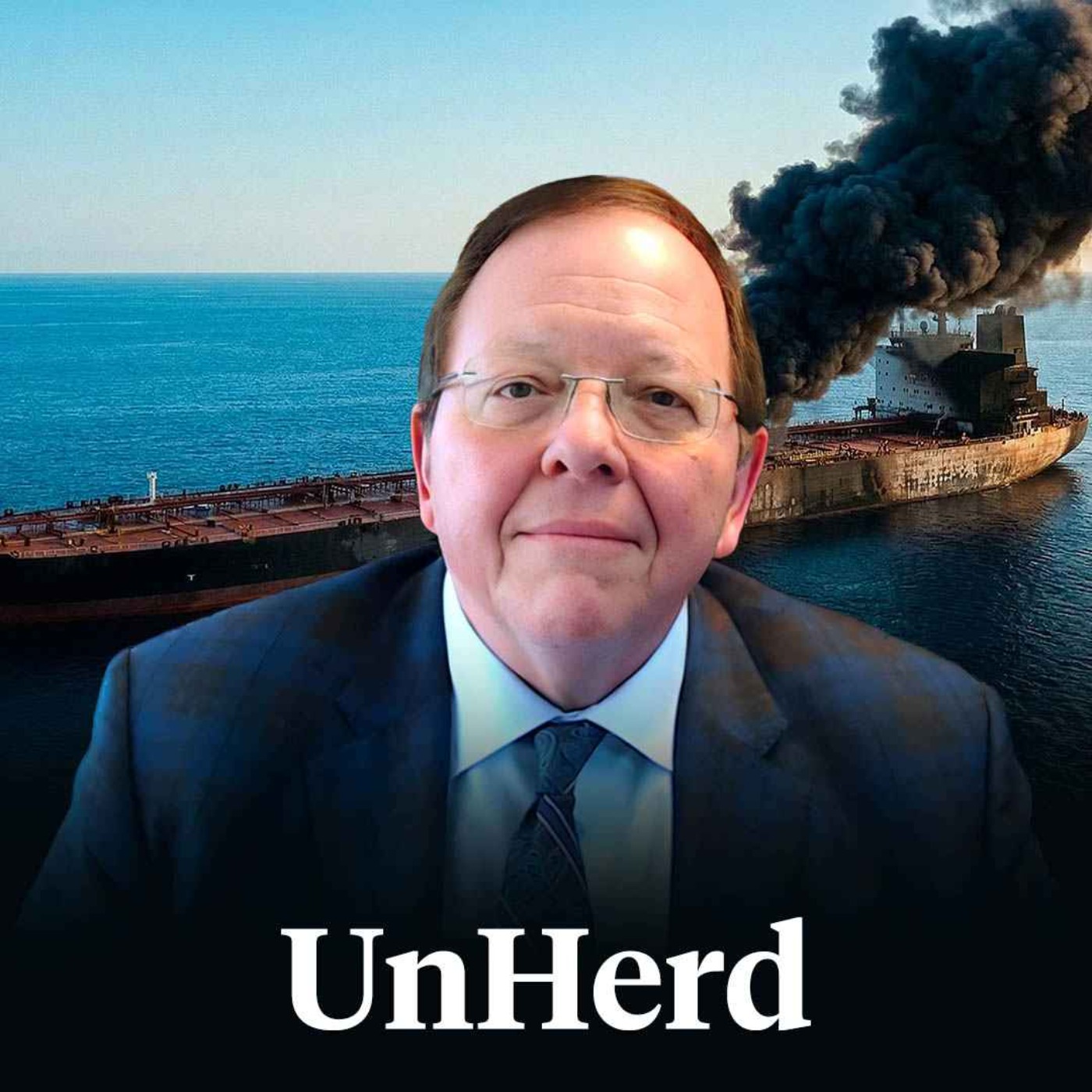
About this episode
Hosted on Acast. See acast.com/privacy for more information.
Get every episode summarized
Each time UnHerd with Freddie Sayers publishes, we email you a written briefing from the transcript — the topics, who appeared, and any specific claims, with the ad reads skipped.
Email me new episodesFree for 3 shows. No card needed.
Hosts & guests
Transcript ready
289 searchable segments. Every word is indexed and playable.
Full transcript
UnHerd with Freddie Sayers — Prof. Robert Pape: Is Iran winning the war?. Machine-transcribed; use the interactive transcript above to jump the player to any line.
A better help ad. Hold on. One second. I just need to. What if you had a room where no one interrupts? No notifications, no expectations. Just space to talk. With better help, therapy happens in a space that's yours. Visit betterHELP.com slash random podcast for 10% off your first month of online therapy. This episode is sponsored by the new film, October 8th. October 8th offers a look at the real life impacts of October 7th on the lives of Jewish people and the eruption of anti-semitism on college campuses, social media and in the streets of America beginning the day after the attack on Israel by Hamas. The film also uncovers how over decades Hamas created sophisticated networks in America to permeate US institutions and examines the tsunami of online anti-semitism
and disinformation unleashed by Iran, China and Russia with the goal of dividing American society. The film features expert insights from the likes of Barry Weiss and Douglas Murray. This is a vital wake-up call about the threat of extremism against democracy and October 8th is now available to buy or rent on Hamas and Prime Apple TV and YouTube. Hello and welcome back to Unheard. Iran is not weakening, it is gaining power. Iran is more powerful now than before the war. These are statements not of some contrarian on social media but one of the most distinguished professors of political science in the US. His name is Professor Robert Pape at the University of Chicago. He is an expert on military strategy and writes a substat called the escalation trap and this is his view of the emerging conflict in Iran.
Professor Pape, welcome to Unheard. Thank you very much for having me. I guess the first question must be how do you justify those kinds of statements because a lot of observers see an almighty power in the United States pretty much pulverizing and much inferior power in the shape of Iran who is not able to do very much in response. How can you justify saying that Iran is more powerful now than before? I have studied every air campaign in history, every air campaign since World War I published a big book bombing to win many articles and foreign affairs. I've spent years teaching targeting strategy for the US Air Force including leadership targeting strategy. I have also studied escalation dynamics for decades and I've modeled the bombing of Iran in particular for 20 years. So I bring not just a quick reaction but quite a bit of understanding of the stages that we are now going through which is what I put on that sub-stack you call the escalation trap
which I started just before the bombing came and it started in order to help people understand that we are going through very likely the predictable stages of what would happen and in fact we are now at stage three and so far all the stages have been fulfilled. So before we get into the stages let me just directly answer your question. So Iran after 18 days of war now controls the traffic through the straight of Hormuz. It did not control that traffic before. To put this in some perspective everybody now knows the straight of Hormuz is 20% of the world's oil but I want to also explain that for 50 years since the 1970s America's number one grand strategic objective for the Middle East was not about Israel. It was about preventing a single state from controlling the 20% of the oil in the Persian Gulf
that is controlling the straight of Hormuz. So what Iran has achieved after 18 days the extra power that it has gained is truly a catastrophic failure and loss for the United States and it is only beginning to exert the power that it now has and that power is likely to grow over time it will grow through the disruption leading to energy shocks throughout the world which will lead to real trouble for the global economy over time and that power it did not have before. Let's start because I really want to push back on some of that. I think there are other ways to see it and let's try and get a bit of both sides in front of our viewers and listeners. But before that set out the stages for us so that we understand how you see the stages of escalation
and where you think we've reached so far. Stage one is tactical success and you saw that as our smart bombs hit. Virtually all of the targets and killed leaders virtually 100% tactically successful and that is what you saw in the opening wave of the bombing. But that would then lead to that tactical success a strategic failure in this case because the goal of regime change is really quite too far for us to reach to. For over 100 years states have been trying to topple regimes with air power alone. And in 100 years it has never and I'm choosing my words carefully. It has never succeeded also Iran has enriched uranium. So you might say okay we don't topple the regime maybe we get a grip on that thousand pounds of 60% enriched uranium
or the 10,000 pounds of 5 and 20% enriched uranium which is so crucial for making weapons and other problems that Iran could throw at us. Well that too was not achieved. So you end up with stage one the smart bombs work they hit targets they don't achieve success. Stage two is where the enemy lashes back and we've seen this in other precision campaigns before. But that lashing back has become a horizontal escalation campaign by Iran. I lay this out in foreign affairs in detail to explain the full strategy of horizontal escalation that Iran has unleashed. And that is what has led to damage in the Gulf states but even more critically the decline of shipping through the Persian Gulf by well over 95%. And they just hit another tanker just before we came on a few hours before we came on.
So that is being done with their drones and their drones are precision guided weapons not just kind of being thrown up in the sky and fall where they may. So now we are at the second the stage that is the most dangerous and critical stage that I said and I said this would be the most critical stage which is the ground powered dilemma. So now you've had stage one the smart bombs hit their hit their hit their targets and of course we're still doing that but they're not leading to hard breaking the regime the regime is harder today more dangerous today. They haven't led to weakening Iran Iran is more in control of world oil than it was 18 days ago. So what are you going to do while you see that there's pressure to double down or go up the escalation ladder. And that is where the ground powered dilemmas are coming in and you're already seeing all the scenarios the maps are coming out on all the you know cable channels of what we're going to do with cars and the coastal regions.
Now this was always likely to come this I called it the ground powered dilemma and this is where we are and this will be the most dangerous phase of the escalation trap because it'll be the pivotal phase. It'll be the phase after we go through if we cost these Rubikons here then we really are probably in Vietnam territory that is a very very long war that's my view on where we are the stages were at and by the way this was again the modeling that I've done for 20 years at the university of Chicago I teach a big class on strategy here the end of every spring 90 minutes on laying out what to expect with the bombing of. The nuclear facilities in Iran been doing this for 20 years the double tap attacks the B2's all of that and so this is exactly the normal trajectory of what to expect once we went down this road and in your model or in your framework how does it end it ends by us going deeper and deeper here present Trump is now on the horns of a dilemma there's no golden off ramp here.
So he's got a choice sitting right in front of him he can try to cut a deal with Iran but that's going to be a big political loser for him because Iran's not just going to give this up give up this power and say oh yeah sure we're going to hand this back and let you wall up us again at your leisure so Iran is going to want a pretty big price here and you hear the foreign minister talking about this and that will be a big price for Donald Trump to pay. But possibly recoverable for his presidency if he goes further and and and he's rejected these deals all the way through you see so he's never really found a deal he's ever liked with Iran if he keeps rejecting the deal because the price will keep getting steeper and steeper and we go through the third stage of the escalation trap. Then I think we're in Lyndon Johnson territory and for your listeners who were certainly not alive but may not know President Lyndon Johnson was president during the Vietnam War the critical years of the Vietnam War and it was spring 1968 that he was doubling down his escalation until it became absolutely crystal clear it was a total failure and that's when his presidency dissolved and he became essentially the worst president that America's ever had.
He had to he didn't weave the presidency but he had to drop out of being reelected his party lost disastrously in the 1968 presidential elections and notice that we have a similar election rhythm here in our country this is spring we have the midterms coming. And so there's really an enormous amount of stake here there's at stake with Iran the Gulf states there's the global world's economy and then there's also President Trump's presidency and politics in the United States this is what is at issue in the escalation and this by the way has been my my my specialty of not just focusing on how bombs hit targets but when I taught for the U.S. Air Force and when I teach I'm connecting military action. To politics politics in the target government politics in the in the attacker politics in the world so I see strategy is not how to put a bomb on a target that's tactics what I do is I do strategy which is how do you actually end up with political end states and what are those political end states you're going to end up with that has to do as much or more with politics as the military
hardware professor I'm now going to try and argue against you and you can explain to me into our listeners why I'm wrong and by the way I teach at the University of Chicago we believe in intellectual darkness so this is the way of this is the way to really get into things so I appreciate that so point one the hard power aspect the actual level of degradation of Iran's capabilities I feel like you somewhat underestimate or skip over there I've got a few figures that I'd like to share so Iranian ballistic missile launches have fallen by more than 90% over the last two and a half weeks 350 of them on February the 28th 25 on March the 14th that is the best day we have drone launches have gone down from more than 800 on day one to 75 on day 15 so this is a complete collapse of their military capability the naval assets their attack craft the submarines gradually all of these are being liquidated by the United States and even
those small launches that they're able to do to attempt to disrupt the state of all moves and land occasional strikes every time they do that they reveal a new launch capability which is then pulverized by the United States so you could make quite the opposite case that in hard power terms the United States has been extraordinarily successful and the Iranian prospects look pretty bleak. This episode is sponsored by the new film October 8th October 8th offers a look at the real life impacts of October 7th on the lives of Jewish people and the eruption of anti-semitism on college campuses social media and in the streets of America beginning the day after the attack on Israel by Hamas. It also uncovers how over decades Hamas created sophisticated networks in America to permeate US institutions and examines the tsunami of online anti-semitism and disinformation unleashed by Iran China and Russia with the goal of dividing American society. The film features expert insights from the likes of Barry Weiss and Douglas Murray this is a vital wake up call about the threat of extremism against democracy and October 8th is now available
by our rent on Amazon Prime Apple TV and YouTube. Howdy howdy ho and welcome to fantasy fanfellas I'm Hayden producer of the fantasy fan girls podcast and your resident lover of all things Sanderson and I'm Steven your bookish Internet goofball but you can call me the smash daddy and we are currently deep diving Brandon Sanderson's fantasy epic Missborn but here's the catch Steven here has not read Missborn before that's right hey hey so each week you'll get my unfiltered raw reactions to every single chip and along the way we'll do character deep dives magic explainers and Steven will even try to guess what's next spoiler alert he'll be wrong. News flash I'm never wrong episodes come out every Wednesday and you can find fantasy fanfellas wherever you get your podcasts. Now open your eyes go to Monday dot com start for free and finally breathe.
Hey moms and dads if you're tired of getting the deer and the headlights response every time you bring up family plans with your kids let me introduce you to your new best friend the skylight calendar skylight calendar was designed to help you manage the chaos of family life ditch the mental load of juggling everyone's schedules by pulling it all into one clear space. This all in one smart touchscreen calendar brings visual structure and color coding across your schedules tasks lists and other family needs. Right now skylight is offering our listeners $30 off their 15 inch calendars by going to my skylight dot com slash get 30. So you're looking at the wrong metrics of hard power I'm not going to make a soft power argument to you you're just and that's not you that is
a secondary headset is doing that and that's the victory narrative. And what that is is the tactical success we have in reducing the visible hardware Iran has for toe to toe set piece conventional battles. So if we were going to fight a naval war with Iran where our navy goes up against its navy that would matter if we were going to fight a tank war or a conventional war with Iran where we're going to have two armies clashing on the battlefield these metrics would matter. But they don't matter and they don't matter really much at all and it's similar to Vietnam see in Vietnam we had a version of this that was called the body count. And it became known after Vietnam as the body count fallacy because what Lyndon Johnson did very similar to what he said that's doing here is he kept recounting how many Vc we had killed or captured in that real war.
And the numbers kept mounting the problem is that the opponent has a strategy and it's actually a military strategy and it's a military strategy connects to politics it's a long war strategy which is about imposing costs on the United States the world and the GCC countries and that is what you are seeing they are not focusing on how to hit. You know sort of our missile batteries exactly that's not that fit for tap they're playing what they're playing is a game of imposing costs long term with tiny numbers of attacks and those tiny number of attacks are things we can't thwart you see what I mean and that's what's happening in the straight of horror moves literally on an hourly basis here. It's not that they're using 10,000 drones no they're using tiny numbers of drones tiny numbers of mines and these are producing in ordnic costs on the world and that is how they have gained political level I guess there must come a threshold however beneath which they can't impose those costs on the US and the rest of the world I mean if they really run out.
Of those mind laying capabilities the anti ship missiles you know there will be a threshold a widget just not even at the hooties level it will just be a nuisance you're quite right it's just that you're not taking into account that that threshold maybe something we could never dip below you see so it's not that that's not logically correct of course that's logically correct that they're literally down to zero. But the problem here is that they produced 55,000 drones for Russia last year so that's if you're talking about going down from 55 we don't know what the number actually is but just imagine how far down you have to go to get to zero drones and maybe three drones a day would be enough you see and what about the 5,000 mines do you see so only a handful of mines is going to go down from 55. It's going to be plenty here for that to solve this problem and then what about their ability to regenerate the drones and to regenerate mines they don't need to have industrial scale factories producing 55,000 drones that's not the idea here the idea is if they can produce as few as say 20 drones a week we could destroy literally 100% of the drones and as long as they can keep manufacturing 20 drones.
A week in a country of 92 million three and a half times the size of Iraq we have no idea where you know most of these drone factories are they're deep underground if we could take them out we would have if they can do that then this is right where the VC work you see this is back to the Vietnam problem and the body counts fallacy that I'm trying to explain that metric makes sense if you're in a toe to toe conventional battle on the armor battlefield that's not what this war is point number two professor the Strait of Hormuz is also critical for Iran people don't seem to focus enough on the fact that the Strait of Hormuz is also how Iran sells its oil and more than the United States more than any really of the Gulf States it is reliant on that product to sustain what is left of its economy. And the recipient mainly of Iranian oil by that channel is China and various other people who will still do to trade with it not particularly Europe and almost not at all the United States so you could make the argument that actually it's Iran who is self-defeating by keeping that Strait close and they're not going to sustain it for very long.
So one of the things we haven't mentioned is I've also studied economic sanctions for 30 years I have made these huge articles studied this problem so I've studied a lot of these dimensions so if we look at taking Iran's oil off the market what that effectively means is making the supply lower for the world. So if we take Iran's oil off the market by shutting it down which of course we can notice what's that's going to do is take even more oil off of the market and make the price of oil go up even more we ran into this problem with Russia. So that's one of the reasons why we fought this war with Russia for four years and we can't persuade ourselves to take Russian oil off the market. The reason is because of inflation bond rates interest rates these are the real possibilities but let's say you even did that let's say okay we're going to pay the price we're going to have eight dollar a gallon down. I'm just sorry to answer that because I just looked it up I'm not going to pretend I know this off the top of my head but Iran is four percent of the world oil market.
Russia is 11 percent United States is 22 percent. But what I'm telling you is the way prices are work is on the margin sir. So what that's going to do is it's going to make the price of oil that's already going up go up more. Now it might it's yeah I'm not saying it's going to double it but it's going to make it go up more and that's just an economic fact of life here and that four percent is plenty enough to add on top of the problems already having. So but back to my point about okay but let's say we pay the price we're going to take we're going to have six seven dollar a gallon gas here what's going to go on for months and it's because we think the economic sanctions essentially are going to wreck the regime. Well the problem is sanctions have a horrible record of wrecking regimes we've had economic sanctions on Cuba's regime since 1960 and notice Donald Trump now is talking about invading Cuba that hasn't gone very well.
We had economic sanctions on Iraq here from 1990 all the way through 2003 that's 13 years where we took virtually all of Iraq's oil off the market and that didn't work either now why is that it's because when you take that money out of a society. With that without with the government still being there you're empowering the government more you're not shifting the balance to the doves what you're doing is making the doves more beholden on the hawks to get the little bits that are left that's why the 13 years of cutting oil 95% we shrunk Iraq's GDP by 48% for 13 years. Did not crush Sodom Hussein's regime and the reason is because the logic doesn't really work it was a logic problem what we did is we made Saddam more powerful another words he was a bigger fish in the smaller pond that we created and that is what will happen here so if we're again we're talking about fighting a protracted war of conventional armies on the battlefield this would all matter.
But you're not talking about that sir you're talking about a situation where they are playing the game of asymmetric warfare long term cause with basically small amounts of attacks that that have inordinate economic effects and even bigger political effects and that is why these strategies are simply producing the escalation trap. These are this is part of the thinking that gets us into the trap. Let me throw another one at you professor is it possible that the world could actually adjust to a different kind of oil market with less reliance on the strata for news for Western for European and American needs and China and India have already shown that they have negotiated safe passage through that so they could continue and actually if you look at the oil price shock such as it's been. Yeah we're looking at around about $100 a barrel which is a huge increase in where we were but it hasn't spiked to 150 if you look at oil futures it's down to 85 and 6 months back down to 70 odd in a year so the markets are presuming that things will gradually come back to normal and you know Saudi has its pipeline that manages to bypass the state of whole moves obviously the United States now unlike in the 90s has its amazing fracking revolution and is much more self sufficient.
The world is less reliant on the state of all moves than it was 30 years ago. Yeah a couple of points here so number one the oil exacts just yesterday are telling the White House to expect 120 130 dollar a barrel oil and then not too distant future so that's coming right from the oil exacts okay so so this is what they're thinking. Number two let's say it gets to 120 or 130 that is the market will adjuster so markets always adjust so at 130 that will be more profitable to do offshore drilling offshore drilling has not happened very much because of the price has been around 70 60 that range you double it to 130 but that takes 18 months 24 months so now you're talking about real investment over time. And it won't be invested in very soon so you're going to need to persuade the oil companies that that price of oil will stay at 130 for probably two years before they're going to make that investment otherwise why would they bring in all that money only to go bankrupt here you see so the economics of this you're right but we need to get an unpack those economics a little more fully the way it's really going to happen in the city of London.
And that's why these are not you don't see the oil execs going oh yeah can't wait to get my offshore drilling going because their fear is they spend 18 months of investment and oil goes back to 60 bucks a barrel they don't know but after six months or a year at 130 you're going to see them in but think about what that's going to mean politically you're going to have gas prices extremely high in this situation so you will be able to eventually bring this back down but there is no way in the short term sir to replace 20% of the world's oil that is simply a fundamental fact and that is not 2% of the world's oil or 4% of the world's oil you're talking about trying to replace 20% of the world's oil that's going to take time and it's going to mean investment of money and that is going to mean that we're going to see this long war play itself out. This will work to Iran's if I'm wrong but it's not actually 20% we're talking about because most of the oil that goes to the state of the news is headed to China India those kind of countries that are already forming a kind of arrangement with Iran you can well see that tankers that were destined for China because of Iran's personal benefit would be allowed safe passage so that 20% rapidly goes down to 8%
Right what what Iran has is power right now Iran and this is in my earlier remarks I chose my words carefully sir I I didn't say Iran had blocked 20% of the world's oil they control 20% of the world's oil those are that's a different story that's what America was really fearful of because when you control 20% of the world's oil you get juicy deals for yourself you see what I mean you become that oil hedge of mine we talked about in the Persian Gulf which becomes more powerful over time so now let's say we just walk away and we allow Iran to keep 20% of control of the world's oil well then it will become richer and more powerful over time let's say we go forward with these ground power options of Marines coastal etc etc the war the whatever options we can talk about the details to take the 20% back well now you're talking about the actual possible disruption of 20% of the oil in a very much more permanent way where that is shut down for a long period of time
where it's not about control it's just the physics of the problem of the law of those wars so you are right sir about the flow oil that's coming in fact Iran today so far has actually increased its exports of oil so it's actually making money more money because of the price going up just as Russia is making more money this is about power sir not simply about bombs on target widgets and that it's important to see this is a power politics game at bottom you can discover more of these kind of conversations with an unheard digital subscription you get 12 weeks of unlimited digital access to unmissable articles from all of our writers such as Kathleen Stark Glenn Larry Wolfgang Munchow Yanis Verifakis and many more for just 12 pounds as a subscriber you can also watch exclusive weekly events here at the unheard club and read more in depth subscriber only investigations and deep dives not only that will send you a free limited edition jg fox illustrated mug which features a punk protesting against offensive speech which I hope you notice is ironically capturing our mission here at unheard which is to serve as a home for those still willing to speak their minds go to unheard dot com slash podcast to claim this offer now
let me throw one final scenario at you and see how you respond to it and this is based really on the Donald Trump attention span two months ago we were all vexed about Greenland we did a number of shows about Greenland and we felt that was going to be the geopolitical center apparently Mr. Trump has kind of forgotten about it and so the world has moved on we were then exercised about Venezuela he did a kind of surgical strike on the president and you know the vice president is now in power and things are rolling along and basically the world is forgetting about it it feels like this is the pattern so is there not a scenario in which in four weeks or eight weeks time Mr. Trump has moved on he's withdrawn he's declared victory if some kind a lot of people will be skeptical about it but there'll be some new thing that everyone is talking about and Iran it's fragile regime will be trying to reconstruct itself they will want oil to be sold once again to China they will kind of be happy that every person is getting about them and we'll be talking about something else how do how do you know and welcome to fantasy fanfellas I'm Hayden producer of the fantasy fan girls podcast and your resident lover of all things sander sent and I'm Stephen your bookish internet goofball but you can call me the smash daddy and we are currently deep diving Brandon sander since fantasy epic Missborn but here's the catch Stephen here has not read Missborn before that's right hey hey so each week you'll get my unfiltered raw reactions to every
single chip and along the way we'll do character deep dives magic explainers and Stephen will even try to guess what's next spoiler alert he'll be wrong news flash I'm never wrong episodes come out every Wednesday and you can find fantasy fanfellas wherever you get your podcasts hey moms and dads if you're tired of getting the deer in the headlights response every time you bring up family plans with your kids let me introduce you to your new best friend the skylight calendar skylight calendar was designed to help you manage the chaos of family life ditch the mental load of juggling every one's schedule by pulling it all into one clear place this all in one touchscreen calendar brings visual structure and color coding across your schedules tasks lists and other family needs right now skylight is offering our listeners thirty dollars off their fifteen inch calendars by going to my skylight dot com slash get thirty go to my skylight dot com slash get thirty for thirty dollars off your fifteen inch calendar that is m y sk y l i g h t dot com slash get thirty
so let me make two points here so number one has Donald Trump forgotten about green one he may have but Europe didn't so if you notice there's no there's no mad rush to answer president Trump's phone call to get those that's courtships from Europe in fact you hear the Germans and others saying not our war well what you're seeing here is is these are the price of green one so Trump may want to pretend green one didn't happen and we'll forget about that white it out that's not the rest of the rest of the world the second big point I want to make is you're in a war sir so this is a two plus actor game here so Donald Trump can just walk and say I'm going to forget about this I'm going to go into Cuba he may he may try to do this okay but in order to shut down the war that has now happened here you've got to get Israel to stop bombing and assassinating Iranian leaders whenever they seem fit you've got to get Russia to stop providing military intelligence to the Iranians to help them with their targeting and you've got to get Iran to get back the straight up for most so if Donald Trump walks and these other three actors just keep going this is not an end to the war see this is one of the things of the Democrats in the United States have now figured out and I know because I'm in dealing with a lot of them in the various media in other ways
and they were hoping that what you could do is just have a way where you're just going to bash Trump politically for a while then he'll pull back and we'll forget about all this this is a trap what's happening here is it's the illusion of control we're finding out that Donald Trump has lost control that's the issue I'm trying to really focus people on we have lost control and so these ideas while Trump will just walk away he'll do Cuba what he's doing in the old office yesterday is trying to project he's in command he has control of the situation this was linden johnson because what really sunk johnson's presidency was when the world figured out not just den Not just repulp not just the other party when the world figured out he had lost control that's when the bottom really fell out and it fell out like that and so this is really what Donald Trump is most afraid of as I see it from his behavior here.
And so that's why I chose the word traps or because it's the opposite of control. Compared to the 1973 shock, is your sense that the escalation mechanisms are more dangerous today or less dangerous? There are more dangerous on the economic front. There's a lot of similarities here. So it was 151 days of OPEC embargo. We're now at 18, essentially here with the Ron. But what I would say is the big difference here is number one precision drone. So OPEC wasn't coming at you know, with precision drones. Number two is the nuclear material. See, the risks that aren't being taken fully yet into account are that the nuclear material, these 1,000 pounds of 60% enriched uranium, 10,000 pounds of five and 20%. Well, they're dispersing inside of a Ron. They may start to disperse outside of a Ron.
That is very dangerous. And then the final point is terrorism. See, the terrorism shoe has not fallen yet. We have a bit of terrorism here, but the real terrorism that could come could come as a result of the battle for Hormuz. And that means, so I'm getting on an airplane to go to New York in a few days here after the battle of Hormuz. I don't think my wife's gonna let me get on airplanes. And it's not because of TSA. This is gonna be the world. We haven't seen the full stretch of the escalation. They couldn't happen here, because this is not just the OPEC shortage. So what you're seeing is different sectors of the world, the financial sector is studying their part, government sector, diplomatic sector. This is gonna start to intersect, and that's what I do. I try to bring things together to understand the stages as they unfold. And I'm not trying to tell you that Donald Trump couldn't cut a deal. He's gonna have to pay quite a price for that deal.
And truth is, he probably should cut a deal, because cut his losses now, possibly recover his presidency, rather than wait three or four months, take the bigger risk that you're gonna win everything, pull a rabbit out of your hat, and take a much greater risk of losing your entire presidency, sinking the GOP, and much of the world's economy for months to come. So these are the real, and so that's why I can't tell. I don't know what President Trump's gonna do tomorrow, or in an hour. I'm not predicting his behavior. Professor Pape, thank you so much for talking to us today. Thank you very much. Really, quite excellent questions. Really fast. Thank you. That was Professor Robert Pape of the University of Chicago, taking a very strong line that America is only just getting into what he calls the escalation trap, and things could get a lot nastier from here. I tried to throw some of the counter-arguments at him, as ever. You can be the judge as to how that fell out. Thanks for tuning in. This was Unheard.
Howdy, howdy ho, and welcome to Fantasy Fanfellas. I'm Hayden, producer of the Fantasy Fan Girls podcast, and your resident lover of all things Sanderson. And I'm Stephen, your bookish internet goofball, but you can call me the smash daddy. And we are currently deep diving Brandon Sanderson's fantasy epic, Mistborn. But here's the catch. Stephen here has not read Mistborn before. That's right, hey, hey. So each week you'll get my unfiltered raw reactions to every single chip. And along the way, we'll do character deep dives, magic explainers, and Stephen will even try to guess what's next. Spoiler alert, he'll be wrong. News flash, I'm never wrong. Episodes come out every Wednesday, and you can find Fantasy Fanfellas wherever you get your podcasts. Craving the coffee flavor you love. But without the caffeine, Kachava's got you covered with their newest coffee flavor. This all-in-one nutrition shake delivers bold, authentic flavor, crafted from premium, decaffeinated Brazilian beans with 25 grams of protein, 6 grams of fiber, greens, and so much more. Treat yourself to the flavor and nutrition your body craves.
Go to kachava.com and use code smoothie. New customers get 15% off their first order. That's K-A-C-H-A-V-A.com code smoothie. The Bleacher Report app is your destination for sports. Right now, the NBA's heating up, March Manus is here, and MLB is almost back. Every day there's a new headline, a new highlight, a new moment you've got to see for yourself. That's why I stay locked in with the Bleacher Report app. For me, it's about staying connected to my sports. I could follow the teams I care about, get real-time scores, breaking news, and highlights all in one place. Download the Bleacher Report app today so you never miss a moment.
More episodes
More from UnHerd with Freddie Sayers

Adrian Wooldridge: Why Labour should keep Starmer
UnHerd with Freddie Sayers

The stage is set for a new WWI
UnHerd with Freddie Sayers

Orbán's defeat is not a liberal victory
UnHerd with Freddie Sayers

Iain McGilchrist: How to escape left-brain thinking
UnHerd with Freddie Sayers