Loading...
newstechnology
Rapidise Advances AI Cameras, NVIDIA Stands as AI Value Stock, LG Boosts AI with Robotics, ASRock Unveils AI Box-A395, and more...
About this Episode
(0:10): Rapidise Advances AI Camera Systems for Global Brands in Transportation, Security, and Automation
(2:15): NVIDIA's Unique Position: A Value Stock with a Growth Trajectory Amid AI Boom
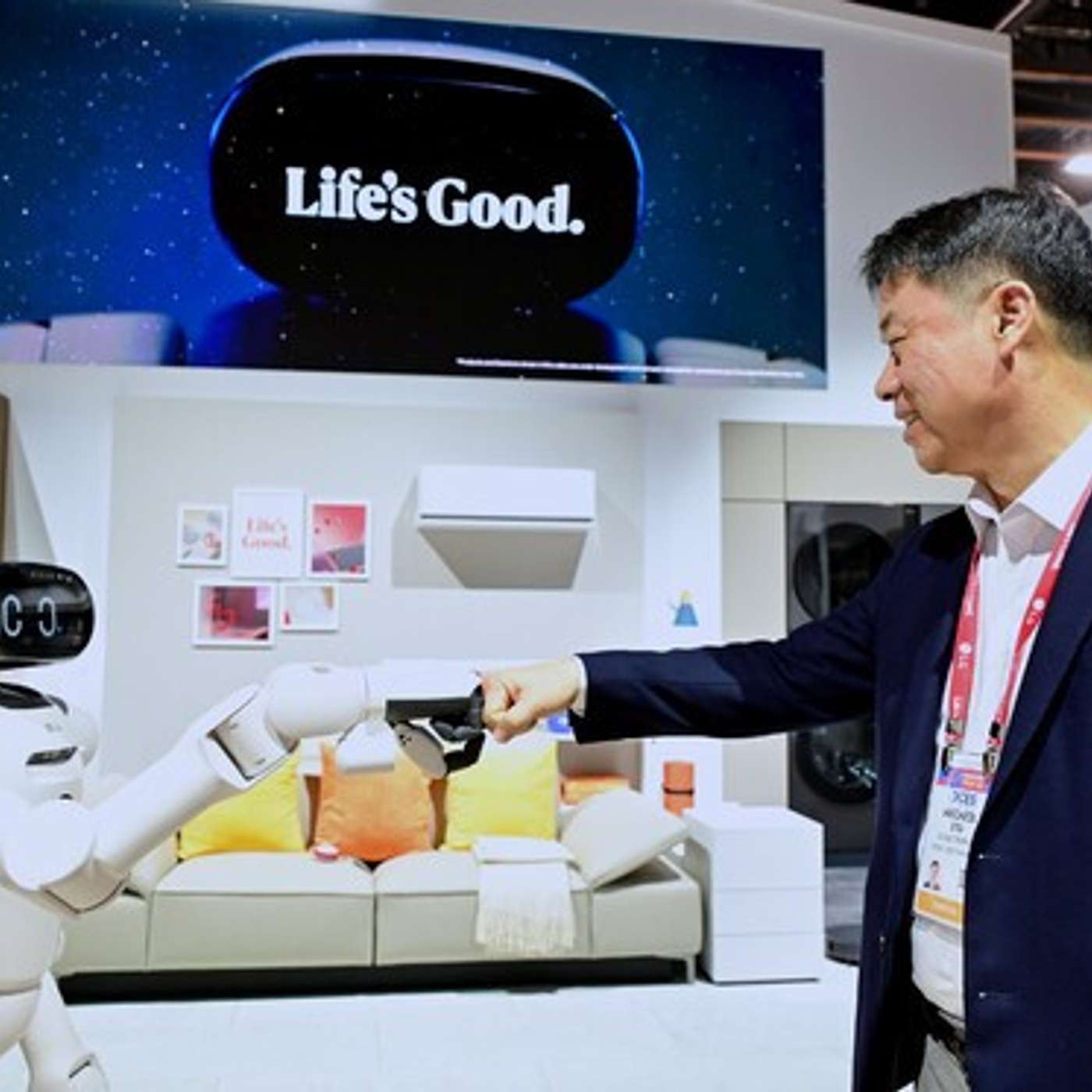
(4:19): LG Electronics Boosts AI Growth with Robotics, Data Center HVAC, and Strategic B2B Ventures
(6:52): ASRock Industrial Launches AI BOX-A395: Compact AI Powerhouse with AMD Ryzen AI Max+ 395
(9:16): Fortinet Unveils Unified AI-Powered Security Platform to Combat Evolving Cyber Threats
To subscribe visit https://www.brief.news.
For more updates in your inbox each morning visit www.brief.news.
Image credit: KMJ
(2:15): NVIDIA's Unique Position: A Value Stock with a Growth Trajectory Amid AI Boom
(4:19): LG Electronics Boosts AI Growth with Robotics, Data Center HVAC, and Strategic B2B Ventures
(6:52): ASRock Industrial Launches AI BOX-A395: Compact AI Powerhouse with AMD Ryzen AI Max+ 395
(9:16): Fortinet Unveils Unified AI-Powered Security Platform to Combat Evolving Cyber Threats
To subscribe visit https://www.brief.news.
For more updates in your inbox each morning visit www.brief.news.
Image credit: KMJ
Hosts & Guests
Transcript
Good morning.
It's March 23rd and this is your daily brief in AI.
Here's everything you need to know.
Rapidice, an India-based ODM, is expanding its vision AI and intelligent camera platform
to help global brands design, develop and manufacture next-generation AI-powered camera systems
for transportation, security, smart infrastructure, and industrial automation.
The product portfolio includes surveillance cameras, dash cameras, body cameras, edge
AI boxes, video doorbells and video management systems with P2P-based real-time streaming
and secure device connectivity.
Regulatory compliance is highlighted as a key consideration, with STQC guidelines in
India cited for cybersecurity, device integrity, and system reliability to guide compliant
design and manufacturing.
Vision AI is positioned as a core layer of digital infrastructure, with edge computing
enabling faster and more secure data processing close to the source.
The move toward edge computing is driving demand for vision-enabled devices that process
data locally to improve speed, efficiency, and security.
Rapidice directs readers to its website for more information, along with a contact email
and press materials.
Further contact and availability details, including references to accompanying images and logos
in the press release, are provided.
Contact information and press materials reference Rapidice's website and related channels
for inquiries.
Rapidice's AI-powered driver monitoring systems detect driver fatigue, distraction, and
unsafe behavior to improve fleet safety and efficiency, with some configurations compliant
with AIS-184 in vehicle camera standards.
The platform support use cases such as fleet intelligence, public safety, industrial monitoring
and smart transportation, with driver monitoring systems enhancing safety.
Some configurations comply with AIS-184 regulatory standards, enabling compliant in vehicle
camera deployments.
Executives emphasize a holistic approach to scalable camera platforms that combine high-performance
hardware with intelligent vision software to meet evolving market needs.
NVIDIA sits at a 23.7 times forward earnings multiple, a valuation more typical of value
stocks than fast-growing tech, even as the company remains a clear growth leader with
strong revenue gains and a defined AI-driven roadmap.
The market eyeing its multiple suggests a balance between value and growth appeal, and
analyst note the current levels sit closer to value indices while investors expect
ongoing AI-led demand.
AI data center demand stays robust, often outpacing supply as cloud giants expand
capacity, with Oracle forecasting substantial future contracted revenue.
NVIDIA's roadmap includes Blackwell and Vera Rubin, with Vera Rubin expected to launch
this year and delivering roughly tenfold the performance of Blackwell.
Industry observers and venture capital proponents expect AI to lift productivity and drive long-term
economic growth through automation, supporting a constructive growth narrative for the company.
CEO Jensen Huang has outlined ambitious growth, pointing toward orders that could reach
about $1 trillion in AI chip sales by 2027, reinforcing a strong growth story.
At a major GTC event, Huang signaled that orders pointing to roughly $1 trillion in revenue
through 2027 underpin a robust outlook in gross margins above 70%.
AI inference and AI agents are highlighted as the next growth drivers, with NVIDIA positioning
platforms to power inference heavy workloads and broaden leadership in the next AI phase.
Some critics warn that current AI spending could be wasteful, adding uncertainty to the
ultimate outcome.
NVIDIA's revenue surged to a record $215 billion with net income of 120 billion in the
latest full year, driven by major customers like Meta and Amazon.
The company has delivered outsized shareholder returns, rising more than 1,200 percent
over five years, due to AI demand and ongoing innovations in GPUs and upcoming Vera Rubin
systems.
LG Electronics is accelerating AI-driven growth across home robotics and AI data center
cooling, aiming to turn these into major growth engines.
The company is pursuing a B2B actuators business by designing and manufacturing robot joints
in-house, targeting components that can account for over 40% of a robot's cost, and positioning
LG as a leading actuator supplier in a market expected to reach tens of trillions of
one.
In AI data center cooling, LG will add liquid cooling to its lineup to become a core
infrastructure partner for global tech giants.
All AGM agenda items were approved, including financial statements, amendments to the articles,
treasury stock retirement, director elections, audit committee appointments, director compensation
limits, and a 35% dividend increase to 1,351 per common share.
Ryu J. Chihol, appointed inside director, highlighted AI and supply chain reorganization
as growth catalysts, while noting market uncertainty presents both challenges and opportunities.
LG's smart factory unit is targeting high margin B2B solutions with manufacturing intelligence
and has secured a backlog of 500 billion one within two years of its 2024 establishment.
Sayo Song Wu of Seoul National University was reappointed to LG's audit committee, reinforcing
governance with academic leadership.
CEO Liu, who became internal director last year, and professor Sayo Song Wu's reappointment
underscore the leadership's focus on AI and governance.
LG outlined four strategic growth directions.
Liden the technology gap in core businesses, push high margin B2B and subscription models,
grow robotics and AI, and drive an AI transformation across the organization.
CEO Ryu J. Chihol is expected to present a detailed roadmap for new ventures at LG's annual
meeting, with home robot commercialization anticipated to take at least five years due
to safety and versatility hurdles.
LG defines AI transformation as a driver to redesign processes and boost productivity
by about 30 percent over the next two to three years, while planning increased investments
in B2B platforms and D2X to lift revenue and profit by 2030.
AI home will build an open ecosystem connecting internal and external devices and services,
leveraging LG's appliance strengths and user data to offer spatial home solutions.
ASRock Industrial unveils the AI Box-A395, a compact AI workstation powered by AMD Ryzen
AI MAX plus 395 processors with Zen 5 CPUs up to 16 cores, a Radion 8060s graphics processing
unit, and an XDNA2NPU delivering up to 50 tops AI acceleration for on-device workloads.
This small form factor is designed for high compute density to enable on-device AI deployment.
The system offers dual 10 gigabit Ethernet-slash 2.5 gigabit Ethernet LAN, multiple USB ports,
and strong display capabilities with 2 HDMI 2.1 and 3 DisplayPort 2.1 outputs, plus 2 M2
slots, and an extra M2 slot for Wi-Fi-slash Bluetooth with Wi-Fi 7.
Storage and networking support RAID 0-slash 1, PCI Gen 4X4, and Wi-Fi 7 with Bluetooth 5.4
for flexible deployment.
2 M2 PCI Gen 4X4 slots, 2 2 4 2-slash 2 2 8 0 support RAID configurations, plus a dedicated
M2 KE for wireless and Bluetooth.
The chassis measures 200 by 100 by 232 millimeters in an aluminum enclosure, with a handle and
onboard TPM 2.0 and redundant bios for enterprise grade reliability and security.
ASRock Industrial directs readers to its website and product inquiry channels, highlighting
its CARES-focused Autonomous B2B approach.
It supports up to 128GB of unified LPDDR5X8000 memory to run large AI models and memory intensive
workloads on device.
Targeted at enterprises, developers, and system integrators, the AI Box-A395 supports
Windows and Linux, and is aimed at AI development, engineering workflows, and high-resolution content
creation.
A robust cooling system with six copper heat pipes sustains AI workloads with low noise.
The AI Box-A395 enables running large language models, generative AI, and vision AI at the
edge to reduce cloud reliance and improve data control.
The release positions ASRock Industrial as an independent entity focused on industrial
PCs, edge computing, and CARES branding for commerce slash automation slash robot
slash entertainment slash security.
Fortinet is rolling out Fortisock, a cloud-delivered platform that unifies Forty Analyzer, Forty
CM, Forty Soar, and Forty Tip into a single data model for log ingestion, normalization,
correlation, automation, case management, behavioral analytics, and identity-focused
investigations, with AI, ML, and Forty AI embedded to accelerate analysis and response.
Forty AI expands across all components to enable agent execution that links telemetry
tools and response actions, including an automated alert triage agent and a model context
protocol for continuity across detection, investigation, and response.
The rollout highlights built-in SOC best practices, AI ML enhancements, simplified licensing,
elastic cloud scale, and future C-10 integrations to speed analysis and response.
CEO Ken Z frames the shift as a necessary step to meet AI-enabled cyber threats, promoting
a unified AI-powered platform with scalable architecture for self-managed, cloud, and
fully managed SOC deployments.
Fortinet emphasizes protection against AI-driven threats and the need for faster coordinated
security operations in a rapidly evolving threat landscape.
They stress industry-facing context to combat AI-assisted reconnaissance, exploit development,
and social engineering, presenting the platform as scalable across deployment models.
The updates aim to deliver a single architecture that reduces operational complexity, speeds
investigations, and scales defenses against AI-driven threats across endpoints, identities,
cloud, and networks.
The goal is a unified AI-powered SecOps platform that reduces complexity, accelerates investigations,
and defends against AI-driven threats across endpoints, identity, cloud, and networks with
options for self-managed, cloud, and managed deployments.
The enhancements reduce tool fragmentation, accelerate investigations, and provide a scalable
AI-powered architecture for modern SOC needs across deployment models.
Fortinet announced, accelerate 2026 innovations for its security operations platform, focusing
on a unified SOC, agentec AI, managed services, and endpoint security improvements, with
an emphasis on AI-powered capabilities, cloud-delivered services, managed coverage, and enhanced
endpoint security within the security operations platform.
The accelerate 2026 initiatives modernize the SOC, introduce agentec AI, expand managed
services, and simplify endpoint security.


