Get every episode summarized
Each time Wheel Bearings publishes, we email you a written briefing from the transcript — the topics, who appeared, and any specific claims, with the ad reads skipped.
Email me new episodesFree for 3 shows. No card needed.
About this episode
Wheel Bearings is made possible by:
“This podcast is supported by your Southern California Kia dealers. Living in Southern California, your SUV needs to do a little bit of everything. From the daily commute to weekends at the beach, road trips to Palm Springs and family adventures in Big Bear.”From the transcript
This week Robbie has been driving the Kia Telluride hybrid and the GMC Sierra EV while Sam had the very impression new Kia Seltos.
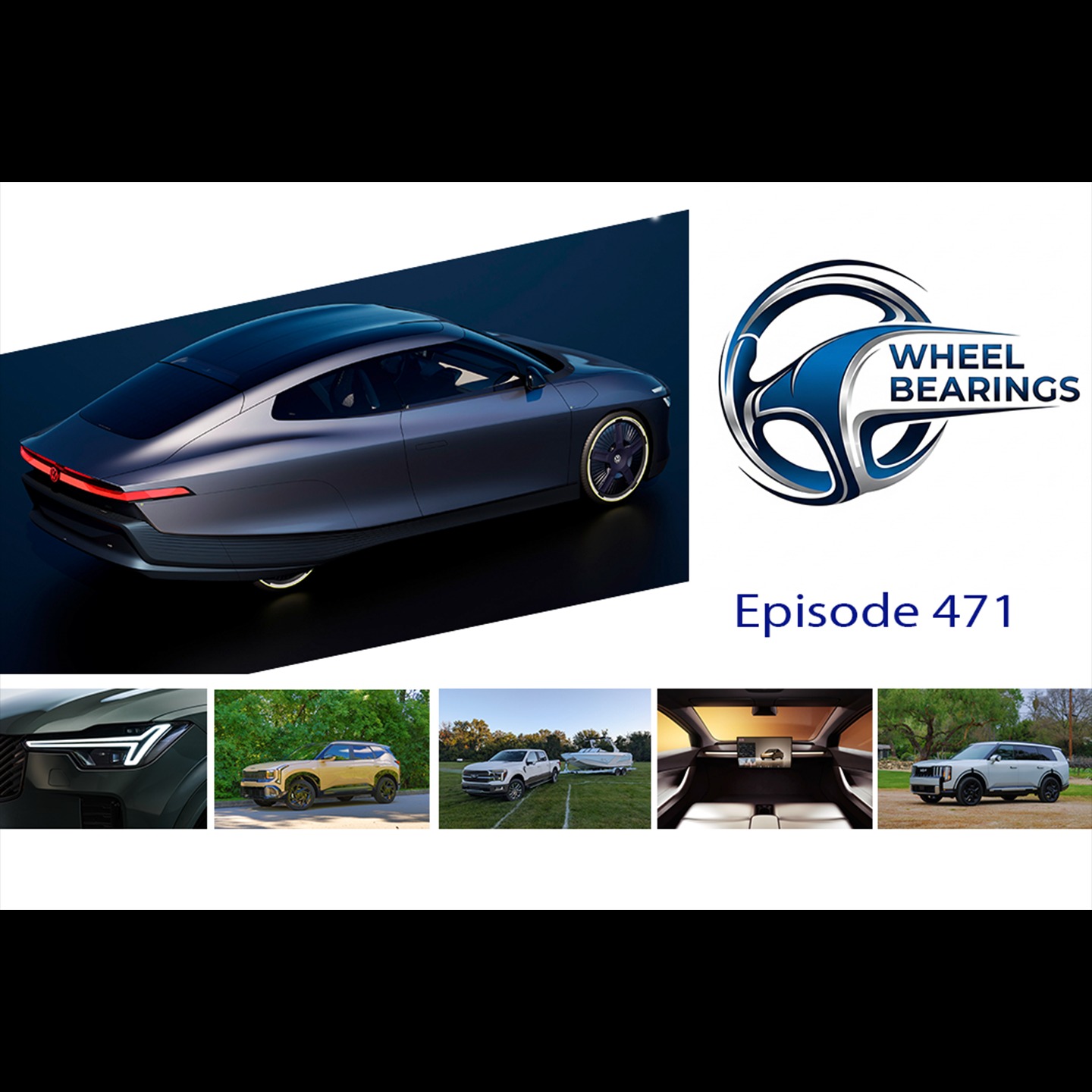
In the news, VW showed a new EV concept and a lot of people misread the press release. Ford is again refreshing the F-150 and adding hands-free towing capability to BlueCruise. Volvo has upgraded the XC90 and XC60 PHEVs with double the electric range. GM dropped details on the new V8s in the 2027 trucks and the updated user interface. Robotaxis without controls make problems for first responders and Sam and Robbie visit a magnet factory.
Links
Mission Efficiency - Volkswagen presents the world’s most efficient near-production electric car
TTD September 15, 2026 - Ford Adds Hands-Free Towing to 2027 F-150You Asked, We Listened: BlueCruise Hands-Free Towing Is Coming
Volvo Cars unveils America's longest electric range plug-in hybrids: the new XC60 and XC90
GM Thinks Truck Buyers Want A Bunch Of Screens For Some Reason - The Autopian
Tesla Cybercab's Touchscreen Is Already Proving To Be A Problem For First Responders - Jalopnik
GM’s legendary Small Block V8 enters its next generation with more power and capability
Advertising Inquiries: https://redcircle.com/brands
Privacy & Opt-Out: https://redcircle.com/privacy
Get every episode summarized
Each time Wheel Bearings publishes, we email you a written briefing from the transcript — the topics, who appeared, and any specific claims, with the ad reads skipped.
Email me new episodesFree for 3 shows. No card needed.
Transcript ready
1,836 searchable segments. Every word is indexed and playable.
Full transcript
Wheel Bearings — Reading Comprehension. Machine-transcribed; use the interactive transcript above to jump the player to any line.
This podcast is supported by your Southern California Kia dealers. Living in Southern California, your SUV needs to do a little bit of everything. From the daily commute to weekends at the beach, road trips to Palm Springs and family adventures in Big Bear. That's why having the right SUV matters. Kia has an SUV built to fit just about every lifestyle, with traditional gas, hybrid, and all electric models. Across the lineup, you'll find sophisticated design, rugged capability, generous cargo space, available seating for up to seven, and on select models, driving range of more than 600 miles. One model that really stands out is the all-new 2027 Kia Celto's. It's a small SUV with big SUV capability, featuring class leading interior space, unavailable turbocharged engine, and available multi-terrain all-wheel drive. Whether you're navigating city streets or heading out for a weekend in the mountains or along the coast, it's ready for wherever life takes you. Whatever your lifestyle, Kia has an SUV designed to fit your needs.
Learn more at Kia.com or visit your Southern California Kia dealer. Saturday, September 26, two of combat sports' most dangerous strikers collide. Bear Knuckle! Liverpool's own down in the Gorilla Tilt coast of war with Cuban powerhouse Yoel Soldier of God Romero. Plus, the Bear Knuckle Middleweight Championship of the world is on the line, when the rating champ Dave Varedneck Mundell defends against undefeated British challenger, Jack Demeek-Pleaver-Colin, BKFC 94, Tilt vs. Romero. Watch it live only on the zone. Sign up now at thezone.com. Alright, take two. This is episode 471 of Wheel Bearings. I am Sam Abuel, Sam from Telemetry. And I am Roberto Baldwin from SA International. And Mr. Baldwin, what have you been driving? So, I teased it last week. I'm just going to be up front. I've been so busy. I haven't had a chance to do any range runs. When I do a range run, it's like hours of me driving a car, like in a circle.
And so it's, most of the time I can, I usually try to carve something out on the weekend. We're recorded on Saturday because tomorrow I have to fly to Utah. So, a lot of excuses. I didn't do a range run for this car. The other car I'm going to talk about. So, but I will talk about how they felt. I drove the Kia Telluride Hybrid. I really like to tell you right. When the first generation Telluride came out, it sort of changed everything, really. This was a really nice, more affordable, like large SUV that was punching above its weight, luxury-wise. And people are like, oh my, I remember we, I had one when we were shopping for our house. And our real estate didn't usually go like, what is that? He'd never seen one. He had no idea what it was. And he was taking pictures of it to send to his wife. That's like, so, just people, just random people, like we're impressed with this vehicle. This is the second generation. It's a lot more boxy, which is literally everything else on the market is a lot more boxy. Everything is two rectangles stacked on top of each other.
There's a big rectangle in a smaller rectangle. And on the smaller rectangle there is like a little slant for the windshield. But essentially everything is just a rectangle. Everything on the road, just rectangle SUVs driving everywhere. I still blame the Ford Raptor for this. But yeah, I like the design. I like the previous version design better. But yeah, it's comfortable. Like I said, it's luxury-wise. It's sort of punching above its weight. I did have the one with the captain's chairs and the second row. So it's a more comfortable ride for people in the second row. But the sort of trade-off is if you want this vehicle to do a lot of, like if you're hauling a bunch of stuff, if one of your main reasons for getting a big SUV is not to have like, you know, six, seven people in your car, but instead to be able to haul things around, what will happen is if you get the captain's chairs is, yeah, that gap. So when you put the seats down, there's just a gap in the middle.
And so it's kind of weird. So yeah, so you know, when you're going to look at these vehicles, you have to decide you want the captain's chair for comfort for the people in the second row, or you want the bench for, you know, maximum cargo hauling capabilities. Either way, I think you're probably going to be fine. If you don't have a big family, I would say get the captain's chairs for when you are, like, hauling people around. If you have a big family and or you, like, you're the parent or the person who just always ends up hauling things all the time, just get the bench seat in the back. That said, the hybrid system is actually really nice. You don't get that sort of, I know we always pick on Toyota. And because the, you know, the Toyota hybrid system is sort of like, you know, the benchmark, but it's loud. The high, the key hybrid system is not, it's nice, it's smooth. The transition is really, really well done. A couple years, last year, I believe I was at a key event or Hyundai events.
And they were like kind of lamenting that people didn't realize that the Hyundai Motor Group made hybrids. Like, we, you know, we really want more and more people to know that we make hybrids. And, you know, the drier program was a hybrid. And, but, you know, I went to another Hyundai thing this week and their hybrids are doing well. So I think more and more people know, yeah, it's about 25% of the vehicles they're selling now in the US are electrified. So either hybrid, plug in hybrid or battery electric. Yeah, so it's, you know, people are catching on the hybrid system. It is a big vehicle, but with the hybrid, you know, the EPA is 31 combined. That's 30 city, 32 highway. I got like, I was getting, I was average, you read about 29. So pretty, you know, a little bit below what, what Kia says. I don't know whenever I think hybrid, I, you know, I was like, I want to get a minimum of like 35.
But, you know, it's a big vehicle, you know, kind of, you know, take it or leave it when it comes to that. It has a 2.5 liter turbo hybrid. It has 329 horsepower, three and three pound feet of torque. No problem getting out of its own way, no problem catching up, no problem overtaking. Is an automatic transmission, doesn't have a CVT, which is like, yay, it's paddle shifters if you want to do that. This one is all-wheel drive. So, you know, you're, you're having a nice time. It was the X line, SX prestige all-wheel drive trim level. That's the one I had. So it's the very fancy top of the line. Yeah, it was like the, yeah, the, the fanciest of the fancy of the vehicles. And, but even though it's a tippy top, like I expected it to be more, and this is the sort of secret sauce of the telluride. So the, let's see, the manufacturer suggested retail price, I feel like Bob Barker, $57,590,
which for a large, nice SUV, that's pretty good. That's actually, that's really good. Now, after it's, it's totally competitive with, with similar offerings in the market, like the Toyota Grand Highlander, and really in terms of three row, you know, crossover SUVs like this, the, you know, the Palisade, the Grand Highlander, and, and the tellurideer, really all there is right now, I think. I don't think there's anything else. Yeah. But it's it for, for what you're getting, it feels like a deal. I mean, it's still very expensive. Let's see, we can get the regular Kia telluride, or for less, I probably should have looked this up. Seems like I don't know how I do my job. So, it's, the starting price is, except all, starting price, give me a starting price. Oh, wow. So you can get the LX, like sort of the cheapest one without the hybrid for $40,000.
So for people, it's not cheap by any means, but, you know, by current standards of what's out there, what's in the marketplace, it's not bad at all. Yeah. It's, it's for, for what it is, what that market is, is asking and what's happening in the world. It's a pretty, it's, it's pretty good. Yeah. That's, that's sort of the Kia sacred sauces that you're getting something. It's not a super, you know, screaming and saying deal, but it's a pretty good deal. And when I'm driving this, I'm like, why would I get a Range Rover? And I know the people who are cross-shopping Range Rovers are not looking at Kia's. Right. People who are buying Range Rovers are going to buy a Range Rover. They're going to buy a Land Rover. That's what they, you know, that's what they want. They want that, that sort of, that, that British luxury. But if you are not, you know, a big fan of British, like, you know, a hardcore fan of British, British vehicles, I know some people who like, you know, they love Jaguars because they're British. That's what they, you know, this is the car I want, this is the car I grew up with, whatever.
Same thing with Range Rovers, Land Rovers. If you were just like, you know, I need a really nice vehicle. Maybe go, I don't know, after you'll see the JLR like a dealership. I don't know over to the Kia dealership, all places. And check it out. Yeah, all will drive. You know, obviously I didn't have a chance to take it off road. Most of these things are going to go off road. I did, we did have a chance to drive these off road late last year. No, it was early this year. Early this year. March, February or March. Maybe. I don't know. I think it was this year. Okay, so at one point they let us drive these off road. And mostly it was like on trails. And but the trails are pretty, pretty, you know, they're steep and there were some hard turns and stuff. And well, and they had that shelf road that was going along. And basically you had to keep it like right on the trail. Yeah, you fall a little bit too far over to the left. You're going to fall off. You just fall off your own. Into the, often to the depths of nowhere, Zville.
So yeah, no, it's, you know, it's, it's for what people are going to do, which most people, again, when it comes to these vehicles, they're not going to, most people are not going to do the thing that the vehicle is capable of. But, but you have the, the peace of mind that it is capable of taking care of, you know, if something, you know, you do have to go up some weird, crazy road. You can do it. So yeah, no, it though, when I finally had it, it was $61,180 with everything. It's weird to make you pick the, the, the charger when it's just us. So it's the, the destination fee was $15,450. Our $15,45, sorry, $15,545. Which is not bad. Yeah, that's too bad. Again, bike, bike, car, car, car, car, it's too much. It's too much, but it's not too bad. It's relatively speaking, it's okay. Yeah, yeah, relatively speaking, you're like, okay, fine. Yeah. Again, this thing had all the thing, dual sunroos, you know, power, lift gate, you know, all the, the fancy bits.
So yeah, Kia tell you ride X, HEV, or their hybrid, X line, SX prestige, all wheel drive. What do you think of, you know, there's some, a couple of odd elements about the design, particularly like those little things at the top of the wheel arches. Oh, the little like, the little little like, they're like, they're like, if you're a clown and you have that little, like, slash up. I like those better than the ones on the Palisade where it looks more like you have like an eyebrow. Yeah. Yeah, if they feel more like, oh, they feel more like they're sort of like an off road, you know, version. And you know, they give us all the reasons why these things are when they talk, the designers talk to us. And you know, they break up a line, it adds this, it does that. I'm fine with the little, I liked a little check that, that, that, that, just that one little vertical, little check that's on the, you know. It's kind of like a, like a binder clip that's holding the top of the wheel arch to the fence.
Yeah, it's like, it, it looks like it's lifting it up. I think that's the idea is it lifts it up. I, I'm fine with it. It's, to me, it's not that big of a deal. I like it way more than the sort of eyebrow that's on the Palisade. Yeah. Because the eyebrows seems very weird because it's very like, you know, you have the wheel arch, but then the eyebrow doesn't go with the wheel arch. It's very straight. It's like you went to get your eyebrows threaded and you didn't, you know, the person wasn't really paying attention. And they just gave you like a night like flat straight, which is not how eyebrows work. It's like, like that. Yeah, because you got a, on the Palisade, you've got a round wheel arch. And then, and then a whole, eyebrow over it. Yeah. A little peculiar. It's a, yeah, it's an odd, it's an odd look. But yeah, yeah, I know I like, and I think this is the same thing with the, the, the, the tell you right and the Palisade before. I'd like the way the tell you, the original tell you right look versus the original Palisade. I think it's just, there's just something. I don't know.
So yeah, so, you know, give it a look, give it a, give it a look, see if you're looking for, you need, you got a whole lot of people. You got a whole lot of stuff. You want to feel a little classy without throwing classy money down and you need all will drive. And you want to save a little bit on gas. You know, the hybrids in these vehicles, yes, they do sort of give you more miles per gallon. But it's not like, oh, it's not doubling it. It's not the, it's not to prelude where the prelude versus the BRZ where it doubles. Yeah. It's like, oh, I'm getting five, five, five, five, maybe eight miles per gallon better. Cool. But, you know, again, if you compare it to, you know, like a Grand Highlander, for example, it's, you know, similar fuel economy to what you're going to get in that vehicle. Yeah. And I think it's a lot nicer driving experience. It just, it sounds better, it feels better. They, yeah, they're just, how many motor group I think? You know, you, you always kind of like, well, when is something, you know, like Volvo was doing amazing for years.
And then it kind of wasn't. And now they're, you know, they're sort of digging their way out. And, you know, but it's, you wonder like, okay, what, at what point does Hyundai motor group, like sort of falter? Everyone falters at some point, you know, Lincoln made an amazing, they had like a string of like great vehicles. And then next generation of all those vehicles are just like, uh, like what happened? Like what you guys are doing so great. And then you just sort of, uh, I think it was, I think, you know, they made the decision to go with software, control, advanced. And, you know, it's just kind of messed up everything. Yeah. Everything, once you go software control, advanced, you just sort of give enough to go stupid. Yeah, exactly. So, uh, no hope left. Yeah, there's no hope left. So, so the next vehicle I got, I got back from Texas, we, me, Sam and I saw each other in Texas. Was a 2026 Sierra EV AT4 max range pickup truck. It's huge. Although to, to be fair, it's actually not any bigger than a gas Sierra.
I know. But it's the same. It's the same size as the gas version. Yeah, it's the same size as the gas version. It's just I am not, I wonder, you know, if you live in a, you know, I had to go to San Jose in this. I went there and back. I, you know, I had to drive around the city. Uh, my band had a show last night, Albany, one of my bands. And so it's great for like loading things in sort of, but it's so tall. It's kind of a pain in the ass because you got lift, we're lifting giant heavy amps up and into the, the back of the truck. And then up and into the back of the truck. And you can't, and you know, when you look at the, the bumper, you know, they have that little extra step. Then we've had to add that step as a society in order to get into the back of our trucks because they're so tall. So there's that. They do, they know this vehicle, GM, what's it say, 478 miles of range. That's so much range.
And so I got into the truck and I immediately drove to San Jose and I got back. I still had 300 and a bazillion miles of range. And then I drove it around doing some stuff with it. Still, I still have like 200 and something miles of range in this truck driving around. I took it to the, I had to go pick up gear, I had to go to the show, I had to go back and drop off gear, I had to come home, you know, just driving around doing things with it. And it's just, you know, it's got a gigantic battery. So at the end of, at some point, it's going, you know, I'm going to have to fill all, put all the electrons and it's a 3000 pound battery back. Yeah, it's, you know, it weighs more than everything I've ever owned, ever. So yeah, it's, it's got a lot of, yeah. But you know, it's taller, you know, it has more ground clearance. That's why this one is so calm because the AT4 has standard, all those scaring, which does make it feel smaller than it is. So that's really nice in the parking lots, you know, I had to pull in the parking lots to do stuff.
It has supercruise, which, you know, use supercruise. You know, supercruise, it's generally fine. Everything, you know, it hasn't really changed much. In the Bay Area still, there's just like areas where it's like, oh, I'm turning off supercruise and then a quarter mile later, back on. And the road is straight. I'm just like, I don't know. I don't know what's going on. Well, I mean, it's not the same thing with the escalade during Operation Frodo and June, the escalade IQ. Every once in a while, it would just randomly switch off supercruise, say, put your hands back on the wheel and then like 10 seconds later. It's like, okay, you can go ahead for you again. All right, go ahead for a couple of, yeah, it would do that. Maybe it's something they put in there just to make sure that you're really, you know, still awake and paying attention. Who knows? Maybe. I mean, it's, again, like I've said, I always just keep my hands on the wheel anyway. And it like, it like rumbles your butt. Yeah. It's got a little rumble seats. It's all, oh, I'm like, oh, all right. Well, my hands are here anyway. And I was already, really, I was already driving anyway.
I was just like, dude, dude, dude, dude. It's fine. It does have the mid gate expandable bed, which I'm like, I think is really cool. I think I'm a big fan of the mid gate. I haven't had a chance to use it because I don't have anything that long that I need to stick in there. Like we just kept seven amps in there. We didn't even have to take the, the, the tonotop like more than halfway. I'm like, well, I guess, I mean, we should have went to the drummer's house and picked up his stuff too. You need, you need an 11 foot paddle board, stand up paddle board to put in there. Yeah, so you put down the mid gate, use the, the 63 way folding tailgate and, you know, like this one has the one where it pops up and it blotches it. So it stuff doesn't fall out, which I think is clever. Because, you know, that's, that's nice. It'll charge at up to 350 kilowatts, which for a battery this size, you're kind of half-time. Yeah. It still takes a lot of charge.
Yeah, it still takes a lot of, there's so much, yeah, such a huge battery. It's still, but yeah, you kind of need it. And then what they say they say, 10 minutes for up to 100 miles and about 10 minutes. So to fill the like 400 miles, let's say you go from 10 to 80, it's like 40 minutes. So because again, it's a bird battery. So this is definitely a car we can park and then go have a nice lunch. Yeah. And while it's charging it, if you're lucky, if the charging station is working correctly, it has the energy transfer, you know, system or you can plug stuff in. I was like, pulled up every time I have one of this truck or I have the F-150 lightening or anything with like the power in the back. I'm always like, oh, maybe the power go out of the club and I can be like, guys, I can save the show. We did it. We did a wedding with, I had the F-150 lightening. We just get a wedding for a really long extension cords. He's all the outlets. Yeah. But we did a wedding when I had the F-150 lightening and there were like rolling blackouts around the area and I was just like, oh, yeah, I'm ready.
I'm ready to save this wedding just in case it will do like, you know, it says it's available 12,300 pounds of towing, which is, yeah, it's awesome. Well, I mean, the good thing about having such an enormous battery is, you know, even when you're towing, you're still going to get well over 200 miles of range on a charge. I think when the TFL guys first got a Silverado EV, they did a towing test and got, I think it was like 220, 230 miles of range with like a 10,000 pound trailer on it, like a box trailer. So. Yeah. No, these, I mean, that's the thing is that yes, it's very big, but trucks are just really big. And to me, I'm just like, this is, it's such a, I'm like, how do you live like this? I, if I lived in a small town or like, I need, I had a need or if I had a farm or something or a ranch,
I'm like, okay, this is, I need this for, for this. But when I see people just driving big trucks as like, that's their car, like around like a, like an urban area, I'm like, how do you live like this? I know. I do. Like, and the prop, and it doesn't help that I'm too tall for the steps, for the site, the steps, the little, you know, the steps to get in. I'm too tall. If I stand on that, I'm like, I like fly, but it's also, but now, but I also have to step over those in order to get into the truck. So it's awkward for somebody at my size, six with three with like a 36-hitching. So I have really long legs. I'm like, mostly just legs and arms, like half spider. It's hard. It's like, it's really weird and awkward to get into the truck, no matter how I do it either. If I step out and I'm like, whoosh, I'm like, I'm like, launching this guy, or I get into the other way. And the problem, you know, that, that sort of, I think this is, this is a personal thing, because I asked another person who's about as tall as me, but his torso is a different size. You know, I have, I had this issue with the, with the Hummer EV, where there was, you know, it was the plastic little Hummer EV thing that was right at my shoulder blades.
Well, the way the seats are actually, you know, it's probably the same seat. They just take, they just took a badge off. So there's no badge on the, the CR EV one, but does have like sort of, you know, a difference in consistency and material. And so I, on that car, it was the same thing, like right across my shoulder blades, it just felt like something's just pushing on it while I'm driving, which made it kind of uncomfortable to drive, which I'm like, okay, well, this is supposed to be, you know, a sort of a luxury, you know, pickup trucks are essentially luxury vehicles with giant beds at this point. And so I was like, ah, this isn't, yeah. And then of course, the fact that it doesn't have car play, I turned on, you know, notifications for my text messages, which is sort of the thing. And at one point, they were overlapping. I didn't know it was, I'm like, I don't know what I'm doing. And this is not, this is not GM's fault, but Google Maps has gone crazy the last few days. Like it's, it's slowly, I feel like AI is just breaking everything. You have a little bit more. It was slopped.
At one point, it told me that the freeway was closed. So it took me off the road. Guess what wasn't closed? The freeway. The freeway. I could see the freeway. And so I feel like Google Maps, like I've had a few like really weird things lately with Google Maps and it happened with this vehicle. You know, the fact that you can put all three things up is great. But if you don't, you know, if you're using something that you can't get with Android Auto, some sort of music or podcast player, you're using your phone, which is like not the thing that you want to be doing in your car. So I'm not thinking of that. You can still connect your phone via Bluetooth and once you've launched something, once you've got something playing, you can control it through the media player that's part of the Android Auto mode of infotainment system. You can play and pause and reverse and go forward. But actually getting something started is the problem.
And if you want to listen to a different album or whatever, either if they ask Siri, or you have to pick up your phone, which I'm just like, not a fan of to be honest. And I probably found like one USB-C port in the front. There's more inside the little cubby. I opened it up and just one. I'm like, I know there's more of them in there. There's probably more. And here's the problem. This is the same problem I have with the escalator. I could not figure out how to open up the front from outside the vehicle. I had to use the key. I think there's no eye stared at it. Every time I used the front, I stared. I was like, I was just moving my hands along the front of the truck trying to find a button or a lever or a pulley. It's like under the, it's in the slot and the bumper. I'll try it later today. There's an air slot in the bumper below the, or yeah, somewhere, it's actually on the bumper.
It's somewhere on the underside of the bumper. That's where it was on the escalator. I'll try it today. I do love the giant front, even though I have to use the stupid key fob to use it because I can't find the stinkin button. We went to lunch and so we were able to shop before the show, we went to dinner and we were able to shove things that we wanted to keep out of sight inside the front. Fronts are great. You can lock stuff. I think that's the big, big A plus for if you're getting a pick up. Is that you have that extra storage that's lockable and no one can see it. Yeah, you see, you can put your tools in there. If you have expensive tools, you can shove them all in the front and you can power them all from the front. Yeah, to me, if you look at their thing, this year EV is a real truck that does real truck things. I'm like, yeah, it does all the real truck things. It's just really big and it's really expensive.
The infotainment, yeah, it's really big. It's really expensive. Any infotainment system does not match what they wanted to do when they removed CarPlay. I wish it was better. It's not. And again, when it comes down to it, the only, like really the one infotainment system that I personally end up using without really worrying about CarPlay is MBS or Mbox. The Mercedes system because it's just like that. And then everything's just right there and it's very easy to use it. Yeah. So, yeah, so that's the CR EV. I did not do a range run. I'm assuming it probably does, you know, it does have 478. Maybe it has a little less. There's no, they don't have to do EPA tests on this. If you look at the Bernoulli, there's nothing because it's gross vehicle weight is over 8500 pounds. Let's see if it does have the gross vehicle weight in here. Oh, so for the USB ports, I think where the wireless charging pad is.
Yeah. That's a panel that I think slides forward and there's a storage been underneath that. Oh, it's in that little, yeah. So I found that like yesterday. I'm like, oh, look at this little like secret area that I didn't open it all the way because I'm on the front of the front at the leading edge of that. So if I, okay, so I'll look at that. So anyway, so there's some ports. It has have like a lot of little cubbies, which I'm like, yeah, I love a cubby. I love a little hidden cubby. So I was just like, what's this button doing? A shoe. And then my phone like almost just like, whoa, whoa, whoa, whoa, come back. So there you go. So there's some USB C ports in there. I apologize to the GMC team for saying I can only find one. But yeah, it's definitely a vehicle that when you buy it, you need to get the owner's manual out. And because there's some things are just like, hey, we hid these. There's so much stuff. You like Easter egg hunts? It's just like, what? What? No, I don't. I just just tell me where the things are. Hey, it's got, it's got real vents. It's got manual vents. Yeah. There you go.
Easy peasy. That's all you really need. And you can feel the, how the, you know, the, the Hummer, I had some like weird issues with the Hummer. The Hummers had software issues since it launched. They're still, you know, they're just kind of there. Zero software issues with the CR EV. So thumbs up for that. So you can see that, you know, and, you know, GM, I think they're still building it. They're still selling it. People are still buying it. I see them in fleets. Cow trans has a lot of these. Not the Amazon. Yeah, I mean, they sell a couple of thousands a month. And it's not a huge number, but, you know, they sell some. Yeah, you know, everyone you sell, if it's at the job site, you know, the guy who shows up with it or the guy who shows up with it. They're like, everyone's like, oh, you're like, hey, how much are you paying for gas? Well, you know, I just saw a clip somebody posted the other day. Somebody sent it to me on Instagram of truck drivers, or truck driver somewhere down south
that just filled up the tank on his tractor trailer. Over $1,000. And the tank wasn't even full. It's so long haul semis, you know, they typically have at least 200 gallon tanks, you know, and with diesel, you know, in the $7 range, $7 gallon range, and up depending on where you are in the country. It's like right around here. It's around $6.79 right now. I saw $8 at one spot. Yeah, over $8.00. Which, you know, that's not where big trucks are getting, you know, are filling up. But if you have, you know, I'm talking about like big tractor trailers that deliver all your stuff. So if you don't own a diesel truck or, you know, an old diesel goal for whatever, you're still paying for these diesel prices because the prices of everything, because absolutely everything is transported and moved around this country. All your little Amazon purchases, all the fresh produce, all everything that's in all your stores,
that's all getting delivered by big trucks. And they all have to pay diesel prices. And they're like, hey, they're not going to, you know, hey, it costs more for us to move this. So we're going to charge you more. And then the people who make the thing are like, oh, okay, we're going to charge the store more. And the store's like, well, we're not going to lose money. We got to keep our doors open and pay our employees. So we're going to charge more. So at the end of the day, we're all playing for high diesel prices. Womp, womp. But, yeah, my next issue of battery and electrification technology magazine for SAE, I got like, there's some like new megawatt chargers that are coming to market. They're all in there. For big trucks. For big trucks. A megawatt chargers. Yeah, that's cool. So, yeah. Yeah, I mean, I, you know, I had it out here about 10 a.m. on Tuesday morning to head to the airport. And I stopped to put some gas in the Dodge Charger I talked about last week.
And regular at that point in time, you know, was 439 a gallon. Premium was 599 a gallon here. That's California prices. When I, when I returned about 36 hours later, driving home from the airport, passing that same gas station that was 439 a gallon the day before was 499 a gallon. And it still is now. And diesel, diesel is at 679. And that's here in, you know, in the Ann Arbor area in Southeast Michigan. It's a, I mean, I, I, I, I'd be RZ doesn't use a lot of gas. I drive it as, as you nearly as much as the Onyck 5. But when I do, I'm just like, man, and I see like a big truck, like a raised truck with giant wheels on it. So I know like whatever the EPA number was that they've halved it. Like raising it up, I throw into big wheels on it, especially destroying all aerodynamics and all drag and everything. There's, there's somebody down the road here that's got a super duty with big wheels on it.
Just everything blasting past me at like 90 miles an hour on, on the freeway. And they, do you know how much your paint for gas? Slow, slow down like 10 miles an hour. You're going to get there around the same, you know, you're going to save like a minute if you, if you keep going faster, but you're going to save so much money. I just want to like, hey, buddy, slow down, save a little gas. You could buy like another pizza. Yeah, or maybe several depending on what you're driving. Yeah, if you live in California, you can, you can get yourself a nice T-bone. Yeah. Yeah, I am definitely glad that we no longer own a diesel vehicle. Yeah. Yeah, I was looking, I was using the calculator in fuel economy that got the other day. And doing a comparison between the 2010 Jetta TDI we had. And the 2017 Honda Civic that replaced it.
And then the QEV6 that we have now. And, you know, and I put in the current prices as they were on that, you know, today. And, you know, the diesel was by far the most expensive to drive compared to the other three, you know, costing, I think it was, came out to like 35, somewhere around $3,500 a year to drive versus about $2,200 for the Honda and about $700 for the EV6. So, yeah, if you don't like those gas prices, go buy an EV. Yeah. And then the prices used EVs have gone up because more and more people want them. Yeah, I was, you know, just out of curiosity. I was looking recently on auto trader, you know, to get an EV6, you know, similarly equipped to ours with similar mileage to when I bought it. I paid $27,000 for it for the one we have right now.
And that is now running about between $31 and $32,000. So, they've gone up by about $4,000 to $5,000. Wow. That's a lot. Yeah. But, I mean, even a $32 grand, you know, for a car with, you know, 15, 20,000 miles on it, you know, that's basically brand new. That's still a bargain. Yeah. And, you know, I've been talking, I've talked to a couple of automakers and I know people like for years were concerned about battered degradation. A lot of this is because of the first, you know, leafs were, you know, air cooled batteries. So, they degraded like a, like a mofo. But like modern EVs, like the battered degradation is not really bad. It's not as bad as even the auto makers thought. Everyone's, everyone's surprisingly delighted at how well the batteries are holding it up. So, you're going to be fine. You know, you can do the thing, the test, or I don't know, something you have to do, I forget. But yeah, I shouldn't, you know, if someone's like, oh, whether you're up at the batter's going to be like 50% of it, no, they're not alone.
Yeah. Unless there's something like, absolutely horribly wrong with the car. Yeah. You're going to be fine. If your cooling system is not working, and you're doing nothing but fast charging it, you know, and 120 degree heat every day. Then, then yet, it might not hold up so well. But, you know, the data from recurrent, you know, they're seeing, you know, 100,000 miles most, you know, apart. If you take leafs out of the equation, the air cooled leafs, pretty much everything else is upwards of, you know, around 90% or more of the original capacity after 100,000 miles. Yeah. You're going to be okay. Yeah. This podcast is supported by your Southern California Kia dealers. Around Southern California, it's easy to spend plenty of time behind the wheel. Whether you're commuting from OC or heading to Santa Barbara for the weekend, going farther between fuel stops is something everyone can appreciate. That's exactly what Kia's hybrid lineup is built for. Kia offers five hybrid models that combine turbocharged power with hybrid efficiency, with some delivering more than 600 miles of driving range on a city.
One model that really stands out is the all new 2027 Kia Tell You Ride hybrid. It offers seating for up to seven passengers, the confidence and capability of a three row SUV, and a turbocharged hybrid powertrain that delivers impressive efficiency for fewer stops at the gas station. It's ready for weekday errands, weekend getaways, and everything in between. If a hybrid fits the way you drive, Kia has a model designed to fit your needs. Learn more at Kia.com or visit your Southern California Kia dealer. Saturday, September 26, two of combat sports' most dangerous strikers collide. Bear Knuckle. Liverpool's own down in the Gorilla Tilt goes to war with Cuban Powerhouse, Joel Soldier of God Romero. Plus, the Bear Knuckle Middleweight Championship of the world is on the line when the rating champ Dave Veredneck Mundell defends against undefeated British challenger. Jack Demeek-Pleaver-Colin, BKFC 94, Till vs. Romero. Watch it live only on the zone.
Sign up now at thezone.com. Hey, it's Kelly Rowland. You may not know this, but I have Exama. So I get how it can steal your time. But why let Exama take over when you can talk to your doctor about Epglis? Epglis, lubricism app LBKZ, a 250mg per 2mL injection, is a prescription medicine used to treat adults and children 12 years of age and older, who weigh at least 88 lbs or 40kg with moderate to severe Exama. Also called a topic dermatitis that is not well controlled with prescription therapies used on the skin, or topicals, or who cannot use topical therapies, Epglis can be used with or without topical corticosteroids. Don't use if you are allergic to Epglis. Allergic reactions can occur that can be severe. I problems can occur. Tell your doctor if you have newer, worsening eye problems. You should not receive a live vaccine when treated with Epglis. Before starting Epglis, tell your doctor if you have a parasitic infection. Pay partnership with Lili. Respect your time. Ask your doctor about Epglis and visit Epglis.com or call 1-800-LiliRX or 1-800-545-5979.
Did you know you can support wheel bearings directly? Head to patreon.com slash wheel bearings media and you can become a patron today. Your contributions will help fund the platforms and tools we use to bring the podcast to you. And exclusives and improvements are already on the way thanks to your generosity. So if you want to be part of an automotive podcast like no other, head to patreon.com slash wheel bearings media. We've updated the wheel bearings merch store and now there's a whole bunch of new choices, new colors, new styles, T-shirts, sweatshirts, hoodies, hats, mugs, travel mugs, stickers, aprons, tote bags, you name it. You can get your wheel bearings merch at shop.wheelbearing.media. You go check it out. That's shop.wheelbearing.media. All right. Well, I also had a Kia this week. Still have the Kia. When I got back on Wednesday night, I picked up the 2027 Kia Salto's, which is the entry level model now in the Kia lineup now that the Rio and the,
well, no, I guess that was the K4 still as well. So this is the entry level crossover. And I was, you know, I mean, the first generation Salto's was fine. But, you know, it was nothing to get real excited about. You know, it was, it was okay. It was a solid vehicle. I got into this one. The change, you know, I mean, the look, you know, the design is basically like a three quarter scale Kia EV9. You know, the styling is very much like the EV9 in terms of the overall shape. You know, and, but it's obviously smaller. It's compact. It's roughly the same size as a Toyota Corolla cross. You know, that's, that's its most direct competitor. And there's two power trains available right now. There's a two liter naturally aspirated four cylinder, 147 horsepower. And then there's also the 1.6, and that one comes with a CVT.
Or you can, if you get the top and align SX, with the SX X line that I've got, that one comes with a 1.6 liter turbocharged four cylinder, 190 horsepower. And that's with an 8 speed automatic transmission. And then there's also a hybrid coming sometime this fall, which will probably be same setup that's in the, that you'll find in the sportage and in like the Hyundai Alonso hybrid and the Tucson hybrid. So the two liter with Hyundai's hybrid system in there. And then that one will probably get somewhere around 40 miles per gallon. We don't have any pricing yet on that, but you know, it's coming this fall. And I was, you know, when I pulled out of the parking lot near the airport, was driving home,
the roads right in that area, you know, if you're, if you've ever flown in and out of Detroit Metro Airport, Merrimon Road. And then as you get on to I 94, not, not a great piece of pavement. In fact, it's a pretty terrible piece of pavement. And then, you know, right now, the whole stretch of I 94 in the area of the airport and east of there is currently in the process of being rebuilt. So, you know, they've got the, you know, all the lanes shifted over to one side of the median. And, you know, so the, the, the lane, the side we're driving on right now, because they've been rebuilding the other side all this year. And then probably next spring, they'll switch over to, to, to do the other side. So, that stretch in 94. Again, not a great piece of pavement. But you know what? This car felt so comfortable driving it on those roads. Kia did an amazing job on the ride quality on, on the Celto's, you know, for what is an entry level crossover.
It, it actually feels really good. You know, it's not like luxury car smooth, but, you know, it absorbs all of, all of the major bumps. You know, it, the ride quality is excellent. It's, you know, you get, you know, it's an entry level model. You know, you get a little more road noise coming through than you would in, you know, some higher end vehicles. But it's, it's not bad at all. I was really impressed by how nice this car is to drive. And, you know, the interior materials, again, really nice. It's got their, whatever Kia calls their, their, their vinyl, you know, their faux leather interior on their soft touch surfaces, lots of soft touch surfaces. So it doesn't feel cheap. And even, you know, I've checked out even the base models. And they're also quite nice as well. You get, you know, the typical Kia setup, we get two 12.3 inch displays, one front for the instrument cluster, one over to the side with touch surface for the infotainment.
And then in between, you get that weird little touch panel there for some of the climate control stuff that is hidden, completely hidden by this steering wheel. So I was driving, you know, people who are like, you know, I've talked about, you know, how everyone's like changing the size of their steering wheels in order to accommodate like the dash clusters and are doing this and they're doing that. And then I get inside of my BRZ and I just kind of like, I'm in those cars. I'm thinking about that and I get my BRZ and I'm like, well, this has, this is it. I can see the entire dash cluster with just a regular steering wheel because they, they, they, they, they, they, because you don't have a 12 and a half inch display panel there with all kinds of extraneous information, weird stuff. It's just like, oh, they just stuck it in this little, they're like, oh, this is where the person sits. This is how they look. They'll look through this hole inside that hole will put the dash cluster. That's it. I don't, and when I look at the dash cluster on the ID4 or the dash cluster on the Machi where they're like kind of tiny, those are fine. Yeah, it's all the information I need.
Yeah, you know, this one's got, you know, pretty big cluster display. And then, you know, from this angle of the shot, if you're watching the video, you can see the little panel here that the climate control panel in the middle there under the steering wheel. But if you were actually sitting in the seat in the driver's seat, the steering wheel just cuts straight through that. Yeah, you can't, you can't see that. Yeah. But, you know, fortunately, it does have, you know, physical switches along the bottom of the dash there for temperature control, you know, for the, you know, the dual zone climate control and for, you know, the fan speed and something else there as well. You got the volume, there's a volume controller manual vents just as they should be. It's, you know, this, this is a really nice vehicle. And the back seat is roomy enough for adults to sit back there. So you can have four full size adults, you know, sitting back there, get a decent amount of cargo space in the back. This one, you know, the X line SX prestige also, you know, has built in navigation and it's got, you know, the kids, like, you know, all the kids and Hyundai's have all the stuff like the, all the base, all the major ADAS stuff.
So you've got adaptive cruise control blind spot monitoring, you know, that stuff is standard across the board. This one also has the blind spot view monitor. So it shows it in the cluster. Hence, while you have such a big cluster because it shows when you turn on the turn signal, it shows you what the camera is seeing. You know, so you see your blind spot, you know, even better than what you'll see in the mirror. So, you know, this is, this is a genuinely nice vehicle to drive. It's got a wireless charging pad. It's got wireless support for wireless Android Auto and Apple CarPlay. This one, you know, is on 18 inch alloys, you know, with some decent sized sidewall, you know, which obviously it can, it helps with that, that ride quality. So, you know, to be honest, you know, if I was looking, if I was looking at, you know, Kia crossovers right now, two row Kia crossovers, I think I'd be tempted to take this even over the slightly larger sportage.
And I would definitely take this over the Toyota Corolla cross. You know, it feels much nicer. It's a much nicer driving experience. So, and I like the way it looks. You know, it's a good looking vehicle. Yeah, I think it's, you know, I had that that lunch with Jose Munoz from, you know, CEO Hyundai this week. And I asked the point like, like, what is how important are inexpensive vehicles to Kia? And this is answered. They're very important because what happens is if you, if you reach, he's like some of those competitors is what they've done. They've gotten rid of all their cheap cars. There's no sedans, there's, you know, they don't have any key, because they, and they have the big, you know, expensive SUVs. Because the profit margins on those SUVs is, you know, those profit measures are much larger than they are on an expensive car. It's really hard to make an inexpensive car that makes money. And that's an expensive car. You can just throw crap out at all day because you're going to like just make it up anyway, because you're charging a premium for it.
But what happens is he said, he's like, what happens is like when we're in now where prices are so everything's much more expensive is that the people who are buying this car, these expensive vehicles, they can't afford them anymore. So they don't have, you know, they can't go down to the inexpensive cars because that automaker doesn't make them anymore. And for Kia, or for Hyundai, you know, which, you know, Hyundai Motor Group overall, but for Hyundai, you know, having an inexpensive car means that there's a vehicle that someone can buy. When they don't, when they aren't making either because they're, you know, they're early in their career or, you know, maybe something's happened or, you know, gases one bazillion dollars a gallon or whatever the reason is, there is an option for those people. And also, you know, that's also the, the, if you, if you're a young buyer and you're looking around for inexpensive cars and everyone else has sort of moved up market and has it replaced, you know, the Honda Fit or the whatever. You know, if you will, Honda does have the CHR.
No, HRV, HRV, sorry, the HRV, which one of my cousins kids hasn't she loves it. So, you know, but if you don't have that entry level vehicle, you don't, you're not going to, there's no conquest there. Right. You're not going to cap. It's going to be hard to, it's easier to retain a buyer than it is to capture a buyer from a competitor. And, you know, so if you get somebody who's buying their first car and you have something that they can afford, you know, that starts at $25,000 or, you know, or even a little bit less, hopefully, but, you know, even, you know, the, the, the, the Salto starts at 25 grand. And that's even a 25 grand. That's still, you know, a nicely equipped car. Yeah. And, you know, then once somebody has been driving that for a few years and they're ready to move up to something bigger the next time they buy a sportage or a Serrento or, you know, some, you know, even, you know, eventually step up to a tell your ride. You know, it's, it's easier to retain those customers than to get them to switch over from another brand.
Yeah. If you give them a good, like entry level vehicle, I mean, this is that ended up with Hondas for years because I had a Honda Civic. One of the best cars I've ever owned, essentially an entry level vehicle, solid bulletproof, last forever, we'll be in the, you know, a CRV. We got a Dell Soul. We got, you know, and then, yeah, so you kind of like once you have that person, then that person is more likely to stick with you versus trying the conquest that you're going to get. And then, like, if you buy a cell to us, like, you know, maybe when they move up, maybe they'll think, oh, I'll have four. But they might just be like, well, you know, I, I like my key. Why would I move to something else. One, one other thing about the cell to us, you know, when I was taking photos of it the other day, I popped, popped the hood to take an under hood picture. And, you know, it was going to look for the, the strut, you know, because usually in a car like this, you know, you got to pull up strut to prop it. When I open the hood, it went up by itself. It's actually got hydraulic struts on it. You know, you don't have to prop it. There's no prop rod for it because it holds itself up, which was, I mean, that is not something you see on many cars anymore, but especially not again on entry level cars.
So, you know, really got to give key of props on this new cell toast. They really did a nice, nice job. Now, granted this one, you know, is the, this one is loaded as you're going to get a cell toast, came to a grand total of 37,250 bucks. You know, including 1495 destination charge, but I can say it starts at 10 grand less than that, you know, 11 grand less than that. You know, so it starts at at 25,000, 24 or 9 something. It's the starting point for the cell toast. And, you know, you can get a really nicely equipped one for well under 30 grand. Yeah, this one had all wheel drive and everything else on it, but still very, very good. Yeah, if you, you know, for automakers, you got to have that entry level inexpensive vehicle, because I, you know, I'm talking to, you know, family members who were in their, you know, college and they're, you know, they have the K4, HRV, you know, they're getting these, and they love these cars. They're like, it's really, it's great. It's wonderful. I'm like, okay, well now that person is going to continue to buy Honda.
They're going to continue to buy a key. They're going to continue to buy a Hyundai. They're going to, and if there's nothing down there from another automaker that they feel is compelling, because the automaker is just sort of either given up on that part of the market, or they're sort of half-assing it. They're just like, well, we need to have the car. Let's just put the car out there and other people are offering better options. Like you're sort of, it's not long term thinking and it's disappointing. All right, let's move on. Let's see. The VW Mission Efficiency. This is a concept that Volkswagen unveiled earlier this week. You know, they did something like this. She's got to be almost 20 years ago now with the XL1, which, you know, the goal was to make the most efficient road legal car in the world. At the time, they were aiming for fuel consumption under two liters per 100 kilometers, which is like 170 something miles per gallon.
So that thing had a little, it was a hybrid with a little diesel engine in it. And it was a two-seater, a little teardrop shape, two-seater. It was a really cool car, but it was really expensive to build. And they did a limited production run. They built a few hundred of them. So this time, they did a, you know, basically a 2026 take on the same idea. How efficient can they make an EV? And they came up with the Mission Efficiency. And this one is a two plus two, extremely aerodynamic. The drag coefficient is 0.158. So for a road legal car, supposedly the most efficient ever. But if you read the press release, the press release, some aspects of this press release are really badly written.
I mean, it's like we did the test, and it's not that bad. It's just people don't read it. And it's in the same paragraph. Right. But the way it's worded, it seems kind of deliberately ambiguous. You know, because they're basically, you know, what they did was they did a test run of about 900 miles, 12,1278 kilometers from Wolfsburg, over through Poland, Czech Republic, and ended up in Vienna, Austria. And, you know, they said, you know, did this on one charge. Now, well, no, it says it on a test drive and never says one charge. At no point does it say one charge in this thing? I'm reading it right now. Because at the end of the, at the end of the graph, or at the second, it was only charged once during the journey. And that's the thing people just didn't read. Yeah. Or they, they misinterpreted that as being the charge at the beginning of the journey.
That doesn't, well, how would you, that would doesn't make any sense either. Why would you disinterpret that? I don't, I'm sorry. That's, this is a reading comprehensive issue. Yeah. Well, yeah. When I, when I first read it, that was actually my first thought was, you know, I was assuming, you know, charge at the beginning of the thing. And I was about to, to actually shoot a note to VW to clarify. So was this the charge at the beginning of the trip, or did you charge it once during the trip? Like, why would they tell you that when I started looking at the numbers, I realized, oh, yeah, no, it's got to be they charged it once during that 1280 kilometers. Yeah. And, you know, so it did, it got what 6.89 kilowatt hours per 100 kilometers overall, without not including charging losses, 7.5. So, I mean, this is, you know, it all worked out, you know, to roughly about 900 miles of range.
All right. And it's no, sorry. 900, 900 miles is what everybody was saying because they misread this thing. But it says right there. Yeah. I know. I've, I've, the problem is that someone, an initial person saw this and they wrote up the thing and they misread it. And then everybody else just copied it without going to the original source. Your job as a journalist is go to the original source when you're re blogging stuff. The problem with re blogging is people are just like, okay, copy pays, copy pays, copy pays. I'd run an article where I got, I got the information from the, the manufacturer about a number posted my article. It went up. Someone else wrote an article where they got the information from the manufacturer, but they got it wrong. And guess what was decimated throughout the entire blog spear? Yeah. The wrong number. It was like me and three other publications. They got the correct number. Everyone else was just copying, pasting from, from all these other people, which is why you should write really like when you're.
Just do the job, man. The job is, I think people think, oh, well, as a journalist, you have to do a lot of writing. I'm like, yeah, you have to do a lot of writing, but you have to do a lot of research and parsing information and read and reading comprehension. And that's, that's the, that's the challenging part is actually parsing, especially the way PR people tend to write stuff is parsing, trying to really extract the truth out of what they're saying. So it sounds too good to be true like probably is like 900 miles on a single charge. It probably is, especially when in the same, it's in the same paragraph. Well, especially, you know, since this thing, you know, it uses the powertrain from the ID polo. So, you know, it's 133 kilowatt, 130 horsepower electric motor and only a 55 kilowatt hour battery pack. So it's not a huge battery pack. Yeah, it's nice and light. Yeah.
And that helps, you know, helps contribute to making this thing so efficient. Yeah. And, you know, they kept a fairly minimalist interior to it. You know, the, the tray there, the center tray is actually kind of cool, you know, in terms of, you know, being store stuff there. Yeah. Like a hogey. Yeah. And look how nice and small that dash cluster is. Look at that. Yeah. But they still did a, you know, a flat top flat bottom steering wheel. Yeah, I don't know what's going on. What's during was refined. I don't know why we're. Yeah. Yeah. Yeah. I was talking to some other journalists about this and they're just like, they were the same. They're like, it's in the order. It's right there in the same graph. It's not hidden somewhere. Like 15 pages. They have 15 graphs down. Whenever I say graphing me paragraphs, all right. Yeah. That's shorthand for lazy writers and magazine people. We call graphs, like paragraphs graphs. And we call headlines heads. And we scale head HED because so you could fill it anyway.
Well, and the lead is spelled L-E-D-E. D-E. Yeah. It's, it's, yeah. So you don't. But, you know, they do, they do that on purpose. You know, so, you know, if you're, if you're putting notes into your, into your story that you're going to submit to an, you know, then they deliberately misspell stuff. And it's part of why they use graph. It's not just laziness, but also, you know, they spell a g-r-a-f. Or if there's something, some piece of information you don't have yet, they'll stick in a TK. Which isn't naturally an, an, an occur and, and regular words in the wild. Yeah. So, so that means to come. Yeah. So the, the misspell things in a way that you can read it and it makes sense. But it, you can, you can search for it easily. Yeah. And your, your spell, your spell checker will like, whoa, it'll give you like a little red line and stuff. So, yeah. It's all, there's a reason for, for misspelled weirdness within the, the publishing and the, the journalism industry. But yeah, it was, it was there where we're like, like that, talking to the journalist, like everyone's saying this thing.
But they charged it during the thing. And then after they charged it, it had 100 was at 164 kilometers left. So it was like 450 ish. Yeah. Miles of range on the charge, which is really good. Well, the 55 kilowatt hour battery pack is great. Yeah. This was like eight, I don't know, I don't, I'm too lazy to do math. But even if you did the math, because you want, you know, you're gonna have to transfer it over to, to, to Miles per hour if you're a US, you, you should still say, I don't, math's hard. I don't people don't, but, I don't, it was a very, it was a weird day to wake up and be like, what is happening? And I looked at those, and someone was making fun of it and telling me about it. And then I'm like, what do you mean? I'm like, oh, did they kind of like hide it? They did this, you know, and I'm like, no, no, it's in the graph. I'm like, wait, what? No, no, everyone just miss, like one person misread it. And then everyone just copied that person. Yeah.
All right, let's move on. So forward this week revealed some updates for the 2027 F 150. There's some visual changes that if you don't actually park a 2027 F 150 right next to a 2026 model and look really, really carefully, you're never going to notice. They tweak the grill a little bit, you know, a couple, actually, a couple different versions of grill and also got some new wheels. That's literally it. You know what, ain't broke. They don't fix it. It's the F series. It's fine. Just yeah. And interior completely unchanged. Nothing new there. They did change the base engine in there. So, you know, they've had the 2.7 liter twin turbo V6 for, since what 2015 when they launched the aluminum trucks when they went to the aluminum trucks. So, you know, for, for a decade now, they've had a 2.7 in there. They switched it out for the three liter version of that engine, which is also used in some, some other vehicles like the range of Raptor and various other stuff.
But if you look at the power and torque numbers, the power and torque numbers are exactly the same as the 2.7 in terms of their peak values. So, 325 horsepower, 400 foot pounds of torque. The, where it changes though, is the peak, the torque peak for the three liter goes from like 3500 RPM down to 2,200 RPM. Oh, that's good though. Yeah. I mean, it makes, if you're doing truck stuff, that's a, that's a nice little, that's a nice little change in your, your, your, how your torque is being delivered. And then they, they talked about, you know, couple of their most popular models of the F-150 are the tremor off road version and the, the Raptor and the tremor. Both of those off road versions are now significantly cheaper for 2027 because they did some decontenting. They pulled up, pulled out a bunch of stuff.
And it's stuff that actually kind of makes sense, you know, when you think about it, because a lot of people are buying those trucks, if they're actually going to use it for off roading, they're going to do a bunch of custom stuff anyway. So like on the tremor, they got rid of the, the step, they got rid of that because a lot of people that buy those are going to put rock sliders on there anyway. Yeah, they're going to break those steps off. Yeah, so, so adding something, get rid of that pull off anyway. Yeah, and they, you know, they now base it on the STX trim level, which is one of the lower trim levels. And so there's, there's a bunch of little things, you know, little features that are no longer standard on there. You can get them, you can get that stuff, you know, and get it basically back to where it was for 26. But now you can, you get a lower starting price, $5,300 cheaper now for the tremor for 2027. Yeah, the steps I get ripped off if you actually do so. Yeah. The standards that, if you're actually going to do off roading, again, that's the sort of, I saw a tremor, a person with a tremor yesterday.
And I don't think that things have ever been off. Oh, no, most of them never are. Yeah. But it had tremor around it. Yeah, like we're, and then the base Raptor is now $4,000 cheaper, because they got rid of some stuff like, for example, they got rid of the fog lights that were in the front bumper because a lot of people buy Raptors are going to buy it aftermarket ones anyway and just throw this away. They got rid of the heated rear seats. Yeah, because it's light up. Yeah, so they basically did a bunch of decontenting. So both of the off road trucks are now thousands of dollars cheaper. All the other trucks are basically the same price as they were. But, I mean, it's good to be honest. To start coming from Ford. Yeah. You know, all the weirdness that's going on with everything. Of course, they're, you know, well, to look at how their, their, the destination charges evolve over the next eight months. Yeah. The other big thing that's new for 2027 is their updating blue crews, their, their hands free system.
And it's now going to have support for towing hands free, which, which is something super GM has had in super crews for like three years now. So if you, any GM trucks in the last three years, they can, they can tow hands free. Now Ford is going to be able to do the same thing. And after they did, they did the background briefing out at Bell Isle Park in Detroit on Monday morning. After that, I went over to Dearborn. And I got a chance to spend some time in their dynamic driving simulator, which is, you know, if you've ever seen one of these, they're really cool. Basically, they put the cab of a vehicle onto a platform that's sitting on a platform with a bunch of hydraulic actuators, actually, actually electrical actuators because they're faster. And the whole thing moves around and tilts and goes forward and backs you, when you're dry, you can drive in this thing.
And then it's surrounded completely surrounded 270 degrees by a screen. And they project the environment around you. And so it actually really feels like you're driving. It's like you're in a bubble inside of a giant room. Yeah. And as giant arms holding the bubble and as you're driving, it moves the bubble around in relation to how real world physics would affect you in the vehicle. Yeah. So I got a chance to spend some time actually trying out towing with super or with blue crews in the dynamic driving simulator. They're going to do the drives a little bit later this fall. But doing it in the simulator, it's surprising how realistic it feels. Like when you're doing lane changes with this, you can feel, it feels like you've got a, they had it set up for a 10,000 pound trailer hooked up to the truck. And having driven a vehicle with a 10,000 pound trailer, it feels very realistic.
And also, as you're slowing down, you can occasionally you'll feel a little bit of a little jerk as the hitch. Because the hitch has got some a little bit of slap on it. A little bit of slap. Yeah. So you'll feel, I mean, it feels totally real. And so I got to spend about 20 minutes driving it and trying it out. So, you know, some of the changes that they did are all in software. So there's no hardware changes for this from the blue crews that's on 2026 and earlier F-150s. Right now, they're not committing to doing, to making that software change available to existing F-150 owners. At least not as an OTA update, but I'm guessing that once they get it launched on the 27 models, they will make it available to owners of earlier F-150s as well. Cool. I mean, I still keep my hands on the wheel, but it's nice, especially for towing something very heavy to have that additional set of like, here's a little help.
Here's some robot help for towing this giant thing. Yeah. And if you've ever told like horses or cows or they move around in the trailer. And that effect you're like, oh, god damn horses. Just dropped like that. So I did get a chance to chat with Kevin Wikenga, who is the blue crews manager, blue crews engineering for the eight S-Team at Ford. And I've talked to him before. And he's actually a listener to the show. So hey, Kevin, thanks for taking the time to chat on Monday. And so I'm going to drop that in here. And then after that, there will also be another conversation, or at least part of the conversation I had with Samuel Mari, who is the head of ADAS and automated driving and software at Ford.
And Jerry Engelman, who is the chief engineer for blue crews, they were at the dynamic driving simulator lab. So I chatted with them as well. So both of those are going to just keep listing. You'll hear those dropped in to the final version. Those of you who might be listening live right now to the stream. Let's see how many are listening live right now. I know there was one person earlier. I was four people. So, hello. So the four people. So to those of you who are listening live, you'll have to download or watch the version coming up later to get all that. Today we're out here at Bell Isle in Detroit. And I've announced that doing a big upgrade for blue crews for the 2027 model year F-150. So tell us about what is changing for the F-150 blue crews this year. Yeah, so for 2027 F-150 we're really excited to announce the blue crews with towing.
So this vehicle will get the crews 1.4 and the ability to be able to tow hands free. So we've done a lot of testing over the years to make sure that we're giving customers a complete confidence inspiring robust blue crews feature. But now you can tow your trailers and your boats hands free. So what did it take to add towing capability to blue crews to go hands free driving to do hands free driving with a trailer? Sure. I mean, so this was a purely software upgrade. We actually haven't made any hardware changes to the vehicle. But it just took us a lot of time to make sure we thoughtfully designed this feature and thought of everything that we could to make sure that we were giving customers something that they can trust and believe in when they're using the system. So whether it be how we activate the feature, the things we look at, we want to make sure you enter your trailer profile information, all of that, to being able to sense trailer dynamics and trailer sway continuously while you're using the feature to know if we can give it to you in a comfortable and confidence inspiring manner. So, you know, obviously when you're developing something like a hands free system like blue crews, when you're doing your initial calibrations, you know, a lot of things you take into account are things like the vehicle weight and vehicle dynamics.
Obviously that changes dramatically when you hook up a trailer, which I think you support up to 10,000 pounds with blue crews. So what sorts of things did you have to add in there into the software to accommodate that and adjust for the changing dynamics and some people might have multiple different types of trailers. So how do you handle that? For sure. So we tested on a wide variety of roads for good reason. So we went up in the mountains of the Appalachians, where you get a ton of twisty curvy winding roads, all with different trailer loads. Same thing, different trailers out in the plains of the Midwest where you could have large crosswinds. And so if you've got a big camper that has a large side profile and you get a gust of wind that can upset the trailer a bit. So we've actually been able to allow blue crews to dynamically adjust itself based on the weight of the trailer that you're telling. We also noticed from our development that if you are passing a semi and you have a big camper, let's say, you might feel your trucker trailer get pushed and pulled towards and away from that semi.
And those are the aerodynamic effects of that semi interacting with your vehicle. So we wanted to make sure that to give our customers a smooth ride, we've actually tuned blue crews as well to be able to proactively counter those forces and make sure that we can keep you steady and planted in the middle of the lane even while you're experiencing things like that. So F series for a number of years now has had load sensors under the bed to be able to take payload, how much how much you're loading up the truck. Are utilizing that as part of that logic to figure out the trailer? We are using some form of mass estimation. Yes. So we have an idea of how heavy the load is that you're towing and again, we can adjust blue crews to behave differently based on that. So say I'm coming up to a tighter curve depending on the weight that you're pulling. We can maybe slow you down sooner, slow you down even more, just depending on what we detect. But we do have some form of mass estimation that we use to detect those. I know one of your competitors has had a feature like this in their system for a couple of years now. One of the things they did was doing some mass estimation based on looking at comparing the amount of acceleration you're getting for a given amount of throttle position.
And using that to say, okay, probably towing X number of thousand pounds. Are you something like that, something that you've incorporated as well? It's something similar to that, but I think where we've really pushed the envelope with the blue crews is all of the thoughtful pieces of design that we've put in place, not just the mass estimation piece, but we're looking at tire pressures of your truck to make sure that everything is good there. We look at again, continuous trailer dynamics, right? It's really important for us to be able to see and feel if your trailer is moving a lot to make sure that we're giving you the feature confidently. And I know the teams at Ford have taken a ton of time to make sure that we've thought of everything. And we've thrown it at this truck to make sure that we give you a really confident feature. So trailer sway control, you mentioned something that's been part of the stability control system on trucks and most any vehicle can tow for a number of years now. How are you adapting that for blue crews? So we, like you said, we have had trailer sway control in production for many years. We actually took that version of the trailer to sway control algorithm.
We modified it for our eight ass needs and we actually tuned it differently so that if you're in hands free driving and we detect that trailer sway is active, we actually will ask you to place your hands back on the wheel first. We can also slow the vehicle down a little bit to try and mitigate trailer sway. And that's because we don't want to suddenly give you control of the vehicle back if trailer sway control kicks in. We want to try and give you some form of heads up like a something might be coming or we just want you to take control of the vehicle for some time while that trailer sway is happening. So one of the, with the trailer sway control traditionally that's usually been done with some breaking applications alternating back and forth to adjust to get trying to get everything stabilized again. Since you have steering control with blue crews as well, are you also utilizing that as part of that logic or is it still just with the brakes? So we actually were able to take that algorithm largely untouched from breaks and we tested with it on our test track to make sure that hey, we're comfortable with how it performs in its current state.
And from that, that's how we derived what we call internally our trailer sway detection, which is that modified version of trailer sway control. We knew we wanted something more upfront to when trailer sway control kicks in. Okay. And then I think from reading the press release, one of the things that when you have a trailer hooked up that you're not doing with other versions of blue crews or when there's no trailer hooked up, the vehicle will, when you're passing a truck or a large vehicle, it will adjust within the lane, give you a little bit more of a gap, it'll shift over to the left or to the right depending on which way you're passing. You don't do that with a trailer. Why is that? So we believe that in those cases, there are some trailers that are so wide that it might actually obscure the detections of the objects next to you. And for that feature, your referencing is in lane requisitioning. It's possible that we can't provide that to you confidently and robustly. So we ended up saying, hey, for this first iteration of workers with towing, let's make sure we're keeping the drivers planted and centered in the lane when you're using.
Okay, fair enough. And then I can remember if you mentioned this earlier, you talked about, you know, having setting up trailer profiles and that's something you've had in the trucks for a while for other use cases like the backup assist, so on. So do you have to set up a different profile for each trailer you might be towing to give it things like the weight and length and things like that for to for a lot to all blue crews to adjust. That's exactly right. So we do require that a unique trailer profile is set up. So if you give us information like the hitch type, the different dimensions of your trailer length with that will let us know if we believe that you have a trailer that we can comfortably provide you. Okay. And then you mentioned beginning of this conversation that this is based on blue crews 1.4. I know on some Ford models, you have you're up to 1.5 now. What's the distinction there? What's the difference between 1.4 1.5 that you don't have with this system?
Sure. The big difference between 1.4 and 1.5 1.5 adds automatic lane changes. So the system will actually make lane changes for you. Just with any of our products, it takes time for the features to propagate across all of our vehicles. And from our customers who get up 150, we've heard from them that towing is a really important thing to them and to be able to do that hands free. They wanted that prioritize. So that's why we introduced. So since this is you said this is a soft, you know, it's basically just software upgrades. There's no no hardware changes for this. Is this something that's going to be available to current F-150 owners that have blue crews? Yeah. Well, we don't have any specific over the air plans this time. It's something that we are investigating in. Okay. Anything else that we haven't talked about with blue crews for the 2027 F-150? I think you asked a lot of great questions. I don't think so. Honestly, we're just really excited that we're able to give this to our customers. I know it's a big thing over the years that they've asked for. They wanted hands free tape ability while they're towing. And me personally, I do tell a little bit. I can say confidently that this does relieve stress when I'm driving. Like just I don't have to look to you. I mirrors as much. I'm confident that this system is going to keep us planted and set into the lane. So just really excited for customers.
I'll be the judge of that. All right. All right. Thanks, Heather feedback. Thank you. And can you tell us a little bit about what you thought about this morning and questions you might have based on. Have you already heard? Yeah. I have chance to chat with Kevin out of all hours morning and kind of went through in some details to what has changed. What the team has done to enable towing. No hardware changes. It's just software updates. So, you know, it sounds like, you know, basically a lot of the same sorts of things that those other guys dated a couple years ago when they launched to towing with super crews. You know, having weight estimation in there, updating the sway control algorithms to and, you know, put obviously putting some some guard rails, some additional guard rails on where and when you can use hands free capability because of the challenges, the physical challenges. With the trailer. So yeah, it sounds all sounds pretty straightforward. So how long has this been?
How does the team been working on this for blue crews? You guys can take that away to your two years. Okay. Yeah, I don't do much towing. So I haven't had a chance to actually try out super crews out on the open road. I did get a chance to drive it when they were first launching it at Milford. So try it out on a couple of their trucks out there. But I haven't had a chance to ever try it on an open road. They do a good job. I think we have more protections in place. The hardest part is, you know, we don't know anything about the trailer and don't control anything about the trailer. And honestly, people sometimes intentionally, but mostly unintentionally, don't have a good trailer. And so what we saw is we thought we needed to protect to some degree against that. So that's actually where most of the development is.
I mean, if you have a really good trailer or a really light trailer, even if it's bad, like we were ready to show that out, out the gate. So it's really the marginal trailers and people pushing the edge of physics and too much weight or too much tongue-wath. Yeah, I mean, the weights fairly simple, but the dynamics of the trailer are not simple. And so trying to understand, like we have kind of a three-tier approach. We know what a good trailer is and we ask them to confirm it. And then before we start driving, and you'll see it in the simulator, we're measuring the dynamics of the vehicle with the trailer. And if those are not good, we won't let you go ahead and freeze it. So what and the things is specifically looking for. So it's mainly the, we were looking at the understeer gradient. So if you put too much weight on the hitch, like you will take weight off of the front end of the truck and the understeer changes.
So we're looking if you've overloaded it, if you've underloaded it and you're lifting the rear wheels off the ground, that changes the dynamics of it differently. And we have estimators looking for all that stuff. And then if your tires are not right, that also changes the understeer gradient and the handling. And so we're looking for all of those conditions before we let you go hands free. So that when you do that, obviously, you know, a lot of that has to be done dynamically when the vehicle is in that's correct. If, you know, if you're detecting that, you know, maybe it's either overloaded on the on the hitch or underloaded on the hitch. You know, is there is there been any incorporated to provide some guidance to the driver and say, Hey, we think you, you know, got too much tongue weight or not enough tongue. The moment we're not being super explicit about it, but we are telling them you can't go hands free. You know, if we get into a sweaty condition, we will place, we will lock them out right and tell them they shouldn't drive to the vehicle.
Yeah. Is there any thought to providing some coaching to drivers? Yeah, there is. And I mean, you can look at adjusting the weight of your failure or something like that. Yeah. I mean, we're looking at getting more specific sammings, actually, after something that part of that was it makes a really complex metaphor. And particularly a lot of people don't understand a lot of that with trail or anything. That's what we saw. So I think we're going to make it conservative effort, get it out into the market. And certainly we have a lot of ways to track how people are using it in the field. You know, it's looking at the hard part for that. Okay. I think you're a questionist, but on, if we don't see that just in Blue Cross, we see that kind of a cross. Yeah. Yeah. Branko. Yeah, well, these buttons like what does a, you know, they flock mean and all these like most customers, even Branko Ractor customers, never used to do nothing. And if we tell them to pull over and, you know,
re-shift the trailer, like the biggest part is not the weight because we detect that really. Yeah. So it's worse to show you. Yeah. And that's a hard one to explain to somebody. Hey, move your, your weight is too high in the trailer and too far after. And like what do they got to do with that information after they're already on the road because I was excited. Right. We've tried to coach them, but I would say it's trying to be minimal one out of the way at the moment. Again, because it's rare, like the base use each toe, like people are fine. They're not pulling. It's like the trailer we're going to be pulling is max. Not very many people are toeing anything or near packs. And if they do toe near max, they typically know what they're doing. Yeah, especially with an F-150, it's more likely to be a smaller camper or maybe some snow bills or jesskeys or something like that. Or smaller, maybe like four to six thousand pounds.
Yeah. I mean, up to about five thousand pounds, there's really not much to go wrong at that point. Yeah. The weight of the truck dominates the story. But at ten thousand pounds, the weight of the trailer dominates the story. And it's serious business. Okay. So anyways, we've tried to work thoughtfully through that, but it's so zelges that have taken the time not the base toe. And we did take a deliberately different approach to some of those decisions relative to our competitors. So you are a little bit more conservative in particular, as you launch the feature, like for many of our customers, it's going to be the first time that can show in any kind of hands-on or hands-free and in condition. So for example, when we approach construction zones, you basically put your hands back on the wheel. Even though we evaluate our performance, we obviously evaluate competitive performance. Even though our competitors on that hands-free, we basically say, even though our performance is equally or even better, we say, hey, no, at least to launch, you know, to kind of establish the technology,
we want to make sure that's the key to customer safety. It's common to come into construction zone that you get a hard beer. And that hard beer can upset an ugly trailer. And so we don't, we've decided we don't want to let the customer experience that part of it. So what indicators are you using, you know, that you're coming up to a construction zone, and obviously you've got before. You'll actually see that in the simulator. We will have a construction zone in the simulator, you can go again. So you'll see it on the cameras. Or are you also, you know, using traffic information, coming over for deaths. Not for deaths, but it's still what's coming out of our cameras. So there's a lot of information flow. For example, in North America, you say, hey, in like half a mile, there's an up-concerned store from like these orange traffic side. So you detect it. So looking for any kind of signals that are indicative of traffic that these are construction zones.
So the new stuff is looking for barrels and signs that indicate construction. And we still have all the old protections that if the lanes get too narrow or the lane, you know. A lot of times you'll pick up lanes that go this way and lanes that go that way. Yeah. So we go. So the curiosity, you know, have you, you know, as Ford looked into incorporating fossil words as, you know, through the connectivity to, you know, to get information about, for example, where there's emergency vehicles or construction zones. I happen to be driving at Dodge and Charger right now that, you know, driving on 94 past several days, you know, as I'm approaching the construction area here. So it's not a west of 275. Yeah, it pops up and alert and you know, works on ahead. Yeah. What I can say is I think you probably saw or something used about afternaps, afternaps, collaboration there. We haven't shared more specifics, but this is a very tight collaboration where we're very close with afternaps.
So you, you have a nice afternaps. Yeah, for next. So if you've used afternaps, you can get a glimpse of what the art of the possibilities to. Okay. And so it's going to be a combination of also us detecting when something is wrong right in particular our next generation system. Yeah, because there's always dynamic situations that might not have gotten them out there. Yeah, it's going to be a combination, but we haven't spoken about that. Yeah, so yeah. Okay. I want to say thing. Jerry already kind of captured it all well. I think just maybe a few words about similar. I mean, you've already experienced it. Yeah, which is great. And the key things is, right, we're close to a billion miles on who crews, I think by Thanksgiving, probably across that. We're very proud of our safety record. And it has gotten a lot better in the last couple of generations. That's 1.4, 1.5. And you've already talked to the camera. Because I think, yeah, you guys have heard me. I think you can complain about the past. Yeah, so for us, it was about a, as Jerry said, right, there's the normal conditions, you know, the jet ski trailer.
And we're not the issue, right? But can we really figure out like for all the different noise conditions, like we talked about, like how we load the trailer, tongue weight, et cetera, et cetera. Then also, they have different customers with different levels of experience is how can we kind of test this, the human machine interface and the interactions in a way that's repeatable. And so this is really where this simulator comes in, where we have over 800 different travel configurations that we're testing here. Before we hit the road, we have like really good, basically. And that doesn't mean we also not doing the other on road tests. We have over 50,000 miles of, of course. But to us, this was a key tool to get us to that level of confidence, where we are scaling it out across F and 50, the next multi-artons scaling, which has a constant combinations here. And make sure that we're flagging them before the customer gets a job. And then test those corner points in the real world, yeah, presumably testing outside here, where do you go? Yeah, exactly.
All right, do you want to? Sure. Well, welcome back, Sam. It's great to have you back in our driving dynamics simulator lab. You were here in the early days. So we first commissioned this simulator. And so over the years since you've been here, we've been growing this in our product development process. So we have four engineers that are coming in here quite readily and regularly through the development cycle of board and Lincoln vehicles here since we commissioned the simulator in 2021. And so we've grown a lot of process around that. So my team is specifically working with our in house eight ass teams to continuously use this system to continuously learn, develop and iterate on our systems. So we've done a lot of work here in terms of how our hands free blue cruise experience works. And you know, we're able to get engineers in human in the loop and improve experiences as well as new capabilities like Blue Thruzontown. So really what we're trying to do here, as we've talked about with you before, we're bringing a simulator platform, which is a combination of computers and actuators in the in vehicle components.
And we're putting a human inside of all of that to really truly put the human in the loop. And really we can hone our experiences there. And ideally, you know, when we're talking about blue cruise, you know, blue cruise is working properly. It's a very mundane and potentially boring experience, right? That's what you want. And that's what we're good. That should be uneventful. And that's mostly what we're going to show you. And so with that, we're able to bring things like our vehicles and our control systems and our HMI together, put them in front of a human and see how the human interacts with those systems. So things like hand over control, you know, how day to day operations work. And we're able to do that in a number of different ways. We can bring people in and do the clinic in so we can bring in say 20 to 40 participants and statistically look at how they behave in a situation and that can guide our development. And so we can bring our development engineers here. And as Jerry said, we've done a lot of simulation work. So we have simulation teams that work in this building as well. And they've simulated over 800 configurations on the simulator through or in the simulation through various scenarios.
And then from that we rank order the various various variants and we can bring critical ones here or ones that we want to take a closer look at and really dive in and evaluate them. And here we can do things that we can't do in the real world. So, you know, we can change the situation slightly. We can change traffic parameters. We can change the wind or sort of noise factors like the road roughness or the interference of tractor trailers that you're passing. I'm going to see how that handles and how somebody or the winds when you're driving across Wyoming in December. Exactly. And the aerodynamics were the big trailer and actually in the trailer profile we ask if like I think 33 feet, 30 feet somewhere around there is the limit and it's aerodynamics. That's the limit of the big trailers. Yeah. So this system really allows us to deep dive into those situations and truly work on our thoughtful design and our robustness of our systems. Okay. So, you know, really what we're hoping today is to give you a behind the scenes look where it can let you get in the simulator and drive it.
I think you drove it. Yeah. First launch it. So we'll have a slightly different situation this time. We'll have a truck and trailer that you'll be driving and we'll walk you through some of what Sammy and Jerry have already walked you through. And once again, this is a two way communication. So you can speak inside the simulator and ask us questions and we can answer those questions as you drive it. All right. That's good. I'm just saying what we're going to pull today is a 10,000 pound trailer. Okay. What we call 50% inertia. So the trailer has some dynamics but it is stable. Okay. So we're not putting you in on this being. It is entirely a camper or you know toy hauler type of trailer. I think we're depicting just a normal. It's a box trailer box, you know, but it is stable. We're not trying to show you the limits. It is possible to check. It's an anti-check knife that does more. It is possible. It has enough dynamics to make it interesting. Okay. But we're not putting you in wild combination. So the most part it'll be boring unless you've perturbed it.
Maybe I think we're set it up so maybe go through the demo but towards the end if you want to look at the picture room. So we're trying to do a little. All right. So what you're seeing here is some of the up front work that we did. So a lot of it is the simulator bucket self is prototype and so we've got bits and pieces of different vehicles and components in there. And then as well, you know, the simulation components we do have, you know, program intent software running. The HMI is a prototype. So you know, there's some rough edges on that. But this is an engineering tool that we use day to day to help guide our development. And so I think eventually as you get into blue crews with towing drives, I think later this year. Then you'll experience the true release intent, but this is sort of a prototype stage. Right. Which that's going to be really fun later. I'm having a lot of fun just adding what you guys are going to pull. We also have these mics. So I'm looking forward to hazing you if you do.
Jack. Well, I guess as a relatively inexperienced tour, you know, that's not beyond the realm of possibility. If that case, this was a great place to have a set. Yeah, I'd rather do it here than out there. He is if you're careful, then there are enough evidence in place. So you're not going to get in trouble. Okay. So he pretends at least in the beginning. Yeah, if you value your life and towing at 10,000 pound trailer is no joke. So if you treat it that way, like you'll see it worked the way it is. So okay. Yeah, it's. Yeah. I've. My earliest experiences with simulation, you know, with driver in the loop simulation like this. Go back to the late 90s when I was still working as an engineer at TRW. I've been. I've been. I've still been looking at the time. And we built a simulator driver in a loop simulator, but it was static.
But we had big giant screen. We had a silicon graphics, iris computer running this thing. And yeah, because there was no emotion, no seat. Yeah, after a few minutes, like, oh, okay, I got to stop. Yeah. Yeah. But, you know, with the what having having all the physical feedback, it's a very different experience. It feels much more much more natural. So. What do you have any questions after being. What are you like? Sure. Thank you. No, I, you know, one one thing, you know, since there's no hardware changes associated with this, it's all, you know, software changes that you've done. Are there plans to make this available to existing F-150 owners with lucers? We are in the past. We've been a little bit too active about announcing OTAs before they were out. So we came out. We are going to talk about OTAs.
Okay. They're starting to hit customers. But as you said, right, there's there's no required hardware changes. I think for for 10 fast for very high lows, like 10,000, we do need specialized tires. For example, the front 50s, that's the last that support will have those tires. But I got the 5,000 pound blim it where most of our customers are at like towing. That's. Yeah, presumably though, anybody will hopefully anyone who's towing 10,000 pounds, you know, has got the max trailer towing packages. Yeah, they're already aware of that. Yeah. But they can put after market tires on they could do a lot of thing on dark controls. So about 5,000 pounds is pretty good. I mean, right now our our handshake tradition is I think the highest towing weights in the industry for any gas power truck. So yeah, thank you. Yeah. Okay. For for for icing. Okay. They're homeroom.
They can be more on the home. Yeah, but the humor is on really. Yeah, they true. Yeah, well, and the hammered. I don't think we've been toe 10,000 pounds anyway because it's so tall. It's 12,000 pounds. Yeah, I know I know the silver auto. It's here. I do. I wasn't sure about the hammer. Yeah, it's so high up on those old three tires. They're long. That's. But your core hunger has to make this. Yeah, you know, they're both like. Get somebody in my neighborhood that has one. Any week. Yeah. They had a mile. They had a mile. Why they get rid of that last summer and got a Hummer instead. No. In Southern California, at least your average, Homer Viers stands at the charger on their phone and yells at people in the. As soon as to be who I mean. When I'm also charging. Anyways, you saw a lot of the experience around us catching. Yeah, behaviors.
Yeah, I would want. I would want. I would say that's not normal unless you're really pushing to the very top. 5,000 pounds. You're not going to see much of any of that other than the brief delay while we learn the dynamics. And then you're going to go. But the protections that we have in there, particularly if you start to see sway, the big thing is slow down. Uh-huh. And so actually our system will slow you down. The first take. Take over and slow down. If you don't do that, we're actually going to slow you down. And then. So I'm down using the vehicle brakes, though, not the trailer brakes. Well, actually, we don't. We don't want to. If we see a trailer starting to sway the right way is the trailer brakes. Right. What he's telling you. We don't want to upstate the vehicle when it's already starting to be a weird. So, but again, that's a lot of the protections that we've put underneath that I think all competitors aren't necessarily doing. And it's it's going to benefit the.
The customers are toeing near the max. Is there any thought to. Having the system activate the trailer brakes? Yes. It's a driver's not responding, you know, like beyond just coasting like it. You know, if it's getting to a point where you need to slow down faster than coasting. To get things under control. Can you, you know, or have you thought about activating the trailer brake? Yeah, it's it's currently set up. We require it on the heavy loads. Right. And then, but the customer configures it and we don't have any control how they configure it. Not that. And that limits how we can act as far as the game. Yeah, they have to set it up. And so again, this is where the trailering is a very different space. And we don't necessarily control everything about the trailer. Yeah, it can have an aftermarket trailer brake controller. There's a lot going on there. So we're just trying to open up the base and, you know, let every customer toe.
And then putting protections in as they start getting near the max. And we think is important. And I think that the road constructions are really interesting. But I mean, we definitely see you know, though if you go in and go that's you felt when you put a sharp learn. This is a very stable trailer, but it can feel feel a little on. Yeah, I know that. I know that. A stable trailer can actually get dangerous if he give a quick jerk. Uh-huh. And that's the thing we're trying to avoid in the construction zone. Right. So you know, if you want it snapping around when you get narrow lanes, for example, you don't want it snapping around. But it's just super great. Yeah, exactly. If you get type of gun both sides of the you don't want it. Snap. So and again, the guy, the person who's really knows how to toe heavy will have a good trailer. But there are a lot of people you get in a pen. You pull something. There's somebody. You don't necessarily go.
You go, you go run to you haul. You're going to get a good start. Yeah. And you, not something you normally do. And you pack it full, not really thinking about trailer inertia and so anyways, I think that's the essence. That's the piece that took us longer is to make sure we were comfortable with those as conditions where the drivers again, I don't think they're intentionally abusing it, but a lot of people just don't know. And you can't see it sitting still in the parking lot. You don't see it until you're driving. And it's already starting to become a problem. And so how you manage it at that point is really. Okay. All right. All right. Great. Well, thank you so much for this opportunity. Let's carry on to what, what else we had? Oh, Volvo. Volvo announced some updates for the XC60 and XC90 for their coming in early 2027. They got some minor styling changes.
So, I think last week we talked about the XC40 updates and it's got, you know, they changed the headlights a little bit, changed the design of the Thor's hammer lighting. So the XC60 gets the same kind of lighting setup that's on the XC40. And then on the XC90, it's got, that's the XC60 on the XC90. It's got a slightly different version of it. I see it's a little outline of it. Yeah. So you get the outline of the Thor's hammer. So you get a solid or an outline. You get a little extra. If you want some more space, you get the little outline of it. But the really important change, though, is on the plug-in hybrids. This is really, this is really impressive. Yeah. So up till now, the plug-in hybrid XC60, XC90 and the V90, V60, the plug, all the plug-in hybrid versions of the 60 and 90 series. VOLvos, I have had a battery pack, it was about 18 kilowatt hours.
And it was down the center tunnel of the car. Now they have moved it to underneath the car. And it has gotten quite a bit larger. So that let's see. XC60 will now have an electric driving range of 78 miles and the XC90 will have 73 miles, which compares to about 32, 33. So more than, more than double the range that they have on the current generation of those. And see they also made some updates, some other interior updates. But those are relatively unimportant. The big thing is the much larger battery pack. Yeah. So gross is 41.2 and then usable is 39.7 kilowatt hours.
So about double what they had before. Yeah. So more battery, more range. Yep. So, yeah. So if you want to plug in a hybrid Volvo, they'll be able to go a lot farther off charge. You ever really want to put gas in your car? Yeah. Except for a long distance trip. Except for a long distance trip. Yeah. Yeah. Oh, wait. That was at, you know, I'm going to double check because that number is for the XC60. Make sure that number is the same for that. It's probably the same battery because the 60 has slightly longer range than the 90. And they're both based on the same platform. So it's very weird that the way the documents are being. I know their text specs are strangely done. They're like, there's an image. I'm like, why? Yeah. Let's see. Oh, yeah. It's the same. 41.2, 37.9. Yeah. All right. So, so these are, these will be the longest range, longest electric range for plug and
hybrid in the US market. Yeah. There are longer range plug and hybrids in China and even in Europe. But these will be the first ones for North America with that kind of range. Are they longer? Are they longer based on those like testing, you know, WLTP? This is from, this is the US press release. No, I mean, another, another, another country. Oh. They say they're longer, but they're really longer in a way that's that they're using those testing procedures. Oh. No, I mean, in some cases, they are longer. Yeah. They've got even bigger batteries. Oh, okay. That makes sense. All right. Or they're lighter vehicles. Yeah. So GM, you know, has been teasing out bits of information about the new Silverado and Sierra, since they launched them, you know, since the first showed what they looked like earlier in the summer. Last week, I had a call with the, their head of UI design for this stuff.
And he walked me through some demos, you know, in a Zoom call showing me some changes they're doing to the infotainment system for the 2027 trucks. And presumably, these same changes will be rolling out to other GM vehicles over the next year or so. But, you know, the first thing, it's still based on Android Automotive. So it's still the same basic underlying software that's in that Sierra EV that you've been driving, Robbie. But, you know, and because it's not electric, they still have Android Auto and Apple CarPlay support in there, wireless. But for the built-in part of it, they now have, they've revamped the interface a little bit compared to what's in the current generation stuff. So the current generation stuff, you know, you can, you can have the, the center screen, display, you know, the map on the entire screen or a media player on the entire screen, you
know, whatever you want in a single pane view. And you can also have it display a dual pane view. So you've got like two thirds of the screen for the map, one third of the screen for the media player. But the way it is in the current trucks like the one you've got, the smaller pane, the smaller window is on the left-hand side. So it's further away from the driver. So if you happen to have... I've been doing the three pane boards like it's the map on top and then like something on the bottom on the left. Oh, the drive modes and then the, the media player. But the media player is the first, the way and that's the thing you probably used the most of it. Exactly. Yeah. And then they thought about that, you know, they looked at the way people were using these and they realized, oh yeah, the media player is something you want, typically want in a smaller window and you want it closer to you because you're using it a lot to pause and go forward and back, things like that. And so they switched it around.
Yeah. They flipped it around. So now the small window is on the left closer to the driver, the big window is on the right. Great. It's also got, you can pull down from the top of the screen to get a quick settings. So basically like on an iPhone or an Android phone, swipe down from the top of the screen and get a bunch of quick settings. You can customize what's there, you know, what things you want available there. It still has the switch for the lights as a virtual switch at the, in the panel or the strip at the bottom of the screen. So no physical light switch anymore, which is they've got on the current trucks. But and then there's also a shortcut there to the, to all of the settings. And then there's other stuff that will pop up there. Again, for, you know, on the left hand side of that strip, for the close to you, that is modal, depends on, you know, what you're doing at any moment in time.
You know, it'll give you, you know, something, it'll give you stuff that's relevant. But for example, one of the things they have built in here is a virtual garage door opener. So it's not, it's not the home link based stuff, but it's, you know, if you go to, you know, a big box store, you know, if you've lost your garage door opener or it's broken or whatever, you can buy a generic garage door opener and program it to, or the remote. And you can program it to your garage door. Now they've got that built in to these trucks. So they've got the generic garage door opener built in there. So what it, what it is is geofatts. So if you, if you have your, your home saved in, in the settings in the system, when, as you approach your home, it'll pop up at the bottom, the garage door opener. And so as you're pulling up to your driveway, just tap that button on the screen and you garage door opens, assuming you have a garage big enough to hold a silver auto or Sierra, which mean to, but, but everyone just has the thing in the rear room here too.
Yeah. Well, for physical button. Yeah. Well, for, for that, you know, they've, they've got to pay, um, GenTex to use that. Oh, it's a licensing issue. Yeah. Oh, okay. So they've, they've just built it in themselves. Oh, okay. So they don't want to pay licensing. Yeah. Okay. Um, and there, you know, there's just a bunch of other things that they've tweaked, you know, and all of the, for the 2027 model trucks, all of them have the same. It's an 11 1 1,5 inch instrument cluster display and a 16.3 inch infotainment screen. Uh, and then on some trim levels on the higher trim levels, you can also get an optional 10 1 1,5 inch passenger screen. Again, I, when I talk to automakers who sell internationally, these vehicles internationally, they're like, it's for Asia. So I don't know what this is for because you can't buy it. I mean, yeah, outside of North America, you know, they, they, they sell, they sell some small numbers of them in the Middle East.
That's basically it. Yeah. It's just, I don't know why I mean, yeah, I talked to Audi, I talked to Mercedes, I, Asia, China, China loves the passenger screen. What's a US, US doesn't really use it, but we just, it's just there. We're building a global car. So that's why I'm a little confused by it being on this, this vehicle. But again, we all have phones in our hands. Yeah. I, I, I haven't gotten anyone excited about the passenger screen and I really try. I'm like, hey, look, there's a screen there. You can like push buttons and do things and they're like, oh, cool. To, to, to, two minutes later, they're back on their phone. Yeah. Um, you know, they, they are expanding the number of apps that are available through the Play Store, um, starting with these trucks. Uh, so there's going to be a lot more entertainment apps. Um, so you can, you can watch Hulu and Disney Plus and YouTube and, you know, a bunch of other stuff on the passenger screen. It's got to filter on it so the driver can't see it anyway. But, whatever I watch the Disney Plus in Germany once on a, in a Mercedes.
For like five minutes and I was like, all right, well, I tested that. I turned it off. It's always like, okay, I tested it. It works. Yeah. Turn it off. Um, and then GM also, um, finally released, uh, some more details on the new engines that are in these trucks. Um, so for the 27 models, you know, we talked earlier this year about the, uh, the new generation small blocks that are in the Corvettes. Corvettes getting a 6.7 liter V8. Um, the, um, for the, um, for the trucks, um, they are getting either 5.7 liter or 6.6 liter V8. Um, and, uh, the initial ones for the new trucks, we built at GM's Flint engine plant, uh, as well as, uh, some additional capacity in tonnewanda, New York, New York Buffalo, and St. Catharines. Um, and, uh, so the, the 5.7 liter is now up to, um, uh, where that number goes.
Um, where are you looking for? The, the power and torque numbers. Uh, it's, it's a 5.7 liter V8 is 422. Yeah, 402 horsepower, 428 pounds feet of torque, um, which is, uh, a little bit more than the 5 liter, uh, coyote in the F-150 and, uh, a little even more compared to the 5.7 liter hemmy in the, uh, in the rams. Um, and then the 6.6 liter gets 481 horsepower and 501 foot pounds of torque, uh, which is just lots. Let's get plenty, plenty of power. No, no shortage of power here. Um, they've also, they're also carrying over the 3 liter, uh, in line 6 diesel, uh, the 3 liter Duramax, uh, so that's got the same 305 horsepower as before. Um, that one, um, yeah, I, I like that engine a lot, but the way diesel prices are right now, I would not be buying that one.
Yeah. Yeah, because it's a, yeah. Yeah, they said when I was looking up stuff in, uh, in the, uh, fuel economy that got the other day, I was comparing, uh, the cost of operating this one to the cost, uh, they haven't got the EPA numbers for the new generation small block V8s yet. But so I was comparing it to the 2026 models. And it's more expensive, even though it gets substantially better fuel economy than the V8s, it's more expensive to run the diesel compared to the V8s. Yeah. The diesel thing was always like, well, it's, you know, it's far more efficient. You know, you can go, you know, you can get more, but the price of diesel is so high that it's sort of, it's sort of killed that whole reason for, you know, also the torque. I mean, obviously, if you're getting diesel, especially on a big truck, you want that torque for toeing and, you know, a nice byproduct was like, oh, yeah, it's, you know, diesel is more expensive, but I'm getting more miles per gallon. Now, diesel is so expensive that the miles per gallon sort of like, when is now a loss?
Yes. And it's like, oh, no. They also updated the 2.7 liter four cylinder turbo, four, four cylinder that is the base engine in these trucks. It's now up to 350 horsepower and 455 foot pounds of torque, which is more than the three liter V6 in the F-150. Which it's, it's, it weighs less. It's got better power. Yeah. It's like the weight to the power. You're like, oh, oh, and, and I know that, you know, I'm going to truck, I need a V8 or I need a, but if you look at gas prices, maybe you don't need a V8. Well, I mean, what the, what the story? You know what? Out to be honest, I, you know, I think there's, there's a whole section of people out there who are buying vehicles who, if you told them that your, your four cylinder was a V8, they would just believe you. Yeah. What's your guy name? V8. Oh, they're not going to look.
And the only, everyone only knows what a hemmy sounds like. Everything else is like, I don't know. The maximum tow rating with the four cylinder is 9400 pounds, which really for a light duty truck, almost nobody's going to be telling more than that. Yeah. That's 9400 pounds is plenty. And it's also got the most payload because the four cylinder is the lightest. So you can haul more stuff. You get, yeah, you get 2,300 pounds of payload with the four cylinder compared to 1,870 or 1,850 for the Silverado and Sierra. So 500 pounds of pet more payload capacity for the, for the V8, the 6.6 liter, the, the payload for the Silverado is 1,500 and 1,450 for the Sierra. Yeah. Wow. So you're, you're getting like almost like 900 more. Yeah. 800 more for Sierra and like 800 more for the Silverado. Because you got a lot, you've got a lot of excess weight. And you're, you're really, and at the end of the day, you know,
what you really care about with a truck is torque. And but you lose like 50 foot pounds of torque, but you weigh so much less that it kind of doesn't matter. Yeah. Well, you know, and, and the, the 6.6 liter, the max towing on the Silverado is 9700 pounds, 9400 on the, on the Sierra, which is the same as the 4 cylinder. Yeah. So you're not going to be towing more. You're going to have, you know, 800 pounds more payload capacity with the 4 cylinder. And a lot better fuel economy. Yeah. Yeah. I mean, the, the, the only hit is like 50, you know, 45 pounds, 46 pounds of torque, which again, lighter so you don't, it's not, that's not a big deal. The biggest hit is the horsepower, but, who cares? And not it, you're not, you're not driving a car vet. Yeah. Well, and you're actually getting more torque with the 4 cylinder than you get from the 5.7 liter V8. Oh, you, oh, wow. It's 455 foot pounds compared to 428 for the 5.7. You, you know, the, the, the 6.6 has an edge in torque, but it doesn't actually help it do
anything more. So just buy the 4 cylinder. Yeah. Just buy the 4 cylinder. And again, just tell your friends it's a V8. Just tell them. I know. And when they hear the turbo spin up, they're like turbo V8, man. I mean, if you, if you're, if you're actually going to use this thing for truck stuff, yeah, rather than to show off, then buy the 4 cylinder. I'm just assuming it's going to be less expensive as well. Oh, yeah, yeah, absolutely. Because it's like, it's half the cylinders. Yeah. Yeah. So, wow, I was like, growing through this and I was looking at, I didn't stop and look at the reference guy. I was like, oh, no. All right. And finally, Tesla, or actually not quite finally, we've got one more after this. Tesla started deploying some of their cybercabs in, in Austin and in Miami. And I think they've got some on the road in California as well.
But they're not actually allowed to go without safety drivers there. And so there's already concerns from first responders about these things. Like, you know, in any of the other, except for the Zooks. And so Zooks actually has some of the same problems here as the cybercab. But notice, there's no steering wheel, no pedals, no controls of any kind. So if one of these gets into a crash or, you know, just dies or something, in order to get it into neutral, and there's also no gear selector. So, you know, if this thing gets stuck somewhere and emergency responders need to move it, if the battery's dead or, you know, decoupled. Even if it's not dead, like how do you move this? Yeah, I mean, you know, with a conventional vehicle, you know, you got an automatic transmission. There's always a mechanical release, you know, if you look somewhere in the vicinity of the
the shift lever, you'll find there's a, there's usually a little cover there that you can pop off, you can stick the screwdriver or something in there and get it into neutral. And then you can just roll the vehicle. The only way to do that in the cybercab and in the Zooks, Zooks is the same way. Is by going through the touchscreen. And then, you know, if the touchscreen is not working, then you've got to call Tesla or Zooks. And they have to send somebody out to do it to actually move this thing. My house is burning down. Yeah. Because there's a, there's a robot taxi who they didn't, I mean, I feel like the, the solution is have a port and give first responders steering wheels that have like accelerator and you're like plop, you just shove it in there and you can kind of drive it, you know, or get it out of the way. If you want something without a steering wheel in there, you need to like give first responders the ability to move it without having to rely on the touchscreen.
Because the touchscreen, if there's an accident, let's say the person wasn't wearing a seat belt, which they had a bag in there and it hits the touchscreen. Yeah. Yeah. It's, it's a very, it's, there's, there's, I know, like, oh, level four, you know, level four, you know, without, I'm sorry, level five, level five, doesn't have a steering wheel. They'd like, oh, look how, there's nothing, there's nothing in the level definitions about steering wheels. So level five vehicle can be level five capable theoretically and still have a steering wheel. I just feel like there has to be a system, you know, the first responders have a bunch of tools that they take, you know, there's the giant wrench for the hydrants, there's that, there's that, there's, there's, you know, the jaws of life in order to get, get cars, you know, crack open a car like a tin can. There's, you know, and yeah, there's got to be some mechanism that the, you know, I mean, there's, there's like a big main high voltage disconnect that, that first responders can, can either pull out or, you know, cut a wire that will disconnect the battery, the high voltage
battery. So, you know, if the car's been in a crash, that's usually the first thing they do is they, they pull that out, you know, to make sure that, you know, it's less likely to cause a fire. But then there needs to be some, at the very least, even if you're not going to have a steering wheel or pedals, there needs to be some mechanism to allow the vehicle to get into neutral. Yeah, or, or again, to be able to just to drive the vehicle, you don't need to like, well, even if you can't drive it, I mean, you know, if it's disabled for whatever reason, if you can at least roll it. Yeah, something. There has to be some sort of, what's fun is that the place I work for SAE is teaming up with Nitsa to, to, to create AVs, competencies and see standards. Ascend is the thing. So, I feel like Nitsa should have done this like 10 years ago. I don't know. Yeah. Some of us for calling it cool, you're doing it now. Cool, you're doing it now. It's a regulations long domingo. Cool, you're doing it now. You should have been doing it a long time ago. I'm glad that, you know, the standards people, which is the place I work for are, are,
they're working with us to make it happen. But yeah, it's this, the sort of like, oh, look how cool this is. I'm like, hold on. What's the unintended consequences of having a vehicle without any controls inside when something happens and they have to move on. We've all, you know, we hear the things about waymos that are stuck, you know, cruises, you know, these row attacks, you get stuck and they're there and or they're blocking emergency vehicles. And like, there's no, like, what do you do? Do I have to call a tow truck out to get this thing out of the way? Do I have to do? And, and giving first responders a build, you just get in the car, do something with a physical control and control the vehicle and drive it out of the way is, it seems like, you know, just a first step in making sure that when things goes, you know, sideways, that, you know, these vehicles are not part of the problem. Yeah. All right. And then finally, the last thing, you and I did see each other in person this week. We were in Texas in Fort Worth. We visited a company called MP Materials, GM
brought us down there. And MP Materials back in 2021 GM announced a partnership with MP Materials. Which is a company that owns a rare earth mine in mountain pass, California. It's about 45 minutes west of Las Vegas. They announced a partnership to buy rare earth magnets produced in the US from US materials. And they're building those magnets now. They built a factory. You want to talk about it? Yeah. No. I think, you know, the idea, you know, we've, we've, one of the issues with rare earth magnets is that essentially the entire industry has been getting everything from China. And then like last year, China was like, yeah, we're not going to give you as many. And then everyone was like, well, what are we going to do? The reality is we had a rare earth magnet mine here in the United States. It just sort of fallen in disrepair. The people who owned it didn't really know what to do with it. There's been a couple owners. And then this
company and people, they buy that they, they have this facility. So now we can produce in this country, which means jobs for people in America, which means, you know, less concern about tariffs, less concern about sourcing because China's like, oh, we're just not going to give you rare earth magnets. So they, they, they, they can mine it. They take it to their facility. They make it into, to slate. They make it into dust. They make it into this. They make it back into dust. They, they form it. There's like, there's this really long complex process to make a battery, which I had never, until we went to this, to this facility, I had no idea. I was like, I don't know, I just dig a battery out of the ground. I knew it was more than that, but I didn't realize how much, how, how complex it was and how, you know, how they were doing it in order to, to, to, to make it work. And GM, like, saw what they're doing and they, you know, they, they didn't give them money financially. They're not like a partner, but they did say, we will buy your batteries. If you,
are magnets, or you're, I'm sorry, you're, you're magnets. We will buy your, if you make the magnets, we'll buy them. And because of that, now, you know, they're also working with Apple, because Apple, you know, for recycling to help, you know, we boost magnets and they're going to work with the DOD for magnets. I mean, we need magnets. It's, it seems like the, the most weird thing, but, you know, all the EVs, they need magnets. And cars have a ton of magnets in them anyway, that, that people don't think about. We only think about, you know, the electric motors that need rare earth magnets. And yeah, it's, you know, they, they showed us the, the sort of test line, the pilot line, then it shows slower, the big line, and they're expanding. And, you know, GM is happy because they're going to be able to source magnets without having to deal with a third party, without having to deal with, with, you know, whatever China is feeling, however, they're feeling this week, or however, you know, our administration is feeling when it comes to tariffs, like that, that volatility is, is, is, is horrible for automakers, because, you know, they like stability,
and they like nice long roadmaps, and they like thinking, okay, this is going to cost this much for the next five, 10 years. And when things, things are all over the place, and they can't get the magnet because the country that makes the magnet is like, nah. So having essentially homegrown American magnets is, is, is a good thing for the industry. It's good for GM. It's good for this company. It's good for people who live in, you know, the Fort Worth region who get jobs. And so yeah, it's pretty, it was, it was really interesting and exciting. And it's one less like, you know, sort of hurdle for, for EV, both production and adoption, I think. Yeah. So that, that's the era of EV that you're driving. It's got two motors in it. Each one of the motors in that truck has 192 magnets in it. And when, when they, when they're fully ramped up in Fort Worth, they're going to be shipping a million magnets a day, a day, a million magnets a day. But I mean, they're small. They're not like giant magnets or like, they're little, they're little magnets. Wait, hold on, I got one.
The Eivis little, they're like that big. So what is that? Like, like an inch, an inch, yeah, an inch by like, it's, you know, it's like, you know, roughly the size of a postage stamp about a quarter inch thick. Yeah, there you go. Yeah, they gave us one. This isn't magnetized because apparently if it was magnetized, they're so powerful, it would just stick to something and then that would be the end of it. Yeah. I tried to figure out, I was, I was hassling Sam on the way to the airport. I was like, I looked it up later. And let's see, you need, you need about to, to energize those magnets. It takes about a burst of like 2,600 volts and 20,000 amps. So I'm not going to be magnetizing this. No, probably not. So they ship them. De-magnetized because if you, you can't ship a magnet that's magnetized because it's a nightmare. It's a nightmare because if it hits, if it gets, if it attaches itself to something, they're so the magnets that are in your EVs are so powerful, you just won't be able to get it off. Well, and you can't even put the motor together. Yeah, because the way the motor is built,
you know, the rotor of an electric motor of an EV motor, you know, is a stack of steel sheets. And, you know, and they've got slots cut in there for the magnets. And if they were, if the magnets were already activated, so they were energized, you would not be able to get it into the motor to assemble it. So they put it, they put it, they put the rotor together. And then they put it in a machine that gives it that quick burst of electrical energy. And that gets, that gets all the, the, the, the molecules aligned properly. So it becomes an active magnet. But, you know, I mean, GM, you know, GM made this decision to work with MP, you know, like back in 2020, 2021, the height of the pandemic, you know, GM and other companies were already realizing, oh, this policy we've had for decades of globalization of concentrating production of everything in
like one place or two places, you know, just going for the lowest cost was fine as long as everything works. But if you have any kind of disruption, the whole thing just falls apart. And even, like, even if it's co, like COVID was a huge disruption. Yeah. But like there was a big sum-dummy or, or there's a big, there's a big event in Thailand, not Thailand. Yeah, in Taiwan. There's a Taiwan, like probably in Thailand, but like one of the, the, the foundries, the semiconductor foundries, they're flooded. Yeah. Well, it didn't suddenly make a difference. We're like, oh no, we can't get semi-conductors. People like, oh, just build a new semi-conductor plant. I'm like, you know what, it takes 10 years to build a foundry, you know? These are not like houses. Well, it happened in Thailand with a factory that was making hard drives. Yeah. Yeah. Yeah. Yeah. You're in a half. You couldn't, couldn't get hard drives. Yeah. So when you, when you have like, we're only building this one thing in this one place because it's the least expensive and they're doing a good job. Like, natural disaster, political upheaval, like maybe the company, maybe someone in the company's been
embezzling billions of dollars and now it's collapsed. Like there's a lot of like, all these like weird variables and everyone just like, oh, oh, we don't have redundancies for that. So now, now they've shifted to a buy where you build. Yeah. And we're seeing that increasingly across the industry, across a lot of industries, really. Yeah. You know, to diversify supply chains, supply chains to make them more resilient. So GM, you know, as a contract with MP to get a thousand tons, thousand metric tons of magnets annually from this plant, the plant has a capacity of 3000 tons. They're also going to be supplying Apple. And, and then they're building another factory about 10 miles down the road, which that's going to be a 7,000 ton annual capacity there. And the DOD has committed to basically purchase, they're not going to be buying all the magnets from there directly, but they wanted that setup. So their defense contractors can then
get the magnets that they need from from MP materials. And which again, makes sense because if the defense truck director is United States, we're building in the US, you know, my dad, what's worked for defense contractors like my entire life, essentially. Then he worked for NATO, and he worked for a bunch of different places like for Lockheed, he worked for Kendra, General Dynamics, all these places. They're building all this, they're doing all this stuff here. Yeah. So, yeah, it's pretty cool. You know, MP material, the mountain pass mine, by the way, there's 17 elements in the periodic table that are considered rare earth elements. And that mine in California has 15 of those. And it's pretty great. And it's one, it's one of only four, you know, and the thing about rare earth elements that's, you know, the column rare earth, but really, they're not actually, the materials actually aren't that rare. Most of the time, they're, found everywhere around the planet, but they're just in such small concentrations that it makes it
not commercially viable to extract it. And there's really only four known places where they have really rich reserves of these rare earth elements. Mountain pass, two locations in China and one in Australia. And so this is the only one in the Western hemisphere. Yeah, which is great. It's, oh, it's funny because of the GM people when they were saying when they went and met with MP for the first time, like they had like a periodic table on the back of their like name tags because they're like, are these people making something? You know, they have to do their due diligence because everyone's on a costume like, hey, we can make this for like nothing. And you go and you talk to them. And you know, sometimes it works out, but I'm assuming for them most of the time it doesn't. They're like, these people are kind of talking out their butts. So they have to say like we have the periodic table behind our name tags. We can make sure they weren't just saying made up like elements. They're like, hold on. Okay. Yeah. Yeah. That's a real thing. So, you know, when GM did this deal with them in 2021,
MP was not making magnets at that point. They had no magnet business. They established one from scratch and went from nothing to having a working factory in five years. And so they've developed the formulations for the magnets. And right now they're shipping magnets to GM to their propulsion engineering center in Pontiac, Michigan, where they're doing, they've been building up prototype units, prototype motors with these magnets. Going through all the validation testing and by the end of the year, they'll be shipping them to GM for production motors. And then they're also looking at, excuse me, using some of the other materials, some of the other elements they have to build up other lines of business for other products, because they use rare elements in semiconductors and LEDs and all kinds of stuff. So. Yeah. Now it was cool. I mean, a big nerds. I mean, Sam and I are both big nerds. So we're
like, oh, wait, wait. So what you do this? You're like, oh, you're going to make this. And then they tell us how like, oh, we have to make a dust. But if the grains are too fine, they have to go in here. And then, but then we do that. Like, oh, yeah. Yeah. When they invited me, I'm like, this is cool. Super nerdy. Yeah. All right. That's it for this week. Thanks everybody for listening. And we'll talk to you next time. Bye. Bye. At Verbo, we understand that even the best of plans sometimes need a little support. So we've planned for the plot twists. Every booking is automatically backed by our Verbo care guarantee, giving you confidence from the very start. Whenever you need help, it's ready. Before you stay through the moments in between and after your trip, because a great trip starts with peace of mind. And maybe a good playlist. But we've got the piece of mine part covered.
Till verse from Miro, watch it live only on the zone. Sign up now at thezone.com.
More episodes