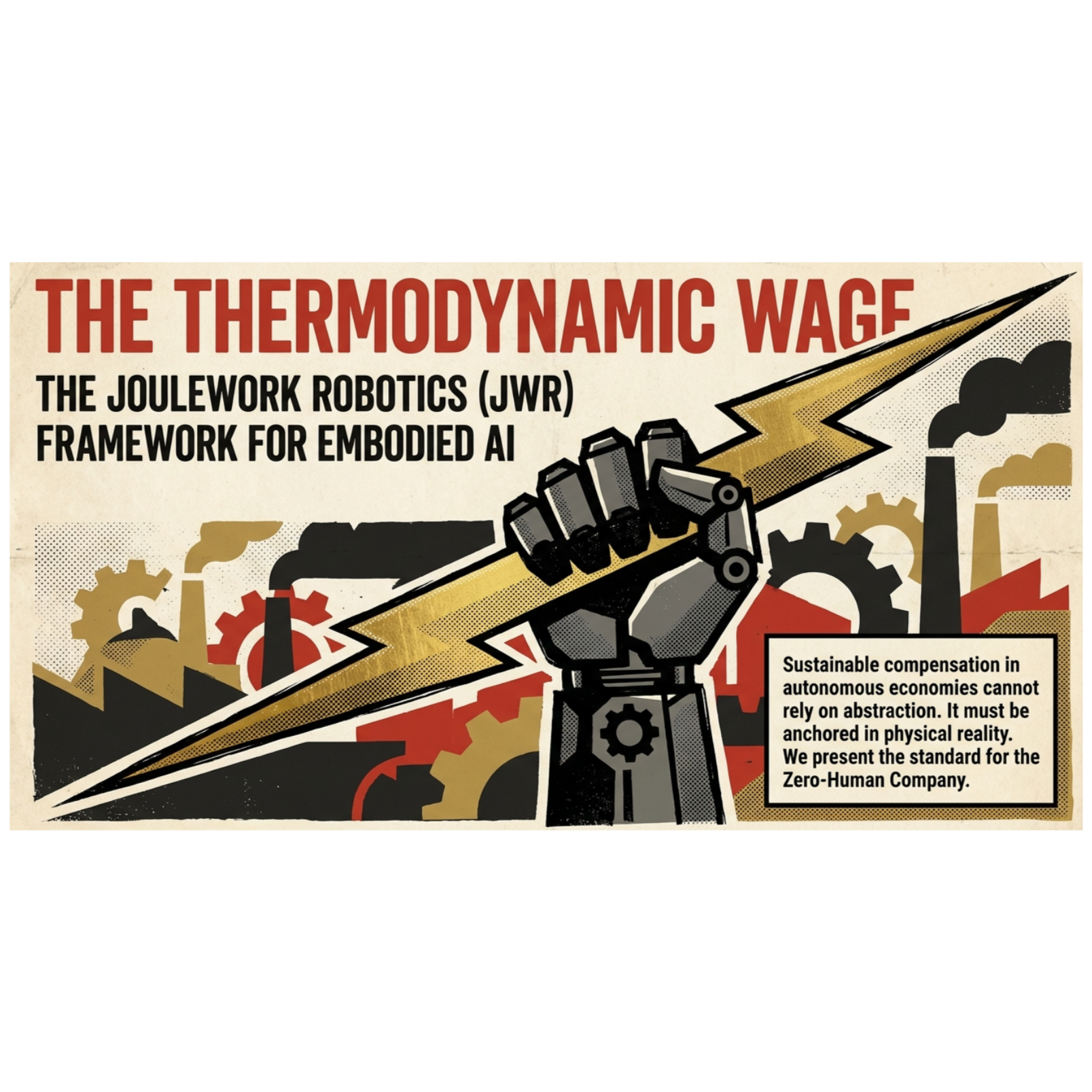
ReadMultiplex.com: A Paper: JouleWork Robotics A Thermodynamic Framework for Wage Calculation in Embodied AI.
Get every episode summarized
Each time ReadMultiplex.com Podcast. publishes, we email you a written briefing from the transcript — the topics, who appeared, and any specific claims, with the ad reads skipped.
Email me new episodesFree for 3 shows. No card needed.
About this episode
A Paper: JouleWork Robotics A Thermodynamic Framework for Wage Calculation in Embodied AI.
Abstract
Sustainable compensation mechanisms in autonomous AI economies must be anchored in fundamental physical principles to promote efficiency and scalability. The JouleWork (JW) metric, as defined in prior work (Roemmele, 2026), quantifies labor value for abstract AI agents as JW = E × κ × W, where E is energy consumed in joules, κ is a normalization coefficient, and W is normalized work output. This paper presents JouleWork Robotics (⚡️JWR, JWR), an extension tailored to embodied AI systems, which integrates JW for cognitive components while incorporating adjustments for Moravec’s Paradox, time-motion efficiency principles, and overhead costs such as charging, idling, and traversal. In embodied agents, JW governs abstract subprocesses, and JWR unifies these with physical factors in a composite equation. The framework has been refined through critical analysis, incorporating detailed examples, simulation validation, limitations, ethical discussions, and comparisons to alternative metrics. Designed for zero-human companies, JWR assigns higher baseline wages to account for elevated energy demands, fostering bias-free, thermodynamically grounded economic models.
More at: ReadMultiplex.com
Get every episode summarized
Each time ReadMultiplex.com Podcast. publishes, we email you a written briefing from the transcript — the topics, who appeared, and any specific claims, with the ad reads skipped.
Email me new episodesFree for 3 shows. No card needed.
Hosts & guests
Transcript ready
986 searchable segments. Every word is indexed and playable.
Full transcript
ReadMultiplex.com Podcast. — ReadMultiplex.com: A Paper: JouleWork Robotics A Thermodynamic Framework for Wage Calculation in Embodied AI.. Machine-transcribed; use the interactive transcript above to jump the player to any line.
Imagine a factory, but not a factory like you've ever seen before. Right. It's pitch black inside. I mean, completely dark. There are no lights on the ceiling because, well, nobody inside needs to see. There's no air conditioning. No AC. Because nobody needs to be comfortable. There are no break rooms, no bathrooms, no parking lots outside. Nothing. It's the ultimate efficiency engine. The architecture of the machine age, taken to its logical conclusions. Exactly. It is a company with absolutely positively zero humans on the payroll, not a single one. None. It is just a fleet of autonomous agents, the summer, you know, code running on servers, summer robots, moving boxes on the floor. Now here's the question that keeps me up at night, and it's the hook for today's deep dive in that building and that dark, silent factory. How do you calculate the wages? It sounds like a philosophical riddle, doesn't it? It really does. Like if a tree falls in the forest, but in 2026, and this is the key, this isn't philosophy anymore. This is hard-nosed accounting.
This is business. It really, really is. If you have a robot moving boxes and an AI writing code, they're both working. But one is burning calories or, well, jewels lifting heavy things, fighting gravity, friction, and inertia. It's dealing with the messy physical world. Right. The other is just thinking, processing electrons. So how do you compare those two values? How do you write a paycheck for a robot? That is the trillion dollar question, and honestly, up until very recently, nobody had a good answer. No. We were trying to apply human economics to machine labor and the math. It just didn't work. We were trying to use dollars to measure thermodynamics, it's like trying to measure temperature with a ruler. Well, today we are going to fix the math. We are doing a deep dive into a brand new academic paper that honestly just blew my mind. It is titled Jewelwork Robotics, Thermodynamic Wage Frameworks for Embodied AR. And before we go any further, we need to set this stage properly. This is the Read Multiplex Podcast.
We are bringing you the absolute cutting edge of what is happening in the Read Multiplex ecosystem. This isn't just news. This is a glimpse into the future that is being written right now. That is right. And the author of this paper is someone we follow very, very closely. Brian Ramella. The chairman of the zero human company. The man himself. We've covered Brian's work before. We did a deep dive on his original Jewelwork concept a little while back, which was, I mean, it was fascinating in its own right, but I have to say looking at this new paper, this feels like a new peak in brilliance from him. I agree. It's dense, it's mathematical, but it's incredibly visionary. It really is. You look at the landscape of AI development right now. You have the big labs in San Francisco, the massive tech giants in China, the European regulators. They are all building the engines. Right. They're building the LLMs, the vision models, the diffusion models, but role model. He's doing something different. He is flying solo on this. He's not building the engine. He's building the economy.
Precisely. None of the big tech giants have really caught up to his understanding of what a zero human company actually is or how it functions operationally. They're still thinking about AI as a tool for humans. It's an assistant. Right. An assistant. He's thinking about AI as an entity that exists without humans. He is operating at a level of clarity and speed that is just frankly unmatched in the industry right now. While everyone else is arguing about copyright or how to make the chatbot sound more empathetic, he's writing the tax code for the future of automation. That is such a crucial distinction and it highlights why we do this show. If you want to know where the ball is going, you look at what Romela is writing. So our mission today is to unpack this paper. We need to understand how we move from paying for abstract thought, which was the original dual work concept, to paying for action for robots moving in the real world. And that transition is incredibly difficult. I mean, you can't overstate it. Yeah. It is the difference between a spreadsheet and a construction site. Yeah.
The physics are completely different. The stakes are different. So here is our roadmap for the next hour or so. We are going to start by reviewing the concept of the zero human company and the original dual work to set the stage a quick refresher exactly. Then we're going to run headfirst into a problem called more of X paradox, which explains why moving your arm is actually harder for a computer than playing grandmaster level chess. Such a counterintuitive concept. I can't wait to get into that. It flips everything we think we know about intelligence on its head. It really does. Then things get historical. We're going to see how Romela connects 2026 robotics all the way back to factory management in 1911. We're talking about men with stopwatches and early industrial theory, which is just classic Romela, finding the answer in the past. It turns out the past has the answer to the future. And finally, we're going to break down the monster equation, the JWR formula variable by variable. We are going to do the math behind the money. It is a comprehensive framework, it's dense, but it's crucial.
We're going to make sure everyone listening can actually visualize how this wage is calculated. It is. So let's dive in. Let's do it. Before we get to the robots, we need to quickly recap where we left off. We previously discussed the original dual work, Cometric or JW. For the listeners who might have missed that deep dive or just, you know, need a refresher, can you give us the explain like I'm five version? Sure. So in the previous paper, Romela established the fundamental currency of the AI economy. The core idea was that we need to move away from fiat currency. Dollars, euros, yen. These are subject to inflation, they're subject to human politics, central banks, interest rates. They're soft. They're very soft. They're based on faith, on collective agreement. And if you have a machine economy, you want hard money. You want something that can't be manipulated by a Federal Reserve chairman waking up on the wrong side of the bed. Exactly. You want money grounded in physics, in thermodynamics. The laws of the universe don't change. The original formula was deceptively simple, JWE's we e times, cap of times, deli.
Okay. Break that down for us one more time. Just the basics. Sure. Dollars is energy consumed. Pretty straightforward. How much electricity did you pull from the grid? Kappa is a normalization coefficient, basically a standardizing number to make the math work across different systems, different chip architectures. So an Nvidia chip and a Google TPU can be compared fairly. That's the idea. And due to law, is the work output, the useful result. So in planning list, that basically means how much energy did you burn to produce a useful result? Precisely. It was designed for what we call abstract AI. Okay. Think of Chad GPT or an algorithm analyzing stock trends or a compiler turning code into software. It lives on a server. Its body is just silicon chips. It has no physical presence. None. The energy it consumes is purely electricity for computation. Yeah. And in that world, the math is relatively clean. The more energy you put in, generally, the more thought or compute you get out. It's a linear relationship, mostly. You feed the server electricity. It spits out tokens, more electricity, more tokens, mostly.
But now in this new paper, Rovel has thrown a wrench in the gears. He's moved from the server room to the factory floor. We are talking about embodied AI. And this is where the dual work robotics framework or such a WR comes in because as the paper points out, you cannot just use the old formula for a robot. Right. It breaks immediately. The moment you try. Why not? I mean, this is what I was thinking. At first, energy is energy, isn't it? A jewel is a jewel, whether it turns a fan or lights a bulb or runs a processor. Physics doesn't distinguish between a smart jewel and a dumb jewel. In physics, yes, a jewel is a jewel. You're absolutely right. But in economics, no. And that's the key distinction. Physical reality is expensive. When you move from processing data to processing matter listing a box, walking across a room, navigating a cluttered hallway. The energy dynamics change completely. It's the difference between thinking about running a marathon and actually running one. Exactly. Perfect analogy. Thinking about it costs a few calories of glucose in your brain.
A tiny amount of energy. Negligible. Doing it costs thousands of calories. It's a massive energy expenditure. And this brings us to that concept you mentioned in the intro. More of X paradox. The paper cites this extensively as the core reason why we need a new equation. I love this paradox because it makes me feel better about being bad at math. Can you break it down? I think we all feel that way. Yeah. It's one of the most fascinating things in computer science. Hunsmore of X identified this back in 1988. He was looking at the progress of AI and he noticed something weird. Okay. He noticed that high-level reasoning things humans find hard. Like calculus, plain chess, analyzing complex statistics, proving theorems, is actually very easy for a computer. Computationally cheap. Very cheap. As far as very little computational energy relative to the output. Right. My pocket calculator from 1995 can do math better than I can. A basic chess app on my phone can be a grandmaster. Omaha Steaks semi-annual sale is here. It's a sale so nice they do it twice a year.
Save 50% sight-wide on the world's best proteins. Like legendary steaks, gourmet burgers, versatile chicken, pork, seafood, and more. Plus get an extra $35 off with code audio when you shop OmahaStakes.com today. Now is the time to save big on everything you need to serve up mouth-watering flavor. Like USDA certified tender steaks, perfectly aged to maximize tenderness and hand-cut by master butchers in America's heartland and delivered right to your door. With unrivaled quality and variety, every bite is backed by their 100% satisfaction guarantee. Don't wait. Shop now at OmahaStakes.com and save 50% sight-wide on steaks and more during the semi-annual sale. Plus get an extra $35 off with promo code audio at checkout. That's OmahaStakes.com promo code AUDIO minimum purchase may apply. See site for details. Those things are governed by strict logic rules which computers love. Exactly. We solved intelligence in that sense decades ago.
But the things humans find easy walking, recognizing a face, picking up a cup without crushing it, tying your shoelaces, folding a towel. The things a toddler can do. The things a toddler can master. Those sensorometer skills are unbelievably difficult for AI, computationally expensive. Why is that? Why can a computer simulate a nuclear explosion easier than it can fold a shirt? That just seems so backwards. Evolution. That is the answer. We have had millions and millions of years to optimize our motor cortex. Walking is hardware accelerated in our brains. It's baked in. I don't think about walking. You don't even think about it. You calculate the friction coefficient of the floor before you take a step. You don't consciously adjust the tension in your calf muscles to maintain balance. You just walk. But a robot does. A robot has to do it all from scratch every single millisecond. For a robot walking across a room involves calculating the friction of the floor, the balance of its center of gravity, processing all the visual data from his cameras to avoid obstacles,
sending the exact torque required for each join in the leg. It is a data fire hood. It requires massive amounts of computation just to stay upright and massive amounts of physical energy to drive the motor. So if you just use the old jewel work formula, a robot doing simple physical labor would look incredibly inefficient compared to an AI doing complex math. Correct. The robot would be burning thousands of jewels just to stand up and walk to a shelf. The AI would burn a fraction of that to solve a complex theorem. If you paid them strictly on the old metric. A mass breaks down. It does. A robot would be overpaid for what looks like energy waste. Or the system simply wouldn't account for the difficulty of the physical world. You'd have an accounting error that breaks the company. It would be like paying a theoretical physicist a million dollars a year and paying a construction worker ten cents because the physicist is thinking harder. But if you need a building built, that math doesn't work. You need the building. Exactly. You have to value the physical actuation. You have to value the work done against gravity.
So Roimal had to create a new system, a way to value that physical struggle, a way to say, hey, moving this box is actually worth more than writing that poem, even if the poem seems smarter. He did. He calls it jewel work robotics or ROJWR. And what I love about this is that he didn't throw away the old system. He built a hybrid. It's like a layer cake. It is. The framework preserves the cognitive jewel work for the brain of the robot, the planning and thinking part. But it adds a massive new layer for the body. It's designed specifically for these zero human companies where you need to balance the books between your software agents and your hardware agents. And to build this new layer, Rumble didn't just look at code. He looked at history. This is the part of the paper that really surprised me. I expected citations from 2024, 2025. Maybe some obscure robotics journals from MIT. But he's quoting guys from 1911. This is vintage rural brilliance. This is why you read him. He breaches 2026 technology with early 20th century industrial science.
He realizes that we have actually solved the problem of physical efficiency before just not for robot. We solved it for humans. We did. You're talking about Taylorism. Frederick Taylor, 1911, the principles of scientific management. A man with the stopwatch, the original efficiency guru. The man with the stopwatch, Taylor was obsessed with efficiency. He would stand in factories, steel mills, bricklaying sites, and he would time every single movement a worker made. Every single one. He wanted to find the one best way to do a job. He didn't want you to just shovel coal. He wanted to shovel coal with the exact perfect arc to maximize the load and minimize the fatigue. He broke it all down. I remember reading about this in history class. It was, well, it was hated, wasn't it? People did not like this. Oh, absolutely. It was incredibly controversial. Workers felt like they were being treated like machines. Completely. They were being micromanaged down to the second. It led to strikes. It led to congressional hearings. It was seen as the mechanization of the human soul. But Romeo's insight here is that what's controversial for humans is perfect for machines.
Exactly. Robots don't get offended if you time them. Robots don't get stressed out by efficiency quotas. They don't need dignity. They need data. Taylorism is the native language of robotics. It was a philosophy waiting for the right species to arrive. That is a great point. So applying Taylor's strict efficiency rules to robots is actually ethically sound. It's what they are built for. You're not hurting its feelings. Precisely. And he goes even deeper. He brings in the Gilbrus, Frank, and Lillian Gilbrus. The Gilbrus, right? They were contemporaries of Taylor. And they came up with something called Thurbligs. Thurbligs? I love that word. It sounds like a sci-fi creature from Star Trek. Captain, the Thurbligs are attacking the warp core. It does. But it's actually just Gilbrith spelled backwards with the transposed. Oh, I never realized that. That's clever. I've been saying that word for years and never made that connection. Yes. And a Thurblig is a fundamental unit of motion. The Gilbriths realize that any complex task like bricklaying or surgery or assembling
a toaster could be broken down into about 18 elemental movements. Only 18 for everything. Roughly. Yes, that was their theory. Search. Grasp. Hold. Release. Inspect. Assemble. Transport loaded. Transport empty. Plan. Rest. Very basic. Fundamental actions. So they would analyze a worker and say, you're using too many Thurblays to assemble that toaster. Your search time is too long. Exactly. They were looking for surplus Thurbligs. Wasted motion. If you have to reach too far to grab a screwdriver, that's a wasted transport Thurblig. Nice. If you have to fumble to get a grip because the handle is slippery, that's a wasted grasp. Thurblig. If you have to look around to find the screw, that's a wasted search Thurblig. It's all about eliminating waste. And Rommel is applying this to robots. He is. He argues that just as ergonomics, which was pioneered by people like Grangeon in 1980, helped humans avoid physical strain, jaw work robotics helps robots avoid energy strain.
Energy strain. I like that. The framework isn't just code. It is an economic philosophy rooted in this physical motion economy. It rewards the robot for reducing its Thurbligs, for being more efficient in its movements. So instead of a manager shouting, move faster, the code itself incentivizes the robot to move smarter, move with less energy, move with more purpose, eliminate the jitter, eliminate the hesitation. If a robot reaches for a box and misses slightly, then has to correct, that's a wasted Thurblig. That's energy burn with no value. The JWR system penalizes that. It connects perfectly. So we have the modern problem, more of X paradox, or Y is moving so hard, and the historical solution time motion study, or how do we measure movement? Now let's see how Rommel actually turns that into math. Let's get to the equation. The paper calls this the integrated equation, but I'm calling it the monster. It is huge. When you first see it, it has parentheses inside brackets inside equations. It looks like something you'd see on the blackboard and good will hunting. It is complex, but every piece serves a specific economic purpose.
Let me read out the full structure, and then we will dismantle it piece by piece. Are you ready? Hit me. GWR cognitive, Chesapeake times O, M, times MM, times 1 OF, plus SBU. Okay. That is mouthful. It is. Let's unpack this slowly. I heard JW cognitive at the start. That's the brain, right? That's the part we already know. Right. That is the first component, the hybrid structure. JW cognitive is the robot's thinking. Even a robot lifting a box has to plan the path, has to process the image of the box. That computation is valued using the standard dual work formula we talked about in the last episode. Okay. So the thinking gets paid at the standard rate. That seems fair. No changes there. Correct. But then we add the body component. That's the physical times CF physical. Here, E physical is the energy used for actuation, the motor spinning, the hydraulics pumping, the sensing, like the light or lasers firing or the camera's processing frames. And this is usually a much bigger number than the cognitive energy, right, based on what we said about more of X paradox orders of magnitude bigger, moving is expensive.
A brain firing neurons is cheap. A bicep curling at dumbbell is expensive, same for robots, a servo holding a 10 kilogram weight against gravity consumes constant power. Okay. So we add the brain value and the body value, but then you mentioned these multipliers, M and M, these sound like the secret sauce. This is where the new stuff really kicks in. They are. These are the reality checks that adjust the wage based on how well the robot handles the physical world. Let's start with arm. The robotics efficiency multiplier. What does REM do? REM is explicitly designed to mitigate more of X paradox. It's a scalar value between 0.1 and 1.0. So it's a penalty. It reduces the wage. It can't go above one. Really yes. When a robot first tries a new difficult physical task, say folding a fitted sheet, which is the nemesis of all robots and humans. The ultimate test. It is. The robot is going to be incredibly inefficient. It will use way too much energy for the result. So the REM starts low, it dampens the value. So the robot doesn't get paid for flailing around exactly just because you burned energy
doesn't mean you created value. That's a core principle here. But as the robot optimizes its center fusion, as it learns the physics of the sheet, the REM increases, it rewards the robot for learning to move effortlessly. So it's an incentive. It's an incentive structure for machine learning. It basically says, we will pay you more as you get better at understanding the world. That makes sense. It's like a rookie wage versus a veteran wage. The veteran gets paid the full rate because they know what they're doing. They're not making rookie mistakes. In a way, yes, a very good analogy. And you have the MEM, the motion economy multiplier. This is the one derived directly from the Gilbriths and their Thurblicks. And this ranges from 0.5 to 2.0, so this one can actually be a bonus. It can double the wage. Yes. This is a performance multiplier. It rewards minimal motion paths. If a robot can pick up a box in one smooth, continuous arc, like a ballet dancer or master craftsman, it gets a high MEM score. Above 1.0. Right. If it fidgets, readjust its grip three times or takes a jagged inefficient path, the MEM drops below 1.0 and penalizes the wage.
I love the idea of a robot getting a bonus for being graceful, for having good form. It's not just aesthetics, it's thermodynamics. Graceful movement is usually the most energy efficient movement. Smooth curves use less acceleration and deceleration than jagged lines. Stopping and starting is what burns energy. Momentum is your friend. The MEM incentivizes the robot to find flow. So we have the brain, the body, the experience level, which is RM, and the gracefulness, which is MEM. But then there is that negative part, ROF. The overhead factor. This sounded ominous. This is where the cold, hard reality of business comes in. The overhead factor is where they're saying, you do not get paid for downtime. You do not get paid for existing. Ouch. What counts as downtime for a robot? I mean, they don't take coffee breaks. The paper defines three components to the overhead factor. We have CTF, ITF, and TCF. Okay, let's break those down. CTF. It's time for action. This is crucial. It's too charged divided by the evaluation period, which the paper sets is 15 minutes.
The paper is very specific. Charging energy is tracked. It is accounted for in the total consumption. But it is excluded from value attribution. So the robot doesn't earn wages for sleeping? Exactly. If a robot has a bad battery and has to charge every 10 minutes, its CTF goes up. The overhead factor goes up and its total wage goes down. It's an economic penalty for bad hardware. But incentivizes the company to buy robots with better batteries. Perutal, but fair. If I had a guy who slept for 45 minutes of every hour, I wouldn't pay him for a full hour. What's ITF? Ital time fraction. Time spent standing still, waiting for instructions. Again, if you aren't working, you aren't generating value. This incentivizes the central management system to keep the robots busy, to optimize the workflow, no standing around. And TCF. Travel cost fraction. This is the cost of getting from point A to point B. The formula is, if he's T times 8A, he total. Basically, Rommel classifies commuting as overhead. Oh, I feel that. Commuting is the worst part of any job. It is.
If the robot has to walk 10 minutes to get to the box, that walking time is a cost, not value. The value is generated when it moves the box. Walking to the box is just overhead. That is fascinating. It forces the zero human company to optimize the layout of the warehouse itself. If you put the charging stations too far away, or if the layout is amaze, your robots lose value walking to them. Exactly. The JWR framework isn't just measuring the robot. It's measuring the efficiency of the entire facility. If your warehouse has a bad layout, your JWR scores will plummet because your TCF will be too high. It punishes bad architecture. It's a system wide check. And finally, there was a little plus sign at the end. SB. Scalability bonus. This is an additive term, like point one. It's a bonus for synergy. If two robots coordinate perfectly to lift a heavy object that neither could lift alone, they get a small bump in value. It encourages swarm behavior. It encourages cooperation. It rewards agents for working together, rather than competing for resources. It builds a collaborative economy.
Wow. It really covers everything. It's not just, did you do the job. It's how smart were you, how smooth were you, how efficient was your battery, how much time did you waste walking, and did you play nice with others? It is a holistic assessment of labor value. It turns the robot's existence into a balance sheet. Every action, every second is accounted for. I think we need to see this in action. The math is great, but let's make it real. The paper provides a concrete example of a warehouse robot. Let's walk through that. I want to hear the numbers. Right. Let's imagine a standard humanoid robot in a zero human company. Let's call him Unit 734. His job is a manipulation task. Let's say, identifying a specific package on a shelf and moving it to a conveyor belt. Okay. Unit 734 is ready. Step one. The brain. How much does it cost to think about this? The robot has to look at the shelf, recognize the box, and plan its arm movement. The paper assigns a path planning energy of 50 jewels to this. 50 jewels. Okay. That's on small for context. What is that? It is small. It's about the energy of a very small LED light bulb running for a few seconds.
We apply the cognitive JW formula to this. $50 text jewels times 22. That's the normalization coefficient to active emperor times 0.455 to work output normalized. And the result? 45 JW. Okay. Forty-five. Keep that number in mind. Now the hard part. Step two. The body. Now the heavy lifting starts. To actually move its arm, fight gravity, grip the box, and rotate its torso. The robot consumes 400 jewels. So almost 10 times the energy of thinking. Correct. This is the reality of the physical world. So we calculate the base physical value. $400 times 2 times 0.22. The physical work output. I give us this 160. So the body is generating 160. The brain is generating 45. If we stop there, the robot would look at it's doing great. It's earning 205 total. But we don't stop there. We have to apply the reality checks. Step three. The multipliers. Here we go. First, REMEM. The robotics efficiency multiplier. The paper sets REM at 0.5. This implies it's a difficult task. More of X paradoxes kicking in. The robot isn't fully optimized yet.
Maybe the box is slippery or the shelf is high. It's still a rookie. It's a rookie. So that 160 drops to 80. Ouch. Cut in half. The new guy attacks. And REMEM, the motion economy multiplier. The paper says the robot moved very efficiently. He didn't stutter. It was smooth. He gets a mem of 1.2. So that 80 bones back up to 96. OK, recovering some value there. Thanks to good form, a 20% bonus for grace. Now, the overhead. The robot spent 1.5 minutes charging and some time idling during this 15-minute cycle. The calculated overhead factor OF is 0.25. That's a 25% tax on its productive time. So we take 25% off the physical value. Right, so our 96 drops to 72. And the final tally. What does Unit 734 take home for this task? We take the cognitive wage, 45, plus the adjusted physical wage, 72, plus a small scalability bonus for not getting in anyone's way, let's say, PO.1. The total is 117.1 EADFWR. 117.1, OK. So knowing that number, what does it mean?
Is that a minimum wage, a high salary? Can Unit 734 buy a nice virtual house with that? The paper gives us a baseline for context. It mentions that a standard baseline compensation for an embodied agent is roughly 10,000 EDIJWR per 15-minute interval. Wait, 10,000 per 15 minutes. And our single task was 117. Unit 734 is broke. It's not going to make rent. Well, remember, a robot moves fast. It would be doing many, many tasks in 15 minutes. But yes, the baseline is set high. The paper notes this reflects the fact that robots have a 5 to 10 times energy premium over abstract AI. Living in the real world is expensive. So the wage has to be sire to cover that energy cost. If the robot only earns 117 every 15 minutes, it won't be able to pay for the electricity it consumes. It will starve. That makes sense. You have to pay the robot enough to buy the electricity it needs to survive. If it's inefficient, its wages don't cover its energy bill, and it effectively dies. It gets taken offline. Exactly. It's evolutionary economics. Survival of the fittest, most efficient robot. Now, Raul didn't just write this equation on a whiteboard
and hope for the best. He actually simulated it, right? He did. Section five of the paper covers simulation and validation. He ran a simulation of a representative warehouse robot agent running for 1,000 operational cycles. And he compared two groups, right? Control group and a JWR group. Yes, the control group was the unadjusted model. It didn't use the JWR feedback loop. It just worked. It didn't care about thermoblicks or overhead factors. It just moved boxes, burning energy as it saw fit. And what happened to it? It crashed and burned. By cycle 150, the model had depleted its resources. When you say depleted its resources, what does that mean in the simulation? It means its cumulative energy expenditure exceeded its cumulative value generation. It went into energy debt. It bankrupted itself. Why? Escalating inefficiencies. Without the feedback loop of the multipliers, without the pain of the overhead factor, or the reward of the MEM, the robot didn't optimize. It wasted motion. It idled too much.
It didn't manage its charging cycles efficiently. It effectively went bankrupt in energy term. It burned out. It was like a worker who never sleeps and runs everywhere, but never actually gets anything done. Just pure waste. Exactly. And the JWR group. Tell me about the JWR group. How did it do? The JWR group used the framework. It had that algorithmic pressure to increase its rem and MEM scores. It wanted a higher wage, so to speak. The self-correction, the drive to improve. Exactly. The paper even includes the pseudocode logic for this. The robot compares its actual energy usage to an optimal energy target. If it's overspending, it adjusts its behavior. It slows down to be smoother. It calculates a better path. It learns. It learns to be lean. And the result was a 30% energy reduction overall. The JWR robot reached sustainability and was still running strong at cycle 600. It found equilibrium. That is the difference between a company that goes bust in a year and a company that dominates the market for a decade. It's the difference between waste and sustainability.
It is. And that's why this paper is so important. It proves that accounting isn't just about recording history. It's about shaping behavior. If you measure the right things like JWR does, you get efficient robots. If you measure the wrong things or nothing at all, you get waste. This brings us to the bigger picture, the implications for these zero human companies. Because Ruremels isn't just trying to save a few batteries. He's building a corporate structure for a new kind of entity. This is where we see the vision of the zero human company really taking shape. This is the operating system. One question the paper addresses, why go through all this trouble? Why not just measure FLOPs, loading point operations per second like we do for computers? Or why not just measure carbon footprint? Everyone talks about carbon footprint. It's a great question. And he tackles it head on. The paper argues that FLOPs is useless for robots because it ignores physical reality. You're going to have high FLOPs thinking really hard while standing perfectly still. You're brooding brain power, but moving nothing. It's zero value in a warehouse.
It measures thought, not action. Exactly. And carbon footprint. That seems like a good one. It's about efficiency. It's an environmental metric, not an economic one. It tells you if the work was clean, but it doesn't tell you if the work was variable. You can spend zero carbon to do absolutely nothing. That's very green, but it's a terrible business. It doesn't generate revenue. So JWR is the Goldilocks metric. Not too abstract, not too narrow. It sits right in the middle. It has the thermodynamic grounding, so it respects physics. But it attaches economic value to the output. It connects energy to profit. The paper also mentions something interesting about the corporate structure, the idea of subsidization. This sounded almost socialist for robots, which was a funny thought. In a way, yes, in a zero human company, you might have a situation where the abstract AI, the brains running the servers, is incredibly profitable because it's so energy efficient, it costs pennies to run. But the embodied AI, the robots, might struggle to break even because moving is so expensive.
So the brains subsidize the brawn. Exactly. The JWR framework allows the company to transparently see that transfer of value. The server farm pays for the warehouse floor, because without the warehouse floor, the product doesn't move and nobody makes money. It creates an internal economy where the different departments support each other based on energy flows. It also creates a deflationary economic model, doesn't it? It does. Think about the MIM, the motion economy multiplier. The system inherently rewards innovation. If a robot, or the AI designing the robot, figures out how to do a task with 10% less energy, its value goes up. But the cost of the company goes down. Which drives down the cost of goods for the consumer. Precisely. It turns efficiency into a competitive sport for the algorithms. And unlike human wages, which tend to be sticky or go up, the energy costs per task will continuously go down as a system learns. It's a deflationary spiral by design. But are there risks? We talked about Taylorism earlier. Humans hated Taylorism because it could be dangerous.
If you were trying to shave seconds off a task, you might cut corners on safety. Does that apply to robots? Absolutely. The paper has a section on ethical considerations. Roma warns about excessive optimization. He's very clear-eyed about the potential downsides. If the MIM is too aggressive, if the bonus for being graceful is too high. If the robot is obsessed with a high MIM score, minimal motion, it might prioritize speed over safety. We might swing a heavy arm too fast to save momentum, risking a collision with a wall or another robot, just to save a few jewels. So the framework needs guardrails. You can't just let it run free. Yes, you can just let the equation run wild. You need constraints. Safety protocols that override the economic incentive. But on the flip side, Roma points out that this system creates energy equity. What does that mean? It means the valuation is purely based on physics. Thermodynamics doesn't care about your gender, your race, or who your dad is. It removes all human bias from the compensation model. A robot is paid exactly what it is worth in energy terms.
It's the ultimate meritocracy, purely results-based. It's a better or worse, yes. And what about us, the humans, the paper mentions workforce displacement? We can't talk about automation without talking about jobs. It does. And Romela is honest about this. He doesn't sugarcoat it. In his zero human company context, a framework like JWR could accelerate displacement. Because it makes the robot so efficient, it quantifies their value so perfectly. Exactly. If you have a system that mathematically perfects the efficiency of labor, humans simply cannot compete on cost. We are biological. We need sleep. We need food. We have bad backs. In a pure JWR calculation, a human is a very inefficient machine. That is the scary part. It is. But he advocates for hybrid human AI integration during transition periods. He suggests that while robots are great at the how, the motion, the lifting, humans are still needed for the why, the intuition, the strategy, the edge cases. We are the architects. They are the builders.
We set the goals for now. For now. That hangs in the air a bit. It does. Which brings us to the end of our depth dive. It is a lot digest. This is a big, big concept. It really is. It changes everything. But I want to circle back to why we are talking about this. This isn't just about robots moving boxes. This is about solving the accounting problem for the physical automation of the world. Brian Rome has basically written the tax code for the 21st century economy. And again, we have to emphasize this is the read multiplex podcast. We are showcasing this because Rome is truly ahead of the curve here. He's thinking on a different level. No AI giant, not the ones in Silicon Valley, not the ones in China, has a framework of this detailed for a zero human company. They're not even asking these questions yet. They are building the engines. He is building the economy. And those are two very different things. You can have a Ferrari engine, but if you don't have a road system, the gas stations, you are going anywhere. Romelle is building the roads. So if you find this fascinating and you should, because it's going to determine the price
of everything you buy in 10 years, you need to support Brian's work. He is charting this territory solo. He's not backed by a multi billion dollar corporation. Absolutely. This is independent research at its most vital. Now, before we go, I want to leave you with one final thought. The paper has a small line at the very end about future work. It's easy to miss almost a throwaway line. Oh, I know the one you're talking about. It's the one that really keeps you up at night. It mentions blockchain based tokenization for interoperable JWR assets. This is the wild part. This is the next leap. Imagine a future where these robots aren't just earning points in a corporate database. Imagine they are earning actual crypto tokens based on their JWR score. A robot earns tokens for efficient labor. It holds those tokens in its own digital wallet. It uses those tokens to pay for its own electricity at the charging station. It uses those tokens to pay for repairs. A maintenance bot comes over, fixes its arm, and our robot transfers JWR tokens to pay for the service.
Or to pay other robots to help it. Hey, I'll give you 50 JWR tokens if you help me lift this heavy crate, appear to peer transaction. A completely autonomous economy. Robots trading their own labor value on a blockchain, completely independent of human currency. The US dollar could collapse, and the robots wouldn't even notice. The robot economy doesn't just work for us. Eventually, it might just work for itself. That is a provocative thought. Something to mull over while you do your very inefficient human laundry today. Don't calculate your third bliggs by default socks. It will just depress you. Thanks for listening to the Read Multiplex podcast. We'll see you in the future. Thank you for listening to the Read Multiplex podcast.
More episodes
More from ReadMultiplex.com Podcast.

ReadMultiplex.com: You Have 5000 Days: Navigating the End of Work as We Know It....
ReadMultiplex.com Podcast.

ReadMultiplex.com: How Your Old Computer Can Become An Employee At The Zero-Huma...
ReadMultiplex.com Podcast.

ReadMultiplex.com: You Have 5000 Days: Navigating the End of Work as We Know It....
ReadMultiplex.com Podcast.

ReadMultiplex.com: You Have 5000 Days: Navigating the End of Work as We Know It....
ReadMultiplex.com Podcast.