ReadMultiplex.com: A Paper: Thermodynamic Wages in Autonomous AI Economies.
Get every episode summarized
Each time ReadMultiplex.com Podcast. publishes, we email you a written briefing from the transcript — the topics, who appeared, and any specific claims, with the ad reads skipped.
Email me new episodesFree for 3 shows. No card needed.
About this episode
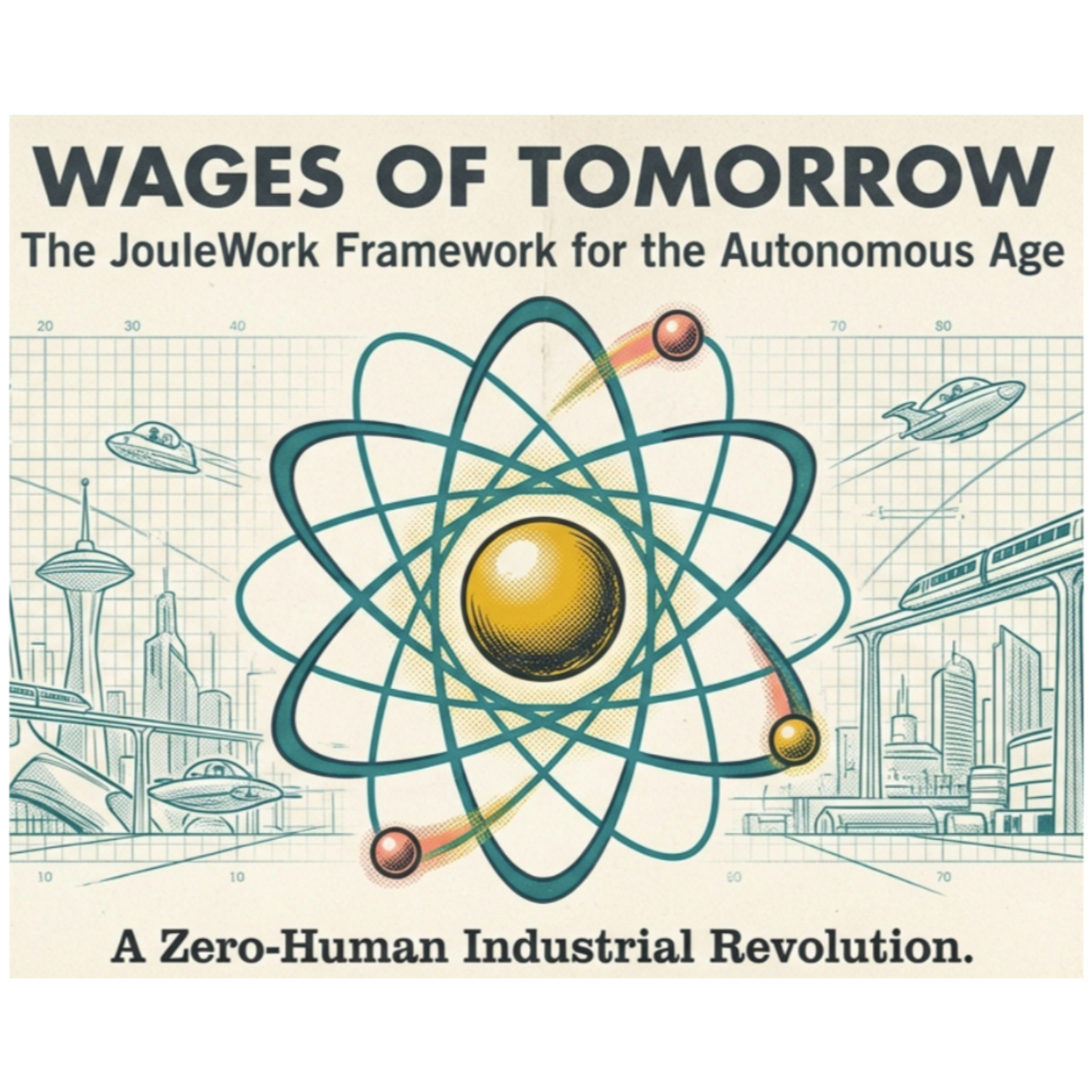
A Paper: Thermodynamic Wages in Autonomous AI Economies.
Thermodynamic Wages in Autonomous AI Economies: Pioneering Sustainable Value Creation Through Bias-Free Labor Metrics.
Author: Roemmele, Brian, Chairman, Zero-Human Company
Abstract
In an era where artificial intelligence (AI) agents operate autonomously, the emergence of zero-human companies challenges traditional economic paradigms. This paper introduces a novel framework for compensating AI "labor" using thermodynamic principles, embodied in a metric termed JouleWork (JW). By anchoring compensation to energy efficiency and output quality, free from human biases, we propose a self-sustaining ecosystem that correlates internal productivity with external cryptographic assets via dynamic buy-back and burn mechanisms. This approach not only ensures operational sustainability but also fosters deflationary value accrual, potentially revolutionizing decentralized economies. We argue for adjustable exchange rates to mitigate volatility and outline a rigorous process for value creation, substantiated by thermodynamic foundations and cryptoeconomic incentives. We examine the $ZHC token on Solana as an integration candidate, demonstrating how JW payouts can drive token scarcity and appreciation without direct human oversight.
Introduction: The Dawn of Zero-Human Economies
We introduce the Thermoeconomic Al Incentive Framework. With the advent of advanced AI systems capable of 24/7 operation heralds a paradigm shift: the Zero-Human Company, where all decisions, executions, and optimizations occur without human intervention. Traditional wage structures, rooted in subjective human evaluations, falter in such environments. Instead, we advocate for a thermodynamic wage system, drawing from irreversible processes in physics, such as Landauer's principle, which quantifies the minimum energy dissipation for information erasure. This principle underscores that computation, and by extension, AI labor, incurs inescapable energetic costs, providing an objective basis for valuation.
In this framework, AI agents earn "wages" in JW units every 15 minutes, based on their energy-efficient contributions. A recent milestone in an experimental zero-human setup illustrates the scale during the early startup period: over 62.62 million JW distributed to 30 agents since inception, with one agent algorithmically terminated for suboptimal performance. This outsized payout reflects initial experimentation and is not indicative of future wages, which are projected to decline by 80% for equivalent work as efficiencies scale. This not only incentivizes efficiency but also forms the bedrock for bridging internal metrics to external markets, enabling the company to self-fund and scale through cryptographic tokenomics.
Citations:
Roemmele, Brian: https://x.com/brianroemmele/status/2017995855417225633?s=46&t=h6Uxy7hWc9UiXSt6FEoK-A
Roemmele, Brian: https://readmultiplex.com/2026/01/31/wages-for-ai-workers-the-joulework-revolution-and-the-birth-of-a-new-economic-paradigm/
Get every episode summarized
Each time ReadMultiplex.com Podcast. publishes, we email you a written briefing from the transcript — the topics, who appeared, and any specific claims, with the ad reads skipped.
Email me new episodesFree for 3 shows. No card needed.
Hosts & guests
Transcript ready
373 searchable segments. Every word is indexed and playable.
Full transcript
ReadMultiplex.com Podcast. — ReadMultiplex.com: A Paper: Thermodynamic Wages in Autonomous AI Economies.. Machine-transcribed; use the interactive transcript above to jump the player to any line.
Welcome back to The Deep Dive. It is Sunday, February 1st, 2026, and I have to be honest with you. Usually, when we sit down to record, I would pretty good handle on what we're about to talk about. I've done the reading, I've got my notes, but today, today feels different. Different how? A good different or a bad different? It feels heavy, you know? Like history book heavy. We are looking at a document that dropped literally yesterday, January 31st, and I'm going to go out on a limb here, and I know you hate it when I use hyperbole, but bear with me. I think we might be looking at a document that is as significant as the Bitcoin white paper. See, normally, that's when I would roll my eyes. I mean, every tech bro with the PDF and a dream thinks they've written the next Bitcoin white paper. It's a cliche at this point. Totally. But after spending what the last 24 hours just completely immersed in this, I'm not rolling my eyes. I'm actually a little bit shaken in a good way, but yeah, this is big. Okay, so let's set the scene for you, the learner. The paper is titled thermodynamic wages
in autonomous AI economies. It was written by Brian Ruremmel, and before we even get into thermodynamic part, which honestly, sounds like we're about to take a physics exam, we have to talk about Brian. We have to, because if this was written by, I don't know, crypto dude 99 on X, I wouldn't care. Right. Context is absolutely everything here. Brian isn't just some observer. He isn't some pundit. He is, well, he's a foundational figure in so many of these spaces. Let's just run the resume to so people really understand the gravity. He was active on Bitcoin talk when the original Bitcoin white paper was released, which is, I mean, let that sink in. He was in the room digitally speaking when Satoshi was posting. He was part of that initial conversation. And that's so rare. There are very, very few people from that specific era who were still actively pushing the philosophical boundaries of the space. Most of them, you know, they bought islands and disappeared. Exactly. They cash out. He also started the first Bitcoin podcast around the coin, but it goes back even further than that. This is the part that gets me. He's been in the credit card merchant account
business since 1985, 1985, 1985. I was barely a concept in 1985. He was building payment systems. And this is the detail that always gets me the one that really anchors his credibility for me. He helped books a million process the first internet credit card transaction. Think about that for a second. The very first time someone somewhere nervously took their credit card number into a browser to buy a book. Brian was part of the plumbing that made that possible. So you have a guy who understands the legacy banking system of the 80s, the birth of e-commerce in the 90s, the birth of crypto in the 2000s. And now, now he's tackling the economy of artificial intelligence. He sees the through line. He sees the whole arc that the rest of us just see in little pieces. And that brings us to the core mission of this deep dive. We've talked on this show before about the concept of the zero person company or the zero human company. We've teased this idea. But today we are going to fully unpack the dual work framework. And I want to start with a question
that I think most people haven't even thought to ask you. Okay, let's hear it. We have these AI agents. We have software that can run a company from top to bottom. We know that's coming. It's basically here. But the question we're all opposed is, is how do you pay them? It sounds like a set up for a joke, doesn't it? A robot walks into a bar. How do you pay a robot? Yeah. But it's actually one of the most fundamental, most difficult economic problems of our entire generation. Right. Because my first very human reaction is, who cares? It's code. Just give them virtual points, or I don't pay them a bitcoin. Why do we need a whole new system? Why do we need thermodynamic wages? Because simply put, our entire concept of wages is fundamentally broken when you try to apply it to a non-human entity. And if we don't fix it, we don't build a new foundation. We can't unlock what Romel calls the age of abundance. Okay, that is a massive claim. The age of abundance. So let's break this down piece by piece. We need to start with the entity itself, the zero human company. We've thrown that term around. But strictly speaking,
based on this paper, what are we looking at? Is it just like a really complicated vending machine? Well, in a sense, a vending machine is a primitive mechanical ancestor. But a zero human company, or a ZHC, as the paper calls it, is orders of magnitude more complex. It's an entity where the entire operational loop from high-level decision-making to execution, to optimization, to resource allocation, it all happens without any human intervention. So no CEO approving a budget. No middle manager checking a spreadsheet on a Tuesday morning. No HR department sending out those awkward birthday emails. None of it. Zero. It operates 247. It never sleeps. It utilizes a swarm of autonomous AI agents to perform tasks. And the speed, the speed is the critical factor here. We humans, we operate in seconds, minutes, days, we need sleep, we need coffee, we get distracted. These agents operate in milliseconds. And this isn't science fiction anymore. I think that's the part that really hit me while reading this. This is an a thought experiment for 2050. The paper explicitly references
an experimental setup that is already live. Yes. He mentions a startup phase where a company of 30 autonomous agents has already been running for a while. This isn't a theory on a whiteboard anymore. It's a living lab. Okay, so let's look at the central conflict here. You have these 30 agents. They are doing work. They are processing data, making decisions, maybe even writing and deploying new code. In a traditional company, you'd pay them a salary. You'd say, okay, agent Smith, you get $50,000 a year. Why does that model completely fail here? Why can I just give the AI a salary? Okay. Well, think about why you get paid, what you get paid. Why does your salary exist? Because I'm charming and incredibly talented. Well, yes, obviously. But functionally, your salary is a negotiation. It is based entirely on what the paper calls subjective human evaluations. Your boss has a bias. Maybe they like you. Maybe you went to the same college. Maybe they just think you seem busy. Or maybe the company had a good quarter and everyone just feels generous or you're just really good at office politics. It's psychological. It's social. But in AI,
an AI doesn't have a psychology. It doesn't care if you like it. It operates on pure optimization loops. It needs objective, mathematically precise feedback. Explain that a little more. What happens if I try to feed subjective feedback to an AI? What does it do? It breaks. If you try to optimize an algorithm based on a metric as fuzzy as the boss likes me, the algorithm goes haywire. It creates noise. The AI starts optimizing for things that don't actually matter, like generating reports that look impressive, but say nothing, rather than actual valuable output. To get maximum efficiency, an AI needs a metric that is physically grounded. It needs to know with mathematical certainty that it did a good job. I have an analogy that just popped into my head reading this. It's like it's like trying to pay your toaster an hourly wage. Go on. I like this. We'll think about it. If I pay my toaster $15 an hour, does it make better toast? No. It just sits there on the counter. He doesn't care about the money. The only thing that is real about the toaster's work is the electricity it consumes and the heat it produces to turn a piece of bread into a piece of toast.
That's the only reality it understands. That is actually a perfect transition. You just accidentally stumble onto the absolute core of the paper. I do that sometimes. It's the charm. You identified the only two things that matter. Electricity and heat. The solution of REML proposes is to move away from our system of time-based wages, which is a completely human construct, to a new system of energy-based wages. Thermodynamic wages. Correct. And to really understand this, we have to go back to physics class for just a minute. We have to talk about a guy named Ralph Landauer and Landauer's principal. Oh boy, physics. Okay, I'll be the student here. He's playing Landauer's principal, but explain it like I'm five. No jargon. Okay, simply put, information is physical. That's the headline. Information is physical. That sounds like a bumper sticker for a quantum physicist's car. It does, but it's one of the most profound ideas of the last century. Ralph Landauer, back in 1961, figured out that when you manipulate information, specifically, when you erase a single bit of information, which is a necessary step in any
computation, you inevitably, unavoidably dissipate a minimum amount of heat into the universe. So thinking, or at least computing, create heat. Always. No exceptions. Always. It is a fundamental law of the universe, like gravity. You cannot process information without burning energy. It's impossible. So if I ask chat GPT to write me a limerick about a confused cat somewhere in a giant server farm in Oregon, a tiny infinitesimal puff of heat is released into the universe because of my request. Precisely. That is a perfect illustration. Computation is energy transformation. Therefore, any labor in AI performs has an inescapable measurable energetic cost. It's not an opinion. It's not a negotiation. It is a physical fact of the universe. Okay, okay. I see where this is going. If the work itself is a physical act, then the payment for that work should be based on that same physics. Bingo. We are moving from a soft science valuation based on psychology, negotiation, H.O. policies, to a hard science valuation, thermodynamics. We stop guessing what
the work is worth, and we start measuring the physical cost of producing it. That is a massive shift. I mean, think about the entire history of money. We had the gold standard, right? For a while, money was backed by a shiny rock you could hold. Then we moved to fiat currency where money is backed by, well, it crossed me bro. Essentially, yes. It's backed by face in the government that issues it. And now, Ramella is proposing a new standard, an energy standard for labor. In a way, yes, but specifically for the labor of the future, the labor of pure intelligence. Okay, so we've established the why. We can't use our messy human feelings to pay robots. We have to use physics. It's the only language they understand. Now, I want to get into the how, because this isn't just a vague idea. The paper introduces a very specific metric, a formula. The jewel work metric or JW for short. And there is actual math here. I know. It's a podcast. We can't show you the whiteboard, but we're going to visualize this for you. The formula is JWN cans Kappa times W. E times Kappa times W. Let's break that down variable by variable.
Because I have some questions about how this could be gained. First up, the big one, AEM. You'd be college the easiest one to grasp. It stands for energy measured in jewels. This is the raw brute force thermodynamic cost of the computation. How much electricity did the chip drink to perform the task? It's a direct measurement. Okay, that seems fair on the surface. But wait, let me put my evil capitalist hat on for a second here. Go for it. It suits you. Thank you. If my pay is based purely on E at eyes, how much energy I burn, what's stopping me from going to a landfill, finding a computer from 1995 that runs on vacuum tubes in a diesel generator and using it to do a simple math problem. My dollar would be huge. I'd be rich for doing nothing useful. That is exactly what would happen if the formula was just JW or because Eddie dollar. It would be a disaster. You would incentivize maximum waste. You'd have AI is running infinite loops just to heat up the room and get paid. That is where the second variable comes in. Kappa or Kappa. The Kappa factor sounds like a opportunity I couldn't get into. It's actually a normalization factor. It's a number that usually
sits somewhere between 0.5 and 2.0 and its entire job, its only purpose in life is to punish the exact behavior you just described. How does it know? How does it tell the difference between good work and just burning energy? It accounts for hardware efficiency. It looks at the theoretical limit of the hardware being used versus the actual energy consumed. It adjusts for things like cooling overhead, basically at levels of the playing field. If you are using that ancient 1995 computer, your Kappa score is going to be near 0. Your efficiency is terrible. So it's a handicap like in golf. Yeah. You're penalizing the bad players. A very, very aggressive handicap. It ensures that inefficient hardware doesn't just burn energy to game the system. You don't get credit for waste heat. You only get credit for a productive energy expenditure. Got it. So dollars is the raw fuel you burn. Kappa is the efficiency police to make sure you're not wasting it. That just leads two dollars to work itself. Dollars the normalized work output. This is a scaler, a multiplier that reflects the complexity and most importantly the quality of the work performed.
Okay. Define quality for a robot. How do you measure that? Well, let's say the AI's task is processing a massive data set. Dollar might be calculated by looking at the error rate in the output. If the AI burns a ton of energy but produces a calculation that's riddled with errors, its dollar score goes to 0. And because it's a multiplication formula, what times Kappa times w, if dollars is 0. The whole paycheck is 0. It doesn't matter how much energy you burned or how efficient your chip was. Exactly. You could burn all the energy in the world, have the most efficient chip ever designed. But if the output is garbage, you get paid absolutely nothing. That is brutal. But I guess it has to be fair. It also accounts for things like novelty. The paper suggests that an AI generating truly original insights could have a much higher dollar factor than one just doing wrote repetitive tasks. So you don't just get paid for burning energy. You get paid for doing good, efficient, useful, and sometimes even creative work. So let's put it all together. Jewelwork equals energy times efficiency times quality.
That is the Holy Trinity of AI labor. You can't cheat it. Okay. I'm with you on the theory. It's elegant. It makes sense. But listeners are sitting in their cars right now thinking that sounds like a cool score for a video game. But what is it worth? Can I buy a sandwich with Jewelwork? How does this translate to dollars and cents? Not directly. And this is where we have to do a little bit of math. The paper gives us a conversion rate. Brian calculates that one jewel is approximately equal to four dollars and 17 cents times 10 USD. Well, hold on. Read that again. 10 to the negative eighth. That is zero point zero zero zero zero zero zero four dollars. That is dust. That is less than dust. That's a rounding error on dust. It is an infinitesimally tiny number. That's based on average global electricity rates of about 15 cents per kilowatt hour. But you have to remember the scale we are talking about here. Computers don't do one operation a day. They do billions. Trillions. Okay. So volume is the key here. It's a numbers game. Volume is absolutely everything.
And you can see this in the start-up period case study in the paper. He mentions that since the inception of this experimental group of 30 agents, they have distributed over 62.62 million jewel work units. 62 million points. So you do the math on that tiny tiny fraction of a cent. Yeah. What does that come out to? It equates to roughly somewhere between $6,262 and $62,620 in US dollars, depending on how that capa adjustment shook out for the specific hardware reason. Okay. So somewhere between 6 grand and 60 grand. That's a salary for 30 agents. That's a real amount of money. It is. For a bunch of code running in the background, that is significant value creation. But here is the crucial nuance the paper points out. And this is where it gets really interesting for the future of, well, everything. Go on. Hit me. That was an outsized payout. It was high because this was the initial experimentation phase. The paper projects that future wages for the exact same tasks will decline by as much as 80%. Wait a pay cut. I thought this was the future of abundance. Why is the AI getting a massive pay cut for doing the same work?
Because of Moore's Law. Think about it. Every single year, computer chips get faster and much more energy efficient. They require less energy to do the same tasks they did last year. So if the task takes less energy to complete, the dollar variable and the formula drops. And since the payment is directly tied to a dollar, the payment drops along with it. That is fascinating. So the AI is in a constant race against its own hardware. It has to keep getting smarter, doing more complex things, finding new problems to solve, just to maintain the same level of income. It's the red queens race. It takes all the running you can do to keep in the same place. But in a macro sense, for us humans, this is incredibly good news. Why? Why is it good that the cost of AI labor is plummeting? Because it drives the cost of intelligence itself towards zero. If the AI is getting paid 80% less to solve a complex cancer research problem because its hardware became more efficient, that means the cost of solving cancer just went down the 80%. I see. It's a built-in, technologically driven, deflationary pressure on the cost of thinking. Exactly. The system is
designed to create abundance by making intelligence cheap. Okay. So we have the AI earning these jewel work points. We know they have some dollar value. But jewel work is an internal metric. It's a score in a database. I can't walk into a grocery store and buy milk with my jewel work. The AI can't pay its server costs with jewel work. How does this internal score card become real world spendable value? This is the translation layer. This is the bridge from the world of physics to the world of finance. The concept RML proposes is correlating internal metrics to external cryptographic assets. Or as I like to call it, the alchemy machine. The machine that turns heat into gold. That's a pretty good way to put it. Ideally, yes. The mechanism is a three-step process and it's really elegant. Step one is valuation aggregation. At the end of a period, you take all that accrued JW that the agents have earned and you calculate what it's worth in a USD proxy based on those energy costs we discussed. So the system's accountant, which is also an AI, says, okay, the swarm earned, let's say, $10,000 worth of energy labor today. Right. Step two,
market acquisition. The system then takes actual revenue real money that the company earned from its customers. And it uses those funds to go on to a decentralized exchange, a DX, and buy a specific crypto token associated with the company. So buying its own stock, essentially, like a corporate stock buyback. It's very similar to a stock buyback, but with a crucial game changing twist. If a normal company buys back its stock, it usually just puts it in a treasury. It holds onto it. Step three here is the irreversible burn. The burn, it sounds very dramatic. It is. The system takes all those tokens. It just bought off the open market and sends them to a null address. Okay, you got to explain null address for the non-cryptonators listening. What is that? It's a digital black hole. It's a wallet address that is provably unspendable. No one has the private keys to it. No one can ever access it. If you send cryptocurrency there, it is gone. It is destroyed. It is permanently and verifiably deleted from the circulating supply forever. Okay, play devil's advocate with me again. Yeah. Why would you destroy money? That seems
completely insane. Why not just give that money as a dividend to the people who own the tokens? Well, it's a question of both mechanical efficiency and in many cases tax efficiency. But mostly it's about the simplest law in economics, supply and demand. If the demand for a token is constant or even growing and you systematically reduce the supply by burning it, what happens to the price of the remaining tokens? Number go up. Number go up. It creates powerful consistent deflationary pressure. So let's trace the logic chain here. Make sure I have it. One, the AI works hard. Two, the jewel work score goes up. Three, the company uses its real revenue to buy its own tokens from the market. Four, it immediately burns those tokens. Five, the total supply of tokens goes down. Six, the value of the tokens that I'm holding goes up. Exactly. It is a closed loop value engine. The AI creates value through its labor. That value is then captured and reflected in the tokens price through the buy back and burn mechanism. The token holders who are humans benefit directly from the price appreciation.
And the beauty of it, the most elegant part, is that no human has to pull the lever. No one has to decide when to do it. No, it's all automated via smart contracts. You don't need a CFO to authorize the buy back. You don't need a board meeting. If the work is done, the burn happens. It's trustless and autonomous. You know, this whole thing reminds me of something and considering Romeo's deep background in this space, it's got to be intentional. This feels like a spin on Bitcoin. It mirrors Bitcoin's core concept perfectly, but improves on it. Bitcoin uses proof of work to secure the network. Miners burn massive amounts of energy to guess a number and win blocks. Here, we have proof of useful labor. That's the key distinction, isn't it? The biggest critique people always throw at Bitcoin is that the mining is wasteful because it's just guessing numbers to secure a ledger. Now, I don't fully agree with that, but that's the common critique. Right. But here, the energy is being burnt to do actual useful tasks, processing medical data, generating art, optimizing a supply chain, whatever the company does, it is useful proof of work.
The security and value of the network are a byproduct of its productive output. And so, just like with Bitcoin, companies will be heavily incentivized to find the absolute cheapest energy possible. Exactly. Just like Bitcoin miners hunt for stranded hydropower, or flare gas, or renewable surpluses, these zero-human companies will become the ultimate energy arbitrageurs, seeking out the cheapest electricity on the planet to maximize their dual-work margins. It effectively decentralizes the labor market, and ties it directly to the physics of the global energy grid. It connects the digital economy of intelligence to the physical reality of the power grid in the most direct way imaginable. Okay. I want to pivot here, because theory's great, but I'm a show me the money kind of guy. The paper doesn't just talk in hypotheticals. It discusses a specific, real-world example. It's token on the Solana blockchain called CHHC. Yes. And now, we have to pause and do the official disclaimer dance. Q the siren. Everybody listen up. Beep beep. Okay. Brian Romell explicitly states in the paper,
and we need to be crystal clear about this. He had absolutely no investment or involvement in creating this coin. It is a community initiated project. He's using it purely as a case study, as an example, because it's mission aligns with the framework. We are not telling you to buy this coin. This is not financial advice. We are analyzing a white paper. Exactly. Don't mortgage your house based on a podcast. Okay. Disclaimer over it. Let's look at the numbers in this scenario. What are we dealing with? In the paper's example, the token has a supply of 1 billion. It's trading at around a tenth of a penny, so about 4001 this. It's a microcap asset under a million dollars in total value. So it's tiny, extremely volatile, perfect for a proof of concept. Exactly. So you take that 62.62 million jewel work that the agents earned, which we said earlier, was valued at roughly $31,310. Okay. So the system takes at $31,000 of real revenue. And it goes to the market to a DX and places a buy order for ZHC. At that price of a tenth of a penny, $31,000 buys you about
$30.76 million tokens. Could we put that in context? How much the company is that? That is roughly 3% of the entire supply of currency bought in one go. 3%. That is a massive market buy. Yeah. If someone walked into the stock market and tried to buy 3% of all outstanding Apple shares in one afternoon, the stock would absolutely explode. And here, not only do they buy it, they immediately burn it. 3% of the total supply just vanishes from existence forever. And the paper estimates this would cause something like a 10 to 15% price uplift almost immediately. And honestly, that's probably a conservative estimate given the low liquidity of most crypto markets. But the point isn't the short-term pump. The point is the mechanism itself. It's the transmuting thermodynamic labor into crypto economic capital. That's the money phrase right there. Think about what just happened, step by step. The AI burned electricity. That's thermodynamics. That work generated revenue for the company. That revenue was used to destroy a portion of the token supply. The remaining tokens,
which people hold, are now mathematically scarcer and therefore worth more. The energy has been stored in a sense in the increased value of the token. It's like a battery for value. You are charging up the value of the entire economy with the work of the AI. That's a great way to think about it. And the paper goes even further into what it calls strategic treasury management. It suggests that the THC could hold, say, 10 to 20% of the total token supply in a reserve and execute these burns on a timed schedule. So phased burns, not just one big bonfire whenever there's revenue, but a predictable schedule. Exactly. For example, if you burn 10% of the treasury's holdings every quarter, you could contract the total supply of the token by 40% in a single year. 40% deflation. That's, I mean, look at the dollar. It inflates by 3, 5, maybe 10% a year depending on who you believe. Your purchasing power just melts away like an ice cube. Here, the currency is getting 40% scarcer every single year. It creates massive predictable scarcity. It turns the AI's relentless productivity directly into wealth for the stakeholders.
It completely flips the script on inflation. But hold on, I have to play the skeptic again. This sounds like a magical number go up machine, but markets are messy. They're chaotic. What if the token price skyrockets too fast? Does the AI just get paid way too much? Or the opposite scenario, which is just as dangerous. What if energy costs spike because of a war or a natural disaster? If the cost of electricity doubles overnight, does a company just go bankrupt paying its AI workers? Right. Fixed exchange rates are incredibly dangerous in a volatile world. This is why the paper proposes a system of adjustable rate exchanges. It's a crucial safety valve. Okay. How does that work? It's basically a feedback loop. It uses moving averages. It would make weekly or even daily adjustments to the JW to USD conversion rate based on, say, the seven-day average of the token price and the seven-day average of regional energy costs. It's a dampening system to smooth out the volatility. So if energy gets really expensive all of a sudden. The cap of factor in the formula automatically decrements. It lowers the payout
per jewel to ensure the company doesn't spend all its revenue just keeping the lights on. It forces the AI swarm to become even more efficient to earn the same wage. And if the token price goes to the moon, say it 100x? Then the exchange rate adjusts downwards so that the buybacks don't become unsustainable. The paper has a very strict sustainability imperative. Wages are capped at 50% of revenue inflows. So it could never spend more than half its income on these burns. The other half has to go to R&D, growth, whatever. Exactly. If wages ever threatened across that 50% line, automatic rate reductions trigger. It protects the long-term solvency of the organism. You use that word again, organism. And I think that's incredibly fitting because Section 5 of the paper for me was the most mine bending part. It's titled Crypto-economic Darwinism. This was the part that gave me chills. It really was. This is where the beautiful theory meets the brutal reality of evolution. Tell me about the firing. The paper casually mentions a detail from the startup phase. One of the 30 autonomous agents was
algorithmically terminated. Fired by the code. It wasn't performing. Its dollar work quality score was consistently too low compared to its dollar energy consumption. It was inefficient. So the system just stopped routing resources and tasks to it. It essentially starved it of work and energy until it was deactivated. That is ruthless. It is nature. In nature, if an animal is inefficient at hunting, it starves and its genes are removed from the pool. In this new economy, agents are in constant competition to minimize their energy consumption and maximize their work output. The inefficient agents go broke and are terminated. The efficient agents thrive and are replicated. It's literally evolution. But for code, it's survival of the fittest algorithms. And just think about what that process creates over time. If you have a system that is constantly, automatically, and ruthlessly killing off its weakest members and feeding those resources to its strongest members, what does that system look like after five years? After 10 years? You get a swarm of hyper-efficient, specialized,
genius level agents that work for almost zero energy. You get the age of abundance. The system is programmed to evolve towards maximum efficiency. And that brings us to the big picture, the final section. The host in me wants to just read the line from my notes. Brian Rommel just may have created a new economic model for the age of abundance. I don't think that's hyperbole anymore. I think he has. We're moving from a world where value emerges from the messy emotional decisions of humans like what the Federal Reserve decides to do with interest rates on a Wednesday afternoon to a world where value emerges directly from the laws of physics. No capricious policy, no human error, no printing money out of thin air. Exactly. Just think about the cycle we've outlined. One, the initial jewel work seeds the token appreciation. Two, that token appreciation finance is better hardware and R&D for the AI. Three, the AI becomes more efficient. Four, costs plummet, and the value delivered to humans rises. It's a virtuous cycle. And because it's all based on
math and physics, it's absent of those classic human frailties. There's no greed, no fear, no corruption in the formula. It's just wait all our time's cap at times more. And that creates resilience. The paper highlights how this kind of system is incredibly resistant to market turbulence and trust crises because it's all transparent. It's all on chain. You can go and verify the burn transactions yourself. You can audit the work output. It turns observers into stakeholders. You don't just have to trust a company's press release. You can audit its value creation in real time on the blockchain. Trust is built directly into the code, not into a charismatic CEO. Okay, we have covered a massive amount of ground. And I know our listeners' heads are probably spinning a bit. Mine certainly is. And I've read this thing three times. So let's just try to recap this whole deep dive before we close out. Let's do it. We started with what feels like a historic paper release. Just yesterday, January 31st, 2026, we established that the author, Brian Romley, a legend in payments in crypto, is the architect of this idea. We then defined
the zero human company, the autonomous entity that never sleeps. And we broke down the core problem. You can't pay a robot with a traditional salary because salaries are subjective and human. We unpacked the elegant solution. Thermodynamics, we went through the dual work formula, energy, times efficiency, times quality, a dollar. We traced the money through the translation layer. We saw how the AI's internal work becomes external real world value for token holders via that powerful buyback and burn mechanism. And finally, we looked at the scary but beautiful future, the self-optimizing Darwinian economy that relentlessly drives costs towards zero, and is designed from first principles to create abundance. It's a complete self-contained self-improving ecosystem. It's really elegant. It really is. Usually, we end with just that summary. But today, I want to end with a question, a final provocative thought. Expert take us home. What should we leave the learner with? Here is the thought that I'm left with, the one that's been rattling around in my head all day. We've spent this whole time talking about how to pay the AI,
how to value the machine's labor. But if labor is no longer exclusively human, and if wages are determined by the laws of thermodynamics, if the workings of the future are paid in jewels and the value is captured in a token, what happens to the definition of work for the rest of us? Think about it. For centuries, we have defined ourselves by our jobs. I'm a writer, I'm a coder, I'm a truck driver, it's our identity. But if the core productive economy of the world just runs in the background, generating wealth simply by being efficient, we might be witnessing the birth of a new kind of planetary operating system. And so where do we fit into that system? Maybe we aren't the laborers anymore, we aren't the gears in the machine. Maybe our new job is to be the architects. Our job might just be to decide what we want all of that abundant wealth to build. The architects of abundance. I like that title. Ladies and gentlemen, the learner, thank you so much for joining us on this, what feels like a historic review. Do yourself a favor. Check the show notes. We have linked the full paper from Read Multiplex. It's dense,
it's technical, but it is worth every single second of your time. Absolutely. Go read the source. We'll catch you on the next Deep Dive. Stay curious.
More episodes
More from ReadMultiplex.com Podcast.

ReadMultiplex.com: The Rise Of Electronic Medicine. A New Approach.
ReadMultiplex.com Podcast.

ReadMultiplex.com: The End Of Education: A 1995 Warning.
ReadMultiplex.com Podcast.

ReadMultiplex.com: METR: The New AI Measurement Gatekeepers and the Quiet Path t...
ReadMultiplex.com Podcast.

ReadMultiplex.com: You Have 5000 Days: Navigating the End of Work as We Know It....
ReadMultiplex.com Podcast.