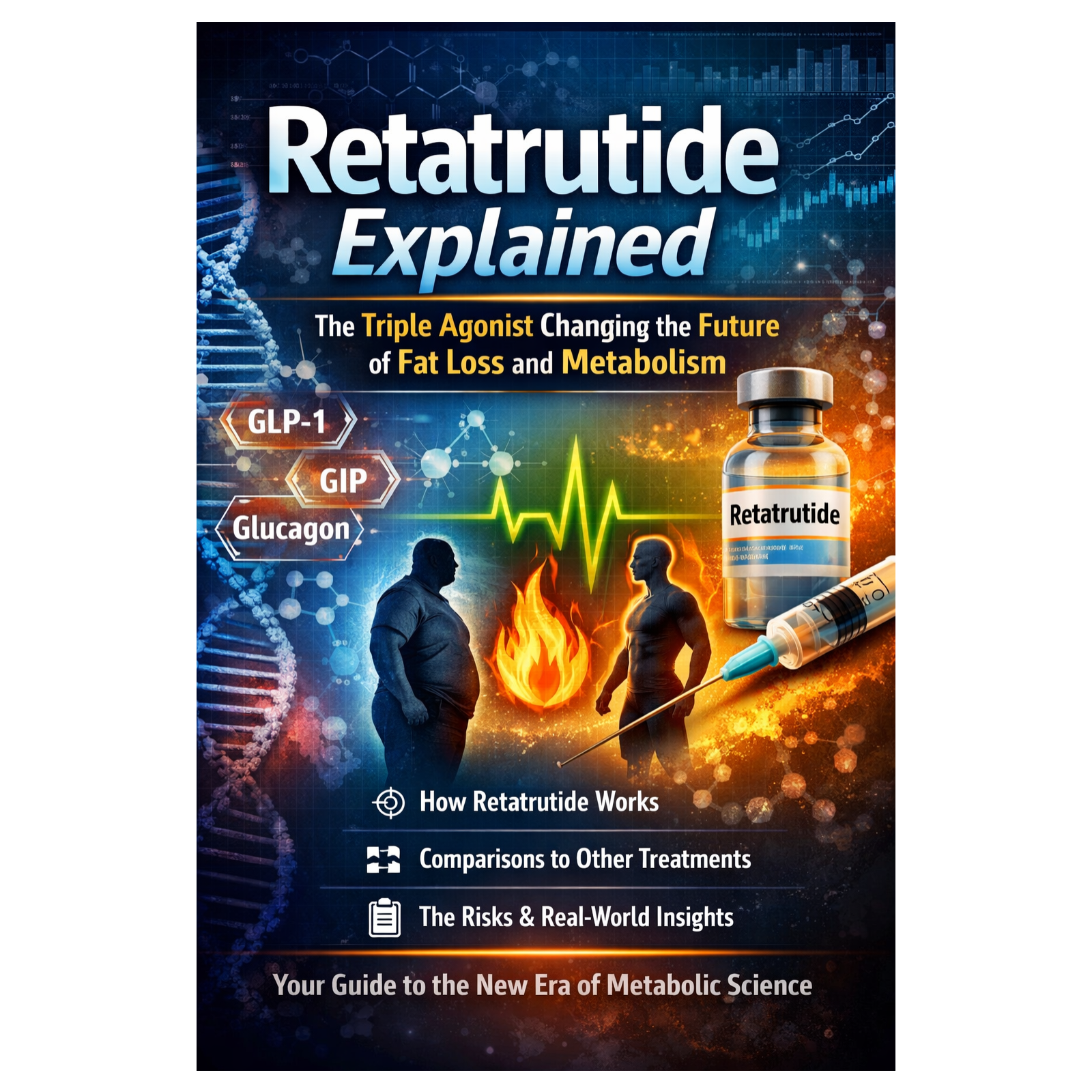
Retatrutide Explained (Revised): The Triple Agonist Changing the Future of Fat Loss and Metabolism
About this episode
What if fat loss wasn’t just about eating less, but also about burning more at the same time? In this episode, we break down retatrutide, one of the most talked about compounds right now, and why it’s getting so much attention. You’ll learn how it works as a triple agonist targeting GLP-1, GIP, and glucagon receptors, and what that actually means for appetite, energy expenditure, and overall metabolic function. We also dive into how it compares to other well-known options, what the early research is showing, and the real-world considerations people aren’t talking about enough. If you want a clear, no-hype explanation of what makes retatrutide different and why it could represent a major shift in how we approach metabolism, this episode is for you.
Get every episode summarized
Each time The Peptide Effect publishes, we email you a written briefing from the transcript — the topics, who appeared, and any specific claims, with the ad reads skipped.
Email me new episodesFree for 3 shows. No card needed.
Hosts & guests

Transcript ready
102 searchable segments. Every word is indexed and playable.
Full transcript
The Peptide Effect — Retatrutide Explained (Revised): The Triple Agonist Changing the Future of Fat Loss and Metabolism. Machine-transcribed; use the interactive transcript above to jump the player to any line.
This content is for educational and informational purposes only. It is not medical advice. Always do your own research and consult a qualified professional before making any decisions related to your health. Today, we're diving into one of the most talked about compounds right now, and that is read-it-true tide. If you've been anywhere in your peptide discussions, research forums, or even mainstream headlines lately, you've probably heard this name popping up more and more. And for good reason, this is not just another incremental step forward. This is one of those moments where people are starting to ask if we're looking at a completely new level of metabolic control. So, let's start simple and build from there. Read-it-true tide is what's called a triple agonist. That means it targets three different receptors in the body at the same time. Those receptors are GLP, one, GIP, and glucagon. Now, if you've been following this space, you already recognize two of those. GLP, one and GIP are the same pathways targeted by compounds like tersepotide. But read-it-true tide adds a third
component, glucagon receptor activity. And that's where things start to get really interesting. GLP, one, at its core, is about slowing gastric emptying, increasing satiety, and helping regulate blood sugar. It's why people feel full faster and stay full longer. GIP works alongside it, and helps amplify insulin response and metabolic efficiency. But glucagon is different. Glucagon is typically associated with raising blood sugar, but it also plays a role in increasing energy expenditure and fat metabolism. So, when you combine all three, what you get is a push and pull system. You're not just reducing intake. You're also increasing output. That's the key shift here. Most earlier compounds focused heavily on appetite suppression. Eat less, lose weight. Read-it-true tide is doing that, but it's also increasing how much energy your body burns. So, now you have both sides of the equation working at the same time. And this is where the early research started turning heads. Because when you look at the data coming out of clinical trials,
the amount of weight loss being observed is significant. We're not talking about small changes. We're talking about numbers that start to rival, and in some cases approach, what people see with surgical interventions. That's why there's so much attention on it. But let's slow down for a second and really understand what's happening under the surface. Because if you just hear weight loss, you miss the bigger picture. When GLP, one is activated, your brain receives stronger signals that you're full. Food becomes less rewarding in a way. Cravings often decrease. People report not thinking about food constantly. That alone can be life changing for some individuals. Now add GIP into the mix, and you're improving how your body handles nutrients, especially glucose, that can stabilize energy levels and reduce spikes and crashes. Then you layer in glucagon receptor activity. This is where your body starts increasing energy expenditure. Think of it as your metabolism being nudged upward, not in a jittery,
stimulant way, but in a more subtle, steady shift toward burning more fuel. So instead of just eating less, your body is also using more. That combination is powerful. Now, one of the biggest questions people have is how this compares to what's already out there. Terzapatide has been considered a major step forward because it targets both GLP, one and GIP, and it has shown impressive results. But read a true tide builds on that by adding the glucagon component. So it's not just an upgrade. It's a different approach. And because of that, people are starting to ask if this could redefine how we think about metabolic health altogether. But here's where we need to stay grounded. Just because something is powerful doesn't mean it's simple. There are always trade-offs, and there are always things we don't fully understand yet. For example, with stronger metabolic effects, you can also see stronger side effects. Naja, gastrointestinal discomfort, changes in appetite that can sometimes feel too extreme. Some people report feeling like they have
to remind themselves to eat. That might sound like a benefit at first, but over time, under-eating can create its own set of issues, especially when it comes to maintaining muscle mass. And that brings us to another important point. Weight loss is not the same as fat loss. If someone is losing weight rapidly, but also losing muscle, that's not an ideal outcome. So one of the conversations happening right now is how to support muscle retention while using compounds like read a true tide. This is where things like resistance training, adequate protein intake, and overall lifestyle choices become critical. Because no compound replaces those fundamentals. It can enhance them, but it doesn't replace them. Another interesting aspect of read a true tide is how it may affect lipid metabolism. Early research suggests improvements in things like triglycerides and cholesterol markers. That's important because metabolic health isn't just about body weight. It's about how your body processes and uses energy at a deeper level. There's also
ongoing exploration into how these pathways might influence inflammation, cardiovascular health, and even neurological factors. Because when you start adjusting how the body handles energy, you're touching multiple systems at once. Now, let's talk about expectations. One of the biggest mistakes people make with new compounds is assuming they're a shortcut. Something that bypasses the need for consistency and discipline. But what we're really seeing is that these tools work best when they're part of a larger system. If someone improves their diet, increases activity, focuses on sleep, and then adds something like read a true tide. The results can be significant. But if those foundations aren't there, the outcome is often less predictable. There's also the psychological side of this. When appetite is suppressed, habits change. For some people, that's freeing. For others, it can feel unfamiliar or even uncomfortable. Food is tied to routine, social interaction, and emotion. So when that dynamic shifts, there can be an adjustment period.
Another thing worth discussing is how quickly things are moving in this space. Read a true tide is still being studied. There's excitement. But there's also a lot we don't know yet about long-term use. That's something to keep in mind. Because early results are just one piece of the puzzle. And this is where doing your own research becomes so important. Understanding mechanisms looking at data, asking questions. Not just following trends. Because trends come and go, but understanding stays with you. Now let's zoom out a bit and look at the bigger picture. What is something like read a true tide represent? It represents a shift from single target approaches to multi pathway modulation. Instead of focusing on one lever, we're starting to see compounds that influence multiple systems at once. That's more aligned with how the body actually works. It's not one pathway in isolation. It's a network. And as research continues, it's likely we'll see even more compounds designed this way. More precise, more targeted, and hopefully more effective. But
with that comes responsibility. Because the more powerful the tool, the more important it is to use it thoughtfully. There's also an interesting conversation happening around accessibility and awareness. As these compounds become more widely discussed, more people are learning about metabolic health in general. And that's a positive thing. Because it shifts the focus from just appearance to overall function. Energy levels, blood sugar stability, cardiovascular health. These are things that impact daily life in a real way. So whether someone is interested in read a true tide specifically or not, the bigger takeaway is understanding how the body regulates energy. Because once you understand that, you start making better decisions across the board. Now, let's touch briefly on comparisons again, because this always comes up. People want to know, is this better than Terzepa tide? Is it better than semi-glatide? Where does it fit? The honest answer is that it's not just about better or worse. It's about different mechanisms and different responses. Some individuals may respond extremely well to GLP, one alone. Others may
benefit from the dual action of GLP, one NGIP. And some may find that adding glucagon activity creates a more noticeable effect. But that also means variability. What works for one person may not work the same way for another. That's something that often gets overlooked. And that's why personalization is becoming such a big focus in this space. Not just what compound, but how it's used in what context and alongside what lifestyle factors. Because at the end of the day, these are tools. And tools are only as effective as how they're used. So if you take anything away from today, let it be this. Read a true tide is exciting because it represents a new level of metabolic modulation. It's not just about eating less. It's about how the body uses energy as a whole. But it's still part of a bigger system. And understanding that system is where the real advantage comes from. This content is for educational and informational purposes only. It is not medical advice.
Always do your own research and consult a qualified professional before making any decisions related to your health. Thanks for listening. Keep learning and stay curious.
More episodes
More from The Peptide Effect
The Hidden GLP-1 Switch: How These Drugs May Reprogram Pancreatic Cells
The Peptide Effect
The Science of Peptide-Based Myostatin Inhibitors: Can We Unlock More Muscle?
The Peptide Effect
Apolipoprotein-Targeting Peptides: The Future of Cholesterol, Brain Health, and...
The Peptide Effect

Border Seizures and the Peptide Market: What’s Happening to Supply, Pricing, and...
The Peptide Effect