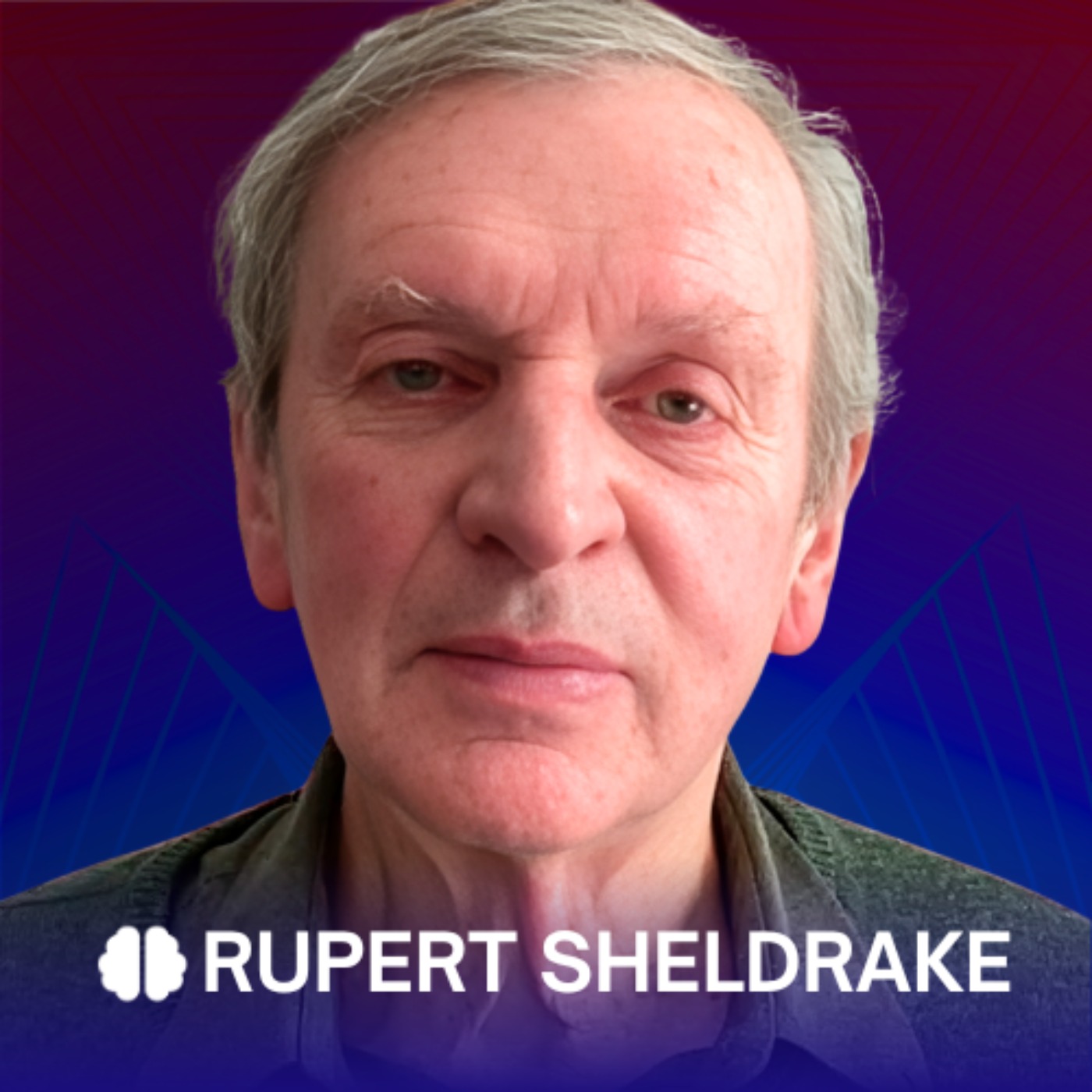
Rupert Sheldrake Explains How Morphic Fields Influence Habits And Unconscious Patterns In Life
About this episode
Watch the full episode with Rupert Sheldrake here: https://youtu.be/FMDmI0qiWRI
Support this show http://supporter.acast.com/inspiredevolution.
Hosted on Acast. See acast.com/privacy for more information.
Get every episode summarized
Each time Inspired Evolution with Amrit Sandhu 🙏🏻 publishes, we email you a written briefing from the transcript — the topics, who appeared, and any specific claims, with the ad reads skipped.
Email me new episodesFree for 3 shows. No card needed.
Hosts & guests
Transcript ready
97 searchable segments. Every word is indexed and playable.
Full transcript
Inspired Evolution with Amrit Sandhu 🙏🏻 — Rupert Sheldrake Explains How Morphic Fields Influence Habits And Unconscious Patterns In Life. Machine-transcribed; use the interactive transcript above to jump the player to any line.
There are certain things that we carry that potentially touchward served us at a certain period of our life, but do not necessarily serve us at this point of our life. And we've probably trained and trained them into the morphogenic field somewhere, because we're carrying them as a memory. But there is an opportunity for us to to clean some of that up. Is that a thing so that we can stop carrying around some of the the dross, I don't want to call it dross, but some of the dross, you know, like, I learned to get it like, I did nice things for my mum and my mum loved me more. So now, like, my love is very conditional, you know, some people carry that program. They feel that love is extremely conditional, but actually then they have the opportunity as they get adults to start to look at this and really evaluate whether this is a belief system that is serving them and whether they want to carry it forward. But there's an opportunity somewhat to rewrite the script. And
I guess the word I'm really focusing on is that, like, which parts of us are habituated in? And how do we rewrite habits through this awareness of does the awareness of morphogenic fields help us sort of curb these habituative thrusts? Wow, I'm making up words, sorry. Well, I mean, basically, they're habits. I mean, it's the simple, we have habits. I mean, the habit of doing things to please your mother, etc, becomes a kind of habit of behaviour. And all of us have habits. We need habits because we can't think out every single action that we do. I mean, our conscious mind is any small part of our mind. And, you know, you and I have the habit of speaking English. I don't have to search for words in my vocabulary. I can speak Hindi as well. But when I go back to India and, you know, I haven't spoken Hindi for a year or two, I have to search my mind for the words. They don't come straight away. It can speak slowly,
because I'm has a, but after a few days, I start becoming more fluent. And so because it's no longer as habitual, speaking English is totally habitual for me. So most of our habits are necessary and important, but we can have dysfunctional ones. And, but to change them, we first have to become aware of them. We're not aware of all our habits simply because they're habitual. Habits are unconscious almost by definition. The whole point of them is that you don't have to think consciously about how you do it or how which is the next word or when you're riding a bicycle when push down the pedal and all that. You don't have to think about these things if they're habitual. And if you're taking a habitual route to work in the morning, when you get to a junction, you just know which way to turn. You don't have to look to map and look at the sign post and say, do I go left or right or straight on it, crossroads? You just do it without thinking. So, if we do have dysfunctional habits, and we need to become aware of them to change them,
and often in a relationship, if we have dysfunctional habits that annoy our partner or other people we know, they're usually quite quick to point them out, to at least my wife is. And if you have, if your life gets into trouble, you know, if you have an addiction, for example, which is a kind of extreme habit, or you have habits that get you into trouble at work or in your family, then you're forced to confront them. And one of the things that psychotherapists do is help people to be aware of their habits, their habits of behavior, their habits of thought, their habitual assumptions. And once you bring them aware of them, then it's easier to change them and usually have to build up an alternative pattern. That's why in recovery programs like alcoholic synonymous, it's not enough to say people to people stop drinking or stop taking
drugs. You have to build up an alternative whole social group, you know, because if people's social life depends on going to the pub and having a beer with people, another beer and the other and so on, then if you say stop drinking, the whole social life falls away and they're completely isolated. So you have to have an alternative social group, which is the whole point of the recovery programs. So you have to find alternative habits to the ones you're trying to change. And this is the role that psychotherapists have. Then there are things like family constellations therapy, which I don't know if you've come across, but it's a form of therapy where you look at habits in families, the whole family can habits of ways in which people relate to each other. My wife, Joel Pers, is a practitioner of family constellation therapies and those very clearly show a kind of family pattern, a habit in the whole family field, which is inherited by a new
generation, without people being aware that they're following some kind of habit that was pursued in previous generations. And by bringing it to light, by making people aware of it, and by looking at how the habit originated and doing something about it, there can be a healing process. But it's very much a matter of bringing unconscious habits to light. Did you want to ask you about your landmark study of these 26 telepathy experiments, but I feel we've run out of time. I'm going to have to put a film in it for next time to hear from more about that, because yeah, you've been studying telepathy as well, emails, phones, texts with a 40% success rate, like that's insane. Well, compared with four people who could, this is based on telephones, let me briefly summarize it, like I'm interested in the way that we're interconnected by invisible interconnections. And morphic resonances are where we're interconnected from the past through memory and collective
memory. Telepathy is a way we're interconnected in the present without a people that we're closely bonded to. And most people have experienced this. Some have experienced it with animals. I wrote a book called Dogs that Know When They're Owners Are Coming Home about people in their animals. But also without a people. And the commonest kind in the modern world is with telephone calls, text messages, or emails. You think of somebody for no apparent reason, then they ring. And you say it's funny, I was just thinking about you. Well, most people have had that experience 85% about. And the skeptic say, oh, it's just a coincidence, you think about people all the time. And if one of them rings you, you think it's telepathy and you just forget the millions of times you're wrong. That's the standard armchair skeptical argument. Well, I've been testing it. In our experiments, we have the something. For 20 years, mind you.
I've done lots of experiments. So how the people that's been replicated widely. The four callers, potential callers, you sit at home, landline phone, no caller ID, you're on camera. The phone rings, what's happened is we've picked one of the four callers at random and asked them to call you. They call you. Before you pick up the phone, you say who it is. I think it's Mary, the new pick up phone, hello Mary, you're right or you're wrong. By chance, you'd be right one time in 425%. In these filmed experiments, it's about 45%. And it's hugely significant statistically. And it happens with emails and SMS messages. And all the details are in peer-reviewed papers. They're all on my website, children.org. Anyway, the point about it is really that we're permeable to other people's thoughts and intentions. Our minds are porous. They're not insulated in the privacy of our skulls, as if the bone of the skull is a perfect insulator that keeps all mental activity inside.
And that's the conventional assumption in science. The materialist assumption is the mind is nothing but the activity of the brain confined to the inside of the head. I discuss this and other dogmas of materialism in my book, The Science Delusion. But the point here just in very brief summary is that we're interconnected both spatially with other people, particularly those were closely bonded to emotionally. Across great distances, I did telephone experiments between Britain and Australia, which is about as far apart as you can get. People picked up when people in Australia were thinking about them. It's not distance dependent. It's dependent on emotional closeness, not physical closeness. So we're bonded and connected to others and we're connected to the past and we're connected to our own past and the past of other people as well through collective memory. So our minds are not just confined to the inside of our heads, but they're part of a much larger
interconnected system and potentially connected to forms of consciousness greater than our own. I hope you're thoroughly enjoying this moment from a full length podcast we've got here on the Inspire Evolution. If you are intrigued and so-called, check out the full episode to where you're listening to this podcast now.
More episodes
More from Inspired Evolution with Amrit Sandhu 🙏🏻

Richard Martini on Animal Souls, Optional Incarnation, Brain Filters and Afterli...
Inspired Evolution with Amrit Sandhu 🙏🏻

Richard Martini on Jesus at Hemis, Saint Isa, Silk Road Mysteries and Afterlife...
Inspired Evolution with Amrit Sandhu 🙏🏻

#574 Richard Martini: Afterlife Communication, Reincarnation, NDEs & Spirit Guid...
Inspired Evolution with Amrit Sandhu 🙏🏻

Dr. Anna Yusim Explains the Four Clairs, Intuition, Synchronicities and Staying...
Inspired Evolution with Amrit Sandhu 🙏🏻