About this episode
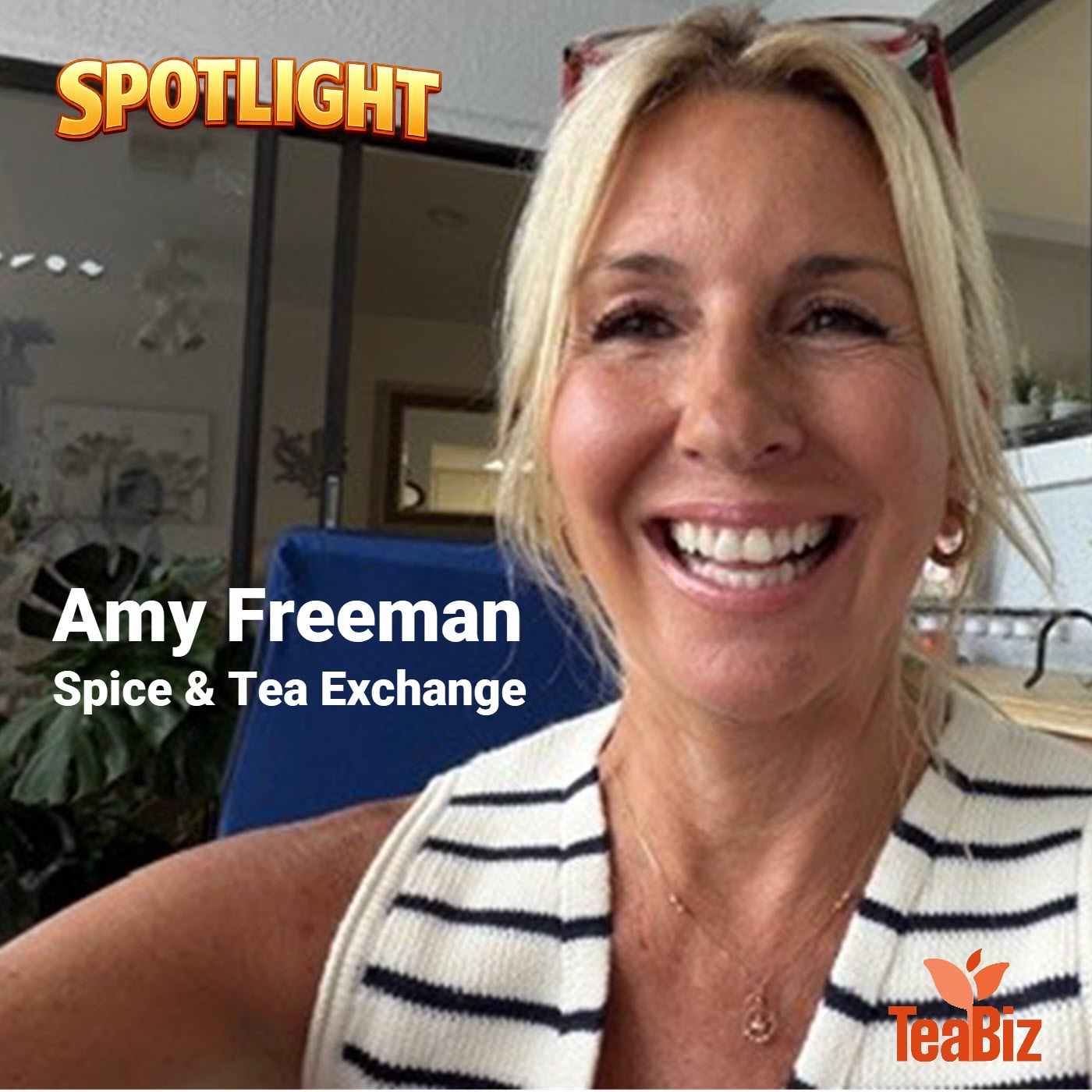
Few specialty retailers have expanded as successfully—or as thoughtfully—as The Spice & Tea Exchange https://www.spiceandtea.com/. Founded during the depths of the 2008 financial crisis, the brand has grown from a single shop in St. Augustine, Florida, into a nationwide franchise with more than 90 locations. | At the heart of that growth is CEO and co-founder Amy Freeman, whose approach combines entrepreneurial discipline with a strong belief in hospitality, storytelling, and sensory retail. Instead of standardizing stores into uniform outlets, Freeman has created a model that promotes local experimentation, community engagement, and hands-on exploration of spices, loose-leaf teas, and culinary ingredients. The company offers over 600 exclusive products, curated by both in-house spice masters and spice masters at franchise locations.| In this Tea Biz Spotlight interview, Amy discusses expanding a franchise network while maintaining authenticity, lessons learned from the pandemic, and why immersive retail and education remain vital for the future of specialty loose-leaf tea.| BIO: Amy Freeman, CEO and Co-Founder of The Spice & Tea Exchange, leads with a philosophy rooted in servant leadership, community connection, and empowering franchisees to create locally relevant offerings while maintaining brand standards. Under her guidance, the company has expanded its loose-leaf tea portfolio to over 85 varieties and continues to innovate across culinary teas, regional blends, and immersive retail experiences. | This distinction reflects Amy’s deep expertise in franchise development, operations, and brand growth, as well as her unwavering commitment to upholding the highest standards and best practices within the franchise community. | Podlink signup: https://pod.link/1549975153
Advertising Inquiries: https://redcircle.com/brands
Privacy & Opt-Out: https://redcircle.com/privacy
Get every episode summarized
Each time Tea Biz publishes, we email you a written briefing from the transcript — the topics, who appeared, and any specific claims, with the ad reads skipped.
Email me new episodesFree for 3 shows. No card needed.
Hosts & guests

Transcript ready
215 searchable segments. Every word is indexed and playable.
Full transcript
Tea Biz — Spotlight | Tea Discovery Drives Retail Growth. Machine-transcribed; use the interactive transcript above to jump the player to any line.
Ring Central's AI receptionist uses voice AI to answer on the first ring, so you'll never miss a call again. In just a few minutes, you can personalize your own AI receptionist to answer questions, route calls, schedule appointments, and even send texts in multiple languages. Plus, it's easy to scale. Create unlimited AI receptionists across any phone system. It's all powered by one reliable platform for effortless AI communications. See for yourself at ringcentral.com Ring Central Voice of your business. Amy Freeman, CEO and co-founder of The Spice and T Exchange, leads with a philosophy-rooted and servant leadership, community connection, and empowering franchisees to create locally relevant offerings while maintaining brand standards. Under her guidance, the company has expanded its loose-leaf, teaport folio to over 85 varieties and continues to innovate across culinary tea's regional blends and immersive retail experiences.
This distinction reflects Amy's deep expertise in franchise development, operations, and brand growth, as well as her unwavering commitment to upholding the highest standards and best practices within the franchise community. Thanks so much, Amy, for joining us on this week's tea-biz podcast. Well, it is a pleasure to be here. It launched The Spice and T Exchange during the 2008 financial crisis and have since expanded to more than 90 locations. What leadership decisions or cultural principles allowed the brand to grow nationwide without losing the authenticity of the original shop? In 2008, I was in the process of selling a business, and I knew what was happening in the world with regard to the finance and banking situation. That chapter was clothing successfully, and I was really looking for what I was going to do next, and I walked into a little store in St. Augustine, Florida, and it was a sensory
overload. I discovered so many things, being cooking and being in restaurants and involved with what I thought at a time, a pretty good breadth of knowledge with regard to spices. I was blown away. I was able to open those jars and smell and taste, and before I knew it, I had $80 worth of spices on the counter, and these little innocent little baggies, and it just went off that this is something that I would never do in the grocery store. I would never buy $80 worth of spices. I had a tremendous amount of variety and a reasonable package that if I didn't like it, I wouldn't have to use it. I could toss it and go on to the next. That is how the spicy and tea exchange was going. Many U.S. specialty retailers struggled during the pandemic.
Your franchise not only survived a continued growth. How did you manage that period operationally? The pandemic forced us to grow and really stretch. I had been saying that I am a franchise or first and foremost, and I serve the franchise these. I believe in servant leadership, that's truly my mission statement now with time to walk the walk. When the stores started closing down one by one, fortunately, I was at a meeting out in Utah with some very savvy franchise or CEOs, founders, and a lot of people who were very innovative and were quick and nimble to respond. I gained a tremendous amount of knowledge and realized that communication is king, and that if I could get ahead of this and communicate openly with my stores to tell them that I'm
with you and telling them what we would do, clearly, concisely, and letting them know that they are safe and we are going to get through this together. We pivoted by everyone's e-commerce blew up or those who were fortunate enough to experience that. If you did well on e-com, it was going to grow exponentially. We gave the stores 20% of the revenues coming in from the website and we actually raised that to 30% for a certain amount of time, and we hand-wrote checks and sent them to them, sent the monies, the revenues from the stores, from the guests that they created from their great customer service who became members of our website. Then we added curbsides service, and then we stayed very, very slow but steady. Your stores are known for immersive retail, open jars, aromas, sampling, storytelling.
What transforms this spice or t-shop into a memorable experience rather than just a place to buy ingredients? That sensory experience ties back to the reason we started this business and that is bringing back memories, educating how do you, how do you even make it a blend? Because so many people are used to eating it, but how is that made up, what are the ingredients to create this? It was a combination of sensory and education and inclusion, immersion. Every guest that comes in is a guest. We are welcoming them into the store and we needed to make sure that we understood the people who were coming in. There are people who are experienced, fights are shots. There are people who like to barbecue or grill. There are people who have never cooked or drank tea in their lives.
There are young people, old people. The common denominator was make them feel safe and allow them to be part of the process. Whether that was touch, taste, smell, feel, talk, whatever it took. The beauty of our business is that you can take the jars, you can open them and smell them. And there's someone right there to ask and answer questions. Then we hand that jar over to the guest. If they're loving that aroma, we ask them to talk to why they like it to the next guest coming in. So, they feel like they're a part of this. Is that really opens people up and allows them to explore in a very different way? And I do believe that that is our secret. These store owners create small batches so they know every single ingredient that goes into those blends so they're able to talk about them intelligently.
They know this has shallots, this has onions, this has salt, this doesn't have salt. This is very spicy. So they're able to really be knowledgeable and so is their team. And that really allows freedom of exploration when people come in and say, you know, I have this ailment or I need this or I can't have that, well, we'll make it for you without that. Or let's move you over to this section and let's try that. So it really is a partnership with our guests. So it is a partnership with us with our franchisees and it's our partnership with our franchisees with their guests. One distinctive element of your model is localized product development, regional blends tailored to local taste. How does that work within the franchise system? This is an art. So being the franchise or you have to have guardrails and you have to have rules and regulations.
But more importantly than that, your franchisee or your employee, whatever direction you're going, has to understand those and know what those are. It doesn't matter if you have them, if they don't, they don't know, aren't trained, aren't taught this. And so if you're going to scale, it's very, very important that you communicate, clearly and concisely and ask for responses back. Do you understand this? Do you have any problems with this? Is there any concern? Let's talk about this. For a franchise or it's really important to do that before they sign a franchise agreement. So we've become very good at that. So the process to become a franchisee of this spicy and tea exchange is a very long and strong process. And we are vetting, making sure that there are the right culture and mix for us because
we feel that it's essentially a 10-year marriage. It's got to be right for them, equally, same for us. So with that being said, these guardrails are in place and then we start, let's learn all of our blends, let's make all of the blends, let's experience selling them. There's a wide array and it will cover most pallets, most needs, however, as we started growing, regionality became a thing. In every aspect, in tea, types of tea, you know, matcha caught on in California and the West Coast much earlier than it did on the East Coast, there are, you know, spicy, Cajun and New Orleans. So there's all of these different things that are happening. And so we really said there's an art and a science to this business. Here's the science. We gave you the rules. Now here's the art. Let's see what your guests are asking for.
What is trending? We use partners. We use all different types of research to see what is coming, what's trending, what's coming, the TV influences that, Instagram influences that. So our franchisees are the front line. And so they're starting to hear in these requests way before we do in Florida, in St. Augustine, Florida. So we listen to our partners and they say, everyone's coming in and they want the Nile Lavender tea. You know, it's the latest greatest craze. All right, let's look at that. Is that sustainable in your area? Is that nationwide? Is this an isolated pocket that this is trending? I'll give you an example, prickly pear in Arizona, prickly pear tea. It's not going to go over in Peoria, Illinois. I guarantee you, but in Sedona and all of these stores that we have there, it's going to be hot, right? So we try it out.
We test it slowly. We make sure that we perfect it. We make sure that the franchisey understands what they are selling. And we have a certain amount of wall space for them to have due to three products that are local. And after 90 days, we see how the sales are going. And then we introduce it to the franchise system and say who wants to try this out. So we slow, we have a slow role. And then we decide whether that's going to be a limited time offer. That's going to be a staple on our show. And you know, then we give the franchisey credit if they create a blend or if they bring something in, they love that. It loves to boast and brag in 99% of the time, that regional area or store. That's their highest sale product. And they love to top that in the system and we give space for that to happen and we
cheer them on. You're part of a growing group of women leading companies in tea and specialty beverages. And you see women altered for nerve shaping this sector. This is a very difficult question for me, but I wanted to really have this conversation with you where women led business. It's difficult. I grew up in a man's world. I'm very comfortable in that it's not a negative or a positive for me. I believe as women, for the most part, we are natural nurturers, business is hard. There's sometimes I wish I was a man or I wish I had more men because they just think differently than we do. And sometimes in very difficult situations, we need that, we need that blend. So being a woman run company, my business partner, Penny and I are not only, we did not know each other prior to this, but we are leading this company and we are the best
of friends and we have a tremendous relationship and we lean on each other quite a bit. It's hard, like I said, it is difficult, but if you lean into your natural talents, I'm a mother of three, I'm a midwestern girl, I believe in integrity and I'm very humble and I believe in fairness. That's great, but what does it get you in business? I can lean into those talents and then I surround myself with people who have areas of expertise that I don't have. I will say, well, let's do this and I had to surround myself with people who are like, nope, this is the way we do it. Women have those capabilities. I do believe that women have an affinity with tea and they really are able to taste it and admire it and nurture it more so than men.
I think a lot of men love tea and appreciate it, but I think this is a business that is easy for women to get into. It's fun to learn about. It hits the educational, the research, it's oldest time, there's a lot there, there's a lot of fulfillment. My company is not a women-led company by design. It just happens to be that way and I have tremendously strong, powerful women in my company and men too. Ring Central's AI receptionist uses voice AI to answer on the first ring so you'll never miss a call again. In just a few minutes, you can personalize your own AI receptionist to answer questions, route calls, schedule appointments, and even send texts in multiple languages. Plus it's easy to scale. Create unlimited AI receptionists across any phone system. It's all powered by one reliable platform for effortless AI communications.
See for yourself at ringcentral.com. Ring Central. Produce of your business. Produced by Autovita Studios, connect your voice to the world.
More episodes
More from Tea Biz

Tea Price Report | Week 35 | Ending 28 August 2026
Tea Biz

Spotlight | Behind the Cup
Tea Biz

Tea News Recap | Nepal Recovers | India Maps Tea | US Grown Matcha
Tea Biz

Ep 245 | Nepal Tea Recovers | India Maps Tea by Satellite | US-Grown Matcha
Tea Biz