Loading...
newsbusinesseducation
Tea News Recap | Hormuz Shock, India-U.S. Pact Reshape Tea Trade
About this Episode
Hormuz Shockwaves Reshape Global Tea Trade and Freight Risk | India-U.S. Trade Pact Could Reopen U.S. Market Access for Indian Tea | DMCC Reveals New Details on 600-Metre Uptown Dubai Megatall Tower | Podlink signup: https://pod.link/1549975153
Advertising Inquiries: https://redcircle.com/brands
Privacy & Opt-Out: https://redcircle.com/privacy
Hosts & Guests

Transcript
Ring Central's AI receptionist uses voice AI to answer on the first ring, so you'll
never miss a call again.
In just a few minutes, you can personalize your own AI receptionist to answer questions,
route calls, schedule appointments, and even send texts in multiple languages.
Plus, it's easy to scale.
Create unlimited AI receptionists across any phone system.
It's all powered by one reliable platform for effortless AI communications.
See for yourself at ringcentral.com
Ring Central
Voice of your business.
The disruption in the Strait of Hormuz is rapidly evolving from a shipping crisis into
a systemic shock to the global tea trade, with consequences now spreading across the
origin markets, transit corridors, and input supply chains.
At the center of the story is exposure.
India's T Association estimates that 41% of India's TX boards move through the Hormuz
linked routes to the Gulf.
Sri Lanka faces a similar dependency with exporters mourning of weekly losses of 10 to 15 million
dollars, as vessels delay, rerouter, suspend shipments altogether.
But the operational reality is becoming clearer and more severe.
According to trade briefing circulating among Indian exporters this week, Pope Maritime
Choke Point dependency remains a strategic vulnerability for Indian tea.
If instability persists, freight rates could rise by as much as 40% insurance premiums
will remain elevated, and transit times may extend by up to 25 days.
It's not just a cost increase, it's a competitive shift.
Indian tea risk losing ground at origins would shorter more flexible routes into the
Gulf markets, including East Africa.
But East Africa is not insulated.
Kenyan exporters are already warning of a potential loss of up to 20% of Middle East
demand, particularly in key markets like Pakistan and the UAE.
Auction liquidity is expected to tighten if cargoes cannot clear, and producers face
rising exposure to delayed payments and unsold inventory.
Sri Lanka, meanwhile, sits in a more precarious position.
The country's orthodox tea sector is heavily export dependent with the Gulf routes disrupted
the industry faces immediate cash flow pressure, delayed shipment execution, and increasing
uncertainty about buyer performance in high-risk markets like Iran.
And this is where the story expands beyond the Gulf.
The affected trade networks stretches deep in the central and west Asia, including
Kazakhstan, Kyrgyzstan, Uzbekistan, and Iraq.
Markets that rely on transit quarters now under strain.
These are not marginal destinations, they are volume-absorbing markets to play critical
real-all in balancing global supply.
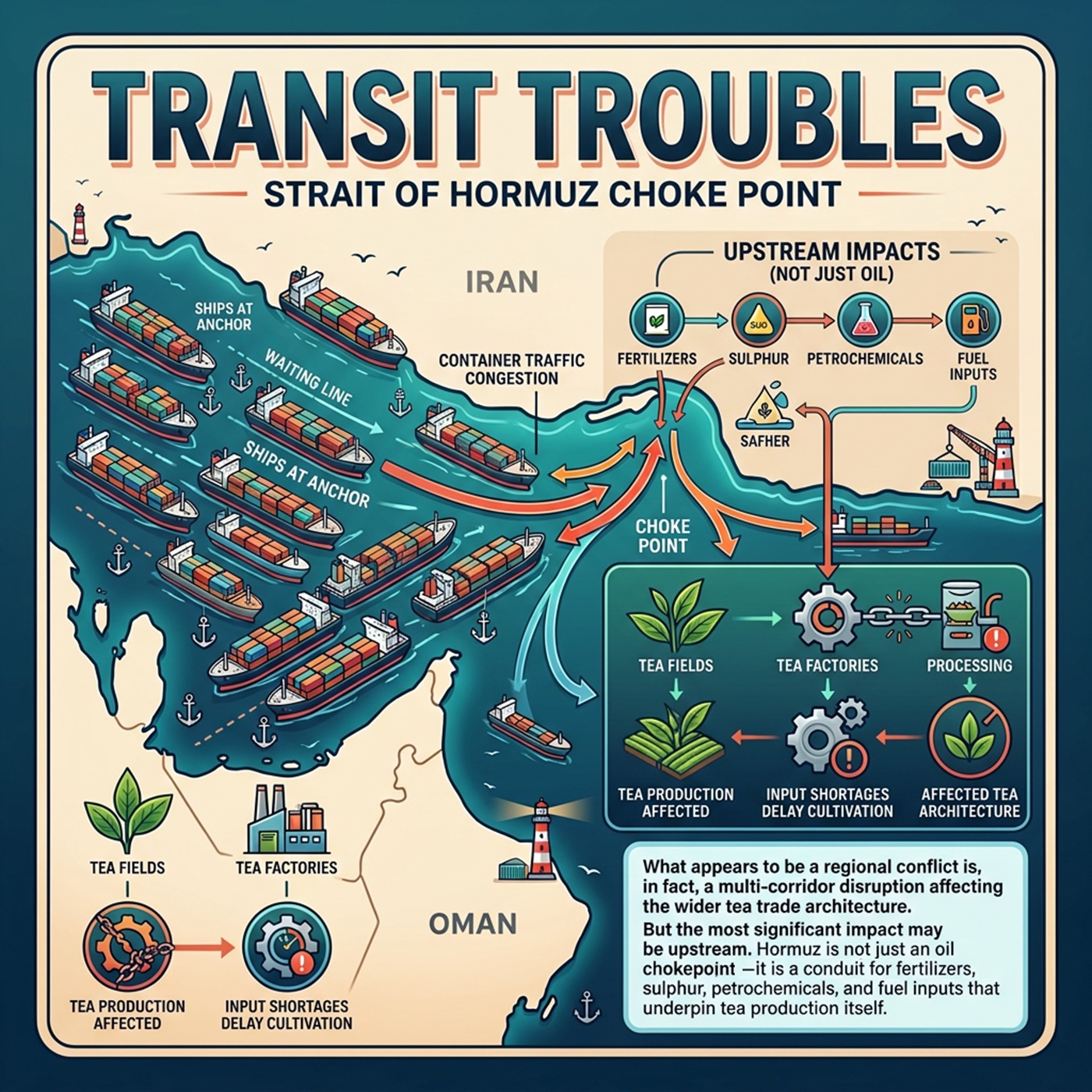
What appears to be a regional conflict is, in fact, a multi-quarter disruption affecting
the wider tea trade architecture.
With a more significant impact, may still be upstream.
Our moves is not just an oil check point, it is a conduit for fertilizer, sulfur, petrochemicals,
and fuel inputs that underpinned tea production itself.
Roughly one-third of the global seaboard fertilizer trade moves through the Gulf, nitrogen
fertilizer production is heavily dependent on natural gas, accounting for up to 70% of
the cost.
As supplies tighten, input prices rise.
At the same time, refinery-linked products, lubricants, base oils, and industrial chemicals
are becoming more expensive and supplies less predictable.
These are essential to factory operations, transportation fleets, and processing infrastructure.
Later on to that, rising diesel-caused, elevated Barker fuel prices and more risk insurance
premiums, and the result is a full spectrum cost escalation.
What emerges is a classic squeeze among the value chain.
Higher input costs the origin, longer transit times to market, increased financial risk
and destinations, and weakening buyer confidence.
It's no longer just a logistics description, and for three weeks it's a structural stress
test of the global tea supply chain.
As this insight, the longer Hamuz remains unstable, and when likely it is that tea flows
will begin to re-route, reprise, and rebalance, with lasting implications for origin, competitiveness,
trade relationships, and global market structure.
India's interim trade framework with the United States could create a meaningful new opening
for Indian tea exporters, though the opportunity remains conditional rather than assured.
Riders reports that tea is among the agricultural products expected to benefit if the framework
advances as outlined, including potential duty-free access to the U.S. market.
That matters because terrifer-leaf can improve competitiveness, especially in price-sensitive
categories, but it does not by itself create market share.
The agreement is still politically contested.
Farm unions and opposition parties in India have warned that parts of agriculture could
face new pressure, while the government argues that protected staples remain insulated
and that export-oriented categories such as tea could gain.
So this is not yet a finished market-access story.
It is a policy discussion with commercial implications, or tea the practical question
is what exporters do with the opening if it materializes.
The U.S. market rewards more than tariff advantage.
Indian tea suppliers will still need to meet buyer expectations on quality, consistency,
residue, compliance, documentation, pack format, and dependable execution.
In other words, improved access may help, but traction will still depend on commercial
readiness.
That is why this matters.
At a time when sourcing strategies are already shifting under pressure from freight risk, geopolitical
uncertainty, and tariff realignment, even a modest improvement in U.S. access could make
Indian tea more competitive and select channels.
Not across the board, not overnight, but enough to put the category back on the watch list
for buyers and exporters alike.
This is a watch point, not a breakthrough.
Tariff relief could open the door, but it will not move tea unless exporters are ready
with compliance, consistency, and a market fit that works in the U.S.
The real opportunity is not lower-trade duties alone.
It is the chance for prepared Indian suppliers to re-enter buyer conversations at the right
moment.
Dubai Multi-Community Center has unveiled further details of its uptown district expansion,
including plans for a mixed-use tower expected to rise above 600 meters.
The proposed Megatall structure forms part of phase 3 of the district's master plan,
executive chairman and CEO, Ahmed bin Soleim, said.
There's one delivered, the 340 meter uptown Dubai tower, and in the central plaza,
phase 2 comprising two great-a office towers and two residential towers is now under construction,
and scheduled for completion in late 2027 or early 2028.
Partee traders, packers and origin suppliers, the significance extends beyond the skyline
ambition.
The MCC's continued capital commitment reinforces Dubai's role as a long-arise and trade hub
linking Africa, South Asia, and the Gulf.
This matters because the DMCCT Center operates the Jibble Ali Free Zone, giving tea companies
access to warehousing, blending, packing, and other value added processing near one of
the region's key logistics gateways.
This is vertical development is economic signaling of Ben Soleim Road, arguing that
scale alone will not determine the district's long-term success.
Well, scale is impressive, but what will define uptown success as how well commercial, residential
and community elements integrate to create sustained economic activity, he said, adding
that mixed use creates value only when it supports talent density, business velocity, and
long-term investor confidence, not just skyline presence.
Business Insight The announcement marks progress, not completion,
but the development sequence now looks more complete.
Phase 1 is delivered, phase 2 is underway, and phase 3 has a clearer anchor project.
For businesses operating within DMCC's T-Equal system, that strengthens the case that
Dubai's trade infrastructure story is still expanding.
Ring Central's AI receptionist uses voice AI to answer on the first ring, so you'll
never miss a call again.
In just a few minutes, you can personalize your own AI receptionist to answer questions,
route calls, schedule appointments, and even send texts in multiple languages.
Plus, it's easy to scale.
Unlimited AI receptionists across any phone system, it's all powered by one reliable
platform for effortless AI communications.
See for yourself at ringcentral.com, ringcentral, voice of your business.
Produced by Adavita Studios, connect your voice to the world.


