Get every episode summarized
Each time happy healthy hustle publishes, we email you a written briefing from the transcript — the topics, who appeared, and any specific claims, with the ad reads skipped.
Email me new episodesFree for 3 shows. No card needed.
About this episode
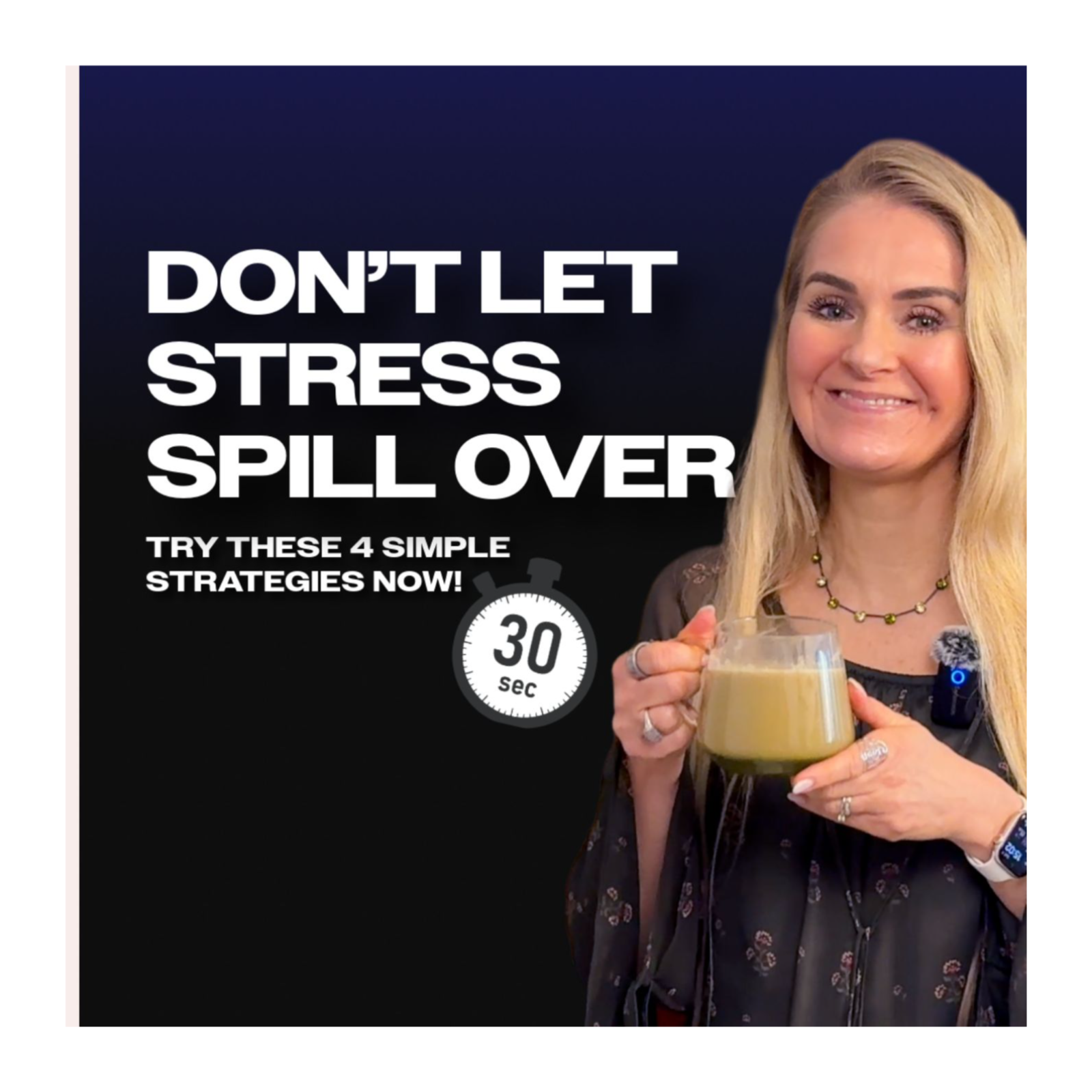
“Stress starts in the skip lunch, the extra yes, the late night email, and the moment you decide to push through instead of pause. Today we are talking about how to prevent stress before it spills over. Most people think stress comes from doing too much.”From the transcript
What if stress is not coming from doing too much… but from never noticing when to stop?
Most people think stress arrives all at once.
It doesn’t.
It builds quietly in skipped lunches, late-night emails, extra responsibilities, and the constant habit of saying “just one more.”
One more task.
One more favor.
One more meeting.
One more thing that “only takes 30 seconds.”
And most of the time, nothing happens immediately.
That is exactly why we keep doing it.
In this episode of the Happy Healthy Hustle Podcast, I share why stress works more like a microwave than a breaking point.
Yes… a microwave.
Because sometimes the best lesson about overload comes from reheating matcha and realizing the most dangerous button in the kitchen might be the +30 seconds button.
Stress rarely announces itself.
It leaks.
It builds in small increments.
And by the time it spills over, the real problem started much earlier.
This episode explores how to recognize those early signs, how to pause before overflow happens, and why recovery should be maintenance—not emergency rescue.
Because protecting your peace should not begin after the crash.
It should begin before.
⸻
In this episode, we explore:
➡️ Why stress builds in “30-second increments” and how to catch it early
➡️ The microwave metaphor and what it teaches us about overload
➡️ Why delayed consequences are often the most dangerous
➡️ The 4-question pause before adding “just one more thing”
➡️ How recovery works better as maintenance than emergency repair
➡️ The Petite Practice body scan reset to help you notice stress before it spills over
The truth is simple:
Stress does not explode overnight.
It leaks in through the small things you keep ignoring.
- The skipped lunch.
- The extra yes.
- The late-night email.
- The moment your body asks for rest and you decide to push through instead.
Small choices create big consequences.
But they can also create real calm.
Because peace is not something you find later.
It is something you protect now.
And sometimes, the smallest pause creates the biggest change.
⸻
Explore more episodes of the Happy Healthy Hustle Podcast: doctorchristiane.com/podcast/
Take the Superpower Quiz: doctorchristiane.com/quiz/
Connect on LinkedIn (Petite Practice Journal): linkedin.com/in/christianeschroeter/
Book me to speak: doctorchristiane.com/speaking-5/
Watch and Subscribe on YouTube: https://www.youtube.com/@doctor.christiane
Get every episode summarized
Each time happy healthy hustle publishes, we email you a written briefing from the transcript — the topics, who appeared, and any specific claims, with the ad reads skipped.
Email me new episodesFree for 3 shows. No card needed.
Hosts & guests
Transcript ready
68 searchable segments. Every word is indexed and playable.
Full transcript
happy healthy hustle — Stop Stress Before It Spills. Machine-transcribed; use the interactive transcript above to jump the player to any line.
Burnout is not the beginning. It is the receipt. Stress starts in the skip lunch, the extra yes, the late night email, and the moment you decide to push through instead of pause. I'm Dr. Cristiana, and this is the Happy Healthy Hustle Podcast. Today we are talking about how to prevent stress before it spills over. Most people think stress comes from doing too much. That's wrong. Stress comes from not noticing when to stop, because stress doesn't just arrive with a siren. It doesn't kick your door down. Stress shows up like this. 30 seconds. One more task. One more favor. One more email. One more. I just finished this, and you don't even feel it building until it spills. I realized this in the least dramatic place possible in my kitchen. So holding a cup
of matcha, I was staring at my microwave, and the most dangerous button in my house is actually the 30 second plus button on my microwave. I like my matcha warm, not hot, and the microwave doesn't care about my preference. So I have a system. I basically heat it, and then I add 30 more seconds, and then another 30. And sometimes it's just a little bit more, because it's not warm yet, and because I'm already there, because what's another 30 seconds? And then everyone's in a while, I push it slightly too far, and then the cup overflows, not in a movie scene, not like exploding. It just overflows. Just enough to drip over the edge and make a really big mess in the microwave. And here's the part that made me stop. After you've had an
overlay once in your microwave, you never approach the microwave the same way again. You open the door really carefully. You look at the cup like it might betray you, you brace yourself, and then one day standing there, waiting for that beep, I thought, uh oh, this is stress. This is actually how stress works. We don't just add stress in big obvious chunks. We add stress in 30 second increments. One more meeting, one more responsibility, one more late night, one more my shirt, one more, it will only take a second. And most of the time, nothing happens immediately, but guess what? Which is why we keep pressing that button, because the build doesn't come right away, delayed builds are the ones that bankrupt high performers, and now quick-nord moment, but in plain English for you.
Microwaves heat liquids by making the water molecules vibrate, and that vibration creates heat, but they don't heat evenly. They are hot spots and cold spots. So liquids can super heat, meaning they get hotter than they actually look without bubbling. So when you take a cup out of that microwave, it looks totally fine, but then when you move it, just a little bit, it actually suddenly surges. So now that means uneven heat, hidden build-up, delayed reaction. And if that doesn't sound like stress, I don't know what does, because stress doesn't show up in one place either. Sometimes it's your neck. Sometimes it's your sleep. Sometimes it's your digestion. Sometimes it's headaches. Sometimes it's irritability. Sometimes it's, oh my gosh, brain fog. And it rarely happens proportional to what you added that day. You can add one more small thing and your body reacts
strongly. You can carry 10 big things and feel fine until you don't. That's not weakness. That's systems. Your body has limits. Even if your calendar pretends it doesn't. And here's the leadership move. Most people assume adding is neutral. They don't ask whether something should be added. They assume it can be handled, but every addition has cost. And if you don't pay attention to the cost, you pay it later with interest. So here is a simple practice. No overhaul, no tracking, no perfection. Before you press that plus 30 second button in your life, pause and ask four questions. First, what am I adding right now? Be specific. A task, a favor, a late night, a mental load? Second, do I need this heat right now? Am I solving a real problem or am I trying to
manage anxiety by doing more? Because doing more feels control. And sometimes it's just panic with a planner. Third, what's the risk of overflow? Not dramatic, honest. If I add this, where will it show up later? Sleep, mood, patience, health, focus? Fourth, if I don't add this, what actually changes? And here's what people don't expect. Very often the answer is nothing. Nothing important. And that's the valuable information. Now here's the alternative that hit me later. Instead of reheating over and over and over again in bursts, those are those little mug warmers that keep your drink consistently warm. Not hot, not cold, just steady. So use a better model for stress. Most people don't treat recovery like a fire extinguisher. They rest only when they crash. They only slow down
when symptoms force them to slow down. They take care of themselves only when it becomes unavoidable. But your body prefers steady input. So what would a mug warmer look like in your life? A 10-minute walk, most days? A real lunch break? Not at your desk? A consistent bedtime routine? Two minutes of breathing between meetings. A weekly planning moment where you remove one thing instead of adding one. Small, steady inputs, beat dramatic resets. That is not self-care language. That is strategy. That's maintenance because no serious system is run until failure. It's monitored. It's adjusted. It's serviced. You deserve the same. In fact, here is your petite practice for today. A 30-second body scan. Set a timer. 30 seconds, one minute, and then ask
yourself. Where do I feel heat right now? Do I feel lightness, pressure, buzzing, tension? Where do I feel cold? Numb, flat, disconnected or drained? What is one kind of thing I can do for my body in the next hour? Or in the next minute? One answer. One small action. That's how you notice the temperature before it spills. If this episode would make you think of your own plus 30-second button, you're not alone. Most of us were trained to pay attention to our calendar before our body. But your body has been communicating with you the whole time. In fact, let me tell you what I would encourage you is where do you add just a little bit more without realizing it? If this has helped you, helpful, share it with someone who's carrying a lot, quietly, steady, capable, trying to keep it all from spilling. And I look forward to seeing you for the next episode.
Thank you so much.
More episodes
More from happy healthy hustle

More Than a Mug: Memories Over Followers
happy healthy hustle

Lead Yourself First: Petite Practices for Calm
happy healthy hustle

Why Your Goals Keep Falling Apart
happy healthy hustle

Why "Leader" Also Means "Ladder
happy healthy hustle