Loading...
leisureautomotive
“Stop The Bleed!” How Dealers Can End Lot Theft Forever (and Save on Insurance Premiums)
About this Episode
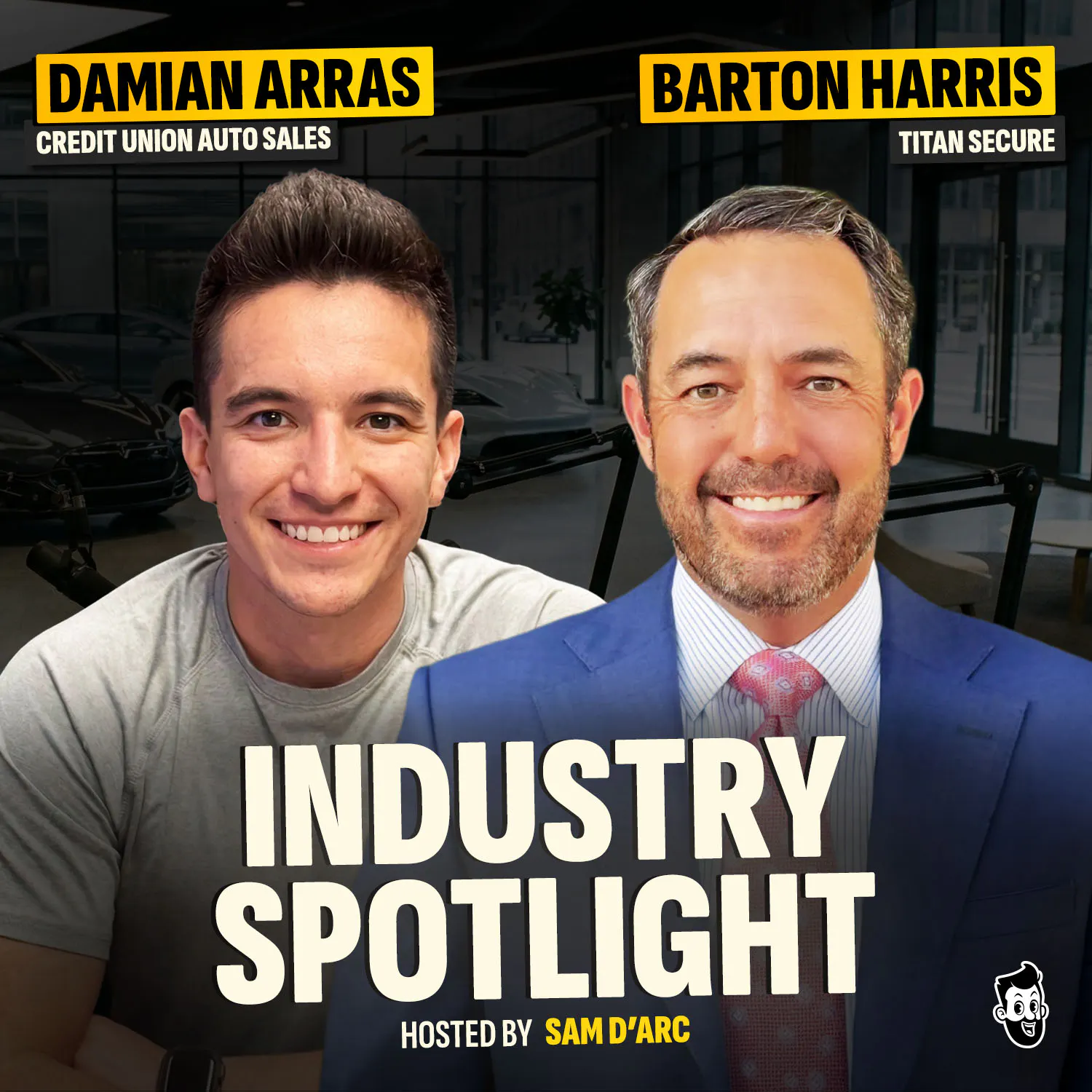
In this episode of the Industry Spotlight, joining host Sam D’Arc are Damian Arras, General Sales Manager at Credit Union Auto Sales, and Barton Harris, Chief Revenue Officer of Titan Secure, to discuss a South African-inspired prevention model that stops vehicle theft before a car ever crosses the curb.
Damien shares how his New Mexico dealership eliminated losses by shifting from reactive GPS tracking to proactive ignition and fuel-cut technology.
Barton explains how this "prevention-first" approach secures inventory in high-crime areas while creating a significant F&I revenue stream with a 90% plus customer penetration rate.
The conversation also highlights how "bait car" technology is helping local law enforcement catch repeat offenders without the danger of high-speed chases.
Have questions about Titan Secure? Reach out to Barton Harris directly:
Cell: 480.392.6620
Email: [email protected]
This episode of the Car Dealership Guy Podcast is brought to you by Titan Secure.
Titan Secure - Titan Secure is a multi-layered vehicle theft prevention system built specifically for automotive retailers. Dealers protect their inventory, gain real-time inventory intelligence, and implement a reinsurance-friendly profit center that goes far beyond traditional GPS recovery solutions. Learn more @ https://carguymedia.com/3PsN5Ju.
Check out Car Dealership Guy’s stuff:
For dealers:
CDG Circles ➤ https://cdgcircles.com/
Industry job board ➤ http://jobs.dealershipguy.com
Dealership recruiting ➤ http://www.cdgrecruiting.com
Fix your dealership’s social media ➤ http://www.trynomad.co
Request to be a podcast guest ➤ http://www.cdgguest.com
For industry vendors:
Advertise with Car Dealership Guy ➤ http://www.cdgpartner.com
Industry job board ➤ http://jobs.dealershipguy.com
Request to be a podcast guest ➤ http://www.cdgguest.com
Topics:
03:25 Why A 2:00 AM GPS Alert Is Completely Useless.
05:00 The Judge Who Praised A Thief For Logging Into Zoom.
07:35 When Your Inventory Becomes Uninsurable.
09:45 Why One Dealer Refuses To Play Vigilante.
13:45 The $0 Fix That Ends Dead Inventory Loss.
16:20 The Insurance Lie Every Dealer Believes.
18:55 Why Car Companies Might Want Theft To Happen.
35:00 The Two-Minute Blackout That Terrified A Dealer.
39:25 The Ride-Along That Exposed Auto Theft's Dark Secret.
Car Dealership Guy Socials:
X ➤ x.com/GuyDealership
Instagram ➤ instagram.com/cardealershipguy/
TikTok ➤ tiktok.com/@guydealership
LinkedIn ➤ linkedin.com/company/cardealershipguy
Threads ➤ threads.net/@cardealershipguy
Facebook ➤ facebook.com/profile.php?id=100077402857683
Everything else ➤ dealershipguy.com
Hosts & Guests
Transcript
Hey, everybody. Welcome to another episode of the car dealership guy industry spotlight. I'm your host,
Sam Darken coming up this episode. Learn how one dealer frustrated with ramp and auto theft
implemented a South African solution in New Mexico, not just to deter theft, but prevent it.
Learn why he says dealers today might be focused on the wrong theft solution. Don't track that stolen
vehicles that leave the lot, prevent it from ever crossing the curb. Plus how that dealership is
helping local law enforcement catch bad actors in the process joining the show today.
Damian Aras General Sales Manager Credit Union Auto Sales and Barton Harris Chief Revenue Officer
Titan Secure props to Titan Secure for supporting today's content. Let's get into it.
Damian welcome to the show. Tell us who you are and what you do. Hi, my name is Damian Aras. I'm
the GSM here at CU Auto Sales. So I do a little bit of everything at the store. I love the name. So
you're an independent auto dealership and you're in New Mexico and the dealership is called Credit
Union Auto Sales. For us auto dealers to get beat up by credit unions every now and again tell us
how did you come up with the name Credit Union Auto Sales. I love it. So back in the 90s when we
first started back in 1994. So we've been around for 31 years now. Long time. The credit unions
got together. They wanted a place that they could send their members where everybody gets a good deal
where the buying process is relatively easy from start to finish for most customers. It's about an
hour or so. I want to decide yes, this is the vehicle I want. As far as the name goes, we got
together with the previous owner. He got together with the credit unions and the marketing team.
They made CU Auto Sales which stands for the Credit Union Auto Sales and then also at the time
they partnered with a new car side called Credit Union Auto Services and they would be the only broker
in New Mexico. So we broke our deals for years. Unfortunately, since COVID, that portion of it
has unfortunately just inventory issues and the market has changed. Yeah, what a creative
naming strategy for a use car dealership. I'm sure you guys capitalize well on that for a long time
and you continue to have success. You and I talked backstage. We both share a common challenge.
I'm excited for this episode for that reason. In New Mexico, in the area you are, theft is a
significant issue and you've been hit by it just as hard as we have it. Ziggler Auto Group,
tell us a little bit about the problem of theft. People stealing your vehicles.
Of course with new technology that comes with the thieves coming out with the latest and
greatest stuff to be able to steal vehicles. So that's the biggest thing here in Albuquerque.
The thieves of opportunity here are the biggest problem. So we don't have issues with, you know,
people that are looking for certain vehicles and they're taking them out and they're trying to
ship them out somewhere. Our biggest thing here is you have a thief of opportunity who's typically
on drugs. They'll break into a car. They'll steal a vehicle. They'll do drugs in it and then they
ditch them. Well, they typically do get, you know, found as far as that goes. So the GPS isn't too
major of an issue here. Especially because the drug is, you know, the drugs in the vehicle once a
smoke meth in it, you know, whatever it is. So it is a total loss at the end of the day. So our
big thing is to prevent it in the first place from happening because, you know, getting a notification
at 2 a.m. that, you know, one of my cars is driving off a lot. It doesn't do much. It doesn't do much.
So it's interesting. The other area where we share common challenges, it sounds like your area is
one of the top in the nation for theft. The Chicago land has also been that, particularly through COVID.
And you mentioned to me backstage, the cops don't really get that aggressive at going after these
vehicle thefts. What's the problem with that? Why can't you get the cops to go after the cars
once they're stolen? So the big thing, you know, I know that the cops would love to be able to
arrest these guys, you know, in Bookham and put them through due process where, you know, they do
get booked. They, you know, get thrown in jail for however amount of time it is, especially because the
amount of reoffenders that we have is pretty insane. So that's the big thing is, you know, we had a
vehicle that was stolen and it was a 2024 Chrysler 300. It had 2,000 miles on it. It was a very,
very nice vehicle. And unfortunately, it was stolen off a lot. Came in that morning and saw that it was
gone. So I went ahead and called the police put in the stolen report a few days later. I get a call
from, from, I think it was BCSO, actually, that they have the person. They went ahead and they
boxed them in. You know, they tried to escape. They, you know, hit the cars on both sides. So the car
was, you know, damaged significantly. There was drugs, you know, drug residue in the vehicle as well.
By the time, you know, we looked at it. And my big eye opener with our judicial system and how it
is very criminal friendly is, you know, I was on the Zoom meeting with, with the course system.
And, you know, the judge is talking to the person that stole the car. And this was her third stolen
vehicle. You know, so it's not, it's not something that was, you know, new for her. It wasn't her
first time. She just happened to, you know, steal a car. This is her third time. And the judge is
talking to her like she's a child. You know, and this is a grown woman and she's telling her,
oh, well, good job on being on time. And, you know, you're, you're going off to your pre-court
stuff. So that's great. And I'm thinking, this is just insane. Like, this is her third time stealing
a car. And you're praising her for being able to log in on her computer. So it's just, it was
baffling to me. You know, afterwards, I know the officer that was on the line, you know, he said,
it's just so frustrating that we, you know, do the work to get these guys to catch them. And
unfortunately, you know, they get let out the same day. And that's the biggest issue we have.
And we saw that a lot in the Chicago land as well. The issues of repeat offenders, even a
little bit of organized crime, but we had one instance during COVID where they, they took a safe
out of the dealership they broke into it, stole a bunch of keys. We actually surrounded the lot
with vans to prevent them from coming back and getting anything else. And with police on the
lot, bad guy comes back, tries to drive out with another vehicle, was prevented because we had
blockers. Bad guy in front of cops gets out of the vehicle and runs to another stolen vehicle
in the road and makes it get away. And, you know, nobody, no chase ensued. And it's frustrating,
Damon, because I think most people don't understand the true cost of this type of theft to the
average business owner. It's significant, especially a small business owner, even a large business
owner, your insurance rates, I would assume are impacted by what are some of the costs to the
business and the product that you offer to your consumer of theft, repeated theft over a period of
time. So as far as cost goes for repeated, repeated theft here, our biggest thing is, you know,
the insurance, of course, the premium skyrocket, you know, not only for ourselves, if a customer gets
a car stolen, the same thing goes with them. You know, but especially for dealership insurance,
in Albuquerque, we already pay very high insurance rates, because we are very high for car theft,
very concourse. So that was the big thing is that, you know, the insurance premiums kept skyrocketing
to a point where, you know, the last vehicle that we had stolen, we just, you know, ate the loss,
just because it was one of the things that we couldn't afford for the insurance to keep going up
and keep having claims and potentially get dropped for the amount that we have.
Your inventory could be uninsurable and then you're out of business. And I think every large
business owner in the automotive world has faced that reality that you've got to do something to
address this significant severe theft. And so you went out searching for a solution and you found
an unusual solution. Tell us, tell us what you did to try to resolve this issue of repeated theft.
You had five vehicles stolen in a short period of time and you said enough is enough.
Exactly. So what we used to do is we used to sell etch. So we would etch all the vehicles
in the event that the vehicle was stolen. They would go ahead and, you know, wait 30 days. And,
like I said, in New Mexico, typically the recoveries, you know, are going to be pretty quick because
there are thieves of opportunity just looking for a ride across town so they can do drugs in a car,
do some crime, and then ditch it. So the payout was never something that was a value, you know,
to the customers. In my opinion, the reinsure program for that, which is what we did, paid out
in five years. So, you know, the reinsurance was one of the things that, you know, took a while for us
to, you know, to get paid out on as well. So what we went out looking is I went ahead and, you know,
looked online and I saw low jack. I saw apex car RX. That's all these different, you know,
manufacturers. I looked into it and my biggest thing is is preventing the car from leaving my
lot in the first place, especially because the police don't respond typically to any kind of crimes
that aren't serious. So somebody's not getting, you know, robbed by a gun at gunpoint, you know,
something major, the police just aren't going to respond. They don't respond to car accidents
anymore, just because they're so busy with the high crime in abracurkey in general that they just
don't have time to do that. So in my opinion, it's a savior for me because I live, you know, five
minutes away from the store. And if I get a GPS notification that the vehicle is getting stolen,
you know, I'd probably too late. Exactly. And try to do a little bit. What are you going to do?
That's my style. Unfortunately, that's not the smart thing to do. So we needed a solution that
actually prevented anything from leaving the law in general. We looked into different kill switches.
You know, we looked into alarm systems, fiber alarms, different kind of stuff. And
Titan, the way that they work is just so unique that I do have access to my fleet.
So as far as test drive goes, as if my texts are taking out cars, you know, on test drives,
I can actually see how they're driving the vehicles. It gives me a diagnostic report as well of,
you know, their driving capabilities. So, you know, as far as it goes, the package was much better for us.
So Damien, enter Barton Harris, chief revenue officer, Titan Secure. Barton, Damien calls
you up and says, look, we're in one of the highest crime areas in the country. Vehicles are being
stolen and they're the bad people are engaging in criminal acts in the vehicles. We don't care
about getting notification once the vehicle's stolen. We want to solve this problem before
ever leaves the lot. And you said we can help with that. What made you think different about theft
prevention, not just GPS, but preventing it before it ever starts. And how did you achieve that
Barton? It's interesting, Sam. I've worked for three of the largest GPS providers and they really
do provide a great service. So this is this is not set up to to speak poorly about competitors
in our industry. But I have to be honest in in my history at GPS, I was morally conflicted,
morally conflicted because we didn't address the root cause of the issue. Our parent company is
the BIA group out of South Africa. Titan was not born in a think tank. So not a bunch of people
sit around going, hey, what can we do to go sell another product to car dealers who get up,
hit up five to ten times a week minimum for the next latest and greatest, right? Yeah, yeah.
We were victims in South Africa of car jackings and auto theft. And just to be clear,
Damien might think that Albuquerque and pueblo, Colorado and Chicago land hold the trophy for auto
theft. You're not even not so, not so South Africa is the number one most volatile environment for auto theft
in the world hands down. And a lot of it has to do with corruption. They're they're using military
grade jamming equipment to steal cars and Toyota's wisdom because the taxi system or all CNS,
they love to go to go get a high lux, which is the equivalent of a of a Tacoma. And they can
strip the car down to the frame in three hours and all the parts are interchangeable, right?
So as a company, we were victims of theft and we own and operate 22 verticals and unrelated
industries. And so what they said is they said, we're not going to do this for this this recovery
stuff anymore. And in fact, in South Africa, you have to have two GPSs on your car qualify for
financial insurance before you take delivery. Wow. Okay. So we talk about preloads in the state,
everybody's going to have to preload a GPS. And they got to be two different ones in two different
locations. So we developed it internally. And it's solved our issues. And then all of the sudden the
word got out and people are like, well, wait a minute. If I don't have to worry about recovery,
I can just park my car. I'm interested in this. And we're proud to say in four years of business,
we've never had a vehicle stolen. We've never had a vehicle moved. That is a very powerful value
proposition to anybody. That's a huge problem. All this is a paradigm shift. I remember when I
started, when I left Berkshire Hathaway and went to work for a GPS company, everybody was still
talking about alarms. This is eight, nine, 10 years ago, right? Now we transition to where everybody
talks about GPS, but there's going to be a likely transition to a prevention model model. So
for Damien, it was a very simple and easy thing. What's the issue? I just need to walk my car
down. Okay, great. I've got that covered. I need a highly tangible unique product to sell to my
customers. I'm like, okay, well, I got that. And then the last thing, as I said, Damien operationally
speaking, how would you like for us to handle this? And he's like, well, what do you mean? I said,
well, we hire our own our own W2 fitment engineers. They're going to come out and put the systems in.
On the off chance, somebody doesn't buy it. We're going to remove it so you don't have a dead cost
drive off, right? If you have an identity theft situation, we're going to we're going to assume
liability for that. And we're going to assume liability for any stolen vehicle on your lot, right?
All right. So so so walk me through this. Damien has his lot. He's got vehicles parked out there.
And your claim is the bad actors can come on the lock and try to steal the vehicle and break into
the store. They can get the keys. They can have a key sitting in hand. And they're going to get in
the car. And in our world, the car driving off the lot triggers an alarm. And then we go into
action, right? Had a security like we have a whole process. We don't talk about it publicly,
but we have a process. You're saying the better thing is to make sure that vehicle never rolls off
the lot. How do you make sure that a bad actor with a key in hand and an intent to remove that
vehicle from your lot can't get it off the lot? It's all it's all the integration process,
right? So what we know to be true in the franchise world, we're even with independence or use
cars is there's a lot of replication, right? And so there can be some friction between a franchise
store and an OEM about making sure that a customer is registering with with the connected solution.
We're not selling the duplication. We sit on top of everything that the OEM is doing. We use factory
pins, relays, etc. And we pin this in directly to the car. We've even sourced all of the tape
that's used by the different manufacturers. So when we place this system in the car,
there's nothing that identifies that it's even there. And when they get in, there's no ignition.
And in the event that there was a car jack, a car jacking situation, we can remotely cut the
fuel to the vehicle. We throw a GPS in there because we want that customer, especially on the
use side to have those telematics features. But everything you see from my competitors,
geofences, speed alerts, trip history, all these things, we offer all that. That's already there.
But what we're saying is is just park your car, lock it up, and just come back to it. We would
much rather see someone have to replace a window than to go through the brain damage of working
with their insurance carrier. And as far as we could say about insurance, I'll let
people say, well, I got in great insurance insurance never makes you whole. They love your
premiums. They hate your payouts. So again, it was a paradigm shift built in a very volatile
environment, somewhere else, improving in the worst environment in the world to then bring
that solution here. There, there, there is an issue with that. We're, we're just trying to do
things differently. Sam, you should never have to recover a car. You should never have to
recover a car. It doesn't matter if you get the car back. I don't know what it costs you,
and I don't know what it costs your auto group for the recovery process, the labor time,
the brain damage, the headaches, why is this car here? That that we need to show up to a dealership
to sell cars. That's our number one deal. We need to sell part service and cars. So, so the
bad actor comes on the lot to a as a key in hand and attempts to initiate ignition and it just
won't start. No, I'm sorry. We've taken six hours to rewire the vehicle. Wow. And I'm not going to,
and I mean, you wouldn't go to a Michelin Star restaurant and ask for the recipe for the
Turtles too. But I can tell you our fitment engineers go through a very rigorous training process.
We have documentation library on how to put these systems in on over 300 cars. It doesn't matter.
We put them in rolls, rice, as we put them in for our ease, and we put them in just regular
domestics. The other great thing about this is, and the OEMs won't have meant to this, but we're
approved by T-Cote, which is the Toyota Council of Technology Excellence in South Africa, and
we're completely approved of VW. So, you got the OEM saying, you know, this is great and shame on
the OEMs for not having this, but that's, you know, that's another. Yeah, so I have a question,
Barton, if it works that well, and to be able to shut a vehicle down so it won't move,
why don't the OEMs just include a standard equipment on dealer lots? If that's just becoming
such a significant issue, that would be a great tool for OEMs to include. Yeah, I guess, I guess
he and I need to ask that question that $9 million. Here's the thing. I think anything that
rolls off of an assembly line. I think we don't give thieves enough credit
for their innovation. I think if thieves spent more time working on whatever craft interests them
besides crime, they'd be highly expensive. Yeah, yeah. Oh, of course. Yeah. So the bottom line is this,
I don't think the OEMs are what we'll do this. I think the OEMs work in a passive reactionary
sense. We're going to be in a proactive sense, and I also believe that manufacturers are fine if
their cars get stolen. They make a lot of money selling parts, and if cars isn't recovered,
they're happy to sell another vehicle. So it's nothing against them. I just think on a scale
of what they sell, we sell 15 million new cars and 30 or 35 million used cars in the United States.
I mean, it may never get there. You know, the difference is we've figured out we've figured out a
way to protect customers. And the bottom line is there may not be 100% adoption, but I can assure you
when I talk to people that have our system, it's the peace of mind. It's not the I need a
speed alert. It's a I just want to park my car and not worry about it. Yeah. So without giving
away the secret sauce, because I do get that bad actors, listen to the show, you don't want to
have them tell how it all works. But I assume there's some sort, is there a dashboard or something
on your end, Damien, where you can designate the times that you're closed or what what indicates
to the vehicle and to the system that you're closed and ready to go in business or you're
you're you're closed and you're you're the vehicle needs to go into a secure mode or it's daytime
and customers could be test driving and salespeople could be moving the vehicle. Yep. So they do have
a dashboard and it is one of the most intricate dashboards. It shows me location of the vehicle
is on the lot or location of the vehicles that are off the lot. And then we have a a geofence
around the property. So at well, we just changed it because of summer hours, but from eight o'clock
at night to seven o'clock in the morning, the vehicle is automatically locked. So they lock
ourselves. We don't have to worry about it. I don't have to lock them every night myself. It's
automated. And in the mornings, it's unlocked. So by the time my text get here, they can go ahead
and start cars with no issues whatsoever. Huh. Is is I want to ask this only because I've seen this
come up in other products. You're you're installing a device into the vehicle. Are there any
OEM implications where an OEM could come back and say, hey, this is going to void the
manufacturer warranty or hey, somebody's been playing with the vehicle. And so we're not going
to cover it the same way we normally would. What are the implications of that, Barton? Right. So
we know we know for certain that OBDs are or that GPS devices are installed through the OBD
it might be thrown on the posts on a on a battery or you know, if they're if they're if they're
getting crazy, they can cut into the factory wiring harness or use a t-tap system.
Yeah. We use pins and relays through the brain in the car. And then our system sits on that
and interacts with that to disengage the starter and the fuel pump when the vehicle is locked.
Okay. Okay. So there's nothing egregious that's that's that's done to the vehicle that would
raise any any issues at all. You're not cutting a wiring harness. No, absolutely. I'm not plugging
into the OBD port. The idea that the dealer would be responsible for for the fitment of this is
completely eliminated here because I know for my time in GPS the one car that we absolutely
needed to connect to we had connection issues. And we love our technicians, but they everybody has
a tendency to short short the install over time we have to go back and do corrections. So
hopefully that's right. Our fitment engineers stay at Damien's dealership from from
Bell to Bell six days a week. They manage all of the batteries because it doesn't matter what
reports or data we provide to the dealer. They get enough reports and data from everybody.
So we handle all of that. We're starting the cars. If they're not busy, Damien has effectively
picked up a W2 to employ from Titan secure at no cost to him. And if we can be very clear on this
we do this on consignment. So this is a Pego model. So use all of our items. So any of the
inventory lot management features that you see from any of our competitors in the GPS world.
We're going to do all the exact same thing. The big deal for us is you can either open our app
as a manager at the end of the night and hit one button and everything shut down in case we catch
a late deal. And then as you come in, it auto unlocks. And what the what the sales guy doesn't have
to do is he doesn't have to interact with the system to disrupt a sale. And the other part of that
is the sales guy never has to worry about a debt battery when it goes to car. So and I think what
we find with dealers is they've never had visibility. Then they blame the GPS for the low batteries.
No, you just never had visibility in your cars. So we just we just manage all that from from
the start and every day. How long from a timing perspective does it take the installer to install
the unit on the vehicle? Yeah, 45 minutes to an hour. Okay. Okay. It's that it's that intricate.
And when I mean intricate, we we have protocols and things in place that have to be met before we
sign off on this. The system has to perform perfectly in order for it to work and protect
the dealer and the dealer's most important folks, his customers. He's the he's the one on
the front lines talking to the customers. I'm not, right? Yeah. So we have to have something that
performs as advertised or we have no credibility. So, Damien, do you put this on all units? Do you
put it on high value inventory? How do you decide which vehicles get this? So all of my vehicles get
it. So everything that we're going to be keeping, that we're going to be retelling, it gets put on.
The great thing is that it's on consignment. So at the end of the day, it doesn't cost me anything
out of pocket up from. However, we have a, you know, I mean, right now we're at about 95% close rate
on it. Customers really see the value in it and what it really does for them. And the peace of
mind alone is huge because, you know, when I'm one of those guys out in the middle of the night, I'll
wake up and I'll be like, oh, did I lock my truck? And then I'll go and I'll make sure, you know,
that it's locked. And just because in New Mexico, it's notorious thing for car theft. And it
doesn't matter where you're at. You know, the nicer parts of town, of course, these are going to
get the nicer vehicles. So that's what they're going to, you know, try to go for. Yeah, that is it.
So I'm just thinking this through use car pricing is so competitive right now. You're an
independent. So, you know, a franchise dealer would say, hey, you're a little bit of a disadvantage
in use car acquisition on our other show daily dealer. We'd ask you all about your acquisition
model and where you get your best trade ins and whatnot. But we know it's a competitive marketplace.
So I'm not going to ask on this show pricing because Barton will get those questions outside of
this. But I'm going to make the assumption that if you're putting it on every single vehicle,
you've got to be able to charge enough for the upsell in the finance office and at that penetration
where it's got to be a decent F and I revenue generator. What does the close rate look like?
What is the pitch in the finance office look like that gets customers to see the value in the
product? Oh, yeah, definitely. So as far as the reserve goes, we're at about a $340 reserve on
the unit. It is a portfolio program or a reinsured program as well. We use portfolio for warranties,
for example. However, it's in the year. So it's much better as far as any program out there,
in my opinion, one of the best. And as far as the value goes, we close 95% of them.
So what we explain to customers is everybody knows somebody in Africa has had a vehicle stolen
or they've had one themselves. I can't tell you the amount of customers I have that come in
after getting vehicle stolen and the biggest thing they found them, but they've been
destroyed essentially. It's done. Yeah, yeah, you're done at that point.
Yeah, I think one thing we wanted to touch on, if that's so we set up a reinsurance program
on this. The actual data that we receive for the state of New Mexico is a 0.4% loss ratio with
a car that has GPS on it. So we partnered with Synergy Warranty Services to set this the reinsurance
program up. Why this was interesting to Damien is one of the things that I asked him about reinsurance,
I go, what tell me about your edge program? He was reserving $125 with a five year urn out.
I said, Damien, we're going to put a $25,000 that benefit. Now I can go all the way to 50,
but 25,000 is good. By the way, if we ever lose a car, I'm going to cover half of the first claim.
So I'm on the hook for 12, 5. I'm not afraid of my price. It's fine. My device hits the car at
$3.99 install. That's it. It's $399. But what we have to remember is, Damien doesn't pay for
the system if it's not sold. We're going to take it off the car. That's what we're going to do.
We're going to take it off the car. If it's a dealer trade, we're going to remove it off the car.
And you eat the expense of the installs from the uninstallable. Yeah. And so what Damien does,
what they do at this point is, is they take $340 and they send that to their reinsurance account.
Now I know that you work for Zurich for a long period. I did. Yeah. 17-year history. So Edges
So here's the difference between the two. This is why it works for Damien. It is difficult
to maintain a good position with reinsurance on service contracts when you don't have a
blend of new cars. Okay. That's fair to say. Damien in his owner reserved $340 on a hard ad
non-cancellable product that terms in 12 months. So that means moving from the A to the B account
in 12 months and not waiting for 60 months to do this. So effectively, what we've tried to do
is this. Save them on it. Save money on insurance premiums by assuming theft and identity theft
losses directly here at Titan. Provide a tangible product. It's a car of $399. Damien sells it for
$799.899. Customers are happy to pay that, right? So that's what we're trying to do is we're
trying to say, listen, let's get you out of your reinsurance position as quickly as possible.
Let's do it with a hard ad because we don't have cancellations. Let's take care of your
inventory and save you some money on your on your insurance. And let's have a product that really
does what it says for your customers and your guests. So on the upgrade, the extended contract
in the finance office, when you sell through to the client, you said it's a 12-month
turnout on the reserves. So is it a one-year contract or is it a longer transaction? It's a one-year
and then they upgrade then they upgrade directly with you after that. They could upgrade they
well, so they can upgrade through the dealer through the dealer for another couple of years,
if they want to, that's fine. But for all intents and purposes, what the dealer needs to understand
is your obligation to this is 12 months. So if you're re-insuring with a GPS provider and you're
selling three, five, six-year terms, that is your turnout period. Talk to no more than a dozen
dealers. I told them I was a consultant, Sam, I ain't telling what I did for a living. And I just
asked them what they want. And my question to dealers is, when was the last time I've entered,
just came in and said, hey, what you want? Because that's what I did with Damien. Hey, Damien,
I'm glad to be here. What do you want to see? What do you want to see in a dashboard? What do
what changes do we need to make? What's important to use so that this becomes an operational efficiency
tool so that you can manage your floor plan, manage your inventory, and make sure that we're selling
the right cars at the right time. And what other areas can we can we shore up for you financially?
That makes it advantageous to do business with you because it seems like every vendor just walks in
and says, you know, if you buy my stuff, I'm going to make another 15%. And you go to NADA and
the big laugh for me is, if you buy everything at NADA, your business is going to be up 5 million
percent, but you're going to be broke in 90 days. Yeah, that's right. So for us and for Damien,
the only thing that mattered was what problems do you have? Let's fix those. And let's have a good
partnership instead of a vendor dealer relationship. And I think that that's important for anybody
that's operating in store. So Damien's at a 90% pen on the upside. I already know his number.
He just doesn't want to brag. Okay, so 90 plus percent, if he got to 50% on the cell through,
you would have to rethink it, right? Because economically, it wouldn't make sense for you to install
all those units. I would imagine. Yeah, you're 100% right. We would be at a whopping $100 to
remove it and he would charge it to the car. Yeah. Okay. So you've got a structure if the
if the penetration falls below, but theft is such a big issue in your market. It's an easy,
it's an easy claim. How many vehicles nationwide? Do you have any stats that show how many
vehicles nationwide you're protecting Barton right now with this technology or similar technology?
How many units maybe even in internationally? Yeah, I think globally we're somewhere between 30 and
35,000. Wow. So Sam, the thing is, is we we have intentionally moved at a very slow pace,
right? As a CRO, I can tell you, and that's a cool title, but as the guy that's as a guy that's
running sales right now, Sam, I am not going to measure and we are not going to measure our
success as a business based on rooftop count. That is very contrary to every other businesses out
there. How many? How many rooftops you got? I don't care. We don't care if we have 500 or a
thousand rooftops. The level of success for us is how successful is the dealer? How successful
is the dealer financially? Are we being impactful for them operationally? Are we are we doing
things that help the dealer? Okay, once we've solved that dealer's issue, then we're going,
then we can move to the next dealer. And I think a great metric is vehicles protected. So 30,
40,000, that's a significant number globally. And you know, maybe the other metric is the
the the provable that I always go to our team and say, Hey, how many thefts have we prevented
using technology? And I'm always told, well, you can't prove the negative, right? Because we
don't know the the deals that have been prevented because they've been prevented. So Damien,
this is the interesting question since you implemented this, how many vehicles have you had driven
off the lot or stolen? Zero. Absolutely zero. And you know, that's the big thing is that I actually
came in one morning and you know, looking around at the law and one of the cars we left the the hatch
open. And like I said, we're in Albuquerque. So it's one of those things that I'm like, well, you
know, something that was missed, but at the end of the day, I know that that car is not going to go
anywhere. So that's the biggest thing. And if somebody starts messing with it, you know, I get
notifications on the vehicles, you know, that something's being, you know, tampered with, I could
check the cameras, if my motion alerts didn't go off for some reason too. And that's the other
thing is, you know, the thieves technology now is just huge. The last vehicle that we had stolen
off the lot, they actually must have had some kind of jammer for our camera system because there
is a period of two minutes where the cameras just went back. And that's the time that they were pulling
into the lot once they crashed through one of the gates. And then they were, you know, out of the
out of the lot already. By the time, you know, we looked, I mean, you couldn't even tell what they
did. And in two minutes, they were gone. So as vehicles become more and more expensive and they
certainly are as technology in the vehicles becomes more attractive to thieves and bad actors.
Barton, don't what is the future of auto theft look like? It's only going to get worse. A lot of
people thought, hey, during code, that was kind of the peak and we'll go back to some sort of a
norm. But we haven't seen that yet, not only physical theft, but also identity theft and fraud,
income fraud, and other things that just contribute to the theft part. And what is the future of theft
look like as we wrap up today? I think the future of theft is that the thieves are going to become
increasingly more efficient. I think that the thieves will go and rent high end cards that they
target to try and take them apart to figure out how to bypass the system. I think that thieves
unless there's some sort of a pivot as to where GPS is installed are going to be able to easily
identify that. I think dealers that are installing GPS, thank goodness you're doing something,
but I think there's inside jobs, especially when there's big exposure, big stores. I think the idea
of taking that out of the dealer's hands so that nobody knows what's going on is big. And I feel
like whether it's the FTC or it's our government or manufacturers trying to circumvent our franchise
laws, I think that the dealers are really under attack right now. And I do believe that theft is the
most disruptive portion in a dealership along with unlines and identity theft issues. And so all three
of those can be short up simple and easy on the side. I don't see it going away. And when the
economy turns and things get rougher, people get more desperate. The one thing that I can say a
tightness, we have never had a vehicle stolen. We have never had a big claim. It's a big claim,
but it is exactly what has happened. So that's that to us is the most and people say the same
thing, Sam, it's so funny. So at two o'clock in the morning, when somebody gets in my car and
starts it, I'm like, hey, listen, man, it's pretty simple. Serial is like something out of a box
and some milk, right? You just eat it. Here's the here's a secret sauce. When you leave the car
and you arm the Titan system, there's nothing that's going to happen unless you're going to give
them six to eight hours to wrench on your car. And just so we're clear, we're monitoring every car
on our side in dealer inventory 24 seven. And that's my guys over in South Africa. There are plus
nine. I'm in Arizona. So that's a plus nine. So when they man's asleep, it's the middle of the day
in South Africa. Yeah. So that's that's how the system set up for us. It really kind of makes it
less theft deterrent, which a lot of systems have been and complete theft prevention. You mentioned
manufacturer systems. You know, I do think the bad actors are doing that. They're studying the
the manufacturer systems, whether it's a BMW headline or wherever that exists. And that's usually
the first thing they pull out. That's why we've heard advice. You've got to have at least two
different systems, right? And and and and and that's cool. South Africa born and delivered here
into the US by in in installers. So you know, it's interesting. And I've noticed this in my own
world, Damon, you probably have to it's easy to bag on the cops because they're the ones that are
like, Hey, why aren't they going after the bad guys? It's not so much them. It's a political issue.
It relates back to the court system and politics. And I'll tell you what we found is a great
strategy. It's to align with them. Our own head of security used to be one police chief and give
them additional tools to go after these bad actors. Barton, is there anything you're doing in your
world? They're a titan secure to help police go after and pursue these bad actors.
So yes, as we we came into the Albuquerque market, we were introduced to Sheriff John Allen
in his auto theft task force for Burleo County. It's interesting. The Burleo County sheriffs are
very revered and unfortunately the APD folks are are not. So it's it's just it is what it is.
We we designed a method a method here to help the police. So I went to Damien,
asked him to find me a car about a 2016 Hyundai Sonata. We donated it to the to the Sheriff's
Department. Prior to that I went on an eight hour ride along with the Burleo County Sheriff's
Department. That was great. We had nine arrests. We covered cars and 150 fentanyl pills and seven
and a half hours. Yeah, let me go through that again. Nine arrests, two recovered cars, 150 fentanyl
pills in seven hours and 30 minutes on the street. So we buy the car. We put the titan system in.
We built an app for law enforcement. So what does that look like? They put the bait car out.
We allow the car to be started when the vehicle starts the task force and they put it out the
same two days for the same amount of time every every week. Okay. They simply get behind the
the vehicle. They press a button. There's no high-speed chases here. There's no no high-speed
chases. There's no danger to law enforcement. There's no danger to the community. We've we've had
over 45 46 arrests including a homicide offender and we now work directly with the United States
Marshall Service because they require anti theft not recovery and we feel very proud about that
because we feel like we're making a difference in a in a community where we're making a profit.
Yeah, you know, it's an interesting point. You know, at the point of vehicle it can be driven.
It turns into a potential weapon, high-speed chase, ramming, bad acts, all sorts of things by
preventing that in the first place. It basically just exposes the bad actors and props to you guys
for engaging with law enforcement, giving them the additional tools to help them to do that.
And that's incredible leadership and automotive, I'd say. The last thing I would say is a takeaway
when meeting with John Allen and his deputies and sergeants and lieutenant says, the saddest
thing about auto theft is it's the funding mechanism for all of the other ancillary crimes that affect
all of us directly. What I mean by that is not the person who's car got stolen, sex trafficking,
drug trafficking, extortion, gun running, human trafficking, the funding mechanism is the auto theft.
So if we don't get out ahead of it and try and eradicate it and we never will eradicate all of it,
maybe, but we're still going to continue to face the same issues like large cities. And it's
just really sad. And the other part of it is a lot of these younger kids get baited into stealing a
car and they go into juvenile as children and they come out as criminals and they never recover
and they never get out of the system. And so thanks for the leadership and engaging with law
enforcement to help give them the tools to help kind of limit or restrict or even stop that cycle
to begin with. Barton Harris chief revenue officer, Titan Secure, Damian RS General Sales Manager,
CU Auto Sales, Credit Union Auto Sales. Yep. Thank you so much for being on the show today.
Damian and sharing this success that you've had in helping to not only prevent theft at your
dealership, high crime area, but also lean into the revenue opportunity that exists in helping
the customers protect themselves as well. Thank you both for being on today.


