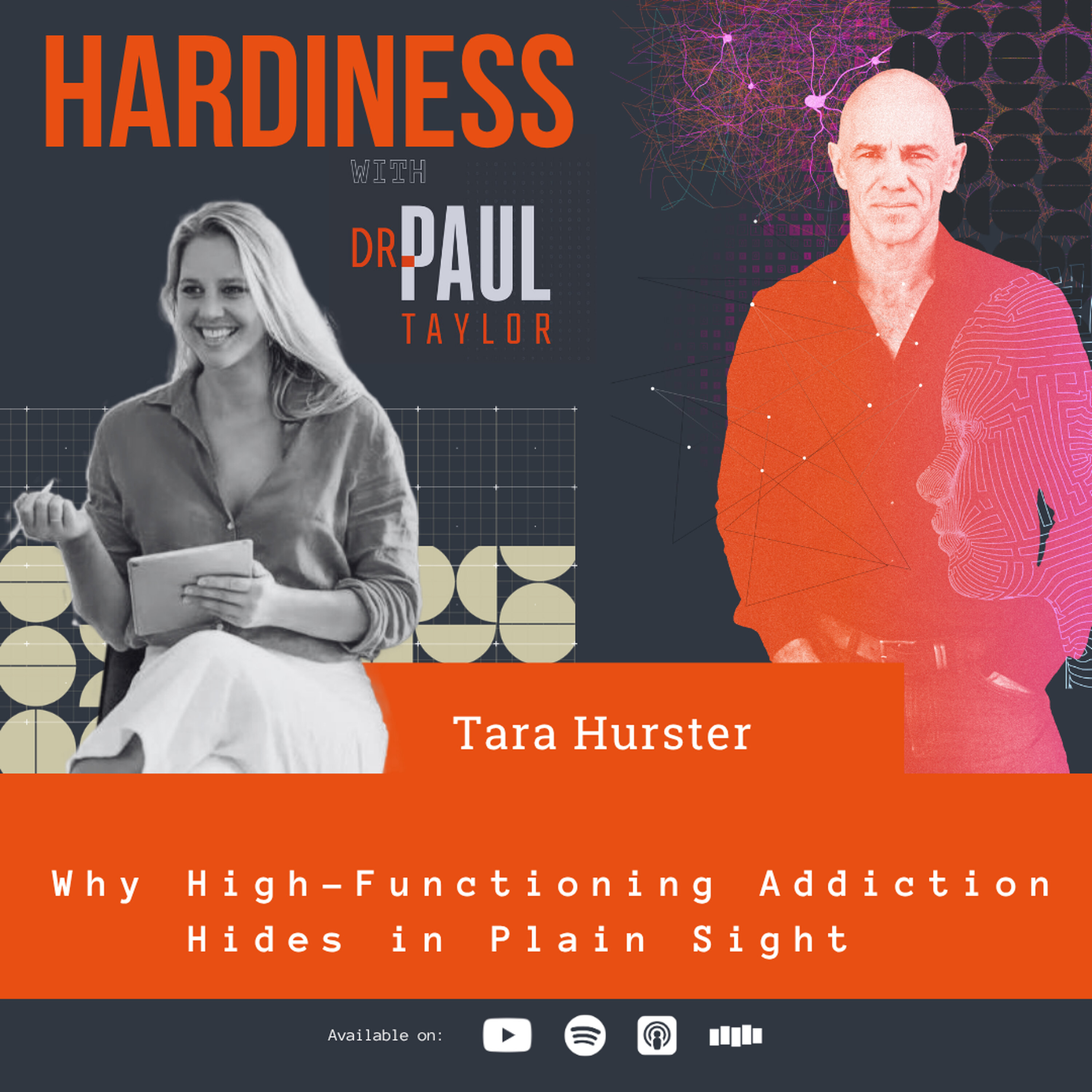
The science of behaviour change and addiction, with Tara Hurster
About this episode
Most addiction advice is built for rock bottom. Tara Hurster says that misses the vast majority of people - the high-functioning drinkers, gamblers, and users who still have jobs, houses, and families, but know something is off. If you’ve ever wondered where “just a bit too much” becomes a real problem, this conversation gives you a clearer answer than shame ever could. Paul speaks with Tara Hurster, psychologist and founder of The TARA Clinic, about the low-to-high risk continuum of addiction, the 12 DSM criteria, and why “stopping” is not the same as changing. . Her approach is practical, non-judgmental, and built around helping people make real choices with real tools - not just white-knuckle their way through. Tara breaks down how tolerance, repeated failed attempts to cut down, negative consequences, and defensiveness can all signal a deeper issue, even when life still looks functional from the outside.
You’ll discover:
- Why addiction can be invisible in high performers and professionals
- How the stages of change model explains denial, preparation, action, and maintenance
- The “stop you swap” trap and why focusing only on abstinence creates a void
- Why relapse is better understood as recycling, and relapse as a lesson
- How identity, values, and stress management drive the behaviours people keep repeating
Time Stamps
01:15 - Risk continuum and the question of where addiction begins
02:12 - The clearest signs: tolerance, failed attempts, and consequences
03:28 - Why questioning a behavior is already a signal worth taking seriously
04:23 - Stages of change and why defensiveness matters
05:34 - Why stopping is not the same as changing
06:32 - “If you stop, you swap” and finding the driver behind the behavior
08:34 - The myth that addiction only looks like rock bottom
09:49 - Only two DSM criteria are needed over 12 months
10:54 - Tara reads the DSM style addiction criteria in plain English
13:25 - Why The Tara Clinic uses the criteria as education, not self diagnosis
14:07 - Why Tara does not align with the 12 step model
15:29 - Tara’s personal story: bullying, tallness, and smoking in year six
17:02 - Why stopping smoking can coincide with a change stage, not just willpower
18:02 - Recovery as a long term redefinition of stress and distress
19:19 - How addiction looks from the outside versus the inside
20:56 - Minimizing the problem and the brain’s self protection mechanisms
21:27 - The brain’s threat response and why stress drives habitual behavior
24:41 - Being the expert in your own life and using lifestyle as a mirror
25:33 - Hello Sunday Morning and the power of noticing hangover regret
26:25 - Tara’s non prescriptive approach: helping clients see their own choices
27:06 - Why smart people often struggle more with change
28:22 - How education works in pre-contemplation without shame
29:25 - Why shame and guilt can push people backwards
30:21 - The survival wiring behind addictive behavior
31:50 - Early stage support and why community matters
32:35 - Preparation stage and why The Tara Clinic starts there
33:22 - The danger of stopping before change has actually happened
34:16 - Dry drunk thinking and the limits of willpower
35:47 - Real change means new routines, people, and environments
36:11 - Why lapse and relapse are reframed as lesson and recycling
37:35 - Can moderation work after addiction? Tara’s non absolute answer
38:14 - Choice, agency, and not becoming another external force
39:23 - Different substances and how the method of use changes the effect
42:22 - Why ice is the hardest substance to manage socially
43:26 - Ice detox, brain recovery, and the physical versus neurological timeline
45:23 - The recurring “wobbles” in recovery from ice use
47:32 - Why early recovery for ice effectively starts after a much longer practice period
48:43 - Common drivers: pressure, stress, identity, and relief
50:16 - Why Tara avoids labels and focuses on language, thought, and identity
53:57 - Values work and why goals and values are not the same thing
55:25 - Tara’s core values: justice, nonconformity, and safety
56:26 - Why value incongruence creates major stress in work and life
57:52 - Questions to ask yourself: have I questioned this, and what happens if I pause it?
59:37 - Reality pants, judgment pants, and honest behavior tracking
60:04 - How to track patterns in drinking and spot triggers
61:37 - Using patterns to find gaps in knowledge, skills, and awareness
62:32 - Where to go next: The Tara Clinic, Smart Recovery, and the ADIS phone line
Resources
Website - https://www.thetaraclinic.com/
LinkedIn - https://www.linkedin.com/in/tarahurster/
Instagram - https://www.instagram.com/thetaraclinic/
Facebook - https://www.facebook.com/thetaraclinic
SMART Recovery – https://smartrecoveryaustralia.com.au/
ADIS phone line: 1800 250 015 available 24/7
The National Alcohol & Other Drug Hotline is a free and confidential phone service that provides counselling, advice, and information for those struggling with addiction. Call 1800 250 015.
Support the Podcast
If you found this conversation valuable, consider subscribing and leaving a review on your preferred podcast platform. Your feedback helps us continue to bring you insightful discussions on important health topics.
See omnystudio.com/listener for privacy information.
Get every episode summarized
Each time Hardiness with Dr Paul Taylor publishes, we email you a written briefing from the transcript — the topics, who appeared, and any specific claims, with the ad reads skipped.
Email me new episodesFree for 3 shows. No card needed.
Hosts & guests
Transcript ready
570 searchable segments. Every word is indexed and playable.
Full transcript
Hardiness with Dr Paul Taylor — The science of behaviour change and addiction, with Tara Hurster. Machine-transcribed; use the interactive transcript above to jump the player to any line.
Tara Hurster. Welcome to the podcast. Thank you for having me. It's great to be here. Yes, great to have you on. We actually met only about, she's was only about a week ago, wasn't it? That's right. That's right. Down in the moment. Yeah. Yes. And we have around here. No, it is exactly. And I was speaking to the conference and we had a quick chat afterwards. And I'm like, I need to get you on my podcast. Because I want to talk about your clinic. So you are Tara Hurster. You've got the Tara clinic, which stands for therapeutic addiction recovery assistance. Hey, when you got that new monic, did she go, yes. Yes. Yes. I was I was driving along the M4 and it just hit me in my face. I just thought, oh my gosh, therapeutic addiction recovery are the first three letters of my name.
And it was never going to be Australia only. So I needed to find a second A. And there you go. Assistance. Assistance. Yeah. Very cool. It's nice when you get it. And then you look online. You go, is anybody got it? Is anybody got it? Exactly. Exactly. Tara.com was already taken. So that's why it's the Tara clinic. Right. Gotcha. So you are a psychologist who clearly works in addiction. And there's a really nice model on your website, which is the Tara clinic.com, which shows the, I guess, the risk continuum that goes from low to moderate to high and in a cute risk and critical. And you're in this sort of low risk to the middle of high risk, right? Which is, I think a lot of people will relate to. I know a number of high functioning alcoholics and and high functioning addicts. And I think there's a lot of people and maybe I was flushing with that
at some stages in my life as well. So what is the line between just a bit of over and does a bit of just, you know, giving it too much of a nudge as we used to say in the on forces? What's the line between that and an addiction? It is the most common question that I'm asked. And it's actually a very low threshold. But basically the way that I look at it is if you have been using or acting out, so doing gambling or porn or whatever it happens to be, in such a way that you are needing to do it more to get the same amount of a buzz or doing it the same amount of time or the same amount isn't giving you the same buzz than that's one of those criteria. So you developing tolerance, basically? That's exactly right. Yes. Yes. Another criteria is if you have had multiple attempts to either stop or cut down that have been unsuccessful. Another
criteria is if you have been injured or there have been some negative consequences as a result of this use or acting out and that you keep going even with these negative consequences being present and you being aware of those negative consequences. There's a lot of different things. So basically if you have questioned whether or not it could be an issue, chances are it's probably an issue and it doesn't mean that addiction is right, you've got this for the rest of your life. It just means that we have identified that there is a gap in our skills and awareness that can be filled with the right skills and tools and when you practice the implementation of that over time, that's what builds mastery. And so up until this point, you've become a master at this coping strategy. Yes. And so what we do at the tower clinic is we just teach you over 160 different
practical tools and strategies and techniques so that you have alternative ways of coping. Very cool. I would probably, I mean as you were talking about that, I thought maybe getting overly defensive when somebody is asking saying to you that we think this is a problem. I think that that is a really good indicator of where you are on the stages of change. Yes. Okay. This yeah, the stages of change model goes from pre-contemplation, contemplation preparation, action maintenance and at the tower clinic, we don't stop at maintenance. We believe that recovery is real. So if you're becoming defensive about something more than likely, you're in the pre-contemplation stage of change. And so in the pre-contemplation stage, that's where we either don't believe that there's a problem or we don't believe that there's a solution. So why would we bother trying? Yeah, I like that. Yeah. That's a nice little thing.
And I think the other thing for people, I like that the stages of change model is that maintenance can be a game of snakes and ladders. It's not like, yeah, I've been six months good. I'm all good. Right? You can go right back to pre-contemplation. You can go right down the ladder to contemplation and then you start again. It's really quite interesting, isn't it? It is very interesting. In the way that we look at it at the tower clinic is it's important to understand there is a really big difference between stopping and changing because stopping something, so focusing on abstinence or quote unquote, clean time. I don't like those terms because that suggests that if you're not clean, you're dirty and that's just not a vibe for me. But if you focus on solely abstinence, when we are stopping a behavior and focusing on stopping, we're not actually
filling that space in our mind or our skills or anything with anything that's actually valuable. We're just creating a void. And what happens with a void is it gets filled with other stuff. So if we are mindlessly stopping something and really focusing on the stopping, we can fill that void with other things. And that's why I always say if you stop, you swap. So instead of just stopping and swapping to, you know, from alcohol to weed or from work to gambling or whatever it happens to be, instead of doing that, let's focus on changing and the way that you focus on changing is identifying the driver behind the behavior. So what is actually the purpose that we were trying to achieve by using alcohol or drugs or gambling or whatever it is? Is it that I need to relax? Is it that I wanted some confidence? Is it that I'm bored? Maybe I'm tired. Maybe I'm
struggling financially and I was hoping to solve all of my problems with a quick win. Whatever the driver behind the behavior is, if you solve for that, the other stuff goes away on its own. And that's what true recovery is. Is redefining the nature of your relationship to stress and distress? Yeah, that's, no, that's very cool. Somebody once said, I can't remember where I read this about don't have dad man's goals. And I was like, that is friggin awesome. So dad man's goals is, I'm not gonna drink because dad people just can just don't do something. Yeah. Because it's more about the behavior change, right? Which is, yes, is really quite cool. And it's interesting. There's a lady Sarah Russbatch who's been on my podcast and she talks about gray area drinking, which I think will identify a lot of your clients, gray area drinkers, gray area weed smokers,
gray area, cocaine, where it's just like, yeah, I'm not an alcoholic, but there's probably a bit of a problem if you really look onto the hood, right? And this is the kind of area that you're in, moving into the, yeah, you do have addiction, but you're not at risk of your life. I'm guessing. Yes, the real frustration that I have been facing throughout my career, and I've been working in this industry for over 15 years now, the frustration that I have been facing is the narrative around addiction is so cataclysmically wrong. That so many people don't see the problem, because oh, well, hang on, I've still got a job. I still have a house. I have most or all of my teeth. I'm not sleeping on the street. And you know, I can read and speak and do all these things. There is
this narrative that is perpetuated by both media and cinema and all of these things that addiction is only present in low socioeconomic areas with low socioeconomic people who have completely hit rock bottom. And the stats show that more people are employed full time that have an addiction that are unemployed. Wow, wow, really? Yeah, yeah. And that's the thing is you only need two of the 12 criteria. I didn't read them all out. I can, I can grab the list and read all the criteria out if you want, but you really only need to meet two of those criteria over a 12 month period to technically be classified under an addiction. Wow, is this a DSM thing? Yes, yes, yes. Do you want me to read you the list? It's yeah, yeah, yeah, let's let's let's go through the list. But I think just
just before we go through the list, so you are psychologists, I think we didn't say that at the outset. Oh, yes, but you're also a pro academic in this area in that you do the all the academic research, but you've had personal experience, which we will get into in a second, but you read me out the 12 DSM criteria and the listeners will know you only need two out of 12, two out of 12. This seems like this seems to me like another DSM expanding of diagnosis. But anyway, let's go through that before we have that conversation. Absolutely. So this is very generalized. So it's specific to the DSM specifically talks about alcohol, opiates, different sort of drugs categories, and then gambling. However, you can use you can look at this as any behavior. Okay, so consuming or doing more of the substance or behavior for longer than was originally
intended, wanting to cut down or stop or have tried unsuccessfully to cut down or stop. So spending a lot of time thinking about seeking out using or coming down from a substance or behavior, experiencing cravings or a strong desire to use or act out, using or acting out is getting in the way of being able to fully engage in work, relationships, or daily duties, continuing to use or act out despite it negatively impacting on or causing problems for your social for you socially or personally. Imported social, occupational or recreational activities are given up or reduced due to using. Using or acting out is impacting on your physical safety or wellbeing, continuing to even when there are physical or psychological problems that were likely caused or exacerbated by using the substance or doing the behavior. So basically that's the
negative consequences one. Right. Noticing a tolerance to the substance or noticing that you feel the need for more of the substance or doing a higher risk taking behavior to get the same bounce or have the same amount doesn't impact you as much as before. And finally, experiencing withdrawals from the substance that you have used. Jumping Jesus, that puts about 90% of the population. That's our next. That is a very reductive way of looking at it because it comes along with so no one has a diagnosis of anything without a full review and assessment by a trained clinician in that area. So just because you've heard me say this over the podcast, it doesn't mean you can say, well, I've got this thing. I think it's it's a great way we use that in our recovery essentials
program, which is step two of our three step blueprint. We use that list there to make it really clear to people to see, oh, oh, so so there was actually problem. This is something that I can start to work on and I can understand in what areas of my life this has actually been impacting on. Yeah, because the first step in behavior change is acceptance that there is an issue to be tiered first and foremost, right? I wanted the first steps. Well, I guess that's the thing is the historical view on addiction and its treatment was really stemming from the 12 step program. And the tire clinic doesn't align with the 12 step program. That's an abstinence based model. That's not what we do. However, the steps within the 12 step framework have really been the underpinning of what created the narrative of what perpetuates the narrative. It's
a frustration of mine. It works for a lot of people and it has helped millions of people. However, one thing when I was first starting the tire clinic people used to ask me why you doing this differently? Why don't you just use the 12 step model? And I said, well, there's so many roads that lead into addiction. Why should there only be one road out? Yeah, I like it. And that's really why I see the benefit of having multiple ways out of a situation. And you know, in the military, you need to have a backup for your backup for your backup plan. Because no battle plan ever survives first contact with the enemy. Exactly. So if you've only got one plan. Let's get because I did mention you being a academic. Can you talk about your own personal story? Because I think it's important in this. Yeah, absolutely. So I love to tell people that addiction
doesn't always look like what you think it looks like. And addiction doesn't always come from trauma quote unquote. So if you want to look at my trauma, I was in year six and I was bullied for being really tall. And I heard that smoking stunts your growth. I was in Germany. You could easily put a coin into a machine on the street, press the button, out-cane packet of cigarettes. And I had seen the adults in my life and in my family smoke since I was a child. And I thought, hang on a minute, when they do it, they don't cough. I need to teach myself to do this so that I don't cough so that I can solve the problem, which was not being tall. So I started smoking when I was in year six because I heard it's done to do growth. And you're six. In your six. Jesus. Yes, yes, yes. And so I smoke and here's where it gets crazy because a lot of people go, oh, just hard
enough. You know, take a cup of concrete and sort you shit out and then you should be fine. And I used to be one of those people early in my psychology training because I stopped smoking in the middle of my HSC trial exams, which in Australia is the period that is the most stressful of a teenager's life. And if you think about, oh, hang on cigarettes help you to calm down. Why on earth would you stop smoking then? Well, when I went into working in the addiction space and I realized within three weeks that I was a total idiot and that I had completely misunderstood what addiction is and how recovery is a process. I realized that it just so happened that I stepped into the action stage of change in the middle of my HSC trials. And that's why it was so easy because it was so easy for me to move away from it. And sure, some of it was my personality, some of it was my natural gifts that I brought into being a psychologist. However, the truth is is that I can I can give blow by
blow indications with practical examples of when I was at different stages of change between when I was in year six to when I was in year 12. And then up into maintenance and then as I got out of maintenance. So I the reason that I know that recovery is a thing and it's not just maintenance is because I literally forgot that I was in recovery for almost 10 years. It was only two and a half years ago that I realized, hang on a second, I had an addiction, holy cow. And that's where you have fully redefined the nature of your relationship to stress and distress. I don't utilize addictive behaviors to cope with stress and distress because that's not how I cope with stress and distress. So there was no stopping because I didn't swap. It was change. It was true change. And I can go through every step of the way if you're interested. But yeah, that's that's my story. Right. So you
deal with a lot of high functioning professionals who are secretly struggling. Right? What's already used to what's already defined as gray area drinkers or gray area fill in the blank. Right? Yes. And so what does addiction look like when somebody who is kneeling at work and seems to have all their shit together on the surface? What does it look like underneath? It's different from the insider's view compared to the outsider's view from the outside, oftentimes. I talk about addiction kind of like farting is it's only the people that are really close to you that know that you do it. Awesome. Yeah. Yeah. So you know, you're unlikely to go around ripping one in front of your mates at the pub. I mean, unless that's your thing, it might be a thing. You were clearly never in the armed forces. No. When you rip it on their head, anyway,
until we won't go there. That's too much pink. It's not okay. But it's you know, you're not going to go into a first date with someone and and put it all out there, right? Yeah. So most of the time, it's it's very difficult for people to see it from the outside. It's those subtle things like things getting missed or maybe the little lies that you start to catch out. And there's the the real sort of questioning yourself of, am I crazy? Did they do that? Didn't they do that? Wait a second. I thought they said whatever, right? So there's there's a lot of that. But most of the time from the outside, it can actually look invisible. It looks like there's nothing wrong because again, people don't tend to drop their guts around the average person, right? However, for the person themselves, it could be things like more often than not, you're leaning on your one vice, right? Oh, I don't
do that. So it's really not that bad. I just do this thing like leave me alone, right? I've got all my my life together. I just have a drink every night. You know, I just have one or two. Minimizing is a really big part. And it is part of what the brain does to try and help you feel good about yourself. Our brain wants us to feel good about ourselves because when we feel good about ourselves, we're more likely to to to do more things, right? So the brain was developed, you know, millions of years ago. And you know, this guy here, it is so old that it doesn't understand what indial plumbing is, right? This brain of ours still thinks that we are being chased by tigers in a cave. And there's three main sections of the brain. The back part of the brain keeps us alive. The front part of the brain deals with all the higher order thinking and problem solving and the middle part of the brain is what our threat response is attached to. And the middle part of the brain is literally
physically attached to the back part of the brain. So that means that our threat response is connected to our survival. And so if we are feeling any form of discomfort, whether it's excitement discomfort, scared discomfort, sad, angry, it doesn't matter, any big feeling, whatever we have practiced the most comes easiest to us at times of stress. So if you notice that when you're feeling big feelings, that this is what you do or this is how you behave, then that's an indication of, oh, hang on a minute, my life is starting to narrow. I'm starting to feel restricted in my choices. It's interesting because I is to say to people I often do at talks that our brilliance of all worked out how to deal with stress, right? And for some people, may include it'll be like, I'll sort this shit out, just bring the alcohol, right? Other people,
it's food, other people, it's other drugs, whatever it may be. But the brain is pretty smart and it learns over time how to deal with the stress hormones. And normally it's through a head of dopamine or dopamine or allergic chemicals, right? Hence the alcohol, the drugs, the chocolate, the whatever, you know, fill in the blank. But it's basically about soothing stress and anxiety because, and that's why we go for these things, right? Because people don't take drugs or do alcohol, because it makes them feel shit. There may be that consequence tomorrow, but you know, you do it because of enjoyment. So the question then becomes, where does the enjoyment of whatever it is, whether it's alcohol, MDMA, cocaine, gambling, what is the enjoyment and become an issue? And I guess the answer is linked to those things that you talked about earlier on.
Yes, exactly. It's, I, so we're not saying here that, forget about the legalities, we're not saying you should never drink alcohol, never take cocaine, never take, but whatever it may be, never gamble, but we're not saying that. It's when that behavior becomes problematic, whenever it's affecting your relationships, it's affecting your work, it's affecting your life, it's affecting your mental health, it's affecting your, you're dropping the ball on other things. That's kind of what I'm getting where you think it's a problem. Yes. And the, the way that I view it is you are the expert in your life. I am only your guide. Yes. So if you yourself are looking at it going, well, hang on a minute, I actually don't like that I have hangovers every Sunday, right? That's, so Chris Reign, he created the Hello Sunday morning. It started. Yes. Yes. Yes. Yes. I think I interviewed him
years ago. Hello Sunday. Yeah. Yeah. Yeah. That wouldn't surprise me. Yes. Yes. So he, when, when we met many, many years ago for the first time, he was explaining to me how it all worked and he just felt, he just felt for himself that Sunday mornings really sucked because he always had a hangover. And he decided to, to, he was, I think he was a journalist at the time and he thought, you know what, I'm just going to see what happens and document what happens. If I just don't drink for a year and that was the blog of Hello Sunday morning. That's right. Yeah. And that then became the organization with Dave break up and all those things and he's gone on to do loads of different things in the addiction space around alcohol. It's, it's, it's really great. So that it's, it's when you are starting to look at how you feel within yourself, within your life and looking at your lifestyle. So your style of living does that facilitate your goals or does it actually hinder your
goals? Yeah. Is it helping you become the person you want to be or is it getting in the way? Yeah. Yeah. Exactly. Exactly. And so I'm never going to say to someone, right, this is what you should do. You should stop drinking. You should stop using. Instead, I help to place a mirror in front of the person. And that means that the person can look at themselves and go, hang on a minute. What am I gaining from this? What am I actually bringing into my life with these choices? What if I made different choices? What would I then bring into my life? And which one would I prefer? And it sounds really simple, but that's the thing is recovery isn't easy. It's simple. And the smarter we are as humans, I have found in my experience. And especially at the tire clinic is the smarter the client is the harder they find this process because they want, they expect there should be a
complicated process that they need to go through. But the truth is is that this brain of ours being millions of years old actually leans on simplistic processes more than anything. So A plus B really does equal C when it comes to addiction recovery. Yeah. And I think there's another thing is that a lot of people don't want to look in the mirror properly. Right. And so and and I would guess that you know, we're very good. You mentioned it earlier on. We are very, very good at justifying our own behavior. Right. And minimizing our flaws, particularly when it's stuff that you know deep down inside is a problem, but it's a hard problem. So we come up with all sorts of excuses that in your experience, how hard is it to get people to have a really honest look in the mirror and that honest conversation? And is there is there any techniques that you can to help people to actually
look properly? Yes. So there are there are specific techniques to help that. The answer to your first part of that question is it depends on what stage of change they're in. Yeah. Yeah. Because if someone is in the pre contemplation stage of change, they either don't think that there's a problem or they don't see that there's a solution. So why would I bother trying? What mirror? What mirror? There is no mirror. Exactly. Exactly. Just like the matrix. There is no spoon. So in that stage of change, the most effective thing is to provide people with education. Education in a non-judgmental way about what is actually happening. So it's not actually setting them down and going point finger pointing going you have a problem because that's often what can happen, right? So shaman guilt actually take you back into the pre contemplation stage
of change. Yeah. When no change occurs. So this idea of shaming someone or bringing about this sense of feeling guilty is actually detrimental to the change process. So no, the truth is here's here's the statement of the entire podcast, the addictive behavior works because it does. It is a mood altering substance or a mood altering behavior that fires off dopamine in the brain and dopamine is directly linked to survival. So when we were back in the UG days and we had say the tooth tiger is trying to kill us, when we would kill that tiger, not only were we safe, but we also got lunch, we survived and we helped our whole tribe thrive. So that is what we're dealing with. We are dealing with a hard, wired chemical construct that is directly linked to the concept of survival.
So that means that at that early, early stage of change, people truly believe and it is real in their brain that this thing keeps me alive. Even when I don't like it, even when I don't want it, if I don't have it, I could die. And that is a lot of distress for someone to carry. And so we want to provide education around safe ways of doing it, ways to start gently reducing things, options of treatment, options of other anxiety and stress management strategies, things like that. This is best provided within either an inpatient environment where there's a lot of wrap around support or within more of a community-based option. So things like it's unlikely that someone in the pre-contemplations stage of change will go to something that they're not forced to
go to. However, things like smart recovery is a really great place for someone in those early stages of change because they're in an environment with people around them that are all working towards the same goal of change. If you have someone who is in the contemplation stage, this is where they've realized that there is a bit of an issue, but we're not really ready to do anything about it yet. That is another place where we really want to be focusing on non-judgmental education on what is actually going on, safe ways of using and doing the behaviour, and then opportunities for treatment. Really just helping to expand someone's knowledge and awareness around the whole situation in the system. When we enter into preparation and at the tar clinic, we don't accept clients who are any earlier than the preparation stage of change. Yeah, I can see why.
Yeah, because the preparation stage of change is where we have acknowledged that there's an issue and we're exploring our options for change. So that means that we might, in that stage, we might try doing a rehab or seeing your doctor or talking to someone about it, we might go to smart recovery, we might call the ADIS phone lines, that's the alcohol and drug information service phone line. We might call the gamble, we're phone line, there might be some things like that, but then as you progress through, and I see these stages of change not linear, but more as a continuum, so as you progress through the preparation stage of change, that's where the behaviour starts to stop. And this is where the issue lies, is for clinicians or clients who are focused on stopping, they will cease treatment while they are still in the preparation stage of change.
When no actual change has occurred yet, but they have stopped. So stopping is- So, so, so, clarify that for me, no actual changes happen, but they have stopped. So how can you have stopped, but there's no actual change? What, no, clinging it. We haven't changed our relationship to stress and distress. We've just simply stopped the behaviour. So in the 12-step space, there's a saying called being a dry drunk, and the idea of being a dry drunk is you go to the same places with the same people doing the same things you just don't have a drink in your hand. And that is the hardest way to maintain recovery because you are solely focused on willpower. Yeah, and it's contrary, because as soon as you come into that place, there is that memory that is driving the dopamine, and dopamine is like, do it again, right? It's not the pleasure of the moment. It's the want to try and do it. Yeah. And so by the time people enter into maintenance and
then in recovery, they are absolutely able to spend time in those places with those people if they choose to. Yeah. But they've got the skills and the confidence in their implementation to be able to make a choice rather than feeling like a puppet on the strings. Yeah. And look, I think everybody can relate to that if they're trying to stop drinking or something like the worst thing you can do is go to the pop. Yeah. When you're just starting out, right? Absolutely. Well, even if you think about a changing lifestyle on the first of January, right? You go full-bore until, I don't know. And exactly. The savants of January. Yeah. Sorry, I said, it ends like down in Australia, but you know, you go through until there and then all of a sudden your willpower is gone. Nothing's really changed. You just haven't been eating this way or haven't been doing this thing for a while. And that's where you can see, ah, that's the difference between stopping and changing.
Changes where you have really built new aspects to your lifestyle, so your style of living. So being really conscious about who you choose to spend time with, what you do when you're spending that time and where you are in terms of your locations. But the interesting thing, and I'll just bring this up so that I can show you visually as well. In the way that we indicate the stages of change, there is a real change in color between the preparation and the action stage of change. And that's because this junction here is actually where you are at the highest risk for what's termed relapse at the tar. Snakes and others. Snakes and others. We don't use that term, so we call a lapse a lesson and we call a relapse recycling. I like it. I like it. I like the reframing of it. Yeah, that's cool. Yeah. Yeah. It's evidence, right? You run an experiment and it's like the karate teacher
who used to be in it, be you win or you learn. Yes, exactly. And that's why we don't count days of sobriety because if you've had 470 days of sobriety and then you drink and go back to day one, does that mean that the last year and a half has been a mess. Yeah. And in your model, can you move from addiction into using that substance, but using it in a way that is not massively maladaptive or is it just abstinence? Like, so let's take me ex-military, Irish, like a tipple. And after the conversation with Sarah Rushbath realized, oh, it's definitely a gray area drinker, gray towards black. But I wouldn't have called myself an addict, right? So having listened to those 12, I'm going tick, tick, tick, tick, right? So, but I know I have a much better
relationship with alcohol where I don't drink anywhere near as much, anywhere near as much as I did. But would that be permissible in your thing? Or is it more that you've got a problem? You've just got to be, you've got to be clean, whatever you want to call it. You've got to not touch that substance for the rest of your life. No. No. I'm not taking anybody's choice away from them. At the tarot clinic, our priority is helping you to have the skills and tools and and confidence to make your own choices. And those choices are then done in a very educated way. You understand the purpose behind the behavior. If you understand the driver behind the behavior, you are making a real choice. If you're doing it because that's what I've always done, or that's what my mates are doing, or if I don't something bad will happen, then you are no longer making a choice. You are being driven by this external thing. And I'm not going to become another
external thing that has to push you into, you know, one way or the other, absolutely not. Again, you are the client, the person, the individual is the hero in their story. They have everything in, in themselves already to be able to make these choices. All I'm doing with the program that we have at the tarot clinic is helping you to understand and build the skills to be able to harness that choice. So in the tarot clinic in your model, are there different substances or with the different substances that we could talk about that can become addictive, whether it's gambling shopping to consumable substances such as alcohol, marijuana, cocaine, MDMA, ice, heroin. And is there a kind of hierarchy of things where you go these ones? It's highly unlikely that you will go back to and have a reasonable relationship
with, but the other ones, you could probably have a normal relationship if you like, or you take those things sometimes, and it's not going to affect. Because I'm thinking as we're talking about this, like someone who got a real problem with weed or alcohol could probably manage that and just do it socially and it's not every night and it's not affecting their lives and that sort of stuff. But heroin and ice, I would find that, which I've never taken by the way, but I would find it hard to believe that you go from being an addict to being an occasional user, where it doesn't affect her. And maybe wrong, there may be people who's listening to this gone up in there. Yeah. So I mean, one of the things at the tarot clinic, we don't label anybody an addict or an alcoholic because we see you as a human and it is a behavior that we're either doing or not. Doing it that time and that's fine. However, the only substance, the reframe of my question then,
would it be then that is there substances that would lend themselves more to doing it occasionally? Yeah. And others were it's like, oh, it's going to be hard to do this occasionally. Because I'm just thinking of things like heroin and ice that, as you'll know with addiction, it's the speed of what should hit your brain and how tightly the neurons bind that really creates that strong chemical addiction. So what's your thoughts on those things? Yes. So, if we just use heroin as the example, there are a few different ways that you can use heroin. The most common one is either smoking it or injecting it. And depending on the method that someone uses as substance actually changes the speed at which it initiates. For example, with cannabis, if you eat a hash cookie compared to smoking it, it's a very different timeline of when you experience
it. So it's not necessarily the substance itself. It's often the the form that you use it in that changes the speed of when your brain sort of picks it up. However, the only substance that I can genuinely say that is the hardest one to use in more of a social setting is crystal methamphetamine otherwise known as ice. Now, it's not for the reason that you think it is. Yeah, the reason that that is the one that is difficult to use in a more casual sense is actually the length of detox. So we have a number of different substances. We have a number of filtration systems in our body, right? We have our skin, we have our lungs, we have our kidneys, we have our liver, we have all these different things that filter our body of different poisons. And sugar
is a poison, like there's lots of different things that are poisons, okay? Now with ice, there are two types of detox. One is the physical body filtering out the substance and that usually takes anywhere from sort of three to 10 days for it to no longer be visible in a in a urine test. Don't quote me on that anybody that's listening in case you have I see what I'm saying. In general, in general, it can be different for everybody however you're in general. However, the brain, when you use ice and ice is also unique in that it doesn't matter if it is a tiny amount or a huge amount, the brain reacts in the same way. So that's different to having one drink to 10 drinks. There's an accumulation with ice, it's more of an
on or an off, right? So when ice is experienced by the brain, what it does is it turns everything on and it turns it up to 100. And when I say everything, so right now I'm at a standing desk, that means that the part of my brain that deals with balance is on. The part of my brain that deals with speaking is on, listening on. But the part of my brain that deals with how I sit is off right now. The part of my brain that deals with what it's how I handle being wet is off because I'm dry, right? So there are different parts of the brain that do different things at different times. And with ice, everything gets turned on all at once. And it actually takes nine to 12 months since your last use for your brain to come back to homeostasis to be back to Jesus. Really? Yes. And it's interesting because the cravings that are experienced from someone
going through that nine to 12 month period are so crazily on the clock, it is unbelievable. So three days after your last use, I call them a wobble. So three days after your last use, you'll get a wobble, which is a really big hit of cravings. And usually people struggle to get past that first three days. In the first seven to 10 days, your brain doesn't have the capacity to experience joy because that substance is actually killed. I call them the little sweeper guys. The guys that help to bring back that happy feeling in your brain. Yeah. Unhead on here, right? Yeah. So in those first three days, you'll get a big wobble. If you get past that, the next wobble is usually at three weeks. It's crazy. It comes in threes. Then if you get through that three weeks later, so it's six weeks, you'll get another wobble. If you get through that, the next wobble is at three months, then at six months, then at nine months, then at 12 months, you can literally set your clock to it. It is unbelievable. And so what I do with clients who come to me with ice as their
main concern is I help them through education to know that these are the times along this process, where we need to increase the amount of helpful things that we're doing to cope with stress and stress so that we're not surprised by this experience. And then essentially use again, because the moment that we use again, even if it's a small amount, it starts. Yes. And this is the only time any other substance. If you wanted to, you probably could use heroin in a casual way. Though, there's not many people that I have met in my sort of 15 years of doing this work, who have chosen to do that. Most of the time, people choose to move on from heroin because of the impacts that it's had on their life in past. But that is other than ice. And still with ice, it's completely up to
the person if they choose to continue to use or not. I'm not going. I'm not the police. I don't I don't talk people what to do with their life. However, that is the only one where I say to people, it's going to be very challenging because you're brain. So early recovery at the tarmaclinic, in my opinion, early recovery is the first 12 months of change. But change doesn't start until you're in the action stage of change. And the action stage of change is very difficult to be in if you're still detoxing. Yeah. Yeah. Okay. So it means that when I have someone coming to me with with Crystal with their female ice as they're as they're concerned, I say to them, you actually get an added bonus of an additional year of practice before early recovery starts. Because in order to overcome those wobbles every, you know, three days, three weeks, six weeks, three months, you all of that. You have to be really practicing those helpful strategies and tools to be able to achieve that 12
months timeline. So then you're now starting recovery with a brain that is fully functioning again or as fully functioning as your brain can be depending on, you know, where your brain is at. That is when then early recovery starts. Is there anything consistent that you see as the the driver behind this, right? I'm guessing stress shows up quite a lot. I'm guessing maybe child, particularly childhood trauma or some sort of traumatic, which is obviously an extreme form of stress. Maybe there's loneliness that's kicking in there. And, you know, general on the happiness, lost your mojo lack of purpose. Like what are some of the consistent themes that you show as the driver of the initial behavior or the maintainer of the behavior? The maintainer is often for especially for people who are high functioning or who are in high
pressured environments is actually managing the pressure. It's a release, right? It's a gasket. I'm sorry, it's like a taking the taking the top off the old high pressure cooker that your mum is behind mummesties, and it's like that big blow off of steam, right? We used to call it the military at blow out. And I actually remember going through flying training and a mirror mind, we were very close to the end and a mirror mind filled a really significant examiner. He was right on the cusp and the boss called me in and said, just take him out and get him pisc, go for a pressure cooker release. He actually used that term. So that's something you consistently see is that is a way to relieve the pressure. Yes. And then it looks yes, absolutely. And another one is identity. And that's a big reason why I don't use labels because if someone identifies as an addict, so our words mirror our thoughts. So what that means
is what we say is a direct representation of either what we're thinking or how we're thinking. And our thoughts impact on and it impact by our belief systems. And all three of those things drive our actions and outcomes. So that means that if I say I'm an addict, if it come an addict, I believe I'm an addict, I'm going to act like an addict. So instead, what we do is we want to shift to the language, to shift the thinking, to shift the belief, to shift the behaviour. And so when I think about what are some of the common things I was in the early, early years in high school. So I looked about 19 when I was 12. It was very easy for me to purchase cigarettes because I just put on a different t-shirt, did the math. And when I was asked, oh, hang on, do you have your idea? No, I don't have it on me. When were you born? Blah, right? It was very easy for me to do that. So part of my identity was actually the person that could supply other kids at my high school with their
cigarettes. Gotcha. Right? So it made me have a purpose. It made me be part of something. And my friendship group at that time was also all the people who were smoking. And so I was this really interesting bridge between the naughty kids and the teachers because I loved school and I really, really enjoyed spending time with the teachers. But I also smoked and most of the naughty kids were the ones that smoked. And so that bridge was this really interesting thing for me to be able to see, oh, hang on a minute, the way that I interact with my world and the way that I perceive my world changes how others interact with me. So if I was spending time with the teachers, I was speaking differently. I was thinking differently. I was talking about different different topics. And then when I would go and sit with the quite unquiet naughty kids, I would speak differently. I would think differently. I would be doing all these things differently. And so having a persona being the person that's known for drinking everybody under the table.
Yes. Yeah, yeah, yeah. Yeah. No, I get it. And I often talk about this is that like the people who view themselves as a hard drinking, you know, I drink like a viking or whatever, that perpetuates the behavior. But that identity can be a positive thing because I have one of the identities about being a fit healthy person, right? But my question then is values playing into identity and a bit of disclosure, I think the key thing that helped me reduce my drinking significantly was the value of authenticity. So that's a deeply held value. And I realized when they're standing up and talking to a bunch of people about peak performance, when I know I must be drinking every night. But you know, I would certainly but label myself now a gray or a drinker or was then. But now I, you know, I'd probably drink twice a week and a lot less volume than I did a year ago or maybe two years ago. But a lot of it was tapping into that value of
authenticity. So do you do values work with people? Yes, absolutely. It's one of the specific sessions within the third program of the three step blueprint. And the reason is because your goals and your values are two different things. I talk about values as being the direction on the compass. So if my value is west, I can never get to west because there's always more west to go, right? Yes, yeah, yeah. And I live in Sydney. And so if my goal is to get to the blue mountains, well, then I'm set. My goal, my behavior, is going in the same direction as my value, which is west. However, if my goal or my behavior is I want to go to Queensland, well, then I'm pulling and against my values. I'm going against my values and it means it's really hard and it feels uncomfortable. Or I need to go all the way around the earth and hope that I reach where I wanted to be in Queensland.
So I've got to go the long way around. So when we think about values, values based behaviors are the easiest way to reduce distress in your life. So my three core values, justice, non conformity and safety. Justice means that throughout my life, even as a child, I can see where I used to stand up for the naughty, you know, stand up for the kids that were being bullied. I was just seeing exactly the same social justice. Absolutely. Yeah. Completely. I was writing into the to the council in early high school saying the reason that all these kids are doing drugs is because there's nothing for them to do. Put a skate ramp in like come on guys, you know, it's not that bad. Right. Non conformity means that I never followed a trend. I was always the leader. So that's why I looked at addiction and said, well, hang on a minute. I want to do it differently. Yes. Yes. Exactly. And then safety is, you know, I never snuck out of
home because I was always thinking it'd take my mom until 10 o'clock the next morning to figure out that I'm not there. And if I'm bleeding in a gutter, well, it's too late. So yeah, when you when you look at what your values are, the idea, even the thought I used to be asked by some friends, oh, let's just sneak out and find them like, no, if I'll tell my mom, and if she says, no, I'm not going to go because I that that value of safety was just so ingrained within me. And that's a big thing is that when people are living in a way that's in congruent with their values, it's a massive stressor, right? Very absolutely. And even working for a company that is in congruent with your personal values is a massive stressor. Whereas if you work forward, this is why a lot of people on, you know, who who work for not for profit agencies, because they're very aligned with the values, they can handle a shitload more stress than people who are working for an organization that's in congruent with their values. Completely,
completely, because instead of you, it's I live by the ocean. So I think about a rip. If you are swimming against the rip, you have to be extremely strong, extremely fit and extremely determined to even potentially get back to shore. But if you swim with the rip, you easily, you know, surface use rips all the time. They love a rip because it gets them out past the break is really quickly. Yeah, no, sorry. Yeah, yeah, values are important. Is there a couple of key questions that people could ask themselves about a certain behavior that aren't just lifted from the DSA? I'm with all of your experience, right? Is there a couple of key questions that people can ask themselves so as they can have an honest look in the mirror about whatever behavior it might be? The first thing that I always say is have I wondered whether this is a problem before?
And if I have wondered it, well, then maybe it's an opportunity to go and find out, right? And just, even if it is a problem, it doesn't mean I have to stop straight away. It doesn't mean I have to stop it all. You have choice in your life and whatever choice you make is up to you as long as you're surrounded by the people that are going to be able to guide you through that process, then yeah, you have the opportunity to make that choice. So my first question is always have I questioned this at all. So if I question it and the answer is, well, yeah, actually I have been wondering, someone said it to me, and I didn't really think so, but maybe, then I would say, all right, what would it feel like if I just said that I wasn't going to do it for the next year? Then see what happens in your body. See what happens in your life.
Yeah, see what happens. And then if a year is just absolutely not, then go, all right, one about three months, if they're still like, oh, right, they're like, okay, what about a month? And then again, if they're still, oh, then we go, all right, well, you know, if we're struggling with the concept of stopping something for a month, then right? Or if you've done dry July, or November, and then the way you celebrated how great you felt that month was by getting shitfaced. Here we go, right? Just asking questions. And I always say put on your reality pants and take off your judgment pants, right? And you're asking yourself these questions. Yeah, because judgment pants, they don't look good and they chafe. So they're not a vibe. But instead, your reality pants, it's like, oh, okay, so this is actually what's going on. And if you're unsure for the next week
or two, just track the behavior honestly. And the best way to track a behavior honestly is have a couple of rules. So if I just use alcohol as the example, because it's just an easy example to use, we want to note down the intention to drink before we pour it, order it at a bar, or accept it from a friend. And then if we're noting it down before we've done that and we still choose to have it, okay, you're choosing to have it, that's fine. I'm not going to stop you. However, it means that you can start to see, oh, hang on a minute, is there a pattern? Do I say that I'm going out for a few beers with mates? And when I actually look at it, I've had seven. Or if I think, oh, you know, with bobbets, all right, but with Matt, not. Or are interesting. Thursday, I seem to start at lunchtime. And then that leads into Friday.
And then that leads into the weekend. And then I feel shit all of Monday to Wednesday. Or right, you can start to see patterns. And then the longer you are tracking it, the more clear those patterns become. Are there certain times of the day, days of the week, people, locations, emotions, feelings? What are these patterns that I can see? And when we start to identify and unpack those patterns, you can then go, ah, now I know that there is a gap in my knowledge, in my skill base, in my understanding or in my awareness, that I can then look to solve. And that's essentially what the whole blueprint, the whole recovery blueprint that we do at the tire clinic, that is all it is. It is about helping people to identify their patterns and fill those gaps of knowledge and skills and awareness so that there is no puppeteer holding their strings anymore. They turn into
Pinocchio. I'm a real boy. Very cool. So Ty, now that 90% of my audience have realized that they're actually addicts, high functioning. And we're, how do we, we don't call them addicts, remember? Sorry, now that 90% of my audience are realizing that they are a high functioning with problematic behaviors. Where do we, where do we send them to? Well, look, if you think that the tire clinic might be the right fit for you, we're available nationwide and we're online. So that means that we don't actually get in the way of your work in school and other life. If you want to go down the tire clinic route, just check us out at the tire clinic.com. I'm sure there would be a link on the website. The podcast, yeah, we'll put down in the show notes. Yeah, the tire clinic. Yeah. If you don't want to go down the tire clinic route, there are some really great free options that are available. So for example, smart recovery,
so smartrecoveryastralia.com.au is the website for smart recovery Australia. There you can find free groups somewhere online, some a face to face. I would encourage you to call the facilitator before turning up just so that you get a vibe as to whether or not you like them. Another option is the ADIS phone line. So the alcohol and drug information service phone line and that's 1-800-50015 and that phone line is nationwide. It's 24-7 and you can call for any any substance related concern whether it's information, whether it's referral options in your local community, whether it's crisis management. I've got a craving right now. Help distract me and they'll go great. Let's play again. Yeah, they're really, really great and they're also really good phone line for family and friends with people that are struggling as well. You can call
them and say, I don't know how to handle this situation. Please help me and they will help you. I'll call a colleague for a friend. Yeah, you can totally do that. Absolutely. But yeah, if you're interested in reaching out to the tire clinic, just jump on the website and click Booker Call and then you can do an assessment otherwise you can do the quiz that's on our on our website. Yeah, notice that on your website. Yeah. Yeah. All right. Go do the quiz people. Tire, this has been excellent. Thank you for sharing all of your knowledge and I don't think I need to tell you this but keep being a non-conformist because we need more of those. Thank you, sir. I appreciate that. Cheers. Thanks.
More episodes
More from Hardiness with Dr Paul Taylor

Not all cholesterol particles carry the same risk - here's what to really look o...
Hardiness with Dr Paul Taylor
A Thirty Thousand Day Life With Carly Taylor
Hardiness with Dr Paul Taylor
Stunning new research on the impact of exercise intensity on our biology: Wisdom...
Hardiness with Dr Paul Taylor
The Best Stressed-Out Mum I Can Be With Carly Taylor
Hardiness with Dr Paul Taylor