Get every episode summarized
Each time The Briefing with Albert Mohler publishes, we email you a written briefing from the transcript — the topics, who appeared, and any specific claims, with the ad reads skipped.
Email me new episodesFree for 3 shows. No card needed.
About this episode
Part I (00:14 – 06:55)
What the Press Don’t Want to Talk About: The Press is Ignoring President Trump’s Moral Clarity on So-Called Gender Reassignment Procedures for Youth
- Trump Puts On a Show, Casting Democrats as the Villains by The New York Times (Katie Rogers)
- A marathon speech, a game show flair, and a clear message from Trump by The Telegraph (Lily Shanagher)
We are at a Watershed Moment on the Transgender Revolution: The New York Times has Allowed an Opinion Column That Claims Ideology Has Trumped Science on the Issue
- Medical Associations Trusted Belief Over Science on Youth Gender Care by The New York Times (Jesse Singal)
- Independent review of gender identity services for children and young people by The Cass Review (Hilary Cass)
The Profane is Becoming Routine: The Public Use of Profanity is Our New Normal – And Our Society is Worse For It
- F-bombs, profanity and politics: a story not fit for this family newspaper by USA Today (Bart Jansen)
Jeff Bezos Orders Massive Force Reduction at Washington Post — Leftists are Outraged at The Post’s Layoffs, But No Business Can Survive Losing $100 Million Per Year
Sign up to receive The Briefing in your inbox every weekday morning.
Follow Dr. Mohler:
X | Instagram | Facebook | YouTube
For more information on The Southern Baptist Theological Seminary, go to sbts.edu.
For more information on Boyce College, just go to BoyceCollege.com.
To write Dr. Mohler or submit a question for The Mailbox, go here.
Get every episode summarized
Each time The Briefing with Albert Mohler publishes, we email you a written briefing from the transcript — the topics, who appeared, and any specific claims, with the ad reads skipped.
Email me new episodesFree for 3 shows. No card needed.
Hosts & guests

Transcript ready
439 searchable segments. Every word is indexed and playable.
Full transcript
The Briefing with Albert Mohler — Thursday, February 26, 2026. Machine-transcribed; use the interactive transcript above to jump the player to any line.
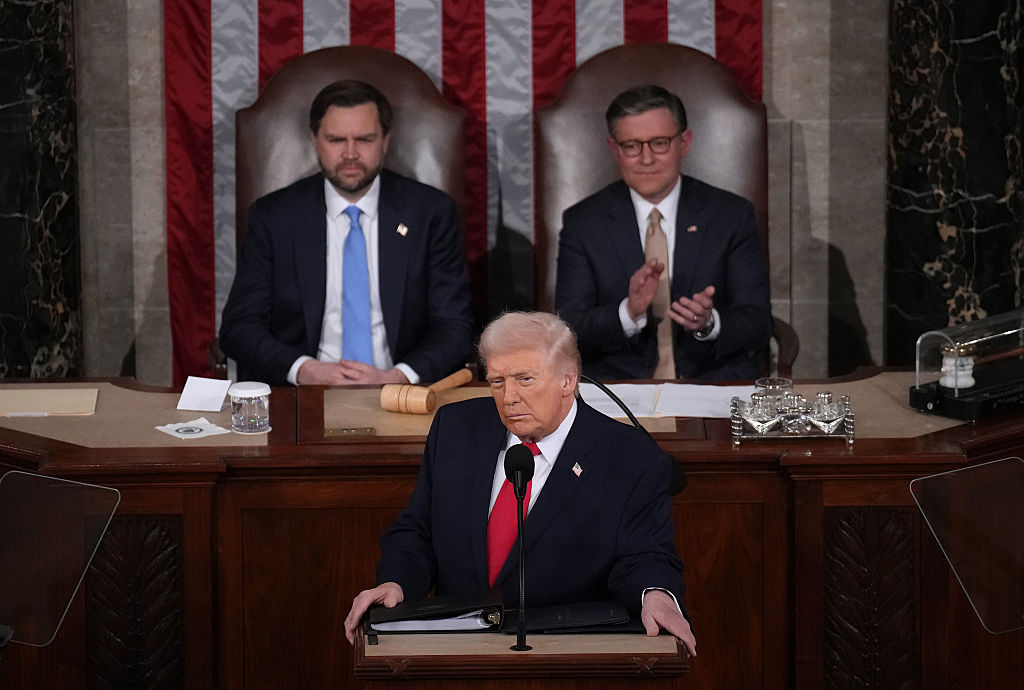
It's Thursday, February 26, 2026. I'm Albert Moeller, and this is The Briefing, a daily analysis of news and events from a Christian worldview. Well the President's state of the Union Address continues to be one of the primary issues of public debate, and as we discussed right after the President gave his speech, it was very clear that the President had given, first of all, an historically long address by most records, the longest yet recorded, and many in the media gave that a lot of attention, and it's not insignificant, but what is most significant, I will argue today, is what the press is avoiding talking about. What's most important right now is what the press, the mainstream press, what they don't want to touch. They're glad to take a part, to go after, to respond to just about everything the President said on Tuesday night. They're in a joint session of Congress. Here's the big tell. Here's what they don't want to talk about. They don't want to talk about the President with the example of a young woman right there
in the assembly. They do not want to talk about the President calling out the transgender insanity. And frankly, when the Democrats would not stand in honor of this young woman, and the fact that she was claiming, reclaiming her biological sex as her gender identity, she was escaping this transgender confusion. And the President noted that in his own words, not a single Democrat would stand. He simply cried out, these people are crazy. And if you were looking at the President's face, here's the amazing thing. It was pretty clear. This was a statement of conviction. This was the President of the United States making a moral judgment. You people are crazy. Now some people will question the politics of that. What I do not want to question is the moral importance of that development. So as I said on the briefing yesterday, I was determined to see how the mainstream media would reveal itself in terms of that particular event. So so far as I can tell, most in the mainstream media have done everything they can to avoid
any reference to this whatsoever. I'm going to talk about why that is so. The New York Times did run one standalone news story. It didn't tell us anything new, but it did honestly. And I think pretty straightforwardly recapitulate what the President said. The telegraph in a major newspaper in London also ran a standalone story. And again, I think it was, it was quite fair. So what are we talking about? We're talking about the fact that most in the mainstream media said nothing, not a word, not a whisper, not a whimper. Let's ask the question why the President called out the Democrats, but more than that, he made a very clear statement like he did in his inaugural address back in January of 2025 when he said that in his administration, there will be two and only two genders, male and female corresponding to biology. When the President said that the federal government and all right-minded people should stand a defense of children over against the transgender ideologies, and the President put himself on the line. And again, I'm so thankful for that on this issue.
The interesting thing is how many in the media have done everything to ignore the President did any such thing. Now, you'll notice though, criticize him on just about everything else and you know in a political context, criticism's fair. That's why you have political debate. The President knew what he was doing on Tuesday night. He did exactly what he went there to do. He made a lot of headlines. He irritated a lot of people. He made a lot of points. He called out a lot of arguments. He did so in a way that is, in many cases, non-traditional in American politics. He broke a lot of the rules that had existed for a long time in American politics. But you know, what we're also saying is that the issues are quite different. No President of the United States had ever had to say as a matter of clarification that his administration would recognize two and only two genders and other two previous Democratic administrations that had intentionally confused the issue. But let's just say you go back even to conservative, to go back to Ronald Reagan elected President in the 1980 election. He never knew he would have to say this. He never said it. This issue wasn't even on the radar at the time.
The President of Trump, I think, showed remarkable clarity and courage by not just making a glancing reference to the issue, but by making sure that Sage Blair, the show and woman and her mother were both present there and willing to be recognized. And so when you look at that, the young woman's right there with her mother right there in the assembly, the fact that is the president said Democrats would not stand in respect and honor to her. This is just about everything. The president went on at considerable length. These people are crazy. So again, my purpose in returning to this today at this point is primarily to say the mainstream media doesn't want to touch that. They don't even want to criticize the president. Let's ask ourselves the question, why? Well it is because when it comes to this particular issue and in some sense, it applies to, of course, all the LGBTQIA plus issues. But especially on the transgender confusion, you know, you're actually, if you're a transgender activist, you are asking people to deny biological reality.
You're asking them to suspend their moral judgment. You're actually asking them to see what they don't see. You're actually asking them to deny what their own eyes are telling them. And you know, that's a hard argument. It's so hard as a matter of fact that the American people are showing a moral reflex in terms of rethinking this issue. So what had been considered by LGBTQ activists and onward march of unbroken progress according to their own determination, they thought they were winning this barrier after barrier was falling. You know, calling a boy a girl or a girl a boy is just a barrier that Americans, thanks be to God, are not willing to cross at least not yet. Okay. So the most important thing we can see today is the fact that the mainstream media want to stay away from this. And we need to learn the lesson why this is just good worldview analysis. Why would they avoid the issue? It's not because they're a real president. We know that. That's pretty clear. It is because I think they know the more attention they give to this issue, the more ground they lose. I think the average American looking at this, seeing that young woman sitting and eventually
standing with her mother, they're going to say, this is the way the world ought to be. Even when they don't have a comprehensive biblical theology, even when they don't have an adequate understanding of creation order, they do understand the distinction between boy and girl and the understand that it does matter and denying that it matters means you're denying what is most basic even in terms of human biology. And it gets back to the president statement, you people are crazy. And you know, that's language that a traditional president wouldn't use. But it is a form of moral insanity period. Okay. It's also interesting that the very day that the president made this very bold reference in his state of the union address, the New York Times did run an article. And I'm going to call them out in this case because I appreciate the fact they did run this article. They ran the article. It's an opinion piece. A guest essay is by Jesse single and he's identified as quote writing a book about the debate over youth, gender, medicine in the United States.
He writes the newsletter called single minded. Okay. Well, that's interesting. The headline is medical associations trusted belief over science on youth gender care. You look at turning points in terms of a moral trajectory and you say, how did that happen? Well now you're looking at a major turning point. This is the New York Times, those influential newspaper arguably in the world. And it is totally has been totally sold out to the LGBTQ agenda. I mean, sold out is in sold out. But now it's at least allowing a guest essay of this kind of clarity, making the central claim that those who've been pushing the transgender agenda, particularly when it comes to children and teenagers, they have been basically peddling an untruth. They quote trusted belief over science on youth gender care. But it's not just that. Remember the headline is this medical associations trusted belief over science on youth gender care. That's an incredible indictment. Here you have a writer in an article published as a guest piece in the New York Times.
It is being run by someone who accuses the major medical associations in the United States basically of going with ideology rather than science. Now let's just get to the bottom line. That's exactly right. That's exactly what they have done. But it is a turning point. We need to recognize this. This tells us that we are at a turning point, a transition moment in this public argument. And the New York Times would actually run this kind of article that tells you the New York Times at least can figure out. There is something new in the air, something they're going to have to recognize. Okay. Jesse Single, by the way, does a very good job in this article, the New York Times ran basically pointing out that groups, even including, say, the American Medical Association, he tracks it. He goes back to historic statements they made. I've done that also on the briefing and in writing, I've gone back and said, here's what they said, say two or three years ago, here's what they're saying now. And in this article, Jesse Single does this and really effectively for the New York Times. He points out that cracks are now appearing in what he calls the supposed wall of consensus.
What was that wall of consensus? As one LGBTQ activist organization said and still says, by the way, quote, every major medical association supports health care for transgender people and you as safe and life saving. End quote. So you'll notice that that's pretty sly. It's very effective. He says they're so saying that. And that's weeks after major medical associations have actually said the exact opposite that there's not adequate scientific data to go ahead with these kinds of treatments and interventions with children and teenagers. Very interesting. As Single says, quote, cracks have appeared in the supposed wall of consensus. Single goes on to write, speaking of what the activist community's been saying, quote, the science doesn't seem so settled after all. And in support to understand what happened here, listen to this carefully, quote, the approach of left of center Americans and our institutions to assume that when a scientific organization releases a policy statement on a hot button issue that the policy statement
must be accurate is a deeply naive understanding of science, human nature, and politics, and how they intersect. End quote. You know, that's what we talk about regularly right here. We talk regularly about the fact that when people say research, experts, all these academic groups, all these professional affiliations, they say based on science, this or that, it is often a political statement. It is often a statement of moral judgment disguised as a scientific statement. And again, it's one thing for us to make that observation. It's another thing to have this called out in this particular context. And of course, single also goes back to the caster view back in 2024. That was the blockbuster headline centered development in the United Kingdom where the caster board came out and basically said there is no adequate science or medical authority for justifying these kinds of hormonal and surgical treatments when it comes to children and teenagers, the scientific evidence that was presented turns out not to be, well,
in some cases, either scientific nor truly evidence. As single points out, oftentimes what comes out from these organizations, and that includes the American Academy of Pediatrics mentioned here, he goes on to say quote, policy statements like this one can reflect the complex and opaque internal politics of an organization rather than dispassionate scientific analysis. You know, I think if anything's a little too generous there, yeah, it's about politics. It's about pandering to these activist groups. It is about major institutional representations, whether it's a major medical association or a sub-specialty, you know, association or society. The fact is they're very susceptible to this kind of ideological intrusion. And yet they claim the mantle of science. Now I also want to point to one other thing. This is not in this article. It's just something for you to observe looking forward. You know, an awful lot of this comes down to money and before these very people, it comes down to insurance coverage.
Okay, so watch what's going to happen. You're going to see re-evaluations of all of this. And at some point, some of these folks are going to determine I am more likely to be sued for doing this than for not doing it. Now that's not the keenest moral judgment in a Christian perspective, but you know what? Sometimes it comes down to that and eventually even the people writing the insurance coverage are going to figure out this isn't working. That might also point out it's wrong. Okay, speaking about wrong, it is interesting how our society has changed so many judgments on so many issues. I often point to the fact that USA Today is kind of a barometer of moral change. It's generally coming pretty much solidly from the left in terms of championing most moral change in a leftward direction, but you know, every once in a while, even those who are generally in that directive in terms of moral change in society, sometimes they see something
and they just have to wonder how did this happen. So for example, a front page article in USA Today just days ago by Bart Janssen, here's the headline profanity vitriol in political discourse surging profanity. You know, it is surging and let's be really candid profanity is showing up all kinds of places where it would never have been seen or heard before. It's not just in movies and on the screen, it's not just about movie ratings or the rest. It's showing up in cable news networks. It's showing up in political routine daily political discussion. It is showing up in the White House is showing up in the president of the United States. And in response to that is showing up now among many other politicians on both sides of the aisle. Back several years ago, the late US Senator Daniel Patrick Moynihan pointed to a process he called defining deviancy down. That's a very keen and essential moral insight.
Here in a society that keeps renegotiating the deviancy line, something that previous generations would have thought would be unthinkable and unquestionably wrong. Well, deviancy gets defined downward constantly downward according to Moynihan in a society that's losing its moral mind. And so even as some words would have been used only in extreme circumstances, such as for example, in a time of war in the heat of battle, you now have the same kind of language showing up in routine political debate. Not only that, you have people who are just dropping these words and don't worry, I'm not going to repeat them. You know what they are. They're dropping these words all over the place. And thus you even have them written all over the show up on billboards and I don't mean spray paint it on. I mean a part of the advertised text. You also have the routine use of so many of these words of profanity. You also have shortcuts and that means that you can just use the first letter and the
entire word is invoked. And there were even people who wore buttons invoking some of the worst of this language at the state of the union address. Is this just normal now? I think the answer to that question is assurably yes, this is just normal now. USA Today had this front page news article, listen to this quote, most of this story isn't fit for a family newspaper. That's the first line in the article at USA today. Now obviously it's a hook journalistically, that's a hook, very interesting. The article goes on to say quote, the country's political discourse has deteriorated to the point or become so robust that the president can drop up. I'm not going to say a word and get one lobbed back in return. Okay. So there it is. You know, the president probably gets as good as he gives, but the point is you've got this language now being used even just a matter of a few years ago, this language would not have been used in two different places I can think of almost immediately. One is on cable news talk shows or debate shows. The other thing is it wouldn't have been used in the White House. I'm not saying the word was never used.
We know from the Watergate takes. No, the word was used, but you know what? It wasn't used by presidents at least in public. Why? Well, at least going back to George Washington, there was the clear understanding that there are things a president must never be seen to do simply because it isn't presidential. It isn't morally right. And not something you want to hear coming out of the mouths of your children. So a president shouldn't say such words. We're now living in a very different world on both sides of the aisle regrettably. But you know what? The president does have some special responsibility in this and he seems that the longer he is in office, the more routinely he drops some of these words. It's also interesting that this USA Today article wants to suggest that there's a tide between the use of this language and political violence. I can't tell you if that's true or not. I can just tell you, you don't have to get to political violence to see the problem. If you have to get to political violence in order to admit there's a problem and causality is the issue, you're really missing the moral point. The moral point is words come with moral weight.
This is something that is essential to a biblical worldview. The biblical worldview tells us that our words reveal the heart, our words reveal how we think the our words reveal who we are. And we are to use words that bring honor to the Lord. We are not to speak in a way that is either blasphemous on the one hand and offensive to God. We're not to use words that are not, well, let's put it this way, not words that we are willing to be associated with publicly and privately. I will give some credit to USA Today and to this writer, again, it's Bart Jansson. I'll give him some credit for finding a way to talk about this so that you get it and you don't say it. Listen to this paragraph. Trust me, it's safe. But just listen to this. It tells you a whole lot, quote, some lawmakers are worried because the most offensive language about procreation and defecation has emerged from the shadows and into everyday discourse. End quote, okay.
I think that's a pretty brilliant way to put it, procreation and defecation, yeah. Things which, by the way, don't need to be used in this kind of news article unless it is about a kind of moral problem, which this is a kind of. So I thought you would find that interesting, I think, parents and others that we particularly interested to know that we really are up against. Some challenges that previous generations didn't have to face. This language isn't new. It was often referred to as gutter language. At other times, it was referred to as locker room language, not that it's appropriate there either. But now it is political language. It's White House language. It's US capital language. It's cable news and broadcast reality language. So there's a warning to us. For Christians, we understand it's a moral challenge and I think Christians understand it's one that's not going to be resolved quickly or easily. Furthermore, it's not just a matter of etiquette. We understand it should be and must be eventually a matter of conscience. All right. While we were talking about the media, I've mentioned the New York Times and USA today.
Of course, there have been so many headlines about the media and in particular about one major American newspaper, when a newspaper is the news, rather than publishing the news, that's interesting. And the big news is about the Washington Post. We're talking about one of the nation's most important newspapers. By the way, it was not always so at a national level. Until the Watergate controversy and that entire development in the 1970s, the Washington Post was largely a Washington directed daily newspaper. It became more than that after Watergate and in a day in which you had emerging national media, the Washington Post and its syndicated writers, particularly opinion writers and its news stories, cent across different news systems. These became very, very influential. The paper was under the control and ownership of the Graham family for a very long time until eventually that the paper was sold and the paper is now under the ownership eventually of Jeff Bezos, who was the founder of Amazon and of course is one of the richest men on
the planet. Okay. So in buying the Washington Post, all kinds of people were complaining. All the journalistic community was up in arms because the journalistic community wants to act as if they are, they're the people who control their own destiny. They control their own universe. It is to be done by what they define as press and journalistic standards. And as you know, the press in the United States, it's not exclusively liberal, but it is overwhelmingly leftist and liberal. And so when Jeff Bezos bought the Washington Post, there are all kinds of cries about the fact that he's going to make cuts at the paper. He's going to make changes at the paper. Well, he did make changes at the paper. He also intervened editorially in terms of the 2024 presidential election and he used his authority as the owner of the paper. He is the, let's repeat it, owner of the paper. He made the decision to stop a editorial in which this, the papers editorial board intended to endorse Kamala Harris in the 2024 election. The paper did not endorse Donald Trump, but it did not endorse Kamala Harris.
And thus you had the journalistic community absolutely up in arms, but the big news came just in the last few weeks as Jeff Bezos has laid off hundreds of employees at the Washington Post and cut entire sections, the sport section largely, the book review section, other sections of the paper, including the depth of international coverage. It is all being cut back. Why is it being cut back? It is because on average, the Washington Post has been losing more than $100 million a year. Okay. So let me just paint a picture for you. If you have an entity that is losing more than $100 million a year, let's just do some simple math. You better stop that in a hurry. Now it's interesting to see some of the supporters of the liberal media come back and say he's a billionaire. He can afford it. The point is, no one should have to cover $100 million losses year after year. What does that tell you? The Washington Post has lost so many subscribers and like I say, it's also losing $100 million
a year. The New York Times has a worldwide circulation of $13 million. The Washington Post is falling fast and frankly, it is below what can support financially the newspaper. And by the way, in these politically polarized times, a paper generally is going to be more to the left or more to the right and this means the vast majority are more to the left and the majority of the majority within the majority. But in this case, Jeff Bezos is saying he's simply not going to be willing to pay out hundreds of millions of dollars in losses. And so he's at least making some kind of effort to cut back on those losses. It's very interesting to see the howling coming from the journalistic community. You would think he just took an ocean liner out to the sea and blew it up. Now we're also looking at a major shift in the entire media landscape. Fewer people are paying for newspaper subscriptions. Most of all, fewer newspapers are even being printed by far.
Fewer are being sold. And that's just about the print form of the media. You also have online presences and of course the New York Times and the Wall Street Journal and many others, including major British newspapers, have made much of that. They're actually capitalizing on that online presence. The Washington Post, it's fallen behind. And here's another lesson in this kind of fast-changing economy, this fast-changing media landscape when you fall behind almost overnight, you're far behind. And then at some point, you're too far behind. But you know, there's another fascinating aspect to all of this and we'll close with this today. And that is that if you are selling something and this isn't free, if you are selling newspapers, here's an obvious truth, someone has to be willing to pay for that newspaper. In other words, if you're selling something and no one's buying it, you don't stay in business for long. As many people have pointed out, those who've been writing and editing the Washington Post evidently didn't care to answer the question, why are people not buying our product?
I don't think they really cared, but all of a sudden, those jobs disappeared and guess what? They care now. It has been very interesting to see some people say, you know, it's just Todry, it's just wrong that Jeff Bezos has made this decision based upon financial considerations. But you know what? Let me tell you what happens when you don't worry about financial considerations. You end up out of business. And you know, in this case, you end up out of business because you deserve to be. Thanks for listening to the briefing. For more information, go to my website at AlbertMolar.com. You can follow me on xrTwitter by going to x.com forward slash AlbertMolar for information on the Southern Baptist Theological Seminary, go to spts.edu for information on voice college to go to voicecollege.com. I'll meet you again tomorrow for the briefing.
More episodes
More from The Briefing with Albert Mohler

Monday, September 21, 2026
The Briefing with Albert Mohler

Friday, September 18, 2026
The Briefing with Albert Mohler
Thursday, September 17, 2026
The Briefing with Albert Mohler
Wednesday, September 16, 2026
The Briefing with Albert Mohler