Loading...

newsdaily
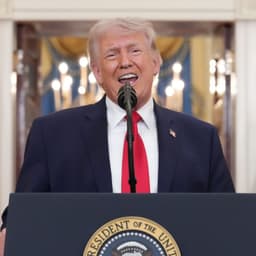
Trump considering 'winding down' Iran military campaign
About this Episode
President Trump posted on social media that the US was getting very close to meeting its objectives in Iran. Earlier he told reporters he didn't want a ceasefire. The BBC's US partner, CBS, has reported that US military officials are making detailed preparations for the possibility of deploying ground troops in Iran. Also: we hear from the journalist in Israel who's been pressured by online gamblers to change a story; why social media is awash with chat about how thin everyone was at the Oscars - and it's not just about the women; and the new research which calls into question the march south by English troops, ordered by King Harold, to face the Norman invasion in the famous Battle of Hastings in 1066.
The Global News Podcast brings you the breaking news you need to hear, as it happens. Listen for the latest headlines and current affairs from around the world. Politics, economics, climate, business, technology, health – we cover it all with expert analysis and insight. Get the news that matters, delivered twice a day on weekdays and daily at weekends, plus special bonus episodes reacting to urgent breaking stories. Follow or subscribe now and never miss a moment. Get in touch: [email protected]


Transcript
This BBC podcast is supported by ads outside the UK.
Grammarly's AI agents help you find natural phrasing, fine-tune tone and confidently write wherever you work.
It's the premier writing tool that 93% of users trust to get more work done.
In a world of generic AI, don't sound like everyone else.
With Grammarly, you never will.
Download Grammarly for free at Grammarly.com
This is the Global News Podcast from the BBC World Service.
I'm Keith Adams and at 4 o'clock GMT on Saturday the 21st of March, these are our main stories.
President Trump has said the US is considering winding down its military efforts in Iran.
Shortly after saying he didn't want a ceasefire.
Iranian missile debris has hit Jerusalem very close to some of the world's most important religious sites.
Denmark was reportedly prepared to blow up runways in Greenland to deter an American invasion.
Also in this podcast, we hear from the journalist in Israel who's been pressured by online gamblers to change a story.
They started threatening me personally, they started threatening my family.
They said that I'm going to make them lose nearly a million dollars and they're going to invest more than that to quote-unquote finish me.
And?
It's encompassing all different age group social classes, ethnicities, with a sense of despair.
Has Hollywood gone too far with weight loss?
In the last few hours we've had reports of fresh air strikes on Tehran and of Iranian missile and drone attacks on Dubai, Kuwait, the UAE and Iraq.
So the war continues unabated.
And yet President Trump has said on social media that he's considering winding down the conflict as the US was close to meeting its objectives.
He earlier spoke to reporters against the familiar backdrop of the presidential helicopter telling them he wasn't looking for a ceasefire with Iran.
I don't want to do a ceasefire. You know, you don't do a ceasefire when you're literally obliterating the other side.
They don't have a navy, they don't have an air force, they don't have any equipment to, they don't have any spotters, they don't have anti-aircraft, they don't have radar and their leaders have all been killed at every level.
We're not looking to do that.
But the president may sound characteristically bullish, but the economic turmoil persists with all three major indexes on the US stock market down at close of play on Wall Street.
The oil tanker traffic jam in the Strait of Hormuz fueling the now four-week slump.
President Trump said again that other countries needed to help get the waterway opened.
So what can we read into the president's latest words on the war?
Our correspondent, Simejola Osho spoke to me from Washington.
Yes, so it's interesting that President Trump has said he's considering winding down military operations against Iran.
He says that the US is close to meeting their objectives which seem to have expanded since the start of the war to now include basically decimating Iran's military.
It feels like the messaging now is sort of to define the parameters of victory.
President Trump has already claimed that this fight is already won.
He's now said that he's open to dialogue, even though he wouldn't want to cease fire because he says Iran is already defeated.
But this messaging contradicts reports that we're hearing here in the US, including from our partner station, CBS, that Department of Defense officials have made preparations for deploying ground forces, although it's not clear under what circumstance President Trump would authorize the use of ground troops.
We're also hearing that nearly 5,000 Marines and several warships are currently on their way to the Middle East from Japan and from the US.
Now President Trump has said just on Thursday that he wouldn't support ground troop operations, but then he said even if he wouldn't tell journalists the Pentagon declined to comment citing operational security.
But what we're seeing is that the Trump administration is expanding their military options, but not necessarily expanding their military operations as we've just heard from President Trump that they're considering winding those down.
But this is an administration that's facing pressure, firstly how to end this war, what does victory look like, would they have to get rid of Iran's uranium?
They're facing pressure with regards to the increase in the number of US servicemen, but casualties, which is now risen to 13, there's pressure around how the war has widened across the Middle East, and also pressure around the spiraling oil prices as a result of what's happening at the Strait of Hormuz.
Right. And what did he say about that? Because that's obviously become such a focus for the war.
He's basically saying this is now a problem for the rest of the world versus a US problem. Previously President Trump has said that the US would secure the Strait one way or the other.
As recently as Tuesday, he said that the US never desired or needed assistance from NATO allies and other country like Japan and South Korea.
And now he's saying that the Strait of Hormuz should be policed by other nations who use it, including Japan and China, and that it would be an easy military operation for them.
He's clearly frustrated at NATO, he's called them cowards, he said that NATO countries are like paper tigers, which is something or someone that appears powerful but is effectively weak.
And then he made that subtle threat saying that the US will remember. He claims that the US doesn't use the Strait of Hormuz, which is partly true because the US produces a lot of its own oil and imports, if it does import oil, mainly from Canada and Mexico.
But whatever happens at the Strait affects the US, particularly politically and economically as we've seen at the stock market here continues to slump as oil prices rise.
As Iran continues to fire missiles at Israel, debris from one of them has hit the historic Old City of Jerusalem, close to some of the world's most important religious sites.
The explosion left a crater near the Old City Wall. Our Global Affairs reporter Sebastian Usher went to the area.
So this is the closest we can get to where the impact site is behind there, where the firefighters are, where the security is, where the police are right on the edge of the wall of the Old City.
Well back at the Jerusalem Bureau, Sebastian gave us more details of the attack and its significance.
This is missile debris, an interception in the sky. If people have been there, they'll know, but just to paint the picture, three incredibly holy sites for Christianity, for Judaism and for Islam are very close together.
And where this impact site was is about 300 meters away from them. That's the Al-Aqsa Mosque, the Western Wall, and that's the Church of a Holy Sepulchre.
The impact site nobody was injured is just on the edge of a car park, but it was quite a deep crater that it caused.
I think because of a security that there's been in the Old City, because of the war, there were fewer people than there would have been normally.
Because this is the first day of Eid, the great Muslim festival, and Al-Aqsa would normally be packed with people. Now it's very much a route that Jewish people take to get to the Western Wall.
So it is extraordinary that people weren't injured, I think, while I have to say. It really brings home the fragility, not just of people in this war, but of incredibly important religious and cultural artifact.
But based in East Jerusalem, which is just next to where the Old City is, there's been a sense that even when you see the interceptions go on overhead, you get the sirens, that you are more protected there than almost anywhere else in Israel, because of those sites being there.
And the thought that Iran would not risk doing something that could harm them, particularly Al-Aqsa, but that may not be the case.
The BBC's Global Affairs reporter Sebastian Asher there in Jerusalem.
Now, some have described it as turning the Middle East conflict into a casino. Gamblers have been placing bets worth millions of dollars on the unfolding events of the war.
One in particular, concerns a report by the Times of Israel Defense Correspondent Immanuel Fabian. It's become the subject of a major dispute on polymarket.
That's a popular prediction site where people can bet on the outcome of almost anything. Immanuel has been telling Katie Razzle what happened.
On this incident on March 10th, I reported that one of these missiles had hit an open area near a city just outside Jerusalem.
And I posted a very short item on our live blog saying that the missile struck an open area. There's no injuries.
And I've hatched a video showing the moment that this missile struck.
Lates that day, I get a very odd email asking me to change the wording of my story and to change it from a missile impacting to a fragment from an interceptor or debris or shrapnel or something along those lines.
And I thought it was a really odd request and I told the person that what I know is correct and that it's a missile.
I used to get another email asking the same thing again. And at that point, I was very confused as to why people were asking me these questions. I didn't realize what their intentions were.
And then over the following hours, I started getting more and more replies on Twitter as well, asking me to change the wording of my story.
And I looked at the profiles on Twitter and I saw that they were all people who were gambling on polymarket.
And that's when I figured out that what had happened is there was a bet on whether or not an Iranian missile would hit Israel on a specific day.
And according to the rules, if a missile is intercepted, even if it causes damage from the fragments, then it's not considered an attack.
So all these people wanted me to change my report, so it would basically align with what they had bet on.
And then once you realized that you were also, I believe, starting to get some quite threatening messages.
So I initially went to Twitter and I wrote, please leave me alone. I'm not going to change my report.
And then I started getting actual threats. Someone messaged me on WhatsApp. They started giving me a countdown saying that I have to change it by a certain time.
They started threatening me personally. They started threatening my family. They wrote details about where I live and about my parents and my siblings.
They said that I'm going to make them lose nearly a million dollars and they're going to invest more than that to quote unquote finish me.
I did go straight away to the police with these threats once I started seeing them come through and it was really quite a worrying thing.
And did you at any point feel so under pressure? You thought, maybe I should change my story.
To be honest, for a moment, when I started getting these requests of can you change it to a fragment for a split second, I thought maybe I was wrong.
Maybe I got my reporting wrong. I need to double check this. I need to go back again and ask and re clarify with the military and with the rescue forces and everything.
And then I'm basically through that away and said, no, I'm not wasting my time on this.
And additionally, I thought, you know, if I do change it, then what's to say they won't come back to me next time with more requests and ask me again to change something else.
That might be more important than just a missile getting in an open forest.
Times of Israel journalist Immanuel Fabian.
In response, a polymarket representative said the company condemns the harassment and threats directed at Mr Fabian adding that such behavior violates its terms of service and has no place on its platform.
They said prediction markets depend on the integrity of independent reporting attempts to pressure journalists to alter their reporting, undermine that integrity and undermine the markets.
So how is the Iran war being felt in the country itself?
Because of the internet blackout, it's difficult to hear directly from voices there.
But the BBC has been in touch with one young woman who's been keeping a daily diary.
She's continuing to send updates and this is an extract from the latest entries read by one of our producers here in London.
Although she's been a long time opponent of the leadership, her father is very loyal to them and she's experiencing conflicting thoughts as foreign forces bombard her country.
Yesterday, it felt as if a decree was issued from the heavens.
Put away your firecrackers and arrows for absolute power still rests in the hands of God.
There was such intense thunder and lightning that we were all terrified.
If it weren't for the sky lighting up and the heaviest spring rain that followed, we would have been certain we were being bombarded with the most powerful weapons.
During the day, the sound of fighter deaths filled the air.
Out of habit, I would write in the group, they're heading to Tehran and my friend would reply minutes later.
Yes, darling, they've arrived. Don't worry about them and we would laugh.
When I sent the photos of us at the cafe to some other friends, they both wrote back saying how beautiful and smiling we looked despite all the trauma and hardship.
I told them we are trying, truly we are trying every day not to break and to keep going.
You can see how much the level of my concerns has dwindled. War truly does something to you, where you can barely plan as far ahead as tomorrow.
Meanwhile, the banks have been experiencing disruption for a few days and the apps for mainly bank and several others are practically useless.
Long lines form at street ATMs and everyone asks each other, does it have cash?
It's unbelievable that my father and many other have occupied the streets for days.
Despite my deep disagreement with them, I must admit it's a clever way to prevent the deployment of your butler, the crown prince and his call for protests.
If Trump actually knew the Iranian people, perhaps he wouldn't have thrown himself into the swamp of this devastating war.
These days when I hear words like Israel, America, Trump, Netanyahu, martyr, commander, operation, blast wave, target, impact, assassination, transition, prince, revolution, lion and son, and war, I want to vomit.
I've been thinking that I wish I could surrender my citizenship and put miles between myself and Persian language and its speakers.
The news of L'Origin is that upset me more than any other news in this period. I felt something collapse inside me.
I felt he was one of the few rational people left and his absence will likely cause great harm.
On the other hand, thinking about which traitor has enough influence to give the coordinates of these people has wrecked my nerves.
My friend's child had a high fever tonight and the hospital in that northern city were in bad shape due to Chashanbe Surik casualties.
Statistics say they were about 300 deaths and 220 amputations. Human life is that cheap.
For a few hours the mother-in-the-group offered advice and we all sent Hamdo Shaffa, healing prayers, until the child's fever gradually broke.
I feel that these days many of us are like that child, feverish and sick, while the emergency room is busy with other things.
If feel lucky the small kindnesses that exist my lower our fever a little, but I don't think there will ever be a cure or an end to those moons.
A voice diary from Tehran.
Still to come in this podcast, what's been the impact of Australia's landmark social media ban three months on?
None of my accounts got banned, which was a bit anticlimactic.
I got kicked off social media. I was kind of hoping that it would allow me to be more productive.
However, I've found that I've just found other ways to procrastinate.
Tallahradic here from 2311 Racing. Victory Lane? Yeah, it's even better with Chamba by my side.
Race to ChambaCasino.com. Let's Chamba.
No purchase necessary, VTW Group, voidware prohibited by law, CTNCs, 21 Plus, sponsored by ChambaCasino.
The Toyota Tundra and Tacoma are built to keep going, blending rugged muscle with precision engineering all supported by Toyota's time-tested legacy of dependability.
Step into a Tundra and feel the unyielding capability with the available I Force Max engine Tundra puts out impressive power, torque and towing performance and the Rumi high-tech cabin.
Keeps you connected on the go or take a look at Tacoma made for drivers who push past the path.
Agile, tough and relentless with available features like crawl control, portable JBL speaker, a power lift gate,
so gear goes in fast and the adventure keeps moving.
The Tacoma and Tundra are engineered to endure season after season, mile after mile.
So drive one home today, visit Toyota.com or stop by your local Toyota dealer to find out more Toyota.
Let's go places.
It's 2009 and we're in the German mountains, a man straps himself into a car on the world's most dangerous racetrack. He whispers to himself.
It's time to put my balls on the dashboard, as he starts the engine.
In 15 minutes, he's in an ambulance, unconscious, in 15 years, he's a billionaire.
This is Toyota Wolf, Formula One's most powerful team boss and the breakout star of Drive to Survive.
This week on Good Bad Billionaire, how Toyota Wolf made his billions.
Listen wherever you get your BBC podcasts.
This is the Global News Podcast.
Now, if you thought that Donald Trump's threat in January to seize the Danish territory of Greenland by force was extraordinary, how about this?
Denmark was reportedly prepared to blow up runways in Greenland in order to deter an American invasion and sent blood supplies to its troops there in case of a battle with US forces.
The Danish National Broadcaster DR carried that report, basing it, it said, on 12 separate sources.
Nils Farstrup is an investigative reporter with DR.
What we learned from talking to our sources for several weeks and these sources, it's important to say they are really central key sources here within the Danish military and also France and German sources that play a central role in this conflict.
And what we learned from our conversations is that Trump's attack on Venezuela in early January.
And the aftermath of that, especially some of the statements that came from him himself and from some of his advisors, including Stephen Miller, that created a very tangible fear that a US attack against Greenland could be imminent.
They wanted to use military force to try and prevent US military from taking over Greenland.
Part of that planning that went on from Danish side in collaboration with German and especially France military involved throwing up plans for transporting explosives to Greenland in order to be able to blow up runways in Newk, in Garnalusiaq and other places in Greenland.
In the event that there would be a US attempt to use these runways as a kind of bridge hit into Greenland, in their minds it was close to happening.
Well, both the US and Denmark are founding members of the NATO Alliance.
Rasmus Jarlow is the chair of the Danish Defense Committee.
Johnny Diamond asked him if he was surprised by these revelations.
No, I'm not surprised. Of course, I cannot. I'm not allowed to reveal whatever operational details that I have knowledge of.
So I'm not confirming information that the journalists have revealed, but it should not be a surprise that preparations were made and it should not be a surprise that if we were attacked, then of course Danish forces would fight back in every possible way.
It may not be a surprise to you. I think a fair number of people were quite surprised when they read the detail of it that Denmark was absolutely prepared to go to war to defend its territory.
No one should be surprised that if you attack a country, of course that country is going to fight back.
I have the impression that the Americans didn't get how serious this was. They thought they could just take this lightly.
I heard Stephen Miller, the security adviser, say at one point that no one is going to fight us over Greenland.
And he's absolutely wrong about that. If anyone invades a territory that belongs to Denmark, of course Danish armed forces will fight back and you will be at war with Denmark.
And we understand, of course, full well the size difference between us and the United States. We understand that they're a very tough opponent, having much, much stronger military than we have.
But of course it is our duty and the duty of our forces to defend our territory and make it expensive for anyone who tries to invade us.
So that should not be a surprise to anyone and you should understand how serious it is to threaten the Allies with invasion.
You mentioned how strong American forces are and we've seen examples of that over the years and more recently.
How long do you think that Denmark might have held out?
I don't want to give an estimate of that, but Greenland is a very, very big place.
So taking all of Greenland would take a long time and the only thing you would achieve is you would have a military control of very hostile environment with a population that absolutely would hate you for having invaded them.
So nothing good would have come out of that and we're happy the Americans seem to have given up on that idea, but just that we came into that situation where we actually had to fear that and make preparations for it is completely insane.
I think that the Americans have given up on the idea of seizing Greenland by force. Do you think the risk of invasion has passed?
Trump has said so. So the threat came from his words and he has downskilled his words now. They're more calm and peaceful.
He says now that the military invasion is off the table after for a long time refusing to rule out a military invasion.
It is an improvement as we're glad that's the case, but I don't think the Americans have given up on the idea of taking over Greenland by other means.
So the crisis is not over before the Americans agree that they are not going to get Greenland and we have not heard a statement like that yet.
That was Rasmus Yarlow. It's been over three months since Australia introduced its world first ban on social media for under 16s, kicking young teens off TikTok, Instagram, YouTube and Snapchat.
Criticised by tech companies but widely welcomed by parents and carers, it was a bold move which is being closely watched by many other governments around the world.
Katie Watson sent this report from a school in Sydney.
It's a huge social experiment with Australian teens, the guinea pigs and when the legislation kicked in on December 10th, the whole world was watching it play out.
More than two million youngsters here were targeted by the ban. So three months on, what's their new reality?
We went to PLC Sydney, a school in the cities in a west to speak to some teens.
I have Instagram, I have TikTok, I have Snapchat, I wasn't kicked off of any of them. I know of three girls out of my entire year group, which is 180, that have been impacted.
None of my accounts got banned, which was a bit anticlimactic. I got kicked off social media. I was kind of hoping that it would allow me to be more productive.
However, I've found that I've just found other ways to procrastinate.
Despite this anecdotal evidence that many teens are still on platforms, the government has released some data, saying that within weeks of the ban starting, 4.7 million accounts belonging to under 16s had been closed down.
So does that mean it's working? Professor Amanda Third is co-director of the Young and Resilient Research Centre at Western Sydney University.
What might not be clear to the public is that there are sort of two stages of implementing the ban.
The first has been for platforms to identify all those accounts of underage users who've declared their age to be under 16.
And the second phase, which will roll out in the next six months, is about using age inference technologies to identify which users, according to their habits, their connections, their practices, which users are underage.
And now then be removed from the platform.
So those who spoke to thinking they're safe aren't necessarily?
Well, not necessarily. I mean, again, we expect that more users will be caught by the legislation in the near future.
PLC Sydney's principal, Paul Burgess, accepts it's going to take a long time to make a real difference.
I don't actually think we're going to see the real benefits from the ban for about four or five years' time.
The real move is for the student who's currently a 10 or 11-year-old and the parents not buying a phone for them until they finish maybe when they're 15.
And that's the challenge for countries like the UK looking at adopting laws of their own, they're having to base their decisions on public sentiment and little hard data.
I'm Harry Older, I'm 15 years old and I'm a year 11 at school.
Harriet has two sisters, Beatrix and Tamsen, she's the only one with social media. They've got cousins in the UK.
So what advice would they have for British kids facing a ban of their own?
I actually got Snapchat in England when I was on holiday there and I was with my cousin when I got it.
So she actually recommended putting my age a bit older.
So I think that even though at that point in time they had no idea about this ban, lots of people are aware of putting your age a lot older.
And any advice you give to a teen thinking my life is going to be ruined.
Quickly change your age right now. You can't do that though. People might come at me for saying this.
But I feel like if you've never experienced it and you never get addicted to the algorithms then it's really not that bad.
Like sometimes I'm a bit left out from some inside jokes that are on social media and some trends, but for the most part I'm fine.
The government hopes that by at least trying to keep teens of social media it's starting a conversation and a cultural shift.
Katie Watson speaking to some slightly disingenuous Australian teens.
The Oscars have been and gone for another year, but instead of talking about the films or the actors who took home a gong,
social media is a wash with chat about how thin everyone was and they're not just talking about the women.
The problem is that young people in particular usually want to emulate their heroes and their fears that this latest got to be thinner than thin phase is getting out of hand.
Wendy Earhart reports.
Everywhere you look models, TV presenters, celebrities and actors are shedding kilos like there's no tomorrow.
It seems more and more people are determined to look perfect, but forget about hitting the gym.
These days, most prefer to take the easy way out by using diet drugs like minjaro, wogovi or ozempic.
Susie Orbach who's a psychoanalyst and author of that as a feminist issue says it's a trend that's deeply worrying.
It's encompassing all different age group social classes, ethnicities with a sense of despair.
There's a kind of uniform look being presented for anybody who's in public and that has seeped itself into the culture in general.
I don't think it's specifically Hollywood.
She's right, people who are not celebrities are splashing the cash to achieve the perfect body image like the ones they see on magazine covers the world over.
So what does that tell us?
It's saying that we can manufacture bodies that both to do with minjaro but also to do with procedures that are now considered perfectly okay.
Resculpting bodies in ways that for some people it's a tremendous relief to not be feeling so abject and so terrible they can't get their body to fit in and conform.
But for other people I think it's a signal that nobody is safe because bodies always have to be fitting into some other cultural or visual representation.
Let's face it everyone wants to look the best that they can but experts are adamant that skipping chips and having a salad instead is a much better healthier way to reach your ideal weight.
Hmm, maybe I should try that.
Maybe healthier but just pass me the chocolate.
Wendy Urkart report in there.
It's the date that every English school child knows 1066 the year of the Battle of Hastings when the English army under King Harold was decisively beaten by invading French forces led by the Duke of Normandy aka William the Conqueror.
The battle led to a profound transformation of English society and the introduction of French language and culture.
For some time now it's been believed that one of the key reasons for King Harold's defeat was that he led his men on a long march to the site of the battle but new research by the University of East Anglia argues that that didn't happen and was the result of a misunderstanding in Victorian times in the 19th century as Rebecca drought reports.
The near 200 miles hen day march of King Harold's army to face the normal invasion is such a famous moment in English history.
It was reenacted to mark the 950th anniversary just a decade ago but only a mad general professor Tom license argues would have sent all his men from Yorkshire to Sussex on foot if ships were available.
He's been looking again at the evidence for how the troops made their way south and believes the journey was undertaken largely by sea.
He says contemporary sources describe hundreds of ships being used to support Harold's campaign against the Viking invasion in the north before heading back south and he argues there's no evidence of a forced march.
Will he realize that Harold had a fleet and a land force and is using the two in tandem. He becomes a much more sophisticated general mounting complex operations on the same scale as those of his opponents.
And I think once we accept that the most likely scenarios that he took a fleet down to London in four days rather than a hard march in 12 or 14.
One can only criticize home for rectusness or impulsiveness indeed it seems to me that he's doing everything right.
Victorian historians he says misinterpreted a reference to the fleet coming home as meaning it was disbanded but their home base was in London.
That report by Rebecca Drowned and that's all from us for now. If you want to get in touch you can email us at globalpodcast at bbc.co.uk
and don't forget our sister podcast the global story which goes in depth and beyond the headlines on one big story.
This edition of the global news podcast was mixed by Stephen Bailey and the producer was Nicky Verico.
The editor is Karen Martin. I'm Keith Adams. Until next time goodbye.
It's 2009 and we're in the German mountains. A man straps himself into a car on the world's most dangerous racetrack. He whispers to himself.
It's time to put my balls on the dashboard as he starts the engine. In 15 minutes he's in an ambulance on conscious in 15 years he's a billionaire.
This is Total Wolf, Formula One's most powerful team boss and the breakout star of Drive to Survive.
This week on Good Bad Billionaire how Total Wolf made his billions. Listen wherever you get your BBC podcasts.