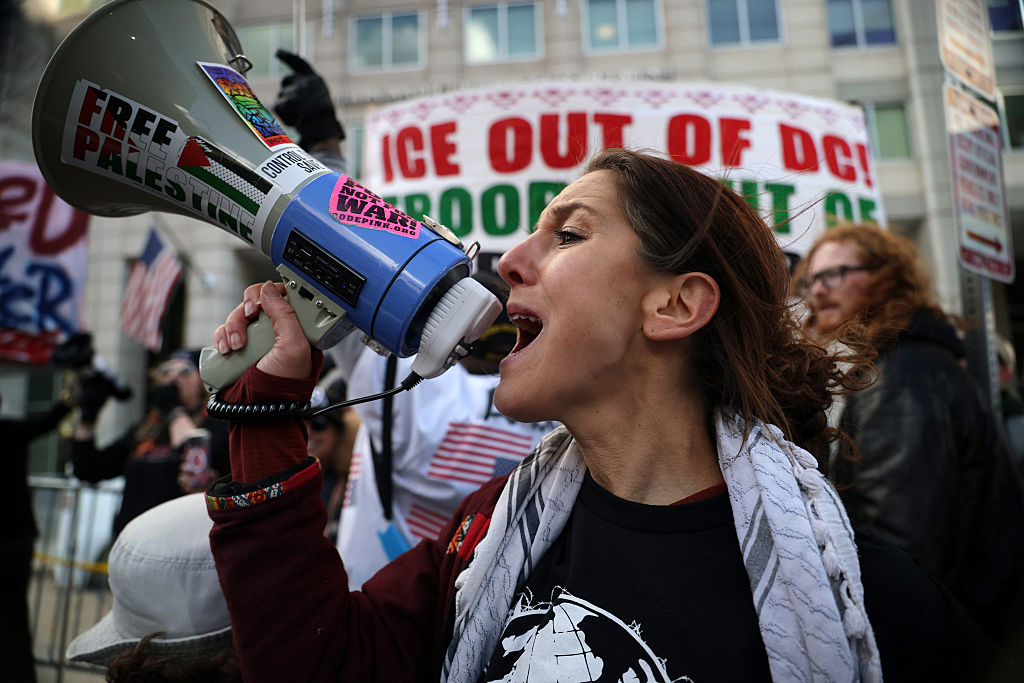
About this episode
Part I (00:14 – 09:23)
A New and Ominous Landscape: Looking at the Recent Church Invasion and Public Attention
- Christian leaders urge protecting worshippers’ rights after protesters interrupt service by The Associated Press (Giovanna Dell’orto)
- The People of Minneapolis vs. ICE: A Street-Level View by The New York Times (Vivian Yee)
Minnesota Reveals a Big Political Realignment: These Protests Are Becoming Predictable
- After Renee Good Killing, Derisive Term for White Women Spreads on the Far Right by The New York Times (Clyde McGrady)
- The Right Is Furious With Liberal White Women by The New York Times (Michelle Goldberg)
- The white women turning to ‘Dark Woke’— They turn private despair into public rage by The Institute for Family Studies (Emily Jashinsky)
AWFUL? The Political Radicalization of Women in Modern Societies
- Young women are radicalising by The New Statesman (Scarlett Maguire)
- Record Numbers of Younger Women Want to Leave the U.S. by Gallup (Benedict Vigers and Julie Ray)
The Inevitable Disappointment of Rebellion: Defying Creation Order Will Never Lead to Human Flourishing
Sign up to receive The Briefing in your inbox every weekday morning.
Follow Dr. Mohler:
X | Instagram | Facebook | YouTube
For more information on The Southern Baptist Theological Seminary, go to sbts.edu.
For more information on Boyce College, just go to BoyceCollege.com.
To write Dr. Mohler or submit a question for The Mailbox, go here.
Get every episode summarized
Each time The Briefing with Albert Mohler publishes, we email you a written briefing from the transcript — the topics, who appeared, and any specific claims, with the ad reads skipped.
Email me new episodesFree for 3 shows. No card needed.
Hosts & guests

Transcript ready
393 searchable segments. Every word is indexed and playable.
Full transcript
The Briefing with Albert Mohler — Tuesday, January 20, 2026. Machine-transcribed; use the interactive transcript above to jump the player to any line.
It's Tuesday, January 20, 2026. I'm Albert Moller, and this is The Briefing, a daily analysis of news and events from a Christian worldview. Events continue to unfold in Minneapolis and St. Paul, Minnesota. Those twin cities have become something of ground zero in the latest front in America's enduring culture war. Let's remind ourselves of the category, culture war. What are we talking about? Not merely political conflict, not just moral division, but a coalescing of the entire culture over moral questions at the very heart of any kind of cultural consensus. The lack of that consensus produces division that division is now very much concentrated in such a way that you have a basic division in the American population. We talk about state by state, red and blue states. We talk about liberal conservative left and right. All of those are a part of the picture. But there's a division at an even more fundamental level. Now, as Christians, we understand that this is over a basic worldview conflict, as clear
as that between, say, Orthodox biblical Christianity and a hardened radical secularism. And you're looking at the fact that increasingly, the options in the middle are evaporating, and it has been that way for the better part of the last several decades. That's becoming increasingly clear. What we now know happened on Sunday, there in St. Paul, when at city's church, a left as activist mob, invaded the church, basically stopping its worship service, even as the congregation was gathered for Lord's Day worship. That is unprecedented, at least in recent American history. That kind of thing didn't happen even in the cultural conflicts of the 1960s and the 1970s. But we are in a very different stage of the culture war. And what we have seen is that the increasing polarization between left and right, liberal conservative theological and secular, this is becoming more and more an issue in which people, particularly right now on the left, are taking dramatic action. And we're going to be looking at some deeper worldview dimensions of this, because it
really has some deeper dimensions. And some of these were already pretty much out in the open before what happened Sunday. So we'll get to that in just a moment. First of all, what was the aftermath, what's been the response, what's been the media coverage, when you look at the invasion of that evangelical church on Sunday? Well, the fact is there hasn't been much Fox News ran a story, CNN ran a story. Most of the major media have just stayed away from any kind of direct coverage of that story. That's that's stunning in itself, because we're talking about a major news story, something that is unprecedented, something that if you were to flip the switch and say this was the invasion of the place of worship of some other major world religion or some liberal mainline Protestant denomination, say by conservative political activists, that would be front page news. And in the main, it has not been. And that's another diagnostic test of the mainstream media. And quite frankly, it has unfolded pretty much as we expected, lamentably.
As I said, Fox News ran a story, CNN ran a story. I want to draw attention to the fact that in the mainstream media, one exception to the avoidance of this story is a major report that was published by the Associated Press. Reporter Giovanna Deliorto did really an outstanding job in covering the story. And one of the reasons why I point to this is not just because the Associated Press that is sometimes better known as AP ran a story, but because they ran it with a lot of good sourcing. And this means they talked to a lot of the persons who were in a position to comment meaningfully on that event. And I appreciate the fact that they called me. I'm cited in the article, all that to say, that's an exception to the rule in terms of what has happened over the course of the last 48 hours, not so much in terms of the news coverage, but in terms of the absence of that news coverage. The AP article begins with a very important statement, quote, the U.S. Department of Justice said Sunday it is investigating a group of protesters in Minnesota who disrupted
services at a church where a local official with U.S. immigration and customs enforcement apparently serves as a pastor. End quote. That's kind of a model of the kind of journalism we wish we could see in a more widespread manner. Later in the article, we re quote, Christians in the United States are divided on the moral and legal dilemmas raised by immigration, including the presence of an estimated 11 million people who are in the country illegally and the spike in illegal border crossings in a silent request during the Biden administration. The next paragraph, quote, opinions differ between and within denominations on whether Christians must prioritize care for strangers and neighbors or the immigration enforcement push in the name of security. White evangelicals tend to support strong enforcement while Catholic leaders have spoken in favor of migrant rights. End quote. That's a generally accurate statement. That's true. It is simply the case that evangelical Christians have tended to stress the enforcement side and many Roman Catholic leaders really have stressed what's described here as the
position, quote, in favor of migrant rights. End quote. Now, as you look at this, of course, there are huge worldview issues, huge biblical and theological issues to consider, but one of the things we do need to know, and I mentioned this yesterday, is the fact that when you have media coverage and cultural conversation about ice, immigrations and customs enforcement, what is often left out is the fact that this is a fully authorized branch of the federal government created in the aftermath of the 9-11 attacks. And by the way, it was controversial then simply because of bringing so many things together under one agency, the president of the time, president of George W. Bush said that it would greatly enhance and concentrate the ability of the United States to control frankly and security dimensions, primarily its borders. And many people on the left are just fundamentally against any kind of border control period. They actually do believe in the mandate of open borders. They make that very, very clear.
The Vatican itself is ambiguous on this. And popes in succession, particularly the late Pope Francis and now Pope Leo, they have signaled their deep and abiding Catholic moral concern for the rights of migrants, but they are not particular about how a nation such as the United States should actually govern itself. And you do not have the Vatican state, which is after all a state. Let me underline that again. It claims to be a state. The Vatican doesn't make clear exactly what it considers to be the rights of states to control their borders and frankly to establish and continue their national project. And I think that's a glaring omission we need to underline. And one of the frustrating things here is that like mainline Protestantism, what you often get from the Catholic left and even from recent popes are generalized statements about the rights of migrants that are not tied to any realistic understanding of the world situation.
And are frankly even the situation if the Vatican were to follow its own advice on border control. But while we're looking at this, I want to go back to the fact that the tensions and Minneapolis and St. Paul just to take the twin cities as an example, and really this is ground zero, those tensions are rising to the point that as the New York Times says, just about anything can break out anywhere. As Vivian Yew writes in the article, quote, fear and fury can explode on any street corner during this charge time in Minneapolis, any time, any place, the muscle of the federal government meets the rage of the citizens who reject its tactics, end quote. I want to just look at that for a moment, yes indeed, the left is protesting the tactics of ICE in larger general sense, the tactics of the federal government. But those activists are actually opposing much more than the tactics of ICE. In many ways, they question the legitimacy of ICE itself. And frankly, the legitimacy of the US federal government's concern when it comes to policing
its own borders and even maintaining a coherent understanding of citizenship. There are deep issues here, far deeper than most media reports would indicate. And we need to understand there's something going on here also in the realignment of the political spectrum. And it's happening as we've already discussed in previous days in one of the most liberal states in the United States. A state that has long been marked by this kind of social activism and was really redefined in terms even of its partisan structure in the middle of the 20th century by political activists and even political scientists, professors in the universities. What you have now is a predictably liberal state that in so many ways emulates Scandinavian. And of course, there's an historic pattern here with Scandinavian immigration into the United States into the state of Minnesota and the upper Midwest in ways that are shaped to that culture. But even as you have very liberal societies in Scandinavia, you have increasingly very liberal society culture on the ground there in Minnesota.
But there's even more to it than that. Minnesota is ground zero of something. And that something is about ICE and immigration and the power and authority of the federal government. And actually about more than that. And I want to credit the New York Times with some pretty thoughtful investigation and a really stunning article. The headline is, shooting in Minneapolis leads some conservatives to impune liberal women. Okay, that's the actual headline. I want to read it again, shooting in Minneapolis leads some conservatives to impune liberal women. Okay, something is going on here. But the something is more fundamental than the New York Times recognizes. That something is a political re-alignment in which the distinction between male and female men and women in the electorate is becoming stunningly wide. And I think the evidence is building up to a situation in which the culture war has taken on a new front. And that front, which has always had gender as a major issue, it now has gender as the
front line issue. And even as you look at red states and blue states, we're really kind of looking at a red gender and a blue gender. And there are a lot of people who don't want to acknowledge that. Now let me just say, obviously there are conservative women and there are liberal men. But the general conservatism of younger men right now and the general conservatism of younger and even middle-aged women, that is now a basic political fact. And this is exactly what the New York Times is talking about in this article, even though it seems to believe that conservatives are the interesting side for, in their words, quote, impugning liberal women. What does that mean? Well it means blaming them. Listen to this. Quote, some right-wing influencers have latched on to a word and acronym. That is awful, AWFUL, which stands for affluent white female urban liberal. So again, the acronym is awful and you may have seen it in social media.
It is becoming a part of the cultural conversation, whether it stays in some lasting form I don't know. But I think undeniably it describes something important. Commentator Eric Erickson said, after the shooting of Renee Good in Minneapolis, quote, an awful affluent white female urban liberal is dead after running her car into an ice agent who opened fire on her. He went on to say progressive whites returning violent ice agents have the right to defend themselves. The point is the use of that term as it appears in this news article and it was used by this commentator quote, this is the coverage in the Times quote, beyond labels and a name calling the death of Ms. Good and the protest and anger in its wake has sparked a response from many on the right that is particularly targeted at white women in the streets, even though men have been just as involved. A majority of college educated women, including white women, have long been skeptical of President Trump's make America great again movement and that skepticism has been growing
according to exit polls after the 2024 election. For months now, such women are attracting the ire of the president's supporters. End quote. Now clearly, that's a part of the picture, but it's also clear there's a lot more to this picture. This brings to mind the fact that this gender divide, which is becoming an ideological divide, it is as we've noted on the briefing. Conversely, a church going divide and it's just reflected in the basic cultural divides that are pervasive now and frankly are undeniable. Listen to this quote, the term awful emerged well before Ms. Good was killed. Conservative critics began attaching it to female protesters at least as far back as last summer. And I'm continuing the quote here, conservatives say there is good reason to key in on such women. I'll end the quote there. The point is that the New York Times finds it interesting that there are many conservatives who have noted the fact that the liberal opposition and even the people protesting in the streets, they're increasingly women.
And as others have noted, the interesting thing here is that they are particularly young and middle aged white women. And this raises a new development. It's not to say that women have ever protested before, but they certainly have in terms of feminist related issues. But when it comes to this kind of protest, I mean, frankly, the New York Times is reporting in similar stories, the fact that this is a new development. This is not just some kind of illusion cooked up by conservatives. This is a real thing. By the way, it's a real thing on both sides of the Atlantic. And then just a minute, we're going to look at a liberal periodical in Britain that is noticing the very same thing. And quite notably pointing to younger women, they're in Britain and what's described as the radicalization in a left or direction. Michelle Goldberg, a liberal calmness in the opinion section for the New York Times and for many years, she wrote a piece in Sunday's edition of the paper with the headline, The Right is Furious with Liberal White Women.
So it's not just news reporters who are noticing this, it's also opinion writers. Fox News has also reported on women described as, quote, organized gangs of wine moms using what are described as antifa tactics, particularly against ice. And Michelle Goldberg notices that as well. But it is interesting that the left in this case is put in an interesting position because on the one hand, they want to suggest that this is some kind of a conservative misrepresentation. On the other hand, they see the increasing role of liberal white women in some of these protests as something of an issue of feminist pride. So you can't have it both ways. But you do have an acknowledgement in Michelle Goldberg's piece that many of these protesters and a lot of the energy in these protests, it is driven by younger and middle-aged white women. The Institute for Family Studies is also pointed to a report by Emily Jashinsky at Unheard.
The headline here is The White Women Turning to Dark Woke. And the importance in this article is that category of dark woke. So woke is this spirit of social justice, of neo-Marxist ideology, and the left's increasing reliance upon those kinds of categories. Woke is something that's been around for a long time. Dark woke is something newer, which is woke with a bitter edge. So you might say that the original woke or wokenness was driven by people. And of course, it came originally from academics as so many of these ideologies do. And in Germany and in France and Germany, it was the Frankfurt School with critical theory. In France, it was the post-structuralist, all of this in the last half of the last century. But what you had coming out of this is this merger of social activism and critical theory and American politics. But the point here is if you take the Frankfurt School and the post-structuralists and others,
they really had the hope that there could arise a liberal or post-liberal leftist movement that could succeed. Dark woke seems to be coming out of frustration that instead of getting the leftist utopia, they had expected they got President Donald Trump. In this article, Emily Gisinski writes, quote, these street soldiers aren't the antifa types torching cars or the rioters looting stores. They are, like Renee Good, millennial moms in the Midwest. Their people from the normal quarters of American life were spending time during the workday, including their bodies and vehicles on the line to protect illegal migrants, some was serious criminal records from deportation. And they see ice as a neo-gastapo that calls for more than rhetorical condemnation. End quote. Now the whole point of this article, and it's also implicit in the mainstream media coverage, is that there is now a basic change in the disposition of the left and a basic change in the activists on the left, increasingly white females.
And the interesting thing here is that many of them are exactly as described here, quote, millennial moms in the Midwest. End quote. Not the people that just a generation ago, you might describe as the most likely social activists, not to mention those in the streets with moving cars and blasting whistles. It is interesting to see this report cite the Institute for Family Studies and Research that found, quote, when we control for education, race, age, and income, liberal women, ages 18 to 40, are over three times as likely to report frequent feelings of loneliness compared to their conservative peers. End quote. Now, I just want to state that at least in part, we as Christians understand that that loneliness can be deeply rooted in the absence of creation structures, most importantly marriage in the family. So we'll just state that when you look at this, or let's just say, the biblical model of marriage and family, when you get outside of that, I think Christians understand, there
is an alienation. And there can well be an understandable sadness, certainly a sense of absence. And frankly, a detachment from creation order that is going to lead to a further sense of outrage and perhaps even activism against the powers that be. I mentioned the research from the United Kingdom. It comes distilled in an article by Scarlett McGuire published in the New Statesman. The New Statesman has been a journal of the left in Britain for a long time, very well established. The headline is, young women are radicalizing. So in this case, looking particularly at younger women, here's the way the article begins, quote, over the past decade, we have had countless opinion pieces, documentaries and dramas about dangerously disenfranchised young men. With much discussion about why they're moving to the populist right, frustrated and overly online young men are widely seen to be the drivers of a quiet revolution that has been taking place in youth politics, the widening gender gap.
But the article continues, quote, yet not enough thought has been given to young women's much greater movement in the opposite direction. So let's just stop there, much greater movement by young women in the opposite direction. Quote, it might not be too surprising that women's political preferences get less attention than men, but that does not mean they are any less significant. End quote, so I'm just reading from the article, listen to this, voting patterns of young women in 2024 tell what's described here as a very different story, quote, nearly one in four, 23% of 18 to 24 year old young women voted, this is in Britain for the green party at the last general election, compared to just 6.7% of the general population. So the green party is on the ideological left in the British spectrum. The point here is that young women are not only abandoning conservative parties, they are abandoning liberal parties of the center. They are moving more radically to the left. And as this article acknowledges, young men yes are shifting to the right, but the shift
of young women to the left is at least in the United Kingdom, and this is documented, more radical. It's more extreme, the numbers are even higher. Later in the article, we read this quote, Britain's young women seem to feel more alienated from their country than their male peers, and are more likely to think that the country is treating them unfairly compared to older generations, we're told men marginally disagree with the statement, women 55% to 37%, quote, young women feel less connected to their country than young men, and are 21 points more likely to think that the country is racist than young men, only a minority say they take pride in being British, and only 38% believe Britain is a tolerant nation, okay? And that's radically distinct from the numbers of the opinions held by younger men in the United Kingdom. Now, let's just remember, this is about Great Britain, but it is parallel to the developments in the United States. It's very interesting that in the English fear, that is to say in the English-speaking world, evidently, this is a now recurring pattern.
I think it's Christians, we need to understand once again, that without just taking young men and young women and absolving either of responsibility, let's put both of them in context or just a moment and recognize that what you have here is a situation that by the Christian biblical worldview is entirely predictable, and that is that if you try to liberate humanity from the structures of creation, most importantly, marriage, family, community, work, all the rest, if you try to create a new artificial synthetic humanity, that is likely to lead to a lot of depression. And so you do have alienated young men, but you now have increasingly angry alienated young women. Now, you say, well, this was a set of numbers from the United Kingdom, okay, so let's come back to the Gallup Organization and a study of younger women in the United States, because these numbers I'm going to give you are just absolutely stunning. So stunning, there's a sense in which I kind of don't believe them.
I'm not saying Gallup is misreporting or miscounting, I'm simply saying, I don't think some of the women responding in this poll or survey, which has the Gallup brand on it. I don't think they're really being honest, at least I don't think so, and I'm going to give you the numbers and you're going to understand why I say this. I want to make clear, I'm not reading here from a media report. I'm reading from the actual report published by the Gallup Organization. Here's the headline, record numbers of younger women want to leave the United States. Here's how the study begins, quote, for the second straight year, about one in five Americans say they'd like to leave the U.S. and move permanently to another country if they could. This heightened desire to migrate is particularly driven by younger women. Now, here are the numbers, I told you they're coming, listen, quote, in 2025, 40% of women age 15 to 44 say they would move abroad permanently if they had the opportunity, end quote. Okay, the math is astounding, the moral basis behind it, even more astounding, but let's
just look at the math for a moment. We're told that 40% of women age 15 to 44 say that they want to move abroad permanently if they have such an opportunity. That's four out of 10. I mean, I don't know how many ways we can put this, you know, put 10 of the women in the room, four of them say they want to leave the country permanently. That just seems surreal. The numbers are real, and frankly, they're fitting into a pattern that has been replicated. It's just growing more extreme year by year, but the interesting thing here is the fact that this is described with such clarity as a gender distinction. That is to say, more young women are radicalizing, they're moving to the left, they're secularizing, and they also see the United States of America as a failed experiment. And when you add to this the evidence that now you're talking about Midwestern moms, some of them joining in the same kind of activism, I think you can understand the streets
of Minneapolis and the headlines and the images coming from the streets of Minneapolis perhaps a bit more clearly. I think it's Christians, and I speak to Christian educators, to Christian ministers, and most emphatically to Christian parents. I think we need to recognize how many of the influencers among young women, now they're troubling influencers among young men, but let's just concentrate here on influencers among young women. I think we obviously have a dramatic dire need here to look at exactly what kind of influence these influencers are putting forth. And to no surprise, a lot of this tends to show up in most concentrated form on the college campus. Who'd have thought it? Well, I wanted to put all of this together today because so many of these things that come together in a confluence, there's more for us to consider in this picture, but this I think is a very important dimension, gives us a lot of Christians to think about. And it certainly affirms the fact, once again, of our gratefulness for the graciousness
of God in the structures of creation for His glory and for our good. The abandonment of those structures will come inevitably with disaster and with deep sadness as well. The saddest thing in this is that the deep sadness that is driving much of this, as reflected and understood even by secular authorities. Thanks for listening to the briefing. For more information, go to my website at albermoor.com. You can follow me on extra Twitter by going to x.com forward slash albermoor. For information on the Southern Baptist Theological Seminary, go to svts.edu. For information on voice college, just go to voice college.com. I'm speaking to you from Polk County, Florida, and I'll meet you again tomorrow for the briefing.
More episodes
More from The Briefing with Albert Mohler

Monday, September 14, 2026
The Briefing with Albert Mohler

Friday, September 11, 2026
The Briefing with Albert Mohler
Thursday, September 10, 2026
The Briefing with Albert Mohler
Wednesday, September 9, 2026
The Briefing with Albert Mohler