Loading...
societyculturerelationships
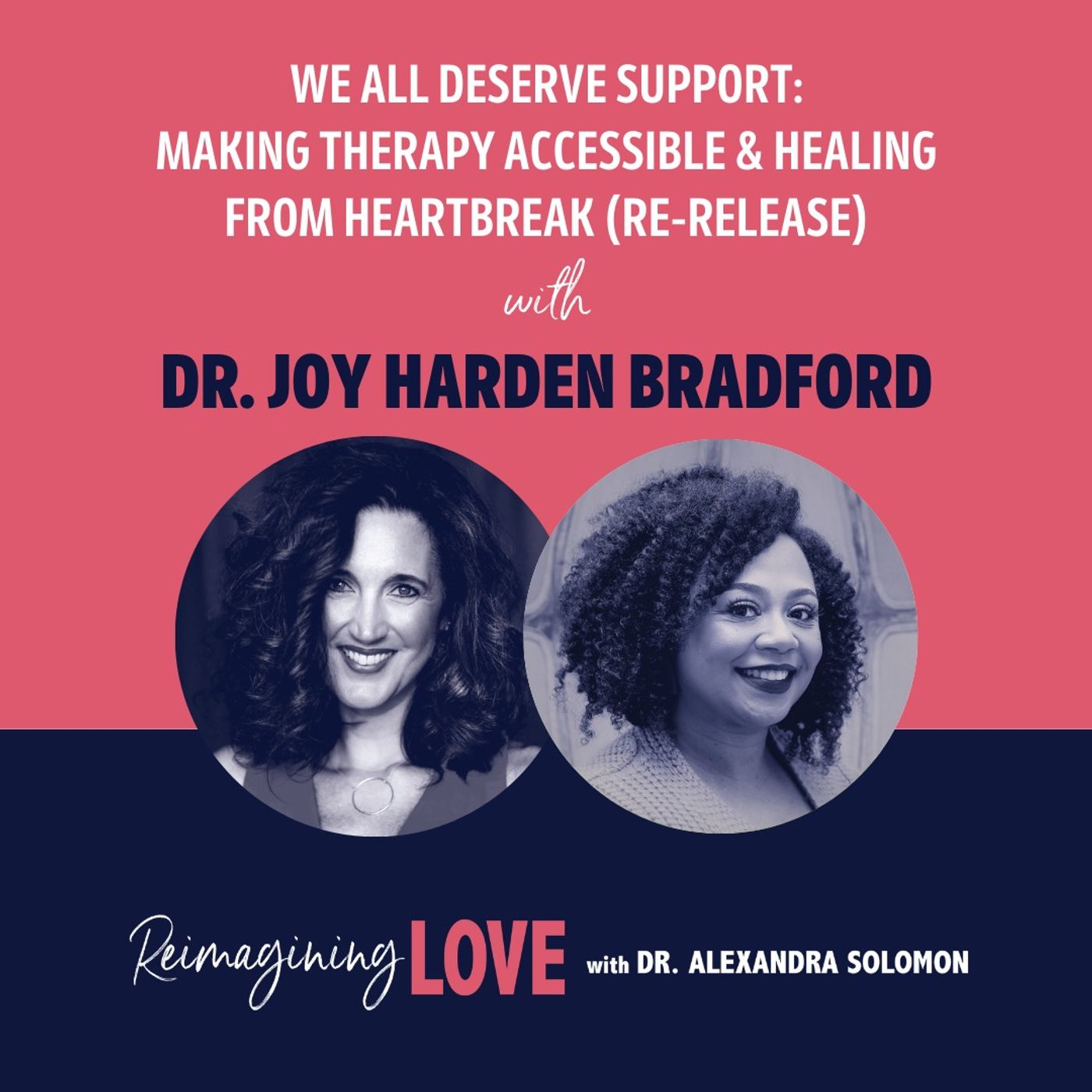
We All Deserve Support: Making Therapy Accessible & Healing from Heartbreak with Dr. Joy Harden Bradford (Re-Release)
About this Episode
Dr. Joy Harden Bradford, founder & CEO of Therapy for Black Girls, joins Dr. Alexandra to discuss her mission to make mental health topics more relevant and accessible for Black women. They also discuss what to look for in a new therapist, the personal growth that comes from breakups and new beginnings, and a listener question from a single mom who's struggling with FOMO.
Resources worth mentioning from the episode:
- Therapy for Black Girls (including the online therapist directory): https://therapyforblackgirls.com/
- Dr. Joy's website: https://hellodrjoy.com/
- Therapy for Black Girls Podcast: https://podcasts.apple.com/us/podcast/therapy-for-black-girls/id1223803641
Continue the conversation with Dr. Alexandra Solomon:
- Ask a question! Submit your relationship challenge: https://form.jotform.com/212295995939274
- Access Resources, like quizzes and courses: https://www.dralexandrasolomon.com/resources
- Order Dr. Alexandra’s book, Love Every Day: https://bookshop.org/p/books/love-every-day-365-relational-self-awareness-practices-to-help-your-relationship-heal-grow-and-thrive-alexandra-solomon/19970421?ean=9781683736530
- Cultivate connection by subscribing to Dr. Alexandra’s Loving Bravely newsletter: https://newsletter.dralexandrasolomon.com/
- Learn more on IG: https://www.instagram.com/dr.alexandra.solomon/
Learn more about the Options Transition to Independence Program which offers education, vocational, independent living, and emotional support for young adults with complex learning needs. https://www.experienceoptions.org/
Hosted by Simplecast, an AdsWizz company. See pcm.adswizz.com for information about our collection and use of personal data for advertising.
Hosts & Guests
Transcript
From unsolved mysteries to unexplained phenomena, from comedy goal to relationship fails,
Amazon Music's got the most ad-free top podcasts, included with Prime, because the only thing
that should interrupt your listening is...
Well, nothing.
Download the Amazon Music app today.
Hello, and welcome to Reimagining Love.
I'm Dr. Alexandra Solomon.
I have been studying relationships for over 20 years, as a couples therapist, a professor,
an award-winning author, and as a wife, mother, daughter, sister, and friend.
Now, I'm inviting you into this space each week as I dig into some of the toughest and most fascinating relational dilemmas of our time.
If you want to discover how to create vibrant and loving relationships in your own life, you have come to the right place.
This is Reimagining Love.
Hello, and welcome back to Reimagining Love.
Today, we are re-airing an episode that features Dr. Joy Harden Bradford.
The reasons that I've chosen this one for you are, number one, and love her work with therapy for black girls,
helping make therapy more accessible for black women.
Number two, I love how she offers us an excellent breakdown of green flags to look for when seeking out a therapist.
And number three, I love how she speaks about building a new beginning out of a breakup, and she talks about this in such a compassionate way,
and through such a modern lens.
This is really important, because we have many different tools at our disposal these days in the modern landscape,
and our relationships look really different too.
So I think this is a nice companion episode to Amanda McCrackens, where we spoke about healing from Limerence.
I have so much compassion for how hurtful endings are, and how profound the loss is, and at the very same time,
how we can build something that is beautiful and uniquely ours out of the pieces.
Let's get into it.
Dr. Joy Harden Bradford is my guest on today's episode.
I'm really excited for you to get to know her, and hear our conversation.
Dr. Joy is a licensed psychologist, a speaker, and founder and CEO of Therapy for Black Girls, and the host of its wildly popular Mental Health Podcast.
Her work focuses on making mental health topics more relevant and accessible for Black women,
and she specializes in creating spaces for them to have fuller and healthier relationships with themselves and others.
Dr. Joy is currently writing her first book, Sisterhood Heels, which is set to release in the summer of 2023.
In this episode, Dr. Joy and I get straight into the good stuff.
We talk about stigmas and accessibility issues in the mental health field, and her mission to normalize and promote therapy and support especially for Black women.
Dr. Joy also specializes in helping clients heal from breakups, and I loved her wisdom and offerings on that topic.
We also discussed a great listener question from a single mom who is experiencing some serious fomo, fear of missing out.
Finally, if you are considering starting therapy, Dr. Joy and I talk about green flags when you're looking for a therapist who's a good fit for you.
There is so much goodness in this conversation, I hope that you love hearing from Dr. Joy.
Dr. Joy, thank you so much for being here with me today, and so glad to have a chance to meet you.
Thank you, we've been chatting on Instagram DM, so it's great to actually be chatting video wise.
I love that, I love that transition, for sure.
Thank you to Instagram, it's how we oftentimes meet wonderful people who are doing wonderful work, but it's nice to go from there to something a little more real.
I agree.
I know that for all the reimagining love listeners who haven't yet discovered you in your work, I know there's going to be just like a great synergy, so I'm excited to make this introduction to listeners who perhaps haven't discovered you yet.
Okay, so on via imagining love, we start from a place that we are whole as we are and also these bodacious blends of growing edges.
So I would love to ask you our relational self-awareness question, are you ready for it?
I'm ready.
Okay, so Dr. Joy, what is a growing edge that you are currently working on in one of your important relationships and what has it been teaching you lately?
This is a very big question, but also a lovely question I like it.
I think the growing edge that I'm working with mostly is the relationship with myself.
So it just feels like in the past, you know, three plus years of the pandemic, there's just been a lot going on.
I think I am being stretched in a lot of ways, but also trying to hold a lot of different things.
And so I think one of the growing edges for me is really being more self-compassionate and really being gentle with myself.
You know, I feel like before the pandemic, there was a lot of go-go-go.
And that kind of slowed down in the past couple of years, but also not really.
You know, so there's been lots of virtual presentations.
I'm also writing my first book.
My kids have been virtual schooling, so you know, they did go back in person just a month ago.
We just want a new house.
So there's just a lot that's been going on and it feels like there's been a lot of competing things for like my energy and time and focus.
And so I'm really trying to do a better job of like balancing, well, maybe not balancing, but like, okay, what needs my attention right now and being okay with not being able to kind of be all things at the same time in all of those places.
Right.
Knowing that at the end of the day, you can either focus on what you were able to get through or you can focus on all the things you didn't get through.
And there's one path that is far more compassionate than the other path.
Right.
You named all these like layers of complexity with the pandemic, but especially as, you know, as clinicians, right?
It's holding and being present to our clients challenges while we have our own challenges of homeschooling little, you know, homeschooling kids and for you writing a book and for you.
I imagine also is a BIPOC clinician just sitting not just in the pandemic pain, but also these added layers of the racial reckoning and the inequitable fallout of the pandemic.
And so I can imagine it for everything I have felt as a clinician, you know, on those emotional front lines.
That much more for you and the work that you do.
Absolutely.
I mean, you know, even of course the pandemic, like there were racial pieces to that, right?
Like very early on, we found out that black and brown communities were hit hardest right in terms of the rates of people both contracting COVID, but also dying from COVID.
And so, you know, the work that I do with therapy for black girls really kind of require me to kind of have these spaces where people could kind of like process their grief,
but also get a better understanding of what was happening for them.
So we had that part of the pandemic, but then we also had, you know, the murders of George Floyd and Breonna Taylor.
You know, so again, we're just all trying to like keep ourselves safe and keep our family safe from this virus.
And then there's also these continuing acts of racism that we needed places to process.
And so because of the work that I do, it definitely required me.
I think it's you kind of stretch and kind of be available to my community so that we could, you know, do the gathering that we need to do to kind of process how we're feeling.
And so you look back to feel proud of what you were able to offer and create during those months.
Absolutely.
I mean, I feel like I have always been really proud of the work, but I definitely feel like this stage of my career kind of just given what was going on in the world really required me to stretch and do some things differently.
As a clinician, you know, and I just think my career itself just fascinates me.
You know, because you know, six years ago, like if you had asked what my career looked like, it would not look like it does now.
I still have a very small private practice, but most of my work is, you know, the podcast and doing public speaking and those kinds of things.
I have been very proud of the work that I've been able to do during the pandemic.
And I'm just excited about, you know, being able to continue doing some of this work.
I can imagine because everything, well, your podcast is huge and it's magnificent and it's thoughtful.
And I can tell how much heart and brain and soul you bring to it.
Like I'm just imagining your listeners are obviously people out in the community, but also I imagine how many clinicians turn to your podcast and then as a source for themselves.
And then they go into their week, right, of the 20, 25, 30 clients that they're going to serve and you have nourished them so that they can go and do what they need to do.
And so you're still in the trenches doing clinical work, but you really have stepped into this other space where you are providing a kind of like a nourishment, right?
Like sort of serving the servers in that way.
Yeah, like nothing grad school could have necessarily prepared me for it.
Yeah, no, the skills I think are transferable, right?
Like I think that's one of the coolest things about being a psychologist is that we do learn skills that really can transfer to lots of different ways to kind of practice or, you know, offer clinical information.
Well, that's a whole separate conversation isn't it about the training, right?
Like how I mean, I can imagine that all of our graduate programs are just like trying to play catch up of what we all are doing now with this work,
the platforms that we're building, the ways that we're taking this field and all kinds of directions like these I think often finds what these poor graduate programs that really still do just need to do what they're doing, which is provide really, really solid clinical skills because nothing else can get built unless you are turning out clinicians with really solid skills, right?
So they've got to stay in their lane, doing what they do.
Thank you to all the programs that are providing excellent, excellent clinical training. So that we can then be like, OK, how are we going to bust out? Where is it going to go next?
Right? How do we transform?
It is really cool, I think, but you're right. I don't think the programs and like our professional boys, like I think that they're trying to do a little bit of catch up to keep up with all the ways that we are growing, I think so quickly.
Yeah, you began your business therapy for black girls back in 2014. Could you have imagined like tell us a bit about how it has grown over the years and when those moments have been where you've been like, oh my gosh, like this is entire movement.
Like what has that journey been like for you?
Yeah, you know, I started in 2014, I started it as a blog. So I had watched the black girls rock awards show on BET and like the energy even through the TV screen was just palpable.
And so I thought, wow, it would be cool to capture even just a little bit of this energy related to black women for mental health.
And so I came up with the name, the domain was available. And so I bought it and just started blogging on this site about what kinds of questions would you ask a therapist who you were interested in working with and how do you make the most of your support system really just you know trying to do some outreach.
So my background is in college student mental health and outreach presentations were always my favorite things. And so I kind of saw the blog as a way to kind of do written forms of the outreach presentations that I had already been doing.
But then it just kind of took off and then we added the therapist directory. So I continue to see these conversations online of people saying, oh, I really love to work with a black therapist is anybody have a recommendation for a great black woman therapist.
And so I thought why why isn't there a place where these recommendations are collected like can we get a list going basically.
And so I started a Google doc for people to recommend their therapist of you were a black woman who had had good experience with the therapist.
You shared their name in a Google doc and then I compiled them by state for other people to be able to reach out. So that very quickly turned into something that was not manageable like just by me anyway.
Because of course like you built it and they came and they came right was not at all expecting it.
And then as therapists heard about it, they wanted to add their information. And so again, it just got very unwieldy very quickly.
And honestly, like I am very tech savvy, but not the degree of tech required to like power something like the directory.
And so I avoided it for a while like I didn't really want to do it because I was very intimidated by the technology I knew was going to be needed to kind of get it off the ground.
And so it was a lot of like calling colleagues and people introducing me to people so that I can like find somebody to build this thing that would allow people to add themselves.
So I finally got a first iteration of the directory, but at the same time I also added the podcast to the therapy for black girls business.
So in the way the podcast came about is that you know, I was doing therapy for black girls, but I was also the director of the counseling center at Clark Atlanta University.
And I had a 45 minute to an hour commute each way. So I started listening to a bunch of podcast and thought, oh, this is really cool.
Like I feel like there are some conversations we could probably have in therapy for black girls that would play nicely as a podcast.
And so I started it thinking like, oh, this sounds really easy. Like it's just people talking, of course being on the other side.
Now we know a little more involved. It's far more involved.
You know, people make it sound effortless, right? Like that's I think the work of a great podcast is that it sounds like it's just people chatting, but there's tons of hours of work, you know, on the other side.
So the podcast is really, I think both the podcast and the directory kind of took off at the same time. So it's really kind of hard to say like which one kind of exploded first, because it feels like they kind of happened simultaneously.
And no, you know, to your earlier question, I could not have imagined that it would be where it is, you know, like we do some promotion for the podcast and the directory, but a lot of it is word of mouth, which is incredible.
I just feel so grateful to have such an engaged community of people who like love the podcast or find a great there, presumably they just want to tell the world about it.
So a lot of our, you know, promotion really happens because of word of mouth. So I'm very thankful and grateful for that.
Ambassadors who have said you all should know about this therapist. She's doing good work.
You identified and stepped into a need, right? Like that's why this is all caught fire is that you named a problem, which is that black women's voices have historically been silenced and their mental health concerns have not been centered the way that other groups mental health concerns have.
Can you talk to us a little bit about why it's so crucial for black women to have spaces where they can unpack their unique experiences and challenges.
But you know, I also talk about the fact that I feel like I had been doing therapy for black girls before it had that name.
So on the college campuses that I was on, I was always running a group for the black women students on campus.
You know, you know, the history of our field, you know, it was developed mostly by older white men.
And so when all these theories and, you know, concepts were being developed, that was not language or we were not a part of like the development of those things.
And so while there are some things that kind of are the same for our population in our community, there was a lot of things related to psychology and mental health that just looked very different for black women.
And because we were not a part of like the history and the building of the field, there has been a lot of stigma related to mental health, especially in the black community.
So the idea that you would talk to a stranger about some very personal things like that's just not something that a lot of our families have had a history of doing.
And so when you're talking about what kinds of things do we need to do to be well, you have to approach that I think very differently for black women.
You kind of you typically have to kind of go to where they are, which again was why outreach was always one of my favorite things because it felt like an opportunity to take what we were doing in the counseling center and bring it to the students.
So let's go do these presentations in their residence halls and let's go do it at their student organization meetings.
I kind of see the work that we do is therapy for black girls at therapy for black girls is like outreach kind of magnified really kind of bringing psychology mental health to people where they are.
And then the numbers have not been there right like the it is the reason that you needed to create a directory is it is very it has historically been very difficult to find black clinicians black female clinicians or black.
And so I imagine there's this like beautiful iterative process that you have kicked off where the more black women black people can see you see black clinicians like kind of know that therapy is not sitting with a white part you know an old white person whatever like whatever notions whatever stereotypes there are about therapy that are perpetuated by media and mythology and whatever it becomes this like feedback loop where the more you show listen this is for us.
This is done by us and for us I know that the graduate program that I have been involved with I see so many more black trainees coming into the program and that's really really encouraging that's also how we make this right and create the shifts that need to happen by inviting by inviting more black women into the field black men into the field too for that matter.
Yeah I mean you know the unfortunate part is that you know there's been so much excitement and so much need that there are tons of people who want to perhaps work with a black woman therapist and then everybody just full right you know so the number still are not there so I'm very excited to hear that more trainees are coming you know kind of in the pipeline because that's definitely needed the reality is that even if every black woman wanted a black woman therapist like they're just a not enough of us to go around.
So that means that you know maybe they have to either you know wait on the wait list or they you know will see somebody who is not a black woman you know so that means that non black therapist also needs to be doing their work so that they can create spaces where black women can have positive therapeutic experiences.
Hi reimagining love listener this is Brian Solomon Alexander son I want to tell you about a very important program that changed my life it's called the options transitions independence program locating carbon
the options program offers educational vocational independent living and emotional support for young adults with complex learning needs.
I heard the options program in the fall of 2021 after graduating high school and a group tremendously in these areas as a person as a whole.
I graduated from the program four years later and I live independently now work in a months away from completing my college degree.
The options program is a great job supporting young adults who have been struggling throughout their lives and with various areas with its school getting a job or executive function is just routine management time management social awareness and more.
If you are a parent of a team trying to figure out the next steps of anyone in your family or community my benefit from the program or maybe you are a therapist with clients who my benefit from the options program I cannot thank recommend options highly enough to learn more had to experience options dot org and you can also find that link in the show notes thank you for your time.
Snoring, gasping during sleep, feeling fatigued, wake up to Zetbound to Zepatide.
The first and only FDA approved prescription medicine for moderate to severe obstructive sleep apnea, OSA and adults with obesity.
Zetbound is an injectable prescription medicine that may help adults with moderate to severe obstructive sleep apnea, OSA and obesity to improve their OSA.
Zetbound should be used with a reduced calorie diet and increased physical activity.
Zetbound is approved as a 2.5, 5, 7.5, 10, 12.5 or 15 milligram injection.
Zetbound contains tersepatide and should not be used with other tersepatide containing products or any GLP1 receptor agonist medicines.
It is not known if Zetbound is safe and effective for use in children. Do not share needles or pens or reuse needles.
Don't take Zetbound if allergic to it or if you or someone in your family had medullary thyroid cancer or multiple endocrine neoplasia syndrome type 2.
Tell your doctor if you get a lump or swelling in your neck. Stop Zetbound and call your doctor if you have severe stomach pain or a serious allergic reaction.
Severe side effects may include inflamed pancreas or gallbladder problems.
Tell your doctor if you experience vision changes, depression or suicidal thoughts before schedule procedures with anesthesia.
If you're nursing, pregnant, planned to be or taking birth control pills.
Taking Zetbound with a sulfonal urea or insulin may cause a little blood sugar.
Side effects include nausea, diarrhea and vomiting, which can cause dehydration and worsen kidney problems.
Talk to your doctor, call 1-800-545-5979 or visit zetbound.lily.com.
Zetbound and its delivery device base in QuickPin are registered trademarks owned or licensed by Eli Lilly and company.
It's subsidiaries or affiliates.
When you are talking to black women clients who are entertaining the idea of working with a non-black therapist,
what is it that you want that client, potential client to know and feel in order to know that she can actually let her guard down and take the energy and take the risk to invest in a interracial therapeutic relationship.
Because we know the therapy relationship is real.
It is a real relationship and you have to feel that sense that my therapist has my back, my therapist is in my corner, my therapist is competent, my therapist wants to understand me.
Are there particular questions or felt senses that you want a prospective black client to feel and know and ask for if she's going to consider working with a non-black therapist?
Yeah, so I think it is okay to be very upfront in those initial consultations about what you're looking for.
And to be able to ask a therapist like, do you have other black women on your caseload?
Can you talk to me about your comfort and expertise in working with other black women clients?
I also encourage people to be open to surprises.
You may have wanted to work with a black woman therapist, but there's also some incredible clinical work that you can do with people who don't come in the package that you expected or maybe we're looking for.
I encourage people to be open to the process, but I also think that so much of that is on the therapist.
And I think our earlier conversation around like training programs, I feel like this is where some of our training programs have not always done a great job in terms of you can't bring a topic to the therapeutic environment before the client does.
I feel like that's a clear miss because I feel like the therapist, it's your responsibility to name.
Hey, we're very different in this experience, and I just want you to know that if there's something that comes up around race or whatever, you can talk about that here, but a lot of therapists don't.
And so I think that that seems a very clear message and that's untalkable.
And of course, as therapists, we never want to give that message, but I think a lot of our training has really kind of led us to feel that way.
So I do think that there are some things that potential clients can do, but I think the onus really is on the therapist to make sure that they are naming these issues and making the the client feel comfortable in that space.
100%.
And I suspect that there is a difference in the experience of a non black, but still by pop therapist and a white therapist, right?
Because as a white therapist, I know that naming race in the room goes against everything that I have taught about whiteness, right?
I have been taught from an early age, it is not polite to talk about race, which is part of how white supremacy, you know, keeps itself where it is.
So I that is absolutely in my work and in my training, it is incumbent upon me and the folks I'm training that there is something that you bring into the room.
For exactly the reason you're saying is our clients follow our lead. If I'm not explicit about, you know, you can talk about sex in this space.
There's no way a client's going to talk bring up their sex life unless I model that we can talk about racial difference.
We can talk about gender difference. All of the differences that uses in our relationship then become as we like to call it grist for the mill, but to write the responsibility 100 times that of 100 is on the therapist to be the relational leader.
In that way, yes.
Okay, so I know that one of the things you really love to work on in your clinical work is helping people through breakups and moving into new beginnings.
What is it that has drawn you to that clinical specialty of breakups?
So you know, it was something that I kind of found as a pattern and probably because I was doing a lot of college student work, right?
You know, and so it feels developmental that a lot of times that's when you have your, you know, maybe first major heartbreak.
And so I just kind of saw it as a theme and then thought like, oh, this is something that I could kind of just make my thing.
And I also think that it at least has been my experience for women.
A lot of times that there is this transformation and like new things that open up after a breakup that like you just didn't even consider, right?
Like it's kind of like all of this facade and like all of these stories that you had built up really come crumbling down and then you have a new opportunity to make something different out of these pieces.
And so I also think that it's just an incredible honor to be able to sit with someone on the side of it and really just an honor to witness like what people rebuild of their lives on the other side of like this major devastation.
Yeah, as you say that it's hard for me to think of another kind of cracking open that has that kind of opportunity, right?
It is such that like both and of devastation and opportunity like other kinds of grief death and other kinds of loss.
So there's something that is so ripe about devastation and loss and that right people don't where are we ever supposed to learn how to move through a breakup well.
And so it oftentimes is in a therapist's office that folks are trying to figure out how you tend to a broken heart, how you learn what you want to learn and what's available to learn, how you know when to move forward, how you move forward.
Yeah, and I also feel like you know in society and like in our peer groups like there isn't always the reverence I think for breakups that there is for maybe even like a divorce or other kinds of losses.
So I think it kind of taps into that disenfranchised grief where you know people tell you like oh just get over there plenty more people today you know like that kind of thing.
And I don't think that that really helps people it really kind of you know wants to rush them through this grieving process when really they need us a space to sit and kind of feel all of the emotions that come with the loss of this relationship.
But also the loss of whatever story we had attached because a lot of times it is the story that is more devastating than it is like the loss of that person.
So I think being a therapist who who gives people space to do that is really something valuable because you don't always get that in even your friendship circles.
That's right. Yeah, friendship circles very often are yeah I mean it's you know what we would call like the idiot compassion right of like they didn't mean anything or they were never I didn't like them from the beginning or you know let's get you drunk.
Let's get you the best way to get over someone is to get under someone new all of this that is perhaps done from a place of love and care but but really invalidates the grief and puts people at risk of just kind of glossing over the loss and diving into the next thing.
Yeah, what do you feel like are some common mistakes that therapists might make in their work with somebody who's going through a breakup like are the things that you things you worry about therapists doing or promoting when a client has come in and they want to work on their breakup or need to work on their breakup.
Yeah, I think one is the pacing right so I think even therapists can sometimes in some ways minimize like the devastation that happens after a breakup I think particularly with younger clients you know so like college.
Students you know because of course when you're a little older you know you know just from your own history like there will be so many other hard breaks and you know but that first one I think it is really hard.
Or even one of those early ones and so I think unintentionally therapists will sometimes try to minimize that as well which I don't think you know of course like we just talked about helps.
The other thing that I see therapists often miss is the real need to disconnect from an ex on social media so I think you know for therapists who maybe aren't you know as social media savvy or don't quite get that whole world.
That's a huge piece of the treatment plan that I think can be missed because a lot of work with clients at least you know probably in the past five years has been around like okay well how are you still connected to this personal social media.
Even if you're not talking with them anymore are you still you know visiting their Facebook page and paying attention to their Instagram page and looking at their Instagram stories right.
So I think if you're not somebody who is really kind of in that world that can be something that's missed but is really really important in the healing after a breakup.
Absolutely I just went through this with the client where I had done some screening around like what is the contact that she has with this acts on social media so I you know obviously I know I know to kind of check in with that but it was so sweet she showed up for a session she had a little sheepish look on her face and she let me know that even though she has set her Instagram so she can't see his stuff she is still looking at the fact that he looks at her stuff.
And and she has identified clear as a bell that that triggers a whole set of roomative thoughts of course right of course of course of course and so much the same way we do with somebody when we're kind of moving through any other kind of addictive or compulsive behavior you know I was just like okay what is the little baby leading edge that you might consider around just a tighter boundary and it's listen it's objectively difficult like people have got their like their zeal accounts sometimes.
Well you know you'll see things so it is it's hard to and every single one of those cutting of those energetic you know chords is another step into the grief so I get that it's hard but I think you're so spot on dr joy and saying that therapist especially therapists of a certain age or therapist who have been in a longer term relationship themselves and so they haven't gone through that kind of partnering breaking up really really do need to stay you know stay.
So it's really educated on what's going on and then just really be in the weeds with clients about where all the places that you might see because seeing an air quotes your acts on social media and seeing them in real life for your brain your brain doesn't really know the difference between those two things right so it is it's so hard let go it's so hard to kind of close those final tabs that makes the grief so much more real but when they aren't close it makes the healing so much.
Yeah and I find that is the hardest part of the the treatment planning so to speak with clients after a break up is like that digital disconnection you know which is interesting because like 10 years ago like this wasn't even a part of the work you would necessarily be doing with the client around a breakup right so for all the great things and I think social media has introduced it has also introduced all these other things that I think for break up but also for lots of other mental health concerns like there's this component to social media and like.
Our digital spaces that you also really have to pay attention to yeah so maybe the takeaway for someone who's listening is to really notice what happens in your body you know before you open up Instagram when you see that they read your story how that feels when you see that how it feels after where do your thoughts go like really paying attention to that data of your body because our bodies communicate to us clear as a bell very often it's just that so often we're used to overriding or saying it's okay I can handle it.
It doesn't really bother me that much but to get really curious about all those little shifts that happen inside of us when we open up you know an app and see something from an X.
Yes.
The first piece you named also about a concern of yours about therapists struggling to pace in the wake of a breakup that makes a lot of sense to me also and I think it is a risk especially with younger clients that therapists are risk of kind of minimizing either a brief relationship or relationship that's been in place.
I know I am a few years ago I sponsored a Northwestern undergraduates honor thesis and she pulled together three of the most progressive feminist sex ed curricula and she did kind of this really cool thematic analysis looking for themes of power and pleasure but one thing she found in her thematic analysis that we hadn't even gone looking for was how much even in these very progressive curricula.
Very progressive curricula young relationships were minimized like there were like terms like puppy love or it's not real love or it's just a crush and so I think that really like was such an aha moment for me around a particular kind of cultural myth that if you're young you don't know what love is and if you're young it can't really matter that much it can't be that devastating so I think that point you just
made about therapists working with younger clients emerging adult clients on these first breakouts like really do need to hold the sacredness of it because that cultural mythology can lead a therapist to miss it and minimize it and rush through it.
And you also just named her another really important point that I think is important to pay attention to like the ambiguous relationships right so you know I think especially for younger people like they are reimagining relationships and all kinds of different ways right and so you know they are these things they call situations ships and like lots of different things that are meaningful to them but like publicly nobody maybe even knew that these people were together.
You know but it can still be a major loss and I think an even more detrimental loss because maybe nobody knew about it right so it was like this secret thing and then it ends and so maybe the therapist is one of the only places you have to even be honest about the fact that this thing was happening you know so I think that that's something else that therapist wants to be aware of is that there are lots of different reimagining of relationships that you do want to be mindful of that those losses can be really big for people to go.
That's just so important that's right because that clients relationships story doesn't fit in some sort of neat narrative box that lives inside the therapist brain it challenges a therapist to really de center the therapist own notions and beliefs about what relationships are called the sequencing of commitment and really just get so curious about what did this person mean to you who did you get to be when you spent time with the therapist.
This person what parts of you were you not allowed to express because you had to be playing it cool because it was just a situation ship and could you for the very first time perhaps in this conversation with me and therapy with me let yourself feel how freaking much you like them how freaking excited you were about the possibility that it might move from a situation ship to something more right but if all of that stuff is buried.
The client is very much at risk of getting stuck in having that like incomplete invalidated grief.
That was so beautiful how you just worried that that feels like an invitation just to say more right like I think the wording we use is just so important.
The wording we use is so important does it open it up or does it shut it down yeah it's a big question but let me just let me just try it because I I know that you've got a good answer to this.
What do you want people to know about how do you know in a therapist is a good match for you like what do you you know what do you like people to be like listening for feeling for when they know it's a therapist is a good fit for them.
So one of the first things that comes to mind is this feeling of like oh I can't wait to talk with her about this right so this even when you know it's going to be difficult like you're already keeping a mental tally of I can't wait to go to therapy to talk with them about this.
Because I know that they're going to be but it helped me in some way or I can I feel safe to share that there I think that that is a huge sign that you feel safe and comfortable in that space.
So I think that that is one of the feelings to kind of be mindful of and pay attention to I think early on in the process you may not quite feel comfortable like saying like a big secret you know or the thing that brings you in that you don't even want to acknowledge to yourself.
So you may not feel comfortable staying immediately but could you see yourself eventually sharing it with this person right like are you already feeling like okay we can have some you know good conversations here I feel seen by them.
I feel like they get me I don't feel like they're questioning whether this thing I shared actually happened and so when I get ready when I feel more comfortable I feel like I will be able to say this thing here.
So I think that that's something else me being attention to but I also think it's really important to pay attention to feelings very early on of this just doesn't this doesn't feel right.
And I think especially for black clients because there tends to be this like weird dynamic around authority and you know like this person is here to help me until I kind of got to just power through it.
We can sometimes like dismiss our own like intuition and like our own thoughts and feelings about how we perceive an experience so if early on you're getting some signs of like I just don't feel like this is right.
I think it's okay to one have that conversation if you can name with your therapist like what doesn't feel right but also if you feel like you know what I don't see myself even getting to a place where I'm going to be able to share that it's okay to kind of.
Terminate that relationship and look for a therapist who you feel like is going to be a better fit and I think a lot of people get very weird and very anxious about like breaking up with a therapist but we as therapists we know that that's a part of the process right.
So you're not necessarily hurting our feelings we want you to be well and you know to be able to do good work even if that's not with us.
And so it is a real I think it one that's a huge assertiveness step that other people struggle with so it's just good practice to be able to kind of name your needs.
But it also is a great way I think to really practice listening to your intuition and doing something that feels like this is something that is more in line with who I feel like I need as a therapist.
Oh beautiful number one are you looking forward to talking about is like oh boy okay I know I know that we're going to have a really rich conversation about this like that positive anticipation.
Number two even if I haven't shared with you my really challenging secret I can start I'm getting closer and closer to imagining that I could share that.
And then three if I've got a twisty feeling in my god or I have felt missed or misunderstood by you.
I love the idea of a client giving a therapist a chance you know and raising it and name it like you said it might be a you know I think especially for a black client such a risk because if a black client takes the risk especially if the therapist is a white therapist in the
there but in the white therapist dismisses it it feels a not like another micro aggression on top of a big old stack of other.
Microgressions are painful misses but I do love the idea of I mean every client is authorized to bring any piece of feedback to their
therapist it is essential it is vital because it's a real relationship and it can be that practice ground and any therapist worth their
fee knows how to metabolize feedback and not get punitive and not get whatever sassy or dismissive I know especially when I'm working with when I'm working with black clients that is vital like when a black
client of mine will take the risk to say I felt misunderstood by you in this moment I am so grateful for the chance to see if we can initiate a repair that is huge you
therapist are people and they're not perfect and there are a lot of therapists who aren't good therapists or aren't good therapists for you then right can you can you break up and go but that's a really
helpful framework that your joy really helpful.
Hi reimagining love listener this is Brian Solomon Alexander son I want to tell you about a very important program that changed my life it's called the options
transitions independence program locating carbon Dale Illinois the options program offers educational vocational independent living and
educational support for young adults with complex learning needs. I heard the options program in the fall of 2021 after graduating high school and a group
tremendously in these areas as a person as a whole I graduated from the program four years later and I live independently now work in a months away from completing my college
degree the options program is a great job supporting young adults who have been struggling throughout their lives and with various areas
with school getting a job or executive functioning just routine management time management social awareness and more if you are a parent of a team trying to
figure out the next steps of anyone in your family or community my benefit from the program or maybe you are a therapist with clients who
might benefit from the options program I cannot think recommend options highly enough to learn more had to experience options
.org and you can also find that link in the show notes thank you for your time.
Okay well let's see what we can do for Lauren so we have a listener question from Lauren who writes in from Texas she uses she her
pronouns and what she wrote to us is how do you deal with FOMO the fear of missing out it's something I've struggled with for years in my
relationships and currently in my intimate relationship I've been a single mom since I was 18 so for the last 11 years most of my friends and my
current partner don't have kids so at times it's really hard for me to sit and watch them go out and do things I can't afford and or don't have the
time for I really want to be happy and excited with my friends and partner talk about the upcoming vacations are taking or going to fun
events but instead I'm usually left feeling resentful and lonely my partner and I have been trying to work through these
feelings but we don't know how any advice or tools would be greatly appreciated thank you.
Okay Dr. Joy what what stands out to you about this question.
So thank you for that question Lauren that is an important question I think you probably you are well I know you're not alone in feeling
that way I think a lot of people the fact that we even have a term called FOMO lets us know that lots of people feel this way so I think it's
brave of you to name that for yourself like I feel really insecure about this I feel left out so a couple of things that stood out to me
was being a single mom since 18 so I would imagine that that was not the vision that you had for like how a pregnancy in parenting would
go and and my feeling is that or what I would want to know more about is like what kind of story you've created around
being a single parent since 18 you know so I'm sure that you had to make very different choices that maybe you
planned right so did college still happen did it happen on a different time frame what your parents supported like I
would want to know all of that because it it kind of feels like there's an undercurrent of I missed out on a lot
because I was parenting by myself at 18 right at 18 when we are all well a lot of us are still trying to figure out who we are now you
have been responsible for someone else and so I would want to know more about like what story you created about who you were as a mom
and being a mom at that time in your life so that's one I would also encourage you to perhaps have this conversation with your friends in your partner like are there ways that the friendship can be
more expensive to include things that you also can participate in given your time in your budget you know so it may be that they are just not
aware or you know what often happens is that you say no so much than friends stop inviting you I hope that's not
happening but if it is like can you you know get more creative around what kinds of things we can do that still allow us
to have a lot of fun you know can we go have a picnic in a park somewhere can we go on a on a hike somewhere
and somebody do more in terms of babysitting for you or maybe not babysitting because the baby is probably not such a baby
yeah she's a lot of it's she's she's supervision 11 but still need supervision right yeah so I mean so is there a friend who
could you know be with your child for a weekend while you go and do something or just even not go do something just be
along with your thoughts right sometimes that is hard for moms to get you know so I would encourage you to have this
conversation with your friends to see in to be honest not in a shaming kind of like you did this to me but here's how I'm
feeling I just honestly want you also know I often feel left out and I wonder if there are ways that we could
think about doing more so that I feel more included in activities as well yeah I'm trying to hold on these two
tracks one track is her FOMO makes a ton of sense like it is objective reality she does not have the
kind of agility that she's watching her friends and her partner have and I was wondering much
in line with what you're saying if the FOMO is pointing her towards some unresolved grief work that she
may you know like I don't know what happened like you were you know you were wondering about kind of how was
this plan was a division who supported you and as it was happening were you able was she able to
grieve was she able to really work to I don't know what the emotions like was she able to move some
anger through some shame through like to create like what was her emotional processing in getting
ready to become a mom at 18 I know there was I imagine there was a lot of logistics that had to
get figured out but it's also it's a lot to ask an 18 year old to do that kind of emotional
processing but it means that she now at you know in her late 20s has the chance to almost
like reparent the 18 year old self of hers right so I would love for her to be able to do some
really gentle work around you know I don't know if she needs to forgive her 18 year old self love
on her 18 year old self celebrate what that 18 year old self was able to do despite at all
but I have wondered if some of that FOMO that craving resentful may just in part heart its reality
base is it also in part showing her some reckoning she needs she needs and deserves to do with herself
so that she can then feel really proud of whatever she's been able to accomplish within these constraints
over these last 11 years very questions I really love that you pointed us to community care right I wonder
if she had been she had imagined there would be more care from her parents or from her partner
and she maybe has felt deeply disappointed and let down by what wasn't there but I wonder now 11 years
in who is in her corner who might she be able to is there a community of other single moms
that she could create you know rotating schedule of kind of like I mean that's that's be fun for kids
I can imagine I have a chance to be with other loving families and let her as you said kind of tag
out for a bit or have some enough of a version of these kinds of experiences that she feels
just a little more satisfied a little more content that her life has different elements to it
you know I mean the amazing thing about this is she's going to be probably less than 40
when this little child of hers is often the world so I'm also hopeful for like what
the sort of quote unquote normal thing the thing that we have sort of said is the normal right way of doing life
is that you're free and easy and exploring the world in your 20s
well maybe she's free and easy exploring the world in her 40s and 50s
I tell you what that might be I mean I feel very hopeful for her next chapters
and her reimagining of what her life gets to look like and that her child will then get to see her
reimagining and celebrating and growing herself in these ways because her child has grown
and you know she's going to be a young and vibrant for a long long time God willing
and able to create more for herself going forward
yeah I think that that's a beautiful part right like this when you're in your 40s and 50s
sometimes you have more resources and more you know just kind of wherewithal
to kind of be able to make to really appreciate like that freedom than you did in your like early 18
or late teens and early 20s right like you typically don't have a lot of money then
you know your your entire brain is not even fully developed at that point right and so
what could this look like and can you look forward to what it looks like once you know your childhoods
of age and maybe out of the home like what could that look like what new phase
might you be able to walk into your life yeah I think the grief work and the compassion work
and the kind of making sense of that chapter of becoming a young single mom like doing that
like turning backwards to do that work maybe is then what frees her up to start to get excited
about what's for because she's stuck right means she's telling us she's stuck
I'm stuck in a cycle of resentment and formal okay well that's that's because something is
holding you back and if an ad she's able to tend to that really gently I imagine it will kind of
loosen her up or create some spaciousness inside of herself to imagine what what might
become next.
Lauren I love this question I think that even if folks don't have this exact version of it
that feeling of FOMO is so real I think it's amplified by social media it's something
that invites us to attend to okay so what what's the work inside of me.
Dr. Joy I have loved talking with you this has been really so great.
My wife is like what is beautiful conversation thank you so much for having and having such great conversation great questions.
All right well I imagine that plenty of people are like oh good she finally has Dr. Joy on
but for people who are just discovering you and your work today in this conversation where is the next step?
Where do you want people to go in terms of learning more about you and what you're up to.
So you can follow me across social media at hello Dr. Joy I am on all of the platforms
at that same username and then my website is hellodoctorjoy.com so you can follow me there
and you know get updates about information and then you can visit my book website
at sisterhoodheels.com to get information about when the book will be released and lots of fun
you know conversations along the way so those are the main places where people can connect with me
and stay updated with the work.
It's just I'm so excited for you like the experience of launching a book into the world is unlike I mean you've done
a lot in your career so far but like I just love the cheer about to have this experience
of what it means to launch a book into the world it's the most magnificent so I'm so excited for you
and we will continue I mean I will continue to shout you know shout out the book
and celebrate the book as it's as it's born so it comes yeah summer of 2023
is when it's when it's arriving in our hands hey.
Indeed indeed.
Well I will put all those links in the show notes and thank you so much.
Thank you for taking the time.
Thank you for having me.
Thank you Dr. Joy for joining me today and thank you Lauren from Texas for your thoughtful questions.
I loved discussing Dr. Joy's initiatives to help black women connect with therapists that are right for them.
I loved hearing her helpful insights about dating and breakups and so much more.
You can check out Dr. Joy's website and her incredible podcast and also her Instagram.
Hi reimagining love listener.
This is Brian Solomon, Alexander Sun.
I want to tell you about a very important program that changed my life.
It's called the Options Transitions Independence Program locating carbon-dale Illinois.
The Options Program offers educational, vocational, independent living and emotional support for young adults with complex learning needs.
I heard the options program in the fall of 2021 after graduating high school and I grew tremendously in these areas as a person as a whole.
I graduated from the program four years later and I live independently now work in a months away from completing my college degree.
The Options Program is a great job supporting young adults who have been struggling throughout their lives and with various areas with its school,
doing a job or executive functioning such as routine management, time management, social awareness and more.
If you are a parent of a team trying to figure out their next steps or if anyone in your family or community might benefit from the program or maybe you are a therapist with clients who might benefit from the options program,
I cannot thank recommend options highly enough.
To learn more, head to experienceoptions.org and you can also find that link in the show notes.
Thank you for your time.
By following the links in the show notes.
Until next time, be well.
Do you have a relationship question that you want answered on the show?
Visit reimagininglove.com to send in a written or audio question.
Questions can be about intimate partnerships, family relationships, friendships, you name it.
If you're looking for more love and relationship content, you can find me on Instagram at dr.Alexandra.Solomon or visit my website drAlexandraSolomon.com
where you'll find my blog as well as the intimate relationship 101E course based off of the popular class I teach at Northwestern University.
Thank you for listening and see you next week here on reimagininglove.
Hi reimagininglove listener. This is Brian Solomon, Alexander Sung.
I want to tell you about a very important program that changed my life.
It's called the Options Transitions Independence Program, located in Carmandale, Illinois.
The Options Program offers educational, vocational, independent living and emotional support for young adults with complex learning needs.
I heard the options program in the fall of 2021 after graduating high school and I grew tremendously in these areas as a person as a whole.
I graduated from the program four years later and I live independently now, work and a months away from completing my college degree.
The Options Program does a great job supporting young adults who have been struggling throughout their lives in various areas with its school, getting a job or executive functioning.
It's just routine management, time management, social awareness and more.
If you are a parent of a team trying to figure out their next steps or if anyone in your family or community might benefit from the program or maybe you are a therapist with clients who might benefit from the options program, I cannot thank recommend options highly enough.
To learn more, head to experienceoptions.org and you can also find that link in the show notes.
Thank you for your time.


